Jeremy Scahill: Obama’s Foreign Policy Deception
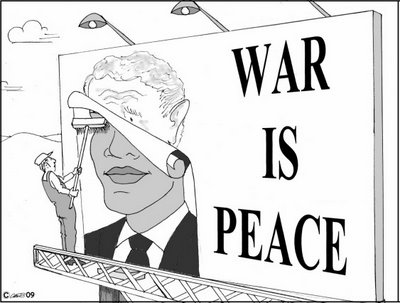
This video with Jeremy Scahill is re-posted from The Nation. Editor’s Note: While we agree with much of what Scahill has to say here, it should be made clear that the Obama campaign did say they would escalate the war in Afghanistan and maintain the US “special” relationship to Israel. In many ways, the Obama administration has continued much of the Bush foreign policy positions and even expanded some of those policies. For additional sources on the foreign policy of Obama, see Tariq Ali’s book The Obama Syndrome and Paul Street’s The Empire’s New Clothes.
On the campaign trail, Obama promised an end to torture, extraordinary rendition and secret prisons. But since taking office he has in fact doubled-down on some of the more insidious policies he inherited from the Bush administration. As Nation correspondent Jeremy Scahill explains, Obama has surrounded himself with war hawks, relied on targeted killing and acted unilaterally to defend US interests. Instead of drawing down the two major ground wars in Iraq and Afghanistan, he has shifted combat to special operations units, prolonging US engagement and fighting a “dirty” war.
2012 Farm Bill will maintain corporate food model
Yesterday, MLive ran a story citing Michigan Senator Debbie Stabenow who believes that the 2012 Farm Bill that passed in the Senate and is being voted on in the House today is a “win for Michigan.”
Actually, the MLive posting wasn’t much of an article, since it was mainly a re-printing of a statement from Senator Stabenow, with no other voices or a critical assessment of the version of the bill passed by the Senate.
The version passed by the Senate is not a win for Michigan, unless you define Michigan as big business. According to Food & Water Watch, which has been organizing a campaign to get the federal government to pass a Fair Farm Bill, the Senate passed version of the Farm Bill benefits the large agri-businesses in the US, not small farmers or a sustainable food system.
Although the Senate bill made changes to commodity policy that will be touted as reform, the bill reinforced prior farm policies that favor large industrial-scale agriculture and overproduction of commodity crops like corn and soybeans. Only a few companies sell what farmers need (like seeds, fertilizer and tractors) and only a few firms buy what farmers raise, which means they pay more for supplies and get less for their crops and livestock. The four largest companies in each industry slaughter nearly all the beef, process two-thirds of the pork, sell half the groceries and process about half the milk in the United States.
This is no accident. It’s the direct result of lobbying campaigns by major agribusinesses, industry trade associations and the policies that Congress passed on their behalf. And the process in which the Farm Bill was decided is even more disconcerting. Started in secret under the guise of the Supercommittee budget slashing process last fall, the farm bill has had little input from anyone other than a handful of legislators and the Big Ag lobbyists who pay the most to play. The secret farm bill developed for the Supercommittee got scant scrutiny from the Senate Agriculture Committee. The 1,000-page proposal was released only a few days before the Committee finalized the nearly trillion-dollar legislation in three short hours – that’s about $90 million a second.
Then, when the Farm Bill finally made its way to the Senate’s agenda last week, nearly 300 amendments flooded in. From the absurd (ending the federal food stamp program and taking on Canadian geese) – to the outright irrelevant (aid to Pakistan and protecting the Pentagon budget), many of the amendments had little to do with farming or food.
The House version of the bill was introduced last week and might be decided on today. The MLive story mentions this in one sentence, but offers up no information on what is in the House version of the Farm Bill, nor where Michigan members of Congress stand on this issue.
Again, according to Food & Water Watch, the House version so far has not been a benefit to the public. They state:
Most of today’s action was related to the nutrition title, which primarily funds the Supplemental Nutrition Assistance Program (formerly known as food stamps). The House Agriculture Committee Farm Bill cuts $16 billion from SNAP benefits, primarily by limiting eligibility. The Committee rejected an effort to make the cuts even steeper (by applying the draconian Ryan Budget cuts) but also rejected an effort to restore the SNAP cuts or use the lower level of $4 billion in cuts in the Senate Farm bill.
So, it not only appears that the Farm Bill will maintain the tax payer subsidies to big Ag, it will continue massive support for factory farms, unsustainable agriculture practices and punish low income families with cuts to food assistance. One more reason why we need a food revolution!
New Media We Recommend
Below is a list of new materials that we have read/watched in recent weeks. The comments are not a “review” of the material, instead sort of an endorsement of ideas and investigations that can provide solid analysis and even inspiration in the struggle for change. All these items are available at The Bloom Collective, so check them out and stimulate your mind.
Imperiled Life: Revolution against Climate Catastrophe, by Javier Sethness-Castro – This is the most recent book in a collaboration between AK Press and the Institute for Anarchist Studies. Aside from the climate denial sector, we all know that global warming and climate change is one of the most pressing issues of the day. Indeed, if there is not significant reduction in carbon emissions in the coming decades, there may not be a future for humanity and many other species. The urgency of this issue is what makes Javier Sethness-Castro’s book so important. Imperiled Life provides readers with sharp analysis on how humanity has come to the brink of climate catastrophe, relying heavily on political theorists such as Arendt, Schell, Hardt, Negri and Chomsky. This analysis provides a framework for not only understanding how we got in this mess, it gives us an opportunity to advocate for something entirely new in terms of human organization, what the author refers to as an “ecological anarcho-communism.” In this model the author says that solidarity would be the basis for all inter-relating and “The prospect of an exit from the social and environmental barbarism depends critically on the autonomous action of the subordinated.” This autonomous action must be global in order to truly bring about revolutionary change. Highly recommended.
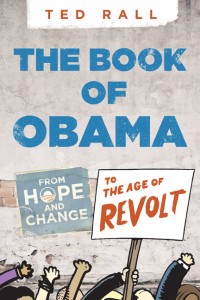
The Book of Obama: From Hope & Change to the Age of Revolt, by Ted Rall – Cartoonist, writer and activist Ted Rall has given us another thoughtful and passionate book, in a sequel to his The Anti-American Manifesto. In this book Rall is speaking to potentially two audiences, those who voted for Obama in 2008 and are now disappointed and those who are already calling for revolution. The bulk of the book is an analysis of the first three years of the Obama administration, with stories woven in about people losing jobs, having homes foreclosed, about those impacted by the BP oil spill, families who lost loved ones in one of the many US wars and people who are suffering because of the loathsome health care system in the US. Rall shows no love for Obama or the Democrats, but he’s not calling for reform or a third party. The cartoonist is calling for revolution and believes that the fair spontaneous uprising that became the Occupy movement is an indication that more and more people are tired of business as usual in this country. The text is accompanied by lots of Rall’s political cartoons, which provide graphic humor along with is commentary on the state of politics in the US. A delightful read, especially for those who don’t put stock in the electoral process.
Be realistic: Demand the impossible, by Mike Davis (pamphlet) – This short pamphlet by former SDS member Mike Davis is both a fabulous gauge for the state of things and an inspiring reflection on what is possible. Writing in the midst of the Occupy movement, Davis provides us with part activist memoir, part dissection of the current state of the world and part reflection of the possible. Davis refers to the revolutionary ethic of the Occupy movement as “cultivating the generosity of the we.” The author gives plenty of examples of what this revolutionary generosity looks like on the west coast, where he has lived most of his adult life. Like his other books, Be realistic, agitates, infuriates and inspires. A wonderful treat.
Dirty Business: “Clean Coal” and the Battle for Our Energy Future (DVD) – This film is a 90-minute documentary produced by the Center for Investigative Reporting that investigates the true cost of our dependence on coal for electricity in the age of climate change. Politicians and corporate interests have mounted a formidable public relations campaign promoting “clean coal” as a solution to our energy/climate problem. America burns more than a billion tons of coal a year—and coal-fired power plants are the single greatest source of the greenhouse gases that cause global warming. Many of us are not aware that even now, in a world globally connected by the Internet, half our electricity still comes from this dirty, nineteenth century technology. DIRTY BUSINESS investigates the coal lobby’s $40 million dollar campaign to convince us that the technology to make coal “clean” already exists.
Hypocrisy of Coke at the London Olympics
The following information is re-posted from the Killer Coke Campaign.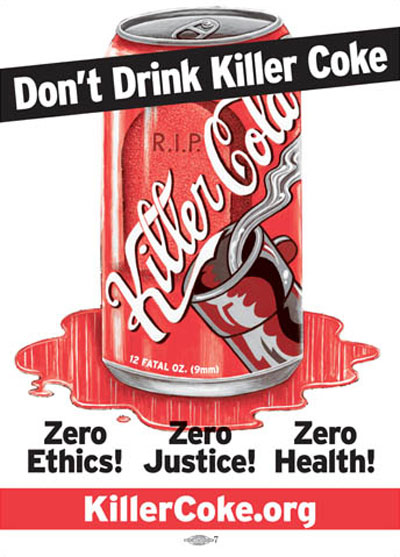
It’s unfortunate the Olympics committee continues to defame the ideals and the spirit the Olympics is supposed to represent. How much lower can the Olympic committee stoop than to sell the Olympic logo to the highest corporate bidders like Coca-Cola, which has exclusive rights as the only soft drinks provider to the Olympics?
As reported by the Associated Press, “Alongside McDonald’s, Coca-Cola has the exclusive right to sell non-alcoholic drinks at Olympic venues. Heineken, partly owned by FEMSA, has been named the games official beer.” Mexican-based FEMSA and Coca-Cola jointly own Coca-Cola FEMSA, which is Coca-Cola’s largest bottler.
Coca-Cola FEMSA is involved in horrific human rights abuses against union leaders and family members in Colombia. FEMSA’s Chairman and Chief Executive Officer, Jose Antonio Fernandez Carbajal, is a member of Heineken’s board. He is also on Heineken’s Supervisory Board with Javier Gerardo Astaburuaga Sanjines, FEMSA’s chief financial officer.
If there are supporters in England during the Olympics who are interested in protesting, feel free to use any images on our site and to download any flyers, posters and stickers.
Why Coke Shouldn’t Be Allowed Near the Olympics
Dozens of colleges and universities and many labor unions throughout the U.S., Canada and Europe have removed Coke machines and banned Coke beverages from their facilities and functions because of Coke’s widespread labor, human rights and environmental abuses.
On April 25, 2012, dozens of proxy holders, including students, academics and human rights leaders attended Coca-Cola’s annual shareholders meeting prepared to ask a series of tough questions, but Coke did not allow most of these questions to be raised. Coke Chair/CEO Muhtar Kent used his bully pulpit to continue a stream of propaganda and lies denying any wrongdoing whatsoever by the Company.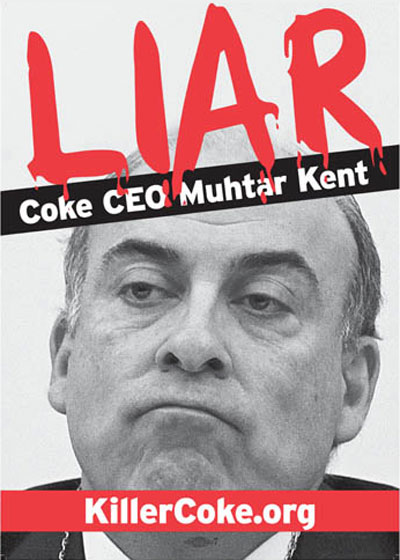
Protesters outside the meeting carried signs that said, “Coke CEO Muhtar Kent – Liar!”; “Coke’s not it! Coke 16 sue, Say Coke plants are ‘Cesspools of racial discrimination.’ ” and “Don’t Drink Killer Coke! Zero Ethics! Zero Justice! Zero Health!” while a mobile billboard saying: “KillerCoke.org Unthinkable! Undrinkable!, Murders in Colombia, Child Labor in El Salvador, Stealing and Polluting Water in India, El Salvador and Mexico” circled the meeting venue.
- Coke must stop operating like a criminal syndicate with impunity in countries like Colombia and Guatemala and stop the violence against union leaders and family members in efforts to crush their unions.
- Coke must stop buying sugar from suppliers that use illegal child labor in the dangerous job of harvesting sugar cane.
- Coke must stop cheating Mexican workers and the government out of hundreds of millions or billions of dollars through an illegal scheme of outsourcing and tax evasion.
- Coke must stop the pollution and over-exploitation of water resources in places like India, Mexico and El Salvador, which is depriving farmers of water for irrigation and communities of water for sanitation and drinking.
- Coke must end their vehement opposition to bottle deposit bills, which aim to clean up the billions of plastic bottles filling our streams, oceans and our lands.
- Coke must end its culture of racial discrimination in the United States and Mexico.
- Coke must stop aggressively marketing beverages to children that we all know are unhealthy and can lead to serious chronic and even terminal illnesses.
All these injustices and more are well-documented in recent books, articles, reports, lawsuits, documentary films and on the website, www.KillerCoke.org.
Background of Issues
1. Colombia: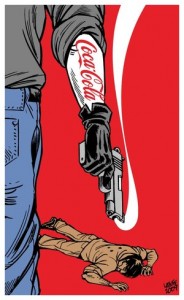
A. In January 2012, another SINALTRAINAL union leader, Ricardo Ramon Paublott Gomez, was murdered by gunfire. We reported on it in our February 21, 2012 newsletter, Item #1, http://www.killercoke.org/nl120221.php
B. In November 2011, there was an intrusion into the home of Juan Carlos Galvis, SINALTRAINAL vice president and Coke worker. His wife, Jackeline Rojas Castaneda, was tied up; gagged and red paint was sprayed on her body and clothes. The intruders threatened to kill her daughter and demanded information about her husband.
In addition to the attack, two laptops, USB sticks, mobiles and documents were stolen. These contained information about Galvis’s work.
It was reported in the book, “The Coke Machine” published in 2010:
“The constant pressure of driving around with bodyguards waiting for the next death threat has clearly gotten to him…
” ‘It is tough,’ [Galvis] says. ‘We are on the brink of death, but we keep surviving. We bring in new members to the union, but the company fires them. If it weren’t for international solidarity, we would have been eliminated long ago. That is the truth.’ ”
Galvis also stated:
“If we lose this fight against Coke, First we will lose our union, Next we will lose our jobs, And then we will all lose our lives!”
We reported on this home invasion in our newsletter, Item#1 on Jan. 11, 2012: http://www.killercoke.org/nl120111.php#1
C. In December 2010, the police entered the Coca-Cola bottler in the city of Medellin, authorized by the president of Coca-Cola. They entered with armored tanks, shields, firing weapons with chemical fumes, intimidating and pressuring the subcontracted workers who were protesting. They militarized the dispute and forced workers to desist and accept verbal commitment of the multinational that promised to resolve the conflict, but simultaneously the workers were notified of their dismissal. Since then, the police remain in the Coca-Cola bottling plant, 24 hours a day, terrorizing workers.
We reported on this in our Feb. 11, 2011, newsletter, Item #1fi: http://www.killercoke.org/nl110213.php#1f1
D. As a part of Coca-Cola’s attempted cover-up of the abuses in Colombia, the Company threatened legal action against the National Film Board of Canada, the International Human Rights Film Festival in Paris, France and Cinema Politica, a worldwide grassroots film collective, if the film, The Coca-Cola Case, was shown uncensored. No one backed down and the film continues to play to large audiences around the world.
We reported on this in our January 15, 2010 newsletter at: http://www.killercoke.org/nl100115b.php
The threatening letter Coke sent out is at: http://www.killercoke.org/downloads/lettertocinemapolitica.pdf
Who Owns the Media – 2012 Report
This information is re-posted from Journalism.org.
In May, 2012 Warren Buffett’s Berkshire Hathaway Company announced the purchase of 63 newspapers, including 23 dailies, from the debt-ridden Media General Company. The transaction was a course reversal for Buffett, who earlier had said he wouldn’t buy newspapers, and created a major new player in the industry. It also left Media General-whose history with newspapers dates back to the mid-1800’s-with only one remaining daily, the Tampa Tribune, which many predict it will still try to sell.
The purchase, seen as a rare vote of confidence in a struggling industry, also capped a period of intense change in U.S. newspaper ownership. In the last 18 months many better known newspaper companies divested most or all of their holdings while a number of new entities, including hedge funds and private equity firms, jumped in.
According to the investment banking firm of Dirks, Van Essen & Murray, which monitors newspaper transactions, a total of 71 daily newspapers were sold as part of 11 different transactions during 2011, the busiest year for sales since 2007.
And newspapers were not the only media to undergo major changes. The last 18 months also saw local television sales reach new heights, the merging of Newsweek and the Daily Beast, Comcast’s acquisition of NBC Universal, the Huffington Post’s movement into web TV and further reach among U.S. broadcast companies into the Hispanic market.
The Pew Research Center’s Project for Excellence in Journalism has compiled a new interactive database to help users make sense of the changes at the highest levels.
Who Owns the News Media provides detailed statistics on the companies that now own our nation’s news media outlets, from newspapers to local television news stations to radio to digital, and this accompanying summary highlights the major changes of the year.
Newspapers
- In transactions other than the Buffett deal with Media General, The New York Times Company sold 14 daily newspapers to Halifax Media and Journal Register Company (with 20 dailies) was acquired by one of its investors, Alden Global Capital. The Times Company’s sale of its Regional Newspaper Group left it with only three remaining dailies, the flagship New York Times, The Boston Globe and the Worcester Telegram & Gazette.
- The Chicago Sun Times was sold to a new company called Wrapports LLC, an organization led by technology executive Michael Ferro Jr. and former Newsday publisher Timothy Knight.
- The San Diego Union-Tribune was sold in November 2011 by the private equity firm Platinum Equity, which bought it in 2009, to a company owned by a local hotel developer.
And so far in 2012:
- Freedom Communications announced on June 11 the sale of its remaining dailies, including the Orange County Register (163,000 print circulation) to the investment group 2001 Trust LLC. That sale ended the company’s almost 80-year history as a newspaper publisher. And as was the case with Journal Register, Freedom had recently emerged from bankruptcy protection.
- Once known as the crown jewel of the now defunct Knight Ridder chain, The Philadelphia Inquirer (along with its sister Philadelphia Daily News) was sold in April for the fourth time in six years. A group of local businessmen bought the company for a reported $55 million, roughly 10% of the $515 million the papers fetched in 2006 when they were purchased by another group of local investors led by advertising executive Brian Tierney.
- Hedge Fund Company Alden Global Capital bought the Journal Register Company with twenty papers including the New Haven Register (CT), the Oakland Press (MI) and the Daily Times (PA). Alden Global has also invested in several other newspaper organizations.
- Versa Capital Management, which purchased a number of small dailies in Ohio in 2011, acquired the Times Leader in Wilkes-Barre, Pennsylvania in March of 2012.
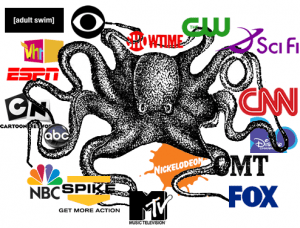
Most of the sale prices in these transactions speak to continued softening of the newspaper market. The New York Times Company Regional Group papers were sold for a total of $143 million. Berkshire Hathaway paid a combined $142 million for the Media General properties, which includes 63 weekly and daily papers.
One exception was the San Diego Union-Tribune. Hotelier Doug Manchester acknowledged paying significantly more than $100 million for it. That is at least twice as much as Platinum reportedly paid, under $50 million, for the paper in 2009.
With daily newspapers still providing the majority of original news reporting, what will these new owners mean for the future of our daily news? What is their background? What is the breadth of their news properties and their properties in other industries? PEJ’s Who Owns the New Media helps answer those questions.
As the Poynter Institute’s Rick Edmonds noted in PEJ’s “State of the News Media 2012” report, it can be “hard to discern…a general strategy” being pursued by these private equity newspaper owners because they “tend to say little or nothing publicly.” But they are generally regarded as advocates of aggressively transforming newspapers into more digitally-oriented operations.
Local Television
- 53 stations were sold in 2011, which brought in a total of $307 million dollars in revenues. While the total value of station mergers and acquisitions was still minuscule compared to the decade before the recession hit, transactions topped a billion dollars for the first time since 2007 and were almost ten times the value of station sales the year before.
- Sinclair Broadcasting was the biggest player in 2011. It bought 15 stations from two ownership groups. In the single largest acquisition in four years, the company paid $385 million for the eight-station broadcast division of Freedom Communications, which had been on the block since the company declared bankruptcy in 2010. These 8 stations brought in $62 million in revenue in 2011. Sinclair also bought seven stations owned by Four Points Media Group for $200 million, whose stations earned $98 million in revenues in 2011.
- ABC and CBS affiliate stations, that produce news across markets, continued to lead in revenues. Both reported $2.9 billion in 2011, down from $3.2 billion in 2010. Fox affiliates followed with $2.2 billion in revenues for 2011, down from $2.3 in 2010.
- While stations in all market sizes lost revenue on average in 2011, the top 25 markets saw the greatest declines by far. The 176 stations in the top 25 markets averaged a 24% decline in revenues in 2011 ($48.5 million dollars). That compares to a 9% loss in midsize markets (26-50), 8% loss in markets 51-100, 12% in markets 101-150 and 9% in the 44 stations in the smallest markets (151+). Even with a 24% decline, though, the largest markets still bring in far more total revenue, an average of $49 million in 2011.
Magazines
- The sales of consumer magazines rose by nearly a quarter in 2011 (23%) compared to a year earlier. Thirty-two acquisitions were announced, compared to 26 in 2010. The value of these deals grew even more sharply-up 15 times more-a 1395% jump from the previous year. According to the Jordan, Edmiston Group, the total value of these acquisitions was $3.2 billion, compared with $214 million the prior year.
- Two of the most noteworthy deals in 2011 were Hearst Corporation’s acquisition of Lagardère’s international magazine group for $651 million in February 2011 (including Elle and Car and Driver) and Axel Springer’s acquisition of WAZ Media Group for $613 million in October 2011. Other notable deals in the last quarter of 2011 included a $38 million investment in Martha Stewart Living Omnimedia by J.C. Penney; Hearst Corporation’s acquisition of Hachette China, the regional publishing operation owned by Hachette Filipacchi Medias Group; and Meredith’s acquisition of Everyday with Rachel Ray from Reader’s Digest.
- Newsweek’s website was integrated into The Daily Beast’s site in August 2011, nine months following the merging of the two companies. Combining the two websites was supposed to boost traffic; instead traffic has fallen significantly. When the deal closed, The Daily Beast’s audience was 2.2 million, while Newsweek drew 3.1 million unique monthly visitors, according to Compete.com. Combined traffic for the two sites for the five months following the August 2011 website merger averaged 2.5 million; in January 2012, that inched up to 2.9 million. Newsweek used to have an online partnership with MSNBC since 2007, which generated more than 50% of its online traffic. But the partnership ended in February 2011, a few months after the merger of Newsweek and The Daily Beast companies.
Cable Television
- Comcast increased its total revenue by 47% in 2011, thanks to the acquisition of NBC Universal and Universal Orlando. Apart from the impact of those deals, company revenues increased 5%. Comcast’s cable communications businesses such as video and high-speed internet (up 5%) performed slightly better than NBCUniversal segments, which together rose 4%. Within NBCU, aside from 24% growth at the relatively small theme parks division, it was cable programming, which includes MSNBC and CNBC that experienced the strongest revenue growth at 11%.
- For News Corp., the phone-hacking scandal in Britain and the associated legal proceedings and parliamentary investigation, including closing of the News of the World tabloid (Britain’s largest paper) hung over the company in 2011. In its August 2011 annual report, News Corp. noted, “(i)t is possible that these proceedings could damage our reputation and might impair our ability to conduct our business.” Revenue projections at Fox News Channel, a key News Corp. holding, continued to climb. One Morgan Stanley analyst estimated the value of Fox News Channel at $12.4 billion.
Network Television
- Comcast’s merger with NBC Universal in January 2011 was the first ownership change for the network since General Electric acquired NBC from its original owner, RCA in 1986.[1] Comcast now has a 51% stake in NBCUniversal, making it a majority owner. Perhaps the most notable change so far has been an effort to bring in more diversity, both in ownership and programming. As part of its commitment to the FCC, in February 2012, Comcast/NBCU announced the scheduled release of the first four minority-owned channels as the first of 10 new independently-owned and operated channels established by 2018.[2] Comcast/NBCU also agreed to allocate $20 million to these channels.
- In addition, the FCC imposed several other conditions on Comcast in order for the merger to go through:
1) It would have to expand its existing broadband network to reach 400,000 more homes and six additional rural communities.
2) It would have to provide free video and high-speed internet service to 600 new schools or libraries in underserved and low-income areas.
3) It would have to make broadband available for less than $10 a month to 2.5 million low-income households. The same households must also be given the option of buying personal computers or netbooks for less than $150.
Digital
- The Huffington Post took several steps in 2012 to expand its brand into new formats. It announced that in July it would begin offering the first web-only 24 hour news network in the same spirit as CNN or Fox News. The “network,” originally called Huffington Post Streaming Network but re-christened Huffpost Live, is projected to carry 12 hours of live video each weekday, with the content replayed for the other 12 hours of each day. In June, the Huffington Post launched a new iPad-only publication called “Huffington” that has the look and feel of a traditional print magazine in a digital form. Huffington hit the Apple store on June 14th priced at 99 cents per issue, $1.99 for a monthly subscription, or $19.99 per year. The publication features both repackaging of Huffingtonpost.com content and content exclusive to the iPad as well.
- Yahoo in the last year struck two partnerships aimed at expanding its news content, particularly in video. In the fall of 2011 Yahoo announced a partnership with ABC News. Yahoo News, the most popular online news destination in the United States according to Nielsen, comScore, and Hitwise has in-house reporters and produces some original content but is nowhere near the size of ABC News. Under the agreement Yahoo News would carry content from ABC News, and the editorial teams from both organizations would collaborate to create original content. In June 2012 Yahoo news entered into a very similar agreement with CNBC. Under the new agreement CNBC will provide financial reporting and information for Yahoo News. This partnership deal does not include a payment by either company, but the two companies will share advertising revenue.
- The hyperlocal news site Patch, owned by AOL, continued to face criticism that its business model is not viable. In May, 2012 a shareholder in AOL, Starboard Value which owns 5.3% of AOL, released a report sharply criticizing Patch, which included its estimates (AOL does not release earnings for Patch in any regular form) that the local news operation lost $147 million and generated just $13 million in ad revenue in 2011. AOL continues to defend its investment in Patch and in early 2012 revealed a new ad team that it hoped would boost ad sales.
Ethnic Media
While there were no major ownership changes in ethnic media in the past year, mainstream media organizations made further inroads in the market. Fox, ABC News and Comcast all made moves to create stations and programming geared to Hispanic Americans, bringing in new competition to Univision, the largest Spanish language network and now the fourth largest network overall.
- Fox Networks Group announced in April 2011 the formation of Fox Hispanic Media, a partnership between Fox International Channels and Fox Global Networks. At its outset, it was composed of three Spanish-language networks, Nat Geo Mundo, a sister channel to National Geographic Channel and Nat Geo WILD; as well as Fox’s existing Spanish-language networks Fox Deportes (sports) and Utilísma (women’s lifestyle). Another broadcast channel, MundoFox, is expected to be released in fall 2012. MundoFox, a partnership between Fox International Channels and Columbian broadcaster RCN Televisión SA will air a mix of content from several outlets, including some news content: two half-hour live newscasts every weekday evening, one for the east coast and the other for the west coast.
- ABC News and Univision made plans in May 2012 for a 24-hour cable news channel that will be in English but will target Hispanic Americans. The channel and its corresponding website will be jointly owned by the two companies and will provide both traditional news and lifestyle programming. The television channel will launch sometime in 2013, but its website will come out in summer 2012. The channel will have its own staff, but resources will be shared between ABC News and Univision.
- Comcast, which was required to launch minority-owned channels as part of securing federal funding approval for its merger with NBC Universal, launched its first such channel in May of 2012 BabyFirst Americas, is designed for young children and their parents with a “special focus on series that reflect the Latino culture.” In addition, Comcast announced plans to launch El Rey, an entertainment network in English for both Latino and general audiences in January 2014. (Comcast also announced two African American-targeted channels to be released in 2012: Aspire and Revolt.)
Caminando por la Paz: People march against violence in a southwest Grand Rapids neighborhood
About 60 people showed up to participate in a march against violence in the Roosevelt Park neighborhood area, between US 131 and Grandville Avenue.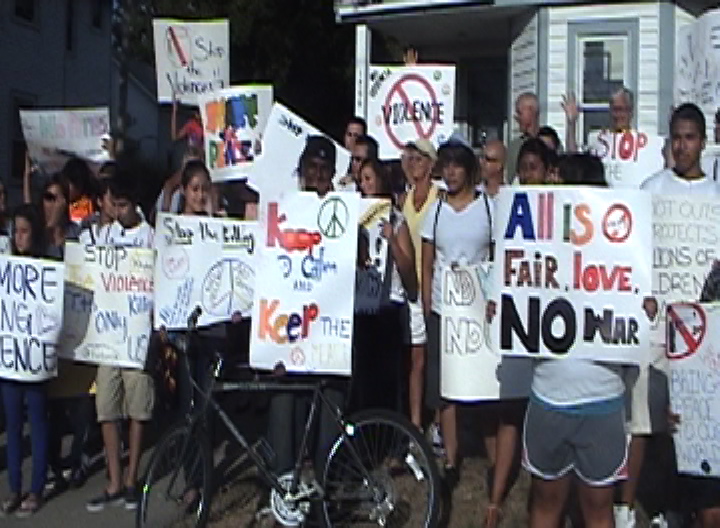
There has been some recent violence in that neighborhood, some involving guns and possibly related to gang violence.
People meet at the Roosevelt Park Neighborhood Association to hear a few words from a local minister, the community organizer with the neighborhood association and LINC.
The group then marched along Grandville Avenue with signs and talking with people along the way about what was going on and how people could get involved.
I spoke with Jerry Aguilar, from the Hispanic Center, who talked at length about the gang issues the neighborhood faces. He said that some families have been involved in gangs for at least two generations and that for many young people it gives them a sense of community.
The Grandville Avenue corridor is one of the poorest areas in the city and it is no surprising that poverty, unemployment and underemployment all contribute to decisions that people make about what to do in order to survive.
Along the march route some young people joined in, while others came outside to show their support. On the side streets the marches even took over the street and shouted for an end to violence. Most of the marchers were young people, along with some families and a few people from outside the neighborhood who came to show solidarity.
Before the march began I had a chance to talk with Hugo Claudin, one of the organizers of the action. There is footage of the march woven into the interview.
When a Feminist Gets Bumped for a Pornographer
This article by Gail Dines is re-posted from CounterPunch.
Last week, midway through a leisurely Saturday afternoon, I got an email from MSNBC asking me to be on the Melissa Harris Perry Show a week later (July 7th). I was delighted to accept, as MHP is not your usual American journalist. A professor of political science at Tulane University, she is an outspoken African American feminist and a progressive voice in a media landscape dominated by right-wing talking heads. MSNBC is a rare media oasis in the U.S. where one gets to hear some actual critical analysis, so I—mistakenly, it turned out—thought this was going to be one of the few positive experiences I’ve had working with corporate-controlled media. In all honesty, after many years of being on talk shows in the U.S., I have come to expect very little in terms of integrity from the media. Their job is to boost ratings by making stories entertaining and light, and God help anyone who gets in their way.
I spent a long time on the phone with MHP’s producer talking about my research on the harms of porn and the ways women in the industry—especially women of color—are financially exploited and physically and emotionally dehumanized and debased. Given MHP’s feminist politics and her scholarly work on the representation of African American women in U.S. history, I was excited to do a show with an interviewer whom I expected would be engaging and thoughtful, in contrast to the usual adolescent sniggering I get from the male journalist who suddenly finds himself in the awkward position of interviewing a feminist who doesn’t think porn is fun.
But by the middle of the week things started to go very wrong. My last conversation with the producers was on the Sunday before the show, and I was told that I would get a call by Tuesday to confirm my travel details. Wednesday came, and no call. On Thursday, I got an email saying that the “segment is changing,” so they won’t need me. “Changing”… not canceled. To the uninitiated this might seem like splitting hairs, but I am an old hand at dealing with the media, and I have been in this position more times than I can count.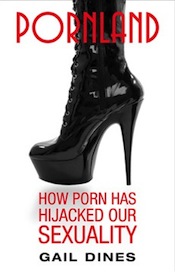
Let me explain how it often plays out: I get a call from a producer to do a show about porn, and in our pre-show discussion the producer is shocked to hear about what really goes on in the porn industry. He or she had no idea that hardcore porn (called “gonzo” by the industry and fans) is now mainstream on the Internet, that choking with a penis, slapping, hair pulling, and verbal abuse is the norm. The producer is horrified to hear that women in porn suffer repeatedly from rectal prolapse (because of pounding anal sex), and get diseases such as clamidia of the eye, gonorrhea of the throat, and fecal throat infections (because of the ATM act in which the penis goes from the anus to the mouth without washing). As we talk, I know exactly what is going on in the producer’s mind: they see their fun, hot-ratings-driver segment going down the tubes, and they are suddenly in the not-so-fun territory of cruelty, violence, and economic exploitation.
As if this weren’t enough, their would-be guest at the other end of the line uses the dreaded word “capitalism,” because, of course, there is no way to talk about the porn industry without a thorough analysis of how this predatory industry actually interfaces with credit card companies, banks, information technology, hotels, venture capitalists, and—wait for it—mainstream media. And now we are at a fork in the road. Either the interview is quickly terminated, or the producer is intrigued
and I am booked. But I know that until the moment the camera rolls, there is no guarantee that I will actually be on the show. Most galling is that if I’m replaced, it’s usually by some porn shill spouting on about porn as fun, feminist empowerment.
Not for one second did I think this would happen with the MHP show. (Seems I am a slow learner.) As soon as I got the email that the segment was “changing,” I could smell a rat. I emailed back and asked if the topic of porn was canceled altogether or if the producer had other plans for the segment. The response was guarded and awkward, so I Googled around to see if the segments of the upcoming show were listed anywhere, but found nothing. I assumed that I would have to wait until Saturday to see just how it had indeed changed, but it turned out that people who are smarter than I am at social media research were digging around to see what was actually going on. Bingo!
They came across a post on Jaclyn Friedman’s Facebook page saying that she was going to be on MHP with pornographer Tristan Taorminio. Now I understood what they meant by the “segment is changing.” Gone was a critical feminist analysis of the porn industry, and in its place was a “fun” discussion of women’s sexual agency, their fantasies, and their empowered choices to make porn. Any discussion of economic exploitation, predatory capitalism, violence, STDs, or rectal prolapses was clearly off the table. We were moving back into ratings nirvana with fluff pieces. Even cynical me was shocked. This was, after all, MHP, not some clueless talk show host.
So I sprang into action and emailed the producer. But this time I copied MHP. I wrote:
Since Dr. Harris Perry is an academic, you should be aware that the currency of our profession is open debate with people representing different positions. You have chosen to do a segment that will draw ratings and titillate, at the expense of a more thoughtful analysis of the role of porn in our culture. Selecting Jaclyn Friedman (who has not studied porn in any rigorous way), and Tristan Taormino (who works for the industry, and has partnered with John Stagliano, a well-known producer of very violent porn) undermines Dr. Melissa Harris Perry’s integrity.
My sense is that Dr. Harris Perry is not aware of the level of violence against women in porn, nor the way that women of color are the most degraded and humiliated, as are black men. For example, one of the best selling porn series targeted to white males is called Oh no! There’s a negro in my daughter/wife/sister/mom. If she were, I doubt she would want a segment that renders invisible the lives of real women and men in the porn industry in favor of a piece that speaks to the lives of a small group of privileged women.
I also attached a link to my chapter on racism in porn from my book Pornland. Within the hour I get an email back asking “Is there a statement you would like to send me so we could include it in our show please?” To which I replied:
You can’t seriously think for one minute that I could offer a statement about the complexities of a global predatory industry that would in any way have an effect given the “direction” you have taken this show.… I find it a little strange that you ask for a statement from me, yet feel fit to give a pornographer such as Tristan Taormino air time.
Surprise! In place of the statement that I refused to make, they used my emails as my statement, without my permission. MHP read them aloud on the show, but not one of the guests or MHP engaged with the content. Instead, they went back to fun feminism, and the (at times incoherent) conversation turned to the need for women to make porn as a way to counter the effects of the multi-billion-dollar-a-year industry. Meanwhile, of course, not one person on the show actually pointed out that the overwhelming market for porn is men and that they are very happy, thank you, with their gonzo. And lest we get away from fun, let’s not even mention the physical and sexual violence that women in porn endure. Or, heaven forbid, the level of male violence that women outside the porn industry also have to live with.
I remember watching an MHP segment on MSNBC after she saw the movie The Help. I use this clip in my classes on racism in media because her passion and eloquence are so deeply felt. She is upset by the movie, and she is almost in tears when she explains how white-produced images of African American women deny the reality of their lives and render invisible the pain and suffering real black domestics endured at the hands of white employers. In another interview, MHP said that her fear was that The Help will become “the historical record because of its popularity, and that people who see the movie will come to believe that that’s really what happened“.
Clearly, MHP understands the power of media images to shape the way people think. If this is true of movies, then it is also true of other media genres, including porn. If MHP is upset at The Help for misrepresenting black women’s lives, then what about popular porn sites such as Bad Black Babes, Pimp My Black Teen, or Ghetto Gaggers, or any of the thousands of websites that show black women “enjoying” sexual degradation at the hands of black and white men? These images, just like the ones in The Help, are part of the media world that creates ideas, attitudes, and beliefs that undermine all women’s rights to full equality, dignity, and justice. I didn’t expect Taormino or the other guests to take this on, but I did expect a political science professor to be a little more savvy and intellectually inquisitive about how individual and collective perceptions are formed by cultural institutions.
My only explanation for MHP’s lapse in judgment is that she, like all media professionals, is held captive by the commercial imperative of corporate-owned media. This segment was clearly meant to be the lighter part of the show, a little relief from the more depressing issues she normally covers—for example, racism, poverty and inequality—as if these very issues don’t create the conditions for women’s entry into the sex industry in the first place. Not only did she squander a golden opportunity to do some real journalism; worse, in this segment, MHP went from being an academic to a talk show host, and along the way she compromised her integrity as a feminist.
This Day in Resistance History: Emma Goldman sentenced to two years in prison for aiding draft resisters
On July 10, 1917, Emma Goldman was sentenced to two years in federal prison for her involvement in the group, the No-Conscription League.
The No-Conscription League was not a pacifist organization, but they did believe that the US involvement in World War I would be disastrous and had no humanitarian goals whatsoever.
The No-Conscription League was formed in May of 1917, shortly after the Wilson administration announced the US would become militarily involved in WWI. Along with this announcement came the forced recruitment of young men known as the draft. Goldman wrote these words when hearing about the draft:
“In these days when every principle and conception of democracy and individual liberty is being cast overboard under the pretext of democratizing Germany. It behooves every liberty loving man and woman to insist on his or her right of individual choice in the ordering of his life and action.”
Goldman was not alone in her assessment of US involvement in WWI. In fact, most of the country had been opposed to US involvement and Wilson was re-elected on a “peace” platform. However, Wilson and his aides had other plans, but before they could publicly announce US entry into WWI they needed to change public opinion. What came next was a watershed moment in US history.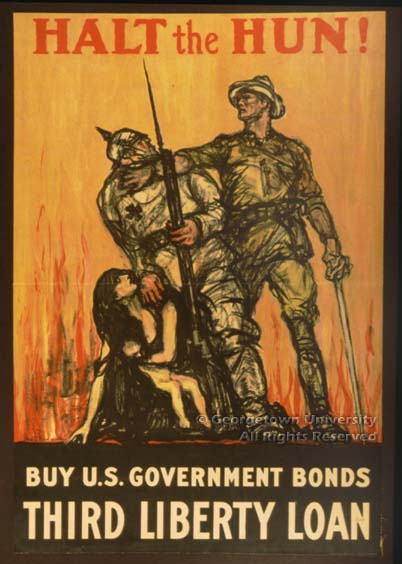
Wilson created what was known as the Committee on Public Information, also known as the Creel Commission, which took its name from George Creel. Creel was joined by the father of the public relations industry, Edward Bernays. Together, they and other members of the Committee engaged in a highly successful campaign to manipulate public opinion, which part involved the demonization of Germans, as is reflected in this poster.
Undeterred by the US government PR campaign in support of the war, Goldman and other members of the No-Conscription League held public debates, created educational material and also began to aid young men who were facing the draft. It was Goldman’s involvement with draft resistance that got her arrested on June 15, 1917, along with Alexander Berkman.
During the trial Goldman gave an passionate speech:
Gentlemen of the jury, we respect your patriotism. We would not, if we could, have you change its meaning for yourself. But may there not be different kinds of patriotism as there are different kinds of liberty? I for one cannot believe that love of one’s country must needs consist in blindness to its social faults, to deafness to its social discords, of inarticulation to its social wrongs. Neither can I believe that the mere accident of birth in a certain country or the mere scrap of a citizen’s paper constitutes the love of country.
I know many people — I am one of them — who were not born here, nor have they applied for citizenship, and who yet love America with deeper passion and greater intensity than many natives whose patriotism manifests itself by pulling, kicking, and insulting those who do not rise when the national anthem is played. Our patriotism is that of the man who loves a woman with open eyes. He is enchanted by her beauty, yet he sees her faults. So we, too, who know America, love her beauty, her richness, her great possibilities; we love her mountains, her canyons, her forests, her Niagara, and her deserts — above all do we love the people that have produced her wealth, her artists who have created beauty, her great apostles who dream and work for liberty — but with the same passionate emotion we hate her superficiality, her cant, her corruption, her mad, unscrupulous worship at the altar of the Golden Calf.
We say that if America has entered the war to make the world safe for democracy, she must first make democracy safe in America. How else is the world to take America seriously, when democracy at home is daily being outraged, free speech suppressed, peaceable assemblies broken up by overbearing and brutal gangsters in uniform; when free press is curtailed and every independent opinion gagged. Verily, poor as we are in democracy, how can we give of it to the world? We further say that democracy conceived in the military servitude of the masses, in their economic enslavement, and nurtured in their tears and blood, is not democracy at all. It is despotism — the cumulative result of a chain of abuses which, according to that dangerous document, the Declaration of Independence, the people have the right to overthrow.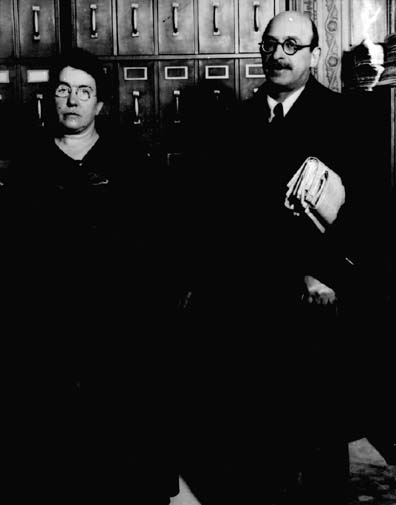
On July 10, 1917, Goldman and Berkman were sentenced to two years in federal prison for conspiring against the draft. They appealed the court decision, which was eventually upheld. The court also ruled that the US government could deport both of them after their two year prison term, a tactic used against many Anarchists and Wobblies during that period.
There is no formal draft today, but young men and women are faced with what some refer to as an “economic draft,” whereby people join the military because few job opportunities exist and it is a temporary way out of poverty. It is well known that military recruiters target poor and often communities of color, which is why in counter-recruitment circles this practice is referred to as an economic draft.
To truly honor the courage of people like Emma Goldman it is important that we do whatever we can to prevent young men and women from entering the military. Here are some links to various groups doing counter-recruitment work and their resources. Also, check out this short video entitled, Before You Enlist.
This article is re-posted from Vox Union.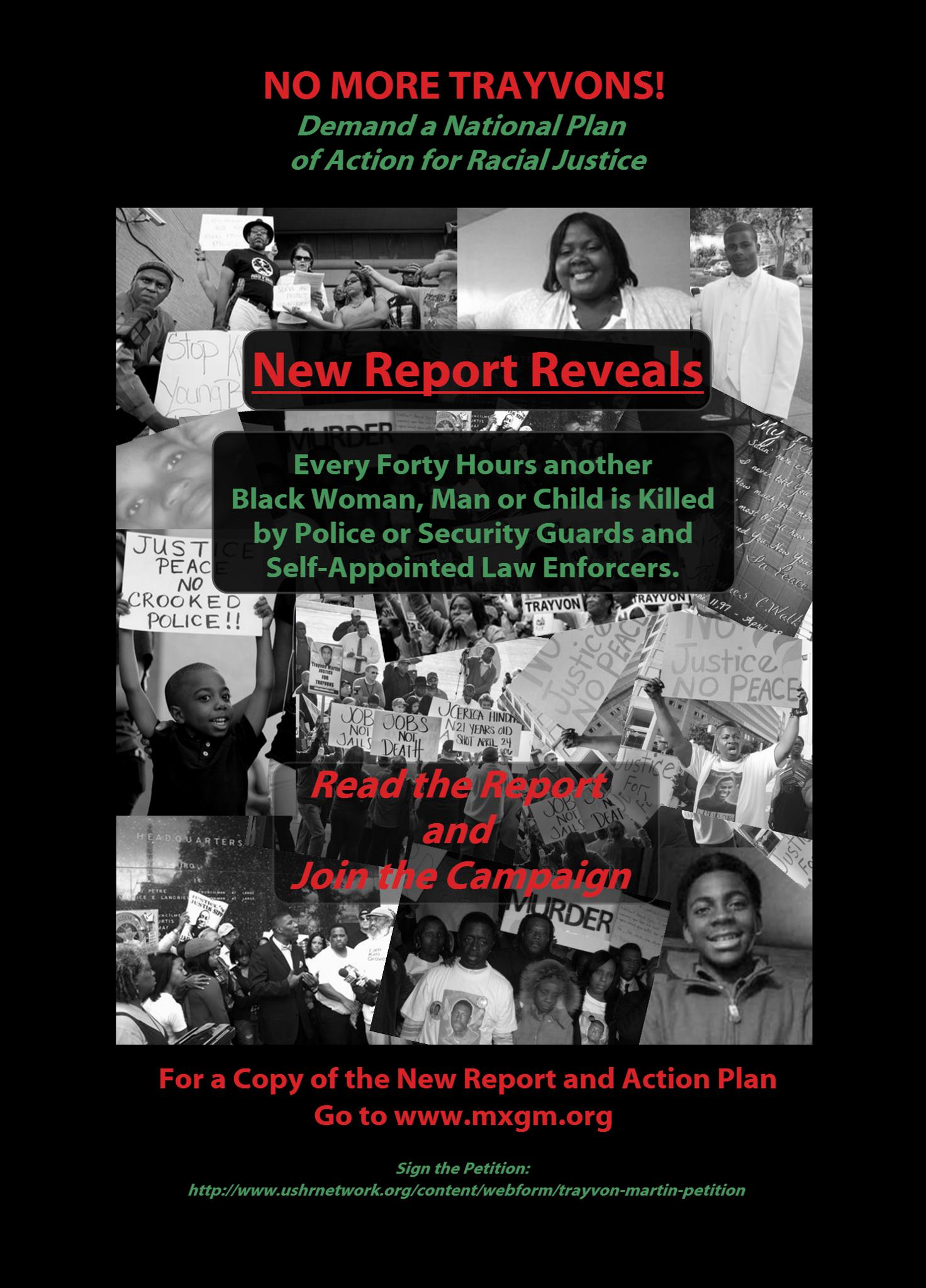
Every 40 hours in the United States one Black woman, man or child is killed by police, and by a smaller number of security guards and self-appointed vigilantes. These are the startling findings of a new Report on Extrajudicial Killings of Black People released July 9, 2012.
What motivated the round-the-clock research for this new Report? More than two years ago, on New Year’s Eve, police killed two innocent men: Oscar Grant in Oakland, Adolph Grimes in New Orleans and shot Robert Tolan in a Houston suburb. Based on research started in 2009 after those murders, we learned there were a lot more killings that had not yet been uncovered. Then, after Trayvon’s murder, there was a huge public outcry and a few headlines about more killings. More grieving families and more calls for investigation. Further research became urgent and it demonstrated that Trayvon’s death was not an isolated tragedy. Between January 1, 2012 and June 30, 2012, at least 110 Black people were killed by police and their “deputies”.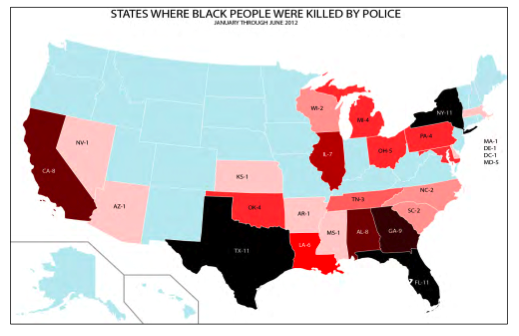
“Any one of these people killed could have been my son or your husband or daughter”, says Arlene Eisen, member of the Malcolm X Solidarity Committee and co-author of the Report.
Rosa Clemente of the Malcolm X Grassroots Movement elaborates, “Nowhere is a Black woman or man safe from racial profiling, invasive policing, constant surveillance, and overriding suspicion. All Black people – regardless of education, class, occupation, behavior or dress – are subject to the whims of the police in this epidemic of state initiated or condoned violence.”
The Report, produced by the Malcolm X Grassroots Movement (MXGM) and the “No More Trayvon Martins” campaign, is part of a larger effort. Kali Akuno, MXGM member and report co-author explained, “The Report shows how people of African descent remain subjected to institutionalized racist policies and procedures that arbitrarily stop, frisk, arrest, brutalize and even execute Black people. The killing will continue despite calls for investigations and lawsuits. We urge people to read this Report and join us in demanding that the Obama administration implement a National Plan of Action for Racial Justice to stop these killings and other human rights violations being committed by the government”.
To read the report visit www.mxgm.org. For information on the petition visit http://www.ushrnetwork.org/content/webform/trayvon-martin-petition.
Homophobia Is Bigger Than Hip-Hop
This article by Alexander Billet is re-posted from Dissident Voice.
First things first: it takes an immense amount of bravery to come out of the closet. That’s true whether you’re a student, a file clerk or a hip-hop artist. Though the circumstances are all very different, the once certain common denominator for coming out is courage. This is, of course, the main motivation for the amount of support rightfully being offered up to Frank Ocean.
Like all other music in today’s world, Ocean is a contradiction. He is an excellent rapper and lyricist who’s made a name for himself in the indie hip-hop and R&B scenes while at the same time writing lyrics for Justin Bieber, Brandy and Beyonce, and collaborating with Jay-Z and Kanye West. He’s part of the collective of young uber-misanthropes Odd Future Wolf Gang Kill Them All (OFGKTA). His relationship with Nas, an MC whose own political and lyrical evolution place him heads above the Odd Future crew, seems to have Ocean straddling a wide spectrum.
Now, he is the first hip-hop artist to come out of the closet while in the midst of his career. On July 4th, Ocean wrote on his Tumblr page that he is bisexual, stating that four years ago he had had a relationship with another man his age. Though he didn’t mention the man’s name, he did thank him for his influence. Ocean also said: “I don’t know what happens now, and that’s alrite [sic]. I don’t have any secrets I need kept anymore… I feel like a free man.”
Some might say that the news of Frank Ocean’s coming out as bisexual might be made “simpler” if he weren’t such a musical contradiction — in particular if he weren’t affiliated with a group who have become infamous for front-loading lyrics that feature gruesome violence against gays and lesbians. But then, the politics of sexual liberation have never been simple. Neither is popular music, or, for that matter, hip-hop.
Timing is everything, and there’s without a doubt some telling timing in Ocean’s decision to come out — namely that it comes barely two months after President Obama himself has announced his support for same-sex marriage. Some have gone so far as to thank Obama for Ocean’s coming out in the first place!
In a certain sense, it’s not so far-fetched. Especially if one accepts the logic that has been promoted for years in the mainstream debate over the rights of LGBTQ people — and the logic of how civil rights are won.
In broad strokes, that logic can be summed up like this: that the leaders know best, that they always have a reason for supporting or opposing something. Those who want just treatment immediately are being reckless, and ironically jeopardizing their rights by standing up for them. If a president changes his position, it is due to his wisdom — a wisdom designed to protect us from ourselves. The state, no matter its laws, can’t be hateful one way or the other because it’s the state, an entity hovering above us all, and it’s our own ideas that are really the problem. The notion of bottom-up movements and cultures providing spaces of enlightenment is right out.
So it’s little wonder that few have asked why despite his own support, Obama continues to drag his feet on signing an executive order around same-sex marriage. The street-level activism that has put years of pressure on the prez has been at best glossed over.
Ocean’s revelations have provoked some thoughtful and interesting debate. AllHipHop.com’s editorial section carried a piece entitled “5 Things That Will Come Out From Frank Ocean’s Coming Out.” The article points out that there have been countless rumor mills about this or that rapper’s sexuality for a long time, then goes on to say that:
Hip-Hop will be forced to cool off on the homophobia. The fact is, Hip-Hop has had gay people in it for a very, very long time. That is a fact and far truer than people care to admit. But, somehow, unlike the rest of the world, the Urban Music world has been slow to accept homosexuality. Sure, there have been folks like Little Richard and Sylvester back in the day, but recently, gays in R&B and Rap stay tucked away in the closet. Frank Ocean is at the beginning of his career, but you better believe with Jay-Z and Kanye West as homies, along with Odd Future, maf*ckas are going to have to recognize.
Russell Simmons, in a very brief article of his own, extended his congratulations to Ocean on Global Grind:
I am profoundly moved by the courage and honesty of Frank Ocean. Your decision to go public about your sexual orientation gives hope and light to so many young people still living in fear. These types of secrets should not matter anymore, but we know they do, and because of that I decided to write this short statement of support for one of the greatest new artists we have.
While both of these tributes are certainly appreciated, they also present a very skewed picture. For one thing, Kanye is already on record declaring that homophobia in hip-hop needs to go. For another, as society’s own ideas have shifted on sexuality, so has the rejection of homophobic ideas within hip-hop — though once again, as in society as a whole, those ideas have not completely disappeared.
Even when it comes to the debate around Odd Future, the tendency has way too often been to place the reactionary ideas squarely on hip-hop’s doorstep with nary a mention of the deep homophobia that prevails in the world at large. Too many commentators, including within hip-hop itself, are willing to present the art-form as a monolithic entity.
A similar dynamic took hold two months ago when Tom Gabel of agit-punkers Against Me! announced her intention to begin hormone therapy and to live as a woman named Laura Jane Grace. There was plenty of thought-provoking and incisive commentary on the matter, including many in the scene asking themselves about the nature of machismo in punk rock. There was little acknowledgement that, along with this machismo, punk also provided a space to question dominant sexual mores (Tom Robinson, Jayne County, Genesis P-Orridge and others).
Looking from the outside, punk must have looked like little else than a bunch of dumb white kids looking to beat up anyone not manly enough. Now, this same one-sidedness has been amplified and sharpened around Ocean and hip-hop.
While Ocean’s announcement is surely significant, it’s not as singular as one might be led to believe. Note the wording in the third paragraph of this article: “[Ocean] is the first hip-hop artist to come out of the closet while in the midst of his career.”
In other words, the hip-hop world is filled with queer and trans MC’s, but most of them have been out before they started recording and touring. The Lost Bois from DC, New Orleans’ Big Freedia, and countless others from various underground scenes, many of whom can rhyme with the best of them. This is befitting a sub-culture that’s grown from a cry against invisibility in the South Bronx to a global language encompassing a diverse array of experiences — racially, economically, and sexually.
The difference, though, is that the major labels have no idea what to do with artists that push sexual taboos — no matter what we’re told about hyper-sexualized teen pop stars. Record companies have spent years molding all popular music into something that is easily consumed and tossed aside; ideas of sexual liberation don’t square with this.
Onus for all this falls squarely on the shoulders of the execs and moguls, who have a fundamentally opposing interest in music to that of the artists. And so while Russell Simmons may have rushed to be one of the first to congratulate Ocean, nobody seems to be asking why Simmons, when he was head of Def Jam, never signed any openly queer MC’s himself.
Nobody appears to be pointing out that homophobia isn’t specific or unique to hip-hop, that it’s woven into society’s fabric and has to be torn out by the root. And, of course, it’s not pointed out that there is a ruling clique of politicians and industry moguls who materially benefit from bigoted ideas running through society, whatever their own race or sexuality.
This skewed picture, at its most extreme, portrays on the one side a mostly tolerant and accepting musical mainstream ready to join hands and sing kumbaya across all lines of sexuality, while on the other side of “urban” music is an endless array of MC’s searching for the word that best rhymes with “faggot”. The underlying message isn’t very thinly veiled; we heard the same script with different actors when African-Americans in California were blamed for passing Prop 8.
It’s a dangerous assumption to make. Not only does the “hip-hop equals homophobia” equation paint with far too broad a brush — forgetting, for example, that historically Blacks have been the most enthusiastic supporters of civil rights legislation. But that same equation lets off the hook a broad structure that remains profoundly unequal and discriminatory toward anyone who deviates from the norm of straightness.
Harvey Milk was murdered by a white former cop. It was a duo of young white men who beat Matthew Shepard and left him to die on a fence in Wyoming. It was a group of older white people who called CeCe McDonald and her friends “niggers” and “faggots” before attacking them and forcing her to defend herself. And it was a white prosecutor who refused to drop the charges of manslaughter against CeCe.
None of these cases are to say that queer-bashing or transphobia, wherever they may rear their ugly heads, should be given a pass from anyone of any race. It will certainly be interesting to see if Ocean’s newfound public sexual identity will have any bearing on OFWGKTA’s future material (I won’t hold my breath, though).
We live in a “post-civil rights” era, however; one in which politicians will gladly use hip-hop culture as a proxy for African-America in their push to divide and conquer. Readers only have to think back to the fallout from Don Imus’ “nappy-headed hos” comment in 2007 for an example of this. The shock-jock’s excuse was that rappers use the same language. Within a few weeks, Imus was out of the spotlight and there were hearings being held on the Hill about hip-hop’s “depravity.” What could have been a national dialogue about structural sexism was now twisted into a conversation about the misogyny of Black men. Obama, right at the start of his presidential campaign, was perhaps more eager than anyone to join that chorus.
A far more effective tactic could be seen last summer, when none other than Odd Future were announced as headliners at Chicago’s Pitchfork Music and Arts Festival. Though the awful misogyny and gay-bashing of the group’s lyrics were rightfully highlighted by activists, they were careful to not let their arguments turn into ones about hip-hop in particular. Rather, the organizers of the Pitchfork Festival themselves were targeted and called out for denying domestic violence and queer community organizations table space in the fest. It was this way that these same groups were able to turn attention toward the sexual violence that is endemic in society as a whole.
And now, as it turns out, such an argument has proven prescient. If a bisexual man like Frank Ocean can find himself affiliated with a group who so casually use anti-gay violence in their lyrics, then it goes to show just how deeply rooted homophobia is in our world. It also speaks toward the urgent need for an alternative that points to the common interests of ordinary LGBTQ people and working people of color.
That’s the reality of the system we live in, and the conversation can’t stop at any one style or culture. Homophobia, bigotry and the struggle against them are, after all, bigger than hip-hop.
 Grand Rapids Institute for Information Democracy