2012 West Michigan Policy Forum to continue agenda of the 1% at next month’s conference
On Monday, August 6, MLive ran a short article focused on how Michigan Governor Rick Snyder will be the first standing Governor to attend one of the West Michigan Policy Forum (WMPF) conferences held in Grand Rapids.
The article tries to make something of the fact that Snyder is attending, but since the conference only started in 2008, the only other Governor who could have attended would have been Jennifer Granholm.
The article does provide the names of some of the speakers for the event, but no background of the first two conferences, the mission of the WMPF or the emphasis of this years’ conference, being held on September 12 & 13.
The mission of the WMPF is pretty straight forward considering who is involved in the organization. With names like DeVos, Seechia, J.C. Huizenga and Jandernoa, you know the emphasis will be on how to change policy that benefits the local capitalist class.
Their main goals are:
- Eliminate the Michigan Business Tax with corresponding spending cuts.
- Implement a freedom‐to‐work status for Michigan.
- Increase funding for providers with effective prevention practices.
- Streamline the permitting process within state government.
- Update funding mechanisms for transportation infrastructure.
I have reported on both the 2008 and 2010 conferences. At both of those conferences it was quite clear to this writer that those in attendance were part of the wealth business class of West Michigan who were committed to finding ways to maintain or improve on their wealth and influence in West Michigan.
At the 2010 conference, there was much talk about making Michigan a Right to Work state. The conference organizers even brought to town Rick Berman, a man who has a long history of attacking unions and helping the business community find was to undermine or break labor unions.
This year’s WMPF promises to continue the discussion and strategizing around how to attack unions, push for a Right to Work state and retain “talent.” Some of the local presenters are Doug DeVos, Dick DeVos, Fred Keller, Brian Harris, Birgit Klohs, Jim Dunlap and Mathew Haworth.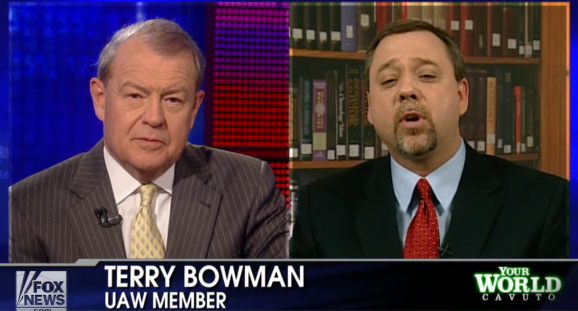
In addition, the conference will feature speakers from outside of West Michigan, such as Bill George, author of True North, who will talk about “leadership”; Dan Gilbert, founder and CEO of Quicken Loans; a consultant with a national corporate consulting firm McKInsey & Co.; and Terry Bowman, founder of Union Conservatives.
Bowman’s group Union Conservatives seems to be nothing more than a recently constructed effort to attack unions by claiming to create a union made up of workers who openly advocate for the capitalist system and attack most current union policies.
Bowman is a regular on Fox News where he is presented as a real union member as opposed to union bosses. In this Fox News story, Bowman criticizes a recent AFL-CIO report on the growing gap between CEOs and wage-workers.
Bowman has also created a new blog called Protecting Our Workers, which features testimony from him and 2 other union members that think most labor unions are bad for business and the free market system.
Bowman’s participation in the West Michigan Policy Forum conference will no doubt be to rally the capitalist class to defeat the November ballot initiative called Protect Our Jobs. Bowman is sourced in numerous articles in reactionary right publications such as American Spectator, which are attacking the Michigan labor union effort to solidify job security into the Michigan Constitution.
GRIID plans on attending the two-day conference next month and will provide analysis on the content of the sessions and speakers.
The Sense of White Supremacy
This article by Vijay Prashad is re-posted from CounterPunch.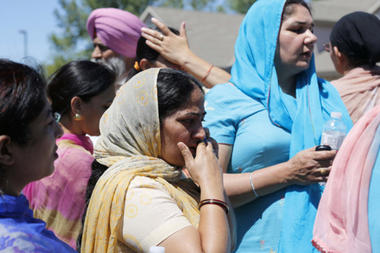
Yesterday morning the orgies of the lone gunman took hold in Oak Creek, Wisconsin, a town in the dragnet of Milwaukee. He targeted a Gurdwara, the religious home of the local Sikh community. The gunman entered the Gurdwara, and as if in mimicry of the school shootings, stalked the worshippers in the halls of the 17,000 square foot “Sikh Temple of Wisconsin.” Police engaged the gunman, who wounded at least one officer. The gunman killed at least seven Sikhs, wounding many more. He was then killed. A few hours after the shooting Ven Boba Ri, a committee member of the Gurdwara told the Milwaukee Journal-Sentinel, “It’s pretty much a hate crime. It’s not an insider.”
The local police smartly said that this is an act of domestic terrorism. The FBI concurred.
This is the not the first act of violence against Sikhs in the United States.
That story begins in the 19th century, when Sikhs migrated to the US, fleeing British colonialism for far-flung pastures. Many landed along the western coast of the United States, working alongside Japanese, Mexican and Filipino workers to make California into a fruit-producer and Oregon and Washington into major lumber producers. But they were not welcomed. Riots in Bellingham, Washington (1907) and Live Oak, California (1908) targeted the “rag heads,” the turban-wearing Sikhs. The mob “stormed makeshift Indian residences, stoned Indian workers and successfully orchestrated the non-involvement of local police.” The Bellingham Morning Reveille ran a drawing of a “Sikh” man with the caption, “This is the type of man driven from this city as the result of last night’s demonstration by a mob of 500 men and boys.” It was a mark of pride to have cleansed the city of the Sikhs.
The Sikhs didn’t take this lying down. A decade later, one Sikh man bragged, “I used to go to Maryville every Saturday. One day a ghora [white man] came out of a bar and motioned to me, saying, ‘Come here, slave!’ I said I was no slave man. He told me that his race ruled India and I hit him and got away fast.”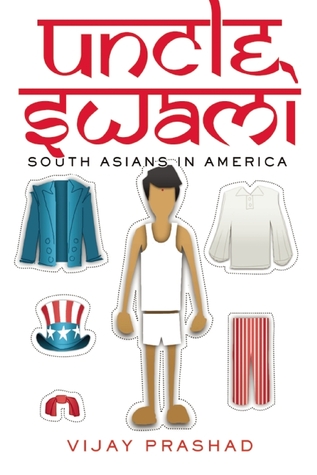
Anti-Sikh violence does not reside only in the early part of the 20th century. It returned a century later, when, after 9/11, Sikh men and women were targeted once more for their turban and head-scarf. Since Osama Bin Laden wore a turban, it was the turban that attracted the racist to the Sikhs. As I note in Uncle Swami, within the first week after 9/11, a disproportionately large number of the 645 bias attacks took place against Sikhs. The statement on the Oak Creek shootings that came from the activist group South Asian Americans Leading Together (SAALT) drew a straight line between the post-9/11 violence and this attack, “While the facts are still emerging, this event serves as a tragic reminder of violence in the form of hate crimes that Sikhs and many members of the South Asian community have endured since September 11th, 2001.”
Two quick reactions to the Oak Creek violence raised the hackles of some of the sharp organizers in the South Asian American community:
* This was an act of senseless violence. “No,” said Rinku Sen, publisher of Colorlines magazines. This is not “senseless,” she noted, but “racist.” This is the fifty-seventh mass shooting in the past thirty years in the United States. Each one is treated as the work of a freak. Patterns are shunned. Structural factors such as the prevalence of guns and the lack of social care for mentally disturbed people should of course be in the frame. But so too should the preponderance of socially acceptable hatred against those seen as outsiders. Intellectually respectable opinions about who is an American (produced, for example, by Sam Huntington, Who Are We? The Challenge to National Identity) comes alongside the politician’s casual racism (Romney’s recent suggestion that the US and the UK are “part of an Anglo-Saxon heritage,” erased in a whip lash the diversity of the United States and Britain). Racist attacks are authorized by a political culture that allows us to think in nativist terms, to bemoan the “browning” of America. By 2034, the Census department estimates, the non-white population of the US is going to be in the majority. With the political class unwilling to reverse the tide of jobless growth and corporate power, the politicians stigmatize the outsider as the problem of poverty and exploitation. This stigmatization, as Moishe Postone argues, obscures “the role played by capitalism in the reproduction of grief.” Far easier to let the Sikhs and the Latinos, the Muslims and the Africans bear the social cost for economic hopelessness and political powerlessness than to target the real problem: the structures that benefit the 1% and allow them to luxuriate in Richistan.
* Sikhs are not Muslims. The second argument, now clichéd, is to make the case that this is violence at the wrong address. Sikhs did nothing wrong, they are peace-loving and so on. It assumes that there are people who did do something wrong, are war-mongering and therefore deserve to be targeted. The liberal gesture of innocence has within it the sharp edge of Islamaphobia. It seems to suggest that Muslims are the ones who should bear this violence, since their ilk did the attacks on 9/11 and they are, all two billion of them, at war with the United States. The attack on Sikhs is not a mistaken attack. Sikhs are not mistaken for Muslims, but seen as part of the community of outsiders who are, as Patrick Buchanan puts it in States of Emergency: The Third World Invasion and Conquest of America, “a fifth column inside the belly of the beast…Should America lose her ethnic-cultural core and become a nation of nations, America will not survive.” Wisconsin’s Governor Scott Walker is not far from all this, being a fan of the Arizona anti-human legislation. The Sikh Coalition, an anti-bias group, is fully aware that this is not simply a situation of mistaken identity. Its 2008 report, Making Our Voices Heard, notes that although it is not the case that Sikhs are members of the Taliban or clones of Bin Laden, it is this recurrent identification that has by now “created an environment in which Sikhs are regularly singled out for abuse and mistreatment by both private and, at times, public actors.” Strikingly, forty-one percent of Sikhs in New York City reported being called derogatory names, half of the Sikh children reported being teased or harassed because of their Sikh identity and one hundred percent of Sikhs report having to endure secondary screenings at some US airports.
Sapreet Kaur of the Sikh Coalition offered her take of the situation, “There have been multiple hate crime shootings within the Sikh community in recent years and the natural impulse of our community is to unfortunately assume the same in this case.”
Vijay Prashad is the author of Uncle Swami: South Asians in America Today (New Press, 2012).
This interview with Michelle Alexander is re-posted from ZNet.
Mark Karlin: Before we get into the details, is it accurate to characterize your thesis, in a colloquial way, by saying that institutionalized racial casting is alive and even ratcheting up in the United States in 2012?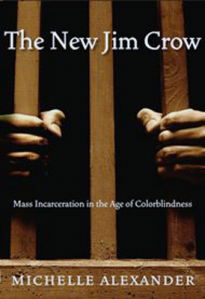
Michelle Alexander: Yes, I do believe that something akin to a racial caste system is alive and well in America. For reasons that have stunningly little to do with crime or crime rates, we, as a nation, have chosen to lock up more than two million people behind bars. Millions more are on probation or parole, or branded felons for life and thus locked into a permanent second-class status. The mass incarceration of poor people of color, particularly black men, has emerged as a new caste system, one specifically designed to address the social, economic, and political challenges of our time. It is, in my view, the moral equivalent of Jim Crow.
MK: You identify the key societal perpetuation of the stigmatization of the black male as the so-called “criminal justice system.” It appears to have become an accepted bureaucratic injustice.
MA: Mass incarceration has become normalized in the United States. Poor folks of color are shuttled from decrepit, underfunded schools to brand new, high tech prisons and then relegated to a permanent undercaste – stigmatized as undeserving of any moral care or concern. Black men in ghetto communities (and many who live in middle class communities) are targeted by the police at early ages, often before they’re old enough to vote. They’re routinely stopped, frisked, and searched without reasonable suspicion or probable cause. Eventually they’re arrested, whether they’ve committed any serious crime or not, and branded criminals or felons for life. Upon release, they’re ushered into a parallel social universe in which the civil and human rights supposedly won during the Civil Rights Movement no longer apply to them. For the rest of their lives, they can be denied the right to vote, automatically excluded from juries, and legally discriminated against in employment, housing, access to education and public benefits. So many of the old forms of discrimination that we supposedly left behind during the Jim Crow era are suddenly legal again once you’ve been branded a felon. That’s why I say we haven’t ended racial caste in America; we have merely redesigned it. In many large urban areas, the majority of working age African American men now have criminal records and are thus subject to legalized discrimination for the rest of their lives. It is viewed as “normal” in ghetto communities to go to prison or jail. One study conducted in Washington, D.C. indicated that 3 out of 4 black men, and nearly all those living in the poorest neighborhoods could expect to find themselves behind bars at some point in their life. Nationwide, 1 in 3 black men can expect to serve time behind bars, but the rates are far higher in segregated and impoverished black communities. A massive new penal system has emerged in the past few decades – a penal system unprecedented in world history. It is a system driven almost entirely by race and class.
Also See: Moyers Moment (2010): Michelle Alexander on The New Jim Crow
MK: How fast has our prison incarceration rate grown and to what extent does the growth correlate with the arrest of black males for nonviolent offenses? Doesn’t the US have the largest incarceration rate in the world?
MA: The United States does have the highest rate of incarceration in the world dwarfing the rates of even highly repressive regimes like Russia, China or Iran. This reflects a radical shift in criminal justice policy, a stunning development that virtually no one – not even the best criminologists – predicted forty years ago. Our prison population quintupled in a thirty year period of time. Not doubled or tripled – quintupled. We went from a prison and jail population of about 300,000 to now more than 2 million. Most people seem to assume that this dramatic surge in imprisonment was due to a corresponding surge in crime, particularly violent crime. But that simply isn’t true. During the same period of time that incarceration rates skyrocketed, crime rates fluctuated. Crime rates went up, then went down, then went up, then went down again. Today, crime rates are at historical lows. But incarceration rates – throughout all of these fluctuations – have consistently soared. Most criminologists today will acknowledge that crime rates and incarceration rates in the United States have had relatively little to do with each other. Incarceration rates – especially black incarceration rates – have soared regardless of whether crime has been going up or down in any given community or the nation as a whole.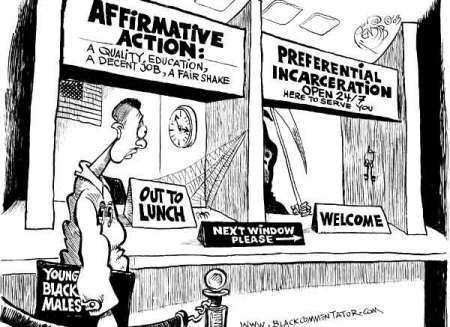
Defenders of the status quo will often try to mislead the public by saying, “Just look at our state prisons: nearly half of the inmates are violent offenders. This system is about protecting the public from violent crime.” This type of statement is highly misleading. First, the statement excludes federal prisoners. Less than 8 percent of federal prisoners are violent offenders – most are convicted of drug or immigration offenses. More important, though, that kind of statement obscures the fact that the overwhelming majority of people who have been arrested in the era of mass incarceration have been arrested for non-violent offenses. What defenders of the system typically fail to acknowledge is that the reason violent offenders comprise a fairly large percentage of the state prison population is because they typically receive longer sentences than non-violent offenders. Because they stay longer, they comprise a larger share of the prison population than the millions of nonviolent offenders who are cycling in and out, trapped in a cycle of perpetual marginality that has been deliberately constructed through our legal system.
I think it’s critically important for people to understand that this system of mass incarceration governs not just those who find themselves in prison on any given day, but also all those who are in jail, on probation or parole, as well as all those who are just months away from being locked up again because they are unable to find work or housing due to their criminal record. Today there are more than 7 million people under formal correctional control in the United States, but only 1.5 million are in prison. The rest – more than 5.5 million – are in jail, on probation or parole. Probationers are the clear majority of those who are under community supervision (85 percent), and only 19 percent of them have been convicted of a violent offense. Most probationers have been convicted of drug possession offenses. More than 50 million Americans are saddled with criminal records that will follow them for the rest of their lives, locking them into a permanent second-class status. .
MK: How does the “war on drugs” figure into the arrests and branding of particularly black males as “criminals”?
MA: The war on drugs has been the engine of mass incarceration. Drug convictions alone constituted about two-thirds of the increase in the federal prison population and more than half of the increase in the state prison population between 1985 and 2000, the period of our prison system’s most dramatic expansion. Drug convictions have increased more than 1000% since the drug war began. To get a sense of how large a contribution the drug war has made to mass incarceration, consider this: There are more people in prisons and jails today just for drug offenses than were incarcerated for all reasons in 1980.
Most Americans violate drug laws in their lifetime, but the enemy in this war has been racially defined. Not by accident, the drug war has been waged almost exclusively in poor communities of color, even though studies have consistently shown – for decades – the people of color are no more likely to use or sell illegal drugs than whites. Now that’s hard for many people to believe, given that the media image of a drug dealer is a black kid standing on the street corner with his pants sagging down. And plenty of drug dealing does happen in the ‘hood, but it happens everywhere else in America as well. In fact, some studies suggest that where significant differences in the data can be found, white youth are more likely to engage in illegal drug dealing than black youth. But that is not what you would guess by taking a peek inside our nation’s prison and jails which are overflowing with black and brown drug offenders. In some states, 80-90 percent of all drug offenders sent to be prison have been one race: African American.
Again, defenders of the system will counter by saying this drug war has been aimed at violent crime. But that is not the case. The overwhelming majority of people arrested in the drug war have been arrested for relatively minor, non-violent drug offenses. One study showed that 4 out of 5 drug arrests were for simple possession, and that most people in state prison for drug offenses had no history of violent crime or even significant selling activity. And in the 1990s – the period of the greatest escalation of the drug war – nearly 80 percent of the increase in drug arrests was for marijuana possession, a drug less harmful than alcohol or tobacco and at least, if not more, prevalent in middle class white neighborhoods and college campuses as it is in the ‘hood. But by waging the drug war and “getting tough” almost exclusively in the ‘hood, we’ve managed to create a vast new racial undercaste in an astonishingly short period of time.
MK: Once a black male enters the prison-industrial complex as a man with a criminal record, what are his prospects in terms of jobs and an economically stable future?
MA: Slim to none. Once you have been branded a criminal or felon, you are typically trapped for life. For the rest of your life you must check the box on employment applications asking the dreaded question: “Have you ever been convicted of a felony?” And once you check that box, the odds are sky high that your application is going straight to the trash. Hundreds of professional licenses are off-limits to people convicted of felonies. In my state, in Ohio, you can’t even become a barber if you’ve been convicted of a felony. Discrimination in housing against people with criminal records is also perfectly legal. Public housing projects as well as private landlords are free to deny housing to people with criminal records. In fact, you don’t even have to be convicted. You can be denied housing – or your family evicted – just based on an arrest. Discrimination in public benefits is also perfectly legal. Under federal law, people convicted of drug felonies are deemed ineligible even for food stamps.
What are people released from prison expected to do? How are they expected to survive? Can’t get a job, locked out of housing, and even food stamps may be off limits. Well, apparently what we expect them to do is to pay hundreds or thousands of dollars in fees, fines, court costs, and back child support (which continues to accrue while you are in prison). And in a growing number of states, you’re actually expected to pay back the costs of your imprisonment. Paying back all these fees, fines, and costs may be a condition of your probation or parole. To make matters worse, if you’re one of the lucky few who actually manages to get a job following release from prison, up to 100% of your wages can be garnished to pay back all those fees, fines and court costs. One hundred percent.
Under these circumstances, what, realistically, do we expect people to do? Perhaps the better question is: What does this system seem designed to do? As I see it, it seems designed to send people right back to prison, which is what happens about 70% of the time. About 70% of those released from prison return within a few years, and the majority of those who return in some states do so in a matter of months because the challenges associated with mere survival on the outside are so immense.
MK: How does the institutionalized racism of the prison-industrial complex affect the rights of black males to vote?
MA: Millions of people are unable to vote due to felony convictions with the highest rates among black men. People in prison are denied the right to vote in 48 states, and while we accept that as normal in the United States, in other western democracies people in prison do have the right to vote. In fact, in some countries there are actually voting drives conducted in prison! But here in the U.S., we seem to take the idea of democracy a bit less seriously and people are denied the right to vote not only when they are in prison, but also upon release in many states. People on probation and parole are typically denied the right to vote, and in eleven states people are denied the right to vote even after completion of their sentences. Nationwide about 1 in 7 black men are temporarily or permanently disenfranchised due to felon disenfranchisement laws. In some states the figure is closer to 1 in 4. Voting rights expert and legal scholar Pam Karlan reports that as of 2004, there were more black men disenfranchised than in 1870, the year the Fifteenth Amendment was ratified prohibiting laws that deny the right to vote on the basis of race.
MK: What are the incentives for police to arrest minority teens for minor drug offenses?
MA: Many people don’t realize that financial incentives have been built into the drug war that guarantee that law enforcement will continue to arrest extraordinary numbers of people, particularly in poor communities of color, for minor drug offenses that get ignored on the other side of town. In the war on drugs, state and state law enforcement agencies have been rewarded in cash by the federal government – through programs like the Edward Byrne Memorial Grant program – for the sheer numbers of people arrested for drug offenses. To make matters worse, federal drug forfeiture laws allow state and local law enforcement agencies to keep, for their own use, up to 80 percent of the cash, cars, and homes seized from suspected drug offenders. You don’t even have to be convicted of a drug offense; if you’re just suspected of a drug offense, law enforcement has the right to keep the cash they find on you or in your home, or seize your car if drugs are allegedly found in it or “suspected” of being transported in the vehicle. Between 1988 and 1992 alone, Byrne-funded drug task forces seized over $1 billion in assets. The targets of these stop and frisk tactics and routine seizures are not college students or middle class suburban youth who use and sell plenty of drugs. No, if the drug war was waged in those communities it would spark such outrage that the war would end overnight. This literal war is waged in segregated, impoverished communities defined largely by race, and the targets are the most vulnerable, least powerful people in our society. Yet far from putting any meaningful constraints on law enforcement in this war, the U.S. Supreme Court has given the police license to stop and search just about anyone, in any public place, without a shred of evidence of criminal activity, and it has also closed the courthouse doors to claims of racial bias at every stage of the judicial process from stops and searches to plea bargaining and sentencing. As I describe in some detail in my book, the U.S. Supreme Court has virtually immunized the system of mass incarceration from judicial scrutiny for racial bias, much in the same way that it rallied to defend slavery and Jim Crow in earlier eras.
MK: In your book, you ask the question, “Can we envision a system that would enforce drug laws almost exclusively among young white men and largely ignore drug crime among young black men?” Yet, you note in the same section that the jailing of some whites allows us as a nation to feel that the criminal justice is colorblind. Would you elaborate on this?
MA: For those who say that the war on drugs and the system of mass incarceration really isn’t about race, I say there is no way we would allow the majority of young white men to be swept into the criminal justice system for minor drug offenses, branded criminals and felons, and then stripped of their basis civil and human rights while young black men who are engaged in the same activity trot off to college. That would never be accepted as the norm. We would never throw up our hands and say to those white boys – well, too bad, if you had just stayed away from marijuana or not dealt dope to your friends when you were 18 you wouldn’t be serving a life sentence in prison right now. You wouldn’t be locked out of jobs, unable to even get work at McDonalds. No, instead we’d say, “What’s wrong with us as a nation that we would condemn so many of our young men to a life of poverty, exclusion, and scorn simply because they made a few mistakes in their youth?” The mass criminalization of white men would disturb us to the core. In my view, the critical questions in this era of mass incarceration are: What disturbs us? What seems contrary to expectation? Who do we really care about?
But of course in this age of colorblindness, a time when we have supposedly moved “beyond race,” we as a nation would feel very uncomfortable if ONLY black people were sent to jail for drug offenses. We seem comfortable with 90 percent of the people arrested and convicted of drug offenses in some states being African American, but if the figure was 100 percent, the veil of colorblindness would be lost. We could no longer tell ourselves stories about why 90 percent or 80 percent is really the right figure, even though black people aren’t more likely to commit drug crimes. The fact that people of all colors have been ensnared by the drug war helps to preserve the system as a whole from serious critique, as it creates the impression – at a glance – that the war is being waged in an unbiased manner, even when nothing could be further from the truth.
MK: To what extent is the criminal and prison-industrial complex, particularly with the emergence of the for-profit prison industry, like any other corporation, with financial demands and lobbyists to feed the beast; i.e. sustain and, when possible, increase the number of incarcerated individuals? A lot of people make money off of this industry. It is a multibillion-dollar operation.
MA: Yes, it is. Private prison companies are now listed on the New York Stock exchange and are doing quite well in a time of economic recession (and depression in some communities). But that’s just the tip of the iceberg. The prison-industrial complex employs millions of people directly and indirectly. Judges, prosecutors, defense attorneys, prison guards, construction companies that build prisons, police, probation officers, court clerks, the list goes on and on. Many predominately white rural communities have come to believe that their local economies depend on prisons for jobs. Prison guard unions have become the powerful political forces in some states, particularly California. They don’t just lobby for better working conditions or higher pay but they also support harsh mandatory minimum sentences, three strikes laws, and other “get tough” measures because those laws represent job security. For those interested in learning more about corporations and private individuals profiting from the caging of human beings, I highly recommend the book “Prison Profiteers: Who Makes Money From Mass Incarceration.”
MK: Would you compare the sentencing differences for drunk driving (mostly white offenders) with sentences for criminal offenses (with mostly blacks charged, even though white offenders are quite high, particularly among the young)? What are the implications of this disparity?
MA: The dramatically different manner in which we, as a nation, responded to the crisis presented by drunk driving and the crisis caused by the emergence of crack cocaine speaks volumes about who we value, and who we view as disposable. During the 1980s, at the same time that crack cocaine was making headlines, a grassroots movement was emerging to address the widespread and sometimes fatal problem of drunk driving. Unlike the drug war, which was born of deliberate political strategy to exploit our nation’s racial divisions (part of the Southern Strategy to flip the South from blue to red), the anti-drunk driving movement was a bottom-up movement led most notably by mothers whose families were shattered by deaths caused by drunk driving. By the end of that decade, drunk drivers were responsible for about 22,000 deaths annually, while overall alcohol-related deaths were close to 100,000 per year. . By contrast, during the same time period, there were no prevalence statistics at all on crack – even though crack babies, crack dealers, and so-called crack whores were dominating the news. In fact, the total number of deaths related to ALL illegal drugs combined was tiny compared to the number of deaths caused by drunk drivers. The total of all drug related deaths due to AIDS, drug overdose, or the violence associated with the drug trade, was estimated at 21,000 annually – less than the number of deaths caused directly by drunk drivers and a small fraction of the number of alcohol-related deaths each year.
So how did we respond to these competing crises that were unfolding simultaneously? Well, in response to the advocacy of groups like Mothers Against Drunk Driving, most states adopted tougher laws to punish drunk driving. Numerous states now have some type of mandatory sentencing for this offense – typically two days in jail for a first offense and two to ten days for a second offense. Possession of a tiny amount of crack cocaine, on the other hand, was given a mandatory minimum sentence of five years in prison.
The vastly different sentences afforded drunk drivers and drug offenders tells us who is viewed as disposable – someone to be purged from the body politic – and who is not. Drunk drivers are predominately white and male. White men comprised 78 percent of the arrests for this offense in 1990 when the new mandatory minimum sentences were adopted. They are generally charged with misdemeanors and typically receive life sentences involving fines, license suspension, and community service. Although drunk driving contains a far greater risk of violent death than the use of sale of illegal drugs, the societal response to drunk drivers has generally emphasized keeping the person functional and in society, while attempting to respond to the dangerous behavior through treatment and counseling. People charged with drug offenses, though, are typically poor people of color. They are routinely charged with felonies and sent to prison.
MK: It costs taxpayers, on an average nationwide, at least $20,000 a year to keep an individual in prison. Why don’t we just create jobs programs where black males can find meaningful employment instead of leaving vast swaths of urban America as financial wastelands and arresting male residents of these areas on minor drug charges? Wouldn’t that create an infinitely more positive outcome? To what degree is that a perpetuation of multigenerational racial poverty?
MA: Of course it would make far more sense to invest in education and job creation in poor communities of color, rather than spend billions of dollars caging them and monitoring them upon release. The fact that this system is so utterly irrational shows that the system isn’t really about public safety. Our system of mass incarceration is better understood as a system of racial and social control than a system of crime prevention or control.
We have now spent 1 trillion dollars waging the drug war since it began. A trillion. Those funds could have been used for education, jobs and drug treatment in the communities that needed it most. We could have used those funds for our collective well being, instead those dollars paved the way for the destruction of countless lives, families, and dreams. One day, I believe historians will look back and they will say that it was there, right there at the prison gates, where we abandoned Martin Luther King, Jr.’s dream and took a dramatic U-turn that would leave millions of Americans permanently locked up or locked out.
The scale of the harm that has been done and the magnitude of the challenge we now face is daunting, to say the least. It can feel overwhelming, even hopeless or paralyzing at times. What keeps me going, and what fills me with determination is the knowledge that that those who risked their lives to end the old Jim Crow would not have been so easily deterred. So I believe we must be willing to pick up where they left off and do the hard work of movement building on behalf of poor people of colors. We must build a movement for education, not incarceration. A movement for jobs, not jails. A movement that will end all forms of discrimination against people released from prison – discrimination that denies them basic human rights to work, shelter and food. We must muster the courage, we must find the will, we must do what is necessary to build a truly transformative movement that will end the history and cycle of caste in America.
Yesterday, we posted a second story about the Grand Rapids Gravel workers strike. In that story we identified a company hired to provide security, but the name was inaccurate.
We now know that the company’s name is Huffmaster. Based out of Troy, Michigan, Huffmaster considers itself “as the leading provider of strike management solutions.”
Huffmaster has been around for 45 years and has a long history of working for companies that use scab workers and seek to bust up unions. In the late 1990s, the parent company of the Detroit News and the Detroit Free Press hired Huffmaster to provide 480 security personnel to protect the scab workers hired by another company. Huffmaster was also hired to break the strike of a teachers’ union in Toledo in earlier this year.
According to the company’s website:
Huffmaster has earned its reputation as the leading strike management resource on the front lines of many of the nation’s most difficult and high-profile labor disputes. As a result, few companies can match our depth of experience or our range of services. We can assist with all aspects of pre-strike contingency planning and, if a work stoppage occurs, we can provide replacement workers, strike-trained uniformed officers and a full array of supporting services. With a unique combination of experience and single-source capabilities, Huffmaster is the proven choice for strike management solutions.
Another aspect of Huffmaster, which is common in security companies, is that the management team includes former military personnel. The President and Vice President of the company both served in the US military, with President Gregory Johnson having served in the US Army Special Forces.
The military connection to Huffmaster doesn’t end there, however. One of the “associations” the company boasts online is with ASIS International. ASIS International has been a major beneficiary of the US led War on Terror and has won major taxpayer funded contracts in Iraq and Afghanistan.
Indeed, Huffmaster has also profited handsomely since the 2011 declared War on Terror. They provide consulting, security and surveillance services in the US for companies that “might be potential targets of terrorist attacks,” such as chemical companies. Huffmaster produced this video a few years ago that used the War on Terror as a pretext to sell its services.
However, the company’s bread and butter lies with strike breaking in the US. According to the company:
When a strike occurs – whether expected or unexpected – Huffmaster’s strike security professionals can rapidly respond to secure your facilities, deter strike-related violence and support your continuing operations with:
Picket Line Security – Our highly specialized strike security officers are trained to deter picket misconduct and, when necessary, keep driveways clear using defensive formations.
Property Protection – Designed to help prevent sabotage and/or vandalism to your facility and equipment through high visibility and deterrence.
Mobile Protection – Dedicated to protecting drivers, trucks and other mobile assets by deterring misconduct on the road.
Evidence Collection – Highly specialized officers are trained in investigative and evidence gathering techniques, which include documenting evidence of picket line misconduct for use in injunctions, restraining order hearings or for employee disciplinary purposes.
Command and Control – Experienced site management teams can coordinate every aspect of your strike security operation.
Executive Protection – Our highly trained agents provide low-profile security to company owners, managers and/or family members who may be targeted for harassment during a labor dispute.
While this writer was present at the Grand Rapids Gravel workers picket line on Friday, we observed Huffmaster security guards attempting to blame union workers for throwing roofing nails near the entrance of the Grand Rapids Gravel Co. facility in Grandville and then contacting the Grandville Police. This clearly was a way to intimidate striking workers.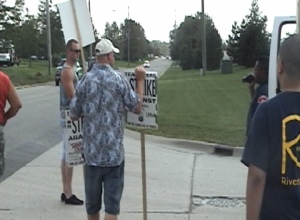
In addition, when striking workers and supporters engaged some of Huffmaster’s guards, one of them made threatening comments as if to provoke a physical confrontation. This was so evident that other Huffmaster security guards had to coax the man back in the van and remove him from the area where the workers were holding the picket line.
You can see from the photo here one Huffmaster security personnel filming the striking workers when the workers were confronting the guards about the fabricated roofing nail incident.
GRIID will continue to provide updates on the Grand Rapids Gravel workers strike, for as long as it lasts. We openly support worker solidarity with these striking workers and believe it is important that people know that the Grand Rapids Gravel Company is using a strike-breaking, scab providing company like Huffmaster.
Michigan Supreme Court votes to allow ballot initiative that would people to vote against Emergency Manager Law Public Act 4
The group Michigan Forward had gathered enough signatures to put the issue on the ballot, but they were denied initially the chance to put the issue of the Michigan Emergency Manager Law on the ballot.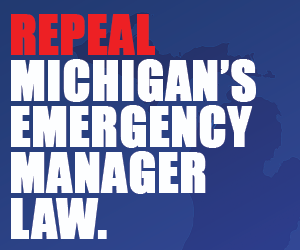
On Friday, the Michigan Supreme Court ruled in their favor and now the issue will be decided by voters on November 6.
According to Michigan Forward:
After months of collecting signatures and lengthy court battles it’s time to move into the next phase of the battle We know that when people learn the truth about this law they vehemently oppose any efforts by Governor Snyder, Treasurer Dillion, an ill advised legislator to subvert the constitution, and dismiss our values as Americans.
We have a short amount of time to educate, mobilize and turn out the vote for the General Election held on November 6, 2012. The election is less than 100 days away. With your help we can Repeal this totalitarian Law, and send a clear message to the Governor and those in the Michigan Legislature who support Public Act 4.
Michigan Forward provides plenty of information on Public Act 4 and is seeking volunteers to organize in communities across the state to repeal Public Act 4 in the November 6 election.
Grand Rapids Gravel workers strike – Day 16
Last week we reported that the Grand Rapids Gravel workers went on strike, after the company told them that they needed to take a $6 an hour pay cut or else.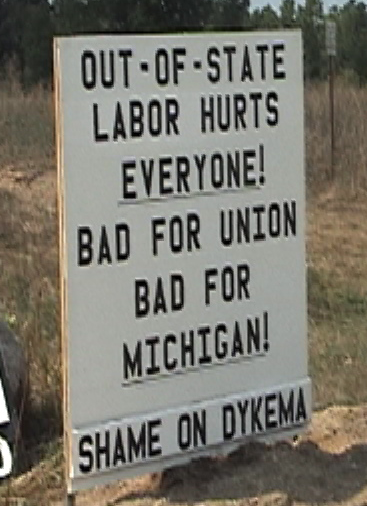
The GR Gravel workers, also members of a local Teamster union, refused the company demands and are in their third week of a strike. Yesterday, I spoke with several of the striking workers at the main Grand Rapids Gravel location in Grandville.
Since last week’s story, the workers found out that the private security company hired from Illinois to patrol the company property is Hoffmaster Security. We could find no online references to this security company, but we saw at least 3 security vans and four security guards patrolling the Grandville facility during the time spent talking with the striking workers.
Most of the guys we spoke with have been with the company since the late 1970s and they confirmed that they had not received a raise since 2000. These workers also confirmed that the reason they believe the company is trying to punish the workers with a pay cut is two-fold.
First, the owner of the company, Dykema, invested heavily in real estate in the last decade and when the bottom dropped out of the real estate market, the owner took a hit. The other reason for the demand to cut workers wages is because the workers are convinced that the owner wants to break the union.
The guys we spoke with said they were making $18 an hour driving truck, but they recently found out that the company is paying scab workers $22 an hour. The scab workers are coming from Indiana, Ohio and some from Michigan. The company has also upgraded some of their mechanics to drive truck, since the mechanics are not union.
During the time we spent with the striking workers yesterday, it was practice to walk with picket signs in front of the gravel trucks as they passed by. The striking workers would also yell at the scab drivers to let them know of their anger that fellow workers would disrespect them by taking their jobs.
Local police were also stopping by during the strike yesterday and at one point were called because the security guards were claiming that the workers put roofing nails on the road at one entrance.

We witnessed the security guards looking at the ground and walking around their van at an entrance to the facility where the strikers were not located and then the security guards drove down to where the striking workers were stationed and began looking around to see if they could find any nails. The striking workers were convinced this was a complete fabrication and just an attempt to get the local police to harass and intimidate those on strike.
Despite such tactics the workers spirits were high and were committed to striking until their demands were met. The Teamsters are providing the striking workers with meals and cold beverages on a regular basis and those we spoke with welcome any kind of solidarity people can provide. Yesterday, there was also members of the Grand Rapids branch of the IWW in solidarity with the striking workers.
Go to this link to find the various locations where the workers are on strike and have a presence.
Update, the name of the security company hired was not accurate. The company’s name is Huffmaster and we posted a story profiling their role in strike breaking.
LGBT organization calling for Boycott of Amway
Today, the California-based LGBT group Rights Equal Rights announced that it was calling for a boycott of Amway/Alticor, because of “its President and company owner
Doug DeVos’ $500,000 contribution to the National Organization (NOM) for Marriage.”
The Rights Equal Rights website also states, “A global boycott of Amway will let others know that there are consequences for giving massive amounts of money to take away the rights of a minority. We will be closely watching the donors who contribute to the anti-gay sides of the four upcoming November 6th marriage elections in Minnesota, Maryland, Maine and Washington State.
This is not the first time that a member of the DeVos family has providing funding to defeat marriage equality or other LGBT rights struggles around the country. The Richard & Helen DeVos Foundation and the Dick & Betsy DeVos Foundation have also provided significant amounts of money to previous anti-gay campaigns, such as defeating marriage equality in Florida and funding anti-gay groups like Focus on the Family and the American Family Association. We obtain this information through their foundation 990s, which were used for the documentary film we produced on the history of the LGBTQ community in Grand Rapids.
Locally, we learned in the Grand Rapids People’s History of the LGBTQ Community that Richard DeVos threatened to pull funding for a new building project at GVSU in 1995, when it was reported that the university was planning on providing domestic partner benefits to their faculty and staff.
The Rights Equal Rights organization sent Doug DeVos a letter expressing their outrage over the Amway President’s financial support of NOM and provided the following list of Amway/Alticor brands and subsidiaries that the organization is asking people to boycott.
Amway – Family of Brands
Atmosphere Artistry Skin Care Products Beauty Products Sold Through Amway Fragrances iCook Jewelry and Apparel Laura Mercier® Legacy of Clean Home Care Products Nutrilite Health Products RéVive Ribbon Water Systems Sold Through Amway XS Food and Beverage Division
Real Estate
DP Fox Ventures, LLC, a diversified management company with interests in real estate, transportation, and sports and entertainment
Access Business Group LLC
Alticor Corporate Enterprises
Interleukin Genetics Gurwitch Products Metagenics
Hospitality & Fitness
Amway Hotel Corporation Amway Grand Plaza Hotel JW Marriott Grand Rapids Courtyard by Marriott Downtown Grand Rapids Peter Island Resorts RDV Sportsplex MVP Sports Clubs in Michigan and Florida
Professional Sports
Orlando Magic – National Basketball Association (NBA) Orlando, FL Grand Rapids Griffins – American Hockey League (AHL) Grand Rapids, MI
Fox Automotive Group
Delta Imports – Porsche, Audi and Subaru, Grand Rapids, MI Fox Acura – Grand Rapids, MI Fox Buick GMC – Comstock Park, MI Fox Ford Mazda – Grand Rapids, MI Fox Honda – Grand Rapids, MI Fox Hyundai Kia – Grand Rapids, MI Fox Nissan – Grand Rapids, MI Fox Saab – Grand Rapids, MI Fox Powersports of Kentwood – Aprilia, Arctic Cat, Piaggio, Qlink, Vespa, Genuine Scooter, MotoGuzzi, Yamaha, Grand Rapids, MI Fox Shawmut Hills – Can-Am, Sea-Doo, Ski-Doo, Suzuki, Yamaha, Honda Powersports, Honda Power Equipment, Kawasaki, Grand Rapids, MI Grand Rapids Harley-Davidson – Hudsonville, MI Fox Collision Center – Grand Rapids, MI Quick Lane Tire & Auto Center – Kentwood, MI Fox Ford Lincoln of Cadillac – Cadillac, MI Fox Toyota of Cadillac – Toyota, Scion, Cadillac, MI Fox Grand Traverse – Ford, Lincoln, BMW, Mazda, Traverse City, MI Mercedes-Benz of Traverse City – Traverse City, MI Fox Collision Center – Traverse City, MI Fox Charlevoix – Buick, Cadillac, Chrysler , Dodge , Jeep, RAM, Gem, Charlevoix, MI Fox Charlevoix Ford – Ford, Lincoln, Charlevoix, MI Fox Collision Center, Charlevoix, MI Fox Negaunee GM – Chevrolet, Buick, GMC, Negaunee, MI Fox Negaunee Chrysler – Chrysler, Dodge, Jeep, Ram, Negaunee, MI Fox Collision Center – Negaunee, MI Fox Marquette – Ford, Lincoln, Marquette, MI
The Boycott Amway/Alticor campaign also has an online petition to sign, provides a number to call Doug DeVos and is asking for people to spread the word on the boycott.
New report exposes flawed carbon trading model
Two days ago we posted a story about a West Michigan company that is hoping that carbon trading, also known as carbon offsets, will support their business efforts.
To further corroborate our analysis we wanted to share with our readers information on a new report from the group Carbon Trade Watch.
The report, entitled Green is the color of Money: The EU ETS faliure as a model for the green economy, was released in June, just in time for the United Nation Conference on Sustainable Development, known as the Rio Summit.
Carbon Trade Watch has this to say about the new report:
New research reveals that the EU ETS has failed to reduce emissions while subsidizing polluters. The third phase of the EU ETS, due to start next year, will see the same pattern of subsidizing polluters (including airlines) and continue to use offsets as a way of evading emissions reductions, within the same financial markets that brought us the economic crisis.
The author of the report, Ricardo Coelho stated: “Carbon trading cannot deliver the necessary phase out of fossil fuels nor can it question the destructive over-production and consumption model that lies at the heart of industrialized countries’ economies. By diverting resources to where it is cheapest to reduce emissions, carbon trading prioritizes end-of-pipe solutions, in detriment of more ambitious and just policies, and actually makes the environmental and climate crisis worse.”
Joanna Cabello, from Carbon Trade Watch stated: “The EU continues to use carbon markets to transfer its environmental commitments to developing countries in the Global South and is pushing the EU ETS as a roadmap for environmental services markets here in Rio. Rio+20 is a smokescreen for big polluters.”
You can download or read the entire report online from Carbon Trade Watch.
In the conclusion they provide several alternatives to the current carbon trading model, alternatives that call for a radical shift in power. The most intriguing recommendations are:
- leaving fossil fuels in the ground and investing instead in appropriate energy-efficiency and safe, clean and community-led renewable energy
- radically reducing wasteful consumption, first and foremost in the North, but also by Southern elites.
- huge financial transfers from North to South, based on the repayment of climate debts and subject to democratic control. The costs of adaptation and mitigation should be paid for by redirecting military budgets, innovative taxes and debt cancellation.
- rights-based resource conservation that enforces Indigenous land rights and promotes peoples’ sovereignty over energy, forests, land and water.
- sustainable family farming and fishing, and peoples’ food sovereignty.
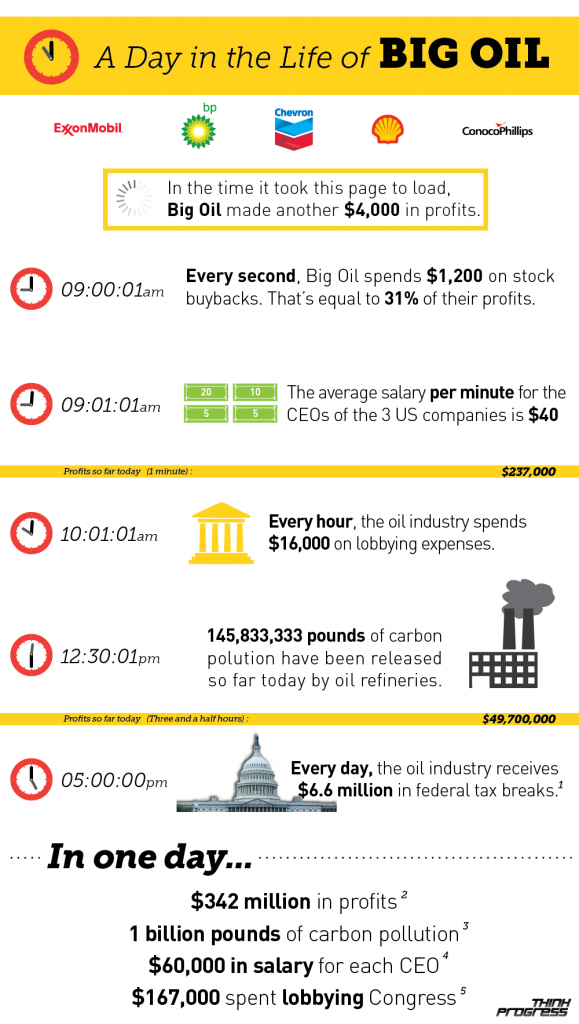
A Day in the Life of Big Oil
The graphic below is from Think Progress and it should underscore Bill McKibben’s recent comment in Rolling Stone Magazine that the fossil fuel industry should be public enemy number one.
Romney and the “Culture” of White Supremacy
This article by Glen Ford is re-posted from Black Agenda Report.
White supremacy is Mitt Romney’s religion, although I’d be willing to bet he has not uttered the epithet “nigger” since reaching adulthood. For Romney and his ilk, it is axiomatic that God’s blessings are manifest in the world through the distribution of wealth. Had God not favored Europeans, He would never have allowed them to expropriate the vast bulk of the Earth’s bounty. They have prospered because their ways are righteous – or, in more modern, secular terms, they possess a superior “culture.”
For the Mormon American multimillionaire, human destiny and divine will are revealed in macroeconomic data. ”As you come here and you see the GDP per capita, for instance, in Israel which is about $21,000 dollars, and compare that with the GDP per capita just across the areas managed by the Palestinian Authority, which is more like $10,000 per capita, you notice such a dramatically stark difference in economic vitality,” Romney told a room full of other wealthy – and, therefore, blessed – people at Jerusalem’s King David Hotel. The actual breakdown is $31,500 vs. $1,500, but I assume the fool misspoke. Romney recognized in those stark 20 to 1 ratios “the power of at least culture and a few other things,” including “the hand of providence.”
Palestinian poverty flows, not from Israeli military conquest, but from the conquered people’s cultural – and, presumably, moral – inferiority, and God’s consequent disapproval. Israeli suppression of Palestinian political, economic and, yes, cultural life, is irrelevant. Two cultures have clashed in Palestine, and one has been found to be 20 times as productive as the other. Enough said.
White South Africa regarded its wealth as prima facie evidence of cultural superiority. The fact that the land, minerals and labor on which that wealth was built belonged to Black people simply proved that Blacks lacked a “culture” adequate to manage those resources. Moreover, White Power was in the best interest of Black South Africans who, the apartheid regime was proud to proclaim, had a higher per capita income than Blacks elsewhere in sub-Saharan Africa. Thus, white cultural superiority could be beneficial to nearby Blacks, under controlled conditions that did not pollute the precious European cultural environment.
In 1973, Edward Botha, information officer for the South African embassy in Washington, assured Americans that his country’s Blacks were content with their situation. “Black people in South Africa own more automobiles than the Russian people do,” said Botha – a material accomplishment that Mitt Romney would surely associate with profound cultural and moral progress. But sadly, the poor Russians, possessing so few cars, retained little culture to speak of.
White U.S. southerners also insisted, during slavery and Jim Crow, that “their” Negroes were the best off in the worldbecause of their exposure to white folks’ religion and way of life. Left to their own devices, however, Black folks’ innate cultural inferiority – depravity! – would do them in. Blacks’ freedom of movement and expression must be contained, for their own good.
White liberals also believed in the Culture Demon. In the 1950s and early 60s, it was considered politically correct to describe African Americans as “culturally deprived” – meaning, Blacks are disadvantaged by lack of exposure to white culture. Power has nothing to do with it.
The 20 to 1 disparity between Israeli and Palestinian per capita income matches the wealth gap between American Blacks and whites (app. $5,000 vs. $100,000 for median Black and white households). The fact that such numbers do not provoke general shock and calls for reparations is proof enough that most whites view the disparity as more a natural phenomenon than evidence of cumulative injustice. Daniel Patrick Moynihan spoke for white folks of the past, present and future when he posited, in 1965, that a Black “culture of poverty” is what keeps Black people poor – not pervasive white racism.
With President Obama’s election, a clear white consensus favors “race neutral” government policies – which, in practice, reject Black grievances based on past discrimination and disadvantage, and set an extremely high bar for complaints of current bias. Such dismissal of essential – and irrefutable – contemporary and historical data can only be rooted in a general white belief that African American culture is what holds Blacks back. Barack Obama either shares this white attitude, or pretends he does for political gain. His singling out of “irresponsible” Black fathers and hectoring of Black parents for feeding their kids Popeye’s chicken for breakfast was a shout-out to white folks that he shared their assessment of Black “culture.” His rejection of targeted economic policies that address deep disparities based on the historical and ongoing realities of race and racism (“A rising tide lifts all boats,” says Obama) puts him in the same “race neutral” camp as Romney and the rest of the GOP – and most of the Democrats, as well. And, of course, Obama also fights for the same empire that sees its roots in the natural (or divinely ordained) rise of “western civilization” – a euphemism for white people – to dominate every nook and cranny of the world, by force.
In truth, white supremacy is foundational to Euro- American culture, which celebrates five hundred years of relentless pillaging, extermination, mass enslavement and racist subjugation of the vast majority of humanity as the march of civilization and progress. It is the culture of a pirate’s bazaar, strewn with stolen goods and bloody booty, guts and bones. Israel is there, too, with a sword between its rotten teeth. Romney is singing “America,” and Obama is composing another lie.
 Grand Rapids Institute for Information Democracy