This article by Glen Ford is re-posted from Black Agenda Report.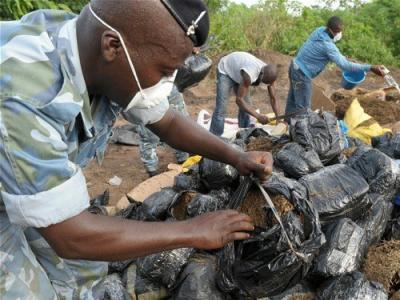
When a high U.S. government official says Africa is “the new frontier,” it’s time for everyone that cares about the continent to watch out, because something really dangerous is afoot. A top guy in the D.E.A. recently described Africa as the “new frontier” where Washington hopes to embed commando-style teams of specially vetted police for an American-run war on drugs, similar to U.S. operations in El Salvador, Guatemala, Panama, and the Dominican Republic. And we all know how those U.S. so-called anti-drug operations turned out. We should add to the list Colombia and Afghanistan, the world capitals of cocaine and heroin, respectively.
According to mythology, everything King Midas touched turned to gold. It appears the United States has the Narcotics Touch; everything the Americans touch turns to dope. American allies in the developing world quickly become narco-states.
The pattern has not changed in 60 years, since the Italian and French mafias were rewarded with international drug franchises in return for their assistance against socialists and communists. Southeast Asia’s Golden Triangle became the center of the global heroin trade during the Vietnam War – a project of the CIA. When the U.S. shifted its focus to suppressing leftist movements in Latin America, cocaine became the region’s biggest export. The United States has never waged war against drugs – quite the opposite. Washington rewards its political friends with drug franchises and monopolies, in return for service to American corporate interests. That’s why most of America’s friends in the developing world are criminal regimes.
The U.S. Drug Enforcement Administration is most proud of its work in Honduras, where a U.S.-backed coup overthrew a mildly leftist government during President Obama’s first year in office. The Americans now roam the country like they own it, in joint operations with the same soldiers and national police that continue to kill and brutalize peasant, student and worker organizations. The joint drug operations, which have succeeded in killing at least four innocent Mosquito Indians, including two pregnant women, will undoubtedly result in a march larger drug trade under the tight control of the military, police and wealthy landowners allied with the Americans. That’s how the American Narco Touch works. The endless phony War on Drugs is a tool of U.S. policy, designed to subvert foreign governments and societies. The drug trade never gets smaller.
Now it’s Africa’s turn. Washington has its eyes on Liberia and Ghana, where it plans to train elite police units after first “vetting” their personnel – a euphemism for making sure that the commandos are willing to act as de facto U.S. operatives. You can be sure that Liberia and Ghana will soon emerge as hubs of the African drug trade – just as happened in Colombia and elsewhere in Latin America. With Washington’s “vetted” operatives in charge of the African drug networks, the U.S. will vastly increase its ability to buy influence among the greedy classes all across the continent, both in and out of uniform. Just as in Colombia and Honduras and Panama and Guatemala, the Drug Wars become indistinguishable from the War on Terror, which used to be called the War on Communism. It’s really a war against the poor.
Yesterday, Ban Fracking Barry County announced a new committee, Citizens Against Drilling on Public Land (CADPL), has formed to unite citizens and groups throughout Michigan against the auction of public land for oil and gas development.
Although the committee is against fracking, its sole purpose is to oppose these biannual DNR auctions, and as such can appeal to a larger number of groups that do not deal directly with fracking. The committee is using two strategies to confront the DNR – first, to get lots of signatures on the attached petition to deliver to the DNR in person.
Second, to get organizations to sign on as a part of this “coalition,” and then present a list of organizations that oppose the auction to the DNR. Something that is not commonly known (and of course, not well advertised) is that before each DNR auction, there is a meeting to confirm that the auction will happen, where public comment is allowed. The date of this meeting has not yet been announced. CADPL’s goal would be to present the list of organizations and petition signatures at that meeting.
So, what can you do?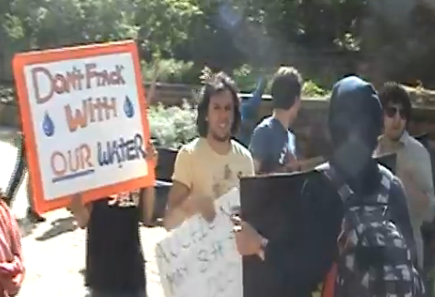
1. Get petitions signed!
You can download a petition at http://www.scribd.com/doc/100857047/Frack-Petition
2. Email cadplmich@gmail.com if you are a part of or know of any organizations that you think would sign on to our mission.
3. Write to your local papers and raise awareness about this auction! It is easy for this corruption to continue when know one knows it’s happening! Make people aware that our public state land is being sold to rich private industry for oil and gas development. Emailcadplmich@gmail.com if you need some talking points.
It was also announced today that the Michigan DNR will be holding another public auction of land on October 24 in Lansing, with potentially 125,000 acres going up for auction.
It is not known at this point if another protest will be organized like the one in May, but we will keep you posted on any new developments or meetings to determine additional strategies.
New Study Looks at Youtube & News
This information is re-posted from the Project for Excellence in Journalism.
On March 11, 2011, an earthquake registering 9.0 on the Richter scale struck the coast of northeastern Japan, triggering a tsunami that would kill more than 18,000 people and leave an estimated $180 billion in damage. The news media worldwide provided extensive coverage of the disaster and its aftermath, but millions of people also turned to the web to learn about the event on the video sharing website YouTube. [1]
In the seven days following the disaster (March 11-18), the 20 most viewed news-related videos on YouTube all focused on the tragedy-and were viewed more than 96 million times.
What people saw in these videos also represented a new kind of visual journalism. Most of that footage was recorded by citizen eyewitnesses who found themselves caught in the tragedy. Some of that video was posted by the citizens themselves. Most of this citizen-footage, however, was posted by news organizations incorporating user-generated content into their news offerings. The most watched video of all was shot by what appeared to be fixed closed-circuit surveillance camera at the Sendai airport.
The disaster in Japan was hardly a unique case. Worldwide YouTube is becoming a major platform for viewing news. In 2011 and early 2012, the most searched term of the month on YouTube was a news related event five out of 15 months, according to the company’s internal data.
What is the nature of news on YouTube? What types of events “go viral” and attract the most viewers? How does this agenda differ from that of the traditional news media? Do the most popular videos on YouTube tend to be videos produced by professional news organizations, by citizens or by political interest groups or governments? How long does people’s attention seem to last?
The Pew Research Center’s Project for Excellence in Journalism examined 15 months’ worth of the most popular news videos on the site (January 2011 to March 2012)[2]-some 260 different videos in all-by identifying and tracking the five most-viewed videos each week located in the “news & politics” channel of YouTube, analyzing the nature of the video, the topics that were viewed most often, who produced them and who posted them.[3]
The data reveal that a complex, symbiotic relationship has developed between citizens and news organizations on YouTube, a relationship that comes close to the continuous journalistic “dialogue” many observers predicted would become the new journalism online. Citizens are creating their own videos about news and posting them. They are also actively sharing news videos produced by journalism professionals. And news organizations are taking advantage of citizen content and incorporating it into their journalism. Consumers, in turn, seem to be embracing the interplay in what they watch and share, creating a new kind of television news.
At the same time, clear ethical standards have not developed on how to attribute the video content moving through the synergistic sharing loop. Even though YouTube offers guidelines on how to attribute content, it’s clear that not everyone follows them, and certain scenarios fall outside those covered by the guidelines. News organizations sometimes post content that was apparently captured by citizen eyewitnesses without any clear attribution as to the original producer. Citizens are posting copyrighted material without permission. And the creator of some material cannot be identified. All this creates the potential for news to be manufactured, or even falsified, without giving audiences much ability to know who produced it or how to verify it.
Among the key findings of this study:
- The most popular news videos tended to depict natural disasters or political upheaval-usually featuring intense visuals. With a majority of YouTube traffic (70%) outside the U.S., the three most popular storylines worldwide over the 15-month period were non-U.S. events. The Japanese earthquake and tsunami was No. 1 (and accounted for 5% of all the 260 videos), followed by elections in Russia (5%) and unrest in the Middle East (4%).
- News events are inherently more ephemeral than other kinds of information, but at any given moment news can outpace even the biggest entertainment videos. In 2011, news events were the most searched term on YouTube four months out of 12, according to YouTube’s internal data: the Japanese Earthquake, the killing of Osama bin Laden, a fatal motorcycle accident, and news of a homeless man who spoke with what those producing the video called a “god-given gift of voice.” Yet over time certain entertainment videos can have a cumulative appeal that will give them higher viewership.
- Citizens play a substantial role in supplying and producing footage. Morethan a third of the most watched videos (39%) were clearly identified as coming from citizens. Another 51% bore the logo of a news organization, though some of that footage, too, appeared to have been originally shot by users rather than journalists. (5% came from corporate and political groups, and the origin of another 5% was not identified.)
- Citizens are also responsible for posting a good deal of the videos originally produced by news outlets. Fully 39% of the news pieces originally produced by a news organization were posted by users. (The rest of the most popular news videos of the last 15 months, 61%, were posted by the same news organizations that produced the reports.) As with other social media, this has multiple implications for news outlets. Audiences on YouTube are reshaping the news agenda, but they are also offering more exposure to the content of traditional news outlets.
- The most popular news videos are a mix of edited and raw footage. Some pundits of the digital revolution predicted that the public, free to choose, would prefer to see video that was unmediated by the press. The most viewed news videos on YouTube, however, come in various forms. More than half of the most-viewed videos, 58%, involved footage that had been edited, but a sizable percentage, 42%, was raw footage. This mix of raw and edited video, moreover, held true across content coming from news organizations and that produced by citizens. Of videos produced by news organizations, 65% were edited, but so were 39% of what came from citizens.
- Personalities are not a main driver of the top news videos. No one individual was featured in even 5% of the most popular videos studied here-and fully 65% did not feature any individual at all. Within the small segment of popular videos that are focused on people, President Barack Obama was the most popular figure (featured in 4% of the top videos worldwide). These ranged from speeches posted in their entirety to satirical ads produced by his political opponents.
- Unlike in traditional TV news, the lengths of the most popular news videos on YouTube vary greatly. The median length of the most popular news videos was 2 minutes and 1 second, which is longer than the median length of a story package on local TV news (41 seconds) but shorter than the median length on national network evening newscasts (2 minutes and 23 seconds). But the variation in the length of the YouTube videos stands out even more. While traditional news tends to follow strict formulas for length, the most popular news videos on YouTube were fairly evenly distributed-from under a minute (29%), one to two minutes (21%), two to five minutes (33%) and longer than five (18%).[4]
The news viewership on YouTube is probably still outpaced by the audience for news on conventional television worldwide. While those top 20 tsunami videos were viewed 96 million times worldwide the week of the disaster, for instance, more people almost certainly watched on local and national television around the globe. Twenty-two million people on average watch the evening news on the three broadcast channels each night in the United States alone, and larger numbers watch local TV newscasts.
But YouTube is a place where consumers can determine the news agenda for themselves and watch the videos at their own convenience-a form of “on demand” video news. In the case of the Japanese earthquake and tsunami, audience interest continued for weeks. The disaster remained among the top-viewed news subjects for three straight weeks. Based on the most viewed videos each week listed by YouTube, it was also the biggest news story on the site for 2011.
For the news industry, the growth of YouTube and other video sharing sites represent a significant opportunity and also a challenge. News producers can use the site to grow their audience, find citizen-created videos, build their brand and generate revenue. At the same time, video-sharing sites are yet another platform they must understand-and to which they must adapt. For its part, YouTube (owned by Google) is developing partnerships with news organizations, including with the news service Reuters, in which the site provides Reuters with money to produce content unique to YouTube. But Company executives say they have no intention of getting into content creation, or moving into the news business. “YouTube is acting as a catalyst for the creation of new original content, by providing funds to content producers as advances against ad revenue,” YouTube’s News Manager Olivia Ma explains.[5] By whatever description, however, YouTube is becoming an important platform by which people acquire news.
Seven years after it was developed by three former employees of PayPal, the reach of YouTube is enormous. The video sharing site is now the third most visited destination online, behind only Google (which owns YouTube) and Facebook, based on data compiled by Netcraft, a British research service. According to the company’s own statistics, more than 72 hours of video are uploaded to YouTube every minute. The site gets over 4 billion video views a day. Slightly under a third of those, 30%, come from the United States.
YouTube has also become a part of the lives of most Americans. Fully 71% of adults have used sites like YouTube or Vimeo at some time, according to a 2011 survey by the Pew Research Center’s Internet & American Life Project. That is up from 66% in 2010. And 28% visit them daily.

Bought by Google in 2006 for $1.65 billion in stock, YouTube has moved from being a repository of videos to becoming a force that is investing in content creation (if not doing the creation themselves). In 2007, the company created a Partner Program, which shares revenues with content creators in order to encourage the production of more creative content. That program now has more than 1 million partners in 27 countries, including news organizations such as CBS, the BBC and National Geographic. In addition, the company has given direct grants to a smaller group of news content producers as a further way of promoting new ideas and production models.
So far, the approach from news organizations has been a blend of participation and resistance. Many news outlets have developed their own YouTube channels and are avidly posting content. The Associated Press, for example, created its channel in 2006 and now boasts more than 250,000 followers and more than a billion views of its videos. (A user becomes a follower of a YouTube channel by hitting the ‘subscribe’ button, which places updates from that channel on the user’s homepage.) The New York Times’ news channel has more than 78,000 followers while Russia Today has more than 280,000. Some news services, such as ABC News, put on YouTube many of the same stories that appear on their television channel.
Other news organizations have chosen a more cautious approach, including taking steps to keep content off the platform. One method for this is through a service offered within YouTube’s Content ID software. Partners of this program can send any of their copyrighted material to YouTube and have it blocked if it gets posted. (The Content ID program, with more than 3,000 members, also has other features companies can take part in such as revenue sharing.) [6]
Some content producers have combined both approaches, posting their own content but also blocking it from being viewed in certain countries. They may choose to do this for copyright preferences or to prevent certain content from being viewed in countries that might consider it culturally insensitive.
Some non-news organizations, including governments, have also attempted to restrict the availability of their content on YouTube, mostly for political reasons. In March 2009, for example, the government of Bangladesh blocked access to the site entirely after a recording of a private meeting between the Prime Minister and army officers was uploaded.The incident occurred two days after an attempted mutiny by border guards left more than 70 people dead. Government officials insisted it was in the country’s “national interest” to block the site and more videos might worsen the tense situation. China, Libya, Pakistan and Iran have also all attempted at one point or another to block YouTube content.
The evolving government and media policies toward YouTube make understanding the nature of what news content is on the site and which is most popular all the more important.
Footnotes
[1] According to the Project’s News Coverage Index, which measures the news agenda of the mainstream media, 57% of the newshole on radio, television, online and in print was devoted to the event the first week it happened. The NCI measures the content of more than 50 news outlets. Newshole is the time on cable, network and radio and space on newspaper front pages and in the top five stories on news websites
[2] PEJ tracked 295 news videos on YouTube during the 15-month period. However, 35 videos were removed from the site for a variety of reasons before the examination was completed, resulting in the overall sample of 260 videos.
[3] As with many settings on YouTube and other social networks, it is up to the person posting the video to choose the categoriztion or channel where each post will appear on the site. This study examines the most popular videos in the “news & politics” category of YouTube. What one person might categorize as “news and politics” another person might label as “science and entertainment” or “tech.” YouTube does not do any reclassifying on its own. One story not categorized as news was Kony2012, which called for action against Ugandan warlord Joseph Kony. The video was posted in March 2012 and viewed more than 76 million times on YouTube in 10 days. But since it was labeled as “nonprofits & activism” it did not appear in the YouTube News and Politics channel and therefore is not part of the analysis. (Click here for a detailed report by the Pew Research Center about the attention surrounding the Kony2012 video.)
[4] In comparison, the vast majority (76%) of packages on national network news were between 2 and 5 minutes. Less than 1% were longer than 5 minutes and 5% were under a minute.
[5] PEJ email correspondence, 6/28/2012.
US Poverty Rate Reaching 50-Year High
This article is re-posted from Common Dreams. Editor’s note: We have noted the high levels of poverty in the Grand Rapids area in general and children living in poverty. However, the issue of poverty is often overlooked and comparatively gets very little coverage to all the news about the “new development” in Grand Rapids.
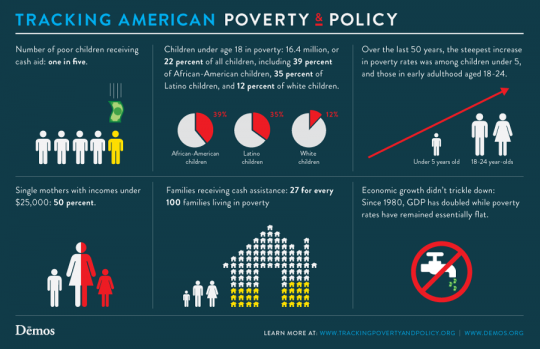
Poverty in the U.S. is on track to be at its highest level in 50 years, according to analysis collected by the Associated Press. Meanwhile, social safety nets are being pulled out from under those in need, leaving them in a spiral downward with little hope of escape.
The consensus of the more than dozen economists and think tanks the AP surveyed, both left- and right-leaning, was that the poverty level — 15.1 percent in 2010 — would reach as high as 15.7 percent for 2011. Even the 2010 figures represent a record breaking number. The Census Bureau states that “the number of people in poverty in 2010 (46.2 million) is the largest number in the 52 years for which poverty estimates have been published.”
A mere tenth of a percent increase to 15.2 percent would make the poverty level match 1983’s rate, which was the highest since1965, AP reports.
Economist Dean Baker of the Center for Economic and Policy Research says that “a rise in the poverty rate is the entirely predictable result of a high unemployment rate and cutbacks in various forms of government support” and sees little chance of a change in course.
“The real tragedy is that this economic collapse was totally preventable before the fact and it could be quickly overcome even now with the right policies. However, in both cases there is not the political will. The interest groups that dominate U.S. politics are just fine with the current situation,” Baker stated.
The safety net allowing some to scrape by are at risk, with unemployment insurance, food stamps and welfare getting cut. But Peter Edelman, director of the Georgetown Center on Poverty, Inequality and Public Policy, tells the AP, “The issues aren’t just with public benefits. We have some deep problems in the economy.”
Edelman, author of So Rich, So Poor: Why It’s So Hard to End Poverty in America, also highlighted the problem of low-wage jobs affecting poverty when he spoke to Bill Moyers in June. “[W]hat I’m worried about is the longer term continuance of this plethora of low-wage jobs. “Of the inability of people at the bottom, and not just the poor, I’m talking about the whole lower half. The way the median wage absolutely stagnated beginning 1973. The economy grew over the last 40 years basically doubled in size. And the entire lower half got none of that. The median wage went up 7 percent in 40 years. A fifth of a percent a year,” Edelman said during his interview with Moyers.
Graphic from Demos on poverty in the U.S.:
Gushing over fracking ignores climate crisis
This article by Neil deMause is re-posted from Fairness & Accuracy in Reporting.
One of the difficulties of reporting on climate change is its incremental nature: It’s hard to expect every media mention of someone driving a car or running an air conditioner to include a note about its effects on the environment. Yet even when the climate impacts of an action are unambiguous and central to a story, reporters all too often avoid the subject.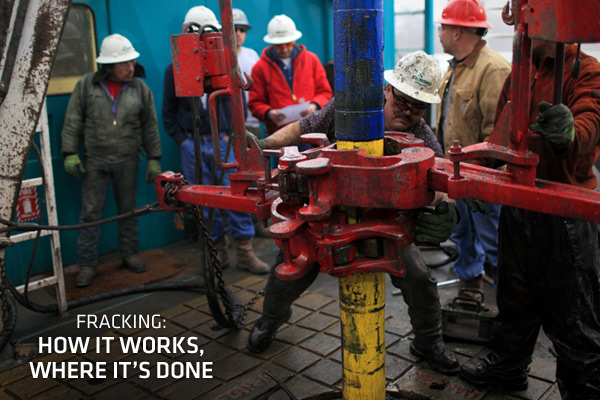
Take the natural-gas extraction technique of hydraulic fracturing (Extra!, 2/12). Better known as “fracking,” the process involves cracking open underground rock layers containing oil and gas deposits by blasting them with a high-pressure chemical slurry. Of the many troubling side effects of fracking—which run from groundwater contamination to increased earthquake activity—one of the most worrisome is its impact on climate change.
Any drilling for fossil fuels means more carbon will eventually be released into the atmosphere, but fracking’s effect on climate is compounded by the fact that the drilling process can create huge methane leaks: A study by Cornell scientists Robert Howarth and Anthony Ingraffea estimated that fracked wells leak 40 to 60 percent more methane than conventional wells (Scientific American, 1/20/12). Because methane is 20 times as potent a greenhouse gas as carbon dioxide, the National Center for Atmos-pheric Research has estimated that at these levels of leakage, switching from oil to natural gas consumption would significantly worsen global warming over the next several decades (Climate Progress, 9/9/11).
Outside of scientific and environmental media, however, you’d be hard-pressed to find any discussion of the climate change risk in fracking coverage, much of which has instead followed the fossil fuel industry’s line that the technique is the first step to a future of cheap energy.
In an article on the spread of fracking to Europe and China, for example, Time magazine (5/21/12) cited the International Energy Agency as predicting that “the world could be entering a golden age of gas, in which inexpensive natural gas replaces coal as the electricity source of choice.” Aside from a brief mention of concerns over groundwater contamination by the chemicals used in fracking—listed as one of the “obstacles” to more widespread adoption of the technology—no downsides were noted, while increased mining of natural gas was discussed as a way for smaller countries to become energy-independent of oil-rich nations. “Fracking,” concluded Time’s Bryan Walsh, “is here to stay.”
USA Today (5/15/12) was even more optimistic about a fracked future, running a front-page story headlined “U.S. Energy Independence Is No Longer Just a Pipe Dream,” that raved about the glorious future that will result from fracked natural gas. The advent of fracking in Williamsport, Pennsylvania, the paper reported, has transformed a “once-sleepy chunk of north-central Pennsylvania” into the star of “an emerging national energy rush,” with companies rushing to move to town and new hotels in the works. The paper went on to list what it called “an improbable-sounding litany of good things” that could result from fracked wells—from falling gas prices to independence from foreign oil to an economic boom that would (according to one report) create 3.6 million new jobs—but failed to mention a single environmental concern.
Meanwhile, an enthusiastic ABC World News report (5/10/12) on “new drilling techniques [that] find oil in your backyard” avoided even saying the name hydraulic fracturing (though a longer Web report did). Instead, correspondent Sharyn Alfonsi interviewed Kansas farmers whose oil royalties “could be” as much as $500,000 a month. At the end of the segment, Alfonsi displayed a map of frackable sites, gushing that there could be “2 trillion barrels of oil in our backyards.” To which Diane Sawyer replied: “Hope it’s in your backyard!”—and then urged viewers to consult a map on the ABC News website to see if fracking riches could be theirs, too.
Reports like these faithfully echo the talking points of the fossil fuel industry: The American Petroleum Institute’s fracking page states confidently, “Shale energy is the answer. It creates jobs, stimulates the economy and provides a secure energy future for America.”
Other media outlets have been more cautious about proclaiming a glorious fracking future: The Associated Press (5/20/12) noted that while some New York farmers look longingly at the lucrative drilling leases that have gone to their neighbors in fracking-friendly Pennsylvania, others worry about well-water contamination and the destruction of farmland for mining roads and pipelines. But even lengthy series on the fracking controversy, such as the New York Times’ ongoing “Drilling Down” (starting 2/26/11) and NPR’s “The Fracking Boom: Missing Answers” (5/14–17/12), have focused solely on the problems of groundwater and air pollution without touching on climate questions.
One rare exception was an NPR Morning Edition story (5/17/12) by Elizabeth Shogren that followed a National Oceanic and Atmospheric Administration scientist who discovered a huge plume of methane north of Denver, ultimately tracing it to new fracking wells in northeastern Colorado. “We need to know a lot about methane itself, which is natural gas, if we’re worried about climate change,” energy consultant Sue Tierney told Shogren. “Fifty years from now, are we really going to be wondering if we really screwed up because we went on this big gas boom?” It’s a question that the media should be asking now, not half a century on.
The local food justice group Our Kitchen Table will be hosting a workshop on how to can dill pickles this Saturday.
Part of OKT’s mission is to provide people with the skills necessary to become more food independent and create greater food sovereignty in the Greater Grand Rapids area.
People can bring jars and ingredients if they want to this Saturday. The ingredients that will be used are pickling cucumbers, distilled vinegar, salt, peppercorns, fresh dill and fresh garlic.
Pickle canning workshop
Saturday, July 28
2 – 4pm
Madison Square CRC
1441 Madison SE, Grand Rapids
For more information on this event or other OKT projects and resources, call 616-570-0218.
Arab Spring, Libyan Winter: Interview with Vijay Prashad
This video is re-posted from ZNet.
Vijay Prashad discusses with Newsclick how the US and its allies have struck back against the mass movements that overthrew Ben Ali and Mubarak. This is what he terms as the Libyan Winter. He analyses the forces that the US and its allies are putting together and the danger to the region from these forces.
Prashad is the author of the recently released book Arab Spring, Libyan Winter, published by AK Press.
Why don’t we just talk about the weather……
It is a late Saturday afternoon in July as I compose another column for Recoil. The most obvious and most pressing issue to write about seems to be the weather.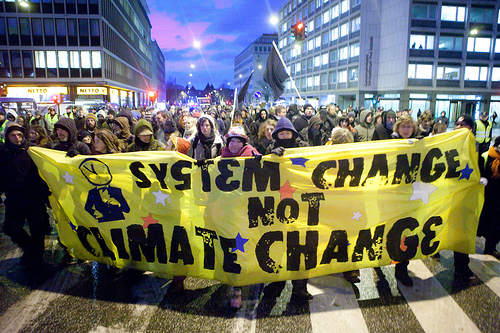
So far, there have been multiple days of record-breaking temperatures in Michigan and across the country, along with extreme lows in precipitation. Trees in my backyard are losing leaves and everywhere I look yards are brown.
The heat has been so oppressive that it is frequently the first thing people talk about, even in very casual settings. To date MLive has run a few stories about the record temperatures, but only one story that “asked” the question of whether or not the most recent heat wave is related to climate change.
I’m not going to waste writing about the need to respond to the oil-industry funded global warming denial sectors in the US, other than to say that it is absurd that much of the US news media still provides equal time/print space to those who claim that human activity has not contributed to climate change. Even in Grand Rapids we have meteorologists who deny there is any evidence that global warming is even an issue.
Instead, I want to address people who have come to terms with the fact that climate change is real and might be the most urgent issue of this generation. Still, it is not an easy topic to address. First, because it often feels quite overwhelming and secondly, most of us don’t haven’t really felt the direct effects of global warming both because of our privileges in the world and our location.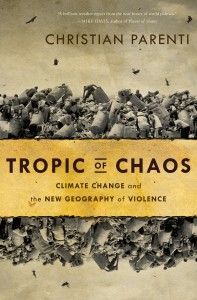
However, there are millions of people who are suffering the direct effects of global warming right now around the world. One well-researched book worth reading that sheds light on this fact is Christian Parenti’s, Tropic of Chaos: Climate Change and the New Geography of Violence. Parenti documents how global warming has caused massive displacement, drought, unstable weather patterns, food & water shortages and has even forced the US military to develop strategic planning scenarios for the future when more people will be scrambling for a declining amount of livable space.
Since we have the privilege of not enduring these hardships brought about because of climate change, we have the opportunity and responsibility to do something about it.
Ever since the Intergovernmental Panel on Climate Change report in 2007, the consensus amongst the scientific and environmental community was that the world needed to reduce current carbon emission levels 80% by 2050. This means we have less than 4 decades to reduce current carbon emission levels by 80% or we will have gone past the point of no return. Serious stuff.
Unfortunately, what many environmentalists and green capitalists have done since then is to convince us to buy electric cars and put florescent light bulbs in our homes, which will do virtually nothing to reduce the level of carbon emissions necessary for future survival. Now, I’m not saying people can’t make lifestyle changes, which would be wise even if we weren’t at a critical stage in history, but lets be honest and acknowledge that carbon emissions are primarily produced from institutional entities and systems.
Climate activists are well aware of the fact that industrial manufacturing, agribusiness, fossil fuel driven transportation and militarism are the four main generators of carbon emissions. Each of these systems perpetually engage in practices that by their very nature are ecologically destructive and impact global warming. Whether it is clear-cutting forests for crops, paving over soil for roads, using coal-powered electricity to manufacture products or the consumption of millions of gallons of oil daily to power the US military alone, these are the real culprits that need to be drastically altered or dismantled if we are serious about the 80% reduction by 2050. In fact, each of these institutions could be radically altered if we abolished the system of capitalism.
Of course, there is no easy plan of action and no 10 simple things you can do to save the planet blueprints here. However, the first task would be to recognize that these are the things that cause the most damage and therefore that is where we should put our energies.
Some easy targets for action would be to stop the extraction and burning of fossil fuels, which means no more pumping and exploring for oil, no more mining of coal and no more extracting of natural gas, particularly through the method known as fracking.
A great deal more could be said about what needs to be done and how we do it, but this is a conversation that should be had in the company of other people who also want to seriously and honestly take action to respect life on this planet. Hell, who knows, it might even be fun and rewarding. A good place to start in Grand Rapids would be with the group Mutual Aid GR, which is hosting an Action Meeting on August 8 at John Ball Park.
No Compromise in defense of Mother Earth!
Yesterday, MLive ran a short article about an upcoming Youth Summit being held at Aquinas College in Grand Rapids.
The article states that the focus of the summit is on the “Great Lakes Water Resources,” and that the student participants will, “examine the many competing demands for Great Lakes waters and create sustainable solutions for the future health and vitality of this precious natural resource.”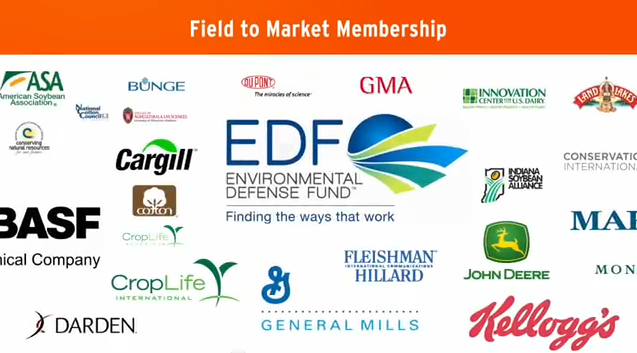
The Youth Summit is being put on by a group known as, The Keystone Center, which the MLive article provides a hyperlink to. However, the MLive reporter offers no description of The Keystone Center only to say that it brings together public and private partners.
The Keystone Center is dominated by corporations on both their board and on every advisory members group they have for each area of their work. For instance, the Field to Market project is centered around agriculture, but is dominated by corporations such as Cargill, Monsanto, Bayer CropScience, DuPont and Coca Cola.
The Keystone Center has a Biotechnology Advisory Board, a Green Products Roundtable and a Surface Mining in Appalachia project. Their Energy program is also stocked with corporate board members, from such eco-friendly entities such as Shell, Pacific Gas & Electric Company, Duke Energy Corporation, the American Petroleum Institute (lobbying group for big oil) and the Nuclear Energy Institute (lobbying wing of the nuclear industry).
The list of board members for all of their projects don’t exactly inspire tremendous environmental optimism. When looking at the organizations sponsoring the Youth Policy Summits, it is like a who’s who of anti-environmental corporations. This list includes The Altria Group (formerly Phillip Morris), the American Coalition for Clean Coal Electricity, Coca Cola, Cargill, ConAgra, Dow Chemical, DTE Energy, GM, Merck, Shell, Verizon and WalMart.
One can only imagine the kind of information that students will get at the Youth Summit. It seems clear that The Keystone Center is nothing more than a front group for corporate America, with a mission to influence young minds on how “Green” the member corporations are.
As we have reported in previous months, the DeVos family continues to be a major financial funder in the 2012 elections.

According to the most recent data from the Center for Responsive Politics, the DeVos family has contributed collectively just over a half a million dollars so far in the 2012 election cycle – $571,000. However, it is important to note that this is just the amount they have collectively contributed from the 49503 zip code and we all know that most of them have multiple homes in multiple locations.
Here is a breakdown of the DeVos Family 2012 Election cycle contributions:
Dan DeVos $87,800
Richard DeVos $85,900
Dick DeVos $71,800
Betsy DeVos $70,800
Pam DeVos $68,300
Helen DeVos $62,900
Doug DeVos $62,800
Maria DeVos $58,300
Rick DeVos $2,500
The DeVos family members have also used a variety of titles and affiliations when making contributions such as Amway, Alticor, The Windquest Group, RDV Corp, The Orlando Magic, DP Fox Venture, Self-Employed and my favorite…….homemaker. Betsy DeVos actually referred to herself as a homemaker.
By posting this information on how much money the DeVos family has contributed to the 2012 election cycle is not just to make a point about their desire to influence the outcome of the elections, it is also to acknowledge that this is just one tactic they use to influence economic and political policy.
The DeVos family has inserted themselves in many other capacities in order to influence and benefit from political and economic policy, such as owning prime property in downtown Grand Rapids, owning sports teams, funding cultural events, sitting on the board of the Right Place, being part of the Econ Club of Grand Rapids, the One Kent Coalition, the West Michigan Policy Forum, Grand Action and the Regional Air Alliance of West Michigan.
This of course is not an exhaustive list of where DeVos family members or their money is involved, but it does remind us of how much power they wield in West Michigan and why that power must be challenged.
 Grand Rapids Institute for Information Democracy