Yesterday, MLive ran a brief article with comments from some local Venezuelans on the recent election in their country.
In the MLive article we hear from three Venezuelans, all of which reflect disappoint in the re-election of Hugo Chavez. One of those interviewed for the story, Maria Morin, said the following about the Chavez government:
Society is getting used to depending on the state. That promotes paternalism and nepotism, and people are not becoming financially independent, which I think is what should happen.
Morin also believes that the “educated” people in the country will grow tired of the paternalism and leave Venezuela.
The only contextual information provided by the MLive reporter spoke about how long Chavez has been President and that he, “has remained popular over the years because of his vast social programs funded by Venezuela’s oil wealth.”
While there is some truth to this comment, it comes nowhere near to reflecting what is happening on the ground in Venezuela. One thing the Chavez government has done since 1999, has been to give more autonomy to local communities. The giving of power to local communities is described in detail in a recent book entitled, Venezuela Speaks: Voices from the Grassroots.
Another major omission from the MLive story was the failure to even mention what the US government has been doing to undermine the Chavez government since, beginning with the attempted coup in 2002 that is well documented in the film, The Revolution Will Not Be Televised.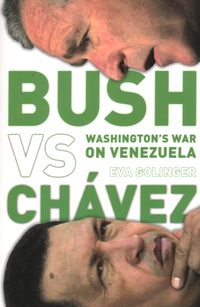
Since the 2002 attempted coup by the US, there have been other means by which the Bush and Obama administrations have sought to undermine the Venezuelan government. This campaign is best described in Eva Golinger’s book, Bush vs Chavez: Washington’s War on Venezuela.
Golinger reveals that Venezuela’s revolutionary process has drawn more than simply the ire of Washington. It has precipitated an ongoing campaign to contain and cripple the democratically elected government of Latin America’s leading oil power. Bush Versus Chávez details how millions of U.S. taxpayer dollars are used to fund groups such as the National Endowment for Democracy, the United States Agency for International Development, and the Office for Transition with the express purpose to support counter-revolutionary groups in Venezuela. It describes how Washington is attempting to impose endless sanctions, justified by fabricated evidence, to cause economic distress. And it illuminates the build-up of U.S. military troops, operations, and exercises in the Caribbean, that specifically threaten the Venezuelan people and government.
The MLive article potentially leaves readers with the impression that the Chavez government is bad for Venezuelans and that the only hope for the country will be the next election that could deposed the current President. It’s not only lazy journalism, it misleads people on a critical point of US foreign policy.
For those wanting solid ongoing analysis of what is taking place in Venezuela, we recommend the site http://venezuelanalysis.com/. There is also this informative interview with Venezuelan Analysis founder Gregory Wilpert on the Real News Network.
Pinkwashing Fracking?
This article by Steve Horn is re-posted from CounterPunch.
The Wizard of Oz was spot on when he said to “Pay no attention to the man behind the curtain.” That’s good life advice if you fall into the “Ignorance is bliss” camp. For a journalist though, it’s doing the exact opposite that’s a sin qua non for the job.
Kevin Begos of the Associated Press took the Wizard’s advice to heart in his July 22 story titled, “Experts: Some fracking critics use bad science.”
Citing “Gasland” director Josh Fox’s viral video “The Sky is Pink” as an example, Begos wrote, “Opponents of fracking say breast cancer rates have spiked exactly where intensive drilling is taking place — and nowhere else in the state…But researchers haven’t seen a spike in breast cancer rates in the area.”
As his main source of expertise on the breast cancer issue, Begos turned to Chandini Portteus, Susan G. Komen for the Cure Foundation’s Vice President of Research, Evaluation, and Scientific Programs. Of the connection between fracking and breast cancer she stated, “what we do know is a little bit, and what we don’t know is a lot.”
Sara Jerving of the Center for Media and Democracy came to diametrically different conclusions in her April 2012 probe for PR Watch, writing,
Benzene, which the U.S. EPA has classified as a Group A, human carcinogen, is released in the fracking process through air pollution and in the water contaminated by the drilling process. The Institute of Medicine released a report in December 2011 that links breast cancer to exposure to benzene.
Up to thirty-seven percent of chemicals in fracking fluids have been identified as endocrine-disruptors — chemicals that have potential adverse developmental and reproductive effects. According to the U.S. EPA, exposure to these types of chemicals has also been implicated in breast cancer.
Jerving also cites the piece of evidence that Fox used to tie fracking to breast cancer in “The Sky is Pink,” explaining, “In the six counties in Texas which have seen the most concentrated gas drilling, breast cancer rates have risen significantly, while over the same period the rates for this kind of cancer have declined elsewhere in the state.”
Who, then, are the “men behind Komen’s curtain”?
Many environmental activists are familiar with the “greenwashing” concept. Fewer, though, are familiar with “pinkwashing,” best documented by the book Pink Ribbons, Inc.: Breast Cancer and the Politics of Philanthropy by Samantha King. It’s a concept fully on display with regards to the ties that bind Komen to the shale gas industry.
Komen’s Ties to the Halliburton Loophole
Behind curtain one is Jane Abraham, named to the Komen Board of Directors in May 2012. She’s the “wife of former [U.S.] Senator and U.S. Secretary of Energy Spencer Abraham,” according to Komen’s website.
Upon leaving his posts as a Senator and Energy Secretary under the George W. Bush Administration, Spencer fled straight for the Board of Directors of Occidential Petroleum, where he still sits on the Board today. Occidential has fracking operations set up in both California– and North Dakota-based shale basins.
He also is one of the Principals of The Abraham Group, LLC, a consulting firm which, among other things, advises oil and gas industry clientele, headed by his wife Jane.
Spencer Abraham was the Bush Administration’s Secretary of Energy when Vice President Dick Cheney oversaw the Energy Task Force. The Task Force was composed of Cheney, as well as the Secretaries of State, Treasury, Interior, Agriculture, Commerce, Transportation and Energy. It was instrumental in facilitating private meetings between oil and gas executives and upper-level Bush Administration Cabinet members.
In the fracking sphere, one of the crucial outcomes of the Task Force’s meetings was the “Halliburton Loophole.” This clause located within the Energy Policy Act of 2005 allows chemicals found in “fracking fluid” to be deemed a “trade secret,” exempting the shale gas industries from both the Clean Water Act and the Safe Drinking Water Act when they perform hydraulic fracturing for shale gas.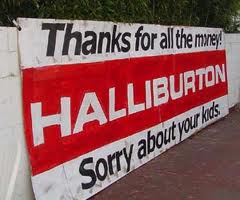
Other Komen Oil and Gas Industry Ties that Bind
Komen also maintains what it calls its “Million Dollar Council,” which receives funding from Koch Industries’ subsidiary, Georgia-Pacific, as well as General Electric (GE). Koch Industries and its many subsidiaries have a major financial stake in shale gas drilling. So too does GE.
Georgia-Pacific “produces resins used for chemicals used to prop open micro-fractures, an important process for fracking to occur,” explained Lee Fang of the Republic Report. Other Koch subsidiaries — including Koch Pipeline, Flint Hills Resources, Koch Supply & Trading and Koch Chemical Technology Group — all have a fiscal future intricately tied to shale gas production, according to Fang’s reporting.
GE, meanwhile, also describes itself as a “massive player” in shale gas production. As I wrote for AlterNet in September 2011:
GE created a device for recycling the water used during the controversial and toxic hydraulic fracturing (fracking) process. Furthermore, it maintains natural gas fueled power plants, and manufactures natural gas-powered turbines, having sold more than $1 billion worth of them in 2011 in the United States, according to Reuters. GE also recently made a deal with Russia to sell between $10 and $15 billion worth of turbines.
The Komen “Million Dollar Council” list also includes a key investor backing oil and gas industry interests, Bank of America, a corporation which boasts on its website of its investments in commodities like coal, oil and natural gas.
Furthermore one of the members of Komen’s Board of Directors, John D. Raffaelli, has spent many years working as an oil and gas industry lobbyist. Described by Komen “as one of the most effective lobbyists in Washington,” Raffaelli served as a hired gun for the American Petroleum Institute, Atlas Energy (which has since been sold to Chevron), General Electric and Edison Electric respectively between 2008-present.
Pink Ribbons, Inc.
In response to a long email query from CounterPunch to Begos questioning numerous aspects of his story, CounterPunch received a short email response from AP’s Director of Media Relations, Paul Colford stating, “The AP stands by his story.”
Fox wasn’t too thrilled with the AP story.
“It is clear to me, as it was from the first moment, that Kevin Begos was not out to give fracking critics a fair shake or look objectively at the facts,” Fox said. “He was deliberately seeking ways to try to discredit the anti-fracking movement and he was willing to twist facts and quotes to serve that purpose while disguising his work as impartial. It is worse than bad journalism, it is highly unethical, dangerous and irresponsible”
It’s unlikely Begos had a vendetta, as Fox suggests. Alternatively, by not doing his homework, Begos was likely unaware that he was serving as a stenographer for the shale gas industry’s stealthy public relations apparatus via Komen.
“Komen has, since its inception, prioritized corporate partnerships over environmental health,” King told CounterPunch. “They do so by providing companies such as General Electric, whose products and practices are linked to cancer, with a platform from which to declare a commitment to ending the disease. At the same time, Komen refuses to prioritize research on the environmental causes of breast cancer and on primary prevention — an unsurprising stance given their dependence on pinkwashing sponsors.”
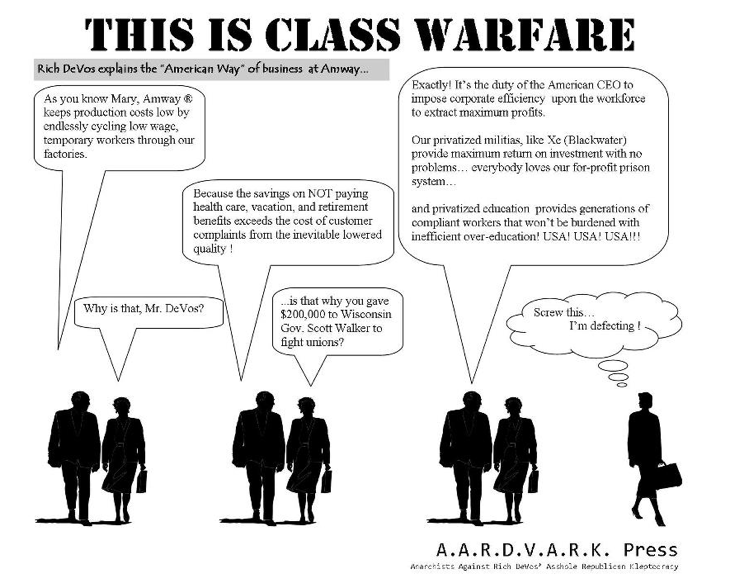
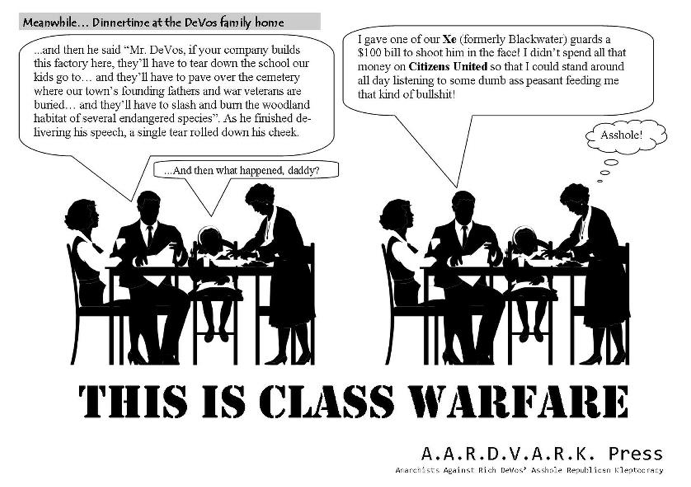
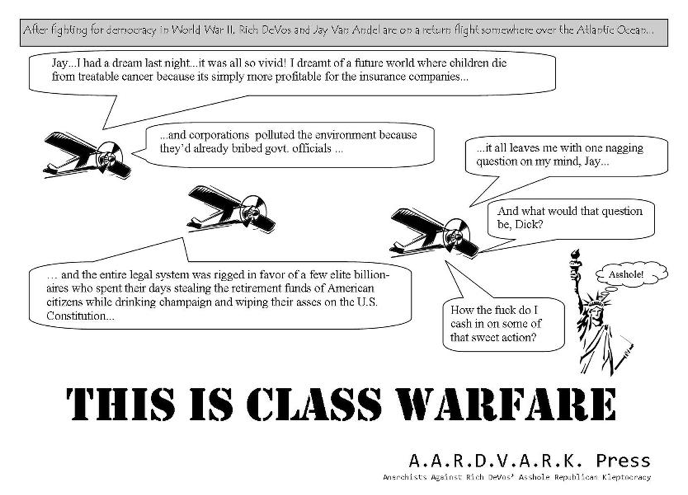
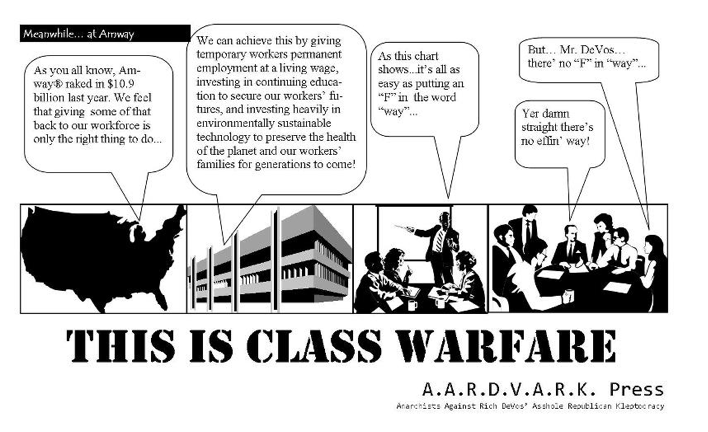
We recently received the cartoons below by someone who calls themselves a “guerilla artist” and goes by the name Thaddeus Bobo. This artist said he has been inspired by the propaganda work done during WWII and more recently the work of David Rees, who created the fabulously satirical book Get Your War On in 2001.
We asked Thaddeus Bobo a few questions about the work that is critical of the DeVos Family and Amway and have included all five of the cartoons below.
GRIID – What inspired you to create these cartoon messages about the DeVos Family?
I actually work at Amway. I see the struggles of the people on the production floor every day. I hear how their kids are struggling to get into decent colleges, how they worry about sick parents whose retirement funds has been ransacked by Wall St, how they constantly worry about where the money for the next unexpected bill is going to come from.
The fact that Rich Devos spent over $200,000USD supporting Citizens United speaks volumes about his respect for the average worker on his production floors. Supporting the anti-union activities of Wisconsin Gov. Scott Walker actively hurts working men and women and their families who are just trying to make a fair wage for their honest labor. These are people just like the ones working at Amway every single day. Many of them are too busy worrying about paying the mortgage to spend much time learning about the DeVos family’s efforts to erode the quality of life for the average middle class American. I felt that I had to do something to express my frustration, and hopefully in a creative way that got people to laugh, to think, to question things for themselves.
GRIID – Will there be other work from AARDVARK Press about the local 1%?
Yes, for sure. I think tackling a few local politicians would be on the agenda, as well as local business owners like Tommy Brann espousing extremist views in the media.
GRIID – Do you have any plans on distribution at this point?
Nothing formal at this point. I was hoping to participate in a local diy ‘zine fest this spring that a few local activists have been dreaming up. I have no experience getting published, but would absolutely love to explore that as an option.
GRIID – There are plenty of working class people who also support the DeVos family “philanthropy.” Do you think that what you are doing offers a counter-narrative to the corporate media commentary on the DeVos family and other local robber barons?
I absolutely do feel that I am pointing out some of those unspoken truths, and in a way that uses humor to shed some light on some seriously un-funny situations.
In regards to the DeVos family, there is almost a “don’t bite the hand that feeds you” mentality that I think speaks volumes about the collective insecurity about not being a “real city” that seems to be prevalent in this town. I am glad that the DeVos family built a children’s hospital in Grand Rapids, it is undeniably a great thing. Altruism isn’t really a factor in these great contributions to our city. The DeVos family, Meijer family, Steelcase, Wolverine and other benefactors gain an enormous amount of social equity, and influence as a direct result of their actions.
Additionally, that great gesture is also tempered by actions like the $500,000 dollars Doug DeVos donated to fight against gay marriage. Its common knowledge that a certain percentage of the population falls into the LGBT community, so it stands to reason that Amway’s workforce of over 5,000 people has a few hundred people that Mr. DeVos has directly insulted. These types of conflict that the DeVos family “benevolently” inflict upon us should be questioned. People should ask “who really benefits from this action?”

Top 25 Censored Stories of the Year
Every year Project Censored publishes the Top 25 Censored Stories. The top censored stories over the past year cover a variety of topics and demonstrate once again how many of the major issues of the day are either ignored or suppressed by the corporate media.
This year’s Top 25 Censored stories include articles on the growing US police state, the degrading condition of oceans, Trillions in Loans to US banks, NATO War Crimes in Libya, Education Reform as Privatization and Wachovia Bank’s role in laundering money for drug cartels in Latin America.
Between 2004 and 2007, Wachovia Bank handled funds totaling $378.4 billion for Mexican currency-exchange houses acting on behalf of drug cartels. The transactions amount to the largest violation of the Bank Secrecy Act, an anti-money-laundering law, in US history. This case is not exceptional; Wachovia is just one of several US and European banks that drug cartels have used to launder money.
Another censored story deals with how FBI agents are responsible for a majority of terrorist plots in the US.
The Federal Bureau of Investigation has embarked on an unusual approach to ensure that the United States is secure from future terrorist attacks. The agency has developed a network of nearly 15,000 spies to infiltrate various communities in an attempt to uncover terrorist plots. However, these moles are actually assisting and encouraging people to commit crimes. Many informants receive cash rewards of up to $100,000 per case.
The New York Police are planting drugs on innocent people to meet arrest quotas is yet another censored news story.
A host of stories document how the New York Police Department operates outside the very laws it is charged with enforcing. In October 2011, a former NYPD narcotics detective testified that he regularly saw police plant drugs on innocent people as a way to meet arrest quotas. The NYPD’s controversial “stop and frisk” program has invested seventy-five million dollars to arrest suspects for possessing minimal amounts of marijuana. Each arrest costs approximately $1,000 to $2,000. Although NYPD use of unlawful restraints and disproportionate force to arrest peaceful Occupy protesters has received some news coverage, police brutality directed against people of color continues to go underreported.
One last story is about HR 347, legislation, which would make many forms of non-violent protest illegal.
In March 2012, President Obama signed into law HR 347, the Federal Restricted Buildings and Grounds Improvement Act of 2011. The law specifies as criminal offenses the acts of entering or remaining in areas defined as “restricted.” Although pundits have debated to what extent the new law restricts First Amendment rights or criminalizes Occupy protests, it does make it easier for the Secret Service to overuse or misuse existing laws to arrest lawful protesters
Federal officials interrupt Enbridge’s greenwash of Kalamazoo River tar sands spill
This article by Anthony Swift is re-posted from the Natural Resources Defense Council.
Federal officials at the Environmental Protection Agency (EPA) have pulled the curtain behind Enbridge’s effort to greenwash its tar sands pipeline spill into Michigan’s Kalamazoo River. On the same day that Enbridge told its investors that its tar sands spill and cleanup had made the Kalamazoo River cleaner, EPA ordered the Canadian tar sands pipeline company to resume its cleanup of the Kalamazoo River after finding that submerged oil “exists throughout approximately 38 miles of the Kalamazoo.” EPA’s findings, based on technical analysis from prominent scientists from the international oil spill response and recovery community, stand in stark contrast with the alternate reality that Enbridge is selling to investors and the public. Enbridge’s legacy in Kalamazoo was outlined by federal investigators as a company whose poor safety practices and failures to learn from past mistakes which resulted in the most expensive onshore pipeline disaster in U.S. history. The Canadian tar sands company’s recent attempt to gloss over this reality with a public relations campaign reveals the company has yet to learn this basic truth – simply saying something doesn’t make it so.
EPA issued Enbridge with an enforcement action requiring the pipeline company to resume its two year cleanup in three sections of the Kalamazoo River. In these areas, totaling over five and a half miles of the Kalamazoo River, there is so much submerged oil that the river is spontaneously generating oil sheen and oil globules and in danger of spreading.
Even with EPA’s new order, Enbridge will still be leave oil contamination in over 32 miles of the Kalamazoo River, where officials believe that the dredging necessary to recover the oil would cause more damage than benefit. That means that after Enbridge finishes the cleanup that EPA has ordered, the company will leave tar sands in place throughout over 30 miles of the Kalamazoo River.
Enbridge’s attempt to greenwash its impact on the Kalamazoo River speaks for itself. In a presentation to investors this week, the company provided three quotes from anonymous local residents, fisherman and river enthusiasts, who gush about what Enbridge’s tar sands spill has done for the community.

Focus on Operations, Presented in Enbridge’s 14th annual investment community conference October 3, 2012
Who are these people and where do they come from? As part of our Voices Against Tar Sands, we talked to folks in Marshall, Michigan. The people we talked to have names and stories to tell. It’s worth listening to what folks like Susan Connolly and Debbie Miller have to say about what Enbridge’s tar sands spill has done to their community.
This isn’t the first time that Enbridge has opted to obscure a problem rather than address it. For instance, Enbridge’s plan to ship tar sands in super tankers through British Columbia’s sensitive inner coastal waters – a treacherous maze of tightly packed rocky islands and reefs – has generated a public uproar in the province. Enbridge’s solution? The company broadened the Douglas Channel by erasing 400 square miles of offending islands on a map which it then promoted in a public relations campaign. Even if you look closely at the supertanker on Enbridge’s map, it’s hard to tell whether its run aground on Hawkesbury Island or if it is still in Devastation Channel.

Enbridge’s version of the Douglas channel compared to a scientists version, provided by SumOfUS
During the Kalamazoo River tar sands spill, Enbridge initially denied that tar sands was spilled. As Congressional and federal investigations began to uncover additional details on the spill, Enbridge CEO Patrick Daniel backtracked, saying:
“No, I haven’t said it’s not tar sand oil. What I indicated is that it was not what we have traditionally referred to as tar sands oil. … If it is part of the same geological formation, then I bow to that expert opinion. I’m not saying, ‘No, it’s not oil sands crude.’ It’s just not traditionally defined as that and viewed as that.” Patrick Daniels, August 12, 2010
It was tar sands diluted with volatile natural gas liquid condensate, technically referred to as diluted bitumen.
And recently, a Canadian newspaper broke another Enbridge flip flop. During hearings before Canadian officials in May, Enbridge pitched the reversal of its line 9 pipeline as a means to provide conventional crude to Eastern Canada. In June, Enbridge officials responded to opposition to plans to build establish the Trailbreaker pipeline system to ship tar sands through New England, saying ‘we have been absolutely clear that the company is not pursuing the Trailbreaker Project… I’m not sure what more we can say or how clearly we can say this.” Belying Enbridge’s denials, this week a U.S. Freedom of Information Act (FOIA) request by the Natural Resources Council of Maine uncovered that the Canadian Consulate has made presentations to the governor of Maine to promote the arrival of tar sands in New England. Is it possible that Enbridge doesn’t traditionally view the Trailbreaker project the way the rest of the world does?
It’s no wonder communities in the Midwest, New England, and British Columbia are balking at Enbridge’s plans to build and expand its tar sands pipeline network through their groundwater and rivers.
What’s the value of $5,169,462?
We all know that this election cycle is the most expensive in US history. Candidates, political parties and PACs are spending money like there was no tomorrow, with nearly $1.5 billion as the estimated amount that will be spent on the Presidential Election alone, according to the Center for Responsible Politics.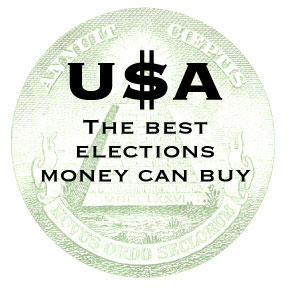
It’s hard to envision $1.5 billion, so lets bring the election money frenzy down to the state level and look at the amounts of money being spent on elections here.
In the race for the Michigan Senate seat, with incumbent Debbie Stabenow running against Republican challenger Pete Hoekstra, about $15.5 million has been raised so far. Hoekstra has raised $3,549,806, while Senator Stabenow has raised $12,061,883 in her bid to be re-elected.
Most of the money raised in larger races like these is spent on TV ads, where candidates sling mud and engage in either half-truths or out right lies in order to sway public opinion.
According to the Michigan Campaign Finance Network Senator Stabenow has already spent $5,169,462 on TV ads across the state, which includes ad buys between now and Election Day. Challenger Pete Hoekstra has spent a big fat zero on paid TV ads.
Now lets stop and think for a moment what the value of $5,169,462 might be in a city like Grand Rapids. $5,169,462 is certainly not enough to end the City of Grand Rapids financial woes, but it would be enough to re-hired dozens of workers who have lost jobs in recent years because of cut backs.
Think about the budgets of local non-profit organizations and how many could double their budgets if $5,169,462 was shared between them. How much more work could be done by groups like the Friends of Grand Rapids Parks, Bethany Refugee Services, Heartside Ministries, Baxter Community Center or the Hispanic Center of Western Michigan?
However, we could shift the conversation to re-direct the $5,169,462 directly to people who were in serious financial need for a variety of reasons. How many people could have health insurance with that money? How many people could put a down payment on a home? How many students could pay off loans with $5,169,462? The possibilities seem endless, yet when it comes to election no amount of money matters if the candidate we support gets elected. Apparently there will be a huge payoff in the end. But I ask you, when have we ever seen a huge payoff, especially for those most marginalized?
Women, Oil and Climate Change Campaign

According to American Nobel Peace laureate Jody Williams global energy policies negatively impact the lives of women and children in ways that most of us don’t even think about. Such a belief is behind the Women, Oil & Climate Change Campaign, which began yesterday, where a delegation of women will talk with other women along one of the major routes of the proposed Tar Sands Pipeline through Canada.
“Women around the world have been at the forefront of movements to reduce the impacts of climate change and build healthy, sustainable environments,” said Jody Williams, Nobel Peace Laureate (1997). “We have been aware of the growing concerns of women living in oil sands communities and we are eager to see the realities for ourselves, first-hand.”
The group started their eight-day tour of Alberta and British Columbia on October 9 and will meet with women community and First Nation leaders, as well as women government and industry officials. Delegation members—which also include Canadian singer-songwriter Sarah Harmer, award-winning Kenyan environmentalist Ikal Angelei, corporate executive Chris Page and climate scientist Marianne Douglas from University of Alberta—will listen to how energy projects are changing the lives and livelihoods of women, children and communities in western Canada, and also the actions that women and communities opposing the energy projects are taking in response.

Some Facts About Women & Climate Change
- Climate change is deepening the food crisis for women and their families. Women are the majority of the world’s small-scale farmers and produce most of the world’s food. More frequent crop failures mean women work harder and families eat less (OXFAM Canada).
- Women comprise 20 million of the 26 million people estimated to have been displaced by climate change. These discrepancies are especially strong in countries that lack gender equality (Women’s Environment Network UK).
- Climate change leads to increased illness and disease and women are the primary caregivers for the sick (OXFAM Canada).
- Women and female children spend more than 10 million ‘person-years’ carrying water from remote sources each year. In Africa alone, the World Health Organization estimates there are more than 40 billion work hours lost each year to the need to fetch drinking water (CARE Ethiopia).
Tar Sands resistance continues in Texas
This article by William Boardman is re-posted from Ecowatch.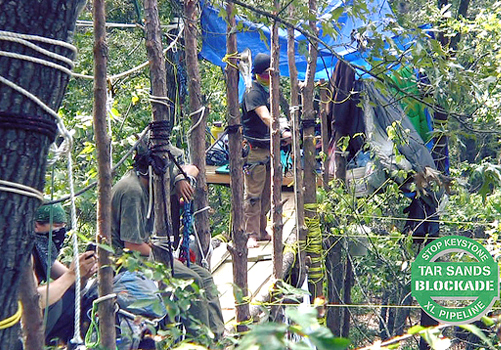
In a remote corner of northeast Texas, there are people living in trees because, they say, they’re trying to protect the planet from increased carbon emissions over the next century to help slow climate change. Challenging this treehouse blockade (see video below) is the advancing Keystone XL pipeline whose owners, the Canadian power company TransCanada, say they’re trying to save the oil industry from worsening economic conditions over the next decade.
TransCanada started building the Texas section of the XL pipeline in early August. Since then, efforts to slow construction by a coalition of landowners, environmentalists and others, calling themselves the Tar Sands Blockade, have gone from protest demonstrations and lawsuits to non-violent civil disobedience actions including an elaborate blockade of treehouses on Sept. 24 in the path of pipeline construction in Winnsboro, Texas.
Because the pipeline is intended to bring toxic tar sands crude oil, heated and under pressure, from the tar sands of Alberta, Canada to the Texas refineries of the Gulf Coast for export to foreign markets, resistance along the route through the American heartland has grown more intense over the years. And the company and the state have responded with violence, jailing, extreme bail amounts and over-charging on arrest.
“Game Over for the Climate?”
“If Canada proceeds, and we do nothing, it will be game over for the climate,” wrote James Hansen, director of the NASA Goddard Institute for Space Studies, last May in the New York Times. Hansen has been calling for measures to ward off or at least mitigate the effects of climate change since he first testified about the dangers before Congress in 1988.
He concluded his piece in the Times saying: “The science of the situation is clear—it’s time for the politics to follow. This is a plan that can unify conservatives and liberals, environmentalists and business. Every major national science academy in the world has reported that global warming is real, caused mostly by humans, and requires urgent action. The cost of acting goes far higher the longer we wait—we can’t wait any longer to avoid the worst and be judged immoral by coming generations.”
Tar sands oil is toxic from the moment it leaves the ground, leaving a devastated environment behind, wasting water in processing, destroying forests, threatening vast water tables with pipeline failures, spreading carcinogens, and finally doing far more damage than regular oil to the atmosphere and the global climate.
The oil industry, having announced plans to invest $379 billion in tar sands development, argues that it’s all benign.
Does It Take a Movie Star to Get Attention?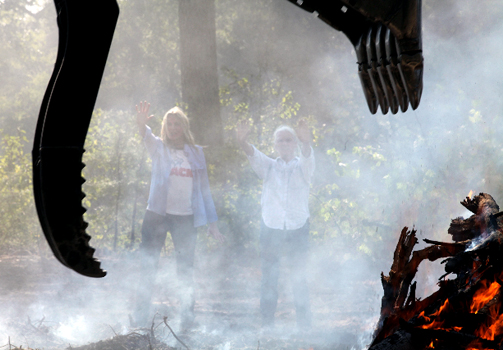
As the Tar Sands Blockade tree village enters its third week, mainstream media have ignored it almost entirely outside the region. Even on the internet there is limited coverage, with such exceptions as firedoglake.com and several environmental websites.
CBS News, USA Today and People showed some interest in the story when Darryl Hannah was arrested on Oct. 4, but CBS did no original coverage, only running an Associated Press story. All three reports ran Hannah’s unattractive mugshot, but none of them mentioned the treehouse blockade or the protestors’ underlying motivation, the dangers of tar sands oil.
Hannah was arrested for criminal trespass and resisting arrest for standing passively in front of TransCanada construction equipment, holding up her hands for it to stop. Hannah said a TransCanada private security guard hurt her wrist. Arrested with her was 78 year old great-grandmother Eleanor Fairchild. Fairchild, who also stood passively with her hands up, was charged with criminal trespass even though she was on her own land.
TransCanada had taken an easement across her land by eminent domain, so in the eyes of Texas law, that part of her land was no longer hers.
TansCanada’s use of eminent domain is under court challenge, but construction continues. The challenge is based in part on the facts that the law intends for eminent domain takings to be for the public good, whereas TransCanada is a multi-billion dollar, private, foreign corporation.
TransCanada also a faces a court challenge to its permits from the U.S. Army Corps of Engineers for this leg of the pipeline. A Sierra Club suit argues at length that TransCanada did not comply with the terms of federal environmental law, in part by failing to file a proper environmental impact statement. A federal judge denied the Sierra Club’s request for an injunction, and the construction continues.
In Winnboro, TransCanada has now encircled the treehouse blockade and shines floodlights at the protestors all night. Police and private security have been taking cameras away from people on the ground. When an important story is happening out of sight of the media, it’s hard for it to make an impression.
Resident concerns over fracking are downplayed in Fox 17 story
Yesterday, WXMI Fox 17 posted a story about exploratory drilling in Ionia at a site where a Texas-based company might engage in hydraulic fracturing.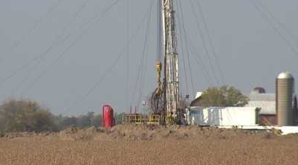
The local Fox affiliate talked to neighbors who live across the street from where the test drilling and potential fracking could take place. One response from the neighbor was:
“It’s not in our backyard, but it’s right across the stinkin’ street. So yea, close enough to really make us think about it. Ya know, start asking questions that we really didn’t ask before,” he explained.
This kind of sentiment has been shared across the country as more and more people find out about the environmental and health effects of hydraulic fracking.
The Fox 17 story then states, “Many environmentalists are against hydraulic fracturing, or fracking, because it involves injecting wells with chemically treated water.” The WXMI story provides no evidence of this claim, nor do they seek out one of the many anti-fracking groups that exist in Michigan, some even in Grand Rapids.
Instead of seeking out details on fracking from an environmentalist, Fox 17 then sites a spokesperson from the Michigan Department of Environmental Quality (DEQ) who states, “So you’d have at least three strengths of casing that would be cemented and sealed. So that would prevent any migration of any kind of fluid up and down the well and prevent anything from getting into the groundwater.”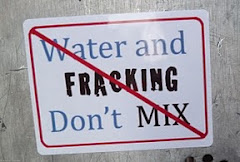
Ending with such a statement from a government official leaves one with the impression that fracking is safe and without health or environmental consequences. This flies in the face of research on the issue, such as recent studies done by the US Geological Survey, which confirm that fracking for natural gas does contaminate groundwater. Many known toxic chemicals are being used in fracking, chemical that are harmful to both humans and animals.
This information is widely available and is one of the reasons there are citizen movements all across the country that opposing hydraulic fracturing.
WXMI 17 could have easily found another voice, such as groups like Ban Fracking Michigan or Mutual Aid GR, which organized an anti-fracking protest two weeks ago in Grand Rapids, which Fox 17 reported on. There is also a big demonstration being organized for October 24 in Lansing, since the Michigan DNR will be hosting another land auction, which will allow oil & gas companies to buy mineral rights to drill on public land. There was a previous DNR land auction in May that also saw over 100 people come out to protest.
The fact that Fox 17 did not seek out other voices in this story or provide any larger contextual information about the growing statewide opposition demonstrates lazy reporting.
The Fracking of Rachel Carson, by Sandra Steingraber
This video is re-posted from Orion Magazine.
Author Sandra Steingraber, who is at the forefront of efforts to halt fracking across the Marcellus Shale deposits, reads excerpts from her essay about the fiftieth anniversary of Rachel Carson’s Silent Spring, accompanied by a full portfolio of fracking photos by Nina Berman.

