A Grand Rapids Power Analysis
This information was presented at an event hosted by the Bloom Collective on September 8 and is re-posted here with the help of several Bloom Collective members.
The presentation began with the premise that in order for institutional or systemic change to take place in any community, people must have a clear understanding of who has power, both economic and political power.
The first slide shared was on understanding the Hierarchy of Power, which is included here.

The hierarchy of power believes that private economic power is the strongest form of power and that this sector of power uses political power to control state power. What is meant by political power is the idea to influence state policy through money and political leverage, which is often manifested in the relationships that private power has, the amount of assets and the associations and boards that it occupies.
Once the idea of a hierarchy of power was established, there was a discussion of who represented private power in Grand Rapids. There certainly are large, global corporations that have a presence in Grand Rapids, such as JP Morgan Chase Bank, AT&T, Coca Cola, Veolia and General Motors. These companies have power in that they can demand tax breaks and subsidies for setting up shop in the area, but they rarely influence local policy on a more regular basis.
The families, individuals and associations that were identified as having the real power in this community includes (but is not limited to) the following: DeVos, Meijer, Van Andel, Cook, Seechia, Michael Jandernoa, John Kennedy, David Frey, Sam Cummings, Huntington, the GR Chamber of Commerce, The Right Place Inc., The Econ Club of Grand Rapids, the West Michigan Policy Forum, Grand Action and the Downtown Development Authority (DDA).
These are the families and entities that through individual wealth or collaboration too often dictate the outcome of policies, economic development and major cultural dynamics that impact the entire community.
The easiest example is the DeVos Family. Their collective wealth and assets is astounding. You can see here how much they own and can get a more detailed listing at this link.
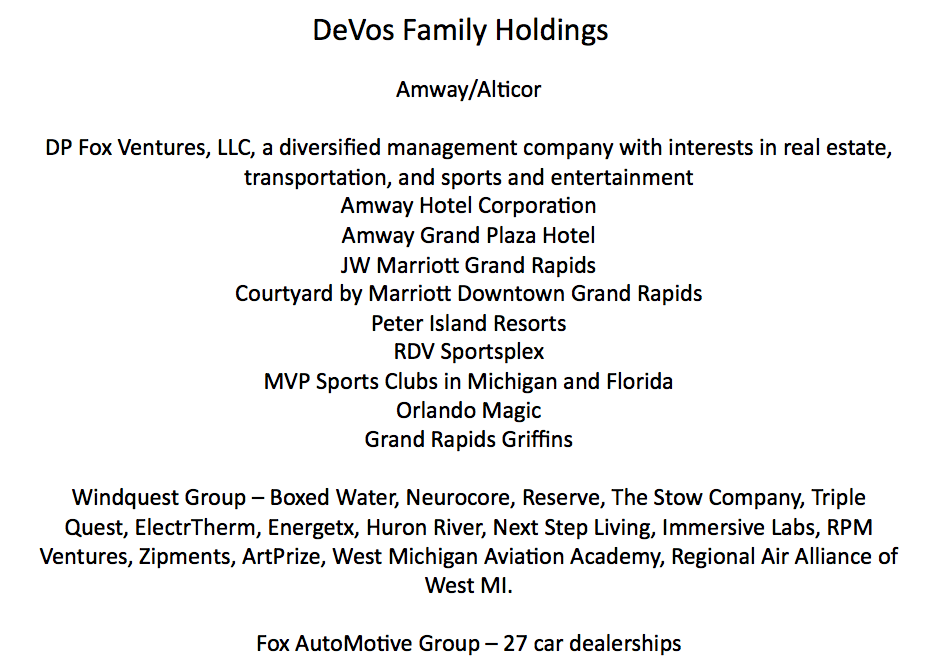
In addition to the wealth & assets that the DeVos Family holds, they influence policy through direct contributions to political parties/candidates or campaigns. According to data provided by the Center for Responsible Politics, we determined that the DeVos family had collective given over half a million dollars in the 2012 election cycle by July.
Other examples of members of the DeVos family influencing policy are the recent donation of $250,000 by Richard DeVos to Wisconsin Gov. Scott Walker in his bid to defeat a recall campaign and a $500,000 donation by Doug DeVos to the National Organization for Marriage (NOM), a lead organization that fights marriage equality across the country. On a more local level, the DeVos family has given money to influence the politics of local universities and colleges, religious institutions, hospitals and non-profits.
In addition to the power that individual families have because of their vast amount of wealth, they also have power through formal associations. If one were to look at who sits on the boards of entities like the Grand Rapids Chamber of Commerce, Grand Action, the Econ Club of Grand Rapids, the West Michigan Policy Forum and the Right Place Inc., one can see the wealthiest and most powerful people occupying those boards. One can also begin to see that certain names appear over and over again, thus creating what could be called interlocking systems of power. Here is a graph to illustrate these interlocking systems in Grand Rapids.
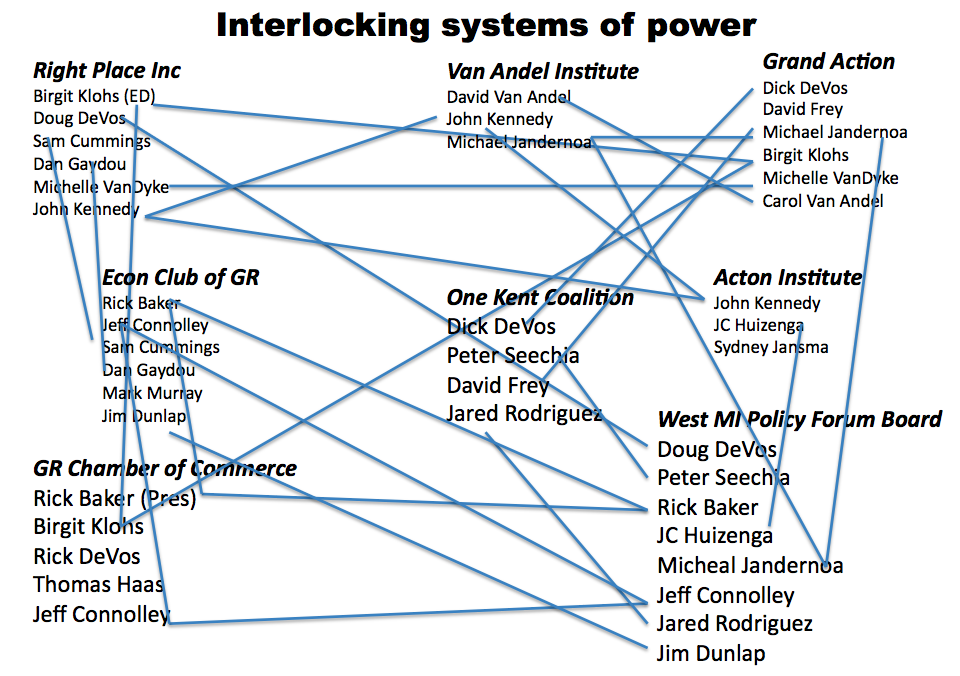
These are the organizations and associations that the wealthiest families use to dictate policy in this community. We have seen this historically with the development of downtown Grand Rapids over the past 20 years, whether it was the construction of the arena, the convention center and now the so-called “urban market.”
Understanding that private economic and political power is greater than state power, we can then see how the state more often than not operates to maintain the social stratification created by the local elites. Through police, the courts and the jail, the state will deal with disproportionately poor and minority communities by putting them in the Prison Industrial Complex. This is not to say that the state does no “good,” such as libraries and public transportation, but the good/bad binary that has been created by the power structure doesn’t allow us to see how power functions. Of course, the state does some “good,” but the point here is that its primary function is to act on behalf of private power and not allow the masses to really have a say in social and economic policies.
The media also plays the same role, since the media is part of the power structure, based on who owns them. However, even most reporters will not question the power structure, since they have either internalized the values of the system or engage in self-censorship in order to protect their job. Very little local media is owned locally and when they do report on those with power, the news is often bias, framed in the good/bad binary and sometimes the news media acts as sort of a PR outlet for power.
This brings us to the last level in the hierarchy of power, the NGO, Social Services sector. More often than not what one sees with non-profit organizations and social services, entities that are dealing with the consequences of private power’s quest for more power – poverty, various forms of discrimination, poor health, destruction of the environment – is that these NGOs will not question the reasons why people are poor, are suffering from bad health or are the victims of discrimination and oppression.
One of the reasons for this failure to get to the root of problems within the NGO sector is because most often non-profits think that the current system is more or less fine and only needs some minor reforms. This is why many people will say that in Grand Rapids, “we do charity real well, but not justice.” There are social service agencies and charitable services all over this community, but they are not a threat to the existing power structure. This is exactly why the wealthy elites in this community often donate large sums of money to these non-profits, because they not only will not have their power threatened, it actually creates the illusion that they are doing “good.”
Radical sociologists identify the social service and non-profit sector as the first line of defense against social uprisings. If your organization or agency can provide charitable assistance to people, then they are less likely to direct their rage towards systems of power. In a sense, much of the social service and non-profit world acts as a buffer between the disenfranchised masses and the power elite or as the Occupy Movement would call them, the 1%.
This is exactly why virtually all those individuals and families who make up the 1% in Grand Rapids have their own foundations. Foundations are first and foremost a way to put one’s wealth into a non-taxable status, but it also serves as a way to create an illusion of concern, redirect attention away from social inequality and to engage in population management.
The power structure often gives money to programs that serve the “needy” as a way to guarantee that those most disenfranchised not only will not rise up against the power structure, but will actually come to see them as people they admire. We can see this all throughout West Michigan, where the DeVos, Prince, Meijer and Van Andel families are viewed with great admiration. The fact that working class people will speak highly of the local power structure is an amazing feat of propaganda that would make Joseph Goebbels blush.
The discussion at the Bloom Collective ended with looking at the function of ArtPrize within a local power analysis. People were able to deconstruct the role this art event played within that hierarchy of power and who the real beneficiaries were of the annual event.
Asking the Chileans for Forgiveness on September 11
Critiquing the news is not just about what they report on, but what they don’t report on.
It is eleven years since planes were flown into the Twin Towers in New York City and the Pentagon in Washington, in what has become known as 9/11. There will be memorial services today, Patriot Day parades and the news media might even provide some kind of retrospective on what happened on September 11, 2001.
We always need to say 2001, because September 11 is not just a day for Americans to stop and reflect, it is a day that continues to haunt the people of Chile.
On September 11, 1973, the CIA led a coup against the democratically elected government of Salvador Allende and put in power one of the worst dictators in Latin American history, Augusto Pinochet.
Pinochet rounded up thousands of people who were identified as dissidents, had thousands of them tortured and murdered. These atrocities happened with US government support. In fact, according to declassified documents, we know how high ranking US government official responded to the first reports of Chilean army massacres.
According to the first transcript dated October 1, 1973, when Kissinger was informed by his assistant secretary of inter-American affairs of initial reports of massacres following the coup he told his staff that the U.S. should not defend what the regime was doing. However, he emphasized: “But I think we should understand our policy–that however unpleasant they act, the [military] government is better for us than Allende was.”
The US government could not tolerate an independent government operating in the Western hemisphere and had been working for years to undermine the Allende government. The effort to rid the Western hemisphere of Allende was motivated in part because of his Socialist leanings, but also because the Chilean government dared to nationalize some of the industries, which resulted in US-based corporations losing profits. The ITT Corporation became the lead private entity to assist the Nixon administration in anti-Allende activities.
The US economic interest in Chile did not end with he September 11, 1973 coup. It continued for years with Chile being somewhat of a laboratory for Milton Friedman’s economic shock doctrine, as is well documented in Naomi Klein’s book, The Shock Doctrine. Friedman himself made visits to Chile after the 1973 coup and then sent a team of his best young economists, known as the Chicago Boys, to ply their trade on the South American country.
The application of an economic shock doctrine in Chile was great for US corporations and the wealthy residents, but would mean poverty for many. Pinochet was eventually removed from power and a campaign began to try him for war crimes in a European court. The US government intervened as they knew that any legal proceedings against Pinochet would ultimately result of charges being brought against Kissinger and other high ranking US officials. Pinochet died in 2006, without ever being punished for the human rights abuses he oversaw.
On this September 11, we ask forgiveness from the Chilean people.
We ask forgiveness for the thousands of murders and tortured bodies.
We ask forgiveness for the families that were destroyed through the violence of the coup and the Pinochet dictatorship.
We ask forgiveness for the economic devastation brought about because of the US intervention and the implementation of the Shock Doctrine.
We ask for forgiveness on September 11, for the torture and death of some many young people, like the great musician Victor Jara, who was tortured and murder in the soccer stadium. We honor those that were murdered on September 11, the other September 11, with this music video by Victor Jara.
Group Calls for Fracking Ban in Europe
This article is re-posted from EcoWatch.
Commission studies, released last Friday, find the risks associated with large-scale shale gas development and fracking to be high and in some cases very high. The studies draw special attention to the cumulative environmental impacts of multiple shale gas wells. Eight key pieces of the European Union (EU) environmental acquis are identified as being ill-equipped to deal with the water, waste, liability, air quality and other issues of large-scale use of hydraulic fracturing.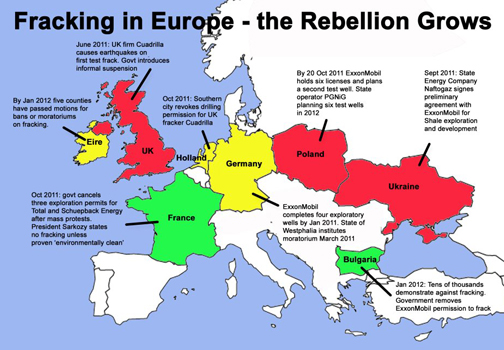
The findings in these studies roundly debunk European Energy Commissioner Günther Oettinger’s view that current EU law adequately deals with the risks of fracking. Given the manifold risks identified in this report, Food & Water Europe calls on the Environment Commissioner Potočnik to ban fracking or—at the very least—address these shortcomings by adapting the EU’s environmental regulatory framework to the ugly reality of large-scale shale gas extraction.
“These studies reviewed a lot of the evidence about the negative environmental impacts of large-scale shale gas extraction and acknowledge the water, air and land-related risks associated with shale gas to be high,” said Wenonah Hauter. “We particularly welcome the studies’ focus on the cumulative environmental impacts of hundreds of wells in Europe’s shale plays.”
This focus is particularly valued, as the draft report about the environmental impacts of shale gas, drafted by MEP Boguslaw Sonik, does not even mention this key fact: Shale gas development requires a lot of wells to be drilled. For example, a mature shale play like the Barnett shale in Texas has 15,000 wells. In other words, unconventional gas is profoundly different from previous European experiences with onshore, conventional gas exploitation.
In sharp contrast to Commissioner Oettinger’s earlier claim that existing European environmental regulation for shale gas activities would be adequate, the report clearly identifies gaps in eight cornerstones of the EU’s environmental acquis, such as the Environmental Impact Assessment Directive, Water Framework Directive, Environmental Liability Directive, Industrial Emissions Directive, Mining Waste Directive, etc. For example, the DG Environment study (pp. 108-109) finds that the Groundwater Directive, particularly Article 6 requiring Member States to develop measures to prevent or limit inputs of pollutants into groundwater, “could in principle involve the prevention of hydraulic fracturing operations, should the latter involve the injection underground of pollutants”. Given this obligation, Member States open themselves to major liabilities in case of environmental damage linked to less than adequate regulation of this risky industry.
Major gaps were also identified in the Environmental Impact Assessment Directive. “The upcoming review of the Environmental Impact Assessment Directive during the fall of 2012 must include fracking in its list of activities, which require a mandatory impact assessment,” said Hauter. Impact assessments are crucial, as they help to establish sound baseline data about e.g. groundwater and air quality, identify seismic risks and help secure a meaningful involvement of local communities before drilling commences.
To avoid a situation, as occurred in the U.S., where policy-makers are engaged in a regulatory catch-up exercise with the shale gas industry, European Environment Commissioner Janez Potočnik must now start leading the EU’s effort to—in the absence of unanimous support among EU Member States for a ban on fracking—demand the highest environmental standards of fracking operations to avoid that EU Member States treat environmental and human health impacts differently.
As Chicago teachers strike, solidarity rally planned in Grand Rapids this Thursday
The battles lines have been drawn in Chicago, with the teachers union going on strike against the punitive measures being imposed on the public education system by Chicago Mayor Rahm Emmanuel.
One writer on the strike reports:
Some 26,000 members of the Chicago Teachers Union (CTU)–educators as well as aides, clerical personnel and clinical professionals–are walking the picket lines in their first strike in 25 years. The CTU has been without a contract since June. At the end of the last school year, 98 percent of teachers who cast a ballot authorized the union to call a strike if the city didn’t come up with a fair contract.
Final confirmation of the strike came at a dramatic live press conference for the 10 p.m. local television news, where CTU President Karen Lewis announced that negotiations had failed to bridge the gap between the city and the teachers’ union. “We have failed to reach an agreement that will prevent a labor strike,” she said. “No CTU members will be inside of our schools Monday.”
Although state laws prohibit the union from striking over issues other than pay, benefits and certain workplace procedures, Lewis made it clear that the CTU is also fighting for fully funded public education with smaller class sizes, decent facilities and improved educational options.
Lewis spoke of the CTU’s alliances with parents and community groups to demand improvements in schools–for example, the installation of air conditioning in schools that begin classes in mid-August. She pointed out that CPS has only 350 social workers for about 400,000 children. The fight for improved social services in the schools, she said, is “critical to all of us.”
Thus, while the specific issues of the Chicago teachers’ strike are limited by law, everyone knows that this fight is about, as one local news anchor put it, how the schools are run. “We ask all of you to join us in this education fight for justice,” Lewis said at the press conference, flanked by rank-and-file union members on the bargaining team.
Asked why the union was resisting implementation of a new evaluation system, CTU Vice President Jesse Sharkey pointed out that the city’s punitive proposal could put as many as one-third of Chicago teachers on track for termination. By tying teacher evaluations to student test scores, Chicago Public Schools (CPS) would only put more pressure on children who already have the burden of high-stakes tests that “distort” their education, Sharkey said.
In Grand Rapids, activists have organized a Solidarity Rally for the Chicago Teachers Union. The facebook invite states:
This is a rally in support of the Chicago Teacher’s Union for a fair contract and to defend public education. On August 29th,the Chicago Teacher’s Union filed it’s ten-day strike notice. If contract negotiations are not settled, they are planning to strike Monday, September 10th. Let us gather to show our solidarity with teachers and to discuss amongst each other the significance of this struggle.
Solidarity with Chicago Teachers
Thursday, September 13
3:00 – 5:00 PM
Monument Park – corner of Division & Fulton in downtown Grand Rapids
MLive falsely pits Gov. Snyder and the West Michigan Policy Forum organizers as in opposition on Right to Work
Yesterday, MLive posted an article by business reporter Rick Haglund with the following headline, Right to Work still a thorn in Gov. Synder’s side.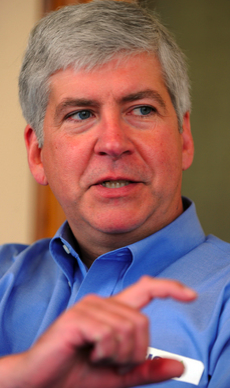
The context of Haglund’s article is Gov. Rick Snyder’s visit to Grand Rapids this Thursday, where he will address members of the West MI Policy Forum at their bi-annual conference.
Haglund states in the second paragraph, “Snyder repeatedly has said right to work is a divisive issue and that he doesn’t want the Legislature to pass a bill on the measure.” It is true that Snyder has said on numerous occasions that he would prefer to not push for Right to Work legislation in Michigan, but that doesn’t mean he will oppose it.
The rest of Haglund’s article tries to further the idea that Snyder is in opposition to groups like the West Michigan Policy Forum (WMPF). The MLive business reporter cites the President of the WMPF, Jared Rodriguez who says, “Freedom to work puts trust in individual workers and allows them to make a personal choice about whether they want to join a labor union.”
Despite framing the article in such a way as to present Gov. Snyder as in conflict with the West Michigan Policy Forum, Haglund offers no real substance to such a claim, nor does he present any information on the WMPF’s perspective on Right to Work.
The West MI Policy Forum has made Right to Work legislation for Michigan one of their main goals since the founding conference in 2008. At the 2010 conference, the group brought to town anti-union propagandist Rick Berman, who presented on tactical approaches to making Right to Work a reality in Michigan.
What I think Gov. Snyder is doing by not taking a strong pro Right to Work stance is buying time. The unions in Michigan have countered the Right to Work possibility by pushing forward a November Ballot Initiative, the Project Our Jobs campaign. If that initiative passes in November, there will be a serious legal battle to overturn it. If it doesn’t pass, Michigan legislators who have aggressively advocated for Michigan to adopt Right to Work legislation will no doubt move forward with proposing such legislation, which means it will then come to Snyder to be signed into law. If Snyder was really against such legislation he would make it clear by stating publicly that he would veto such legislation if it passed in the legislature. He has not done so to date.
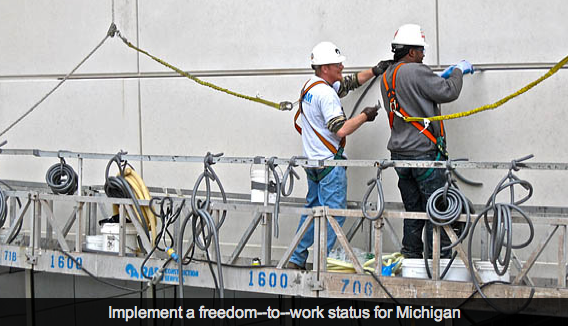
In addition to Synder having never said he would veto Right to Work legislation, his commitment to anti-union policies and positions has been pretty clear. In fact, one could argue that Snyder has been following the game plan of the West MI Policy Forum and the Mackinac Center for Public Policy ever since he took office nearly two years ago.
Snyder signed onto the elimination of the Michigan Business Tax, implemented the Emergency Financial Manager Law, has tied revenue sharing for municipalities by their ability to downsize their workforce and privatize public services and has supported greater movement to privatize public education by attacking public education.
GRIID plans to be at the West Michigan Policy Forum conference this week to report on the two-day event, an event that Snyder will fit right in with, despite MLive’s attempt to present him as a dissident to conservative policies.
By the way, MLive is a sponsor of the West Michigan Policy Forum, so don’t expect them to provide any critical analysis of the conference.
Our Kitchen Table to offer class on the History of Food in October

Throughout history and today, food production has been a key component of how members of a society organize themselves and express their different cultural norms and identities. This class explores different types of sustenance economies as well as the history of food from before the rise of civilizations.
Topics will include the history of colonialism, the rise of agri-business and how these have destroyed cultural practices. Finally, we will learn about the relationship of cultures with food and the importance of biodiversity for preserving cultural heritage.

The class is free. Participants are asked to purchase a copy of The Earth Knows My Name: Food, Culture and Sustainability in the Gardens of Ethnic Americans, by Patricia Klindienst (2006, Beacon Press). The class will also include other readings, including selections from Food and Culture: A Reader, edited by Carole Counihan and Penny Esterik (2008, Routledge, second edition).
OKT History of Food Class
- Meeting four consecutive Tuesday evenings, 6 to 8 p.m.
- Oct. 9, 16, 23 and 30
- Taught by anthropologist and GVSU adjunct professor, Christy Mello
- Location TBA
For more information contact OKT at http://oktjustice.org/contact/.
Opposition Mounts As First Tar Sands Mine In US Gets A Green Light
This article by Melanie Jae Martin is re-posted from ZNet.
Last week, a new front opened in the struggle against tar sands mining in the U.S. If you didn’t know that tar sands mining is in the works on this side of the border in the first place, you’re not alone. Most people don’t realize that tar sands extraction, which has caused tremendous pollution and environmental degradation in Canada, has crossed the border to U.S. soil, where it has taken root in Utah.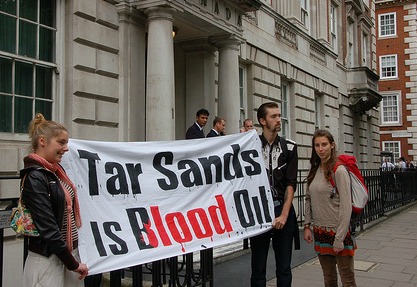
Activists on both sides of the border have been working fervently to halt the spread of tar sands in Canada and the piping of tar sands oil from Alberta to Texas. Beginning with Tar Sands Action’s mass arrests outside the White House in August 2011, followed by the Indigenous Environmental Network’s protests at the climate talks in Durban that December, activists have made Canadian tar sands mining and the Keystone XL pipeline to the Gulf of Mexico a high-profile issue this past year.
Now, direct action campaigns like the Tar Sands Blockade in Texas are continuing the effort to stop construction of the southern leg of the pipeline by disrupting business as usual for the oil industry. The threat of tar sands mining in the U.S., however, complicates the struggle. It forces geographically divergent groups to either divide their efforts or find ways to unite across vast distances. That’s why groups like Utah Tar Sands Resistance and Before It Starts are forming a strategy that can join, as well as compliment, the tornado of opposition that has formed against the tar sands industry.
Before It Starts — co-founded by Ashley Anderson, who began Peaceful Uprising with Tim DeChrisopher in 2009 — is focusing primarily on national outreach, while Utah Tar Sands Resistance is focusing on forging local and regional coalitions. In both groups, activists who have experience in nonviolent direct action are prepared to ramp up efforts when the time is right. Thus far, however, the struggle has mainly been waged in the courtroom.
The environmental group Living Rivers initiated a legal challenge in 2010 to halt the progress of what’s set to become the first commercial tar sands mine in the U.S. — a forested area in Eastern Utah called PR Spring, which the state has leased a portion of to the Canadian mining company U.S. Oil Sands. Living Rivers has contested the company’s permit to dump wastewater at the mine, but last week, the judge — an employee of the Utah Department of Environmental Quality — sided with U.S. Oil Sands, granting it the right to pour toxic wastewater into the remote wilderness of eastern Utah.
The case hinged on whether or not PR Spring contains groundwater. In the hearing back in May, U.S. Oil Sands argued that the land holds no groundwater, which means that polluting the land wouldn’t contaminate water systems. But according to engineering geologist Elliott Lips, who spoke as a witness for Living Rivers, the land holds numerous seeps and springs, which the toxic tailings would pollute before either continuing to flow into rivers or percolating downward into the Mesa Verde aquifer. Ultimately, the judge was satisfied knowing that the company had conducted its own tests and would have reported water if it had found any.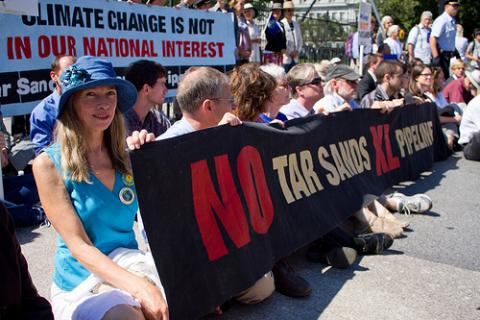
Raphael Cordray, co-founder of the Utah Tar Sands Resistance, explains that tar sands mining would be incredibly destructive in a number of ways, such as polluting water, lowering river levels and destroying diverse ecosystems. “There’s so much wild land in our state, and that’s something I’m proud of,” she said. “That’s our legacy. And it’s a treasure for the whole world. Some of these places they’re trying to mine are so unique that if more people realized they existed, they’d certainly be considered national parks.”
To catalyze mass resistance, the group plans to lead trips to the site. “Helping people experience the majesty of this land firsthand will show people how much is at stake, and move them to take a stronger stand,” said Utah Tar Sands Resistance co-founder Lionel Trepanier.
Together with activists from Peaceful Uprising and Living Rivers, Utah Tar Sands Resistance visited the PR Spring site two weeks ago, and members returned home ready to ramp up efforts to halt the mining. As a member of both groups, I went along on the trip, because I wanted to see firsthand what the land looked like and whether the mining company’s claims about the absence of groundwater were accurate.
As it turns out, they couldn’t be more false. Water has etched its presence into this land, leaving creek beds that may run low at times but never go away. And clearly, the area holds plenty of water to support the large herds of deer and elk, as well as the aspen, Douglas firs and pinyon pines that make up the dense forest covering much of the land.
This vibrant green scenery was juxtaposed by the two-acre strip mine just feet away from the forest’s edge. The difference between life and death could not have been more stark. Looking into the face of such destruction, I realized it’s no longer about saving the ecosystem, or saving our water — it’s about saving life on Earth. But that kind of effort isn’t possible without a broad movement behind it.
According to Lionel Trepanier, the groups working on this issue are looking to Texas’ Tar Sands Blockade as a model for building a broad coalition that includes “diverse groups of people like ranchers, hunters, the Indigenous community and climate justice activists.”
“I think we so often assume that someone won’t agree with us just because they seem different from us, when they could be our biggest ally,” said Cordray. “We’re committed to breaking down those barriers formed by fear of reaching out, and approaching people as human beings who need clean water and a healthy environment just as much as we do.”
While still in the first leg of its campaign to stop tar sands and oil shale mining, the group is reaching out with its teach-in and slideshow presentation to a wide range of outdoors retailers, religious communities and groups concerned about environmental quality in the city. When they handed out flyers and spoke with attendees at a recent Nature Conservancy film screening, they were surprised at how many people in the seemingly politically moderate, middle-class crowd were outraged at the prospect of tar sands mining coming to Utah.
“People are genuinely shocked this is happening,” said Trepanier. “They just want some direction, some guidance.”
After the Utah Tar Sands Resistance secures a vehicle to use for the trips, they’ll invite people at the teach-ins to attend, and will bring as many as possible to the site. They feel that being in nature together will break down barriers, helping them to see each other not as the labels society assigns them, but as human beings who are mutually dependent on the ecosystem, and on each other.
To raise awareness and empower people to join a coalition that ultimately aims to halt the destruction of tar sands and equally-destructive oil shale mining, Utah Tar Sands Resistance and Peaceful Uprising have been working together on creative methods of outreach. In April, they staged a flash mob dubbed Citizens’ Public Hearing in the office of the state agency leasing out public land for tar sands mining. Dozens of people flooded the office, where a woman playing an elementary school student announced that she had called a public hearing to expose the agency’s misguided decision to let state lands be destroyed. They also performed a similar street play, called Bringing Science Lessons to the Governor, outside the governor’s mansion when he held a luncheon to talk energy policy with four other Western governors.
Members are now building a “tar sands monster,” a Frankenstein-inspired creature who never wanted to be pulled from the earth to pollute the waters, which they believe will make an attention-getting mascot for their efforts. The activists also plan to use online videos of their theatrical endeavors as an outreach tool to get activists across the country thinking about joining them in their struggle when the time is right.
Uniting a diverse range of people such as activists, farmers, landowners and outdoor enthusiasts, many of whom may have not previously thought of themselves as activists, will be important, as this is only the beginning of proposed tar sands operations in the U.S. The state agency (School and Institutional Trust Lands Administration, or SITLA) that leased the PR Spring site to U.S. Oil Sands holds pockets of land scattered around the state, which it may lease for tar sands and oil shale mining.
The Bureau of Land Management is also considering leasing nearly 2.5 million acres of public land throughout Utah, Wyoming and Colorado for tar sands and oil shale mining. Much of this would overlap with indigenous land or is in close proximity to national parks and other protected areas.
In the meantime, Living Rivers will likely appeal the decision to let U.S. Oil Sands dump wastewater into the land. Its success, however, will be determined by the extent to which groups like Utah Tar Sands Resistance can educate and empower the general public. Such a base of support, like the one that has formed in Texas, will not only pose a challenge to fossil fuel interests, but also help to usher in a new era of environmental justice.
Update on Thursday’s Public Comment Opportunity to stop DNR auction of public lands for fracking
Last Thursday, we posted a story about this week’s Natural Resources Commission (NRC) meeting in Lansing and the opportunity for people to weigh in on the proposed October 24 auction of more public land for oil & gas extraction.
The group Citizens Against Drilling on Public Land Michigan has announced that due to so many peoples signing up for the public comment opportunity the Natural Resources Commission meeting has been moved.
The new location for the September meeting will be held at Lansing Center located at 333 E. Michigan Avenue in downtown Lansing – just a few blocks from the state Capitol.
Citizens Against Drilling on Public Land Michigan states, “The NRC is encouraging those addressing the commission on the same topic to designate a spokesperson to speak on behalf of the group. That spokesperson will be granted ten (10) minutes. All others not included in the group will now be limited to three (3) minutes each to allow maximum public input. Also attached is a copy of the Public Appearance Guidelines. Please bring 10 printed copies of your comments to hand out to the NRC commissioners.”
For more information contact Citizens Against Drilling on Public Land Michigan cadplmich@gmail.com.
For those interested in being part of any organizing against the October 24 DNR land auction you can contact the Grand Rapids group Mutual Aid GR at http://www.facebook.com/MutualAidGR.
Did Democratic delegates just vote down Obama bid to pander to AIPAC on Jerusalem?
This article by Ali Abunimah is re-posted from Electronic Intifada.
An extraordinary thing happened at the Democratic National Convention today. The official party platform for 2012 left out a reference that “Jerusalem is and will remain the capital of Israel” that was in the 2008 version.
Under pressure from the Israel lobby and the Republicans the Democratic leadership hastily moved to shove it back in on a voice vote that required a two-thirds majority. But to the stunned surprise of Los Angeles Mayor Antonio Villaraigosa who was chairing the convention, the “No” votes seemed to be louder, as the video above shows.
Shocked, Villaraigosa held the vote a second time, and then a third time. Each time it seemed the noes had it. Nonetheless, Villaraigosa declared that it had passed anyway. Loud booing could be heard. It’s an astonishing spectacle (see a longer version of the video from C-Span).
Obama intervened directly
Apparently, Obama himself intervened as JTA reports:
late Tuesday afternoon – after Republicans launched a full-force offensive criticizing the omission – the Democrats reversed course. Robert Wexler, a member of the platform draft committee, and a chief Jewish surrogate for the Obama campaign, credited President Obama for the change.
“They are returning the language to the 2008 situation,” Wexler told JTA late Tuesday. “The president directly intervened to make sure this amendment happened.”
But it seems ploy by Obama to pander to the Israel lobby has badly backfired. Gleeful Republicans are already circulating the video and spinning it as Democrats booing Israel.
Shower Israel with love and affection
Just this morning, in a New York Times oped, Israeli-American tycoon Haim Saban ostensibly defended Obama against Republican claims that Obama has “thrown allies like Israel under the bus.” Saban admiringly listed Obama’s unconditional financial, military and diplomatic largesse to Israel. But even after all that Saban – an Obama supporter – suggested that Obama “should have showered Israelis with more love and affection.”
That was in the morning. In the afternoon the Jerusalem debacle occured at the convention. I personally am uninterested in the GOP vs. Democratic aspect. I consider both parties indistinguishable on Israel and so many other issues. They are part of the same ruling establishment.
But ramming through AIPAC’s desires – despite an apparent no vote – was a neat summary of how US elites make decisions when it comes to Israel. Both parties are in a bidding war to appease Israel’s most extreme supporters at home and abroad. If this means riding roughshod over their own members, the American public, world opinion, international law and the basic rights of the Palestinian people, then so be it.
We can expect that in an effort to repair the damage from today, Obama’s big convention speech tomorrow night will shower Israel even more “love” than ever.
Obama’s history of pandering
For Obama, it is also nothing new. Despite elevated and unrealistic expectations that he would be different, I had warned as early as 2007 that Obama had surrendered any autonomy on Palestine to AIPAC.
JTA is revealing on how the platform is actually written in the first place – effectively under direct AIPAC supervision:
A Jewish official speaking on background said that at least three American Israel Public Affairs Committee officials were present during the entire period when the platform was drafted last month in Minneapolis. Other Democratic and Jewish officials confirmed AIPAC’s participation in the process.
There is another way
For those committed to justice in Palestine today’s events are a reminder that the road to justice does not go through the GOP the RNC or the DNC, but for us in the United States it goes through BDS – boycott, divestment and sanctions against an Israeli apartheid regime that has the full backing of US political elites.
Jerusalem, after all, and all of Palestine are not Barack Obama’s or Mitt Romney’s to auction off to the highest bidder.
Michigan Department of Civil Rights to host an LGBT anti-discrimination forum in Grand Rapids on Sept. 19
The Michigan Department of Civil Rights (MDCR) is partnering with the Community Relations Commission of Grand Rapids to host a public hearing on the issue of how anti-discrimination ordinances and the LGBTQ community.
The MDCR has already hosted forums in Jackson and in Holland, where hundreds of people came out to express their concerns and tell their stories about how they or someone they know who identifies as LGBTQ are still being discriminated against in Michigan.
The City of Grand Rapids passed an anti-discrimination ordinance to include some protections for the LGBTQ community in 1994, making it just the 10th city in the country to do so.
However, despite Grand Rapids having such an ordinance, people who identify as Gay, Lesbian, Bisexual, Transgender or Queer continue to be harassed, intimidated and discriminated against in a variety of ways. The public hearing on September 19 will provide an opportunity for those who are being discriminated against and those who are allies of the LGBTQ community to tell their stories.
According to a Media Release from the Grand Rapids CRC:
The event, co-sponsored by the Grand Rapids Community Relations Commission,
will take place at Grand Rapids Community College, DeVos Campus, Sneden Hall, Room 108, 415 Fulton SE, Grand Rapids, 49503 from 4 to 6 pm.
Both written and verbal testimony will be accepted. Follow this link to learn more about telling your story http://www.michigan.gov/documents/mdcr/ELCRAPrompt2012_385444_7.pdf.
To provide written testimony, please email it to calcagnor@michigan.gov before September 17, 2012. Please indicate if you would like to testify during the hearing.
If you want to attend the hearing and need an accommodation to do so, please notify MDCR at calcagnor@michigan.gov.
For more information on the Michigan Department of Civil Rights, visit www.michigan.gov/mdcr.
 Grand Rapids Institute for Information Democracy