Ride the Taco
This video by subMedia is re-posted from Dissident Voice. subMedia’s video collection is a fabulous mix of satire, analysis and presentation of global political resistance.
On tap this week:
- Ride the Taco
- Romney and Obama’s climate silence
- Chinese Resistance to Civilization
- You are not in Mexico S.A.
- Athens Anarchist Anti-Fascist Motorcycle Club
- Severed Heads of State
- Dawn Paley‘s “Drug War Capitalism”
Panel discussion on homeless LGBTQ Youth held at GVSU today
The GVSU School of Social Work hosted a panel discussion this morning at the downtown campus on the topic of LGBTQ Youth and homelessness.
The panel included Susan Sheppard with Arbor Circle, Mary Alice Walker with Heartside Ministry and Colette Seguin-Beighley with the GVSU LGBT Resource Center.
Colette began the discussion by telling a story about a gay youth whom Colette had correspondence with. The young man said that his mother hated the church that Colette was part of, because it was an open and affirming church, which is why the gay youth decided to continue correspondence with Colette.
The young man had faced homelessness because his family did not accept his identity, so Colette and her family took him in for the next 6 months. It was her first encounter with a homeless LGBTQ youth.
In a time where Marriage Equality is becoming more acceptable, homeless LGBTQ youth is not really on the radar screen for both progressive sectors and many LGBT organizations across the country. Colette said it is a much more difficult issue to tackle and that it is one that needs to dealt with through an intersectional lens.
Mary Alice Walker, who works at Heartside Ministry, talked about how their organization has recently designated their space as a safe space for the LGBTQ community. She told a story about a 21 year old Black bisexual man who has used the services at Heartside, but how his identity and the fact that he is now 21 has limited the kinds of services and safe spaces for him, since he is no longer a youth.
Mary Alice also talked about how LGBTQ youth are often bullied in a variety of circumstances. She also addressed the lack of services available to LGBTQ youth, particularly Trans youth, since most shelters will not allow them to stay since they do not identify as male or female. Mary Alice also talked about how those in the social service profession needed to not only become familiar with the terminology and identifying language that LGBTQ youth use, so that greater sensitivity can be part of the services offered.
Susan Sheppard, who works for Arbor Circle, talked about the gaps in the community. She talked a bit about the history of federal policy on homeless youth in the US, a policy, which has never included any language specific to LGBTQ youth.
In Grand Rapids there is The Bridge, Homeless Youth Services and the Street Outreach Program, which is all part of Arbor Circle. Susan talked about a variety of issues that contributed to the homelessness of LGBTQ youth, but that her staff tries to focus on providing a safe space and building relationships with these youth.
During the Q&A part of the program, most of the questions focused on issues of parental involvement, church involvement, federal funding or other social service focused questions. The conversation clearly demonstrated that this is a complex issue that includes basic social services such as housing, counseling, food assistance, transportation needs, health care and HIV/AIDS services. It seems clear that there are inadequate amount of services available to homeless LGBTQ youth in Kent County, plus a lack of understanding from some service providers about LGBTQ youth and homophobia.
What was lacking in the discussion was looking at this issue through a much bigger lens and outside of the social service framework. The panel was asked by this writer about the importance of looking at root causes of LGBTQ homelessness and the benefits of social movements to address this problem instead of just social services.
Susan Sheppard acknowledged that having a strong social movement would be important in addressing root causes, but she also suggested that the emphasis be on legislation. Colette Seguin-Beighley agreed that social movements would be important to not only reframe the issue of LGBTQ homeless youth, but could also get people to think about how the work could be done specifically by folks in the LGBTQ community. She said that there are people talking about starting a housing collective that would assist homeless LGBTQ youth, but not in a non-profit model. She also stated at one point that funding is always an issue, but not because the money doesn’t exist, it’s what we spend it on. Beighley noted that federal funding has been cut for some of the projects for homelessness, while at the same time millions have left this community to funds the US occupation of Iraq and Afghanistan and that these are connections that need to be made.
Seizing the climate crisis to demand a truly populist agenda
This article by Naomi Klein is re-posted from The Nation.
Less than three days after Sandy made landfall on the East Coast of the United States, Iain Murray of the Competitive Enterprise Institute blamed New Yorkers’ resistance to big-box stores for the misery they were about to endure. Writing on Forbes.com, he explained that the city’s refusal to embrace Walmart will likely make the recovery much harder: “Mom-and-pop stores simply can’t do what big stores can in these circumstances,” he wrote.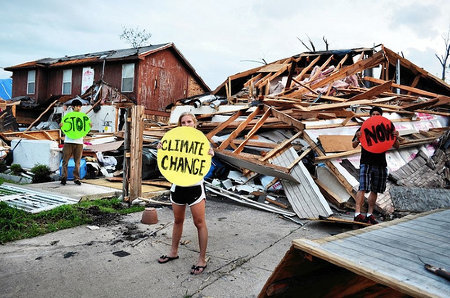
And the preemptive scapegoating didn’t stop there. He also warned that if the pace of reconstruction turned out to be sluggish (as it so often is) then “pro-union rules such as the Davis-Bacon Act” would be to blame, a reference to the statute that requires workers on public-works projects to be paid not the minimum wage, but the prevailing wage in the region.
The same day, Frank Rapoport, a lawyer representing several billion-dollar construction and real estate contractors, jumped in to suggest that many of those public works projects shouldn’t be public at all. Instead, cash-strapped governments should turn to “public private partnerships,” known as “P3s.” That means roads, bridges and tunnels being rebuilt by private companies, which, for instance, could install tolls and keep the profits.
Up until now, the only thing stopping them has been the law—specifically the absence of laws in New York State and New Jersey that enable these sorts of deals. But Rapoport is convinced that the combination of broke governments and needy people will provide just the catalyst needed to break the deadlock. “There were some bridges that were washed out in New Jersey that need structural replacement, and it’s going to be very expensive,” he told The Nation. “And so the government may well not have the money to build it the right way. And that’s when you turn to a P3.”
Ray Lehmann, co-founder of the R Street Institute, a mouthpiece for the insurance lobby (formerly a division of the climate-denying Heartland Institute), had another public prize in his sights. In a Wall Street Journal article about Sandy, he was quoted arguing for the eventual “full privatization” of the National Flood Insurance Program, the federal initiative that provides affordable protection from some natural disasters—and which private insurers see as unfair competition.
But the prize for shameless disaster capitalism surely goes to right-wing economist Russell S. Sobel, writing in a New York Times online forum. Sobel suggested that, in hard-hit areas, FEMA should create “free trade zones—in which all normal regulations, licensing and taxes [are] suspended.” This corporate free-for-all would, apparently, “better provide the goods and services victims need.”
Yes that’s right: this catastrophe very likely created by climate change—a crisis born of the colossal regulatory failure to prevent corporations from treating the atmosphere as their open sewer—is just one more opportunity for more deregulation. And the fact that this storm has demonstrated that poor and working-class people are far more vulnerable to the climate crisis shows that this is clearly the right moment to strip those people of what few labor protections they have left, as well as to privatize the meager public services available to them. Most of all, when faced with an extraordinarily costly crisis born of corporate greed, hand out tax holidays to corporations.
Is there anyone who can still feign surprise at this stuff? The flurry of attempts to use Sandy’s destructive power as a cash grab is just the latest chapter in the very long story I have called The Shock Doctrine. And it is but the tiniest glimpse into the ways large corporations are seeking to reap enormous profits from climate chaos.
One example: between 2008 and 2010, at least 261 patents were filed or issued related to “climate-ready” crops—seeds supposedly able to withstand extreme conditions like droughts and floods; of these patents close to 80 percent were controlled by just six agribusiness giants, including Monsanto and Syngenta. With history as our teacher, we know that small farmers will go into debt trying to buy these new miracle seeds, and that many will lose their land.
When these displaced farmers move to cities seeking work, they will find other peasants, indigenous people and artisanal fishing people who lost their lands for similar reasons. Some will have been displaced by foreign agribusiness companies looking to grow export crops for wealthy nations worried about their own food security in a climate stressed future. Some will have moved because a new breed of carbon entrepreneur was determined to plant a tree farm on what used to be a community-managed forest, in order to collect lucrative credits.
In November 2010, The Economist ran a climate change cover story that serves as a useful (if harrowing) blueprint for how climate change could serve as the pretext for the last great land grab, a final colonial clearing of the forests, farms and coastlines by a handful of multinationals. The editors explain that droughts and heat stress are such a threat to farmers that only big players can survive the turmoil, and that “abandoning the farm may be the way many farmers choose to adapt.” They had the same message for fisher folk inconveniently occupying valuable ocean-front lands: wouldn’t it be so much safer, given rising seas and all, if they joined their fellow farmers in the urban slums? “Protecting a single port city from floods is easier than protecting a similar population spread out along a coastline of fishing villages.”
But, you might wonder, isn’t there a joblessness crisis in most of these cities? Nothing a little “reform of labor markets” and free trade can’t fix. Besides, cities, they explain, have “social strategies, formal or informal.” I’m pretty sure that means that people whose “social strategies” used to involve growing and catching their own food can now cling to life by selling broken pens at intersections, or perhaps by dealing drugs. What the informal social strategy should be when super storm winds howl through those precarious slums remains unspoken.
For a long time, climate change was treated by environmentalists as a great equalizer, the one issue that affected everyone, rich or poor. They failed to account for the myriad ways by which the superrich would protect themselves from the less savory effects of the economic model that made them so wealthy. In the past six years, we have seen the emergence of private firefighters in the United States, hired by insurance companies to offer a “concierge” service to their wealthier clients, as well as the short-lived “HelpJet”—a charter airline in Florida that offered five-star evacuation services from hurricane zones. “No standing in lines, no hassle with crowds, just a first class experience that turns a problem into a vacation.” And, post-Sandy, upscale real estate agents are predicting that back-up power generators will be the new status symbol with the penthouse and mansion set.
It seems that for some, climate change is imagined less as a clear and present danger than as a kind of spa vacation; nothing that the right combination of bespoke services and well-curated accessories can’t overcome. That, at least, was the impression left by the Barneys New York pre-Sandy sale—which offered deals on Sencha green tea, backgammon sets and $500 throw blankets so its high-end customers could “settle in with style”. Let the rest of the world eat “social strategies, formal or informal.”
So we know how the shock doctors are readying to exploit the climate crisis, and we know from the past how that would turn out. But here is the real question: Could this crisis present a different kind of opportunity, one that disperses power into the hands of the many rather than consolidating it the hands of the few; one that radically expands the commons, rather than auctions it off in pieces? In short, could Sandy be the beginning of a People’s Shock?
I think it can. As I outlined last year in these pages, there are changes we can make that actually have a chance of getting our emissions down to the level science demands. These include relocalizing our economies (so we are going to need those farmers where they are); vastly expanding and reimagining the public sphere to not just hold back the next storm but to prevent even worse disruptions in the future; regulating the hell out of corporations and reducing their poisonous political power; and reinventing economics so it no longer defines success as the endless expansion of consumption.
These are approaches to the crisis would help rebuild the real economy at a time when most of us have had it with speculative bubbles. They would create lasting jobs at a time when they are urgently needed. And they would strengthen our ties to one another and to our communities— goals that, while abstract, can nonetheless save lives in a crisis.
Just as the Great Depression and the Second World War launched populist movements that claimed as their proud legacies social safety nets across the industrialized world, so climate change can be a historic moment to usher in the next great wave of progressive change. Moreover, none of the anti-democratic trickery I described in The Shock Doctrine is necessary to advance this agenda. Far from seizing on the climate crisis to push through unpopular policies, our task is to seize upon it to demand a truly populist agenda.
The reconstruction from Sandy is a great place to start road testing these ideas. Unlike the disaster capitalists who use crisis to end-run democracy, a People’s Recovery (as many from the Occupy movement are already demanding) would call for new democratic processes, including neighborhood assemblies, to decide how hard-hit communities should be rebuilt. The overriding principle must be addressing the twin crises of inequality and climate change at the same time. For starters, that means reconstruction that doesn’t just create jobs but jobs that pay a living wage. It means not just more public transit, but energy efficient affordable housing along those transit lines. It also means not just more renewable power but democratic community control over those projects.
But at the same time as we ramp up alternatives, we need to step up the fight against the forces actively making the climate crisis worse. Regardless of who wins the election, that means standing firm against the continued expansion of the fossil fuel sector into new and high-risk territories, whether through tar sands, fracking, coal exports to China or Arctic drilling. It also means recognizing the limits of political pressure and going after the fossil fuel companies directly, as we are doing at 350.org with our “Do The Math” tour. These companies have shown that they are willing to burn five times as much carbon as the most conservative estimates say is compatible with a livable planet. We’ve done the math, and we simply can’t let them.
We find ourselves in a race against time: either this crisis will become an opportunity for an evolutionary leap, a holistic readjustment of our relationship with the natural world. Or it will become an opportunity for the biggest disaster capitalism free-for-all in human history, leaving the world even more brutally cleaved between winners and losers.
When I wrote The Shock Doctrine, I was documenting crimes of the past. The good news is that this is a crime in progress; it is still within our power to stop it. Let’s make sure that this time, the good guys win.
Reflections on Dr. King’s Evil Triplets

“We must rapidly begin the shift from a “thing-oriented” society to a “person-oriented” society. When machines and computers, profit motives and property rights are considered more important than people, the giant triplets of racism, materialism, and militarism are incapable of being conquered.” Dr. Martin Luther King Jr.
In 1967, Dr. Martin Luther King Jr. gave one of the more memorable and dynamic speeches of his life.
The “Beyond Vietnam: A Time to Break Silence” speech is an amazing piece of writing that gives an incredible astute analysis of US foreign policy and US power.
In this speech King shares a solid understanding of US policy in Vietnam, in South East Asia and in the rest of the world that the US was involved in at the time.
However, King did not see US foreign policy merely through an anti-war lens. King understood the real nature of US foreign policy and US power and identified them as the evil triplets of racism, capitalism and militarism.
Dr. King understood that these were the structural or systemic problems that the people of the US faced and that they were at the root not only of the US war in Vietnam, but the US war against Black America.

A revolution against an edifice that creates poverty
On the matter of capitalism, Dr. King recognized the need for revolutionary change and replacing an economic system that created and functioned on poverty and suffering. Using the language of his faith King said:
A true revolution of values will soon cause us to question the fairness and justice of many of our past and present policies. On the one hand we are called to play the good Samaritan on life’s roadside; but that will be only an initial act. One day we must come to see that the whole Jericho road must be transformed so that men and women will not be constantly beaten and robbed as they make their journey on life’s highway. True compassion is more than flinging a coin to a beggar; it is not haphazard and superficial. It comes to see that an edifice which produces beggars needs restructuring. A true revolution of values will soon look uneasily on the glaring contrast of poverty and wealth. With righteous indignation, it will look across the seas and see individual capitalists of the West investing huge sums of money in Asia, Africa and South America, only to take the profits out with no concern for the social betterment of the countries, and say: “This is not just.”
Taking a cue from Dr. King, it seems pretty clear that we have an “edifice” called capitalism, which produces poverty and definitely needs restructuring. I do not take his comments to mean we need to reform the system, rather we need a new one not centered around profit and private property, as the slain civil rights leader pointed out.
We also should take to heart the need for those who seeks radical change to have righteous indignation directed at those with tremendous wealth, no matter how “philanthropic” they might be. Indeed, this was at the core of the Occupy Movement, the righteous indignation directed at the 1%.
US Militarism
“A nation that continues year after year to spend more money on military defense than on programs of social uplift is approaching spiritual death.”
This statement from Dr. King at his Beyond Vietnam speech is a powerful one, but one that is too often forgotten by those who continue to support war mongers. According to the National Priorities Project, the US has spent (as of this posting) nearly $1.4 Trillion jut on the occupations of Iraq and Afghanistan. Imagine if that kind of money was redirected to human needs right here in this country, in this state, in all of our communities. Poverty, debt, poor nutrition and lack of health care could all be done away with.
However, on the eve of the 2012 election, neither the Democrats or Republicans are talking about any reductions in the US military budget. Instead, the two wings of the capitalist system are vying to see which can be better at war making and imperialism.
A new evil triplet – Climate Change
In thinking about a third major issue that has far reaching implications, I would like to suggest that we modify Dr. King’s list of evil triplets and exchange racism for climate change. This is not to say that racism is no longer a serious threat to humanity, since it certainly is. However, Climate Change confronts all of us in a new and daunting way. If we do not reduce the current levels of carbon emissions by 80% before 2050, we might not have a future.
This is the level of reduction in carbon emissions put forth by the Inter-Governmental Panel on Climate Change since 2007, and some are arguing that it might be worse in 2012 than it was when the international panel of climate scientist put forth their original data.
Without focusing too much on numbers, it is important to recognize two things about where we stand on Climate Change. First, there has been no substantive effort from the major industrial governments of the world, particularly the US on this matter. Secondly, the fossil fuel industry has made it clear they don’t give a damn about our collective future, just so long as they can continue to make profits. And since this is where they stand on these issues, they continue to make sure that the political system in this country won’t do anything to seriously disrupt their profit-making goal.
Lastly, it must be stated that Climate Change is a direct consequence of the militarism and capitalism, which Dr. King directed is rage towards in his 1967 speech. The warming of the planet is a result of an economic system based on profits and constant growth. In order for that system to fulfill its needs, it will use military force to achieve such ends, which means that the burning of fossil fuels will accelerate, since the US military is one of the largest consumers of fossil fuels on the planet.
On this day before the 2012 elections, let us commit to working on doing away with the evil triplets of our time – militarism, capitalism and climate change. And let us recognize, as Dr. King did, that doing away with such deeply entrenched system will require sacrifice, it will require risk and it will require way more than the sideshow that is electoral politics.
Obama’s Secret Wars
This article by Patrick Cockburn is re-posted from CounterPunch.
Drones or their equivalent have long attracted political and military leaders dreaming of the surgical removal of their enemies. In 1812, the governor of Moscow, Count Rostopchin, devised a plan to get a hot-air balloon to hover over the French lines at Borodino and drop an explosive device on Napoleon. The source for this is the memoirs of the French writer, traveller and politician Chateaubriand and I have not read it anywhere else, but the story illustrates how, from the first moment man took to the air, he has seen it as a means of assassination.
President Barack Obama thinks much the same way as Rostopchin did 200 years ago. The enhanced and secret use of unmanned drones is one of the most striking features of his foreign policy. During his presidency they have been used against Pakistan, Yemen, Somalia, Afghanistan, Libya and Iraq. In Pakistan alone some 337 CIA strikes have killed 1,908 to 3,225 people since 2004, according to the Washington-based New America Foundation. Of these, between 1,618 and 2,769 are said to have been militants.
The precision of the numbers, combined with the great disparity between the highest and lowest figures, will send a chill through anybody who has examined US air attacks in Iraq and Afghanistan. Official mendacity about civilians killed has been a feature of every air war. Within days of the fall of the Taliban in 2001, the US military was trying to explain away why it had blown up Afghan wedding parties that it claimed were convoys of “terrorists”.
What makes Obama’s drone wars so important is that they are right at the centre of foreign policy in South Asia, the Middle East and North Africa. Drones were used by George W Bush between 2004 and 2008 on a smaller scale, but their mass use since is not just the fruit of technical developments or tactical convenience.
One of the most important changes in world politics over the past decade is that the US has failed to win two wars, one in Iraq, the other in Afghanistan, despite deploying large and vastly expensive land armies. Equally telling, these failures were against relatively puny forces of guerrillas. For American hardliners and neo-liberals these wars were designed to lay the ghosts of Vietnam and Somalia, enabling the open use of US military might, but they turned out to be Vietnam and Somalia revisited. American popular and establishment support for military intervention abroad using ground troops is at a low ebb.
The use of unmanned drones seems to avoid these problems. First of all there are no direct and immediate American casualties. The attacks also sound as if they are carrying the fight to the enemy in the shape of al-Qa’ida, with its top 20 operatives in north-west Pakistan being regularly eliminated – only to be mysteriously replaced by another top 20 operatives. Drone strikes have been difficult for the Republicans to criticise during the presidential campaign without opening themselves up to charges that they are soft on terrorism. In one of the few sensible remarks on foreign policy in the presidential debates, Mitt Romney said “we can’t kill our way out of this”, but later added that this did not mean he was anti-drone.
From the White House’s point of view, drones have the great advantage of being largely secret. Richard Nixon and Henry Kissinger were once denounced as war criminals for waging a secret bombing campaign by B-52s on Cambodia. The official silence over today’s drones can be justified by claiming that this is a covert war against al-Qa’ida waged by the CIA and the US Joint Special Operations Command, and requires secrecy to be effective.
Are the drones as effective as claimed? Air power has always over-sold itself as being cheap and deadly compared with ground forces. It was first used by the Italians in their colonial conquest of Libya in 1911. Britain’s “Bomber” Harris, who led the RAF Bomber Command during its mass raids on Germany in the Second World War, cut his teeth devastating Kurdish villages in Iraq in the 1920s.
Air power can deliver much, but it cannot deliver everything. This is as true of drones as it is of B-52s. The drones make more political sense at home than military sense abroad. Whatever the accuracy of the missiles, targets must still be identified before they are destroyed, requiring good local information. Where the local state is weak or nonexistent, as in Yemen, Somalia, Libya or Waziristan in north-west Pakistan, this is easy to do because the CIA can have its own network of agents or co-operate with local intelligence agencies.
But there is something misleading and almost comical about a picture of al-Qa’ida as a tightly organised group along the lines of a miniature Pentagon. It is, on the contrary, much more a series of political and religious attitudes combined with willingness to wage holy war using certain tactics, notably suicide bombing.
Drones have other serious disadvantages. They create rage in the countries where they are used, such as Pakistan. If, as is evident, they are carried out with the connivance of Islamabad, this discredits the government as American proxies. Exact figures about civilian casualties are often mythical since outsiders do not know who is living in family compounds in Afghanistan or north-west Pakistan (witness the time it took for US intelligence to find Osama bin Laden in his Abbottabad compound).
Many places where drones are used are inaccessible to foreign or even local journalists. Civilian casualties can be minimised or denied. I reported in 2009 a US bombing raid on three villages in Farah province, south of Herat, which killed 147 people, according to locals. There were craters 30ft deep which a US spokesman cheerfully suggested had been made by Taliban fighters throwing grenades into houses. This was an obvious lie, but it was impossible for journalists to prove the opposite.
Of course, local people knew what had happened. They drove their tractors pulling trailers full of body parts to the provincial capital where government soldiers opened fire, killing three of them. I wondered at the time how many of the surviving young men of the three villages, and in the rest of Farah province, joined the Taliban because of that bombing raid.
Drones do not change very much on the ground. They do provide political camouflage at home and abroad, concealing the US retreat in Afghanistan and Iraq. They store up trouble because they may create more enemies than they eliminate. They rely on a network of informants that can only be established in weak, failed or failing states. They also invite other states such as China and Russia to invest in drones to kill their dissidents beyond their borders. Secret assassination campaigns by drones, hot-air balloons, bombs or rare poisons all carry the risk that somebody, somewhere is plotting their retaliation.
After Sandy, Communities Mobilize A New Kind Of Disaster Relief
This article by Laura Gottesdeiner is re-posted from ZNet.
I’m not sure when I realized that we were in the middle of a full-blown disaster. Maybe it was when I saw the outline of a National Guard soldier hanging off the side of a hummer on a blackened strip of Rockaway Boulevard. Perhaps it was when I received a panicky email from an assemblyman’s office saying that “ppl are starving in Broad Channel.” I’m sure the comparisons to Hurricane Katrina and September 11 helped speed the realization. All I know for sure is that by Thursday, when widespread gas shortages swept New York City and out-of-staters began offering to donate bio-diesel trucks, I understood that we were organizing in the midst of a crisis.
Communication and travel in the affected areas has been difficult for lack of electricity and cell reception, but reports are nevertheless circulating among the network of volunteers who have mobilized since Tuesday morning, when Hurricane Sandy abated. There were stories of elderly women eating food out of dumpsters in still-blacked-out Lower Manhattan; a large ship cresting the median of a highway in Rockaway; the Red Cross aid station in the center of a desolate parking lot in Staten Island, guarded by NYPD barricades and serving only military rations; trick-or-treating through the pitch-black streets of Red Hook; the anxiety over running out of gas; kids navigating the former streets in a canoe; seniors stuck in their homes; families told to abandon their pets because the emergency shelters can’t accommodate animals. In some of these isolated pockets of the city, the logistical challenges are so daunting that federal authorities were just getting their feet on the ground as late as Thursday afternoon.
Meanwhile, a grassroots network of community-run relief stations and free kitchens has sprung up in the wake of Hurricane Sandy. The response began small and grew rapidly. On Monday there appeared an Occupy Sandy Relief Facebook page and the Recovers sites, set up by the environmental organization 350.org. Tuesday, a free kitchen opened at the Red Hook Initiative, a small nonprofit adjacent to a 5,000-person public housing complex without electricity. Wednesday, another kitchen was up and running in Rockaway Beach, much of which was on fire. During a Thursday evening conference call, it took an hour simply to list the number of drop-off locations, distribution sites and on-the-ground relief stations that spanned at least four of the boroughs, all coordinated by the InterOccupy network. Thousands of volunteers clamored to be put to work; donations were pouring in. The almost unwieldy expansion was similar to the early days of Zuccotti Park: spontaneous, decentralized and, for many, all-consuming. Few outside the network, however, understood that this relief was in itself an act of resistance.
Storms receive a very different kind of response from society and from government officials than other types of crises — especially in a major urban center like New York City. The police and firefighters suddenly take interest in people’s material needs; the Red Cross and FEMA, the Federal Emergency Management Agency, deploy millions of dollars and thousands of workers in efforts to alleviate the devastation. Officials yank on boots and call press conferences where they’ll say almost anything; Mayor Bloomberg went so far as to endorse Obama, words of support that the campaigning president welcomed with gratitude.
Unlike poverty, homelessness, hunger, displacement and other untenable living situations, weather-wrought devastation mobilizes public sympathy and government action because it is a “natural” disaster. This delineation is, of course, mostly a myth in the era of accelerating climate change. But it’s one society clings to anyway, because to recognize natural disasters as the natural outcomes of human capitalism would be even more disruptive than the storm itself.
For organizers, however, disaster relief and political protest are two tactics toward a common goal: stopping large-scale human suffering incentivized by global economic forces. After all, as a former volunteer at occupied Zuccotti Park recently reminded me, Occupy itself was also born out of a deadly and lucrative crisis.
I first learned this lesson from members of Occupy Homes Minneapolis, many of whom had been first responders after a tornado sliced through an area of North Minneapolis in May 2011. The storm knocked down chimneys, damaged roofs and sculpted trees into gigantic bonsais. A year later, as many of the same organizers focused on saving the area from the undeniably human-created foreclosure crisis, it was almost impossible to distinguish between the blocks that were hit by the tornado and those plagued by displacement. The boarded-up doors, the kicked-in cellar windows and neglected roofs were all the same. Aside from the intact trees, there were only two major differences. One was architectural: The tornado-stricken blocks were mostly filled with Tudor homes, while the foreclosed homes were, conveniently, more often 1940s Colonials with aluminum siding and copper wires that made them especially enticing for scrappers. The second was sentimental: The broader public had sympathy for the victims of the tornado, while, only one year later, the majority still held foreclosed-upon families responsible for the collective crisis that ended up claiming these families’ homes.
Hurricane Sandy wrecked devastation on thousands of New Yorkers, and temporary inconvenience on millions more. Meanwhile, nonprofits, churches, neighborhood groups and community organizers have been lending and continue to lend everything from a day’s work to a chainsaw to bike-powered electricity — a show of community care that many are talking about as the spirit of New Yorkers. The question remains, however, what will happen to this spirit when the effects of this storm abate, leaving us again to the mercy of a world that incentivizes suffering. At the very least, an even stronger relief network will be in place to weather the next surge.
Michiganders Fight Fracking on State Land
This article by Maryann Lesert is re-posted from In These Times.
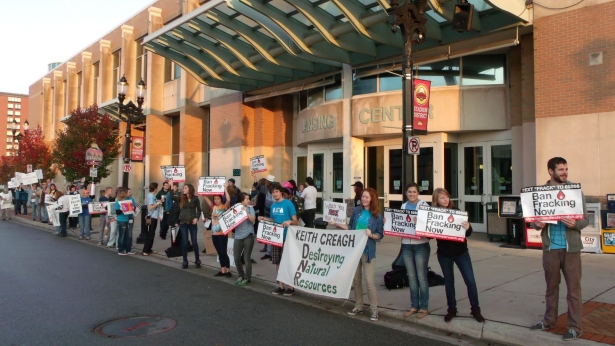
(Photo by Maryann Lesert)
At 8:00 a.m. on October 24, over 100 protesters gathered outside Michigan’s Lansing Center, preparing to do battle with the Michigan Department of Natural Resources (MDNR). A banner dropped over a roof across the street read, “No Fracking. No Compromise.” Thirty minutes later, two balloons with noisemaking devices floated up to the atrium ceiling, beeping over the staircase and the hall to the auction room, as more banners appeared: “Deep Water Earth First!” and “You Frack and We’ll Be Back!”
The occasion for the protest was the MDNR’s biannual auction of hundreds of thousands of acres of public land to bidders interested in purchasing mineral rights leases for oil and gas drilling. The MDNR, charged with “manag[ing] state-owned mineral rights in a manner that protects and enhances the public trust,” has held leasing auctions for decades, but in the past five years, with increased industry speculation over Michigan’s shale layers and potential gas and oil production, the MDNR has leased out over one million acres through a process some Michiganders feel favors the industry (and the money it brings to the table) over the public.
The October 24 auction saw mineral rights for over 193,000 acres of state land in 22 counties put up for bid. And the protesters—college students, middle-aged Michigan residents alarmed that the right to extract minerals and water from the land around their homes and communities was about to be handed over to the oil and gas industry—were hoping to stop the auction and the quiet spread of horizontal hydraulic fracturing (or fracking) across “Pure Michigan,” as the state’s tourism department calls it.
Kevin Heatley is a restoration ecologist from Pennsylvania who lives on the Marcellus Shale, a gas-rich shale “play” about a mile below the surface of parts of Ohio, West Virginia, Pennsylvania, and New York that has been extensively fracked. Heatley was at the auction last week and understands protesters’ concerns. “It only took [the natural gas industry] four to five years to fundamentally change Pennsylvania. And they use the same playbook everywhere they go.” With the Michigan Department of Environmental Quality’s current map of frack wells showing 40 permits issued (over half of which are on state land) and another 15 applications pending, Heatley predicts that “the whole lower peninsula is going to be under the drill” if the industry has its way.
The industry has a friend in Michigan’s GOP-controlled House. In April, the Natural Gas Subcommittee released a report recommending that the state lease all of its remaining public land—5.3 million acres of mineral rights—and encouraging fracking and carbon dioxide injection to boost extraction. Bemoaning the fact that the MDNR currently administers “only 14,136 oil and gas leases,” the report called for “lease or lose” legislation that would “effectively force the state to lease all mineral interests not currently leased.”
Public opposition to the auctioning off of state land for oil and gas drilling began building momentum at last May’s auction, when the state offered mineral rights to 108,000 acres, including Barry and Oakland County recreation areas that locals expected the MDNR to protect. As bidders walked into the building to register, protesters drummed and chanted; later they banged on the auction room windows as specific parks went up for bid. In the wake of that auction, several action groups formed, including the Committee to Ban Fracking in Michigan. (Full disclosure: I worked on the Committee’s summer signature drive to get a fracking ban on the November 2012 ballot; I’ve also shared research and writing with anti-fracking education groups, such as Ban Michigan Fracking, that are working with the Committee to gather the 322,600 signatures needed to get a ban on the 2014 ballot.)
Last week’s protest was organized by Central Michigan University students Chloe Gleichman, Alysha McClain and Mariah Urueta, who formed Citizens Against Drilling on Public Land (CADPL) after attending the May auction. Frustrated by the MDNR’s lack of accountability, they drafted a petition urging MDNR Director Keith Creagh “to put our citizen’s welfare and environmental health as a top priority and cease oil and gas lease auctions on state land.” They collected 3,300 signatures and 13 nonprofit endorsements, and, with help from Michigan’s Food & Water Watch, delivered those signatures to a September 13 public comment session of the Natural Resources Commission. When Creagh announced that the October auction would go forward despite opposition, CADPL called on the coalition of individuals and grassroots groups to join the protest.
Inside the auction room at 9:00 a.m., after some initial disruptors had been removed, 10 or 12 armed MDNR conservation officers kept watch as protesters quieted and sat down. Signs posted between the public seating and the bidder’s area set the rules: “[T]here is no opportunity for public comment. Only the auctioneer and registered bidders are authorized to participate or speak.” But as bidding began, protesters continued to disrupt the proceedings, and within minutes a dozen had been evicted, including several who hollered out “Stolen!” during the auctioneer’s first few pronouncements that bidders had “won” acreage. Those making audible comments were turned over to Lansing police officers who recorded each protester’s name and address and evicted them from the building, warning that they would be arrested if they returned.
Within an hour, nearly half of the room had been evicted. As Allegan County bidding drew to a close, Kathy Chiaravalli, a human resources consultant who lives on Cass Lake in Oakland County, called out, “Why are we selling the right for them to poison us for pennies?” Chiaravalli was one of several people who registered to bid at the May auction, hoping to keep at least some land out of the hands of the oil and gas industry, but she realized early on that “bidding didn’t work. No matter what, we’d be outbid.” She’s been researching fracking from an economic perspective, trying to work with the governor’s office to raise the minimum bid. “At $10 per acre,” she said, “we’re subsidizing the industry.” As she was escorted out, she reiterated: “Billions in gas profits. Pennies for Michigan. Drink benzene!”
By the time the auction ended at 3:00 p.m., over 12,000 acres of the Allegan State Forest, several Kent County parks, and what seemed to be all of Ogemaw County’s public land had been leased. Forty protesters had been evicted and seven arrested, including three people who dove past the ropes that separated bidders from observers just before the auction began, in an attempt to lock themselves to the auction podium or the bidders’ tables.
Now, activist groups are looking ahead. The newly formed Michigan Land Air Water Defense (MiLAWD), working with Michigan environmental attorney Jim Olson, is seeking to nullify the results of the October and May auctions on the grounds that the MDNR has failed to uphold the public trust and to use its own regulations to protect state game, recreation, and other specialty designated areas. Meanwhile, the founders of CADPL, pleased by the banner drops, the direct action and the disruptions, are looking forward to keeping the solidarity and the momentum going. The next event, sponsored by MiLAWD, CADPL, Flow for Water, and Food & Water Watch, is a November 12 Michigan Fractivism workshop in Allegan that will feature sessions on legal issues, organizing, and using the media to promote awareness.
The fractivists’ hope is to increase public awareness and participation. Corinne Turner, a Barry county resident and one of the many protestors at both auctions, says of the May experience, “What struck me to my core as we marched and shouted in the lobby of Constitution Hall, was that we were in the people’s house, and they were downstairs auctioning off the people’s land. It was obvious that if more people knew about it, they’d be there too.”
The Indefinite Detention of the Progressive Voter
This article by Sam Husseini is re-posted from CounterPunch.
Earlier this year President Obama signed the National Defense Authorization Act into law. It allows for the indefinite detention without trial for any U.S. citizen deemed to be a terrorist or an accessory to terrorism.
Some might have thought that there would be wide-spread revolt among people who voted for Obama against legalized indefinite detention. And there was some protest, mostly led by Chris Hedges (who did not vote for Obama), with some legal victories against the law.
But the political success seems to have come from the law itself — in favor of Obama. Instead of provoking a revolt, the result seems to be this:
Obama is in effect telling his supporters: “You better support me more, because I just signed this law saying the president of the U.S. can detain anyone he wants. Now, do you want me to have this power, or do you want Mitt Romney to have this power?”
And so, perversely, Obama by signing a law most of his supporters almost certainly didn’t want, has actually ensured a greater grip on them. He has in effect indefinitely detained them.
Solving a problem in a positive way strengthens the citizenry. Avoiding doing so fosters a continual servitude upon the benevolence of corrupt power.
Similar effects are produced by targeting specific “constituencies”. Consider:
By allegedly deferring final decision on the XL pipeline, environmentalists concerned with climate disruption are further compelled to back Obama — with no assurance on the issues they presumably care about. But Obama benefits in a sense since this threat of the pipeline is real — people who care about this issue feel desperate, needing to stop Romney and minimize long term activism that could propel the emergence of the Green Party or another challenge to the mainstream.
Similarly, rather than resolving the standoff with Iran, keeping “all options on the table” — the Obama administration maintains the threat of war at a simmer while assured that “Romney is worse.”
Because “Obamacare” did not create a new structure, as Medicare and Social Security did, it is largely reversible, so, limited as it was, whatever benefits come from it are largely dependent on Obama winning the election.
This extends to dealings with foreign officials as well. The Financial Times recently reported: “Barack Obama has pleaded with Russia’s president for ‘space’ to deal with the issue of missile defense, saying he would have greater ‘flexibility’ after the 2012 U.S. election.”
After Obama stated that he personally favors gay marriage, gay pundit Dan Savage wrote: “Gay people better get out there and support the president. If he loses in November, we’ll be blamed.” What a cowering stance. This is a world were “constituencies” view themselves as such, not as citizens — and also, where they are made to work for the politician, not the other way around. Politicians thus are not “public servants” as they frequently depict themselves, but as lords that serfs are made to defend lest another “lord” who is worse prevail.
Similar patterns exist on a host of issues from military spending, to immigration, and a related dynamic happens with the Republican Party.
The entire structure of political support, of lesser evilism, of operating continuously out of fear, not only stifles dreaming, but the fixation on survival comes at the cost of actually living.
New Media We Recommend
Below is a list of new materials that we have read/watched in recent weeks. The comments are not a “review” of the material, instead sort of an endorsement of ideas and investigations that can provide solid analysis and even inspiration in the struggle for change. All these items are available at The Bloom Collective, so check them out and stimulate your mind.
Capitalism: A Structural Genocide, by Garry Leech – This new book by Garry Leech is an important contribution, not only to the growing body of anti-capitalist literature, but to our collective understanding of how millions are people die unnecessarily because of the structural violence that is inherent in capitalism. Leech makes the case about the inherent structural violence and structural genocide of capitalism by looking at numerous case studies, such as Mexico after NAFTA, neo-liberalism in India, disease and pharmaceutical companies in Sub-Saharan Africa and global climate change. In addition, Leech looks at the hegemonic role of the US education system, the media and the non-profit industrial complex. Capitalism: A Structural Genocide is well written and a powerful into illuminating own understanding of an economic system that is brutal, pathological and must be dismantled.
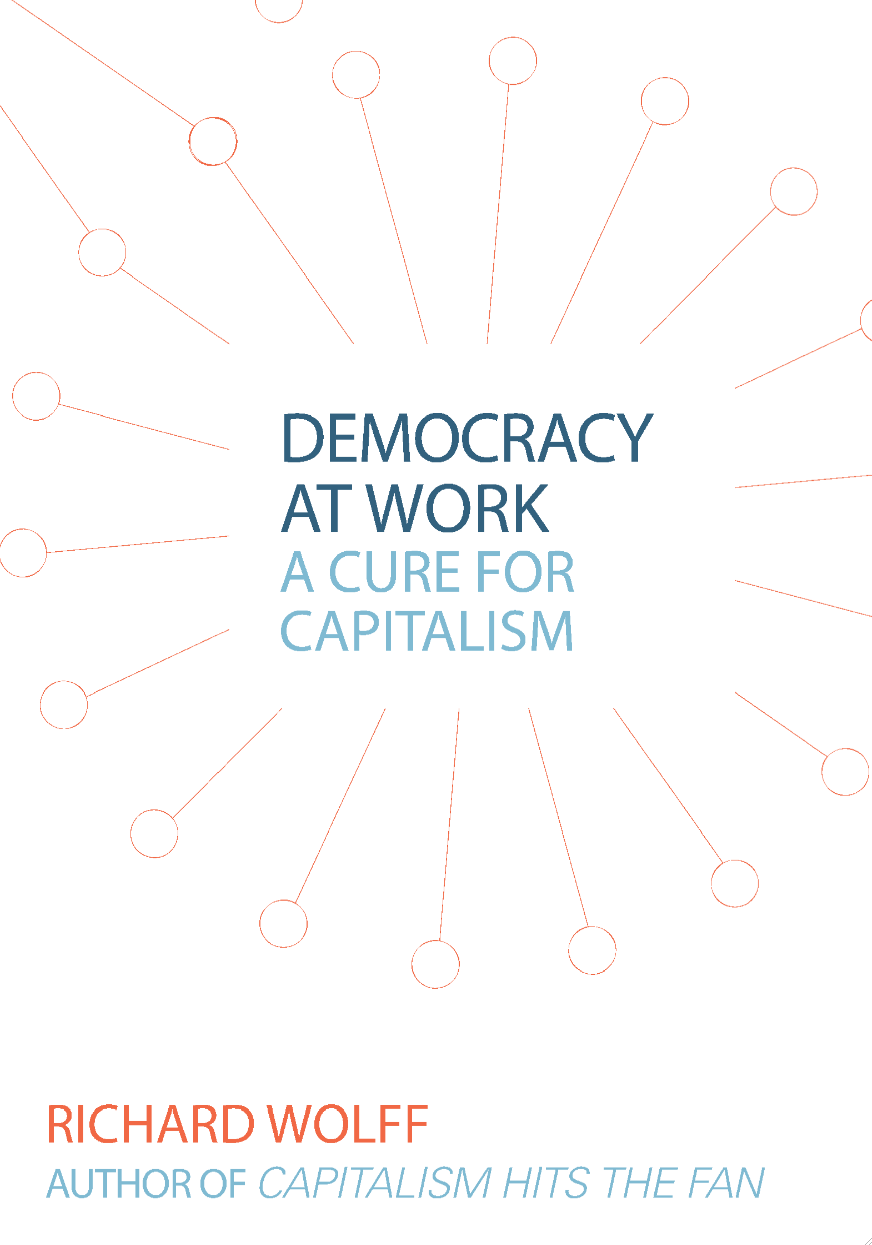
Democracy at Work: A Cure for Capitalism, by Richard Wolff – In his sequel to Capitalism Hits the Fan, Richard Wolff gives us another gem on understanding the structural problems of capitalism. This new book from Haymarket Books provides a strong critique of capitalism, particularly with the author’s investigation of the free market through history. Wolff not only points of the inherent anti-democratic nature of free market capitalism, he demonstrates that the evolving forms of State Capitalism in the US have only served to prop up the market as a means of avoid social revolution. Wolff looks at the crisis after the 1929 Stock Market crash and the more recent economic disaster from 2007/2008. What makes this book useful beyond the critique, is Wolff’s writing style, which is extremely accessible. The only shortcoming of the book is that he doesn’t spend enough time hashing out what he refers to as Worker Self-Direct Enterprises (WSDEs). He contrasts what WSDEs are with the anti-democratic nature of capitalist employees, but he could have made his argument stronger by providing more concrete examples of where and how these work. Despite this shortcoming, Democracy at Work is still worth reading.
Autobiography of a Blue-eyed Devil: My Life and Times in a Racist, Imperialist Society, by Inga Muscio – In her widely anticipated follow-up to Cunt: A Declaration of Independence, controversial author Inga Muscio asserts that the history we learn in school and throughout life is, in fact, a marketing brand developed by white men who maintain the right to spin their ideologies as hard facts. Muscio draws insight from personal experience, tackling a wide array of topics, from white normativity to gentrification to US foreign policy, with dissention and unflinching self-awareness. Beautifully written, with passion and delightful prose. Highly recommended.
Earth at Risk (DVD) – This 4 DVD collection is based on a recent conference featuring some of the best environmental voices in North America, which hosted a conference to talk about developing a culture of resistance to industrial capitalism and modern civilization. The format of each video is that Derrick Jensen facilitates a conversation with people who address different aspects of resisting and dismantling the system that is killing the planet. The conversations include environmental activist such as the amazing Indian writer Arundhati Roy, the environmental lawyer Thomas Linzey, Native American activist Waziyatawin, radical cartoonist Stephanie McMillan, and more. Each DVD provides a wealth of information and ideas for radical change. Highly recommended for those who believe that direct action is necessary for the future of all life.
Insurgent artist Josh MacPhee speaks at GVSU on art and resistance
Last night, GVSU hosted artist Josh MacPhee, with the international arts cooperative known as Just Seeds.
Josh identifies as a printmaker, but he said that his work and that of the collective is more about collecting people’s culture, particularly cultures of resistance.
He told the audience of mostly students and faculty that he wanted to talk about 5 projects the cooperative has been involved in, all of which deal with history. But before he discusses these project, MacPhee says that he had an interest in art from very early on, especially as a means of telling a story. He showed the audience a slide of a drawing he did at 6 of dinosaurs. He also told those in attendance that he was involved in punk rock, which because of its political nature, also influenced the evolution of his interest in doing radical art.
The Just Seeds Cooperative has produced two books, with two more in the works, books that are collections of international political artwork. The most recent volume Signal: 02, that we included in our recommended reading section, is a fabulous selection of international political art, which includes art from the 1968 Mexican student movement that was brutally repressed.
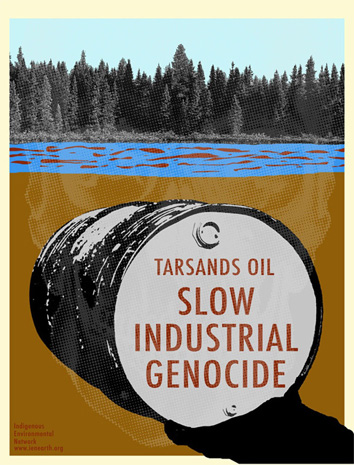
MacPhee then shifted to talking about the history-themed projects he mentioned in his opening remarks. One of those projects was called Resourced, dealing with the environment and resource extraction. While doing this project there was a campaign to bring a pipeline in with liquefied gas, which led to other prints being made. Just after this there was a large climate change summit in Cancun, where lots of their work was shown/used.
He then talked about the Quebec student movement, which was in part a response to the government’s attempt to increase student tuition. Massive protests broke out and the students made all kinds of images and used them for posters, signs, banners and put them in windows.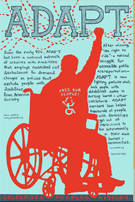
A third project that MacPhee mentioned was the Celebrate People’s History Project. This project was designed to both investigate and communicate the rich history of activism in particularly communities, a history, which has often been suppressed. MacPhee says about 60 of them have already been created, but many more are in the works. He said that the idea was to get them up on the street and add an e-mail addresses on the poster, so people could respond and give input. MacPhee says they get responses both positive and critical, but either way it has generated lots of conversation about this forgotten or suppressed history.
MacPhee then discussed the project they called United Victorian Workers. This was a project to reclaim the suppressed history about the radical labor organizing that was taking place over 100 years ago in one town. The group used street theater and gave out worker newspapers and buttons as a means to educate people about what organized workers did in those days. Here is a video of the project:
Another project MacPhee highlighted was called Spectres of Liberty. This is a multi-media project to make history visible, particularly the history of anti-slavery resistance that has been suppressed in the city of Troy. Ironically, Troy is supposed to be the hometown of the mythical character of Uncle Sam. Here is a video of one of those projects entitled The Ghosts of Liberty Street Church:
MacPhee also talked about a project called Interference Archive, which evolved out of their experience of dealing with archivists, who too often were unwilling to grant access to material created by activists in the past or were unwilling to allow such archived material come alive again in projects that people were working on. Their project was to create an archive space with materials available for anyone, so people can not only look at material, but use it again. They also use the space for creating new work, screenings, critiques, hosting exhibition and creating/displaying zines.
The last project that MacPhee presented dealt with the decades long struggle against the use of nuclear power. In this project there was an effort to connect the nuclear disaster at Three Mile Island in 1979 in Pennsylvania to what has happen at the Fukushima plant in Japan. Josh talked about how so many Hollywood movies are about The Apocalypse, which isually is presented as happening quite abruptly, but it was his contention, based on what is happening in Japan, that the Apocalypse happens slowly and we get to watch it. MacPhee said there is a massive movement in Japan against the nuke plant, where every week at least 50,000 people are protesting and using art as a form of resistance. MacPhee showed us a print he did that used the culturally iconic image of the Hollywood symbol in California and replaced it with the word Fukushima. MacPhee did this, waste from the nuclear disaster in Japan are now washing up on shore in California.

