The lack of action and silence by most Democratic lawmakers on the arrest and deportation of immigrants and foreign nationals who have spoken out against the US financed genocide in Gaza should tell us something about the Democratic Party.
For example, Rep. Hillary Scholten has said nothing about the numerous students and faculty members throughout the US that are being deported because of their stance against the US financed genocide in Gaza. I checked Scholten’s social media and her Congressional page, and it is nothing but silence. In addition, Rep. Scholten has not be interviewed by the news media regarding these ICE arrests of people who have spoken out in support of Palestine.

Of course, I am not surprised by this, especially since Rep. Scholten has unconditionally supported Israel ever since she took office in January of 2023, something I have methodically documented. Additionally, Rep. Scholten supported the Biden Administration’s position on the pro-Palestine campus movement, which was to chastise them. Nearly one year ago I wrote an article entitled, It’s bad enough that Rep. Hillary Scholten has consistently voted to fund the Israeli genocide of Palestinians, now she wants to condemn students who are publicly opposing genocide. In that article I stated:
Rep. Scholten, the so-called liberal, once again is demonstrating her allegiance to US Imperialism, to Zionism and her commitment to the repression of free speech. Notice that the Congresswoman provides no evidence of antisemitism. You just have to invoke it to make it a fact, just like Zionists preach. On top of the unsubstantiated claim of antisemitism, Rep. Scholten takes it one step further by partnering with a Republican from Indiana to introduce legislation that in reality is meant to further silence critics of Israel and US policies that support Israel.
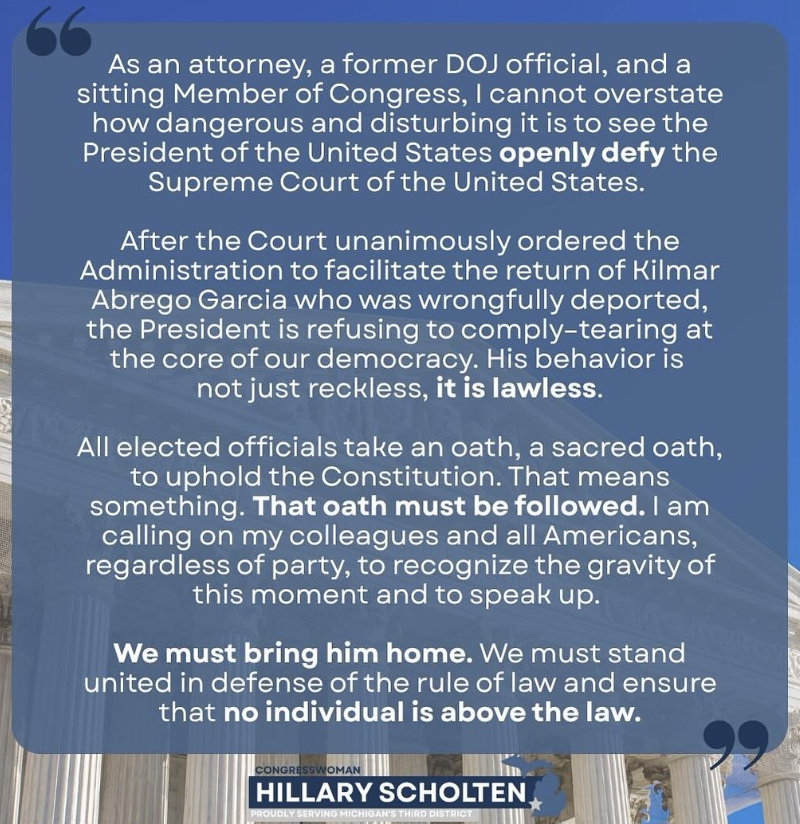 Now, in regards to the issue of Kilmar Abrego Garcia, Rep. Scholten did release a statement, which you can see here on the right. The statement is weak and deeply problematic. First, as Scholten often does, she reminds us that she is an attorney and former member of the Department of Justice, like that really means anything when she supports criminalizing immigrants and genocide in Gaza. Second, Scholten only released this statement after the US Supreme Court ruling and did not condemn what happened to Kilmar Abrego Garcia up until that point. Third, Scholten statement doesn’t center what happened to Kilmar Abrego Garcia, rather it is all about the Trump Administration. Fourth, Scholten ends the statement about how we need to stand united in defense of the rule of law. This is some shit, since the rule of law in the US has justified genocide, slavery, Jim Crow policies, mass deportations, mass incarceration, preventing people from having an abortion, criminalizing queer and trans people, and justifying an economic system that allows less than one percent of the population to expand their wealth while millions live in poverty.
Again, none of this is a surprise, since the Democratic Party has done virtually nothing to actually resist what the Trump Administration is currently doing, except make weak ass statements that urge us to defend the rule of law.
The anarchist writer Peter Gelderloos, in a recent article wrote:
It is insanely delusional to believe that the Democrat[ic Party is capable of changing in a meaningful way, and it is insanely delusional to trust them. They are guilty of genocide, mass murder, mass incarceration, impoverishment, bloody wars, and oppressive politics. The system they uphold, the system they promise can be reformed if we just trust them one more time, has condemned this generation and the next one and the next one to a future of unimaginable suffering, danger, and poverty.
I want to end with what I wrote in a recent article from last week, which is part 3 of a 3 part series:
Over the past few months, especially at the large rallies – those rallies that will not save us – I have seen signs that say things like, “defend our democracy” or “protect the constitution.” As someone who identifies as an anarchist, I in no way want to defend democracy or protect the constitution, especially since the Constitution and the so-called democracy in the US has been built on genocide, slavery, white supremacy, capitalism, patriarchy and ecological devastation. I don’t want to fight, to struggle, or to take risks, all for some 6th grade notion of what democracy is. I don’t want to pledge allegiance to some flag or give away my power to a government structure that was designed to benefit the wealthiest people in this country. As John Jay, a Founding Father and former Chief Justice of the Supreme Court, famously stated, “Those who own the country ought to govern it”. Our so-called democracy was designed the way that John Jay and the founders intended.
Episode #1 affirmed stereotypes about Black people, thus perpetuating structural racism. The episode also demonstrated that this TV series will be a highly constructed show with the GRPD dictating the narrative about who they are and what they do.
Episode #2 begins with a roll call at the GRPD, where one of the cops says, apparently some of the homeless people were raising hell at US 131 and Ann St. Viewers then see a GRPD cop in their cruiser and we hear this cop say that there is more crime at night, and that “nothing good happens after midnight.” No clarification or verification of the claims are made, since cops always tell the truth.
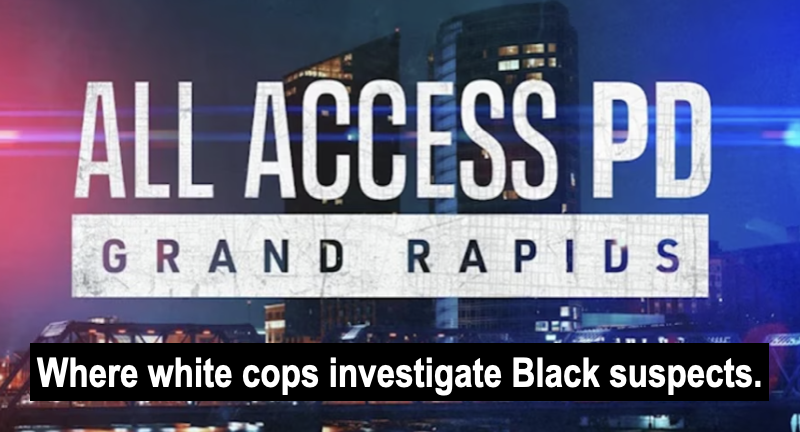
In the subsequent scene we hear gun shots being fired, a 911 call, with someone saying that gun shots happened in the street. This is followed by mostly bodycam footage, with a cop saying that they couldn’t find anyone who was shot.
We then see the GRPD in the same neighborhood, looking for clues and talking to residents about the shooting. A GRPD cop then goes to the hospital and talks to a Black woman who saw the shooting, since she brought someone to the hospital who had been hit by a bullet. This is also when we hear that the Black woman that the cop was speaking with said that they were on a “party bus”, which is the name of Episode #2.
Back at the scene of the shooting, where the cops find the party bus, they also find a gun and some bullet shell casings. Everyone the GRPD spoke to who were on the party bus, all appear to be BIPOC people.
Viewers are then introduced to a white female-appearing cop who says they were tasked with heading up the homicide investigation. The GRPD is back at the hospital, where the body of a Black man is on a stretcher and is pronounced dead. The GRPD cop “allows” the mother of the victim to pray over his body during a 30 second clip of the episode. Always important for a constructed TV show to demonstrate to viewers that the cops are compassionate.
About 10 minutes into the episode, the episode brings us back to the GRPD headquarters talking about getting the video footage from the party bus. Chief Winstrom then says that he has full confidence in the female officer. The female cop is attempting to speak with a Black person who saw what had happen, but refuses to give information without a lawyer. Chief Winstrom then calls this dynamic “generational mistrust.” Winstrom is followed by another GRPD cop who says that people who don’t come forward with information as a “societal problem.”
“Generational mistrust” and people not giving cops information as a “societal problem?” It is deeply unfortunately that the producers of this show do not unpack or interrogate these terms, terms which are politically and racially charged. A basic question that could be asked at this point is, do Black people have reason to not trust the police? This is a very basic question, but a critical one to think about and talk about. The All Access PD Grand Rapids show only provides the GRPD’s perspective on this matter. What if viewers heard from Angela Davis, Miriame Kaba, Andrea J. Ritchie, Ruth Wilson Gilmore or Marc Lamont Hill?
Back to the episode………
The cops then look at video from porch cameras and talk about the shooters. Chief Winstrom then talks to the camera saying the the Grand Rapids City Commission wants answers to the increase in shootings over the summer (summer of 2023). The next scene is in a City Commission meeting, with Winstrom addressing the commissioners. Winstrom then talks up Commissioner Knight, with the following scene including Lisa Knight and the mother of the shooting victim.
The episode then cuts to another day, where the GRPD get a call about another shooting, with a AR 15 rifle. The cops find the shooter who is in a vehicle and then takes off. The cops purse the vehicle onto Cesar Chavez Way/Grandville Ave, where the shooter is boxed in. A latino male gets out of the car with no apparent weapon, while the GRPD has guns pointed at him and then releases a police dog on the man. The dog bites the man, and then we see the man bloodied and in cuffs. Winstrom then says that the illegal use of guns is a problem.
The episode then pivots back to the party bus shooting, where the GRPD are now looking at the social media profiles of those who were on the party bus. The social media videos they show are primarily of Black people.
The next portion of the episode involves looking at the guns that was found and the bullet casings. The white female cop who was heading up the investigation received a photo of a Black guy in a white hat, the same white hat that was found at the scene of the shooting.

The potential suspect lives outside the city limits, so the Kent County Sheriff’s Department now gets involved, with them and the GRPD heading to the suspects home. Most of the cops arrive on the scene heavily armed and using an armored vehicle. For the next minute they use bodycam footage, in COPS-like fashion. Eventually, someone in the mobile home comes out and the GRPD begins to ask her questions.
A Black male witness comes in to speak with the GRPD. This witness had a gun and shot it into the air, but his brother also had a gun and fit the image of the photo that the GRPD had. The brother then came in (another Black man), but during the questioning the Black man’s face was not blurred, unlike other people in the episode. The female investigator continued the questioning and the man she was questioning stated he didn’t have a gun. The homicide investigator was “shocked” that this Black man denied having a gun.
The episode ends with the mother of the shooting victim coming in to the GRPD headquarters and talking to Winstrom on camera, praising them for all they have done on this case. The mother states, “You give off a vibe that you really care.” The mother then praises the female homicide investigator, with Winstrom and another cop smiling as the episode credits are rolling.
After watching two episodes, one could easily conclude that only Black & Brown people commit violent crimes and that the GRPD does the work to keep the public safe. However, the reality is quite different, where the GRPD is not preventing violence from happening, it traffics in racial stereotyping and celebrates cops as heroes. Anyone with half a brain is not buying this polished PR shit!
GRIID weekly audio digest #2
 In the second installment of the GRIID audio digest, we bring you the following three stories from last week:
- At last week’s Town Hall meeting Rep. Scholten left early to avoid being held accountable and State Rep. Grant would not own up to questions on housing and immigration
- Copaganda: Deconstructing the GRPD TV series on HBO/MAX – Episode #1
- Politicians and rallies won’t save us: We need direct action, disruptions to systems of power and community care
GRIID invites our readers to share this audio digest and suggest platforms that we can share these weekly audio versions of our posts.
One of the 10 principles of journalism is that it must serve as an independent monitor of power.
Now, I don’t claim to be a journalist, more of a media watchdog, but I do engage in movement media. Movement media is reporting and documenting what social movements are doing, which is what I have been trying to do with GRIID since 2009.
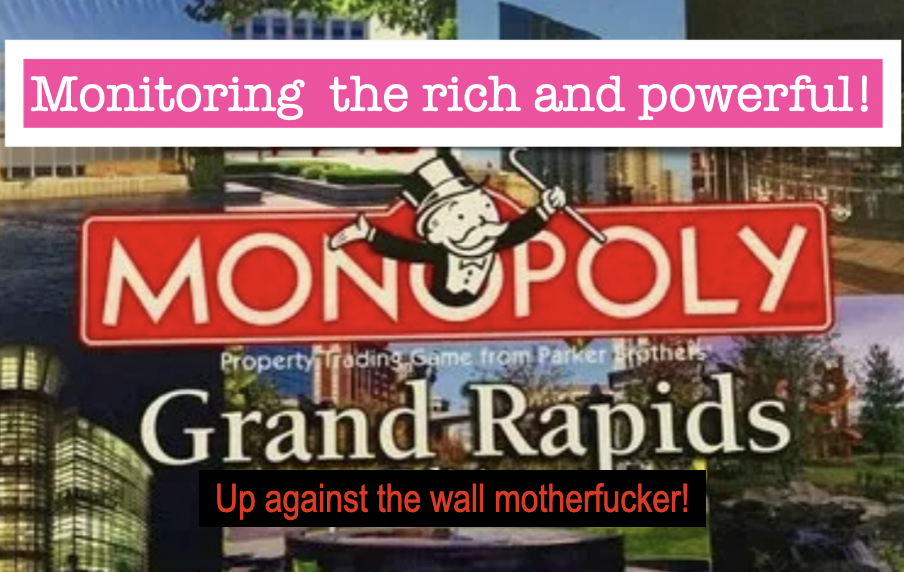
However, since I have been monitoring what I call the Grand Rapids Power Structure for nearly two decades, I thought I would start a new segment – Monitoring the Rich and Powerful in Grand Rapids.
The Monitoring the Rich and Powerful in Grand Rapids segments will offer brief commentary on those who have power over others in this community. These segments will not replace my regular reporting on the Grand Rapids Power Structure, since those stories will offer more in depth writing.
As we navigate a second Trump Administration with the likes of Elon Musk, it seems like a perfect opportunity to shed some light on rich and powerful of Grand Rapids, or to frame it the way that radical media from the 60s and 70s would do regarding the Capitalist Class, using the phrase, “up against the wall motherfucker!”
- Our first example comes to us from the monopoly business press for this city, Crain’s Grand Rapids Business, with the headline, DeVos, Van Andel families named Crain’s Newsmaker of the Year for 3 towers project. I found this story at https://dickdevos.com/, since he apparently likes to promote himself and his family……who knew! The Crain’s article doesn’t quote either the DeVos or Van Andel families, since they pay people to speak on their behalf. ““When you look at the location, it’s truly sitting in the center of an emerging sports entertainment district with the arena, amphitheater, the soccer stadium, just that vision for what could be,” Thomas said. Brad Thomas is the CEO of Progressive Companies and a lead shill on the DeVos/Van Andel 3 Towers Project. His comment about an “emerging sports entertainment district” is instructive, especially since these are all projects that were pimped by Grand Action 2.0, also started by the DeVos/Van Andel cartel. The result, as I have already noted, will expand the wealth of these billionaire families and it will primarily benefit tourists and the other businesses that are in the downtown area. The 3 Towers will also exclude the masses of people who won’t be able to afford any of the projects that Grand Action 2.0 has secured, with hundreds of millions in public money.
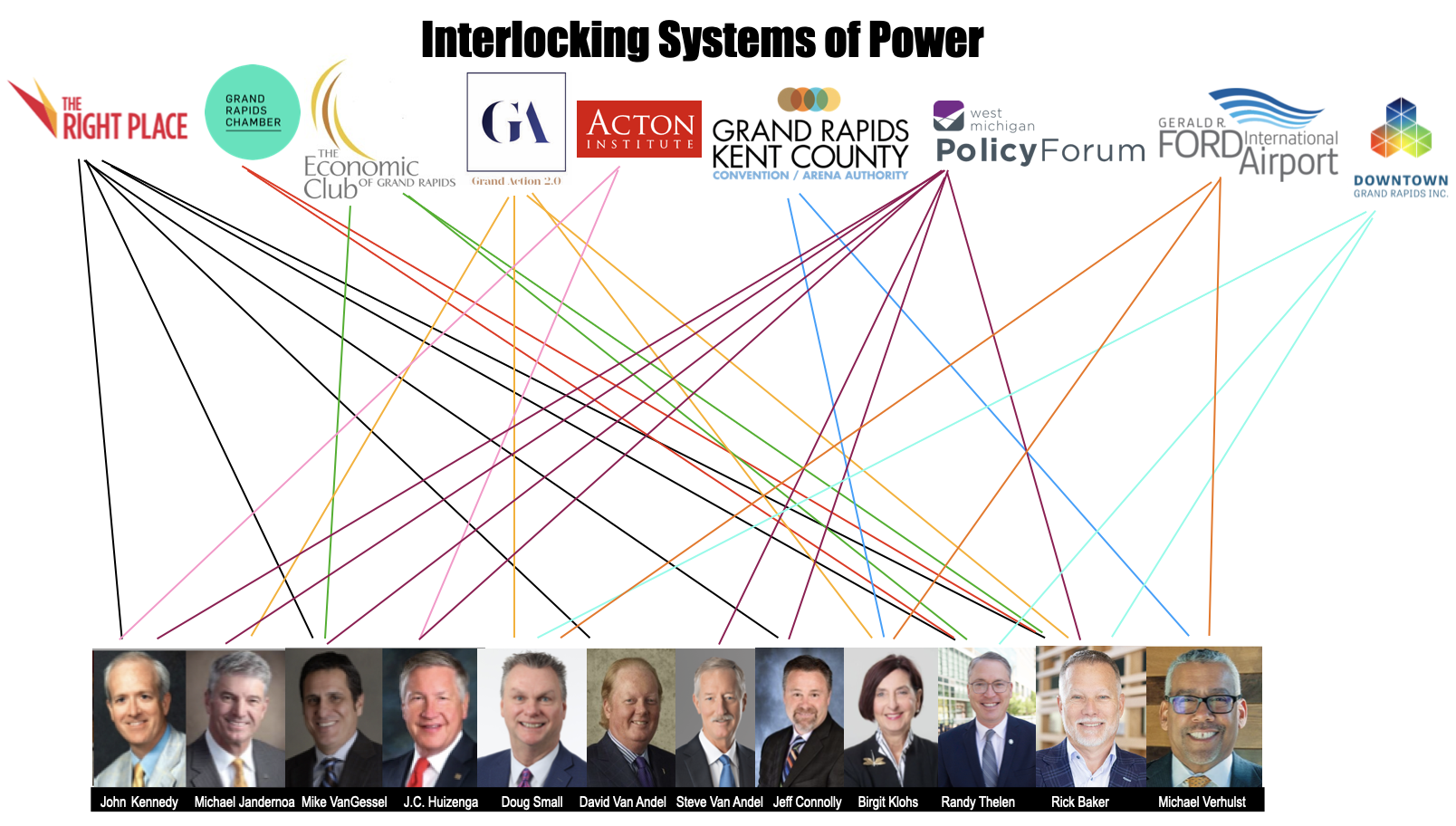
- Our second example for this installment of Monitoring the Rich and Powerful in Grand Rapids, centers around how the rich and powerful insert themselves onto Boards in order to have greater control over policy decisions and how money gets spent in this city. For example, the West Michigan Policy Forum is a who’s who of those that make up the Grand Rapids Power Structure. The Executive Committee alone has some of the biggest power brokers in this city, like Dick and Doug DeVos, John Kennedy, Michael Jandernoa, Mike VanGessel and J.C. Huizenga. The interlocking systems of power in this city are incestuous and should be yet another indication of how much power these robber barons have in this community.
Monitoring the most powerful family in West MI: DeVos Family Reader – April 2025 edition
 It has been eleven months since I last update the DeVos Family Reader. As always, there has been plenty to report on regarding the most powerful family in West Michigan.
In Howard Zinn’s monumental book, A People’s History of the United States, he constantly juxtaposes the amazing things that people did to fight for liberation and the people behind the systems of oppression that social movements were fighting against.
This is exactly why I have spent years monitoring, investigating and critiquing the DeVos Family. They are the most recognizable and powerful manifestation of the systems of power and oppression in West Michigan. Now, I know there are plenty of people who share the belief that without the DeVos Family, Grand Rapids wouldn’t be where it is today. I fully agree with that belief, but for reasons that are the exact opposite of those who hold the most powerful family in West Michigan in high regard.
This updated version of the DeVos Family Reader includes information and analysis on a variety of local issues, even some that are not directly focused on the DeVos Family, but there are connections.
The main issues that I have reported on since May of 2024 are:
- DeVos campaign contributions in the 2024 Elections, both in the Primary and the November Election.
- How the local commercial news media continues to acts as stenographers for the DeVos Family.
- How the DeVos Family continues to expand their wealthy by using public money for projects like the 3 Towers – announced last September, plus the new soccer stadium will be named the Amway Stadium. In addition, the DeVos and Van Andel families will be the owners of the new professional soccer team in Grand Rapids, which is what GRIID has predicted all along.
- Lastly, GRIID has posted several articles about the connection between the DeVos Family and the Trump Administration, including their connection to the groups behind Project 2025.
The DeVos Family Reader is now up to 815 pages, with more than 3 decades of reporting on the most powerful family in West Michigan.

Politicians and rallies won’t save us: We need direct action, disruptions to systems of power, and we need community care – Part III
Editor’s note: This is Part III of a three part series on movement work, strategies and tactics for the current political climate in the US.
Last week, I began a three part series on why we shouldn’t rely on politicians, the political system or over-reliance on specific tactics in order to create change and work to build the kind of world that we want to see.
In Part I, I addressed why politicians won’t save us, why rallies won’t save us, and why we need to develop goals, strategies and tactics to fight against systems of power and oppression. I primarily used examples from the Civil Rights Movement/Black Freedom Struggle, so I want to expand on that today by talking about Direct Action, disrupting systems of power and oppression, and why it is important if we want to achieve our goals.

In Part II, I talked about the importance of using disruptive tactics, especially if we really want to have an effect on systems of power and oppression, along with the power of Direct Action. Direct action means that we take collective action to change our circumstances, without handing our power to a middle person – bosses, politicians and or any other authority. Direct Action means we take matters into our own hands and not expect those in power to do what we want. Direct Action means forcing systems of power and oppression to do what we want.
In Part III, I want to talk about what we can do with each other, which is to practice Mutual Aid, Community Care and develop forms of self-governance that do not rely on the existing systems of power and oppression. However, before I talk about Mutual Aid and Community Care, I want to address some things about the so-called democracy we live in.
Over the past few months, especially at the large rallies – those rallies that will not save us – I have seen signs that say things like, “defend our democracy” or “protect the constitution.” As someone who identifies as an anarchist, I in no way want to defend democracy or protect the constitution, especially since the Constitution and the so-called democracy in the US has been built on genocide, slavery, white supremacy, capitalism, patriarchy and ecological devastation. I don’t want to fight, to struggle, or to take risks, all for some 6th grade notion of what democracy is. I don’t want to pledge allegiance to some flag or give away my power to a government structure that was designed to benefit the wealthiest people in this country. As John Jay, a Founding Father and former Chief Justice of the Supreme Court, famously stated, “Those who own the country ought to govern it”. Our so-called democracy was designed the way that John Jay and the founders intended.
While we are engaged in developing strategies to dismantle systems of power and use disruptive tactics and Direct Action, we need to simultaneously develop our own systems of governance and practice what Stephen D’Arcy calls a Transition Phase. D’Arcy lays out for us in his essay, Environmentalism as if Winning Mattered: A Self-Organization Strategy, what a Resistance Phase and a Transition Phase look like. Much of the Transition Phase should reflect the principles and practice of Mutual Aid and Community Care.
We take care of each other
The immigrant-led group Movimiento Cosecha GR often says, “what we need is already right here in our community.” What Cosecha organizers mean by this statement is not just material needs, but ideas, vision and radical imagination. Radical Imagination – imagining that another world is possible, that we don’t have to settle for what systems of power and oppression give us. As the great Puerto Rican poet, Martin Espada once said, “No change for the good ever happens without it being imagined first, even if that change seems hopeless or impossible in the present.”
Mutual Aid has been a practice in many communities and culture for a very long time. Mutual Aid project are essentially a form of political participation in which people take responsibility for caring for one another and not just through symbolic acts or putting pressure on representative, but by actually building social relationships that are more survivable. Check out this video, which provides a wonderful popular education framework for what Mutual Aid is.
I would also recommend that people read the book, Mutual Aid: Building Solidarity During this crisis (and the next), by Dean Spade. Spade, who is a long time activist/organizer, proposes four criteria for evaluating the success of a mutual aid effort:
- Does it provide material relief?
- Does it leave out an especially marginalized part of the affected group (i.e., people with criminal records, people without immigration status?)
- Does it legitimize or expand a system resistant left movements are trying to dismantle?
- Does it mobilize people, especially those most directly impacted, for ongoing struggle?
There are several groups that have been involved in Mutual Aid work in Grand Rapids over the years. The Bloom Collective hosted several of the first Really, Really Free Market events around 2007-2008. Really Really Free Markets are where people bring items they no longer need and then people take what they need, which means no one is buying or selling.
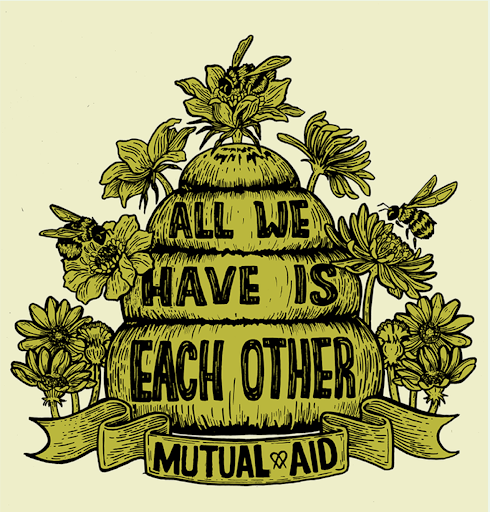 In 2017, GR Rapid Response to ICE started practicing Mutual Aid, by providing material support to immigrants that were impacted by Immigration and Customs Enforcement (ICE) violence. GR Rapid Response to ICE continues to practice Mutual Aid in the present. There are other groups, like the the West Michigan Care Collective and Grand Rapids Pullover Prevention. The Grand Rapids Area Mutual Aid Network, which was create at the beginning of COVID in March or 2020, also does amazing work in this community and has provided lots of material aid, including raising several hundred thousand in dollars of Mutual Aid for primarily BIPOC, queer, trans, those with disabilities and immigrant neighbors in the greater Grand Rapids area.
There have also been amazing Mutual Aid Projects that have been created to respond to a particular crisis over the last decade or so. Some inspiring examples are how quickly grassroots mutual aid groups responded to Hurricane Sandy and those that formed with the fires in Los Angeles last year.
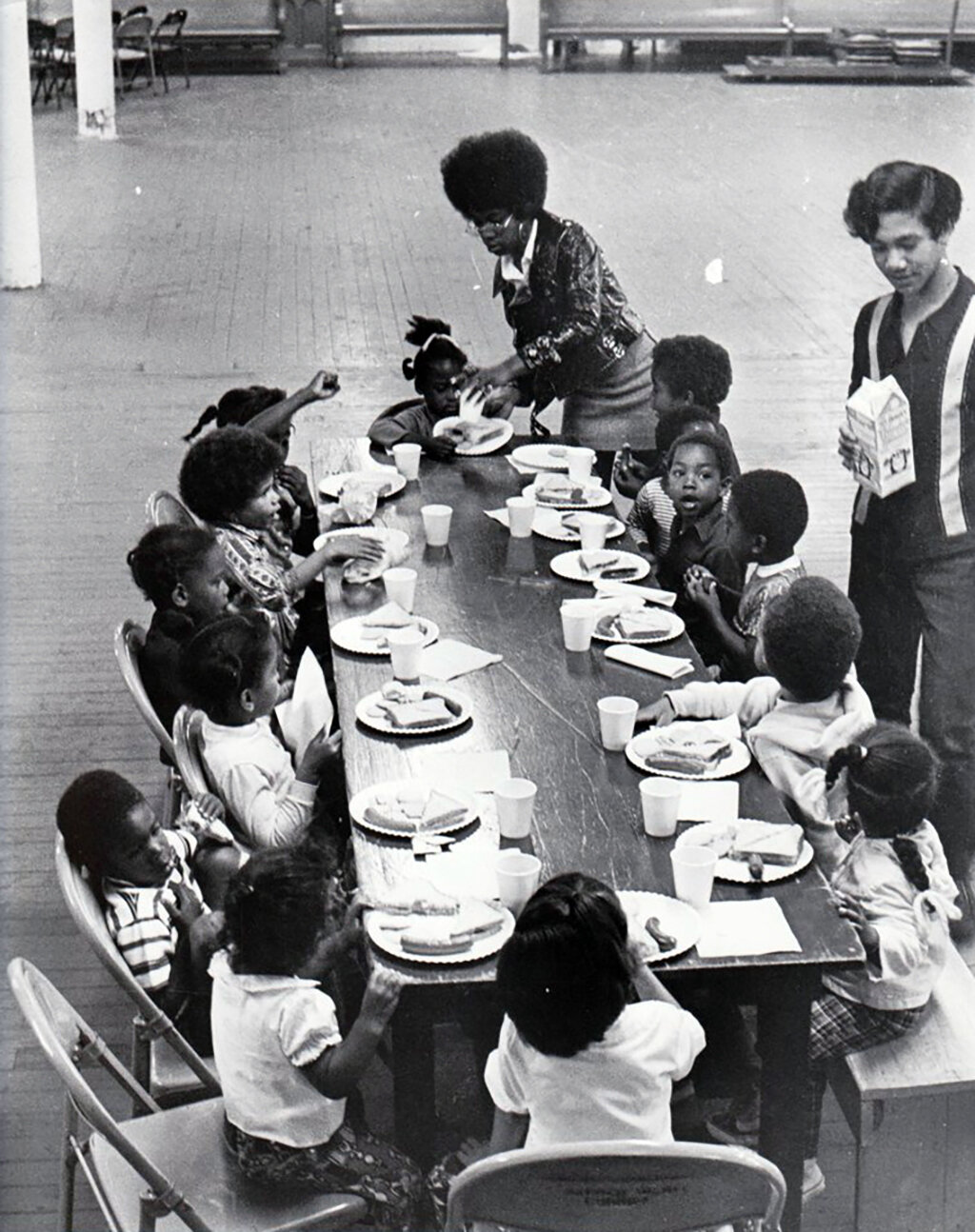 Throughout history there have also been fabulous examples of communities practicing Mutual Aid. One of the most overlooked is the Black Panther Party for Self-Defense (BPP). The BPP is inaccurately represented by systems of power and oppression as simply being gun-wielding thugs, but nothing could be farther from the truth. The BPP was part of the lager Black Freedom Struggle and began in 1966 with their Ten-Point Program, which provided a framework for what they wanted. It is true that the BPP engaged in armed self-defense, but they saw that as only one of their Survival Programs. The BPP’s Survival Programs were Mutual Aid Projects and they developed over 60 of them during their short history. People are somewhat familiar with the Children’s Breakfast Program, but most people don’t know that they had their own ambulance service, free commissary for prisoners program, free clinics, their own newspaper and Liberation Schools. Click here to see the entire list.
These kinds of autonomous Mutual Aid Projects need to be explored and practiced if we want to develop real people power. The history of social service programs that make up the larger US government safety net, particularly the programs that began after the Great Depression did not come out of no where. In fact, there were two primary factors that determined much of what we often call the New Deal programs. First, the New Deal programs that provided material support to families deeply impacted by the Great Depression were modeled after the people-created projects that came directly out of those most impacted. (See Dana Franks book, What Can We Learn from the Great Depression?: Stories of Ordinary People & Collective Action in Hard Times)
Second, the New Deal policies that the FDR Administration put in place was a direct response to the massive public pressure from working class people and organized labor. In the early 1930s there were over 1,000 labor strikes happening on an annual basis across the US (See Jeremy Brecher’s book, Strike!). The US government was forced to create New Deal programs because of the massive resistance to economic conditions that were brought about by the Capitalist Class. If the FDR Administration not passed New Deal policies, the public would have been in open rebellion against the government. And just to be clear, the New Deal policies did not benefit everyone, especially the poorest, Black communities, Mexicans and other groups that were hit the hardest from the Great Depression.
What I have been attempting to communicate in this three part series is that if we just want to get rid of Trump and Musk then we will continue to perpetuate systems of power and oppression. We have to come to terms with the fact that the current political system, the Neoliberal economic system, which is also driven by US imperialism abroad, a system which is bi-partisan, is the very system that produced the likes of Donald Trump.
I don’t want to go back to normal. Normal in the US leaves us with mass incarceration, the climate crisis, a housing system that is rooted in profits, police brutalizing Black, Latinx, immigrant and trans people, plus a political system that is antithetical to anything resembling real democracy. The system ain’t working for most of us, so instead of just hoping for mild reforms and lesser of evils politics, why don’t we practice solidarity, mutual aid and fight like hell for collective liberation.

Palestine Solidarity Information, Analysis, Local Actions and Events for the week of April 13th
It has been 18 months since the Israeli government began their most recent assault on Gaza and the West Bank. The retaliation for the October 7, 2023 Hamas attack in Israel, has escalated to what the international community has called genocide, therefore, GRIID will be providing weekly links to information and analysis that we think can better inform us of what is happening, along with the role that the US government is playing. We will also provide information on local events and actions that people can get involved in. All of this information is to provide people with the capacity of what Noam Chomsky refers to as, intellectual self-defense.

Information
“Point-Blank”: Israeli Soldiers Execute 15 Gaza Medics & Rescue Workers, Bury in Unmarked Mass Grave
Breaking the Silence on Palestinian Armed Struggle: A Call for Legal Clarity
Israeli Troops Blow Whistle on War Crimes in Gaza ‘Kill Zone’
UN Exposes Systematic Israeli Rape of Palestinians
The Ecology of Occupation: Palestine’s Struggle for Land and Life
Israel kills children routinely in West Bank
Israel Preparing to Seize Ethnically Cleansed City of Rafah as Part of Permanent Buffer Zone
Leaked Data Reveals Massive Israeli Campaign to Remove Pro-Palestine Posts on Facebook and Instagram
Analysis & History
Gaza’s Unbreakable Resistance with Ramzy Baroud
Drop Site Newsroom: Jeremy Scahill, Ryan Grim, and Abubaker Abed on Gaza in Crisis
Image used in this post is from https://electronicintifada.net/blogs/tamara-nassar/israel-kills-children-routinely-west-bank
Politicians and rallies won’t save us: We need direct action, disruptions to systems of power and community care – Part II
Editor’s note: This is Part II of a three part series on movement work, strategies and tactics for the current political climate in the US.
Yesterday, I began a three part series on why we shouldn’t rely on politicians, the political system or over-reliance on specific tactics in order to create change and work to build the kind of world that we want to see.
In Part I, I addressed why politicians won’t save us, why rallies won’t save us, and why we need to develop goals, strategies and tactics to fight against systems of power and oppression. I primarily used examples from the Civil Rights Movement/Black Freedom Struggle, so I want to expand on that today by talking about Direct Action, disrupting systems of power and oppression, and why it is important if we want to achieve our goals.

Disrupting systems of power and oppression
As I said in Part I, rallies can be a useful tactic that can make statements, demonstrate to us that we are not alone and even build community. However, alone rallies or symbolic protests will never be enough to disrupt and dismantle systems of power and oppression. As Ronald Reagan’s Secretary of State, Alexander Haig used to say, “people can march all they want, as long as they pay their taxes.”
In any sort of social movement or radical politics, we need to participate in disruptive actions, actions that are disruptive to systems of power and oppression. Instead of just holding signs outside of Social Security offices, why not go inside and disrupt their ability to do what they do? Instead of holding signs on highway overpasses, why not occupy the offices of members of Congress….all members of Congress?
Disrupting systems of power and oppression often means attacking either their ability to make profits, conduct business as usual and perpetuate harm. Capitalism is an insidious economic system that is based on profits and constant growth, but it is also rooted in exploitation and destruction, both of the exploitation of humans and ecosystems. This is why the South African Anti-Apartheid campaign had as one of its strategies a boycott, divestment and sanctions campaign to not support businesses that were profiting off of racial apartheid, robust boycott campaign targeting some of the largest perpetrators of racial apartheid, divesting funds from banks, pension funds, etc, and to call for governments to impose sanctions. This campaign involved a great deal of resistance, and lots of civil disobedience. The current Palestinian BDS campaign is built around the exact same model.
Another form of disruption is when we throw a monkey wrench into systems of power and oppression to conduct business as usual. During the End the Contract campaign that happened in Kent County in 2018-2019, the campaign that sought to get Kent County to end their contract with ICE, those involved in the campaign engaged in all kinds of disruptions. In fact, the kickoff to the campaign in late June of 2018, began with some 200 people showing up to the Kent County Commission meeting and shutting it down. The campaign disrupted numerous county meetings over the next several of months, but it also involved in taking up space in the 4th of July parade, going in to the Kent County Jail and making so much noise that those working the phones had a difficult time hearing callers. After the GRPD called ICE on Jilmar Raos Gomez, the campaign shut down several Grand Rapids City Commission meetings, and on numerous occasions it disrupted traffic. You can read about this campaign here. The County never ended their contact, but ICE did in September of 2019, primarily because of all the bad press and bad PR the campaign had generated!
Lastly, disruptions can mean engaging in actions that reduce harm that is being perpetrated by systems of power and oppression. This can look like what animal liberation groups have done by liberating animals from cages to destroying the machinery of those systems of cruelty. Harm reduction disruptions can also look like Indigenous people blockading fossil fuel corporations from continuing to build oil pipelines. According to a report put out by the Indigenous Environmental Network in 2021, Indigenous-led resistance campaigns against pipelines in the US and Canada have reduced greenhouse gas pollution by at least 25% annually since these campaigns began.
Disruptions that can reduce harm is exactly what GR Rapid Response to ICE does, with their organized effort to mobilize people who have been trained to show up when affected people being targeted by ICE, to try to prevent them from disappearing immigrants from this community.

Direct Action
Most of the examples I provide in the previous sections on disruptive tactics would also qualify as Direct Action. However, I want to explore what Direct Action is a bit more and provide some additional examples.
Direct action means that we take collective action to change our circumstances, without handing our power to a middle person – bosses, politicians and or any other authority. Direct Action means we take matters into our own hands and not expect those in power to do what we want.
Direct Action is often not even in the form of a protest. Direct Action can mean organizing a union where you work. Having a union can make your workplace safer, provide increased wages, better benefits and allow workers to level the playing field instead of just taking orders. Direct Action can mean starting a food cooperative, creating a community-based neighborhood garden or creating a seed bank in your community.
Direct Action can also look like refusing the draft, withholding taxes because you do not want to support US Imperialism, chaining yourself to a tree to prevent it from being cut down or chaining yourself to a bulldozer that is being used for an oil pipeline construction. Direct Action is when the Disability Justice movement blocked public transportation systems in order to make sure that those systems were accessible or when the people provided resources and direct support to those wanting to have an abortion pre-Roe v Wade.
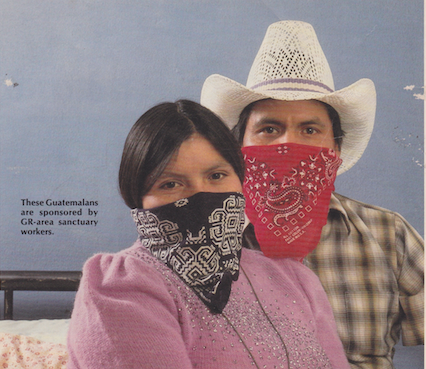 Direct Action looks like what the Black Panther Party for Self-Defense did when they patrolled their own neighborhoods to prevent cops from brutalizing members of the community, and Direct Action looks like what those who were enslaved did to escape from plantation, burn them or kill those who owned plantations. Direct Action look like communities offering sanctuary to undocumented immigrants, regardless of the fact that the US government considers it illegal.
Again, Direct Action is when we take collective action to change our circumstances, without handing our power to a middle person – Mayors, plantation owners, CEOs, cops or any other authority figures that are a part of systems of power and oppression.
In addition to fighting systems of power and oppression, many of the previous social movements also created communities of care and did not relying on existing systems to support and sustain their community. Many people call this Mutual Aid or Community Care, which is what I will discuss in Part III.

In Episode #1 of the TV series featuring the GRPD, called All Access Grand Rapids, we first hear from GRPD Police Chief Eric Winstrom. This makes complete sense, since not only is Winstrom a slick PR person, he always wants to control the narrative about the GRPD.
Winstrom states that when he came to Grand Rapids, “trust in the Grand Rapids Police Department was at an all-time low.” Unfortunately, the TV show doesn’t provide any historical context around why the community, specifically Black and Brown residents did not trust the GRPD.
For the five years before Winstrom came to Grand Rapids, there were numerous instances that contributed to the community’s lack of trust when it came to the GRPD, such as:
- GRPD stoping Black youth and pulling guns on them
- GRPD arresting Honestie Hodges, an 11 year old Black girl, while the cops were out looking for a Black suspect
- 100 Black men coming to the Grand Rapids City Commission meeting to demand the City hold the GRPD accountable for their abuses in Black neighborhoods
- GRPD caught on video beating a Black man in his car, with the man’s child in the car
- GRPD stopping at gunpoint two Latino youth
- GRPD calling ICE on Jilmar Ramos Gomez, a former US Marine
Right after Winstrom provides no context for why the community did not trust the cops, he says, “If there is no trust, that equals a more dangerous and more violent city.” Wow. A more dangerous and violent city for whom?
Once the episode gets passed the GRPD-dictated framing of the narrative, the episode moves into using a clock counter on the screen, footage of the dispatch and using audio from calls regarding a shooting. The footage goes from an arial shot bodycam footage where cops show up to find Amillier Penn lying dead on the ground.
Winstrom then states that the local news was covering this issues, but they failed to report that homicides predominantly happen in Black neighborhoods. Again, there is no verification for such a claim and no commentary from those who might have a robust critique or response to Winstrom’s claim.
The episode then cuts to Winstrom and one of his captains at the GRPD headquarters reviewing bodycam footage and Winstom is clearly playing to the camera, stating, “here he is, a 15 year old full of bullets.”
Next there are two cops who are involved in the investigative aspect of homicides, where they talk about how hard it is to get witnesses coming forward. These two cops then go out into the community to ask neighbors near the shooting of they access Ring camera footage. The episode then continues with some of this Ring camera footage shown, which adds to the drama, along with the music in the background. One of the investigative cops is looking right into the camera say that they couldn’t imagine how the young man might have been feeling in this moment and how the family might be dealing with it. This scene is clearly a constructed scene, since the camera crew is asking questions, which is another way of trying to humanize the cops.
Viewers of the episode then go into the home of Amillier Penn, where his mother is talking and grieving the loss of her son. This only lasts a minute, then it is back to the GRPD headquarters where the cops are looking at what Amillier Penn’s phone messages were just before he died. From there is the episode cuts to footage of a vigil for Amillier.
At 13 minutes into the episode, it shifts and goes to the GRPD killing of Patrick Lyoya, where they use footage of the City’s Press Conference and commentary from Winstrom on the importance of showing the video of what happened in order to “not lose the community’d trust.”
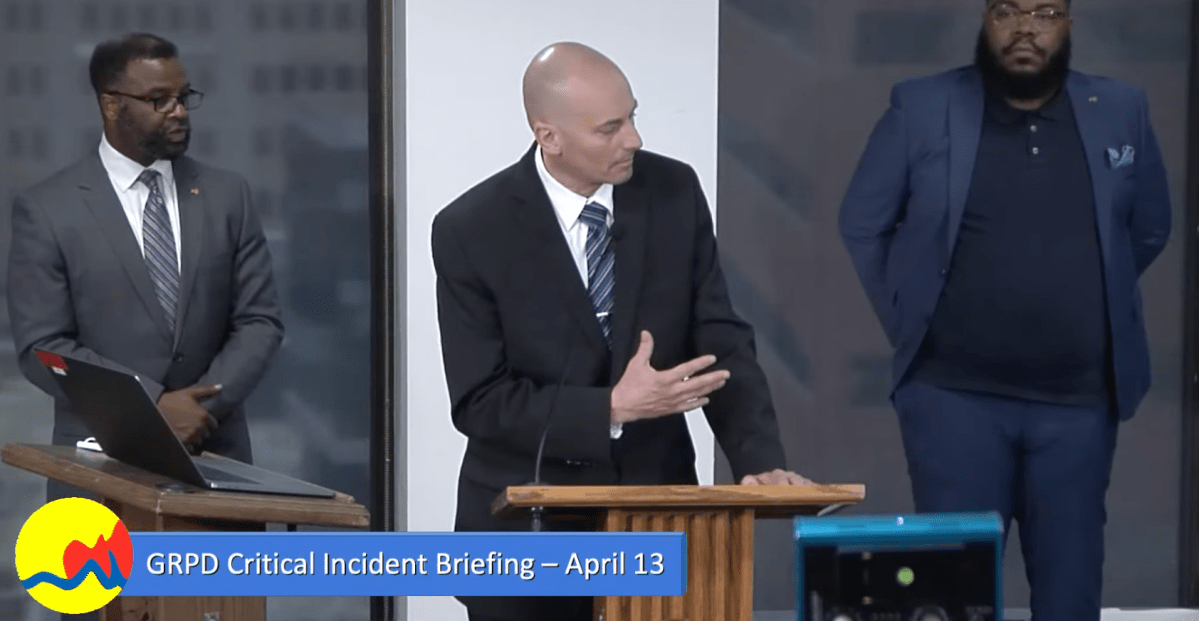
At 14 minutes into the episode, Winstrom then speaks to the camera, essentially blaming the lack of community trust from the Patrick Lyoya murder, thus preventing people coming forward on the death of Amillier Penn. Next, we see Winstrom at the Garage Bar talking with people and telling them that they need to step forward if they know anything.
At the 15 minute mark into the episode, viewers get to hear from Amillier’s father, who talks about how how difficult it has been and how he has been trying to be a soldier for his son.
The GRPD then spots a witness to the shooting and finds him at a park and convinces him to get in the cruiser and come down to the station to tell him what he remembers. Back in the GRPD headquarters, one of the detectives says that someone named CP shot Amillier, but they don’t have any proof. However, this doesn’t prevent the GRPD putting up an image of CP, a young Black man with his full name on the screen.
In the next few minutes one of the detectives talks about Amillier’s father who started posting images of CP on his Facebook page and was demanding that the GRPD go and arrest this guy. In addition, the detective states on camera that Amillier’s father changed hi Facebook profile to an image of a pistol and talking about revenge. The detective then says that this undermines what the cops are trying to do.
The episode then cuts to the funeral of Amillier, which seems rather invasive to me.
At about 26:30 into the episode the cops start talking about these “fight club” videos that were on Amillier’s phone. The cops even then say that Amilier was involved in these fights and show video of Amillier in a street fight with CP. Fight Club is actually the title of Episode #1.
At about 29:45 into the episode, one of the detectives has potential witnesses at the GRPD headquarters and asks a young Black person if CP was the shooter. Their response was, “I don’t know.” Right after this, the detective talks with another cops saying they have a text that they believe incriminates CP. The episode then jumps to a new shooting, where they show the footage. They believe it is this CP person. The episode shows the footage of the shooting repeatedly, which was rather gratuitous. The investigator on this shooting then bring Winstrom into the case and shows him footage and Winstrom is convinced that CP is the shooter, claiming that they can let the prosecutor make the decision if what they have is enough.
The next scene is with roughly 15 GRPD cops in a meeting and getting order to go look for CP, which also included images of the young Black man holding guns.
The detective who had lots of camera time then says, looking directly into the camera, “It’s time to arrest this dude.” After that for the next 2 minutes the episode shows cops in riot gear at the door and then entering the home and taking into custody CP. All of this is done with dramatic music, for effect.
The few remaining minutes of the episode takes place in the GRPD headquarters, where cops are questioning CP and his mother, and showing her pictures from the most recent shooting.
Winstrom then – speaking to the camera – states that with CP in jail, that maybe this gives witnesses an opportunity to come forth regarding Amillier’s shooting.
The murder of Amillier Penn still has not been resolved.
This All Access Grand Rapids episode sure reminded me of the show COPS, where Black bodies are criminalized and that Black people in urban settings are represented as thugs. This first episode affirms that stereotype, thus perpetuating structural racism and justifying state carceral violence. The episode also demonstrated that this TV series will be a highly constructed show with the GRPD dictating the narrative about who they are and what they do.
New GRIID weekly audio digest – #1
Today GRIID is announcing a new way that people can access our information. Today I am posting the first audio file, where people can listen to GRIID stories over the past few days.
GRIID plans to post an audio version of stories you would normally read on a weekly basis, so that you can get the news, information and analysis of what is happening in the Greater Grand Rapids Area.
It is my hope that the weekly GRIID audio digest will be a welcomed addition for those who follow this site.
 Grand Rapids Institute for Information Democracy