This article by Jon Queally is re-posted from Common Dreams.
As international climate negotiations in Doha stumble towards what many observers predict will be uninspiring agreements not nearly adequate to meet the urgent need to reduce global emissions, environmental campaigners in the US—led mostly by students—have taken new steps in forging a broad-based assault on what they see as the most powerful enemy when it comes to preventing the dangerous impacts of human-caused global warming and climate change.
The target? The fossil fuel companies themselves.
Fueled by a nearly month-long national bus tour by the group 350.org, college divestment campaigns have sprung up all over the US with student groups calling on university leaders to pull their financial investments out from oil, coal, and gas companies that profit from the exact activities that scientists have shown are warming the planet at an alarming rate.
“We’ve felt serious momentum along this transcontinental roadshow—but the numbers of full-on divestment campaigns got larger faster than we could have dreamed,” said 350 co-founder Bill McKibben. “A year notable for ice-melt, parched crops, and superstorms is going out with a different kind of bang: an explosion in activism, aimed squarely at the rogue fossil fuel industry.”
Meanwhile, advocacy groups Oil Change International and the Other 98% have teamed up to launch a public relations campaign of its own designed to put the fossil fuel corporations in their proper context.
Not mincing words, the group set up a website called Exxonhatesyourchildren.com and released this video:
Oil companies hate your children
The new campaign by Oil Change International and the Other 98% says that if you judge Exxon and other fossil fuel companies not by the rhetoric of their finely-polished TV ads, but by their actions and predictable consequences, it is easy to conclude that they “hate your children.”
Claiming the “facts speak for themselves,” the campaign asks the US public to consider the following:
1. Exxon must hate your children because their business model depends on drilling for more and more of the fuels that cause climate disruption, even though fossil fuel companies have already discovered significantly more oil, gas and coal than scientists say we can safely burn. They are creating climate chaos every day — and they’re getting rich doing it. Even the International Energy Agency now agrees that in order to have even chances of limiting global warming to just 2 degrees Celsius (beyond which the worst impacts of warming will kick in), two-thirds of the current proven reserves of fossil fuels must remain in the ground by 2050.
2. Exxon must hate your children because, for years, they spent millions funding a coordinated campaign to create confusion about climate science, which slowed the move towards a more sustainable future. Now Exxon (finally) admits that climate change is a problem, but…
- They say they can’t predict what will happen, and
- Therefore they will continue business as usual.
3. In June 2012, Rex Tillerson, the CEO of Exxon, acknowledged that burning of fossil fuels is warming the planet, but said society will be able to “adapt”. Tillerson blamed a public that is “illiterate” in science and math, a “lazy” press, and advocacy groups that “manufacture fear” for misconceptions around the oil and gas industry.
4.Exxon must hate your children because they and other fossil fuel companies send campaign contributions to candidates for Congress, and in turn, they get massive subsidies…at the expense of more important causes. For every one dollar Big Oil spends on political contributions, they get $59 back in subsidies — a 5800% rate of return. Meanwhile, they make record profits — in 2011, just the 5 biggest oil companies alone (including Exxon) made roughly $135 billion in profits. The at least $10 billion annually in our tax dollars that goes to supporting these rich fossil fuel companies should instead go to building a safe future for all our children.
5.Exxon must hate your children because climate change threatens the future of all of our children, and they seem to just ignore it. Even before Superstorm Sandy hit the East Coast of the United States, we were witnessing climate impacts on a daily basis, and they’re only getting worse. Just this summer, we’ve seen drought engulf the breadbasket of America. We’ve seen freak storms ravage the Midwest and east coast. All of these impacts are consistent with scientific predictions of climate change. Yet Exxon continues drilling and funding Congressional campaigns, in order to get more subsidies to feed their addiction to their climate-destroying profits.
This article by Glen Greenwald is re-posted from The Guardian.
When the legislation that became known as “Obamacare” was first drafted, the key legislator was the Democratic Chairman of the Senate Finance Committee, Max Baucus, whose committee took the lead in drafting the legislation. As Baucus himself repeatedly boasted, the architect of that legislation was Elizabeth Folwer, his chief health policy counsel; indeed, as Marcy Wheeler discovered, it was Fowler who actually drafted it. As Politico put it at the time: “If you drew an organizational chart of major players in the Senate health care negotiations, Fowler would be the chief operating officer.”
What was most amazing about all of that was that, before joining Baucus’ office as the point person for the health care bill, Fowler was the Vice President for Public Policy and External Affairs (i.e. informal lobbying) at WellPoint, the nation’s largest health insurance provider (before going to WellPoint, as well as after, Folwer had worked as Baucus’ top health care aide). And when that health care bill was drafted, the person whom Fowler replaced as chief health counsel in Baucus’ office, Michelle Easton, was lobbying for WellPoint as a principal at Tarplin, Downs, and Young.
Whatever one’s views on Obamacare were and are: the bill’s mandate that everyone purchase the products of the private health insurance industry, unaccompanied by any public alternative, was a huge gift to that industry; as Wheeler wrote at the time: “to the extent that Liz Fowler is the author of this document, we might as well consider WellPoint its author as well.” Watch the five-minute Bill Moyers report from 2009, embedded below, on the key role played in all of this by Liz Fowler and the “revolving door” between the health insurance/lobbying industry and government officials at the time this bill was written and passed.
More amazingly still, when the Obama White House needed someone to oversee implementation of Obamacare after the bill passed, it chose . . . Liz Fowler. That the White House would put a former health insurance industry executive in charge of implementation of its new massive health care law was roundly condemned by good government groups as at least a violation of the “spirit” of governing ethics rules and even “gross”, but those objections were, of course, brushed aside by the White House. She then became Special Assistant to the President for Healthcare and Economic Policy at the National Economic Council.
Now, as Politico’s “Influence” column briefly noted on Tuesday, Fowler is once again passing through the deeply corrupting revolving door as she leaves the Obama administration to return to the loving and lucrative arms of the private health care industry:
“Elizabeth Fowler is leaving the White House for a senior-level position leading ‘global health policy’ at Johnson & Johnson’s government affairs and policy group.”
The pharmaceutical giant that just hired Fowler actively supported the passage of Obamacare through its membership in the Pharmaceutical Researchers and Manufacturers of America (PhRMA) lobby. Indeed, PhRMA was one of the most aggressive supporters – and most lavish beneficiaries – of the health care bill drafted by Fowler. Mother Jones’ James Ridgeway proclaimed “Big Pharma” the “big winner” in the health care bill. And now, Fowler will receive ample rewards from that same industry as she peddles her influence in government and exploits her experience with its inner workings to work on that industry’s behalf, all of which has been made perfectly legal by the same insular, Versailles-like Washington culture that so lavishly benefits from all of this.
It’s difficult to find someone who embodies the sleazy, anti-democratic, corporatist revolving door that greases Washington as shamelessly and purely as Liz Fowler. One of the few competitors I can think of is Adm. Michael McConnell, who parlayed his military and intelligence career into a lucrative gig at Booz Allen, one of the nation’s largest private intelligence contractors; then became George W Bush’s Director of National Intelligence (where he spearheaded a huge gift to the telecom industry – retroactive immunity shielding it from all accountability for its participation in the illegal Bush NSA eavesdropping program – as well as continued his Booz Allen work of privatizing intelligence and surveillance functions); then returned to the loving arms of Booz Allen, where he now exploits his national security credentials on behalf of industry interests (by, for instance, spearheading the fear-mongering campaign about cyber-warfare in order to advocate for security programs that would amply enrich Booz Allen’s clients).
This is precisely the behavior which, quite rationally, makes the citizenry so jaded about Washington. It’s what ensures that the interests of the same permanent power factions are served regardless of election outcomes. It’s what makes a complete mockery out claims of democracy. And it’s what demonstrates that corporatism and oligarchy are the dominant forms of government in the US:
This article by Steve Horn is re-posted from CounterPunch. Editor’s note: We have reported in recent months about Michigan DEQ and DNR reps citing FracFocus as a legitimate source for chemical disclosure, which this article clearly questions.
 Last year, a hydraulic fracturing (“fracking”) chemical fluid disclosure “model bill” was passed by both the Council of State Governments (CSG) and the American Legislative Exchange Council (ALEC). It proceeded to pass in multiple states across the country soon thereafter, but as Bloomberg recently reported, the bill has been an abject failure with regards to “disclosure.”
That was by design, thanks to the bill’s chief author, ExxonMobil.
Originating as a Texas bill with disclosure standards drawn up under the auspices of the Obama Administration’s Department of Energy Fracking Subcommittee rife with oil and gas industry insiders, the model is now codified as law in Colorado, Pennsylvania, and Illinois.
Bloomberg reported that the public is being kept “clueless” as to what chemicals are injected into the ground during the fracking process by the oil and gas industry.
“Truck-Sized” Loopholes: Fracking Chemical Fluid Non-Disclosure by Design
“Drilling companies in Texas, the biggest oil-and-natural gas producing state, claimed similar exemptions about 19,000 times this year through August,” explained Bloomberg. “Trade-secret exemptions block information on more than five ingredients for every well in Texas, undermining the statute’s purpose of informing people about chemicals that are hauled through their communities and injected thousands of feet beneath their homes and farms.”
For close observers of this issue, it’s no surprise that the model bills contain “truck-sized” loopholes.
“A close reading of the bill…reveals loopholes that would allow energy companies to withhold the names of certain fluid contents, for reasons including that they have been deemed trade secrets,” The New York Times explained back in April.
Disclosure Goes Through FracFocus, PR Front For Oil and Gas Industry
The model bill that’s passed in four states so far mandates that fracking chemical fluid disclosure be conducted by FracFocus, which recently celebrated its one-year anniversary, claiming it has produced chemical data on over 15,000 fracked wells in a promotional video.
The reality is far more messy, as reported in an August investigation by Bloomberg.
“Energy companies failed to list more than two out of every five fracked wells in eight U.S. states from April 11, 2011, when FracFocus began operating, through the end of last year,” wrote Bloomberg. “The gaps reveal shortcomings in the voluntary approach to transparency on the site, which has received funding from oil and gas trade groups and $1.5 million from the U.S. Department of Energy.”
This moved U.S. Representative Diana DeGette (D-CO) to say that FracFocus and the model bills it would soon be a part of make a mockery of the term “disclosure.”
“FracFocus is just a fig leaf for the industry to be able to say they’re doing something in terms of disclosure,” she said.
“Fig leaf” is one way of putting it.
Another way of putting it is “public relations ploy.” As Dory Hippauf of ShaleShock Media recently revealed in an article titled “FracUNfocusED,” FracFocus is actually a PR front for the oil and gas industry.
Hippauf revealed that FracFocus‘ domain is registered by Brothers & Company, a public relations firm whose clients include America’s Natural Gas Alliance, Chesapeake Energy, and American Clean Skies Foundation – a front group for Chesapeake Energy.
Given the situation, it’s not surprising then that “companies claimed trade secrets or otherwise failed to identify the chemicals they used about 22 percent of the time,” according to Bloomberg‘s analysis of FracFocus data for 18 states.
Put another way, the ExxonMobil’s bill has done exactly what it set out to do: business as usual for the oil and gas industry.
New Media We Recommend
Below is a list of new materials that we have read/watched in recent weeks. The comments are not a “review” of the material, instead sort of an endorsement of ideas and investigations that can provide solid analysis and even inspiration in the struggle for change. All these items are available at The Bloom Collective, so check them out and stimulate your mind.
Power, by Todd May – This short zine is an excellent introduction into the concept of power and it part of the Institute for Anarchist Studies Lexicon Series. Todd May does a good job of defining power and making it clear that there is power over and power with, meaning that power can be used for repression or creation. What I found so useful about this zine was the author’s critique of neoliberalism and the promotion of entrepreneurs. Entrepreneurs are seen through this analysis of power as individual agents that rely on a system where more and more of society is privatized. Counter to this notion is collectivism and the idea that we can solve problems by sharing ideas, resources and skills in order to create a power structure that is based upon mutual aid and direct democracy. May says that too often the left thinks of power exclusively in a negative way and that we need to reclaim the power from below or the power with possibilities for society. Highly recommended.

Territories in Resistance: A Cartography of Latin American Social Movements, by Raul Zibechi – This new collection of essays by Uruguayan scholar Raul Zibechi is a fabulous investigation into the current social movements in Latin America and their relation to the State. Zibechi covers a great deal of territory in these essays, which are organized in very interesting sections, some of which deal with social movements and spaces, communities of resistance, urban resistance and indigenous movements. The section on the movement’s relationship to the State is well thought out and provides good lessons on how social movements can deal with State power. Zibechi documents that there have been different approaches in dealing with state power and that is what makes this collection of essays so power, in that they do not dictate a singular path. Territories in Resistance is not only a wonderful contribution in understanding the current political dynamics in Latin America, it is a useful tool for anyone who wants to explore how social movements interact with the State.
Occupation Diaries, by Raja Shehadeh – With the recent Israel assault on Gaza, one of the most important things we can do is to humanize the Palestinians. This is exactly what Raja Shehadeh does in these wonderful entries in his diary from 2009 through May 2012. Beautifully written, Occupation Diaries is at once a window into the daily realities of Palestinians living under occupation, along with the beauty of a people and their land. Shehadeh will in one sentence be talking about Israeli check points and in the next the beautiful wildflowers along the side of the road. What makes these beautiful reflections on life in Palestine so beautiful is the sharp sense of history the writer has. This injection of history helps the reader be reminded of the context of the Israeli occupation and what it has meant for Palestinians over the past several decades. Highly recommended.

The Last Mountain (DVD) – The mining and burning of coal is at the epicenter of America’s struggle to balance its energy needs with environmental concerns. Nowhere is that concern greater than in Coal River Valley, West Virginia, where a small but passionate group of ordinary citizens are trying to stop Big Coal corporations, like Massey Energy, from continuing the devastating practice of Mountain Top Removal. The citizens argue the practice of dynamiting the mountain’s top off to mine the coal within pollutes the air and water, is responsible for the deaths of their neighbors and spreads pollution to other states. Yet, regardless of evidence supporting these claims, Big Coal corporations repeat the process daily in the name of profit. Massive profit allows Big Coal to wield incredible financial influence over lobbyists and government officials in both parties, rewrite environmental protection laws, avoid lawsuits and eliminate more than 40,000 mining jobs, all while claiming to be a miner’s best friend. As our energy needs increase, so does Big Coal’s control over our future. A passionate and personal tale that honors the extraordinary power of ordinary Americans when they fight for what they believe in, THE LAST MOUNTAIN shines a light on America’s energy needs and how those needs are being supplied. It is a fight for our future that affects us all.

Last night over 200 people, mostly from the Latino community, came to the weekly meeting at the City of Grand Rapids to ask the City Commission to take a stand with them and demand the opportunity for undocumented immigrants to obtain a Michigan driver’s license.
The immigrant rights community has been organizing around this issue ever since Michigan Secretary of State Ruth Johnson decided to punish those who are undocumented and not allow them to obtain a driver’s license.
In early November, hundreds of people calling for these rights rallied in Lansing, where they demanded a meeting with Governor Snyder’s office. The statewide effort was able to meet with Snyder’s office, but with no clear outcome, so now groups around the state are pressuring local governments to assist them in overturning Sec. of State Ruth Johnson’s anti-immigrant position.
 On Monday, some of those who came to the Grand Rapids City Commission meeting spoke before the Wyoming commissioners, as was stated by Luz Guel, one of the organizers of last nights action at City Hall. Guel was one of several who spoke about the justice of undocumented people obtaining a drivers license, since driving is such a necessary reality for people who work and have children.
Some of those who addressed the city commission were students who want to stay in Michigan, but have suffered from family members being deported, harassed and intimidated by law enforcement. Others talked about living in constant fear of deportation, since they do not have a driver’s license, but drive out of necessity of raising a family. One mother, who was nearly in tears, said that some days she doesn’t take her kids to school because of the risks involved.
It took great courage for her and several others who identified as undocumented to get up and speak before the city officials. Besides those who were most effected by the State policy, there were also some allies in the room who spoke. One ally, Azizi Jasper, talked about how living in a state that doesn’t have a very good mass transit system makes it nearly impossible for people to not use a car. He said it is not just and will only harm Michigan if this injustice is allowed to continue.
Here is a short video of the comments made by a Latino pastor that reflects the urgency and justice of this issue.
After the public comment period was over, most of the Commissioners thanked people for their comments and said they would do what they could to assist the immigrant community on this issue. Commissioner White agrees with the request and acknowledged that the US has a history of changing the law to accommodate the need for immigrants to come to this country.
Mayor Heartwell said he knows that the immigrant community makes Grand Rapids a better city and that all people have the rights to move about without identification. He states that they don’t have direct control over the issue of drivers’ licenses and that Governor Snyder is an advocate for immigrants and that maybe there is a difference between Ruth Johnson and the Governor, even though this writer sees no indication that the Snyder administration has been pro-immigrant rights over the past two years.
Heartwell went on to say they have a legislative committee and since there is legislation being introduced to change the current policy, he thinks that as the 2nd largest city they can pressure the state to make the necessary changes. He also is with the MI Municipal League and the Urban Core of Mayors, which can bring together the power of cities to address issues like this.
While the response was positive from the city commission, make no mistake about it that it is the efforts and the sacrifices that the immigrant community makes, which will eventually win this battle.
Enbridge Bid to Dismiss Landowners’ Lawsuit Fails, Pipeline Case to Continue in Michigan
This article by Lisa Song is re-posted from InsideClimate News.
A lawsuit against pipeline company Enbridge Inc. was returned to Michigan state court on Tuesday, after a judge ruled that a group that is trying to stop work on the company’s 210-mile pipeline replacement project could not pursue the case in federal court. The ruling didn’t address the merits of the case.
POLAR (Protect Our Land And Rights), the nonprofit group that filed the suit, is seeking an injunction against Enbridge, claiming the Canadian company hasn’t obtained all the necessary state and local permits.
“We want Enbridge to follow the existing laws,” said POLAR founder Jeff Axt, who owns property along the route. “These aren’t obstructions recently created to stop a pipeline. These are existing laws, regulations and ordinances that have been on township books for years, that need to be complied with before the project proceeds.”
Enbridge spokesman Larry Springer said the company doesn’t comment on pending litigation: “Once we’re back in state court…we’ll be prepared to proceed there.”
At a Nov. 7 hearing, Enbridge had questioned POLAR’s legal standing in the case and asked the court to dismiss the lawsuit. The company argued that POLAR couldn’t seek an injunction because, among other reasons, it’s not one of the government agencies affected by pipeline construction. Federal Judge Robert H. Cleland agreed with that argument in his ruling on Tuesday. But instead of dismissing the case, he remanded it to state court.
Axt said the decision gives POLAR a second chance to present its case. “He could have just dismissed this, and everything would just go away. What he did was remand it back to state court…so that’s a victory.”
Gary Field, a lawyer representing POLAR, expects Enbridge to challenge POLAR’s legal standing in state court as well. “Enbridge, I think, has a strategy of trying to delay and string things out and diminish POLAR’s resources, which I think they’re somewhat adept at doing.”
Enbridge didn’t challenge the merits of the case, he said. “They didn’t say they had the permits. They just said these guys [POLAR] can’t ask us if we have the permits or not.”
Field believes it will be easier to defend POLAR’s legal standing in state court, due to differences in state and federal court standards. Tuesday’s ruling means “we’re still alive to continue this endeavor,” he said.
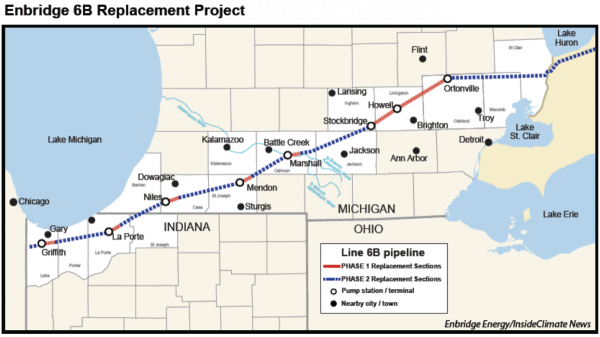
The 6B pipeline would run through Michigan and Indiana and carry crude oil from Canada, including tar sands oil, or bitumen. It will replace an existing pipeline that ruptured in 2010 and spilled more than a million gallons of dilbit—bitumen diluted with liquid chemicals—into Michigan’s Kalamazoo River. Enbridge was fined $3.7 million and was cited by the National Transportation Safety Board for its “complete breakdown of safety.” Some sections of the Kalamazoo remain contaminated more than two years later.
Axt and other landowners along the route say the project deserves extra scrutiny because of Enbridge’s history in the area. Over the past few months, landowners in Michigan and Indiana have filed lawsuits and tried to block pipeline construction. They’ve complained about the company’s “heavy-handedness” in dealing with them and have urged state regulators to increase oversight of the project.
The pipeline will be replaced in two stages. Phase 1, which is 75 miles long and runs through a corner of Indiana, is under construction, and most of the land in Michigan has already been cleared. Phase 2 is still waiting for approval from the Michigan Public Service Commission.
Field said the lawsuit may not be resolved until Phase 1 is complete. “We’re trying to prevent that, but the wheels of justice move slowly.”
But Axt said even a delayed decision can help landowners along Phase 2 of the pipeline. “It’s a good thing in the long term for the good of the state. When you have case law, the next group of landowners can rely on the seeds we’ve planted today.”
POLAR was formed over the summer, when a group of Michigan landowners living on or near the pipeline’s path banded together to support property rights and environmental protection. The group’s original lawsuit was filed in the 6th Judicial District Court in Oakland County. Enbridge then moved the case to federal court and challenged the group’s standing.
In October, the Michigan Township Association filed an amicus brief in support of POLAR’s position. The association represents more than 1,235 townships.
Larry Merrill, the association’s executive director, said he wasn’t surprised by Tuesday’s ruling.
“The federal rules [on] standing are more stringent than in state court…so we have no problem with it remanded to Oakland county circuit court.”
Merrill said the Township Association hasn’t decided whether it will file another amicus brief in state court.
POLAR has another ally in Brandon Township, a community of 15,000 located 50 miles north of Detroit. The pipeline passes through the township, and Enbridge has refused to follow some of the local ordinances and requests for extra safety measures.
In legal filings, Enbridge has said that it follows federal pipeline regulations, which preempt state and local ordinances.
But the U.S. Department of Transportation has said it has no control over state rules and regulations. Charles Ten Brink, a law professor from Michigan State University, told InsideClimate News last month that federal law doesn’t always supersede local ordinances.
On Nov. 5, two days before the federal hearing, Brandon Township asked to intervene in the case. The judge’s ruling on Tuesday did not address whether the township could join POLAR as a party in the lawsuit.
Brandon Township Supervisor Kathy Thurman said the board of trustees will meet Thursday night to discuss whether and how to continue the township’s involvement.
Axt emphasized that the lawsuit is not about opposing a pipeline, but rather about forcing Enbridge to abide by local regulations. “I think we can all agree the existing laws and permits should all be followed, whether you’re building a pipeline, a house, a road, or a dog house.
Is 350′s Carbon Divestment Campaign Complete?
This article by Christian Parenti is re-posted from CounterPunch.
Three Critiques and a Suggestion
I have much respect for Bill McKibben and 350.org, the organization he started. Future generations will hail the 350 activists of today as heroes. That said I am very worried about the pitfalls of 350′s current “Do the Math” campaign, which seeks to pressure universities, churches and other institutions to divest their investment portfolios of all fossil fuel stocks.
Though elegant in its simplicity — attacking Big Carbon directly — this symbolically charged strategy (or rather tactic) suffers three crucial weaknesses. First, it misrecognizes the basic economics of the fossil fuel industry and thus probably won’t hurt it. Second, it misrecognizes the nature and function of the stock market. Third, it ignores the potentially very important role of government in addressing the climate crisis.
The divestment campaign flows from an excellent article McKibben wrote which makes the stark point that we cannot burn all the fossil fuel currently in the ground without crossing the line into truly dangerous, potentially self-fueling climate change. His punch line: We must attack the fossil fuel industry.
The 350 campaign has started with a big 21 city road show to get the word out. From there, smaller groups are starting to pressure universities, churches and other institutions to divest their fossil fuel stocks. The website for the 350′s tour explains the divestment strategy as follows:
The one thing we know the fossil fuel industry cares about is money. Universities, pension funds, and churches invest a lot of it. If we start with these local institutions and hit the industry where it hurts — their bottom line — we can get their attention and force them to change.
And the spectacle of targeting the enemy — giving them a name and an address — is great but it needs to be linked to other forms of leverage. Namely, we need to also focus on state power and what we can do with it. The movement should be demanding that government at every level move to contain and control Big Carbon and to directly support alternative energy. Regulation is the only thing that will actually check the industries — oil, gas, coal — that are destroying the planet. (More on which below.)
I am all for dumping carbon stocks, if for no other reason than a sense of decency and honor. But how is dumping oil stock supposed to hurt the enemy? The boards of oil companies will be embarrassed? The spectacle of the discussion around divestment might provoke actions on other fronts — like legislation? I am not at all clear on how this is supposed to work. And I am not sure McKibben or 350 are either.
How Does Big Carbon Make Money?
First, the assumption that we can hit the fossil fuel giants’ “bottom line” by going after their stock prices is deeply flawed. It unconsciously plays into a very neoliberal, or right-wing, set of nostrums that markets can fix things and that government is, as Mckibben often says, is “broken.” But more to the point, it is deeply confused about how wealth is actually produced.
Consider Exxon Mobil, the world’s largest company by profits. It makes its money by selling oil and related products, not by selling stock. In fact, many of the key players in the oil industry do not even sell stocks.
For example the most infamous climate deniers, Koch Industries, sell no shares on stock markets. Koch Industries, being privately held, is thus not even on the 350 target list.
Most of the largest oil companies in the world are actually state-owned. As Forbes put it:
More than 70% of world oil reserves, and an even greater percentage of the remaining reserves of ‘easy oil’ are held by national oil companies controlled by kings and potentates and even some democratically elected governments.
Huge government-owned oil companies include Saudi Aramco, Gasprom, PDVSA, The Iran National Oil company, Rosnef, PetroBras, Pemex and Petro China.
And how do we actually sustain and feed Exxon, Chevron, Shell and the rest? Not as investors, but as consumers. We give them money when we buy gasoline. Economically speaking, more effective than a divestment campaign would be a gas boycott; though it would be next to impossible given the current structure of our transportation sector. This brings us to the next question.
What is the Real Function of the Stock Market?
The official version of capitalism holds the stock markets exist to help firms raise money for investment. But empirical investigation reveals that the opposite is more often the case. In reality, the stock market, though culturally powerful, is not particularly important to how capitalism actually creates wealth (and pollution).
As Doug Henwood showed in his classic book Wall Street, for most major companies, the stock market is a net drain (not a source) of capital. Working off Henwood’s writing, the journalist, blogger and economist Josh Mason put it well, “The function of the stock market in modern capitalism is to get money out of corporations, not put money into them.”
In other words, publicly traded companies tend to have less money for investment than private ones. As The Economist noted recently:
One study shows that [publicly] listed companies have invested only 4% of their total assets, compared with 10% for ‘observably similar’ privately held companies.
The real function of stock markets is to allow the owning class to distribute their risk across the whole economy. Stocks also incentivize managers by giving them a real (but liquid) form of ownership in the same firms they work for. Stock IPOs payback original private investors. Pension funds allow retired workers to claim some of the wealth produced by current workers, and in the process may give some part of the working class the illusion of an alliance with the real owning class. Stock bubbles allow large speculators to snatch the wealth of late arriving, low information, small investors.
The evidence shows that stock markets are a place to distribute wealth; they are not where the “bottom line” is produced.
Where do firms actually get their income and investment money? From producing and selling real goods and services.
Look again at Exxon Mobil, none of its income or investment money is derived from selling stock, or by issuing debt. It’s income and investment are entirely derived from operating cash flow. That is, from producing and selling petroleum-based products, like oil, gas, asphalt and gasoline. Between 2007 and 2011, the company generated over $240 billion in cash from operations; of that they invested about $94 billion in new capital (more pipelines, drilling rigs, the acquisition of other companies, etc). Meanwhile, Exxon took a much larger amount of its income ($164 billion) and gave it back to investors in the form of dividends, share repurchases and debt reduction.
So how will dumping Exxon stock hurt its income, that is, its bottom line? It might, in fact, improve the company’s price to earning ratio thus making the stock more attractive to immoral buyers. Or it could allow the firm to more easily buy back stock (which it has been doing at a massive scale for the last 5 years) and thus retain more of its earnings for use to develop more oil fields.
What Good is Government?
The third big flaw in the divestment campaign is that it, as yet, ignores the potentially very powerful role of government; this, despite Mckibben acknowledging government’s potentially central role. As he said in the kick off article:
If you put a price on carbon, through a direct tax or other methods, it would enlist markets in the fight against global warming. Once Exxon has to pay for the damage its carbon is doing to the atmosphere, the price of its products would rise. Consumers would get a strong signal to use less fossil fuel — every time they stopped at the pump, they’d be reminded that you don’t need a semi-military vehicle to go to the grocery store. The economic playing field would now be a level one for nonpolluting energy sources.
Absolutely correct! But I do not see how stock divestment raises the price of gas. Regulation and taxes, on the other hand, could do that.
Luckily, the laws we need already exist. Thanks to the case Massachusetts v. Environmental Protection Agency, the EPA has the obligation to regulate — that is limit the emissions of — CO2 and other potent greenhouse gases. As Kassie Siegel, an attorney with the Center for Biological Diversity has explained it:
“the United States has the strongest environmental laws in the world… The Clean Air Act can achieve everything we need: a 40 percent reduction of greenhouse gas emissions over 1990 levels by 2020.”
So far the EPA is sitting on 30 rules that it must issue as a result of Mass v. EPA. Clearly Obama put a muzzle on the agency in his first term and has cowered in the face of right-wing attacks on the EPA. So the positive impact of Mass v. EPA is stalled out. But the movement has not pressured for action on this front. First there was the pointless chard of “comprehensive climate legislation” in first two yeas of the Obama era. Now, we are focused on divestment but with no real discussion of the important things government can do, right now, if pressured by grassroots action.
Another tool that the government could use is to reorient government procurement away from fossil fuel energy, toward clean energy and technology — to use the government’s vast spending power to create a market for green energy. After all, the government didn’t just fund the invention of the microprocessor; it was also the first major consumer of the device. For most of its first three decades of activity, IBM– which lead the creation of computers — got more than half of its business from federal contracts.
In other words, government consumption (not just its R&D investment) is a powerful force that has created whole markets and new technologies.
Elsewhere I have called this strategy the Big Green Buy. Consider this: Altogether federal, state and local government (“total government expenditures”) constitute more than 38 percent of our GDP. The federal government spent about $3.6 trillion last year. It owns or leases more than 430,000 buildings (mostly large office buildings) and 650,000 vehicles. It is the world’s largest consumer of energy and vehicles, and the nation’s largest greenhouse gas emitter. Add state and local government activity, and all those numbers grow by about a third again.
A redirection of government purchasing toward wind, solar power, etc., plus robust action by the EPA – that is, imposition of a de facto carbon tax (if you emit too much you pay a fine) — would create massive markets for clean power, electric vehicles and efficient buildings, and would simultaneously drive private investment toward that market.
This strategy — call it cap and buy — could and should happen at the state and local level as well. I hope that 350 campaigners and others will add these ideas to their strategy. Activists can pressure their universities, churches and towns, as well as their state and local governments to buy clean power and electric vehicles, retrofit buildings for efficiency, and pressure the federal government to allow the EPA to do its job and enforce the clean air act, very vigorously.
Let’s be honest. The only force on earth that can really control Exxon is the U.S. government. Moral outrage and symbolic action — like divestment — won’t bring it down.
Again, history and people are ignored in yet another MLive story about Wealthy/Division area
Ok, so how hard is it to talk to people who have actually lived south of Wealthy near Division Street? They are not unapproachable or frightening despite the unfounded stereotypes.
Everyone in that neighborhood, once called the Forgotten Corners, has a story and a history. Some of the residents have lived there since the 1950s and have seen numerous changes, both good and bad. So, I ask you, why are they and their perspectives not included in the coverage of the Wealthy/Division “development” projects?
Instead of residents, however, MLive readers hear from the entity in charge of the “development” project, ICCF. ICCF’s director assures readers that the, “neighborhood’s low income residents don’t get pushed out in the rush.” However, there is nothing in the article that actually explains how low income neighbors will not be pushed out.
The article does says that ICCF and the Baker Lofts project is setting aside rental units for low income people, but that doesn’t have anything to do with the existing residents.
Such a statement from the director of ICCF also ignores the fact that all the people living in houses on the 400 block of Sheldon had to move, since those houses were torn down or are in the process of being torn down. Most of those houses were rental units, but they had individuals and families who were living there and now do not live in that neighborhood.
According to a 2002 ICCF document that was the product of neighborhood planning meetings, they state, “All current home owners will be able to continue to enjoy their homes, including some form of protection against tax increases that could threaten their ownership in the future.” If this was the case, why were those living on the 400 block of Sheldon asked to leave? And why are other neighbors being asked to sell their property & homes for the purpose of tearing them down to build new properties, as I have been told by several neighbors on the 500 block of Sheldon and LaGrave?
Again, why are these voices not included in this narrative? Why does someone else always speak on behalf of the “poor” or “low income residents?” Because, they don’t matter and never have in the 28 years I lived in that neighborhood.
New Report and Video calls out Obama administration for killing children with drones

A new report from the War Costs calls out the Obama administration for killing children with the use of predator drones in its ongoing imperialist military policies in countries such as Pakistan, Yemen and Afghanistan.
The report, entitled Youth Disrupted: Effects of US Drones Strikes on Children in Targeted Areas, details the deaths and other ways that the use of US drones is impacting children and their families. The report states:
The United States’ secretive, CIA-run drone-strike policy has led to the deaths of 178 children in Pakistan and Yemen, according to data meticulously collected by The Bureau of Investigative Journalism. Those 178 are part of at least 900 innocent civilians who have died from U.S. drone strikes.
In addition, War Costs created this short video that names the children killed by US predator drones and mixes in comments from the Obama administration either denying civilian casualties or justifying them as collateral damage.
Viral Apartheid: The Rise of HIV Exceptionalism the theme of presentation at GVSU for World AIDS Day
Earlier today, there was a presentation at the downtown campus of GVSU, hosted by the LGBT Resource Center.
HIV activist and journalist with the American Independent News Network, Todd Heywood, gave a talk entitled Viral Apartheid: The Rise of HIV Exceptionalism.
Todd himself is HIV positive and has been reporting on HIV for years and is in the process of writing a book, also entitled Viral Apartheid.
He began with a graph that showed criminal prosecution of people who are HIV positive. Michigan has the second highest number of prosecuted cases in the country. One of the barriers to actually knowing how many cases have been prosecuted is due to the fact that HIV cases are often listed as felonious assault crimes.
The second layer of criminalization is the use of general criminal laws. For example, someone who is HIV positive and assaults someone else could be charged with bio-terrorism or other crimes, because of how the law defines HIV.
Heywood said that much of this is this due to the fact that America is generally ignorant about HIV/AIDS. Most people get their information from US news media, which Heywood says, “sucks on basic information on this issue.” The Kaiser Family Foundation report noted that most Americans have a 1987 level of understanding on these issues, which means that people still think you can be infected from a mosquito.
This lack of understanding on HIV issues also gets translated into law enforcement, where the police have internalized the misinformation about HIV. The CDC acknowledges that those who are HIV positive will lead norm lives, but the popular perception is that HIV is a “death sentence.”
Heywood said that this misinformation about disease in the US is more than a century old, in that it has been influenced by people he indentifies as “sanitarians,” people who have most often framed disease as something those in poverty create.
In 1890, the Koch postulate on germ theory, was published and led to the creation and use of antibiotics and vaccines. Much of this has been beneficial, but one negative outcome has been that American medical schools directed students away from studying infectious diseases beginning in 1980, because of the belief that there was no real need to further study this field of public health. Ironically, this was right at the time that HIV came on the scene.
The CDC set up its first task force in 1981, after several deaths had occurred in the US from HIV. Some of the early funding was directed at whether or not “too much sperm” was the cause of HIV.
In 1984, it was finally discovered what the virus was and Heywood said that the US media began reporting on this issue in 1985. Some reactions from this early reporting was that hospital workers wouldn’t treat those who were HIV positive and funeral homes would not take the bodies.
The federal government announced in 1985 that a cure must be found for this new disease before it gets out of the “high risk” group, which Heywood said was code for gays. Heywood believes that what motivated the federal government’s action was to stop the virus before it infected the “heterosexual community.”
Heywood says that from the get go those who were HIV positive were criminalized and that criminalization continues through to today. The 1988 federal commission on AIDS put forth recommendations, with the ones that emphasized criminalization as the ones getting most attention.
The federal law was later amended, which put emphasis on the idea of “intent to transmit the disease,” which continued to put the blame on those who were HIV positive. In 1988, the free market think tank American Legislative Exchange Council (ALEC) produced a report, which promoted a particular drug as a cure. Written by Michael Tanner, the report was actually created by the pharmaceutical industry as a mechanism to make money. Tanner has since said the law are outdated and need to be changed.
In 2010, the National HIV/AIDS Strategy said that the emphasis on criminalization is not really working, so states should go back and review it in order to make changes. The federal government wants to make changes, but they cannot until the states invite them to do so. The federal government acknowledges that the current legislation violates the human and civil rights of people who are HIV positive, but this position has not translated into policy.
Heywood then presented what he called the evidence of failure on existing HIV policy that emphasizes criminalization. He said the current risk of transmission is .5% in the US. The CDC uses these numbers and this is without accounting for the use of condoms and HIV drugs, which make the transmission of HIV almost impossible. Nonetheless, people can still go to prison just for being HIV positive. By contrast, Gonorrhea transmission rates are 60 – 90%, yet there is no criminal prosecution for non-disclosure of Gonorrhea.
Heywood also said there is tremendous racial disparity in legal cases involving people who are HIV positive. Black men who have sex with White women represented 14% of the cases of HIV in the surveyed counties, but represented 41% of the defendants. Conversely, White men who have sex with men represent 39% of HIV cases in the region, but only 15% of the defendants.
In the end, criminalization does not prevent the spread of HIV and in fact, it increases the actual amount of transmission. Being HIV positive also put you at risk of being marginalized and increases your risk of being the victim of violence. Heywood stated that 78% of women who are HIV positive are the victims of domestic violence, due to the fact that they have to disclose.
Heywood ended his comments by saying that if we are to reverse the trend of criminalizing those who are HIV positive there needs to be more conversation about this issue, particularly in the LGBT community, people need to get tested and there needs to be greater emphasis of outreach, particularly to those who are not HIV positive.
Here is a slideshow that Heywood used during his presentation, which provides more details of the history and current laws, as well as sources for his data and citations.

