Are We Hostages to Hollywood History? Ben Affleck’s “Argo”
This article by Nima Shirazi is re-posted from Dissident Voice.
Ben Affleck’s new film, Argo, hit theaters today. It tells the tale of six American diplomats who, having escaped the besieged Embassy in Tehran in late 1979 and taken shelter at the home of the Canadian ambassador Ken Taylor, were successfully smuggled out of Iran in a daring Hollywood-produced CIA operation under the guise of being a Canadian film crew.
From the movie trailer, one can tell a great many things. The story is fascinating, the plot suspenseful and action-packed. Yet there are worrying signs that the events depicted will present a rather decontextualized and myopic perspective of Iranian actions in the wake of their revolution.
“The actions of Iran have shocked the civilized world,” President Jimmy Carter declared two weeks after the embassy’s occupation during a November 28, 1979 press conference. This was coming from the leader of the nation whose operatives orchestrated a coup d’etat 26 years earlier to overthrow the Iranian Prime Minister Mohammad Mossadegh for the crime of nationalizing his country’s oil industry and which funded and supported the brutal Pahlavi dictatorship for the next quarter century. Civilized, indeed.
A video of Carter speaking those very words opens Argo‘s trailer which is replete with sinister music, angry bearded mobs, clenched fists pumping the air, sounds of gunfire, glaring portraits of Ayatollah Khomeini and plenty of hand-wringing, hapless, innocent Americans and the concerned, humanitarian heroes of Tinsel Town and the Central Intelligence Agency who saved them.
The mastermind behind the clandestine mission featured in the film is CIA operative Tony Mendez, portrayed by Affleck himself. In a short clip of the movie shown on The Daily Show, Mendez is described as an “exfil[tration] spec[ialist]” who “got a lot of the Shah’s people out after the fall.” What a hero!
The issue is not that hostage-taking is legitimate or moral or that amazing true stories shouldn’t be made into big budget movies. It’s not, and they should be. The issue here is context. Without it, Manichean views of the world – with good guys and bad guys neatly identified – continue to prevail. At a time of especially heightened tension between Iran, the United States, and now Canada, films like Argo – with its narrative of American victimhood and Middle Eastern rage – certainly do favors.
I have not seen this film. I could be wrong about all this. Argo may very well include a nuanced and sophisticated exploration of the causes behind the Iranian Revolution and U.S. government decisions leading up to the hostage crisis, but then again, it might not.
In an interview at the Toronto Film Festival, Affleck said: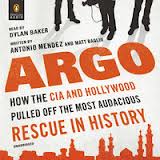
While the [action portrayed in the] movie is 30 years old, it really is still relevant. Both in the sense that it’s about the unintended consequences of revolution and in the sense that we’re dealing with the exact same issues now than we were then.
Earlier this week, Affleck joined blowhard ignoramus Bill O’Reilly on Fox News to discuss the film. In describing Argo, Affleck said:
You know, it was such a great story. For one thing, it’s a thriller. It’s actually comedy with the Hollywood satire. It’s a complicated CIA movie, it’s a political movie. And it’s all true.
In a thrillingly complicated comical twist, about thirty seconds later, the star of Surviving Christmas and Reindeer Games contradicted himself completely:
To me, I made a movie that my friends who are Democrats and my friends who are Republicans can both watch. It’s not a political movie.
Affleck also spent much of his time praising the U.S. intelligence and foreign service agents, including those who actively worked against the popular revolution that overthrew the Pahlavi monarchy.
[T]his is really a tribute to the folks and our clan that’s in services, and diplomats in the foreign service who are risking their lives over there, tragically seeing examples of that very recently. And folks who are — what they give up to serve us and to serve our country.
He added:
I’ve been to the CIA. I met General David Petraeus. These are extraordinary honorable people at the CIA. Make no mistake about it.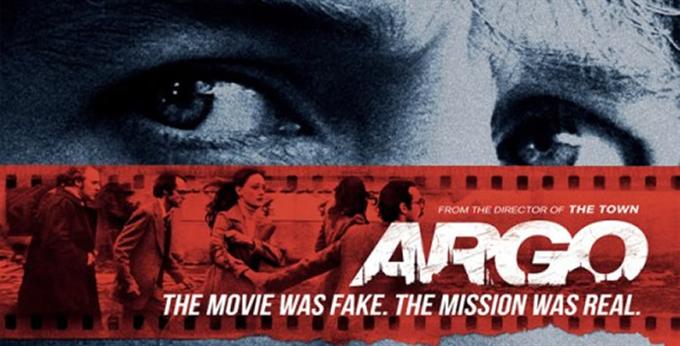
O’Reilly summed it up: “This is a Valentine from Ben Affleck to the Intelligence Community,” he declared.
Affleck also demonstrated a dizzying fealty to alarmist misinformation over the Iranian nuclear program. If the “Islamist regime,” he warned, “got a bomb, I think everybody thinks that would be trouble.” Affleck then proceeded to opine that “Israel is not entirely capable of whacking them to the extent in which they need to be whacked.” Read that again.
He continued, “And I wouldn’t outsource U.S. foreign policy to any other government…However, we have to have a line beyond which we say this is not acceptable in Iran.” It didn’t take much for O’Reilly to draw out what his Fox News audience most wanted to hear. ”I wouldn’t oppose military action,” Affleck obliged.
Considering its filmmaker’s perspective, there’s a good chance Argo may not present a particularly erudite understanding of the events of Autumn 1979, despite the fact that the film itself opens with a quick review of Iranian history and the revolution.
With this in mind, there is some vital context that might – I repeat, might – be missing from Argo which every theatergoer should know in order to better contextualize what they’ll be watching this weekend:
Tyranny and Terror Under the Shah, Bankrolled by the U.S.
For most Americans, the history of Iranian-U.S. relations began on November 4, 1979, the day revolutionary students seized control of the American Embassy in Tehran. According to the American narrative, one November morning – out of the blue – some crazy Iranian fanatics seized the U.S. Embassy in Tehran and held dozens of innocent Americans hostage for 444 days because they were mean and hated Americans for no reason.
Here’s some of what’s missing:
The United States of America backed, armed and supported the tyrannical rule of Mohammad Reza Pahlavi, the Shah of Iran, for more than 25 years.
As late as 1977, President Jimmy Carter, speaking at a New Years Eve state dinner, called the Shah’s Iran “an island of stability” in an otherwise turbulent Middle East. Carter said this at a time when in Iran, under the Shah, “dissent was ruthlessly suppressed, in part by the use of torture in the dungeons of SAVAK, the [American and Israeli-trained] secret police,” Time magazine reported, adding:
The depth of its commitment to the Shah apparently blinded Washington to the growing discontent. U.S. policymakers wanted to believe that their investment was buying stability and friendship; they trusted what they heard from the monarch, who dismissed all opposition as ‘the blah-blahs of armchair critics.’
Such commitment to the belief in the Shah’s “stability” and inevitable longevity was evidenced in many U.S. intelligence assessments at the time. For example, as Jeffrey T. Richelson recalls in Wizards of Langley: “A sixty-page CIA study completed in August 1977, Iran in the 1980s, had asserted that ‘there will be no radical change in Iranian political behavior in the near future’ and that ‘the Shah will be an active participant in the Iranian life well into the 1980s.’
Another CIA report from mid-1978 and entitled “Iran After the Shah”, affirmed that “Iran is not in a revolutionary or even a ‘prerevolutionary’ situation.”
As Time pointed out in its January 7, 1980 report:
Even after the revolution began, U.S. officials were convinced that ‘there is no alternative to the Shah.’ Carter took time out from the Camp David summit in September 1978 to phone the Iranian monarch and assure him of Washington’s continued support.
Popular street demonstrations against the Shah’s rule became frequent throughout Iran in 1978 (as was the killing of protesters by government forces) and, eventually, many cities were placed under martial law. During a peaceful demonstration in Tehran on September 8, 1978, government security forces opened fire on unarmed protesters, killing and wounding hundreds.
Nevertheless, that very month, the U.S. State Department expressed its confidence that the Shah would retain his control over Iran, though perhaps without “the same position of unquestioned authority he formerly enjoyed.”
At the same time that nationwide strikes spread throughout bazaars, banks, the oil and gas industry, newspapers, customs and post offices, mining and transportation sectors, as well as most universities and high schools, an “Intelligence Assessment” released by the Defense Intelligence Agency declared that the Shah “is expected to remain actively in power over the next ten years.”
On October 27, 1978, as the revolution surged, the CIA issued another report, this one suggesting that “the political situation [in Iran] is unlikely to be clarified at least until late next year when the Shah, the Cabinet, and the new parliament that is scheduled to be elected in June begin to interact on the political scene.”
Just a few months later, in the face of a massive popular uprising representing the end of millennia of monarchy in Iran, the Shah and his wife Farah fled Iran in early 1979, never to return. They flew to Egypt, where they received a warm welcome by Anwar Sadat.
Following the Shah’s departure, the transitional Iranian government immediately cut ties with two countries: Apartheid South Africa and the State of Israel, both nations founded on the violent dispossession, forced displacement, and institutionalized discrimination against an indigenous population.
Despite the leading role it had played in propping up the Shah’s dictatorship for so long, Iran did not break off relations with the United States in the hopes of ushering in a new diplomatic relationship based on mutual respect.
Catalyzing the Crisis
Later that year, in October 1979, the Shah sought medical treatment in the United States for his worsening cancer, the interim government of Iran warned the U.S. against admitting the Shah as it wished for the deposed dictator to face trial and justice in Iran for his crimes against the Iranian people. When asked whether it would be problematic if the Shah’s young children were to enter the United States for schooling, Iran’s secular Prime Minister, Mehdi Barzargan, responded that such would not create any difficulties, but still “reiterated his warning about the dangers of admitting the shah himself.”
President Carter had to make a decision and asked the advice of his closest advisers. ”He went around the room, and most of us said, ‘Let him in.’” recalls Vice President Walter Mondale. “And he said, ‘And if [the Iranians] take our employees in our embassy hostage, then what would be your advice?’ And the room just fell dead. No one had an answer to that. Turns out, we never did.”
It is rumored, however, that Secretary of State Cyrus Vance, Deputy Secretary of State Warren Christopher, and Undersecretary of State David Newsom all tried to hedge their bets and prevent the Shah’s admission to the U.S. in the hopes that it would help mend relations with the new transitional government in Tehran.
In favor of admission, on the other hand, were National Security Adviser Zbigniew Brzezinski, Chase Bank chairman David Rockefeller, former Secretary of State Henry Kissinger, and former World Bank president John J. McCloy, who had served as Assistant Secretary of War during World War II and U.S. High Commissioner for Germany, who were collectively dubbed “influential friends of the Shah” by Brzezinski himself. Apparently, Brzezinski personally “felt strongly that at stake were [the United State’s] traditional commitment to asylum and our loyalty to a friend. To compromise those principles would be to pay an extraordinarily high price not only in terms of self-esteem but also in our standing among our allies….”
In response to such lobbying by the Shah’s good buddies, President Carter acquiesced to the Shah’s demands on October 21, 1979. The very next day, Pahlavi and his family arrived in New York City on October 22, 1979 aboard Rockefeller’s private jet.
Reporting in The New York Times in May 1981 following the Shah’s death and state funeral in Egypt, Dr. Lawrence K. Altman wrote that, from this decision “flowed a chain of events that dramatically reshaped recent American history and led, all too inevitably, to the 444 days of the hostage crisis.”
Henry Precht, the senior Iranian task-force officer at the State Department, who was then in Iran, is quoted in Altman’s article as saying that “the initial reaction of Ayatollah Ruhollah Khomeini and the Iranians was ”exceptionally controlled.” Precht added, however, “But one had the feeling that the Iranians, always suspicious, now sensed that they had indeed been duped and that the Shah had come to the United States not for medical treatment but to set up counterrevolutionary headquarters.” In response, Altman reveals, a group of Iranian students met “in a small mountain village above Teheran to determine what action they would take to vent their fury at the Shah’s admission to the United States.”
Following the seizure of the Embassy and the taking of hostages, a reporter asked Carter why he had reversed his previous position and permitted the Shah to enter the U.S. when “medical treatment was available elsewhere [and] you had been warned by our chargé that the Americans might be endangered in Tehran.” Carter replied that he has made “the right decision” and had “no regrets about it nor apologies to make.” He said:
The decision that I made, personally and without pressure from anyone, to carry out the principles of our country, to provide for the means of giving the Shah necessary medical assistance to save his life, was proper.
Carter’s humanitarian mission to save Iranian lives was apparently limited to that of a single corrupt despot, a puppet dictator that served Washington’s hegemonic designs in the Middle East for decades. The lives of Iranian civilians who suffered under the Shah’s rule and American largesse, however, had not been considered worth saving.
Decades of Torture and Repression
The Shah’s Organisation of Intelligence and National Security, known by its Farsi acronym SAVAK, acted as the dictator’s personal secret police force, was tasked with suppressing dissent and opposition to the monarchy. Created in 1957 with the help of American and Israeli intelligence agents, the SAVAK grew in size and brutality and, as journalist Marsha Cohen points out, included “thousands of informers, censorship, arbitrary arrest and imprisonment, and widespread torture and assassination of political opponents. A censorship office monitored journalists, academics and writers, and kept a watchful eye on students. The penalty for possession of forbidden books included interrogation, torture and long term imprisonment.”
In 1976, according to Amnesty International, the Shah’s Iran had the “highest rate of death penalties in the world, no valid system of civilian courts and a history of torture which is beyond belief.” The report concluded, “No country in the world has a worse record in human rights than Iran.” The number of political prisoners detained at any given point was reportedly “anything between 25,000 and 100,000.”
The same year, renowned Iranian poet and author Reza Baraheni wrote in New York Review of Books:
The CIA re-created the monarchy, built up the SAVAK and trained all its prominent members, and stood by the Shah and his secret police as their powerful ally. Iran became the police state it is now.
He continued:
Thousands of men and women have been summarily executed during the last twenty-three years. More than 300,000 people have been in and out of prison during the last nineteen years of the existence of SAVAK; an average of 1,500 people are arrested every month. In one instance alone, American-trained counterinsurgency troops of the Iranian Army and SAVAK killed more than 6,000 people on June 5, 1963.
In another article, Baraheni wrote that “[c]orruption is so widespread that threats of jailing, even shooting, cannot solve the problem, because at the heart of corruption are the Shah himself and the royal family.”
The Associated Press also ran a story about the abusive, and sometimes lethal, treatment of prisoners by the SAVAK as reported by the Red Cross, which had gained access to “5,000 inmates in 37 jails and prisons” over three separate visits to Iran between March 1977 and February 1978.
Both the United States and Israel played a large role in the SAVAK’s activities. As Robert Fisk points out in his book The Great War For Civilisation, “A permanent secret US mission was attached to Savak headquarters.”
Jesse Leaf, a former high-level CIA analyst in Iran until his resignation in 1973, revealed years later “that the CIA sent an operative to teach interrogation methods to SAVAK” in seminars that “were based on German torture techniques from World War II.” While no Americans admitted to witnessing torture, Leaf recalled “seeing and being told of people who were there seeing the rooms and being told of torture. And I know that the torture rooms were toured and it was all paid for by the USA.” When asked why none of the American agents protested such brutality, Leaf explained, “Why should we protest? We were on their side, remember?”
“Methods of interrogation” often used by SAVAK, writes Fisk, “included – apart from the conventional electric wires attached to genitals, beating on the soles of feet and nail extraction—rape and ‘cooking,’ the latter a self-explanatory form of suffering in which the victim was strapped to a bed of wire that was then electrified to become a red-hot toaster…They recorded that the inmates had been beaten, burned with cigarettes and chemicals, tortured with electrodes, raped, sodomised with bottles and boiling eggs. Interrogators forced electric cables into the uterus of female prisoners. The Red Cross report named 124 prisoners who had died under torture.”
According to Iranian scholar R.K. Ramazani:
Mossad was totally identified with the Shah’s CIA-created SAVAK. This was the principal instrument of the regime’s repressive measures, which included physically punishing religious and secular political dissidents by electric shock, tearing out of fingernails and toenails, rape, and genital torture.
The Mossad connection was confirmed earlier this year by CBS News’ Dan Raviv and Israeli journalist Yossi Melman in their book Spies Against Armageddon, in which they reveal:
Israeli intelligence trained Savak, the Shah’s brutal secret police and espionage service. As part of the compensation, the Shah allowed the Mossad to operate on his soil as a base for recruiting agents in Iraq and other countries. Iran even provided documentation to enhance the Israelis’ cover stories.
In early January 1980, an Associated Press report noted that the “Iranian militants…holding some 50 Americans hostage in the U.S. Embassy in Tehran…say they will not release them until Shah Mohammad Reza Pahlavi is returned to Iran to stand trial on charges of corruption and other crimes – including the reported torture.” The article continued, “The Iranian government has demanded an international hearing of its grievances against the shah and his former government.”
When asked about these demands by the press, President Carter replied:
I don’t know of any international forum within which charges have ever been brought against a deposed leader who has left his country. There have been instances of changing governments down through the centuries in history, and I don’t know of any instance where such a leader, who left his country after his government fell, has been tried in an international court or in an international forum…
But as I said earlier, I don’t think there’s any forum that will listen to the Iranians make any sort of claim, justified or not, as long as they hold against their will and abuse the hostages, in complete contravention to every international law and every precept or every commitment or principle of humankind.
Within three weeks of the Embassy takeover, about a dozen women and African-Americans were released by the Iranian students in what Khomeini called an act of solidarity with oppressed minority groups in the U.S. Later, a sick hostage was also released. None of the hostages were killed.
Open Hands and Iron Fists
The remaining 52 American hostages were released upon the inauguration of President Ronald Reagan in January 1981, in accordance with the Algiers Accord, an agreement signed by Iran and the United States.
Shortly after the hostage-taking, President Carter imposed sanctions upon Iran and had frozen billions of dollars of Iranian government assets in an act that one U.S. official described as “economic and political warfare.” The Accord assured Iran that all assets would be returned; to date, the U.S. has never complied with this agreement.
The Accord also affirms, as its primary point, that the “United States pledges that it is and from now on will be the policy of the United States not to intervene, directly or indirectly, politically or militarily, in Iran’s internal affairs.”
Since then, not only did the U.S. government renege on this promise two years later when it again imposed sanctions on Iran, it has continued to violate the agreement through relentless and inhumane economic warfare, drone surveillance, covert operations, support for Iranian terrorist groups, and cyber attacks, not to mention the sporadic murder of Iranian civilians.
In March 2009, President Obama delivered a Nowruz message to Iranians and their government in which he declared that his new “administration is now committed to diplomacy that addresses the full range of issues before us, and to pursuing constructive ties among the United States, Iran and the international community” and affirmed that the “process will not be advanced by threats.” Just nine days before this message, however, Obama had announced the extension of economic sanctions on Iran imposed by President Clinton in March 1995 and were set to expire.
Subsequently, Obama has imposed ever more brutal sanctions on the Iranian people, increased arms sales to Iran’s Middle East neighbors, substantially built-up America’s own armaments and warship presence in the Persian Gulf and Indian Ocean, expanded covert operations in the region (and in Iran specifically), and has consistently maintained the aggressive posture that “all options are on the table” when it comes to dealing with Iran, code for the willingness of the American executive to commit the supreme international crime of launching a voluntary war.
Nevertheless, this weekend, moviegoers will be treated to a full dose of Western diplomats running scared from angry Middle Eastern mobs, unwitting victims of seemingly irrational rage. Even though Argo‘s audience will obviously be rooting for the daring rescue to succeed, it’s still essential to understand what all those Iranians might have been so upset about.
Vote Screws

Jonik is a long-time contributor of cartoons to National Lampoon, New Yorker, NY Times, Gourmet, Cosmopolitan, Audubon, Fantasy & Science Fiction, Wall St. Journal, Mad, and other national publications. He began also doing editorial cartoons the day after Papa Bush started bombing Baghdad. His editorial work has been published in many alternative publications and is not copyrighted so that activists without budgets can “steal this cartoon.” Those with budgets, however, are nice about sharing that. Read other articles by Jonik, or visit Jonik’s website.
Interview with Beatrix Hoffman: Health Care for Some
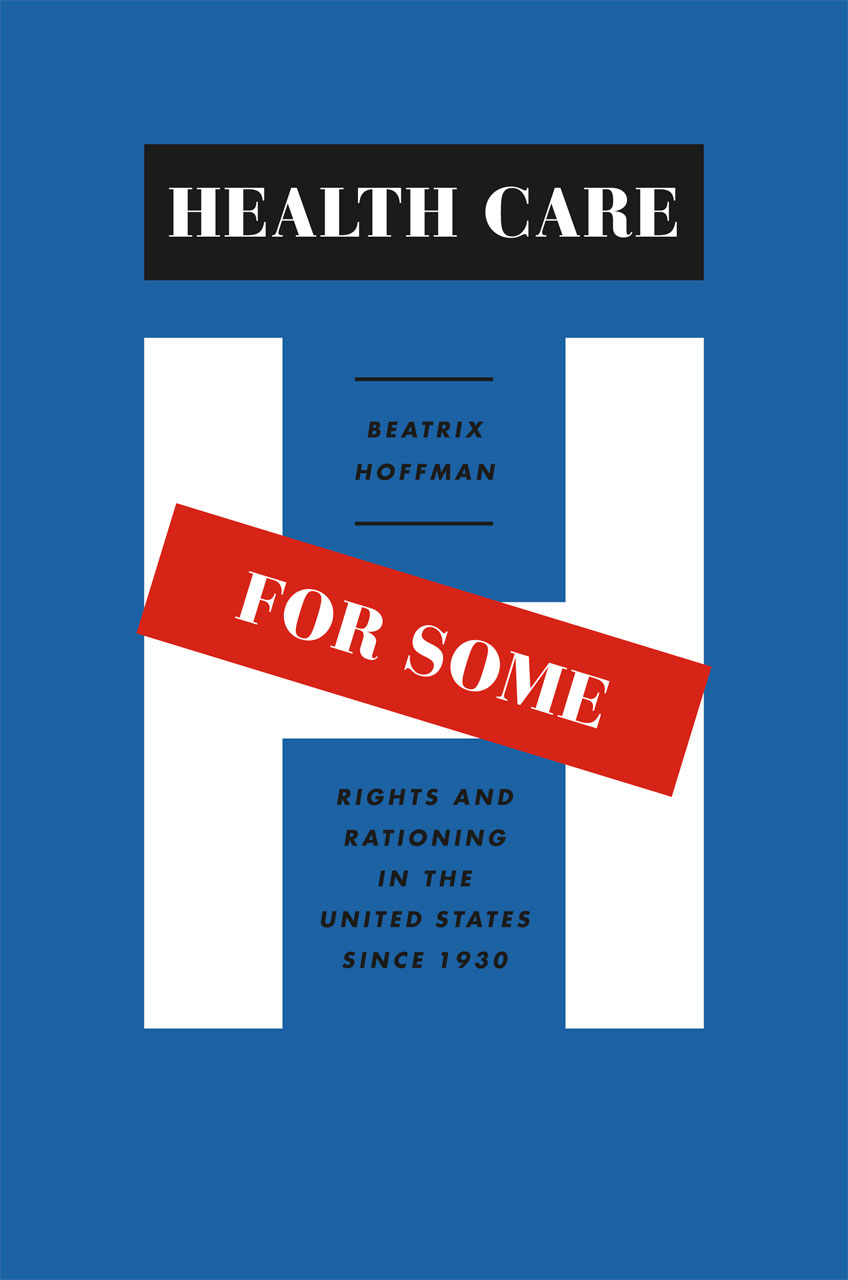
Earlier today, we sat down with Professor Beatrix Hoffman, author of the recent book Health Care for Some: Rights and Rationing in the United States Since 1930.
Beatrix was in Grand Rapids to present at the 2012 Great Lakes History Conference at GVSU.
We talked about the history of what she referred to as health care rationing in the US, from the early part of the 20th Century through the Affordable Health Care Act. She talked a bit about the history of grassroots social movements and health care reform, which once again demonstrates that change comes from below, not from those in power.
Beatrix also highlighted three women activists, each of which had a tremendous impact on health care policy and health care rights from the 1930s through the 1980s.
Tariq Ali on the EU receiving the Nobel Peace Prize
This video is re-posted from Democracy Now.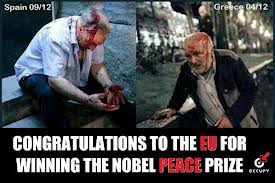
The European Union was awarded the Nobel Peace Prize earlier today for its historic role in uniting the continent. Committee chair Thorbjoern Jagland praised the EU for transforming Europe “from a continent of wars to a continent of peace.” The selection surprised many as it comes at a time when much of Europe is facing an economic crisis that threatens the EU’s future. Just this past week, thousands of Greeks protested in Athens against a visit by German Chancellor Angela Merkel, who has pushed Greece, Spain and Ireland to enact deep austerity measures.
For more, we go to London to speak with Tariq Ali, political commentator, historian, activist and editor of the New Left Review. “My initial response was to burst out laughing, because this Nobel Peace Prize committee, basically run by clapped-out former politicians in Norway, never fails to amuse and disappoint,” Ali says. “To give the prize to the European Community at a time, effectively, when economically it is promoting unemployment, creating real class divides in virtually every country in Europe, where it has led to enormous violence on the streets of Greece, because of the policies being pushed by the EU … it’s a complete and utter joke.”
Interview with Filmmaker Grace Lee

We had the opportunity to sit down and have a conversation with independent filmmaker Grace Lee, while she was in Grand Rapids for the Great Lakes History Conference at GVSU.
Grace has produced several films, such as The Grace Lee Project and more recently, Janeane From Des Moines, which is a film meant to counter the media created narrative around elections in the US.
We spoke about how Grace got involved in filmmaking, her current project (a film on Detroit activist Grace Lee Boggs), the film Janeane from Des Moines (being screened in many swing states in the US) and the importance of independent media.
Yesterday, MLive ran a brief article with comments from some local Venezuelans on the recent election in their country.
In the MLive article we hear from three Venezuelans, all of which reflect disappoint in the re-election of Hugo Chavez. One of those interviewed for the story, Maria Morin, said the following about the Chavez government:
Society is getting used to depending on the state. That promotes paternalism and nepotism, and people are not becoming financially independent, which I think is what should happen.
Morin also believes that the “educated” people in the country will grow tired of the paternalism and leave Venezuela.
The only contextual information provided by the MLive reporter spoke about how long Chavez has been President and that he, “has remained popular over the years because of his vast social programs funded by Venezuela’s oil wealth.”
While there is some truth to this comment, it comes nowhere near to reflecting what is happening on the ground in Venezuela. One thing the Chavez government has done since 1999, has been to give more autonomy to local communities. The giving of power to local communities is described in detail in a recent book entitled, Venezuela Speaks: Voices from the Grassroots.
Another major omission from the MLive story was the failure to even mention what the US government has been doing to undermine the Chavez government since, beginning with the attempted coup in 2002 that is well documented in the film, The Revolution Will Not Be Televised.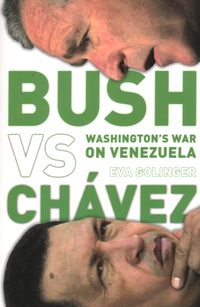
Since the 2002 attempted coup by the US, there have been other means by which the Bush and Obama administrations have sought to undermine the Venezuelan government. This campaign is best described in Eva Golinger’s book, Bush vs Chavez: Washington’s War on Venezuela.
Golinger reveals that Venezuela’s revolutionary process has drawn more than simply the ire of Washington. It has precipitated an ongoing campaign to contain and cripple the democratically elected government of Latin America’s leading oil power. Bush Versus Chávez details how millions of U.S. taxpayer dollars are used to fund groups such as the National Endowment for Democracy, the United States Agency for International Development, and the Office for Transition with the express purpose to support counter-revolutionary groups in Venezuela. It describes how Washington is attempting to impose endless sanctions, justified by fabricated evidence, to cause economic distress. And it illuminates the build-up of U.S. military troops, operations, and exercises in the Caribbean, that specifically threaten the Venezuelan people and government.
The MLive article potentially leaves readers with the impression that the Chavez government is bad for Venezuelans and that the only hope for the country will be the next election that could deposed the current President. It’s not only lazy journalism, it misleads people on a critical point of US foreign policy.
For those wanting solid ongoing analysis of what is taking place in Venezuela, we recommend the site http://venezuelanalysis.com/. There is also this informative interview with Venezuelan Analysis founder Gregory Wilpert on the Real News Network.
Pinkwashing Fracking?
This article by Steve Horn is re-posted from CounterPunch.
The Wizard of Oz was spot on when he said to “Pay no attention to the man behind the curtain.” That’s good life advice if you fall into the “Ignorance is bliss” camp. For a journalist though, it’s doing the exact opposite that’s a sin qua non for the job.
Kevin Begos of the Associated Press took the Wizard’s advice to heart in his July 22 story titled, “Experts: Some fracking critics use bad science.”
Citing “Gasland” director Josh Fox’s viral video “The Sky is Pink” as an example, Begos wrote, “Opponents of fracking say breast cancer rates have spiked exactly where intensive drilling is taking place — and nowhere else in the state…But researchers haven’t seen a spike in breast cancer rates in the area.”
As his main source of expertise on the breast cancer issue, Begos turned to Chandini Portteus, Susan G. Komen for the Cure Foundation’s Vice President of Research, Evaluation, and Scientific Programs. Of the connection between fracking and breast cancer she stated, “what we do know is a little bit, and what we don’t know is a lot.”
Sara Jerving of the Center for Media and Democracy came to diametrically different conclusions in her April 2012 probe for PR Watch, writing,
Benzene, which the U.S. EPA has classified as a Group A, human carcinogen, is released in the fracking process through air pollution and in the water contaminated by the drilling process. The Institute of Medicine released a report in December 2011 that links breast cancer to exposure to benzene.
Up to thirty-seven percent of chemicals in fracking fluids have been identified as endocrine-disruptors — chemicals that have potential adverse developmental and reproductive effects. According to the U.S. EPA, exposure to these types of chemicals has also been implicated in breast cancer.
Jerving also cites the piece of evidence that Fox used to tie fracking to breast cancer in “The Sky is Pink,” explaining, “In the six counties in Texas which have seen the most concentrated gas drilling, breast cancer rates have risen significantly, while over the same period the rates for this kind of cancer have declined elsewhere in the state.”
Who, then, are the “men behind Komen’s curtain”?
Many environmental activists are familiar with the “greenwashing” concept. Fewer, though, are familiar with “pinkwashing,” best documented by the book Pink Ribbons, Inc.: Breast Cancer and the Politics of Philanthropy by Samantha King. It’s a concept fully on display with regards to the ties that bind Komen to the shale gas industry.
Komen’s Ties to the Halliburton Loophole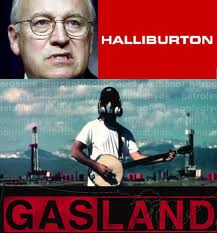
Behind curtain one is Jane Abraham, named to the Komen Board of Directors in May 2012. She’s the “wife of former [U.S.] Senator and U.S. Secretary of Energy Spencer Abraham,” according to Komen’s website.
Upon leaving his posts as a Senator and Energy Secretary under the George W. Bush Administration, Spencer fled straight for the Board of Directors of Occidential Petroleum, where he still sits on the Board today. Occidential has fracking operations set up in both California– and North Dakota-based shale basins.
He also is one of the Principals of The Abraham Group, LLC, a consulting firm which, among other things, advises oil and gas industry clientele, headed by his wife Jane.
Spencer Abraham was the Bush Administration’s Secretary of Energy when Vice President Dick Cheney oversaw the Energy Task Force. The Task Force was composed of Cheney, as well as the Secretaries of State, Treasury, Interior, Agriculture, Commerce, Transportation and Energy. It was instrumental in facilitating private meetings between oil and gas executives and upper-level Bush Administration Cabinet members.
In the fracking sphere, one of the crucial outcomes of the Task Force’s meetings was the “Halliburton Loophole.” This clause located within the Energy Policy Act of 2005 allows chemicals found in “fracking fluid” to be deemed a “trade secret,” exempting the shale gas industries from both the Clean Water Act and the Safe Drinking Water Act when they perform hydraulic fracturing for shale gas.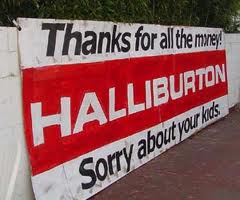
Other Komen Oil and Gas Industry Ties that Bind
Komen also maintains what it calls its “Million Dollar Council,” which receives funding from Koch Industries’ subsidiary, Georgia-Pacific, as well as General Electric (GE). Koch Industries and its many subsidiaries have a major financial stake in shale gas drilling. So too does GE.
Georgia-Pacific “produces resins used for chemicals used to prop open micro-fractures, an important process for fracking to occur,” explained Lee Fang of the Republic Report. Other Koch subsidiaries — including Koch Pipeline, Flint Hills Resources, Koch Supply & Trading and Koch Chemical Technology Group — all have a fiscal future intricately tied to shale gas production, according to Fang’s reporting.
GE, meanwhile, also describes itself as a “massive player” in shale gas production. As I wrote for AlterNet in September 2011:
GE created a device for recycling the water used during the controversial and toxic hydraulic fracturing (fracking) process. Furthermore, it maintains natural gas fueled power plants, and manufactures natural gas-powered turbines, having sold more than $1 billion worth of them in 2011 in the United States, according to Reuters. GE also recently made a deal with Russia to sell between $10 and $15 billion worth of turbines.
The Komen “Million Dollar Council” list also includes a key investor backing oil and gas industry interests, Bank of America, a corporation which boasts on its website of its investments in commodities like coal, oil and natural gas.
Furthermore one of the members of Komen’s Board of Directors, John D. Raffaelli, has spent many years working as an oil and gas industry lobbyist. Described by Komen “as one of the most effective lobbyists in Washington,” Raffaelli served as a hired gun for the American Petroleum Institute, Atlas Energy (which has since been sold to Chevron), General Electric and Edison Electric respectively between 2008-present.
Pink Ribbons, Inc.
In response to a long email query from CounterPunch to Begos questioning numerous aspects of his story, CounterPunch received a short email response from AP’s Director of Media Relations, Paul Colford stating, “The AP stands by his story.”
Fox wasn’t too thrilled with the AP story.
“It is clear to me, as it was from the first moment, that Kevin Begos was not out to give fracking critics a fair shake or look objectively at the facts,” Fox said. “He was deliberately seeking ways to try to discredit the anti-fracking movement and he was willing to twist facts and quotes to serve that purpose while disguising his work as impartial. It is worse than bad journalism, it is highly unethical, dangerous and irresponsible”
It’s unlikely Begos had a vendetta, as Fox suggests. Alternatively, by not doing his homework, Begos was likely unaware that he was serving as a stenographer for the shale gas industry’s stealthy public relations apparatus via Komen.
“Komen has, since its inception, prioritized corporate partnerships over environmental health,” King told CounterPunch. “They do so by providing companies such as General Electric, whose products and practices are linked to cancer, with a platform from which to declare a commitment to ending the disease. At the same time, Komen refuses to prioritize research on the environmental causes of breast cancer and on primary prevention — an unsurprising stance given their dependence on pinkwashing sponsors.”
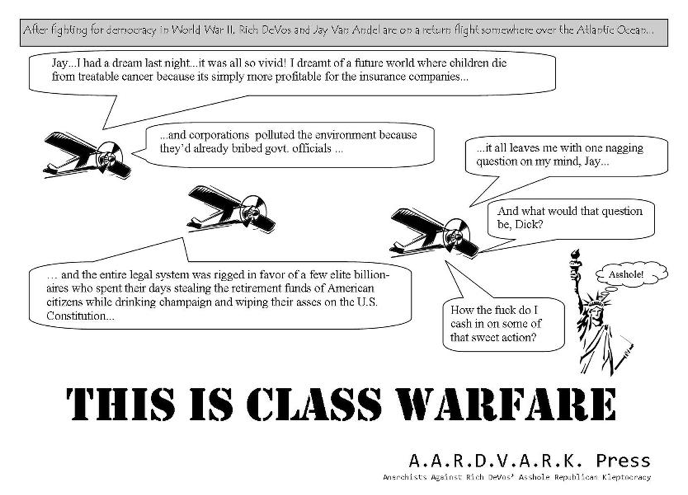
We recently received the cartoons below by someone who calls themselves a “guerilla artist” and goes by the name Thaddeus Bobo. This artist said he has been inspired by the propaganda work done during WWII and more recently the work of David Rees, who created the fabulously satirical book Get Your War On in 2001.
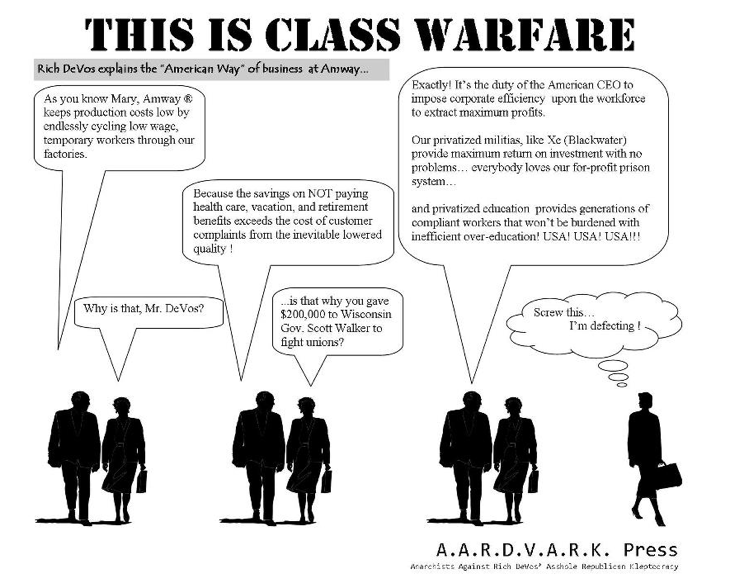
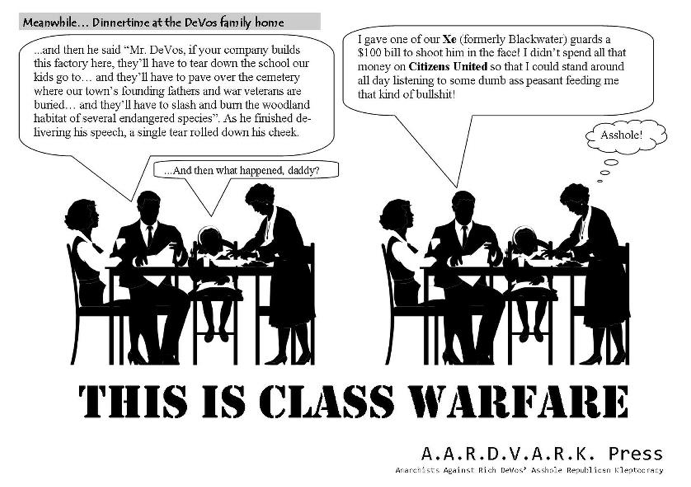
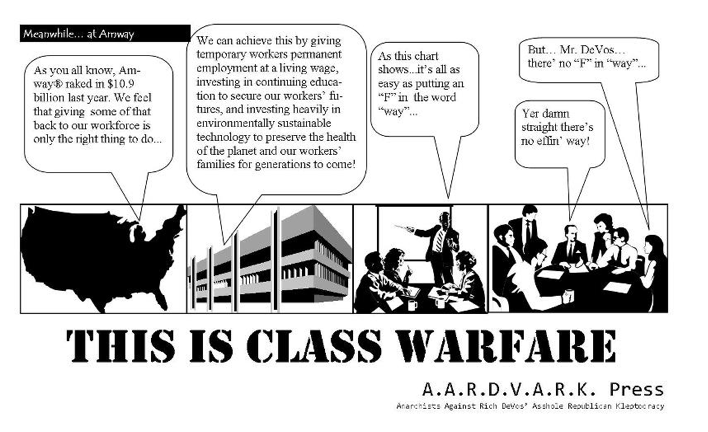
We asked Thaddeus Bobo a few questions about the work that is critical of the DeVos Family and Amway and have included all five of the cartoons below.
GRIID – What inspired you to create these cartoon messages about the DeVos Family?
I actually work at Amway. I see the struggles of the people on the production floor every day. I hear how their kids are struggling to get into decent colleges, how they worry about sick parents whose retirement funds has been ransacked by Wall St, how they constantly worry about where the money for the next unexpected bill is going to come from.
The fact that Rich Devos spent over $200,000USD supporting Citizens United speaks volumes about his respect for the average worker on his production floors. Supporting the anti-union activities of Wisconsin Gov. Scott Walker actively hurts working men and women and their families who are just trying to make a fair wage for their honest labor. These are people just like the ones working at Amway every single day. Many of them are too busy worrying about paying the mortgage to spend much time learning about the DeVos family’s efforts to erode the quality of life for the average middle class American. I felt that I had to do something to express my frustration, and hopefully in a creative way that got people to laugh, to think, to question things for themselves.
GRIID – Will there be other work from AARDVARK Press about the local 1%?
Yes, for sure. I think tackling a few local politicians would be on the agenda, as well as local business owners like Tommy Brann espousing extremist views in the media.
GRIID – Do you have any plans on distribution at this point?
Nothing formal at this point. I was hoping to participate in a local diy ‘zine fest this spring that a few local activists have been dreaming up. I have no experience getting published, but would absolutely love to explore that as an option.
GRIID – There are plenty of working class people who also support the DeVos family “philanthropy.” Do you think that what you are doing offers a counter-narrative to the corporate media commentary on the DeVos family and other local robber barons?
I absolutely do feel that I am pointing out some of those unspoken truths, and in a way that uses humor to shed some light on some seriously un-funny situations.
In regards to the DeVos family, there is almost a “don’t bite the hand that feeds you” mentality that I think speaks volumes about the collective insecurity about not being a “real city” that seems to be prevalent in this town. I am glad that the DeVos family built a children’s hospital in Grand Rapids, it is undeniably a great thing. Altruism isn’t really a factor in these great contributions to our city. The DeVos family, Meijer family, Steelcase, Wolverine and other benefactors gain an enormous amount of social equity, and influence as a direct result of their actions.
Additionally, that great gesture is also tempered by actions like the $500,000 dollars Doug DeVos donated to fight against gay marriage. Its common knowledge that a certain percentage of the population falls into the LGBT community, so it stands to reason that Amway’s workforce of over 5,000 people has a few hundred people that Mr. DeVos has directly insulted. These types of conflict that the DeVos family “benevolently” inflict upon us should be questioned. People should ask “who really benefits from this action?”

Top 25 Censored Stories of the Year
Every year Project Censored publishes the Top 25 Censored Stories. The top censored stories over the past year cover a variety of topics and demonstrate once again how many of the major issues of the day are either ignored or suppressed by the corporate media.
This year’s Top 25 Censored stories include articles on the growing US police state, the degrading condition of oceans, Trillions in Loans to US banks, NATO War Crimes in Libya, Education Reform as Privatization and Wachovia Bank’s role in laundering money for drug cartels in Latin America.
Between 2004 and 2007, Wachovia Bank handled funds totaling $378.4 billion for Mexican currency-exchange houses acting on behalf of drug cartels. The transactions amount to the largest violation of the Bank Secrecy Act, an anti-money-laundering law, in US history. This case is not exceptional; Wachovia is just one of several US and European banks that drug cartels have used to launder money.
Another censored story deals with how FBI agents are responsible for a majority of terrorist plots in the US.
The Federal Bureau of Investigation has embarked on an unusual approach to ensure that the United States is secure from future terrorist attacks. The agency has developed a network of nearly 15,000 spies to infiltrate various communities in an attempt to uncover terrorist plots. However, these moles are actually assisting and encouraging people to commit crimes. Many informants receive cash rewards of up to $100,000 per case.
The New York Police are planting drugs on innocent people to meet arrest quotas is yet another censored news story.
A host of stories document how the New York Police Department operates outside the very laws it is charged with enforcing. In October 2011, a former NYPD narcotics detective testified that he regularly saw police plant drugs on innocent people as a way to meet arrest quotas. The NYPD’s controversial “stop and frisk” program has invested seventy-five million dollars to arrest suspects for possessing minimal amounts of marijuana. Each arrest costs approximately $1,000 to $2,000. Although NYPD use of unlawful restraints and disproportionate force to arrest peaceful Occupy protesters has received some news coverage, police brutality directed against people of color continues to go underreported.
One last story is about HR 347, legislation, which would make many forms of non-violent protest illegal.
In March 2012, President Obama signed into law HR 347, the Federal Restricted Buildings and Grounds Improvement Act of 2011. The law specifies as criminal offenses the acts of entering or remaining in areas defined as “restricted.” Although pundits have debated to what extent the new law restricts First Amendment rights or criminalizes Occupy protests, it does make it easier for the Secret Service to overuse or misuse existing laws to arrest lawful protesters
Federal officials interrupt Enbridge’s greenwash of Kalamazoo River tar sands spill
This article by Anthony Swift is re-posted from the Natural Resources Defense Council.
Federal officials at the Environmental Protection Agency (EPA) have pulled the curtain behind Enbridge’s effort to greenwash its tar sands pipeline spill into Michigan’s Kalamazoo River. On the same day that Enbridge told its investors that its tar sands spill and cleanup had made the Kalamazoo River cleaner, EPA ordered the Canadian tar sands pipeline company to resume its cleanup of the Kalamazoo River after finding that submerged oil “exists throughout approximately 38 miles of the Kalamazoo.” EPA’s findings, based on technical analysis from prominent scientists from the international oil spill response and recovery community, stand in stark contrast with the alternate reality that Enbridge is selling to investors and the public. Enbridge’s legacy in Kalamazoo was outlined by federal investigators as a company whose poor safety practices and failures to learn from past mistakes which resulted in the most expensive onshore pipeline disaster in U.S. history. The Canadian tar sands company’s recent attempt to gloss over this reality with a public relations campaign reveals the company has yet to learn this basic truth – simply saying something doesn’t make it so.
EPA issued Enbridge with an enforcement action requiring the pipeline company to resume its two year cleanup in three sections of the Kalamazoo River. In these areas, totaling over five and a half miles of the Kalamazoo River, there is so much submerged oil that the river is spontaneously generating oil sheen and oil globules and in danger of spreading.
Even with EPA’s new order, Enbridge will still be leave oil contamination in over 32 miles of the Kalamazoo River, where officials believe that the dredging necessary to recover the oil would cause more damage than benefit. That means that after Enbridge finishes the cleanup that EPA has ordered, the company will leave tar sands in place throughout over 30 miles of the Kalamazoo River.
Enbridge’s attempt to greenwash its impact on the Kalamazoo River speaks for itself. In a presentation to investors this week, the company provided three quotes from anonymous local residents, fisherman and river enthusiasts, who gush about what Enbridge’s tar sands spill has done for the community.

Focus on Operations, Presented in Enbridge’s 14th annual investment community conference October 3, 2012
Who are these people and where do they come from? As part of our Voices Against Tar Sands, we talked to folks in Marshall, Michigan. The people we talked to have names and stories to tell. It’s worth listening to what folks like Susan Connolly and Debbie Miller have to say about what Enbridge’s tar sands spill has done to their community.
This isn’t the first time that Enbridge has opted to obscure a problem rather than address it. For instance, Enbridge’s plan to ship tar sands in super tankers through British Columbia’s sensitive inner coastal waters – a treacherous maze of tightly packed rocky islands and reefs – has generated a public uproar in the province. Enbridge’s solution? The company broadened the Douglas Channel by erasing 400 square miles of offending islands on a map which it then promoted in a public relations campaign. Even if you look closely at the supertanker on Enbridge’s map, it’s hard to tell whether its run aground on Hawkesbury Island or if it is still in Devastation Channel.

Enbridge’s version of the Douglas channel compared to a scientists version, provided by SumOfUS
During the Kalamazoo River tar sands spill, Enbridge initially denied that tar sands was spilled. As Congressional and federal investigations began to uncover additional details on the spill, Enbridge CEO Patrick Daniel backtracked, saying:
“No, I haven’t said it’s not tar sand oil. What I indicated is that it was not what we have traditionally referred to as tar sands oil. … If it is part of the same geological formation, then I bow to that expert opinion. I’m not saying, ‘No, it’s not oil sands crude.’ It’s just not traditionally defined as that and viewed as that.” Patrick Daniels, August 12, 2010
It was tar sands diluted with volatile natural gas liquid condensate, technically referred to as diluted bitumen.
And recently, a Canadian newspaper broke another Enbridge flip flop. During hearings before Canadian officials in May, Enbridge pitched the reversal of its line 9 pipeline as a means to provide conventional crude to Eastern Canada. In June, Enbridge officials responded to opposition to plans to build establish the Trailbreaker pipeline system to ship tar sands through New England, saying ‘we have been absolutely clear that the company is not pursuing the Trailbreaker Project… I’m not sure what more we can say or how clearly we can say this.” Belying Enbridge’s denials, this week a U.S. Freedom of Information Act (FOIA) request by the Natural Resources Council of Maine uncovered that the Canadian Consulate has made presentations to the governor of Maine to promote the arrival of tar sands in New England. Is it possible that Enbridge doesn’t traditionally view the Trailbreaker project the way the rest of the world does?
It’s no wonder communities in the Midwest, New England, and British Columbia are balking at Enbridge’s plans to build and expand its tar sands pipeline network through their groundwater and rivers.
 Grand Rapids Institute for Information Democracy