Obama Aides Launch Preemptive Attack on New Iran Plan
This article by Gareth Porter is re-posted from ZNet.
Although the place and time of the next round of talks on Iran’s nuclear programme have not yet been announced, the manoeuvring by Iran and the United States to influence the outcome has already begun.
Iran sought support for a revised proposal to the talks during the United Nations General Assembly (UNGA) last month, according to a New York Times report Oct. 4. Then, only a few days later, the Barack Obama administration launched a preemptive attack on the proposal through New York Times reporter David Sanger.
The officials suggested the Iranian proposal would give Iran an easier route to a “breakout” to weapons grade uranium enrichment. But that claim flies in the face of some obvious realities.
An Oct. 4 story by Sanger reported that Iran had begun describing a “9-step plan” to diplomats at the UNGA and quoted administration officials as charging that the proposal would not “guarantee that Iran cannot produce a weapon”. Instead, the officials argued, it would allow Iran to keep the option of resuming 20-percent enriched uranium, thus being able to enrich to weapons grade levels much more quickly.
Iran’s nuclear negotiator Saeed Jalili issued a denial that Iran had “delivered any new proposal other than what had been put forward in talks with the P5+1″. But that statement did not constitute a denial that Iran was discussing such a proposal, because the Times story had said the proposal had been initially made to European officials during the P5+1 meeting in Istanbul in July.
Obama administration officials complained that, under the Iranian plan, Iran would carry out a “suspension” of 20-percent enrichment only after oil sanctions have been lifted and oil revenues are flowing again.
That description of the proposal is consistent with an Iranian “five-step plan”, presented during the talks with P5+1, the text of which was published by Arms Control Today last summer. In that proposal, the P5+1 would have ended all sanctions against Iran in steps one and two, but Iran would have ended its 20-percent enrichment only in the fifth step.
In that same final step, however, Iran also would have closed down the Fordow enrichment plant and transferred its entire stockpile of 20-percent enriched uranium to “a third country under IAEA (International Atomic Energy Agency) custody”.
Iran has made clear that it intends to use the 20-percent enrichment as bargaining leverage to achieve an end to the most damaging economic sanctions.
Ambassador Seyed Hossein Mousavian, the spokesperson for Iran’s nuclear negotiating team from 2003 to 2005 and now a visiting scholar at Princeton University, told IPS, “Iran is prepared to stop 20-percent enrichment and go below five percent. The question is what will the P5+1 provide in return. As long as the end state of a comprehensive agreement is not clear for Iran, it will not consider halting enrichment at 20 percent.”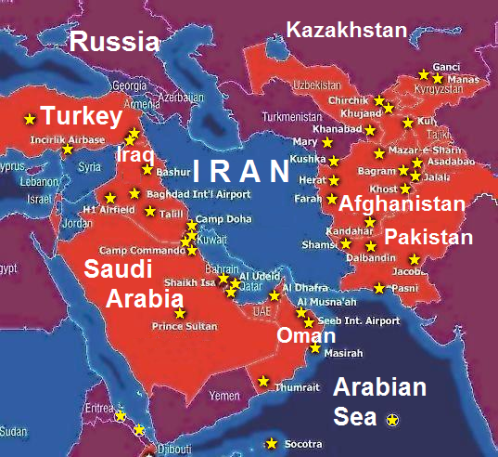
But the administration’s portrayal of the Iranian proposal as offering a sanctions-free path to continued 20-percent enrichment is highly misleading, according to close observers of the Iran nuclear issue. It also ignores elements of the proposal that would minimise the risk of a “breakout” to enrichment of uranium to weapons grade levels.
The Obama administration criticism of the proposal, as reported by Sanger, was couched in such a way as to justify the U.S. refusal to discuss lifting the sanctions on Iranian oil exports during the four rounds of talks with Iran. A senior administration official was quoted as saying that Iran “could restart the program in a nanosecond,” whereas “it would take years” to re-impose the sanctions.
Paul Pillar, national intelligence officer for Near East and South Asia from 2000 to 2005, noted in a commentary in The National Interest that it is “far easier to impose sanctions on Iran than to lift them” and that if Iran reneged on a nuclear agreement, “it would be easier still.”
Peter Jenkins, British permanent representative to the IAEA from 2001 to 2006, noted in an e-mail to IPS that it took the EU only two months to agree to impose oil sanctions, and that “political resistance among the 27 (EU member states) to imposing oil sanctions would probably be less if re-imposition were required by an Iranian breach of a deal with the P5+1.”
Jenkins pointed out that EU oil purchases from Iran now have experience in getting supplies from other countries which could make re-imposing sanctions even easier.
One U.S. official was quoted by Sanger as complaining that the Iranian proposal would allow Iran to “move the fuel around, and it stays in the country”. That description appeared to hint that the purpose is to give Tehran the option of a breakout to weapons grade enrichment.
But the biggest difference between the proposal now being discussed by Iranian diplomats and the one offered last summer is that the new proposal reflects the reality that Iran began last spring to convert 20-percent enriched uranium into U308 in powdered form for fuel plates for its Tehran Research Reactor.
The conversion of 20 percent enriched uranium to U308, which was documented but not highlighted in the Aug. 30 IAEA report, makes it more difficult to use that same uranium for enrichment to weapons grade levels.
The new Iranian proposal evidently envisions U308 uranium remaining in the country for use by the Tehran Research Reactor rather than the entire stockpile of 20-percent enriched uranium being shipped to another country as in its previous proposal.
Former State Department official Mark Fitzpatrick of the International Institute of Strategic Studies, who has argued in the past that the only purpose Iran could have in enriching to 20 percent is a nuclear weapon, told the Times that the conversion “tends to confirm that there is civilian purpose in enriching to this level”.
But Fitzpatrick told the Times that the Iranians know how to reconvert the U308 powder back to a gaseous form that can then be used for weapons grade enrichment. “It would not take long to set it up,” Fitzpatrick said.
In an interview with IPS, Dr. Harold A. Feiveson, a senior research scientist at Princeton’s Woodrow Wilson’s school and a specialist on nuclear weapons, said “it would not be super hard” to carry out such a reconversion.
But Feiveson admitted that he is not aware of anyone ever having done it. The reconversion to 20 percent enrichment “would be pretty visible” and “would take some time,” said Feiveson. “You would have to kick the (IAEA) inspectors out.”
Even Israeli policymakers have acknowledged that Iran’s diversion of 20-percent enriched uranium represents a step away from a breakout capability, as Haaretz reported Oct. 9.
Defence ministry sources told the Israeli daily that the Iran’s reduction of its stockpile of medium-enriched uranium had added “eight months at least” to what the Israeli government has cited as its “deadline” on Iran. The same sources said it was the justification for Prime Minister Benjamin Netanyahu’s dropping the threat of attack on Iran in his U.N. speech.
The deep reduction in Iranian oil revenues from sanctions and the recent plunge in the value of Iran’s currency may well have made Iran more interested in compromise than when the talks with the P5+1 started in April.
Mousavian told IPS, “I am convinced that Iran is ready for a package deal based on recognition of two principles.” The first principle, he said, is that “Iran recognises the P5+1 concerns and will remove all such concerns”; the second is that the P5+1 “recognises the rights of Iran and gradually lifts sanctions”.
But Iran’s supreme leader Ayatollah Ali Khamenei has expressed serious doubts about whether the Obama administration is willing to end the sanctions on Iran under any circumstances. In an Oct. 10 speech, Khamenei said the Americans “lie” in suggesting sanctions would be lifted in return for Iran giving up its nuclear program.
U.S. officials “make decisions out of grudge and aversion (toward Iran)”, Khamenei said.
Porn Stars & Sinners in Grand Rapids: A Feminist Interpretation
Yesterday, MLive posted a story about “porn star” Ron Jeremy’s visit to a West Michigan church.
The article talked about how the pastor at Daybreak Church invited Jeremy to share the stage with him and “guest pastor Craig Gross, an anti-pornography pastor who Jeremy counts as a close friend.”
Jeremy and the Daybreak pastor discussed how everyone is a sinner and is in need of saving. Ron Jeremy also apparently said that lots of “porn stars believe in God.” The bulk of the article provides lots of commentary from Jeremy who acknowledged that he still makes pornographic films.
So what can one make of this visit to West Michigan by Ron Jeremy? Well, it’s not the first time he has been here or the first time he has appeared with Pastor of XXX Church, Craig Gross.
The two men have “debated” pornography before in West Michigan, but their debates, like Jeremy’s recent visit, is rooted in the idea that pornography is wrong because it promotes sex outside of marriage.
Talking about pornography in a religious context is also a way to attract younger churchgoers, which the XXX Church is known to do, with its hip graphics of youth sporting tattoos and wearing shirts that say, “Jesus Loves Porn Stars.”
Such an analysis, or lack thereof, of the pornographic industry omits what many feminists believe to be the more important and relevant analysis.
Ever since Catherine MacKinnon and Andrea Dworkin began to challenge pornography from a feminist perspective, the discussion about pornography has shifted from just sex to harm. These two fierce feminists paved the way for many others since then, such as Jane Caputi, Diana E.H. Russell and Gail Dines to use a feminist analysis of pornography so that instead of just talking about frivolous sexual behavior, we could talk about pornography as a means of objectification, exploitation, violence and global capitalism.
This changes the very nature of the false debate between the like of Ron Jeremy and Craig Gross, two men who want to moralize pornography instead of thinking critically about the impact of one of the most profitable media industries.
According to the work of Gail Dines and Robert Jensen, the estimated profits from global pornography is $57 Billion. Comparatively, Hollywood films make roughly $23 Billion annually from global sales. In addition, there are roughly 4.2 million pornographic websites and 68 million daily porn searches.
Beyond the shear amount of pornography now available in the digital age, the issue of the harm done is what Dines and Jensen focus on. In the film The Price of Pleasure, feminist critics of pornography point to the dehumanizing nature of the current mass-produced pornography. Most pornography is produced by and for men, thus women’s bodies are merely to be consumed and tossed aside. Dines and Jensen have interviewed hundreds of porn producers and other people who have worked in the industry and what they have come to find as the norm is reflected in the following comment:
“Women were born with three holes for one purpose: To cram a cock deep inside every cuddly cavity! Like true cock sockets, our whores subject their beautiful bodies to the nastiest 4-way debauchery ever lensed.”
— Cover description of Zero Tolerance: No Holes Barred (DVD)
Women who have been consumed by the porn industry are tossed aside once they no longer fit the necessary role as object of male fantasy.
However, what Dines and Jensen have also done is looked at the harm done to men who consume pornography. Both argue that it negatively impacts men’s ability to enjoy healthy sexual intimacy with their partners, since they have become accustomed to the instant gratification of non-consensual and male pleasure-focus imagery of pornography. Here are other consequences of regular porn consumption by men:
Much more could be said about this topic, which is a perspective you will not get from porn stars like Ron Jeremy, despite his willingness to visit churches in West Michigan.
Lastly, here is an interview we did with Robert Jensen when he visited West Michigan in 2008, while on book tour with Getting Off: Pornography and the End of Masculinity.
Bloom Collective to host premier screening of Frankenstein for President this Friday
This Friday, the Bloom Collective will host a public screening of the locally produced film, Frankenstein for President.
The film is seasonal in two ways. First, it is a zombie & vampire film just in time for Halloween. Second, it is seasonal in that it takes a satirical look at elections in the US.
Frankenstein for President is about the monsters of capitalism, how the system creates zombies and how elections become not only a distraction from the real pressing issues of the day, but how it justifies a system that is designed to benefit the privileged few.
Frankenstein for President
Friday, October 26
8:00PM
8 Jefferson SE, Grand Rapids – right next to Bartertown
The event is also a costume party, so feel free to dress up. The event is free and open to the public, but donations will be accepted and DVDs of the film will be available for purchase. There will also be refreshments, music and dancing. For updates go to http://www.facebook.com/events/128327400649409/?fref=ts
Fracking Poisoning Families at Alarming Rate
This article is re-posted from Common Dreams.
Residents living near gas fracking sites suffer an increasingly high rate of health problems now linked to pollutants used in the gas extraction process, according to a new report released Thursday.
The study, conducted by Earthworks’ Oil & Gas Accountability Project, pulled from a survey of 108 Pennsylvania residents in 14 counties, and a series of air and water tests. The results showed close to 70 percent of participants reported an increase in throat irritation and roughly 80 percent suffered from sinus problems after natural gas extraction companies moved to their areas. The symptoms intensify the closer the residents are to the fracking sites.
“We use water for nothing other than flushing the commode,” said Janet McIntyre referring to the now toxic levels of water on her land, which neighbors a fracking site. McIntyre said her entire family, including their pets, suffered from a wide array of health problems including projectile vomiting and skin rashes, indicative of other families’ symptoms in the areas surveyed. Other symptoms include sinus, respiratory, fatigue, and mood problems.
“Twenty-two households reported that pets and livestock began to have symptoms (such as seizures or losing hair) or suddenly fell ill and died after gas development began nearby,” the report finds.
After taking water and air samples, Earthworks detected chemicals that have been linked to oil and gas operations and also directly connected to many of the symptoms reported in the survey on the resident’s properties. This study showed a higher concentration of ethylbenzene and xylene, volatile compounds found in petroleum hydrocarbons, at the households as compared to control sites.
“For too long, the oil and gas industry and state regulators have dismissed community members’ health complaints as ‘false’ or ‘anecdotal’,” said Nadia Steinzor, the project’s lead author. “With this research, they cannot credibly ignore communities any longer.”
According to a separate report released earlier this month, EPA regulators are having trouble keeping up with the “rapid pace” of shale oil and gas development, due to a lack in resources, staff, data and a number of legal loopholes.
This article by Tolu Olorunda is re-posted from Dissident Voice.
This is the life of the poor; this is the perpetual cry I hear.
— Khalil Gibran, Spirits Rebellious
“A house is not just a roof over somebody. It must have all the necessities that a human being needs. Because even this beautiful museum, if there is no water, no light, this is not a museum. It’s a slum,” Mnikelo Ndabankulu said this past Sunday afternoon inside the Charles H. Wright Museum, where Dear Mandela, a Sundance grant-funded film about the South African shack dwellers movement, was being screened. “For us, a house, a structure in the middle of nowhere is not a house. It’s a shelter. But it becomes a house when there are clinics, schools, shops—infrastructure—around” — the words of Zodwa Nsibande, a fellow member of the shack dwellers movement, Abahlali baseMjondolo, visiting Detroit from South Africa.
They were being hosted for the weekend by Welfare Rights, a long-running grassroots organization in Detroit. The activists touched briefly, while their film screened inside the museum’s theater, on a recurring scene in their travels. Through their 8-city nationwide visit, Detroit being the 7th, they had noticed an invariably older crowd. This is, of course, not the norm worldwide, where the young tend to be active socio-politically. Imagine, Zodwa said, a young South African saying: “Because my fathers and mothers fought for liberation I don’t have to fight for it.” This would suggest struggle is a project with an end date, rather than an endless process of resistance to any and all forms of oppression.
In Durban, their oppression is multi-layered, but central to it Land.
Abahlali baseMjondolo was formed in 2005 as a response to rising attacks on informal settlements, using education of the law as the main weapon. We see in Dear Mandela an emphasized knowledge of the constitution to resist the illegal evictions and rebuild what is destroyed.
“We don’t have resources,” Mnikelo said. “We only have masses and political ideology. So we have to force the government to do what the constitution says.”
The notion seems almost foreign in this land where apathy clouds the day and people have “ceased to ask anymore” of government than that, in the words of Hannah Arendt, it “show due consideration for their vital interests and personal liberty.” And yet, justice takes a different orientation in a land with 3.5 million homeless people and 18.5 million vacant homes, a land with acres upon acres of rich soil waiting for builders with axes and hammers. From country to country, the contrast is sharp.
“In South Africa, we’re fighting for land,” Mnikelo said, envisioning a much-different scenario in Durban. “When we build these shacks, the government doesn’t always say, Yes. Government says, No; we say, Yes. … [Here in Detroit], if people want those empty buildings to be theirs, they would take them over.”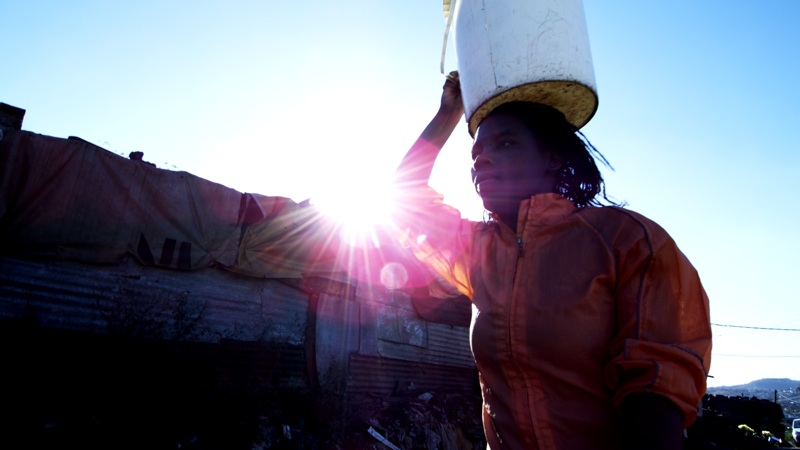
Unity is key for any meaningful victory, Zodwa said. There would have to be coalitions of homeless people to begin organizing and occupying. But organizing should have a strategic definition, contextual and conscious of its surrounding. “Everything that we do is determined by the time and space that we’re living in,” she said, speaking of Abahlali, which actively represents 25,000 dwellers from 64 settlements. “In our movement, we’ve got two kinds of people. People who are good with negotiating.” This group is put into the boardrooms to lobby municipality officials for housing needs and upgrades. “And there are people who don’t care about negotiating, who only want resistance—so you put them in the streets.”
We get a glimpse of these streets in the chaotic opening scenes of Dear Mandela as a crowd of protesters scream and flee from rubber bullets fired upon them by police officers. They are nonviolent, poor activists fighting for a human right: housing. But they are also fighting for their community; each settlement is held tight together by family values: sharing, participation, support, solidarity. “You don’t pass by when people are building a house” we hear early on in the film.
In one scene, government goons called Red Ants have descended upon a settlement. Cloaked in jail jumpsuit red, they are contracted to chop down shacks, usually while the resident students or workers are out for the day. “They don’t talk, they just do the chopping.” Flanked around them are soldiers with rifles drawn, ready to fire. And yet, as is mentioned, “people build anyway because they don’t have nowhere else to go.” They are simply disobeying an immoral law, an act of self-determination.
They are also asking some salient questions, such as: what is a slum? what is a house? What is a settlement? As Zodwa mentioned, there’s been a shift recently to move semantically beyond “House” to “Human Settlement” because “Human Settlement comprises of all elements that make a human being.”
Dear Mandela plays on the screen touching moments of simple, everyday humanity forged by deep social bonds. It also tells the complex story of South African life. Close-up shots of shacks are offered against a lavish wine-filled gala at “Emperor’s Palace” thrown by the Department of Housing to congratulate itself in curbing the shack problem and restoring order to society. Like life, Dear Mandela is a journey of tragedy and triumph. A light moment is grained against the ever-present looming fears of random, brutal eviction; and yet, victory does come through struggle. The title evokes the central narrative of the so-called New South Africa, of a post-Mandela generation fighting for freedoms promised but never realized; as Mnikelo notes in one scene, “I do not like the fact that what he has been jailed for has never been achieved.”
The film was shot between 2007 and 2012, capturing the heart of the movement’s struggle before and after the devastating Slums Act of 2007. South African-born filmmaker Dara Kell was present and talked of “people telling their own story in their own way, and coming in with an attitude of respect, rather than trying to be a director and having a vision and making a film that fits into your vision.” Especially when covering a life-and-death struggle. “I mean, it is creating a process because you decide what to focus on,” she continued. “You are building a certain narrative.”
Kell and her co-filmmaker ultimately “wanted to create a cinematic experience, a beautiful film to watch.” And yet it’s a haunting experience, evoking strong emotions because we see the raw brutality of Power in its inability to concede anything—even basic human rights guaranteed to all—without fierce, prolonged, often blood-dashing demand.
The film begins with helicopter shots flying over Durban panning large swaths of land checkered by informal settlements. It’s a humbling moment, for if one were to skim over Detroit, it would be a different scene. It would be of a three story brick structure decorated with bright fall flowers and manicured lawns next to a series of ecological ruins, of weeds, roof-high, swallowing unoccupied, decomposing houses.
Following the screening, during a discussion with the activists, Marian Kramer, co-president of the National Welfare Rights Union, drew the parallels between the land and home struggles from Durban to Detroit. “This struggle going on in South Africa: we’re not there yet, as far as people building their houses, but we’re getting there,” she said. “When you don’t have your own bed to live in and you have to stay on somebody’s couch, you’re homeless. These houses are out here that people should be occupying, and people are looking at us like we’re the criminals [for trying to move families in].”
She spoke of the gentrifying of many of Detroit’s neighborhoods, historically Black—the shocking scope of a people abandoned, left to fend for themselves and do-or-die in the age of collateral damage; lives are disposable, entire neighborhoods are allowed to return to nature in real time, sprawled out against land that once held communities.
A stand has to be taken against injustice, she said. “If we don’t start implementing that housing is a human right, then we become a part of the same people taking the homes away from [those in South Africa]. We cannot let folks live in this country without the right to a house. It is not right for people to have two when others can’t get one.”
“Why are we sitting back and letting these banks, the mortgage companies—HUD, Fannie, Freddie Mae, and all of them—get away with it?”
“Cause we’re scared!” Maureen Taylor, state chair of Michigan Welfare Rights, answered. “No backbone!”
“That’s right,” Marian Kramer agreed. “Everybody’s scared. [But] when you get scared you split it into two: there’s scared that pushes you forward to do something and there’s scared that makes you go hide in your house. We want that fear that’s going to push you forward for the future.”
From city to city, country to country, the struggle continues.
Sports Boycott Begins Against Israeli Apartheid
This article is re-posted from the End the Occupation Campaign.
Last week, more than 100 organizations worldwide — including dozens of US Campaign coalition members — signed onto a letter of support for the first Israeli sports team boycott campaign in the United States, organized by member group Minnesota Break the Bonds Campaign (MN BBC). The Israeli basketball team Maccabi-Haifa has been in the United States playing U.S. teams including the Minnesota Timberwolves.
When the Timberwolves refused to cancel their game with the Maccabi, almost two dozen activists protested inside the stadium calling on the team to “Stop Playing with Apartheid!” The protestors were ejected from the game for “disruptive and inappropriate messages” (meanwhile, counter-protestors waving Israeli flags were allowed to stay). According to a press release on the MN BBC website, a legal observer and civil rights attorney was assaulted and temporarily arrested by local security and police.

The Palestinian call for boycott, divestment, and sanctions (BDS) first made its way into U.S. basketball discourse when the US Campaign learned that legendary player Kareem Abdul-Jabbar canceled participation in an Israeli film festival following Israel’s killing of twelve unarmed Palestinian refugees attempting to exercise their internationally-recognized right of return.A boycott of Apartheid South Africa’s sports teams proved to be a particularly effective tool in the struggle to end oppression there. At the time, South African teams that had not taken a public stance against apartheid would not be invited by any self-respecting tournament or venue. It should be no different with Apartheid Israel today. In the same way that South African teams were, almost all Israeli sports teams are cynically used as ambassadors of an apartheid state. Additionally, Maccabi is sponsored by Ya’akov Shahar, chairman of Mayer’s Cars and Trucks Ltd., the official importer to Israel of Volvo. Both companies are heavily involved in the Israeli occupation, as documented by Who Profits?, an Israeli research project. Israeli sports teams like Maccabi are also notorious for racism and racial discrimination against Palestinians. As the activists in Minnesota stated: “Love Basketball; Hate Apartheid.”
Green is the New Red: An Interview with Will Potter

Interview with independent journalist Will Potter author of “Green is the New Red: An Insider’s Account of a Social Movement Under Siege.”
“Part history, part action thriller and courtroom drama, part memoir, Green Is the New Red plunges us into the wild, unruly, and entirely inspirational world of extreme environmental activism. Will Potter, participant-observer and partisan-reporter, is the perfect guide… Green Is the New Red is an indispensable book that will change the way we think about commitment, the limits of protest, and the possibility of radical change.”
For more info: http://www.greenisthenewred.com
This article by Sara Jerving and Mary Bottari is re-posted from PR Watch.
In a new lawsuit against the Securities and Exchange Commission (SEC), big energy extractors are pushing for carte blanche in their interactions with foreign governments, making it harder to track whether their deals are padding the coffers of dictators, warlords, or crony capitalists. The United States Chamber of Commerce, American Petroleum Institute, the Independent Petroleum Association of America, and the National Foreign Trade Council filed a lawsuit on October 10, 2012 against a new SEC rule, which requires U.S. oil, mining and gas companies to formally disclose payments made to foreign governments as part of their annual SEC reporting. 
This lawsuit is not the only effort underway to make it easier for American corporations working overseas to bribe corrupt government officials. The U.S. Chamber of Commerce is also pushing for a radical rollback of a 35 year old anti-bribery statute that has been tripping up U.S. companies abroad.
New SEC Rule Forces Disclosure of Financial Transactions With Foreign Governments
The challenged SEC provision, which aims to bring transparency to U.S. corporate payments to foreign governments abroad in an effort to combat bribery and corruption, was required by Congress in a last minute addition to the 2010 Dodd-Frank Wall Street reform bill. Some parts of Dodd-Frank have gone into effect while others are still under assault by industry in the lengthy rule-making processes. Senators Dick Lugar (R-Indiana) and Ben Cardin (D-Maryland) authored the provision, which simply requires U.S. corporations to report in their annual SEC filing any payments made to foreign governments. This legislation is a crucial step in increasing transparency and accountability in countries with a history of government corruption. In many countries, there are often huge discrepancies between what companies might say that they paid the government and what the government said it received. Formal disclosure can serve as a critical tool for activists and citizens fighting corruption and poverty, which is why the measure was backed by groups like Oxfam International and Bono’s ONE campaign. “The Cardin-Lugar Amendment puts transparency — the key to citizens’ ability to hold their government to account — ahead of corruption. To do otherwise is a losing proposition for the United States and company shareholders,” Lugar said in a statement this week. The SEC worked on the rule for two years with abundant business input.
Lawsuit Alleges Rule too Costly, Violates Corporate Rights
The groups which filed the lawsuit allege that the SEC failed to take into account the rule’s costs and benefits and that it “grossly misinterpreted its statutory mandate” in crafting the rule and has violated corporate “First Amendment” rights.
For supporters, it is difficult to see what is so costly about inserting a few paragraphs into an annual SEC filing. “We are greatly disappointed that the oil industry is trying to use the courts to bully the SEC and push for secrecy in their payments to governments,” said Ian Gary of Oxfam. “We call on companies, such as BP, Exxon, Chevron and Shell, who are hiding behind industry associations to do their dirty work while espousing transparency rhetoric, to disassociate themselves from the lawsuit.”
The attorney heading the challenge to the Dodd-Frank anti-bribery rule is Eugene Scalia, son of Supreme Court Justice Antonin Scalia. Of the six challenges that SEC regulations have faced and lost in federal court of appeals in Washington, DC since the mid 2000s, Eugene Scalia was behind four. He won a case on behalf of the U.S. Chamber of Commerce last year on the Dodd-Frank “proxy access rule,” which would have allowed shareholders to play a role in nominating company directors. Scalia also helped win a case in September against the SEC on a rule which would have imposed trading limits on speculators.
U.S. Chamber of Commerce Tries to Gut Foreign Corrupt Practices Act
Efforts to keep bribery under a veil of secrecy go beyond attacks against the SEC transparency rule. The U.S. Chamber of Commerce has also been waging a war against the 1977 Foreign Corrupt Practices Act, which was adopted after a rash of bribery scandals of foreign officials was revealed, involving more than 400 U.S. corporations. The law, introduced by Senator William Proxmire (D-Wisconsin), bans companies from bribing foreign officials in order to secure land and retain business deals, and requires public companies to file financial statements and maintain internal controls. The Department of Justice (DOJ) and SEC are responsible for its enforcement and have been stepping up the pace in recent years, dedicating new staff and resources to a crackdown.
Now, the Chamber is actively pushing five amendments to the 1977 law, which would significantly weaken its enforcement mechanisms.
The value of the law was recently highlighted when The New York Times broke the story this spring that Walmex (Wal-Mart in Mexico), executives allegedly covered up millions of dollars in bribes to Mexican officials in an effort to fuel the company’s expansion in the country. Wal-Mart says it spent some $51 million on an internal investigation looking into whether the subsidiary violated the anti-bribery law and the U.S. Justice Department is also investigating.
According to the Chamber’s tax filings, 14 of the group’s 55 board members between 2007 and 2010 “were affiliated with companies that were reportedly under investigation for violations or had settled allegations that they violated the Foreign Corrupt Practices Act.” Chamber member Pfizer recently paid $60 million to the SEC and DOJ to settle claims that its subsidiaries bribed foreign doctors and pubic officials to gain market access for its products in Eastern Europe.
Major American firms frequently embrace transparency as an alternative to mandatory binding regulation. Now transparency is also taking a beating as U.S. firms fight for the right to bribe foreign governments and hide their activities from American shareholders and the citizens of the nations where they do business.
Experts at Kent County forum claim fracking is safe in Michigan, but audience wasn’t buying it
Last night about 60 people showed up to a forum at the Cannon Township offices to talk about the issue of hydraulic fracturing in Michigan.
The forum, hosted by 73rd District State Representative Peter MacGregor, was biased from the get go. The three “experts” were all state workers, one from the DNR and two from the DEQ.
When people entered the meeting space Rep. MacGregor handed them an information sheet, which was just an FAQ document put out by the DEQ that had no sources to support the claims made, even though it refuted many of the major concerns about hydraulic fracturing. There were also glossy documents on a table put out by the Michigan Oil & Gas Producers Education Foundation, which were brought by oil & gas industry people who did not identify themselves until they were questioned by this writer at the end of the night.
At the beginning of the forum, when Rep. MacGregor spoke, one of the Oil & Gas representatives leaned over and said to another industry person, “We gotta give him (MacGregor) some money,” and then winked.
The representative from the DNR spoke first and talked a little about the history of oil and gas drilling in the state. He said that Michigan produces 22% of its own natural gas use, which means an additional 78% needs to be imported. However, he framed these comments to suggest that “our” natural gas consumption levels required the additional importation, but he never clarified how natural gas is consumed in the state. The audience didn’t hear how much was consumed by industry, commercial or residential needs, instead spoke as if “our” natural gas needs were collective.
The DNR representative then spoke about how the State gets royalties when giving out oil & gas leases. The state makes money from the sale of the lease, like the rights to extract oil & gas that are being auctioned off next Wednesday in Lansing. He also stated that if oil and gas is extracted, the state can get up to one-sixth of the value of a producing well.
Revenue from leases in 2012 alone equaled nearly $36 million. He stated that the money gained from these sales go to state parks and the Game & Fish Protection Trust Fund. He also stated that the Oil & Gas industry currently leases 1,511,265 acres in Michigan.
One revealing statement given by the DNR representative was in response to a question asked about why the state doesn’t discontinue any additional leasing for oil & gas extraction on public land. The DNR guy said, “It doesn’t do us any good if the land is just sitting there.”
Another resident asked the person from the DNR what recourse people have if they don’t want fracking to take place near them or anywhere else in the state? He responded by saying that people have been writing letters to the Governor, “but we make a lot of money off the leasing and the necessary protections are in place.”
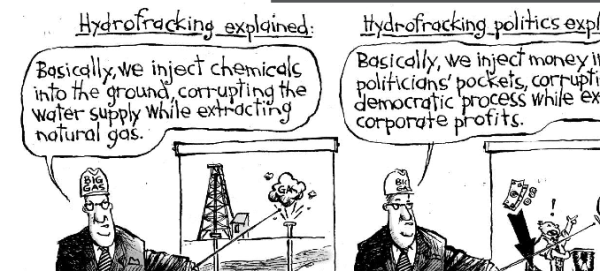
A representative from the DEQ spoke next, with specific information about the hydraulic fracturing process and how “safe it is.” He stated that Michigan has different standards than most other states in the country, so all of the public concerns are not necessary.
At one point the DEQ person was talking about projected energy use increases in the state and how natural gas is likely to be one of the major energy sources that will fulfill the state’s energy needs through 2035. However, he spoke about this as if it was a given, meaning the growth of renewable energy sources would not replace fossil fuels, nor was there an assumption that the energy consumption levels would drop to avoid further climate catastrophe.
The DEQ spokesperson pretty much echoed the positions in the FAQ document put out by the DEQ, but when he was questioned on some of these issues he engaged in word play in order to sidestep what seemed obvious to this writer. For instance, when asked about the cancer causing realities of some of the chemicals used in fracking he said that one would have to be exposed to them and then they might get cancer. However, he said earlier in the presentation that these were cancer causing chemicals, not chemicals that might given you cancer.
When someone questioned him about the use of fracking brine on roads, which was done in Kalkaska County in May, he said that that was a mistake and his office put order to stop this from happening. However, he qualified that statement by say that this practice os only on hold for a year, until more studies can be done, which contradicted an earlier statement that the public would never be exposed to the chemicals used in fracking.
At one point the guy from the DEQ also stated that if people had questions about what chemicals were being used, since the DEQ does not require full disclosure (they said they can determine through testing which chemicals are used) that people should check out the site Frac Focus. They claimed that this was a site where companies could voluntarily post what chemicals they were using.
However, what they didn’t tell those in attendance is that Frac Focus is run by two entities, the Ground Water Protection Council and the Interstate Oil & Gas Compact Commission. Both groups are a partnership between the state and oil & gas industry with no independent representation. The Interstate Oil & Gas Compact Commission host bi-annual conferences with the next one in Texas at the end of this month, a conference being sponsored by the likes of BP, Marathon Oil, Shell, Chesapeake Energy, Halliburton and Enbridge. One would be hard pressed to think that such an entity would actually operate with the public interest in mind.
All throughout the night Rep. MacGregor and the men from the DEQ and DNR kept trying to convince those in attendance that there was nothing to worry about in regards to the issue of hydraulic fracturing, but people were not buying it.
One woman made the point about the protection of the rural way of life and when drilling begins, truck traffic increases, noise increases, chemical use increases, etc. “We’ll have to live with a terminal being built in our communities.”
Another person pointed out that the DEQ representative stated, “We do the best we can with the existing laws, but the existing laws protect and benefit BP and other oil & gas companies, particularly since the Halliburton loophole was put in place.” The person from the DEQ then said they were more mistrusting of the industry than those in attendance.
Someone else asked questions about the chemical contaminated fracking brine that was being store under ground and if there were studies being done to demonstrate that it would never leak and if so, who was conducting these studies? The DEQ guy said, “We are really smart. We don’t know the recipe, but we can test for what kinds are being used.” He said that this brine could not come through the rock, but he never addressed the issue of earthquakes creating cracks for the brine to leak into the ground water or the fact that fracking itself could cause fissures in these rock formations.
It was clear that after two hours, despite the attempts from MacGregor and the state workers that people were still skeptical of what the oil & gas industry is doing through the practice of fracking.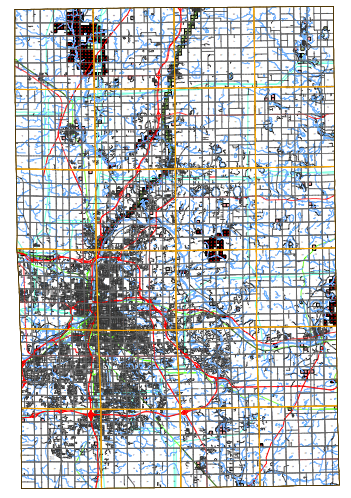
At the end of the night, this writer asked if there were oil & gas representatives in the audience and 4 of them raised their hands. None of them asked questions all night and it is safe to assume that they were gauging public opinion in order to come up with clear talking points in order to minimize any scrutiny. I also asked Rep. MacGregor if he was the recipient of any oil & gas industry money and he responded by saying, “I am 99.9% sure I have not,” which isn’t a definite no.
People in Kent County should be concerned about this issue, especially since the DNR will be auctioning off hundreds of acres in Kent County next Wednesday in Lansing, which means that there could be oil & gas fracking taking place on public land in the areas highlighted in the map shown here, with the darkest parts being public land up for auction. You can see that the areas to the north in Kent County are between Sparta and Cedar Springs, some land near Lowell and a corridor along the Grand River and 131 near Rockford. You can also search this DEQ document to see exactly which parcels of land are being auctioned off in the state on October 24.
American Family Association Ponders How to ‘Reach Out with Biblical Compassion’ to Gay Youth
This article by Brian Tashman is re-posted from Right Wing Watch. Editors Note: The American Family Association is very active in West Michigan and is the recipient of significant amounts of funding from several prominent West Michigan families.
The American Family Association without fail hurls some of the most derogatory and incendiary rhetoric at the gay community,. For example, the group’s spokesman Bryan Fischer claims that gays are like drug addicts, domestic terrorists and Nazis and are responsible for the Holocaust, and the organization’s general manager blamed gays for Hurricane Isaac and linked the repeal of Don’t Ask Don’t Tell to an increase in suicides in the military.
But now the anti-gay group hopes to teach people how to “reach out with biblical compassion” to gay youth, which they routinely call “Big Gay.”
The AFA’s Rightly Concerned blog reposted an article from Kerby Anderson Probe Ministries about the “gay agenda in schools,” fitting with the AFA’s new campaign to stop “Mix it Up at Lunch Day” out of the fear young people will eat the gay “poisoned candy.”
The blog post warns that homosexuality in and of itself leads to health and psychiatric problems and suggests anti-bullying efforts are simply attempts to “increase homosexual behavior among students.” Ironically, Anderson cites a study which concludes “educational efforts, prevention programs, and health services must be designed to address the unique needs of GLB youth” to argue that schools should not assist their gay, lesbian and bisexual students in anyway…unless it is with ex-gay therapy.
“We should reach out to those caught in the sin of homosexuality and offer them hope and point them to Jesus Christ so that they will find freedom from the sexual sin that binds their lives,” Anderson writes, claiming that “many in the homosexual lifestyle are there because of some emotional brokenness in their families” and are “trying to meet their emotional needs in ungodly ways.”
The strategy has obviously been successful because no one would want to be against making the schools a safer environment. It almost doesn’t matter whether the allegations are true. Once you raise the concern of safety, most administrators, teachers, and parents quickly fall in line.
There is an irony in all of this. Many of the behaviors that are taught and affirmed in these school programs and clubs are unsafe in term of public health. For example, Pediatrics (Journal of the American Academy of Pediatrics) reported on a Harvard study that found more than thirty risks positively associated with self-reported gay-lesbian-bisexual (GLB) orientation. So it is indeed ironic that the idea of “safety” is often used as means to introduce teaching and discussion of behaviors that have been proven to be quite “unsafe.”
Permitting and promoting homosexual activity through on-campus programs and clubs will certainly increase homosexual behavior among students. Administrators, teachers, and parents should reconsider the impact these programs, and the subsequent behavior, will have on the student body.
When we talk about the issue of homosexuality, it is important to keep two biblical principles in tension. On the one hand we must stay true to our biblical convictions, and on the other hand we should reach out with biblical compassion. Essentially this is the balance between truth and love.
On the one hand, it is crucial for us to understand how the homosexual agenda threatens to normalize and even promote homosexuality within the schools. Moreover, gay activists are pushing an agenda in the courts, the legislature, the schools, and the court of public opinion that will ultimately threaten biblical authority and many of our personal and religious freedoms. Christians, therefore, must stand for truth.
I have provided a brief overview of the groups and programs that are promoting the gay agenda in the public schools. I encourage you to find out what is happening in your community. We have also documented the potential legal liability associated with many of the behaviors that are encouraged by these programs. Often administrators and teachers are unaware of the potential dangers associated with homosexual education in the schools. Take time to share this information with them.
On the other hand, it is also important for us to reach out to those caught in the midst of homosexuality and offer God’s grace and redemption. We cannot let the hardened rhetoric of gay activists keep us from having Christ’s heart toward homosexuals. As individuals and as the church, we should reach out to those caught in the sin of homosexuality and offer them hope and point them to Jesus Christ so that they will find freedom from the sexual sin that binds their lives.
It is important to remember that many in the homosexual lifestyle are there because of some emotional brokenness in their families. They may be trying to meet their emotional needs in ungodly ways. Youth in the public schools may be experimenting sexually and find themselves caught up in the homosexual lifestyle.
 Grand Rapids Institute for Information Democracy