Normalizing Male Dominance: Gender Representation in 2012 Films
This report was conducted by Chloe Beighley and Jeff Smith. For a more updated version of gender representation in films, see our study of films from 2015.
This is the first of several reports based on our investigation of Hollywood films in 2012. In this report we looked at gender representation, both quantitatively and qualitatively. Part of our analysis looked at represented by extreme gender roles, some by gender parity and other films by extreme gender inequalities. Our analysis looks at films by genres, with some concluding remarks about gender roles and examples of male and female characters that were less objectified and represented gender roles that were more human or outside of the narrow gender roles of most films.

A picture is worth 1,000 words. The above picture really only needs two words to describe it: gender inequality. In a shot from one of the year’s biggest films, The Avengers, we are privy to a perfect representation of women in films. Five men standing, preparing to protect the city of New York from being wiped off the map, and there is one woman with them. She is dressed in a suit that perfectly forms to her curves, as to appear appealing, and she armed with the smallest weapon. This is how women are portrayed in cinema.

We looked at a total of 72 of the top films from 2012 for the larger film study. The above graphic represents the lead characters of 67 of those films. Of the 67 films, 55 of the lead characters were male, and only 12 of the characters were female. That number of females includes the films in which we considered the gender roles to be equal. This is a huge misrepresentation of women in the world, and especially in the media, and only furthers gender stereotypes in the United States. For the analysis part we only included 53 of the 72 films.
Looking at the 53 films (listed at the end) in the category of gender representation, we see that the majority of characters were male, and only 7 were female. This further proves that men still dominate the cinema and gender is continually misrepresented in cinema and in films. Men are seen as the protectors, the saviors, the breadwinners, and the know-alls. Women are constantly being misrepresented in these films, shown for purposes of objectification, support of the male characters, and mostly as love interests that drive the male characters. In the few movies where we see strong lead female characters, we also see them having the support of at least one male who is involved in their situation in some way where the female ends up needing their help. We very rarely see any breaks in stereotypical gender roles. Even in action films where the lead is a female, there is always some sort of emotional baggage tied into the movie that makes her seem more “soft.” If this did not exist in the films then the women would seem “threatening” or “unlikable,” which is not what cinema wants in their female characters. Women in cinema, even in their action roles, are portrayed in a way that objectifies them, even if that is not the end goal of their role.
There were plenty of films where women were presented in stereotypical roles, which we would define as stereotypes that perpetuate gender roles within a male-dominated system. In these roles women are overtly feminine, have weak character, lack confidence, have an identity that is tied to a man or need to be saved by a man.
One example is how women are portrayed in the film Project X. Project X is a “high school” film about three guys who throw a party at one of their houses, a party that is over the top in terms of size, but fits into the typical high school film genre. One of the lead male characters has a friend who is female. They flirt on and off before the party, but want to hook up at the party. Instead, the male character, played by Thomas Mann, ends up with another woman at one point. The girlfriend walks in on them, runs away, only to forgive him later and be by his side after the fallout from the party devastation.
In addition, there are scenes all throughout the film during the party, where some of the high school girls in attendance are topless around and in the pool. This kind of casual hypersexual depiction does not take place with male characters, thus normalizing the objectification of female bodies.
There were other films that fit this genre of movies that cater to high school and college age audiences, where the gender roles are hyper-sexualized. In the film 21 Jump Street, the two male lead characters played by Channing Tatum and Jonah Hill, are cops that go undercover in a high school to thwart illegal drug dealing. Both Tatum and Hill play hyper-masculine roles, with Tatum being the eye-candy and Hill playing a character that wants to relive his high school years, be accepted by the cool kids and get the girl.
There are several different party scenes where women are objectified, but throughout the film both lead male characters use language that is both over the top and dismissive of women.
Such movies present men as stuck in a permanent state of adolescence, where men never mature much beyond puberty and women are available purely for male pleasure.
Other films that perpetuated this permanent state of male adolescence were American Reunion, where five male friends try to re-live their high school sex fantasies when attending their 10 year high school reunion. Another film that promotes a permanent state of male adolescence was That’s My Boy. Like many of Adam Sandler’s film, That’s My Boy is a comedy geared toward normalizing male privilege and objectifying women. Negative male behavior is normalized in numerous scenes, but the most egregious is when a group of men go to a strip club as part of a bachelor party.

One last example of films that normalize male adolescent behavior was the movie Ted. In this film Mark Wahlberg’s character has a teddy bear that comes to life and as he gets older the teddy bear adopts crude behavior that involves lots of casual sex and where women are presented as lacking in intelligence. Ted exemplifies the permanent state of adolescence that men are encouraged to embrace in this culture.
Superhero Category
We see gender role reversal in one of 2012’s big blockbuster hits, The Hunger Games. In this film we are seeing a new type of heroine who defies gender stereotypes in cinema. She is not a victim, she is not passive, she is not cold. She takes action, she is compassionate, and she’s strong. She has taken over her deceased father’s role of providing for her family, and also has become a mother figure to our younger sister, when her own mother couldn’t fulfill the role. In terms of romantic interests, she is caught between her best friend at home, and another contestant in the games with her. However, she is not sexualized with either character until she and Peeta kiss, which was only prompted by her trainer. The thought process being that people watching the Games would begin to support her if she and Peeta looked as though they were falling in love, essentially sex sells. The scene also shows her love interest whom is not participating in the Games watching the kiss on TV. This adds drama to the scene, essentially, conflict sells. These are themes that we are seeing over and over in movies being released today.

Generally, in superhero movies, the gender roles are stereotypical. There is a man who comes to save the woman from peril and is deemed a hero. We are seeing the same amount of gender stereotypes in the superhero genre films that were released in 2012, namely, The Avengers, The Amazing Spider Man, Snow White and the Huntsman, and The Dark Knight Rises.
In The Avengers we see a collaboration of superheroes who are trying to protect the world from a super villain. In this instance, there was not a woman that needed protection, however, we still see stereotypical gender roles. The men are all fighting for control of the situation, each claiming to have the best solution to the problems they face. On the same level, they are trying to undermine the other male characters with snide comments. The main female character, the Black Widow, fights on the same level as the men do, an area we see a small amount of gender equity in the film. However, she is still very sexualized. When we first meet her character, she is playing the role of a prostitute, and is extremely scantily dressed. She is also the only character in the film that cries on screen. Additionally, there are undertones of a romantic relationship with another character. We see romantic relationships with nearly all of the characters in the film, however, her relationship is not spoken about, and therefore given more clout.
In The Amazing Spider Man we see the common role between Peter Parker and his love interest, in this movie, Gwen, named differently in other Spider Man films. They are schoolmates, then she grows to become a bit of a love interest, there is heavy flirting as he pursues her, and then some romantic kissing. They hide their relationship from her father, which adds a sense of danger or tabooness to their relationship, and of course, in the end, he does save her life, and comes home to her. We see very stereotypical gender roles in superhero films in this film.
 In Snow White and the Huntsman the clash of two poignant traditional characters, Snow White and the Evil Queen and their fight for beauty. Snow White is not overly sexualized, she is trying to portray a stronger female heroine. She is bold and fearless, we don’t see as much of the girl who needs to be protected by the dwarves and Prince Charming, we do see, however, her being mentored by the huntsman, which does reinforce patriarchy. Similarly, in their fight for beauty, the judgement of who is the fairest in the kingdom comes from a male, the mirror on the wall, so the Evil Queen fights to be the most beautiful woman in the kingdom based on male opinion. The Evil Queen is highly sexualized. We see her going naked into a bath, and then emerging from that bath naked, covered in a white substance. Similarly, we see her in her bed, and her night clothes, as she kills the king.
In The Dark Knight Rises there are two strong female characters, Catwoman and villain Miranda Tate. While both of these women demonstrate courage and confidence, they are not independent of men. Miranda Tate deceives Bruce Wayne and sleeps with him. She is with the villain Bane and owes her life to him. The Catwoman character is often represented as being selfish and wanting her own freedom. Her character ultimately succumbs to Batman’s plea that she help save Gotham, but her decision to come back and fight Bane was to be with the hero Batman. Both Miranda Tate and the Catwoman character fall into the familiar pattern of being either defined by men or saved by them.
There are other films that have male heroes as the central character, such as Abraham Lincoln Vampire Hunter, Dredd, John Carter, Men in Black 3, Skyfall, Taken 2, The Bourne Legacy, The Expendables 2, The Grey, The Hobbit, The Man with the Iron First, The Raven, The Woman in Black, Total Recall and Wrath of the Titans.
In each of these films, the men are clearly the saviors, the heroes, the focus of the plot. When female characters do appear in these films, it is primarily to be saved. There are some strong willed women in some of these movies, such as the female Judge in Dredd, who is an apprentice and another woman who is the drug lord, but clearly cast as a villain.
In this group of films most women are saved or merely play the role as the girlfriend, wife or love interest. Rarely, do we see women the primary protagonist, as in the films Resident Evil: Retribution, Prometheus and Underworld: Awakening. In Prometheus, it is the female scientist who keeps a level head and is able to survive, whereas all the male experts were fooled or gave into personal gain. In President Evil and Underworld, the lead females characters are strong and confident, but one is a vampire who is looking for her male partner and the lead female character in Resident Evil is often sexualized by the way she is dressed.
Animated Films

In the animated movie, Brave, we see a young female character trying to defy social norms by not getting married, and the struggle that ensues with another female character, her mother. The girl goes on a journey with her mother, which is a result of her desire to not be married. In the end, we see a understanding growing between the two characters, who agree on defying the “social responsibility” of a princess being given to a prince.
The mother character is both domineering and understanding, two characteristics which are not often seen together in maternal characters in cinema, especially in children’s movies where the mother character tends to be sweet and nurturing, or overbearing. The mother also is perceived as the head of the house, where the father/king responds to what the mother would like done.
The young girl is both headstrong and rash in the beginning of the movie, focusing on her weaponry and adventuring. By the end of the movie, she has become both more understanding of others and a caring daughter.
Frankenweenie, created by Tim Burton, portrayed the classic Frankenstein tale with a bit of a twist. A young boy who loves his dog is suffering when the dog is suddenly hit by a car. Using the lessons he learned in science class, he resurrects his dog. The film is shot in black and white and uses Burton’s familiar stop-motion medium that we saw in Corpse Bride and Nightmare Before Christmas. We see animated film gender stereotypes here, a young boy being the main character, his dog being male, his role model in the film being a the male science teacher, his mother being overly protective and the villain, of sorts, being the cranky male neighbor/mayor of the town. The boy of course has a young love interest, and she is stuck with her creepy uncle while her parents are gone, creating a friendship between the two.

Hotel Transylvania does not have a singular main character, however, it heavily focuses on the overprotective father and his teenaged daughter. The other characters in the hotel are family characters as well, and we are not seeing anything out of the ordinary in terms of gender in this film. The daughter wants to roam free and learn about the world, her overbearing father says no, and then a love interest comes to stay at the hotel. Eventually, they leave the hotel and travel together. There was certainly potential of the vampire girl to end up with someone other than a straight, white male, however that did not occur. Since monsters in movies are traditionally represented as “the other,” there was also room for her to end up with a variety of characters, including other monsters, however, she ended up with a white male human, completing the fairy tale.
The families that come to stay at the hotel are male dominated monster characters. They are the best male friends of the father, and are traditional monster characters: the werewolf, the mummy, frankenstein, and the invisible man. Their wives are certainly vocal secondary characters, however, it is the men who make the majority of the decisions and voice their concerns in the film.
In The Lorax, the main character, the Lorax is voiced by a male. The first three characters that appear on screen are male characters. Also, the towns “billionaire character” who is the antagonist is a male. The first woman character, Audrey, voiced by Taylor Swift, is deemed a love interest right from the time she is introduced. She plays a stereotypical “hippie chick,” tall, with long messy hair who wants to paint and plant trees. The main male character Ted, voiced by Zac Efron, lives with his mom and grandmother and does not have a father figure, which is interesting, since in a large number of children films, the maternal character is missing. The grandmother plays a huge role in encouraging Ted to find the Onceler and learn about planting trees. The mother is also very encouraging of his journey, especially when he faces characters who want to stop him. The character that Ted goes to seek out while looking for a tree, The Onceler is also a male, and the part of the storyline, follows him as he devastates a forest and entire ecosystem and then gets Ted to help him rebuild it. There is nothing extremely different about gender roles in this film.
Madagascar 3: Europes Most Wanted follows the gender representations that the other Madagascar films have followed. The main characters are three males and a female. The Lion, who is male, and the leader of the group makes all the plans for the group. At the beginning there is a struggle of power between the three men, then the woman hippo decides that she will be in control when they are interrupted and the argument is stopped. The animal control chief is a woman, who is stereotyped similarly to how female policewomen are usually portrayed, very harsh and motivated in her job.
The animals buy a circus so they can go back to America and the lion tells the other animals not to think of him as an authority figure because they own the circus now. He tries to act like an authority figure but one of the other animals tells him they feel bad for him. However, when the circus fails, he takes the position of trainer and gains their respect.
Ice Age: Continental Drift follows the same storyline as the previous Ice Age movies. The movie focuses around the three main male characters, Manny, Sid, and Diego. Manny is having trouble controlling his teenage daughter, who in turn is having trouble fitting in with the other mammoths. The men face conflict with the male leader of a pirate ship. When the men sink his ship, the pirate leader, Gutt, vows to take revenge, and ends up holding their families hostage. The female roles come from Manny’s wife, Ellie, their grandmother, and their daughter, Peaches. Also, from the first-mate of the pirate ship, Shira, who becomes the love interest of Diego. The women are all in very secondary roles as loving companions, similar to the roles that we saw in Hotel Transylvania. One difference we do see, however, is Shira betraying her friends to protect Diego and his friend’s families. Shira saves Manny’s wife, therefore earning the love and respect of the group of friends. Also, Granny plays a large part in protecting the family when her pet whale stops the fighting between the pirates and the friends. In this film, there are also Sirens, creatures that portray what each of the male characters find desirable, which creates an environment where the female characters are being objectified.
In Wreck-It Ralph, the relationships between male and female characters are portrayed as much more of a partnership than we see in many other movies, where one, mostly male, character is dominating another, usually female, character. There is a solid relationship of mutual partnership between the main character Ralph, and one of the female characters, Vanellope, who has been made an outcast in her game by another character who has taken over. They continually work together to help solve each others problems. There is the opportunity for the movie to have a stereotypical lesbian character, and it seems like they will head down that path with the character of Sergeant Calhoun; however, she works closely with another male character, Felix and the two become romantically involved. In the arcade itself, the movie does a good job of having young women playing the games and not making the conclusion that only young men play video games.
ParaNorman continues the male dominated representation like the other animated films we have looked at. In Paranorman, a boy who has the power to see the dead saves the town by uncovering the haunting secret surrounding ghosts, which plague his town. Female characters have marginal roles, like Norman’s sister, who plays a stereotypical teenager that is irritating and obsessed with boys. ParaNorman had potential to deal with historical gender oppression, since the ghosts that haunt the town were community leaders that sentenced a young girl hundreds of years ago because they did not understand her gifts. The film mildly presents the harm done during what is often called the Salem Witch hunt; wherein men accused women and girls of witchcraft as a means of controlling female behavior. While this film does have a positive lesson for younger audiences, it failed to challenge gender norms.
Male Drama Category
There were several films we looked at in this study that would fall under the genre of drama. Disproportionately, these movies had lead characters that were men and the majority of the time, men who played stereotypical male roles.
The revisionist film Argo is primarily about the heroics and political hardball played by men during the Iran hostage crisis. The movie Battleship was a typical military film, except instead of fighting enemies from foreign lands, the US military fights aliens from outer space. Men are the dominant characters who not only win the war, they get the girls.
Other drama films also focused on men, like Lockout, Looper, Premium Rush, Safe House and Lawless. Women are certainly present in these films, but their roles are marginal and only serve to bolster the male character’s identity. The movie Lawless typifies this dynamic, where one female character, who works for the men, and has a love interest in the lead character played by Tom Hardy. This women is sexually assaulted in the film, but her victimization is not relevant to the plot, which centers around three brothers from a small town involved in selling moonshine during the period of Prohibition in the US. A scene near the end of the film reflects the essence of Lawless, when there is a bloody shootout between two groups of men.

There were a few dramatic films that did give women larger roles. The Oliver Stone film Savages, has two strong willed women, one who is the lover for the two male characters, and a female drug lord in Mexico, played by Salma Hayek. The other film was The Trouble With the Curve, where the daughter of Clint Eastwood’s character is played by Amy Adams. Eastwood is a baseball scout who is losing his eyesight and is helped one season by his daughter to scout new players. In the process Amy Adam’s character decides to quit her job at a law firm as an extremely gifted lawyer, in order to take over for her father and become a new baseball scout, while at the same time rescuing her relationship with her dad and ending a romantic relationship with a fellow lawyer. It is a heartwarming film that challenges some gender roles, but in the end Amy Adams character finds another male love interest and plays the role of the female fixer in a dysfunctional family.
Romantic/Romantic Comedy Films
In Dark Shadows, we see quite a few different love interests for Johnny Depp’s character, Barnabus, which are really the drive behind the film. The plot, which involves restoring the family to their original fame and fortune, is interlaced with the romantic dealings of Barnabus. We see a sexually aggressive female character in Angelique, who loves Barnabus and wants his love in return. There is a particularly amusing segment where Angelique tries to force herself upon Barnabus, in turn destroying her office. The character that Barnabas loves is one of a younger girl with a much sweeter demeanor, much more so than Angelique. We also see the members of the family occupying his house trying to vie for his love and attention, which the writers rely on to drive the humour of the film.
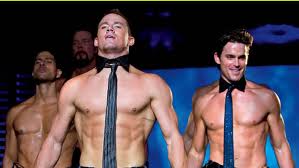
The premise of Magic Mike seems like it is driven completely by the sexual objectification of some of Hollywood’s most “attractive” actors. The plot is based around the main stripper, Mike, changing his lifestyle for the woman that he loves, the sister of one of the strippers. With the exception of the lead female character, the women in the film are also objectified, being portrayed as girls who love male strippers, and will eventually sleep with them.
In The Five Year Engagement we see a bit of gender parity, the movie focusing equally on the main male and female characters. The situation with the male character seems to be more crass and sexually objectifying. He is seen naked in a scene, he makes the decision to cheat on his fiance, and when he enters into a new relationship, the woman that he is dating is young and very sexually active, which they show more than once in the movie. When the main female character enters into another relationship, it is with an older man who is portrayed as more mature, and they do not show the same types of situations as they do with the male characters. In the end, they do switch traditional gender roles, and the main female character proposes to the main male character.
The Vow follows the gender roles as in all Nicholas Sparks movies. The couple is in love, they face turmoil, they are separated, and in the end they are together. This movie is no different. There is a bit of gender parity, each character being equally focused on. The main female character is a little more stereotyped, she comes from a wealthy family and she lives at home with them, which is opposing how she lived with her husband and had an art studio before her accident. Following suit to all Sparks movies, the couple does get back together in the end of the film.
In Twilight: Breaking Dawn Part 2 we see a change in the attitude of Bella, as she is now a vampire. She functions much more singularly, not following Edward around or reacting to his every action. She spends time on her own, doing her own problem solving. Also, she now plays the role of a stereotypical mother, being protective of her child, and protecting her family. It is a refreshing change from the previous movies. The other female vampires play roles that they have previously played, mostly being strong female character with male counterparts. Similarly, the male vampires play roles that they have been in throughout the film series. Edward becoming a strong protective father figure, being the difference.
What To Expect When You’re Expecting focuses on the female characters, trying to show how potential childbirth affects each character. Each potential mother handles the arrival in different ways and we see natural childbirth, adoption, and a miscarriage, and the resulting emotional trauma of each situation. However, the film does not completely disregard the male characters. There are plenty of scenes where the fathers or potential fathers spend time together discussing life with children and how their lives have changed. Though the movie seems as though it would focus on the babies and the mothers, the writers added the parts of the movie about the fathers to add more humour and also to appeal to a male audience.
There were a few examples of solid representations of women where the female character was independent and did not rely on men, were not portrayed as emotionally unstable, and not used for purposes of a love interest. Brave was certainly one example of a movie where the lead female character did not rely on men, and in fact, did not want to get married. Also, it could be argued that in The Hunger Games, Katniss was not used for a love interest, but rather, had other love interests, which were manifested for the purpose of achieving her end goal. Also, in Snow White and the Huntsman, the Queen was certainly using men as a means to her end, however, she was certainly doing so to protect herself. Though there are not a large number of deviations from the cinematic norm, it is certainly nice to see a few differing representations of women in 2012 cinema. 
In addition to the instances where women are portrayed with positive characteristics, there were films that also allowed men to step outside the limited boundaries of normative male behavior. For instance, the main character in the film Perks of Being a Wallflower, Charlie, while struggling with depression, is allowed to show emotion and does not try to just fit into the dominant culture. The friends he develops throughout the film, both male and female, allow him to be his own person and deal with the myriad of emotions that any teenager is confronted with.
Considering the power of images and messages in Hollywood films, it is safe to conclude that male dominance continues to be the norm and that gender stereotypes continue to limit the kind of representation that is possible in film. There is not a simple cause and effect of media representation and what happens in the real world, but media representation does normalize the reality of male dominance that continues to be pervasive in the United States.
Here is a listing of the films we looked at for the gender representation study:
Lead Characters:
21 Jump Street – 2 Males
Abraham Lincoln Vampire Hunter – Male
American Reunion – Male
Argo – Male
Battleship – Male
Brave – Female
Cabin in the Woods – Male
Chernobyl Diaries – Male
Chronicle – Male
Cloud Atlas – Male
Contraband – Male
Dark Shadows – Male
Diary of a Wimpy Kid: Dog Days – Male
Dredd – Male
Flight – Male
Frankenweenie – Male
Fun Size – Female
Here Comes The Boom – Male
Hit and Run – Male
House at the End of the Street – Female
Hunger Games – Female
Ice Age Continental Drift – Male
John Carter – Male
Lawless – 3 Males
Life of Pi – Male
Lockout – Male
Looper – Male
Madagascar 3 – Male
Magic Mike – Male
Men in Black 3 – Male
One for the Money – Female
ParaNorman – Male
Premium Rush – Male
Project X – Male
Prometheus – Both
Resident Evil: Retribution – Female
Safe House – Male
Savages – Gender parody
Skyfall – Male
Snow White and the Huntsman – Female
Taken 2 – Male
Ted – Male
That’s My Boy – Male
The Amazing Spider Man – Male
The Avengers – Male
The Bourne Legacy – Male
The Campaign – 2 Males
The Dark Knight Rises – Male
The Dictator – Male
The Expendables 2 – Male
The Five Year Engagement – Both
The Grey – Male
The Hobbit – Male
The Lorax – Male
The Man with the Iron Fist – Male
The Odd Life of Timothy Green – Male
The Perks of Being a Wallflower – Male
The Raven – Male
The Vow – Both
The Watch – Male
The Woman in Black – Male
Think Like A Man – Both
Total Recall – Male
Trouble with the Curve – Male
Twilight Breaking Dawn 2 – Female
A Wake Up Call from Vandana Shiva
This video is re-posted from the Perennial Plate.
There has been a lot written about GMOs, pesticides, organic etc. to the point that it’s easy to lose touch with how these issues actually impact people’s lives.
On our recent trip to India, we got a wake up call from environmental activist Dr. Vandana Shiva on the reality of these issues and how they can impact farmers to the point of suicide. Watch this video to learn the message of Dr. Shiva and the seed saving solution that she and her partner Bija Devi are manifesting in rural India.
Disaster Capitalism: A Duty to Make Money off the Titanic in Grand Rapids and Beyond
This article is in memory of Kate Wheeler, former GRIID contributor, who passed away in 2012. Kate wrote an excellent piece last year entitled, The Capitalist Shame of the Titanic, for the 100th anniversary of the Titanic disaster.
On Saturday, the Titanic Artifact Exhibit opened at the Grand Rapids Public Museum, which was cause for the media to contact one of the owners of this collection of artifacts, local bar owner Mark Sellers.
On Sunday, MLive ran a story with Sellers, entitled, Bar owner Mark Seller reflects on ‘duty’ to protect Titanic shipwreck as exhibit opens in Grand Rapids. The article spending very little time on the exhibit itself and focuses on Seller’s motivation for buying the company that owns the Titanic artifacts, along with some history of the acquisition.
We learn from the MLive story that Sellers company, Sellers Capital Management Inc. (there is little public information about this company), had acquired Premier Exhibitions, the company responsible for the Titanic Exhibit, along with several others such as Bodies Revealed, Real Pirates, Cleopatra, Tutankhamun, America I Am and Dialogue in the Dark.
The MLive story presents some of the controversy around the acquisition and even cites Robert Ballard, the explorer who discovered the Titanic wreckage. Ballard, according to MLive, refers to Premier Exhibitions as “grave robbers.” Ballard has been very vocal in his opposition to taking anything from the wreckage. Here is a longer commit from an article in the National Geographic from last year.
Robert Ballard, who has long argued that the wreck and all its contents should be preserved in situ, has been particularly caustic in his criticism of RMST’s methodologies. “You don’t go to the Louvre and stick your finger on the Mona Lisa,” Ballard told me. “You don’t visit Gettysburg with a shovel. These guys are driven by greed—just look at their sordid history.”
Indeed, greed seems to be a theme surrounding the Titanic, from its inception to the profitability of the exhibits. Sellers argues in the MLive story that while the previous owners of the exhibit wanted to take more from the wreckage, since he and his partners took it over they have a commitment to leave the wreckage alone. Sellers even refers to the wreckage as, “sacred.”
However, we should not simply assume that this is what motivates those at Premier Exhibitions. Just look at the cast of characters that make up its board and one can see that profits seem to be the common denominator.
The Board of Directors at Premier Exhibitions is made up of seven white guys, all of which have a long history in investment capitalism. In addition to Sellers, the board consists of Sam Weiser, Bill Adams, Doug Banker, Ron Bernard, Steve Palley and Bruce Steinberg.
Weiser, before coming to Sellers Capital Management Inc, worked for the Hedge Fund Consulting Group within Citigroup Inc.’s Global Prime Brokerage division. Weiser, who also sits on the board of Paragon technologies, was paid $281,250 from Premier Exhibitions in 2011 for his services.
Bill Adams used to work for the Mitchell Madison Group, a global strategic consulting practice, and sits on the boards of Direct Marketing Solutions, Inc., CarHop, McKissock and YLighting.

Doug Banker is currently Vice President of McGhee Entertainment, which manages several musicians, including Ted Nugent and KISS. Banker was compensated by Premier Exhibitions with $150,000 in 2011 for his services.
Ronald Bernard has been involved with several large media companies over the years, as well as the National Football League. He was President of VIACOM Network Enterprises from 1987 – 1993. Bernard was compensated $90,000 in 2011 by Premier Exhibitions for his services on the board.
Steve Palley has also been involved with numerous media companies, most notably King World Productions, Inc., which manages TV shows like Oprah Winfrey and Rachel Ray.
Bruce Steinberg has been involved in the media world in his role as General Manager of Broadcasting at BSkyB and Chief Executive Officer of UK Gold and UK Living TV. Steinberg was also compensated $90,000 for his time on the board of Premier Exhibitions in 2011 alone.
What this look into those on the board of Premier Exhibitions reveals is that they are a well connected company to the world of finance and media, with several board members sitting on other boards, which solidifies inter-locking systems of power. These inter-locking systems of power function in such a way to create a network of private economic power that assures that their collective interests will be maintained.
It seems to this writer that the primary motivator, like that of the people who owned the Titanic before it sank, is greed. Those who own the artifacts and exhibit what has been salvaged seem to be acting, in the words of Naomi Klein, as disaster capitalists…….making money off the natural and human made disasters. In fact, one could argue that it is their duty as capitalists to do so.
The Dignity Campaign’s Alternative Vision for Immigration Reform
This article by David Bacon is re-posted from ZNet.
For some immigrant rights organizations, President Obama’s principles for comprehensive immigration reform sound familiar. “The idea of the three-part tradeoff, that is, that we get some legalization in trade for guest worker programs and increased immigration enforcement, has been around for a long time,” says Lillian Galedo, executive director of Filipino Advocates for Justice in the San Francisco Bay Area. “We need a new alternative, based on much more progressive ideas. I don’t think the Dignity Campaign is the only alternative, but it’s an effort to get us to talk about what we actually want, not just what politicians in Washington tell us is politically possible or necessary.”
The Dignity Campaign is a loose network of more than forty immigrant rights and community organizations, unions and churches that has crafted an immigration reform proposal based on “human, labor and civil rights for all.” (Full disclosure: I am an active supporter of the Dignity Campaign.) The campaign’s member organizations support it as an alternative to the political strategy behind the tradeoff because of what they call the bitter impact of earlier tradeoffs over the last thirty years.
In Tucson, Arizona, the Coalición de Derechos Humanos calls comprehensive immigration reform, the shorthand name for the tradeoff strategy, “primarily a vague promise used to attract immigrant and Latino voters, [while] border communities have suffered the costs of irresponsible and brutal enforcement-only policies, resulting in death and violence.” A recent study by the Migration Policy Institute found that the federal government spends more today on border and immigration enforcement than on all other law enforcement agencies combined.
When the first discussions of the Dignity Campaign proposal began four years ago, Derechos Humanos formulated the demands about border enforcement. Instead of even more immigration agents, walls and now drones, they call for dismantling the high-tech wall, removing the National Guard, closing private mass detention centers and restoring civil rights to people living in border communities.
Isabel Garcia is a public defender, and every day her fellow lawyers defend dozens of people brought into Tucson’s Operation Streamline courtroom in chains, where they’re sentenced to prison terms for crossing the border. “That courtroom should be closed,” she says, “and the money redirected to healthcare and education, which our state is now busy cutting.” Derechos Humanos wrote that demand into the Dignity Campaign proposal too.
Galedo and Garcia first saw the tradeoff in 1986, in the Immigration Reform and Control Act. That law, signed by President Ronald Reagan, set up an amnesty that gave legal status relatively quickly to almost 3 million people. Nevertheless, they and other immigration activists of the day, including Bert Corona—widely recognized as the father of the modern immigrant rights movement—campaigned against it. The bill also contained employer sanctions, a provision that made it illegal for employers to hire undocumented workers, and expanded a limited guest worker program into today’s H-2A visa scheme.
“We’ve lived with the consequences ever since,” Galedo says. “That’s why, when we look at Obama’s principles, or the CIR bills of the last decade, we think not just about our need for legalization, but that we’ll have another twenty-five years of enforcement and more guest workers. Because we’ve lived with those costs, we believe the best starting point for immigration reform is a discussion of what immigrant communities actually need and want, and what we know will actually solve the social problems around migration. That’s the source of the Dignity Campaign.”
Anoop Prasad, staff attorney at the Asian Law Caucus in San Francisco, worries that President Obama’s plan for mandatory national use of the E-Verify database (a tactic for enforcing employer sanctions) “would in effect compel employers to act as immigration agents, responsible for verifying employees’ immigration status. This approach has not only proven ineffective in deterring people from coming to the US, it inhibits workers from exercising their basic workplace rights and protections.”
Several local unions and labor councils support the Dignity Campaign because thousands of union members have been fired as a result of workplace enforcement, and the campaign calls for repealing employer sanctions.
Another leg of the tradeoff, expanded guest worker programs, are also hotly opposed by Dignity Campaign organizations. Some wanted them abolished immediately because of a long record of employer abuse, while others favored an approach based on ensuring that workers in those programs have rights. In the end, the proposal calls for their abolition after five years, and increased enforcement of worker rights during that period. The Labor Council for Latin American Advancement (the AFL-CIO’s constituency group for Latino union members) voted to support the Dignity Campaign because those programs treat migrants “as low wage workers with no rights.”
Changing trade policy especially separates the Dignity Campaign and other grassroots proposals from beltway CIR proposals. The Dignity Campaign proposal was modeled on the TRADE Act, introduced by Congressman Mike Michaud (D-ME), and calls for renegotiating all trade agreements to eliminate provisions that increase poverty abroad and displace workers and farmers or lower their living standards.
“Massive migration caused by poverty can only be addressed by changing those policies that cause poverty in the first place,” says Bill Chandler, executive director of the Mississippi Immigrant Rights Alliance. “President Obama promised to renegotiate NAFTA before his first election, and that promise must now be kept as part of a humane immigration policy.”
The Binational Front of Indigenous Organizations (FIOB) is an organization of Mexican indigenous communities with a base in Oaxaca, and chapters in California and Baja California where Oaxacans travel as migrant workers. For José González, its binational vice-coordinator in San Diego, “the economic policies of the U.S. must be changed, because they are an enormous factor displacing people from our communities, forcing us to leave as our only way to survive.”
Said FIOB on International Migrants Day last December, the Dignity Campaign “makes a clear demand for a broad immigration reform, and deals directly with the situation in which we live in our communities of origin.”
Finally, the Dignity Campaign calls for legal status for the undocumented, in a rapid and inclusive process, without excessive fees, fines, waiting periods or a preliminary temporary status. At the same time, it also calls for protecting the family reunification system and eliminating the current huge backlog by issuing all pending visas within a short period.
The Obama proposal, like most CIR bills of the last decade, pits people applying for family visas against those needing legalization. It proposes that the undocumented “must wait until the existing legal immigration backlogs are cleared before getting in line to apply for lawful permanent residency (i.e. a ‘green card’), and ultimately United States citizenship.” Today some applicants in Mexico City receiving family reunification visas applied over twenty years ago. In Manila the line is even longer. But no CIR proposal would issue more family visas to clear that backlog, while on the other hand they increase visas for guest workers.
“The only way to resolve this is by eliminating the backlogs,” Galedo says. “In our community we have people who have been waiting for years, and according to the federal government, 280,000 undocumented Filipinos as well. We need common ground here, not a fight.”
The groups that support the Dignity Campaign view the CIR proposals as products of an insider process in Washington, not the result of consultation with grassroots immigrant communities, unions and churches. “Now that there finally appears to be the political will to address immigration, it is critical that the voices of these communities be central in the debate,” Garcia urges.
Over the past few years, especially since the failure of the last big reform bills, this kind of process has taken place in many parts of the country. In addition to consultations with the FIOB, in Washington State, Community2Community and Pueblo Unido por la Dignidad organized over 30 Dignity Dialogues to get input from immigrant communities. The Mississippi Immigrants Rights Alliance has talked about an alternative to the CIR bills at its annual Unity Conferences of African-American and immigrant community leaders.
Even before the Dignity Campaign started, the American Friends Service Committee had extensive community meetings that resulted in a plan called A New Path. The Dignity Campaign proposal drew extensively on its ideas. There are others as well, but almost all have basic elements in common.
Campaign participants warn that the CIR proposals will move to the right as they go through Congress. This is what happened in the effort to pass the succession CIR bills over the last decade, and one reason why they died. It is also an important reason many groups outside of Washington have called for an alternative.
In the battles over those earlier bills, advocates for more progressive ideas were criticized for “making the perfect the enemy of the good,” discrediting what was politically possible, and dividing the base of support for CIR. But the Dignity Campaign believes that a progressive alternative gives the movement a goal and a vision to organize and educate the community. Instead of being “the enemy of the good,” Rosalinda Guillén of Community2Community says, “A good proposal will rescue immigration reform from bad ones.”
Many of the organizations that developed the Dignity Campaign supported a bill introduced by Congresswoman Sheila Jackson Lee at the height of the last Congressional debate over immigration that tied legalization to job training and creation programs, and bolstered workplace rights instead of increasing enforcement. “Finding common ground between African Americans and immigrants is a key to winning immigration reform,” according to Bill Chandler. “Fighting for jobs and rights is a much better way to do that than anti-immigrant enforcement and guest worker programs.”
Whether the Dignity Campaign proposal, and others like it, become the basis of an alternative bill in Congress this time around depends on the willingness of progressive members to act independently. In the face of pressure to line up behind the President, it is unclear whether that will happen.
Chandler says a movement-building strategy is necessary to produce real change. “It was the civil rights movement that ended the old bracero guest worker program, and won the 1965 immigration reform that repealed discriminatory quotas and set up the family reunification system,” he emphasizes.
The Dignity Campaign says, “We need to raise our aspirations, rather than simply criticize Congressional proposals.”
New Media We Recommend
Below is a list of new materials that we have read/watched in recent weeks. The comments are not a “review” of the material, instead sort of an endorsement of ideas and investigations that can provide solid analysis and even inspiration in the struggle for change. All these items are available at The Bloom Collective, so check them out and stimulate your mind.
They’re Bankrupting US: And 20 Other Myths about Unions, by Bill Fletcher Jr. – With all the recent attacks against organized labor, particularly the anti-union Right to Work law, this new book by Bill Fletcher Jr. is very timely. The 21 chapters are stand-alone responses to claims made by anti-labor sectors and often the news media. Some of the claims are that unions cost too much, workers are forced to join them and that unions are destroying the economy. Fletcher, who has written numerous books on labor history/labor struggles, does a solid job of responding to each of the claims and acknowledges the shortcomings and historical instances where unions have not defended working people. Fletcher does not do enough to honestly assess the majority of labor unions relationship to the Democratic Party, but the bulk of the book is a valuable read for those who are in unions and those who are looking for sound arguments to defend workplace democracy.
 Blood and Politics: The White Nationalist Movement from the Margins to the Mainstream, by Leonard Zeskind – White Nationalist movements have been in the US for centuries and one could certainly argue that the country is founded on White Nationalist principles. In Blood and Politics, author Leonard Zeskind investigates the White Nationalist movements since the mid-1970s. These movements include the KKK, Holocaust denial groups, the Aryan Nation, Christian Patriots and anti-immigration groups. Zeskind’s work is well researched and well written, with good analysis of how these movements have interacted with electoral politics since the Reagan years. Parts of the book are particularly useful for those of us who live in Michigan, since Michigan has been home to many of these White nationalist groups, particularly Militia groups and anti-immigration zealots. Blood and Politics provides analysis up to and including the first few years after the September 11, 2001 terrorist attacks in the US. A valuable resource for those wanting some history on the groups that continue to engage in hate crimes and influence the move the right nationally on issues such as race, immigration and economics.
Game Over: How Politics Has Turned the Sports World Upside Down, by Dave Zirin – Game Over is yet another literary gem from insurgent sports writer Dave Zirin. In this newest collection of essays, Zirin demonstrates once again that sports and politics do go together, even if the owners of the sports world do their best to prevent that from happening. Zirin not only tells the stories of heroic athletes who dare to challenge the “Jockocracy,” he provides analysis so powerful, its like being run over by Houston Texans defensive lineman J.J. Watt. Game Over dissects recent sports stories, like the Penn State scandal, soccer and the Arab Spring, class war against sports team owners, racism, sexism and homophobia in the sports world. What makes Zirin’s treatment of these topics so elucidating is his ability to weave history into the analysis, in order to demonstrate that sports and politics have always been intertwined. If you care about injustice and the struggles of people around the world, you would be missing out on a great deal by not reading this book.
Corporate FM: What Happened to Radio? (DVD) – Corporate FM is about what happens when a city loses a communal microphone. Radioʼs broad coverage gives it the ability to unify huge populations. Unlike Facebook, Satellite radio, or web-based music sharing apps, locally owned terrestrial radio can reach thousands of people across all incomes and ages in a local region at the same time with a message that is relevant to them at that moment. Worse, the death of privately operated local radio stations is not just destroying the stations that are bought up, but damning the future of all stations on the dial—the public and college stations as well. The entire medium of radio becomes threatened when there are only two stations worth listening to. By investigating how the financial system gutted commercial radio instead of growing it, documentary filmmakers Kevin McKinney and Jill McKeever reveal the problem and propose a solution that could revitalize the medium and rejuvenate the communities that radio is legally obliged to serve.
This video is re-posted from Specialty Studios.
Most Americans know little about the source of oil for the proposed Keystone Pipeline—the tar sands of Northern Alberta. The tar sands are not a traditional oil field. The oil is extracted and processed from the sands at a significant and devastating environmental and health cost to the land and people, and the process itself is a major contributor to climate change.
White Water, Black Gold follows Canadian adventurer David Lavallee on his three-year journey across Western Canada in search of the truth about the impact of the world’s dirtiest and thirstiest oil industry. This is a journey of jarring contrasts, from the pristine mountain ice fields that are the source of the industry’s water, to the tar sands tailing ponds, where thousands of migrating birds have unwittingly landed and died.
In the course of his journey Lavallee, backed by university scientists, makes a number of discoveries that raise serious concerns for Canada and the U.S.
Native peoples living downstream are contracting unusual cancers; new science shows that water resources in an era of climate change will be increasingly scarce; the proposed expansion of the oilfields to meet Keystone Pipeline demand could endanger multiple river systems across Canada that makeup about half of its water supply; and planned oil pipelines across British Columbia and the U.S. bring fresh threats to rivers, salmon and the Pacific Ocean.
White Water, Black Gold is a powerful tool for waking up Americans to the potential impact of the Keystone Pipeline, and clearly shows that we will be paying the environmental, social and public health costs long after the oil has run dry.
You can watch the 54 minute film online at http://vimeo.com/32526916.
Oil and Gas Sector Ranks Number Two in Global Warming Pollution
This article by Tom Kenworthy is re-posted from EcoWatch.
When it comes to greenhouse gas (GHG) emissions, power plants are the 800-pound gorilla in the room. But a new report from the U.S. Environmental Protection Agency (EPA) shows that oil and natural gas are a pretty sizable monkey on our climate back as well.
Reporting for the first time on GHGs from petroleum and natural gas systems, the U.S. EPA this week said that the oil and gas sector ranked second in emissions to power plants, releasing 225 million metric tons of carbon dioxide equivalent in 2011. More than a third of that came from methane, the main constituent of natural gas, and a far more potent global warming gas than carbon dioxide.
The oil and gas sector was responsible for 40 percent of total U.S. methane emissions. In terms of greenhouse gas equivalent, the sector’s overall emissions were only about one-tenth those of power plants.

Emissions from petroleum and natural gas systems come from a range of activities from drilling oil and gas wells both onshore and offshore, and the processing, transmission, storage and distribution of natural gas.
This was the second year that the U.S. EPA, directed by Congress, has reported U.S. GHG emission data. The 2011 data includes a total of 41 sources, 12 of them new in the second year of the program.
This year’s release of the data shows that power plant emissions, which account for about one-third of all U.S. emissions, were abut 4.6 percent lower than 2010 levels.
Refineries ranked number three on the list of biggest emitters, with about 182 million metric tons of carbon dioxide equivalent.
Drug War Mexico, NAFTA, and Why People Leave
This interview is re-posted from Dissident Voice.
In this interview with the Real News Network, Peter Watt, author of Drug War Mexico, talks about how US policy and neoliberal ‘reforms’ helped create conditions for the growth of drug cartels and the impoverishment of millions.
Watt also talks about the nearly twenty years of the North American Free Trade Agreement (NAFTA) and how millions of peasants have lost their land and have little alternative than to come to the US, often undocumented.
The content of this interview is important, particularly now as the US government is debating new immigration policy.
How Immigration Reform Could Expand Incarceration of Immigrants
This article by Seth Freed Wessler is re-posted from ColorLines.
The House made its first formal foray into immigration reform yesterday at a lengthy Judiciary Committee hearing in which Republicans struck a familiar chord. Despite record-setting deportation levels in recent years, Republican members of the committee were in broad agreement that they want even more enforcement before they could sign onto the comprehensive reform ideas laid out by Senate negotiators and President Obama.
“There is not in my opinion very much enforcement going on at all in the interior of the country,” said Judiciary Committee Chair Bob Goodlatte, a Virginia Republican.
The heightened enforcement that Goodlatte and others seek raises a thorny question for the immigration reform process: Will it address the dire concerns many have about the ways in which immigrants are detained while awaiting deportation?
Immigration reform advocates around the country are raising concerns about the sprawling complex of prisons and detention centers, run often by private corporations, that are used to lock up non-citizens. Today, a group of senators led by Judiciary Committee Chairman Patrick Leahy will release a strongly worded letter to colleagues calling for greater protections for immigrants inside those detention centers.
“Our laws mandate detention or deportation for many people, denying them access to a hearing before a judge, without guaranteeing legal counsel for those who cannot afford it,” the senators wrote, according to the Huffington Post. “Immigration enforcement measures frequently target minority and immigrant communities through impermissible racial profiling that instills fear and distrust of law enforcement and makes communities less safe. Our system is not fair. It is unnecessarily punitive and disproportionate.”
The tone at yesterday’s House Judiciary Committee hearing suggests Republicans in that chamber would disagree. The ideas swirling there would instead expand policies that tightly entwine the criminal justice and immigration systems. Though a large-scale legalization of undocumented immigrants would seem on its face to render detention facilities obsolete, efforts are already underway to keep them growing.
Detention Reform or Detention Expansion
In recent years, the Obama administration has detained and deported immigrants at a record-setting pace. Though the administration purports to target serious criminal offenders, critics say immigration laws paint “serious” in exceptionally broad strokes. The bulk of the 1.5 million people deported in the last four years were charged with minor violations, and many of these people would still find themselves subject to deportation even if they’re on track to legal status or have a green card.
And for immigrants pegged with a long list of convictions, detention before deportation is mandatory. Laws passed in the 1990’s took the power away from ICE agents and immigration judges to review the particulars of cases, release detainees or stop their deportation. Approximately two-thirds of the 400,000 detainees last year were held on a mandatory basis in one of the more than 300 facilities that dot the American landscape, without the possibility of release, according to the advocacy group Detention Watch Network.
Advocates hope that an immigration reform bill will begin to replace punitive lock up with alternative, community-based measures to keep track of non-citizens in deportation proceedings. Last week, President Obama nodded in that direction. The White House’s guiding principles for immigration reform note that the president’s proposal “allows DHS to better focus its detention resources on public safety and national security threats by expanding alternatives to detention and reducing overall detention costs.”
In 2012, the federal government spent over $2 billion on detention operations, a nearly 150 percent increase from just seven years ago. And the two leading private detention companies, Corrections Corporation of America and Geo Group, together netted about $425 million in revenues from their ICE contracts. The industry spends millions lobbying Congress.
Republicans yesterday made clear that they’re not interested in cuts.
Rep. Randy Forbes, a Virginia Republican on the House Judiciary Committee, asked San Antonio Mayor Julian Castro, who testified at the hearing, if the U.S. should be allowed to summarily deport people with gang affiliations “before they committed another criminal act.” In 2005, Rep. Forbes introduced the Alien Gang Removal Act, which would have led to the mandatory detention and deportation of anyone the government labeled a member of a gang, even if they’ve never been convicted of a crime. Similar language made it’s way into a comprehensive immigration reform bill considered by the Senate in 2006.
Belinda Escobosa Helzer, an attorney with the ACLU of Southern California, says that laws like these cast an overbroad net that encourages racial profiling. “What we’ve seen in practice in California is that a lot of youth of color are being documented as gang members because of where they live, who they went to school with, who they were walking with,” she said, not because they’ve committed a crime.
A provision like the one Forbes suggests would add to an already long list of exclusions Congress could build into a reform bill.
Civil liberties and immigrant rights groups, meanwhile, are advocating for reduced reliance on detention facilities in the immigration enforcement process and restored discretion to judges.
“It’s absolutely crucial Congress include a rollback of mandatory detention laws in any new immigration legislation,” said Emily Tucker, the advocacy director at Detention Watch Network, in a statement Tuesday.
The collateral effects of detention have only recently come into view. A 2011 Colorlines.com investigation revealed that the detention of parents regularly leaves children stuck in foster care or in other precarious situations.
“Because of the deportations that have taken place over the last few years there are anywhere from 5,000 to 6,000 children who have been placed in foster care because their parents have been deported. The children were citizens,” Rep. Karen Bass, a California Democratic and member of the House Judiciary Committee, said at the hearing yesterday, citing the findings of the Colorlines.com investigation.
Filling Federal Prisons
Democratic congressional staffers and Beltway advocates say they’re most concerned that in exchange for backing the legalization of undocumented immigrants, Republicans will demand an expansion of a program called Operation Streamline, which began in 2005 in counties along the U.S.-Mexico border to prosecute and incarcerate people crossing the border.
Advocates of the program say incarceration deters immigrants from crossing and contributes to the reported 40-year low in new migration over the border. There’s little evidence to support this claim, but Sen. John McCain, the leading GOP immigration reformer, and other border Republicans have nonetheless listed additional investments in Streamline as a key component of their border security demands in recent years.
Though congressional staffers and advocates say the demand has yet to appear on the table in the current round of Beltway trading, many expect it will.
Prosecutions for immigration-related offenses rose by 50 percent in just the last five years, and the federal Bureau of Prisons is building new facilities to make room. In the 1990’s the BOP began contracting out the operation of federal prisons to hold so called “criminal aliens,” who include people convicted of violations like reentry and of other crimes. Geo Group and Corrections Corporation of America now operate all 13 of the facilities that hold a cumulative 24,000 inmates. The companies took in over $460 million in revenue from federal contracts in 2011, the Huffington Post reports.
Advocates, journalists and the BOP’s own researchers have documented diminished quality and widespread abuse and neglect of inmates in private facilities and many are concerned that immigration reform could facilitate greater opportunities for these companies. Already, expansion looks likely.
In July the government put out a call for a 14th privately run facility—a 1,000 bed prison with a $25 million price tag. And a report released in September by the Government Accountability Office revealed that the BOP projects the addition of 1,500 more inmates to these facilities every year, increasing the population of the prisons by 50 percent by the end of the decade.
In a move that will help keep the prisons full, less than a month ago, California Rep. Darrell Issa, a Republican on the Judiciary Committee, introduced legislation to add long mandatory minimums to sentencing rules for reentry and other immigration related offenses. In one case, his bill sets a sentencing range between 10 and 20 years for people coming back to the country. If passed, either on its own or as part of a comprehensive immigration reform bill, it would drive up the time these inmates spend behind bars.
God made a farmer ad revised to reflect a more honest reality of who does the work in our food system

During last Sunday’s Super Bowl, millions of viewers saw the commercial by Dodge Trucks, featuring the voice of conservative radio personality Paul Harvey.
Most people this writer talked to thought the ad was going to be for one of the big agri-business companies like Cargill or Monsanto. Instead, Dodge Trucks made their own cultural case for associating their vehicles with the iconic image of American farmers.
The creative people at Brave New Films and Cuenteme took the same ad and altered it with different images, to make a point about who really does the bulk of the farm work in the US, the millions of migrant workers.
Here is the altered ad.

