
Next Wednesday, January 23rd, the International Socialist Club at GVSU will host writer/activist Sherry Wolf, who will speak on how Israeli policies towards Palestine are a form of Apartheid.
For years critics of Israeli policies have made to connection between South African Apartheid and Israeli Apartheid, including South African Bishop Desmond Tutu. This criticism has included an organized BDS Campaign, known as a Boycott, Divestment and Sanctions Campaign against Israel.
A BDS campaign was one of the most effective tactics used to defeat South African Apartheid and those involved in the BDS Campaign against Israel believe it will have similar results.
According to the Facebook event, Sherry Wolf, “will speak on why she opposes Israel’s occupation of Palestinian land and also offer a socialist perspective on the issue while also comparing and contrasting South African Apartheid to Israeli apartheid. She will briefly touch on the Boycott Divestment and Sanctions movement.”
This event is co-sponsored by Healing Children of Conflict, is free and open to the public.
Israel’s Apartheid State
Wednesday, January 23
7:00PM
GVSU downtown campus
Loosemore Auditorium
The Pentagon as a Global NRA
This article by Tom Engelhardt is re-posted from Tom Dispatch.
Given these last weeks, who doesn’t know what an AR-15 is? Who hasn’t seen the mind-boggling stats on the way assault rifles have flooded this country, or tabulations of accumulating Newtown-style mass killings, or noted that there are barely more gas stations nationwide than federally licensed firearms dealers, or heard the renewed debates over the Second Amendment, or been struck by the rapid shifts in public opinion on gun control, or checked out the disputes over how effective an assault-rifle ban was the last time around? Who doesn’t know about the NRA’s suggestion to weaponize schools, or about the price poor neighborhoods may be paying in gun deaths for the present expansive interpretation of the Second Amendment? Who hasn’t seen the legions of stories about how, in the wake of the Newtown slaughter, sales of guns, especially AR-15 assault rifles, have soared, ammunition sales have surged, background checks for future gun purchases have risen sharply, and gun shows have been besieged with customers?
If you haven’t stumbled across figures on gun violence in America or on suicide-by-gun, you’ve been hiding under a rock. If you haven’t heard about Chicago’s soaring and Washington D.C.’s plunging gun-death stats (and that both towns have relatively strict gun laws), where have you been?
Has there, in fact, been any aspect of the weaponization of the United States that, since the Newtown massacre, hasn’t been discussed? Are you the only person in the country, for instance, who doesn’t know that Vice President Joe Biden has been assigned the task of coming up with an administration gun-control agenda before Barack Obama is inaugurated for his second term? And can you honestly tell me that you haven’t seen global comparisons of killing rates in countries that have tight gun laws and the U.S., or read at least one discussion about life in countries like Colombia or Guatemala, where armed guards are omnipresent?
After years of mass killings that resulted in next to no national dialogue about the role of guns and how to control them, the subject is back on the American agenda in a significant way and — by all signs — isn’t about to leave town anytime soon. The discussion has been so expansive after years in a well-armed wilderness that it’s easy to miss what still isn’t being discussed, and in some sense just how narrow our focus remains.
Think of it this way: the Obama administration is reportedly going to call on Congress to pass a new ban on assault weapons, as well as one on high-capacity ammunition magazines, and to close the loopholes that allow certain gun purchasers to avoid background checks. But Biden has already conceded, at least implicitly, that facing a Republican-controlled House of Representatives and a filibuster-prone Senate, the administration’s ability to make much of this happen — as on so many domestic issues — is limited.
That will shock few Americans. After all, the most essential fact about the Obama presidency is this: at home, the president is a hamstrung weakling; abroad, in terms of his ability to choose a course of action and — from drones strikes and special ops raids to cyberwar and other matters — simply act, he’s closer to Superman. So here’s a question: while the administration is pledging to try to curb the wholesale spread of ever more powerful weaponry at home, what is it doing about the same issue abroad where it has so much more power to pursue the agenda it prefers?
Flooding the World With the Most Advanced Weaponry Money Can Buy
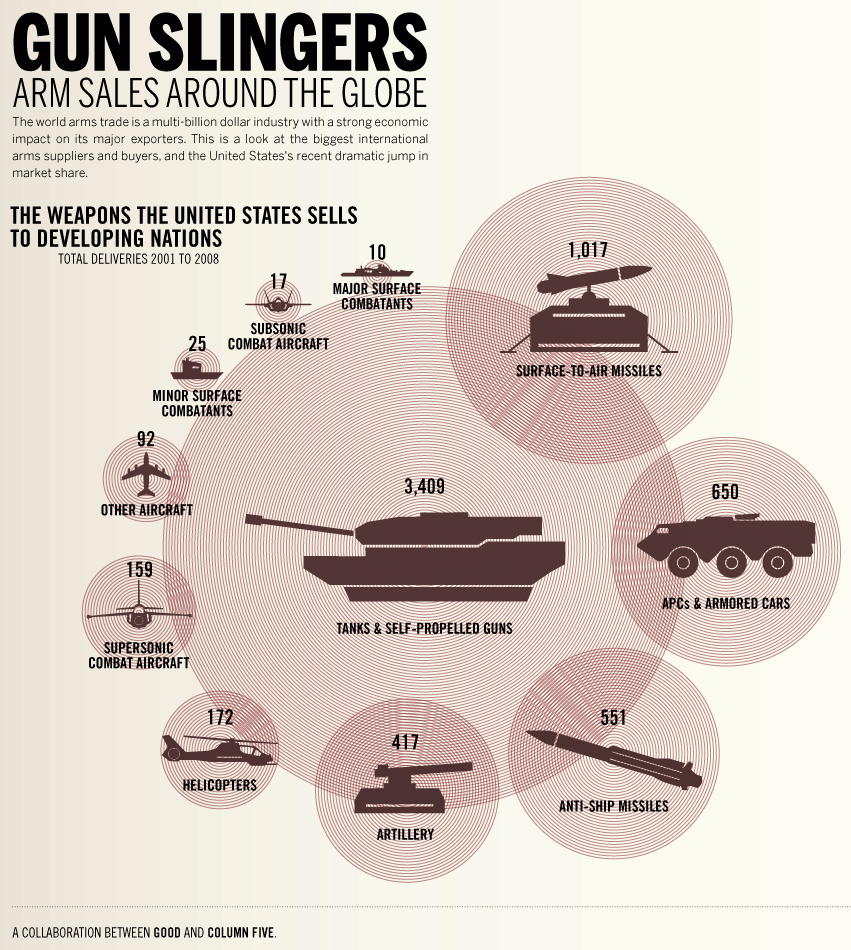
As a start, it’s worth noting that no one ever mentions the domestic gun control debate in the same breath with the dominant role the U.S. plays in what’s called the global arms trade. And yet, the link between the two should be obvious enough.
In the U.S., the National Rifle Association (NRA), an ultra-powerful lobbying group closely allied with weapons-making companies, has a strong grip on Congress — it gives 288 members of that body its top “A-rating” — and is in a combative relationship with the White House. Abroad, it’s so much simpler and less contested. Beyond U.S. borders, the reality is: the Pentagon, with the White House in tow, is the functional equivalent of the NRA, and like that organization, it has been working tirelessly in recent years in close alliance with major weapons-makers to ensure that there are ever less controls on the ever more powerful weaponry it wants to see sold abroad.
Between them, the White House and the Pentagon — with a helping hand from the State Department — ensure that the U.S. remains by far the leading purveyor of the “right to bear arms” globally. Year in, year out, in countries around the world, they do their best to pave the way (as the NRA does domestically) for the almost unfettered sales of ever more lethal weapons. In fact, the U.S. now has something remarkably close to a monopoly on what’s politely called the “transfer” of weaponry on a global scale. In 1990, as the Cold War was ending, the U.S. had cornered an impressive 37% of the global weapons trade. By 2011, the last year for which we have figures, that percentage had reached a near-monopolistic 78% ($66.3 billion in weapons sales), with the Russians coming in a distant second at 5.6% ($4.8 billion).
Admittedly, that figure was improbably inflated, thanks to the Saudis who decided to spend a pile of their oil money as if there were no tomorrow. In doing so, they created a bonanza year abroad for the major weapons-makers. They sealed deals on $33.4 billion in U.S. arms in 2011, including 84 of Boeing’s F-15 fighter jets and dozens of that company’s Apache attack helicopters as well as Sikorsky Blackhawk helicopters — and those were just the highest-end items in a striking set of purchases. But if 2011 was a year of break-the-bank arms-deals with the Saudis, 2012 doesn’t look bad either. As it ended, the Pentagon announced that they hadn’t turned off the oil spigot. They agreed to ante up another $4 billion to Boeing for upgrades on their armada of jet fighters and were planning to spend up to $6.7 billion for 20 Lockheed 25 C-130J transport and refueling planes. Some of this weaponry could, of course, be used in any Saudi conflict with Iran (or any other Middle Eastern state), but some could simply ensure future Newtown-like carnage in restive areas of that autocratic, fundamentalist regime’s land or in policing actions in neighboring small states like Bahrain.
And don’t think the Saudis were alone in the region. When it came to U.S. weapons-makers flooding the Middle East with firepower, they were in good company. Among states purchasing (or simply getting) infusions of U.S. arms in recent years were Bahrain, Egypt, Iraq, Jordan, Kuwait, Oman, Tunisia, Qatar, the United Arab Emirates (UAE), and Yemen. As Nick Turse has written, “When it comes to the Middle East, the Pentagon acts not as a buyer, but as a broker and shill, clearing the way for its Middle Eastern partners to buy some of the world’s most advanced weaponry.”
Typically, for instance, on Christmas Day in 2011, the U.S. signed a deal with the UAE in which, for $3.5 billion, it would receive Lockheed Martin’s Theater High Altitude Area Defense, an advanced antimissile interception system, part of what Reuters termed “an accelerating military buildup of its friends and allies near Iran.” Of course, selling to Arab allies without offering Israel something even better would be out of the question, so in mid-2012 it was announced that Israel would purchase 20 of Lockheed Martin’s F-35 Joint Strike Fighters, America’s most advanced jet (and weapons boondoggle), still in development, for $2.7 billion.
From tanks to littoral combat ships, it would be easy to go on, but you get the idea. Of course, U.S. weapons-makers in Pentagon-brokered or facilitated deals sell their weaponry and military supplies to countries planet-wide, ranging from Brazil to Singapore to Australia. But it generally seems that the biggest deals and the most advanced weaponry follow in the wake of Washington’s latest crises. In the Middle East at the moment, that would be the ongoing U.S.-Israeli confrontation with Iran, for which Washington has long been building up a massive military presence in the Persian Gulf and on bases in allied countries around that land.
A Second Amendment World, Pentagon-Style
It’s a given that every American foreign policy crisis turns out to be yet another opportunity for the Pentagon to plug U.S. weapons systems into the “needs” of its allies, and for the weapons-makers to deliver. So, from India to South Korea, Singapore to Japan, the Obama administration’s announced 2012 “pivot to” or “rebalancing in” Asia — an essentially military program focused on containing China — has proven the latest boon for U.S. weapons sales and weapons-makers.
As Jim Wolf of Reuters recently reported, the Aerospace Industries Association, a trade group that includes Boeing, Lockheed Martin, and other weapons companies, “said sales agreements with countries in the U.S. Pacific Command’s area of activity rose to $13.7 billion in fiscal 2012, up 5.4% from a year before. Such pacts represent orders for future delivery.” As the vice president of that association put it, Washington’s Asian pivot “will result in growing opportunities for our industry to help equip our friends.” We’re talking advanced jet fighters, missile systems, and similar major weapons programs, including F-35s, F-16s, Patriot anti-missile batteries, and the like for countries ranging from South Korea to Taiwan and India.
All of this ensures the sharpening of divides between China and its neighbors in the Pacific amid what may become a regional arms race. For the Pentagon, it seems, no weaponry is now off the table for key Asian allies in its incipient anti-China alliance, including advanced drones. The Obama administration is already brokering a $1.2 billon sale of Northrop Grumman’s RQ-4 “Global Hawk” spy drones to South Korea. Recently, it has been reported that Japan is preparing to buy the same model as its dispute sharpens with China over a set of islands in the East China Sea. (The Obama administration has also been pushing the idea of selling advanced armed drones to allies like Italy and Turkey, but — a rare occurrence — has met resistance from Congressional representatives worrying about other countries pulling a “Washington”: that is, choosing its particular bad guys and sending drone assassins across foreign borders to take them out.)
Here’s the strange thing in the present gun control context: no one — not pundits, politicians, or reporters — seems to see the slightest contradiction in an administration that calls for legal limits on advanced weaponry in the U.S. and yet (as rare press reports indicate) is working assiduously to remove barriers to the sale of advanced weaponry overseas. There are, of course, still limits on arms sales abroad, some imposed by Congress, some for obvious reasons. The Pentagon does not broker weapons sales to Iran, North Korea, or Cuba, and it has, for example, been prohibited by Congress from selling them to the military regime in Myanmar. But generally the Obama administration has put effort into further easing the way for major arms sales abroad, while working to rewrite global export rules to make them ever more permeable.
In other words, the Pentagon is the largest federally licensed weapons dealer on the planet and its goal — one that the NRA might envy — is to create a world in which the rights of those deemed our allies to bear our (most advanced) armaments “shall not be infringed.” The Pentagon, it seems, is intent on pursuing its own global version of the Second Amendment, not for citizens of the world but for governments, including grim, autocratic states like Saudi Arabia which are perfectly capable of using such weaponry to create Newtowns on an unimaginable scale.
A well regulated militia indeed.
This Global Violence Against Women Will No Longer Be Tolerated
This article by Eve Ensler is re-posted from Common Dreams.
There seems to be two types of risings on the planet right now. One is a sexual violence typhoon that is impacting most countries in the world. It’s been happening forever but, like climate change, it’s suddenly impossible to ignore. I first noticed more ominous waves during the US elections, the extreme and ignorant anti-women policies perpetrated by the Republicans. Then, like climate storms, floods and fires, specific extreme manifestations began to gain attention. A group of boys allegedly raping a girl in Steubenville, Ohio; a 14-year-old girl shot in the head for insisting girls have the right to learn in Pakistan; the gang rape and murder of a girl on a bus in Delhi; and in Britain the revelations that Jimmy Savile was able to abuse hundreds of girls over six decades, while British institutions from the BBC to Broadmoor turned a blind eye.
And, like the response to climate change, first there was an attempt at denial, then there is the blaming of the victim: a woman raped in Dubai fined after telling police she had been drinking; a priest in Italy telling women they are beaten because they don’t clean the house well and wear tight clothes; women in the US military raped by their comrades who then use that as proof that they never belonged there in the first place; raped girls in Rochdale being ignored by police and social workers because they were seen as damaged goods who were “making their own choices”. It goes on and on.
Like climate change, only the patriarchs with power seem to be blind to the magnitude of the horrors. As a matter of fact they are engineering it. There is a rape culture – a mindset that seems to have infected every aspect of our lives: the raping of the Earth through ecological destruction by the corporate powerful, pillaging resources for their own coffers with no concern for the Earth, or the indigenous peoples, or the notion of reciprocity; the rape of the poor through exploitation, land grabs, neglect; the rape of women’s bodies through physical violence and commodification, where a girl can be purchased for less than the cost of a mobile phone. The modelling and licensing of this rape culture is done by those protected by power and privilege – presidents, celebrities, sports stars, police officers, television executives, priests – with impunity.
But there is another rising. In the last year I have travelled the world for One Billion Rising, the global campaign that is a call for the one billion women who have been beaten or raped and the men who love them to strike, rise and dance on 14 February to end violence against women and girls. This movement is moving through the planet with a force and urgency unlike anything we have experienced – it is what the Indian activist Kamla Bhasin calls a “feminist tsunami”. Across 182 countries entire communities are planning to rise and voice their outrage and dreams. Nurses, teachers, domestic workers, indigenous leaders, fisherwomen, peasants, scholars, union organisers, all have come together.
Coalitions are being forged, with a new openness between issues, classes, tribes, races, artists, activists young and old. From Anna Cruz prosecuting 700 murders of women a year in Guatemala to Fartun, who opened the first shelter for women in Somalia, bravely organising for women to take to the streets of Mogadishu. From farmworker women – calling themselves Vaginas Campesinas – who will be dancing in their fields for less violent conditions, to the brave and outspoken nuns Sister Mary John from Philippines, Joan Chittester from the US, and Tenzin Palmo from Tibet. Entire networks are being activated – Gabriela in the Philippines, Unite in Britain, the AFL-CIO union in the US, and more than 14,000 other groups around the world.

Feminists and activists across the world have been tirelessly working for this moment for decades. If you don’t believe the door is opening look to India, where sexual violence has now become the central issue. Look to the winning of the US elections by women who said no to the anti-women extremists. Look to the UK, where a real debate is beginning about institutional violence against women – Keir Starmer, the director of public prosecutions, spoke for many when he said the Savile report “must be seen as a watershed moment”. Look to loving men such as Kaizaad Katwal, Jason Day, Robert Redford, the Dalai Lama and millions of others who are rising with us. Look to City of Joy in Bukavu, Democratic Republic of Congo, where women who, in spite of the violent escalations of the M23 militias and the daily threat of annihilation, continue to heal and study and become powerful in order to save their sisters.
So I am opting for Rising #2. We don’t have any idea what’s going to happen when one billion women and men protest on the same day. We do know that the preparation for it over these last months has already announced, united and catalysed a movement that, like the violence, can and will no longer be denied.
Now is the time. One month. 14 February. Rise in the streets, in the schools, on the buses, in your homes, in the dark alleyways, in the offices and factories and fishing boats and fields. Let our rising reveal our understanding that, until women are equal, safe and free, no society can prosper and life is diminished. Let our rising announce our commitment to make ending violence against women and girls the central concern of our times.
For V-Day events near you, see www.vday.org
This article by Rob Urie is re-posted from Counter Punch.
By reports, 2012 was the warmest year in recorded history in the U.S. The last decade was the warmest on record globally. Even for those arguing other hypotheses also fit the warming climate, the consistency of warming, the joint probability in statistical terms, must give pause because the consequences are (1) very far along already and (2) potentially catastrophic in excess of previous human experience. Alternative hypotheses not only need to be plausible in a general sense, they require specific explanations of how consistently the climate has warmed. In fact, there are no other plausible explanations of both the direction and consistency of climate change.
The ‘man-made’ warming hypothesis fits the timeline of the growth of industrial capitalism reasonably well. Non-capitalist industry, more recent in history but existent nonetheless, has accompanied capitalist imperialism- the spread of global capitalism as a system of domination, control and expropriation. To some extent the growth of non-capitalist industry has been a reaction to the threat of capitalist imperialism. It poses both an internal and external threat to non-capitalist economies, to the extent they still exist. In fact, capitalism was conceived to bring about an alternative political order and it appears to have done so quite successfully.
Capitalism is put forward as a mode of social organization that creates vast wealth. Capitalist imperialism has managed to expropriate vast wealth–that much is evident. If the catastrophic consequences of global warming come to pass even this wealth will have proved an illusion. In a philosophical sense, it seems a metaphor—we enter this world with nothing and leave it with nothing, why then would the devotion of entire lives to material acquisition constitute a plausible explanation of existence as capitalists have it? And why would a system based on local rationalities, personal economic striving, such as Adam Smith’s petite bourgeois shopkeeps organized into global corporations, be expected to lead to global rationalities—positive collective outcomes, outside of the internal logic of capitalist ideology?
A wee bit of arithmetic helps explain a lot. Revenues – Costs = Profits. Profits rise if costs borne by producers fall. The profit motive in capitalist production guarantees costs of production will be forced onto others unless the capitalist is forced to bear them. And unless one wishes to argue the world’s creatures need no place to live, no food to eat and no clean water to drink, the destruction of these in capitalist production is a cost to either be borne by the producer or to be borne by others. Even the most radical ‘free-market’ capitalist economists agree that this set of relations is a prerequisite for capitalism to in any sense ‘work.’ And production that threatens to end the world, as global warming does, means ‘profits’ from said production would not exist if capitalists were forced to bear their true costs.
Those who have even casually passed through regions of capitalist extraction and / or industrial production have seen that capitalists have almost never been forced to bear the costs of capitalist production. From the coal regions of Pennsylvania to the abandoned industrial sites of the ‘rust belt’ to the poisoned resource extraction sites in the West to mountain top removal in West Virginia to the ‘tar sands’ regions of Canada to coal mines in Mongolia, costs in terms of subsequent un-inhabitability of the land and destruction of the planet’s bounty remain while profits accrue. After depleting resources and causing ancillary destruction capitalists have historically simply moved on to as yet un-depleted and un-destroyed territories. The ‘tragedy of the commons’ used in capitalist property theory would be a minor inconvenience next to the ‘tragedy of private property’ perpetrated by capitalism, even if it weren’t already a cynical lie (see the last fifth of Marx’s Capital, Vol. I for context).
But this isn’t a morality tale. Nor is global warming an accident of history for which none bear responsibility. It is the epic social struggle of our time. Capitalism is a form of economic imperialism from which specific people have benefited and continue to benefit from the destruction of the planet. The ‘rational individuals’ of capitalist theory have aggregated to collective insanity. And as history is in the process of demonstrating, Adam Smith’s ‘invisible hand’ is an illusion—a world of people acting in their own narrow economic interests has resulted in a world where people act in their own narrow economic interests to collective suicide.
Long before global warming was identified, the problem of ‘externalities,’ or the tendency of capitalists to force their costs of production onto people who see no benefit from it, was identified and remedies were sought. Before he became a bought-and-paid-for tool of Papa Koch, father of the infamous ‘Koch Brothers’ and founder of the John Birch Society, Austrian economist Friedrich Hayek argued the legitimate role of government was to correct ‘market failures’ such as environmental destruction. Later in his life, when he was fully a bought-and-paid-for tool of Papa Koch, he conveniently (for Papa Koch’s sake) argued capitalism was such a blessing to humankind that ‘market-based’ solutions to externalities were preferred.
But market based solutions to externalities are a cynical hoax in several dimensions. In the first, they presuppose environmentally destructive production is eternal fact and the purported goal of ‘solutions’ is to limit growth to a trend level that remains collectively suicidal. In the second, in the face of all historical experience to the contrary, market-based solutions assume the same capitalists who have spent three centuries profiting from forcing their costs onto others will comply with rules they, themselves, have largely written with full knowledge there does not exist, and there are no plans to create, a credible enforcement system. In the third, even if such an enforcement system were conceived and developed, ‘private’ capture of state institutions would neutralize enforcement capability (‘Citizens United’ anyone?). Finally, debt financed production creates both financial and institutional leverage. Creditors benefit when costs of production are shifted to others because it improves their probability of repayment—and creditors control the money in a debt based economy. The contention that more capitalism is the solution to the catastrophes capitalism creates only works in a closed logical system—there is no level of catastrophe that would render ‘more capitalism’ illogical within the internal rules of this logic.
Likewise, the contention individual ‘consumers’ can solve global warming through choosing environmentally ‘friendly’ products begins with the premise that consumers cause externalities through their ‘choice’ of products. In the first, this assumes all consumers know the production processes that go into producing goods and services, are able to quantify the proportion of costs embedded in the price of the products versus those that aren’t, and truly have choices. In the second, it assumes consumers have no material needs. Western agriculture, from whence the food most Westerners eat comes, is a major contributor to greenhouse gases. Shifting to sustainable agricultural practices implausibly assumes consumers both understand the impact of existing practices and can force a shift from below. In the third, it once again assumes capitalism is the solution to the catastrophes capitalism creates—that individuals acting in their own economic self-interest will aggregate to serve the collective interest when they have so spectacularly not done so historically. In fact, the premise of consumers foregoing their own economic self-interest to serve the collective good puts a lie to thefundamental premise of capitalism. In other words, once it is granted that ‘consumers’ could and would act in the collective interest, the internal logic of capitalism quickly fades away.
Capitalist imperialism is destroying the planet, largely for beings that see little benefit (and often great harm) from the system. The only way this won’t constitute mass murder on a scale never before imagined in human history is if global warming isn’t really a threat; capitalist production isn’t behind it, or some combination of the two. Capitalist apparatchiks are pursuing two tracks in response—to replace social discourse around the issue with a commercial response—one that uses all means available to persuade people the problem isn’t real and / or the people responsible for it are not the people responsible for it. The second track is to propose solutions that (1) don’t call into question the nature of the problem—the political economy of capitalism is responsible for global warming and (2), provide the appearance of action toward a solution without effective action taking place.
Those looking to Western governments for an effective response face two challenges. In the first, in the face of global warming, the premise of capitalism, that individuals acting in their individual interests produce good collective outcomes, is demonstrably false. This system has apparently produced the worst of all possible outcomes—catastrophic environmental failure that threatens most life on the planet. If the theory of individual interests accumulating to collective good is false, so is the classical liberal conception of the state. If the state’s role, as imagined in capitalist theory, is the protection of ‘private’ interests and private interests are driving the world toward collective suicide (or rather capitalist homicide), the state must be recovered to serve collective interests. As the private interests currently in control of the state are tightening their grip on power through the build out of the corporate police state, I leave it to readers to propose non-confrontational counter-measures likely to be effective. Otherwise, global warming is the confrontation forced upon us.
Finally—Thomas Malthus was proved a captive of his ideology with his prediction of entropy, mass starvation as a growing population faced a static food supply. Mr. Malthus was writing in the early stages of global capitalism’s expanding reach. The agricultural technologies tied to capitalist production expanded the food supply to feed the growing population. In fact, capitalism re-engineered ‘the world’ to be dependent on capitalist production. Technological solutions to global warming will no doubt be put forward and tried. But technology is inexorably tied to the logic of capitalist production as capitalism is emerging as ‘the problem.’ Only a fundamental shift away from the premises of capitalism will provide workable solutions. And global warming is a gradual problem in a political system that responds to crisis. A politics of crisis around global warming must arise for effective political action to coalesce.
The Pipeline President: Obama’s Keystone XL
This article by Tom Weis is re-posted from EcoWatch. Edtor’s Note: While we agree with much of what this article states, we also do believe that the President really has a choice, because of the systems of power in this country and how they function. When politicians make the “right choice” it is only because the public has forced their hand to do so. Stopping the Keystone XL Pipeline will happen because of the growing public resistance to it.
Note to President Obama: You approved it. You own it.
By now, most people following the Keystone XL saga know that last spring, President Obama made a special trip on Air Force One to the “Pipeline Crossroads of the World” to call for fast-track approval of the southern (OK-TX) leg of TransCanada’s Keystone XL tar sands pipeline. Standing in a pipe yard in Cushing, Oklahoma, the President declared:
“And today, I’m directing my administration to cut through the red tape, break through the bureaucratic hurdles, and make this project a priority, to go ahead and get it done.”
Since then, TransCanada has constructed roughly one-third of the 485-mile southern leg (if not for fierce push back by a few determined landowners and the courageous efforts of Tar Sands Blockade, it would be more).
With ownership comes responsibility. As the pipeline president, Obama not only owns Keystone XL, he also owns the atrocities being committed in its name in Texas:
- Great grandmothers being pepper-sprayed in the face and having their land fraudulently seized by a foreign corporation
- Peaceful protesters being sadistically assaulted by local law enforcement, with the encouragement of TransCanada officials
- I could go on … this is sick stuff.
All this is occurring despite the fact that countless landowners in six Great Plains states whose private property the pipeline would cross don’t want it. Native American tribes whose treaty lands the pipeline would desecrate don’t want it. Even the President’s own U.S. Environmental Protection Agency administrator, Lisa Jackson, reportedly resigned in large part because of it. So why does President Obama want it so badly?
- It can’t be jobs. Obama’s Keystone XL risks destroying more jobs than it creates.
- It can’t be energy independence. Obama’s Keystone XL is being built as an export pipeline for Canada to sell its dirty oil to foreign markets.
- It can’t be cheaper gas. Obama’s Keystone XL portends higher, not lower, gas prices for the Midwest and Rockies.
- It can’t be public health. Obama’s Keystone XL threatens to further poison the air of people living near tar sands oil refineries.
- It can’t be economic security. Obama’s Keystone XL imperils U.S. aquifers and waterways and the local economies they support.
- It can’t be national security. Twenty prominent scientists have warned of the climate impacts of Obama’s Keystone XL, with an elite Military Advisory Board declaring climate change a threat to our national security.
There’s still a way out of this mess, but the window of opportunity is rapidly closing on this presidency. The minute we see President Obama use the powers of his presidency to end this immoral assault on America is the day we’ll know he is ready to deal with a climate spiraling out of control on his watch.
This begins with:
- Immediately halting construction of Keystone XL’s southern leg.
- Rejecting outright TransCanada’s permit to build the northern leg.
- Using the bully pulpit of the presidency to begin a long overdue adult national conversation about how we’re going to solve the gravest challenge of our time.
The hour is late, but it is not too late for President Obama to trade out his dead-end “all of the above” energy strategy for a life-affirming green industrial revolution. A principled leader would use the next four years to do what is hard: stand up and fight like hell for the future of life on Earth—earning the eternal gratitude of generations to come.
A compromised politician would do what is easy: cave into the fossil fuel lobby and sacrifice the future of our children and grandchildren on the rotting altar of corporate greed. If President Barack Obama continues down the dangerous path he is currently on, he will go down in history as the pipeline president who knew the horrors of the climate peril we face, but lacked the moral courage to act.
It’s choice time.
Anti-Fracking Rally in Lansing during the State of the State Address
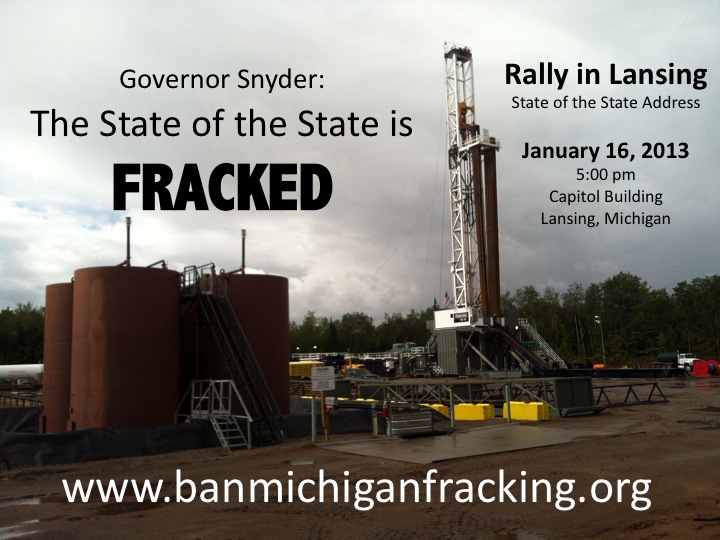
For more information, go to https://www.facebook.com/pages/Ban-Michigan-Fracking/121670147948131?ref=hl.
This aticle by Beth Brogan is re-posted from ZNet.
A former security adviser for Barack Obama now says the Pentagon’s targeted drone program is counter-productive, is “encouraging a new arms race,” and has killed far more civilians than has been acknowledged.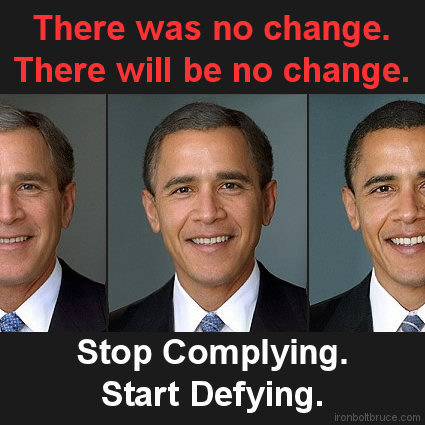
In an article for the January 2013 issue of the journal International Affairs, Michael Boyle, a La Salle University expert on counterterrorism who served as an adviser on the Obama campaign’s counterterrorism expert group from July 2007-November 2008, writes that the Obama administration’s increasing reliance on drone attacks is having “adverse strategic effects that have not been properly weighed against the tactical gains associated with killing terrorists,” the Guardian reports.
Although Obama pledged to end the so-called ‘War on Terror,’ Boyle continues:
“Instead, he has been just as ruthless and indifferent to the rule of law as his predecessor … while President Bush issued a call to arms to defend ‘civilisation’ against the threat of terrorism, President Obama has waged his war on terror in the shadows, using drone strikes, special operations and sophisticated surveillance to fight a brutal covert war against al-Qaida and other Islamist networks.”
Boyle argues that the administration has been “successful in spinning the number of civilian casualties” because it has reportedly begun counting all military-age men in the strike zone as militants unless the administration has clear evidence to the contrary, the Guardian reports. As a result, the standards the US uses to select targets has been “gradual(ly) loosening.”
He continues:
The consequences can be seen in the targeting of mosques or funeral processions that kill non-combatants and tear at the social fabric of the regions where they occur. No one really knows the number of deaths caused by drones in these distant, sometimes ungoverned, lands.
The use of drones by the US has increased dramatically during the Obama administration, with the Bureau of Investigative Journalism estimating that US forces have conducted 307 deadly drone strikes in Pakistan alone since Obama took office four years ago.
Peter Singer, director of the 21st Century Initiative at the Brookings Institution says the US now has 7,000 drones operating and 12,000 more on the ground, while not a single new manned combat aircraft is under research or development at any western aerospace company.
Boyle argues for more transparency about the surging use of drones by the Obama administration, because, he says, Americans are “unaware of the scale of the drone program … and the destruction it has caused in their name.”
Learning to Love Torture, Zero Dark Thirty-Style
This article by Karen J. Greenberg is re-posted from Tom Dispatch.
On January 11th, 11 years to the day after the Bush administration opened its notorious prison at Guantanamo Bay, Cuba, Zero Dark Thirty, Kathryn Bigelow’s deeply flawed movie about the hunt for Osama bin Laden, opens nationwide. The filmmakers and distributors are evidently ignorant of the significance of the date — a perfect indication of the carelessness and thoughtlessness of the film, which will unfortunately substitute for actual history in the minds of many Americans.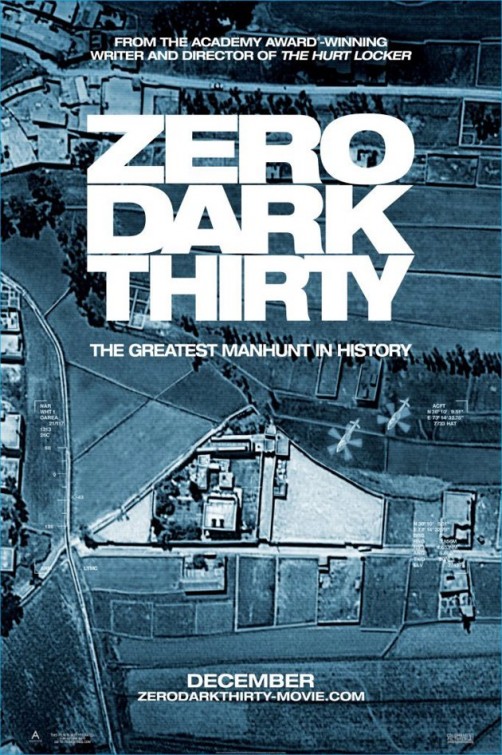
The sad fact is that Zero Dark Thirty could have been written by the tight circle of national security advisors who counseled President George W. Bush to create the post-9/11 policies that led to Guantanamo, the global network of borrowed “black sites” that added up to an offshore universe of injustice, and the grim torture practices — euphemistically known as “enhanced interrogation techniques” — that went with them. It’s also a film that those in the Obama administration who have championed non-accountability for such shameful policies could and (evidently did) get behind. It might as well be called Back to the Future, Part IV, for the film, like the country it speaks to, seems stuck forever in that time warp moment of revenge and hubris that swept the country just after 9/11.
As its core, Bigelow’s film makes the bald-faced assertion that torture did help the United States track down the perpetrator of 9/11. Zero Dark Thirty — for anyone who doesn’t know by now — is the story of Maya (Jessica Chastain), a young CIA agent who believes that information from a detainee named Ammar will lead to bin Laden. After weeks, maybe months of torture, he does indeed provide a key bit of information that leads to another piece of information that leads… well, you get the idea. Eventually, the name of bin Laden’s courier is revealed. From the first mention of his name, Maya dedicates herself to finding him, and he finally leads the CIA to the compound where bin Laden is hiding. Of course, you know how it all ends.
However compelling the heroine’s determination to find bin Laden may be, the fact is that Bigelow has bought in, hook, line, and sinker, to the ethos of the Bush administration and its apologists. It’s as if she had followed an old government memo and decided to offer in fictional form step-by-step instructions for the creation, implementation, and selling of Bush-era torture and detention policies.
Here, then, are the seven steps that bring back the Bush administration and should help Americans learn how to love torture, Bigelow-style.
First, Rouse Fear. From its opening scene, Zero Dark Thirty equates our post-9/11 fears with the need for torture. The movie begins in darkness with the actual heartbreaking cries and screams for help of people trapped inside the towers of the World Trade Center: “I’m going to die, aren’t I?… It’s so hot. I’m burning up…” a female voice cries out. As those voices fade, the black screen yields to a full view of Ammar being roughed up by men in black ski masks and then strung up, arms wide apart.
The sounds of torture replace the desperate pleas of the victims. “Is he ever getting out?” Maya asks. “Never,” her close CIA associate Dan (Jason Clarke) answers. These are meant to be words of reassurance in response to the horrors of 9/11. Bigelow’s first step, then, is to echo former Vice-President Dick Cheney’s mantra from that now-distant moment in which he claimed the nation needed to go to “the dark side.” That was part of his impassioned demand that, given the immense threat posed by al-Qaeda, going beyond the law was the only way to seek retribution and security.
Bigelow also follows Cheney’s lead into a world of fear. The Bush administration understood that, for their global dreams, including a future invasion of Iraq, to become reality, fear was their best ally. From Terre Haute to El Paso, Portland, Oregon, to Portland, Maine, Americans were to be regularly reminded that they were deeply and eternally endangered by terrorists.
Bigelow similarly keeps the fear monitor bleeping whenever she can. Interspersed with the narrative of the bin Laden chase, she provides often blood-filled footage from terrorist attacks around the globe in the decade after 9/11: the 2004 bombings of oil installations in Khobar, Saudi Arabia, that killed 22; the 2005 suicide bombings in London that killed 56; the 2008 Marriott Hotel bombing in Islamabad that killed 54 people; and the thwarted Times Square bombing of May, 2010. We are in constant jeopardy, she wants us to remember, and uses Maya to remind us of this throughout.
Second, Undermine the Law. Torture is illegal under both American and international law. It was only pronounced “legal” in a series of secret memorandums produced by the Bush Justice Department and approved at the highest levels of the administration. (Top officials, including Cheney and National Security Adviser Condoleezza Rice, evidently even had torture techniques demonstrated for them in the White House before green-lighting them.) Maintaining that there was no way Americans could be kept safe via purely legal methods, they asked for and were given secret legal authority to make torture the go-to option in their Global War on Terror. Yet Bigelow never even nods toward this striking rethinking of the law. She assumes the legality of the acts she portrays up close and personal, only hedging her bets toward the movie’s end when she indicates in passing that the legal system was a potential impediment to getting bin Laden. “Who the hell am I supposed to ask [for confirmation about the courier], some guy at Gitmo who’s all lawyered up?” asks Obama’s national security advisor in the filmic run-up to the raid.
Just as new policies were put in place to legalize torture, so the detention of terror suspects without charges or trials (including people who, we now know, were treated horrifically despite being innocent of anything) became a foundational act of the administration. Specifically, government lawyers were employed to create particularly tortured (if you’ll excuse the word) legal documents exempting detainees from the Geneva Conventions, thus enabling their interrogation under conditions that blatantly violated domestic and international laws.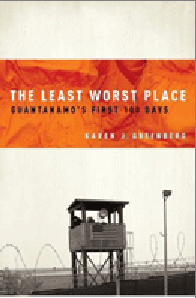
Zero Dark Thirty accepts without hesitation or question the importance of this unconstitutional detention policy as crucial to the torture program. From the very first days of the war on terror, the U.S. government rounded up individuals globally and began to question them brutally. Whether they actually had information to reveal, whether the government had any concrete evidence against them, they held hundreds — in the end, thousands — of detainees in U.S. custody at secret CIA black sites worldwide, in the prisons of allied states known for their own torture policies, at Bagram Detention Center in Afghanistan, and of course at Guantanamo, which was the crown jewel of the Bush administration’s offshore detention system.
Dan and Maya themselves not only travel to secret black sites to obtain valuable information from detainees, but to the cages and interrogation booths at Bagram where men in those now-familiar orange jumpsuits are shown awaiting a nightmare experience. Bigelow’s film repeatedly suggests that it was crucially important for national security to keep a pool of potential information sources — those detainees — available just in case they might one day turn out to have information.
Third, Indulge in the Horror: Torture is displayed onscreen in what can only be called pornographic detail for nearly the film’s first hour. In this way, Zero Dark Thirty eerily mimics the obsessive, essentially fetishistic approach of Bush’s top officials to the subject. Cheney, former Secretary of Defense Donald Rumsfeld, Cheney’s former Chief of Staff David Addington, and John Yoo from the Office of Legal Counsel, among others, plunged into the minutiae of “enhanced interrogation” tactics, micro-managing just what levels of abuse should and should not apply, would and would not constitute torture after 9/11.
In black site after black site, on victim after victim, the movie shows acts of torture in exquisite detail, Bigelow’s camera seeming to relish its gruesomeness: waterboarding, stress positions, beatings, sleep deprivation resulting in memory loss and severe disorientation, sexual humiliation, containment in a small box, and more. Whenever she gets the chance, Bigelow seems to take the opportunity to suggest that this mangling of human flesh and immersion in brutality on the part of Americans is at least understandable and probably worthwhile. The film’s almost subliminal message on the subject of torture should remind us of the way in which a form of sadism-as-patriotic-duty filtered down to the troops on the ground, as evidenced by the now infamous 2004 photos from Abu Ghraib of smiling American soldiers offering thumbs-up responses to their ability to humiliate and hurt captives in dog collars.
Fourth, Dehumanize the Victims. Like the national security establishment that promoted torture policies, Bigelow dehumanizes her victims. Despite repeated beatings, humiliations, and aggressive torture techniques of various sorts, Ammar never becomes even a faintly sympathetic character to anyone in the film. As a result, there is never anyone for the audience to identify with who becomes emotionally distraught over the abuses. Dehumanization was a necessary tool in promoting torture; now, it is a necessary tool in promoting Zero Dark Thirty, which desensitizes its audience in ways that should be frightening to us and make us wonder who exactly we have become in the years since 9/11.
Fifth, Never Doubt That Torture Works. Given all this, it’s a small step to touting the effectiveness of torture in eliciting the truth. “In the end, everybody breaks, bro’: it’s biology,” Dan says to his victim. He also repeats over and over, “If you lie to me, I hurt you” — meaning, “If I hurt you, you won’t lie to me.” Maya concurs, telling Ammar, bruised, bloodied, and begging for her help, that he can stop his pain by telling the truth.
How many times does the American public need to be told that torture did not yield the results the government promised? How many times does it need to be said that waterboarding Khalid Sheikh Mohammed, the mastermind of 9/11, 183 times obviously didn’t work? How many times does it need to be pointed out that torture can — and did — produce misleading or false information, notably in the torture of Ibn al-Shaykh al-Libi, the Libyan who ran an al-Qaeda training camp in Afghanistan and who confessed under torture that there were weapons of mass destruction in Iraq?
Sixth, Hold No One Accountable. The Obama administration made the determination that holding Bush administration figures, CIA officials, or the actual torturers responsible for what they did in a court of law was far more trouble than it might ever be worth. Instead, the president chose to move on and officially never look back. Bigelow takes advantage of this passivity to suggest to her audience that the only downside of torture is the fear of accountability. As he prepares to leave Pakistan, Dan tells Maya, “You gotta be real careful with the detainees now. Politics are changing and you don’t want to be the last one holding the dog collar when the oversight committee comes…”
The sad truth is that Zero Dark Thirty could not have been produced in its present form if any of the officials who created and implemented U.S. torture policy had been held accountable for what happened, or any genuine sunshine had been thrown upon it. With scant public debate and no public record of accountability, Bigelow feels free to leave out even a scintilla of criticism of that torture program. Her film is thus one more example of the fact that without accountability, the pernicious narrative continues, possibly gaining traction as it does.
Seventh, Employ the Media. While the Bush administration had the Fox television series 24 as a weekly reminder that torture keeps us safe, the current administration, bent on its no-accountability policy, has Bigelow’s film on its side. It’s the perfect piece of propaganda, with all the appeal that naked brutality, fear, and revenge can bring.
Hollywood and most of its critics have embraced the film. It has already been named among the best films of the year, and is considered a shoe-in for Oscar nominations. Hollywood, that one-time bastion of liberalism, has provided the final piece in the perfect blueprint for the whitewashing of torture policy. If that isn’t a happily-ever-after ending, what is?
This article by Winona LaDuke is re-posted from Yes Magazine.
Attawapiskat Chief Theresa Spence enters her fourth week of a hunger strike outside the Canadian parliament building, thousands of protesters voice their support in Los Angeles, London, Minneapolis, and New York City. Spence and the protesters of the Idle No More movement are drawing attention to deplorable conditions in native communities and the recent passage of Bill C-45, which sidesteps most Canadian environmental laws.
Put it this way: Before the passage of Bill C-45, 2.6 million rivers, lakes, and a good portion of Canada’s three ocean shorelines were protected under the Navigable Waters Act. Now, only eighty-seven are protected. That’s just the beginning of the problem, which seems not to have drawn much attention from the general public.
“Flash mob” protests with traditional dancing and drumming have erupted in dozens of shopping malls across North America, marches and highway blockades by aboriginal groups and supporters have emerged across Canada and as far away as New Zealand and the Middle East. This weekend, hundreds of native people and their supporters held a flash mob round dance, with hand drums and singing, at the Mall of America in Minneapolis, again as a part of the Idle No More protest movement. This quickly emerging wave of native activism on environmental and human rights issues has spread like a wildfire across the continent.
Prime Minister Harper’s push for tar sands and mining
A group of natives from Aamjiwnaang First Nation in Sarnia, Ontario, pitched a pickup truck across the tracks of a Canadian National Railway spur and blocked train traffic Friday in support of the Idle No More protest in Ottawa. The blockade began just after Boxing Day, that famed Canadian holiday, and has continued.
The Aamjiwnaang blockade is one of hundreds. A center of controversy is the proposed Northern Gateway pipeline, which would cost $6 billion and bring tar sands from Alberta to the Pacific. The pipeline will cross over 40 native nations, all of whom have expressed opposition. The legislative changes could expedite approval of this and many other projects—all of which are in aboriginal territories.
“Idle No More” is Canadian for “That’s enough BS, we’re coming out to stop you,” or something like that. Canada often touts a sort of “better than thou” human rights position in the international arena and has, for instance, a rather small military, so it’s not likely to launch any pre-emptive strikes against known or unknown adversaries, and has often sought to appear as a good guy, more so than its southern neighbor. More than a few American expatriates moved to Canada during the Vietnam war, and stayed there, thinking it was a pretty good deal.
That is sort of passé, particularly if you are a native person. And particularly if you are Chief Theresa Spence. Spence is the leader of Attawapiskat First Nation—a very remote Cree community from James Bay, Ontario, which is at the bottom of Hudson Bay. The community’s 1,549 on-reserve residents (a third of whom are under the age of 19) have weathered quite a bit, including the fur trade, residential schools, a status as non-treaty Indians, and limited access to modern conveniences such as toilets and electricity. This is a bit commonplace in the far north, but it has become exacerbated in the past five years.
Enter DeBeers, the largest diamond mining enterprise in the world. The company moved into northern Ontario in 2006. The Victor Mine reached commercial production in 2008 and was voted “Mine of the Year” by the readers of the international trade publication, Mining Magazine. The company states that it is “committed to sustainable development in local communities.” But this is where the first world meets the third world in the north, as Canadian MP Bob Rae discovered last year on his tour of the destitute conditions in the village. Infrastructure in the subarctic is in short supply. There is no road into the village eight months of the year; during the other four months, during freeze up, there’s an ice road. A diamond mine needs a lot of infrastructure. And that has to be shipped in, so the trucks launch out of Moosonee, Ontario. Then, they build a better road. The problem is that the road won’t work when the climate changes, and already stretched infrastructure gets tapped out.
There is some money flowing in, that’s for sure. A 2010 report from DeBeers states that payments to the eight communities associated with its two mines in Canada totalled $5,231,000 that year. Forbes magazine reports that diamond sales by the world’s largest diamond company “increased 33 percent, year-over-year, to $3.5 billion” and that DeBeers “reported record EBITDA of almost $1.2 billion, a 55 percent increase over the first the first half of 2010.”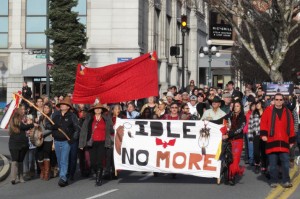
As the Canadian Mining Watch group notes, “Whatever Attawapiskat’s share of that $5 million is, given the chronic underfunding of the community, the need for expensive responses to deal with recurring crises, including one that DeBeers themselves may have precipitated by overloading the community’s sewage system , it’s not surprising that the community hasn’t been able to translate its … income into improvements in physical infrastructure.” Last year, Attawapiskat drew international attention when many families in the Cree community were living in tents.
The neighboring village of Kashechewan is in similar disarray. They have been boiling and importing water. The village almost had a complete evacuation due to health conditions, and as Alvin Fiddler, Deputy Grand Chief of the Nishnawbe Aski Nation, a regional advocacy network, told a reporter, “fuel shortages are becoming more common among remote northern Ontario communities right now.” That’s because the ice road used to truck in a year’s supply of diesel last winter did not last as long as usual. “Everybody is running out now. We’re looking at a two-month gap” until the ice road is solid enough to truck in fresh supplies, Mr. Fiddler said.
Kashechewan’s chief and council are poised to shut down the band office, two schools, the power generation center, the health clinic, and the fire hall because the buildings were not heated and could no longer operate safely. “In addition, some 21 homes had become uninhabitable,” according to Chief Derek Stephen. Those basements had been flooded last spring, as the weather patterns changed. (Just as a side note, in 2007, some 21 Cree youth from Kashechewan attempted to commit suicide, and the Canadian aboriginal youth suicide rate is five times the national average.)
Both communities are beneficiaries of an agreement with DeBeers.
The lost boys of Aamjiwnaang
Back at Aamjiwnaang, the Ojibwe have blockaded the tracks. Those are tracks that are full of chemical trains, lots of them. There are some 62 industrial plants in what the Canadian government calls Industrial Valley. The Aamjiwnaang people would like to call it home, but they’ve a few challenges in their house.
There’s a recent Men’s Health magazine article called, “The Lost Boys of Aamjiwnaang.” That’s because the Ojibwe Reserve of Aamjiwnaang has few boys. Put it this way: In a normal society, there are about l05 boys to l00 girls born. That’s the odds for a thousand years or so. However, at Aamjiwnaang, things are different.
Between 1993 and 2003, there had been two girls born for every boy in the tribal community, one of the steepest declines ever recorded in birth gender ratio. As the reporter for Men’s Health notes, “These tribal lands have become a kind of petri dish for industrial pollutants.”
This trend is international, particularly in more industrialized countries , and the odd statistics at Aamjiwnaang are indicative of larger trends. The rail line known as the St. Clair spur, carries Canadian National and CSX trains to several large industries in Sarnia’s Chemical Valley. Usually four or five trains move through each day, all full of chemicals. The Ojibwe have faced a chronic dosage of chemicals for twenty-five years, and are concerned about the health impacts. They are also concerned about proposals to move tar sands oil through their community in a pre-existing pipeline known as Line Nine.
The Idle No More movement is further spurred by what Clayton Thomas Muller, a representative of the movement, calls “the extremist right wing government of Steven Harper,” a government that seems intent on selling the natural wealth of the Canadian (aboriginal) north to the highest bidders in a multinational market. The recent passing of the omnibus budget Bill C-45, which gutted thirty years of environmental legislation, was approved by the Senate in a 50-27 vote.
Aboriginal leaders charge the Conservative government with pushing the bill through without consulting them. They note the bill infringes on their treaty rights, compromises ownership of their land, and takes away protection for Canada’s waterways and most of the environment. Since Canada’s economy is largely based on exploiting natural resources at an alarming rate, moving into a leading position in the world in terms of greenhouse gas emissions, fracking and lacing pristine water with cyanide for new mines, it’s convenient to gut the environmental laws. It’s also convenient to violate the international laws which are treaties.
Start seeing Indians
In the United States, the native community has been coming out in numbers and regalia to support the Canadian native struggle to protect the environment—drawing attention at the same time to similar concerns and issues here in the U.S. For instance, Ojibwe from the Keewenaw Bay Community in Michigan rallied against a Rio Tinto Zinc mine project, while Navajo protesters in Flagstaff, Ariz., continued opposing a ski project with manufactured snow at a sacred mountain.
Pamela Paimeta, a spokesperson for the Idle No More movement in Canada, urges the larger community to see what is occuring across the country as a reality check.
“The first Nations are the last best hope that Canadians have for protecting land for food and clean water for the future,” she said. “Not just for our people but for Canadians as well. So this country falls or survives on whether they acknowledge or recognize and implement those aboriginal and treaty rights. So they need to stand with us and protect what is essential.”
Meanwhile , Chief Theresa Spence is still hoping to meet with Prime Minister Stephen Harper, urging him to “open his heart” and meet with native leaders angered by his policies.
“He’s a person with a heart but he needs to open his heart,” she said. “I’m sure he has faith in the Creator himself and for him to delay this, it’s very disrespectful, I feel, to not even meet with us.”
The reality is that Attawapiskat, Aamjiwnaang, and Kashechewan are remote native communities that receive little or no attention until a human rights crisis of great proportion causes national shame.
Facebook and social media equalize access for those who never see the spotlight. (Just think of the Arab Spring). With the help of social media, the Idle No More movement has taken on a life of its own in much the same way the first “Occupy Wall Street” camp gave birth to a multitude of “occupy” protests with no clear leadership.
“This has spread in ways that we wouldn’t even have imagined,” said Sheelah McLean, an instructor at the University of Saskatchewan and one of the four women who originally coined the “Idle No More” slogan.
“What this movement is supposed to do is build consciousness about the inequalities so that everyone is outraged about what is happening here in Canada. Every Canadian should be outraged.”
Actually, we all should be outraged, and Idle no More.
Last night Representative Justin Amash hosted a Town Hall Meeting at the Ford Museum in Grand Rapids. The auditorium was about half-full, which would make the turnout around 200.
Amash talked briefly before the question and answer period and addressed only one major political issue, the “fiscal cliff.” The West Michigan Representative has received a fair amount of attention recently because of his stance on this issue, which has resulted in him being removed from the Budget Committee.
Amash stated that the country needs to spend less than what it does now, in order to balance the budget, a comment that elicited a strong applause. However, Amash made numerous comments that had a populist tone to them all night, but there was never much substance to back it up. This is a theme we will return to later.
Representative Amash stated that the agreement to avoid going over the “fiscal cliff” is temporary and will only prolong the problem. The country, he believes, is in really bad shape financially and it will continue to be a problem, especially for the poor.
Amash said that both Democrats and Republicans have both not done a good job on spending and that both parties are responsible for the nation’s economic woes. However, his answer to how the problem is solved was “if the public understands the problem, which is different than trying to get the politicians to understand.” This is either a naïve statement on his part or just a diversion, since the public needs to do more than understand the problem for real change to take place.
The last thing the Representative addressed before opening the night up to questions from the audience, was to talk about his commitment to transparency. It is not secret that he regularly posts on Facebook how he votes, so that constituents can see where he stands on issues. This is certainly better than what most federal politicians are willing to do, but just posting a brief explanation of how he voted is not enough for real transparency. Amash rarely puts a hyper-link to the actual legislation, so people can read the language for the themselves and he rarely provides much context for the vote as it relates to the larger picture of whatever issue he is voting for. A better site for transparency is VoteSmart.org, where you can check the voting records of all politicians. You can also view them by most recent votes or by topics, which provides the public with a more comprehensive view of how any politician votes on particular issues like Trade, Health Care or Military Spending.
Questions, but not many answers
This writer counted 17 different questions that were presented to the Congressman during the Q & A period. Most of the questions came from people who clearly supported Amash and made no bones about their affiliation with the Tea Party or Libertarian wing of the Republican Party.
This was evident to anyone present, since people either said they were members of the Tea Party or they use language in their questions to reflect a specific way they saw politics in the US.
Virtually everyone who asked a question expressed nothing short of contempt for the government, with statements about corruption, theft, lack of transparency, no regard for the public and no regard for real democracy.
Some people who asked questions discussed the Federalist Papers, some the Federal Reserve and silver and others asked Amash why he hasn’t left the Republican Party.
The Congressman addressed many of these questions with kind of an answer. Despite Amash’s statements about how the government is broken, he believes in working within the system, even if it means personally talking to each member of Congress. Amash is not interested in leaving the Republican Party, but he acknowledged on numerous occasions that both parties are to blame for the state of the country.
Some one asked him about the Tea Party Movement and its ability to affect change? He said that the Tea Party and Occupy both have had an impact on politics as usual, but he offered no concrete example to substantiate his claims.
Another person asked him about term limits, which he said he supported. Amash said that some members of Congress have been their too long and have lost touch with their communities. They live just outside of DC in the wealthiest part of the country, in Virginia. Amash even stated that many in Congress were wealthy before they got there, which is how they can get elected. This analysis also brought a loud applause from the audience. However, Amash’s solution to the financial corruption of government was that both parties needed to change. Again, populist rhetoric, but only mild reformist tactics were suggested for action.
There were some question from people who had a different perspective or at least different concerns from those who were in the majority in the room. One person said that the immigration system is broken, and asked how do we fix it? Amash thinks we need to have a system where people can come and work freely in the US and have access to becoming citizens. “There needs to be a better system in place. A big reason why so many who come illegally is because it is too difficult to come in.” Amash also said that the government shouldn’t just be able to grab people and deport them, even though that is the policy of the current administration. In fact, deportations have increased dramatically under the Obama administration.
Another person with the Micah Center in Grand Rapids said they were holding a large meeting on immigration reform in March and wanted him to commit to being there. Amash responded by saying that they should talk to his staff afterwards to work out a date.
Another person asked about concrete examples of funding cuts that Amash would support in order for the budget to be balanced. Amash said that there needs to be changes to the current Social Security and Medicare systems and that military spending does need to be reduced. On military spending Amash said there is a “great deal of waste and there are missions we shouldn’t be on.” When asked which mission the US shouldn’t be involved in, Amash stated that Libya took place without Congressional approval and that the Afghanistan war cost is outrageous. It is not that he was against the war, since he stated, “We should fight a war to win it and go home.”
One last question that was asked had to do with how the Congress thinks environmental conservation should take place. Here Amash showed his true colors and his commitment to neo-liberal capitalism, by saying, “the best way to conserve the environment is to have a vibrant economy. Poor people around the world don’t care about the environment, because the people aren’t wealthy enough to care about it.”
In the end it seems to this writer that while the rhetoric of Amash seemed anti-establishment, when confronted with what calls to action, the Congressman made sure that people should still put their faith in reforming the government from within. He did advocate that the public needs to be better informed so it could pressure the government to change. While this is a popular notion it is naïve to think that the systems of power in this country will give up that power based on public pressure, at least not the kind of pressure that Amash was suggesting.
 Grand Rapids Institute for Information Democracy