Meet the Private Prison Lobby
This article by Laura Carlsen is re-posted from CounterPunch.
As the immigration reform debate heats up, an important argument has been surprisingly missing. By granting legal status to immigrants and ordering future flows, the government could save billions of dollars. A shift to focus border security on real crime, both local and cross-border, would increase public safety and render a huge dividend to cash-strapped public coffers.
This kind of common-sense immigration reform has the multibillion-dollar private prison industry shaking in its boots. Its lobbyists are actively targeting members of congressional budget and appropriations committees to not only maintain, but increase incarceration of migrants — with or without comprehensive immigration reform.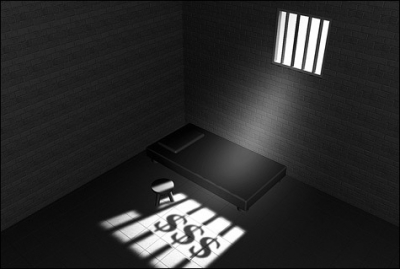
While a broad public consensus has formed around the need to legally integrate migrants into the communities where they live and work, private prison companies Corrections Corporation of America (CCA) and The GEO Group, thrive off laws that criminalize migrants, including mandatory detention and the definition of immigration violations as felonies.
CCA and GEO also know that in the current immigration debate they cannot come straight out and say ‘immigrants should be defined as criminals because it makes us rich’—even though it does. CCA comes pretty close to saying this in its 2010 Annual Report, when it warns that “any changes [in the laws] with respect to drugs and controlled substances or illegal immigration could affect the number of persons arrested, convicted and sentenced, thereby potentially reducing demand for correctional facilities to house them.”
So most of their work is behind the scenes. Their number-one goal: to assure that no matter what else happens, Operation Streamline—their goose of the golden eggs—survives, with more money than ever.
Border enforcement and immigration reform
Operation Streamline began in 2005, and it imprisons men and women for immigration violations, sometimes up to 10 months or more, and it channels more than $1 billion a year in federal funds to private-run detention centers.
Bob Libal, of Grassroots Leadership, which issued a major report on Operation Streamline’s migrant-to-prison pipeline last year, commented on Operation Streamline and related programs, “These are programs where immigrants lose years of their lives and taxpayers lose billions of dollars, but the private prison corporations are counting on these programs to make profits to pay their executives exorbitant salaries and reinvest their money in lobbying efforts.”
He notes that the problem of decoupling immigration reform from enforcement is a political—and economic—one. “There is no legal reason why we can’t fix our immigration system and legalize people who are here without increasing border militarization and criminal penalties.”
It would seem contradictory for a program that rounds up undocumented migrants to be funded alongside comprehensive immigration reform. Yet both President Obama’s plan and the plan put forward by the Gang of 8 senators call to increase Border Patrol enforcement programs.
Enlace, coordinator of the National Private Prison Detention Campaign, has compiled data on private prison industry money to pressure Congress for more enforcement business in any comprehensive immigration reform bill.
Lobbying for Lock Up
Private prison corporations, especially CCA and GEO, have begun a massive effort to assure that even if immigration reform goes through, the practice of locking people up for immigration infractions will continue.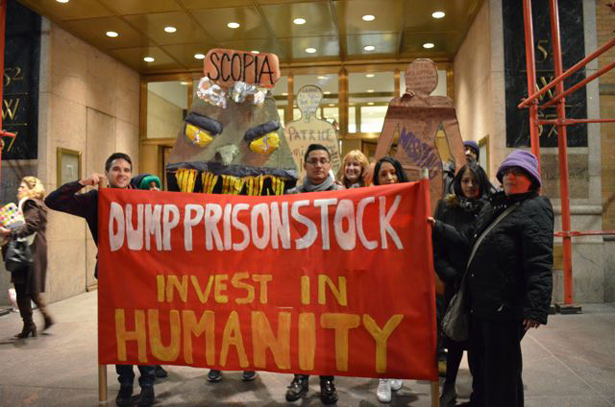
They have the money and the clout to push their agenda on the hill. Working without fanfare, the private prison lobby has targeted key Congressional representatives, especially on the finance, budget and judiciary committees. Using the lever of hefty campaign donations, lobbyists for these companies have been working for years to get Congress members in their pockets by slipping money into theirs.
First, a brief guide to the private prison lobby. Numbers are from their 2012 quarterly lobby disclosure reports filed with the Secretary of the Senate and Clerk of the House. The Center for Responsive Politics has a useful site where much of this information is posted.
Akin Gump Strauss Hauer & Feld, lobbyist for CCA, received $220,000 for its services for CCA in 2012.
Mehlman Vogel Castagnetti Inc., received $280,000 to lobby for CCA in 2012. McBee Strategic Consulting received $320,000 in 2012 from CCA. CCA in-house lobby registered $970,000 in lobbying for 2012.
Navigators Global lobbies for GEO. GEO paid Navigators Global $120,000 for lobbying in 2012. Lionel (Leo) Aguirre was also paid $120,000 for lobbying for GEO.
Among the gang of eight senators, all but Lindsay Graham and John McCain have received significant money from the private prison corporations. The transparency watchdog, Open Secrets, compiled the figures by adding contributions from members, employees, PACs or immediate family members of the organization.
* Chuck Schumer (D-N.Y.): Chair of the Rules Committee, Member of Judiciary and Chair of Subcommittee on Immigration and Border Enforcement. In 2012, Schumer received at least $64,000 from lobbyists Akin Gump et al, and $2,500 from Mehlman Vogel. He also received $34,500 from FMR (Fidelity), which owns 5.09 percent of CCA and 8.67 percent of GEO.
* Marco Rubio (R-Fla.): Member of the Commerce, Science, and Transportation Committee, and Foreign Relations, received $29,300 from the GEO Group. Wells Fargo (also heavily invested in private prisons) gave Rubio $16,150.
* Bob Menendez (D-N.J): Finance Committee, new chair of Foreign Relations, received more than $39,000 in documented money from private prison lobbyists, with $34,916 coming from Akin Gump, $6,300 from Mehlman Vogel Castagnetti Inc. and $1,000 from McBee Strategic Consulting.
* Michael Bennet (D-Colo.): Finance Committee, received at least $30,794 from Akin Gump.
The prison lobby also targeted other key members of Congress. Patty Murray (D-Wash.), chair of the Senate Budget committee and member of Appropriations, received $21,600 from Akin Gump; $74,700 from McBee Strategic Consulting.
Debbie Wasserman Schultz (D-Fla.), who is on the House Budget and Judiciary committees, received money from: Akin, Gump et al ($19,600); and contributions from Mehlman Vogel associates totaling $2,500.
What these lobbyists want for their money is an immigration reform bill that tightens, rather than loosens the criminal net for undocumented workers and their families.
The inhumane and illogical step of pre-deportation detention was invented by the private prison industry. Last year, the Obama administration spent more money on immigration enforcement, including detention, than all other federal law enforcement agencies combined — a staggering $18 billion. The detention centers receive $166 per person, per day in government funds — an amount that would be a godsend to a homeless family or unemployed worker.
Peter Cervantes-Gautschi, director of Enlace, notes, “The private prison industry is swamping the Senate Budget and Appropriations Committees to try to buy them to keep Operation Streamline so they can incarcerate more immigrants in private prisons despite immigration reform.” There is nothing surprising about that, he adds, “That’s their business.”
The national movement made up of local organizations against private detention centers has a simple demand — stop funding private immigrant detention centers. They have blocked construction of new prisons and pressured investment funds and individuals to divest from private prison stock. They have also turned their sights on the politicians that feed federal money into the system.
Maria Rodriguez of the Florida Immigrant Coalition, a member of the divestment campaign, explains that her group is meeting with Florida Congressional representatives to counteract the influence of the private prison lobby.
“In the broadest sense, what we’re trying to do is to show the financial impact on policies and the conversation in the context of immigration reform,” she says.
Are members of Congress being bought off? Rodriguez replies, “I think that when people are being heavily lobbied and when there’s financial interests involved and when our representatives are benefiting from those financial interests directly through lobbying, it compromises their ability to do what’s right for taxpayers and immigrant families.”
Campaign leaders say it’s important for constituents to know the kind of pressure their representatives are under. There’s a lot at stake for the private prison companies. CCA and GEO reported combined revenues of $3 billion dollars in 2011, with nearly half — $1.3 billion — coming directly from federal government, according to 2011 annual reports. They will fight hard for continued incarceration under immigration reform — whether it makes sense policy-wise or not.
The human rights issues involved in locking up migrants for profit, separating families and detaining individuals in poor and humiliating conditions rarely even make it into the debate. Instead, politicians are tempted to curry support among the prison industry and conservatives, with more talk of “enforcement” as the trading chip for citizenship and less talk of human rights.
Meanwhile, citizen groups are hoping that greater transparency and public awareness of the role of private prison corporations will lead to a more lasting and rights-based comprehensive immigration reform, one where for-profit immigrant detention centers become a relic of a crueler past.
This Day in Resistance History: Activists arrested in protest for the Americans with Disabilities Act in 1990
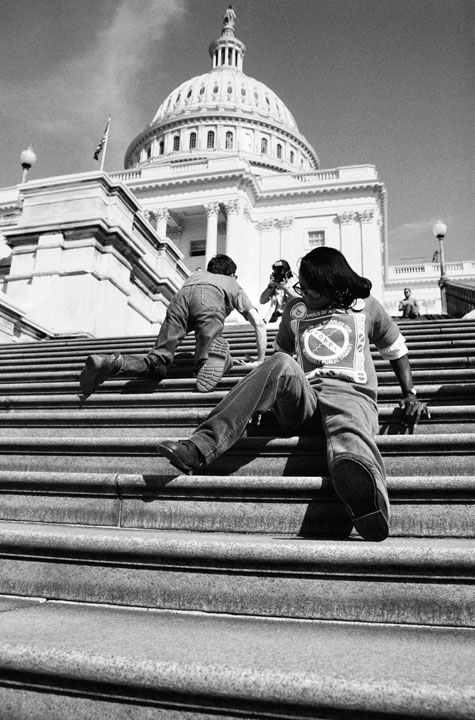
On this day, March 14, 1990, at least 16 activists were arrested in Washington, DC during a protest where people were demanding that the federal government pass the Americans with Disabilities Act.
There were numerous actions during that week in March of 1990 and one of those acts was organized by the group ADAPT. ADAPT is a disabilities rights group that was founded in 1983 and known for using non-violent direct action as a primary tactic for social change.
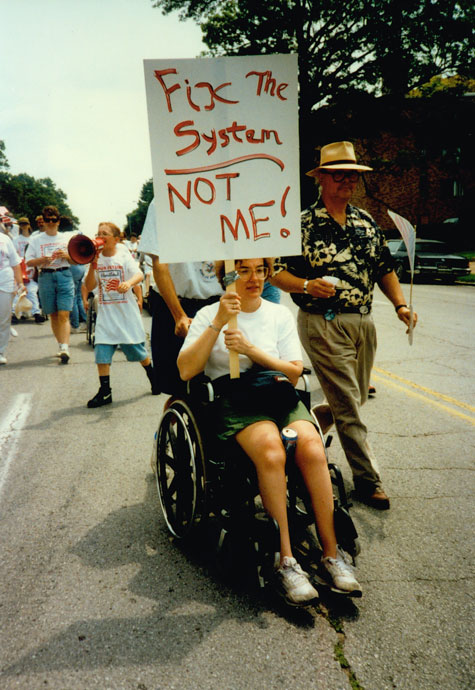
ADAPT organized what they called the DC Capitol Crawl in March of 1990, where people who were in normally in wheelchairs, got out of the wheelchairs and dragged themselves up the steps of the Capitol building in DC. This wasn’t just a symbolic protest against the systematic lack of accessibility in the US for people with disabilities, it was a direct confrontation against the federal government, which also did not make accessibility a priority before they were forced to face the Americans with Disabilities Act.
Other actions involved people chaining themselves to buses, since the public transit system did not make it a priority to have wheelchair lifts, making buses accessible to people with disabilities.
It was because of these kinds of actions that the federal government finally signed into law the Americans with Disabilities Act in July of 1990.
Today, we honor the courageous and committed members of ADAPT and others who fought for more rights and freedom to move about that the ableist world had denied them for too long.
This article by Rebekah Wilce is re-posted from PRWatch.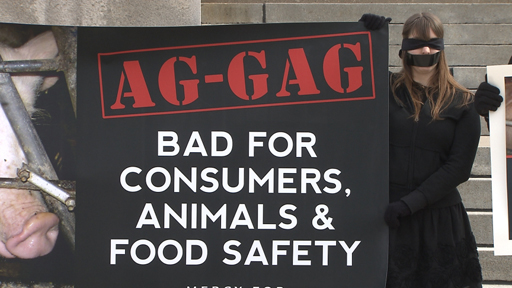
Remember “fecal soup”? A CBS “60 Minutes” exposé in 1987 documented widespread food safety violations by the poultry industry, making use of undercover video from a hidden camera placed by the “60 Minutes” crew. The episode vindicated U.S. Department of Agriculture (USDA) whistleblower Hobart Bartley, who had been ignored and threatened by his superiors and finally transferred to another plant when he warned of unsanitary conditions at a Simmons Industries plant in Missouri. Bartley was particularly irate about the “eight-foot-high vat of water called the ‘chiller,’ where as many as 10,000 chicken carcasses were routinely left to float, soaking up moisture to increase their selling weight. Dried blood, feces, and hair were floating in along with the dead birds. Diane Sawyer later called it ‘fecal soup.'”
In the modern era, effective enforcement of food safety and the humane treatment of animals has long relied on undercover video investigations by reporters and citizens. The footage and images gained can serve as proof of criminal wrongdoing or lay ugly practices bare. Such images can vindicate whistleblowers who otherwise risk retaliation when speaking up. Now this practice, which has time and time again exposed hidden dangers — including downer cows linked to Mad Cow disease in the food supply — is under threat by a series of state bills dubbed “ag gag” bills.
Recent Ag Gag Law in Florida, Followed by 17 Others in Two Years
In 2011, a 21 million egg-a-year Florida producer, Wilton Simpson of Simpson Farms, requested a bill from then-state Florida Senator Jim Norman.
At Simpson’s behest, in February 2011 Norman introduced a bill to the Florida Senate that would make photography “at or of a farm” a first-degree felony. SB1246, the “Farms” bill, and copycat bills in Minnesota and Iowa would later be called “ag gag” bills by the New York Times‘ Mark Bittman.
Simpson and the Florida Farm Bureau wanted to “deter animal-rights activists from obtaining imagery used to harm the industry,” according to The Florida Independent, but the bill as written would have applied to anyone, including journalists. The bill died in committee in 2012.
But while Florida’s bill did not pass, similar “ag gag” bills were introduced in Iowa, Minnesota, and New York in 2011. A modified bill passed in Iowa in March 2012. The bill’s proponents in the Iowa state legislature were heavily funded by corporate agribusiness interests.
2012 saw the introduction of similar bills in six more states. “Ag gag” became law in Utah, and a modified version was signed into law in Missouri. Nine “ag gag” bills have been introduced so far in 2013: in New Hampshire, Wyoming, Nebraska, Indiana, Arkansas, Pennsylvania, Illinois, Tennessee, and New Mexico. (See the Center for Media and Democracy’s article on SourceWatch for more.)
New Tactic Devised to Make Bills Legal
In its original form, the “ag gag” bill was a blatant violation of the First Amendment right to freedom of speech and expression and would have quashed the right of independent investigators to document the truth. So legislators in Iowa and Utah changed the bills to make lying on employment applications a crime. Now factory farms and slaughterhouses can screen out reporters and other investigators by asking on job applications, “Are you affiliated with a news organization, labor union, or animal protection group?”
A former Humane Society investigator, Cody Carlson, wrote in The Atlantic, “Two years ago, I had to answer a similar question when I applied to work at the nation’s second biggest egg producer, located in Thompson, Iowa. If the Ag Gag law had been in effect then, I might be writing this article from a cell.” The same would have been true for a New York Times or Chicago Tribune investigative reporter.
Instead, Carlson was able to work undercover at four Iowa egg farms in the winter of 2010 and expose abuses such as manure pits not cleaned or maintained in multiple years, and laying hens with unnoticed and untreated prolapsed uteruses.
Carlson wrote, “A few months later, Iowa’s egg farms were in the news again when nearly identical conditions were found at several other locations, this time by the Food and Drug Administration (FDA). The farms were at the center of a massive salmonella outbreak that caused the biggest egg recall in United States history.”
March of Bills Have Roots in ALEC
The ideological ancestor of these bills is a 2002 “model” bill called the “Animal and Ecological Terrorism Act” (AETA) pushed by the American Legislative Exchange Council (ALEC), the corporate bill mill responsible for spreading 2011’s spate of “voter ID” laws and the NRA-drafted “Stand your Ground” law, as Green is the New Red author Will Potter points out.
AETA broadly prohibits various kinds of “obstruction” of “an animal or natural resource activity,” including by damage or destruction, trespassing, as well as “entering an animal or research facility to take pictures by photograph, video camera, or other means with the intent to commit criminal activities or defame the facility or its owner.”
The newer “ag gag” bills focus more exclusively on “prohibiting a person from entering onto a farm or photographing or video recording a farm without the owner’s written consent” (from Florida’s 2011 bill).
ALEC approved AETA and started pushing it both in the states and at the federal level in January 2004, with its publication of the propaganda pamphlet “Animal & Ecological Terrorism in America.” According to a text comparison performed by the Center for Media and Democracy (CMD), the ALEC bill appears to be based on a 1990 Kansas bill called the “Farm Animal and Field Crop and Research Facilities Protection Act.”
After ALEC started pushing the bill, it was introduced in Tennessee in 2006, but died in committee; a limited version was passed in California in 2008; and a nearly identical bill was introduced in Washington State in 2010 (see CMD’s text comparison here), but died in committee.
As the New York Times‘ Mark Bittman commented in the first wave of bill introductions two years ago, “The biggest problem of all is that we’ve created a system in which standard factory-farming practices are inhumane, and the kinds of abuses documented [by the investigations criminalized by the bills] are really just reminders of that.”
The path between Washington’s 2010 bill and Florida’s 2011 bill is not clear, but it is clear that the intended result is the same. “Ag gag” bills seek to prevent the documentation and exposure of safety violations and atrocities in animal industries by criminalizing them and labeling them “obstruction.” In other words, turn off the tape and bury the evidence rather than reforming the system.
National Call-In Day on Comprehensive Immigration Reform

There are several West Michigan groups participating in the National Call-In Days for Immigration Reform.
Groups like the West Michigan Immigration Coalition, the Micah Center and AIR-MOP are all encouraging people to call their Senators no later that Thursday afternoon and ask them to support Comprehensive Immigration Reform.
The Call-In is part of a larger campaign to pressure Congress to support Comprehensive Immigration Reform, which also include delegations to meet with members of Congress and the March on Washington that is being planned for April 10.
This video is re-posted from ZNet.
In this video interview Noam Chomsky talks to TJ Armand about the mixed legacy of Hugo Chavez, freedom of speech violations in Turkey and religious fundamentalism in the US.
Chomsky also addresses questions around the Tea Party, Civil Liberties under the Obama administration and the issue of gay marriage in the U.S. On the matter of gay marriage in the US, Chomsky says that it’s not a class issue and that those in the corporate world could care less about it, since it doesn’t challenge power.
Students plan on Demanding that GVSU Make Adidas Pay $1.8 Million to Indonesian Workers
Last month we reported that a new chapter of United Students Against Sweatshops (USAS) had formed at GVSU.
In February, GVSU students hosted 2 speakers from Indonesia who were on tour with USAS, talking about the campaign against footwear giant Adidas.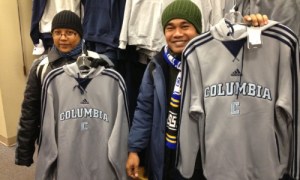
On Tuesday, March 19, students from United Students Against Sweatshops at Grand Valley State University, will be meeting with the vice president to demand the school take action against Adidas, who has refused to pay their Indonesian factory workers $1.8 million they are legally owed for making college-logo apparel. They will join students at more than 30 universities throughout the U.S. in a national day of action to demand that universities hold brands like Adidas responsible for worsening sweatshop abuse.
According to the GVSU United Students Against Sweatshops:
2,800 workers from the now-shuttered PT Kizone factory sewed Adidas products for $0.60 an hour, and were intially left without their US$3.3 million in legally-owed severance pay when the factory closed in April 2011. While other buyers have paid a portion of the severance, Adidas is the only major buyer that has refused to contribute a single penny. As a result former workers have had to withdraw their children from school and are barely able to afford two meals a day for their families.
In Sept 2012, Cornell University announced its decision to terminate its eight-year contract with Adidas effective October 1st, becoming the first U.S. University in history to terminate an agreement with the apparel giant over labor rights abuses. Oberlin College recently followed suit and became the second school to sever ties with the company.
“Part of our schools mission statement is “Grand Valley State University educates students to shape their lives, their professions, and their societies” we now have the chance to shape our society by showing Adidas we will not stand for oppression of fellow human beings. Grand Valley has the chance to show the rest of the world that we are a leader in social responsibility,” said Lindsey Disler, one of the GVSU USAS organizers.
In addition to the unresolved violations at PT Kizone, USAS student leaders have received reports from Central American and Caribbean workers about deteriorating conditions at Adidas supplier factories, including stories of anti-union threats at several factories owned by Gildan Activewear, which recently became Adidas’ largest supplier in the Western Hemisphere. Adidas’ behavior at PT Kizone is part of a much larger pattern of abusing workers rights. Students across the country are ready to take action when new Adidas violations come to light.
The GVSU chapter of USAS welcomes people from the community to join them next Tuesday for the action in support of labor rights around the world.
I Think I’m Emma Goldman

This video by subMedia is re-posted from dissident voice.
I have not rocked out a mash-up in quite some time, and I forget how much I enjoy it. This one is for a new track by anarcho-rapper MC SOLE with beats by DJ Pain 1 in an homage to the legendary american anarcho-feminist Emma Goldman.
Nationally renown activist, LaDonna Redmond, to lead OKT’s April 27 Convening on food justice
 LaDonna Redmond is at the forefront of the food justice movement. She currently leads an Institute for Agriculture and Trade Policy (IATP) project that focuses on health, justice and the food system. The project centers on health disparities resulting from the food system, from the farm to consumers—particularly as they affect low‐income populations and communities of color. It also entails creating universal Food Justice Principles. Our Kitchen Table, managers of the Southeast Area Farmers’ Market, attended IATP’s Food + Justice =Democracy conference September 2012 and took part in the co‐creation of these food justice principles.
As a next step, local collective gatherings across the nation are reviewing the draft principles.Redmond will lead part 4 of the Grand Rapids area Convening, hosted by OKT, 9 a.m. to 1 p.m. Saturday April 27 at Madison Square Church, 1441 Madison SE.
A speaker, radio host and former Food and Society Policy Fellow, Redmond was one of 25 citizen and business leaders named a Responsibility Pioneer by Time Magazine. She successfully worked to get Chicago Public Schools to evaluate junk food, launched urban agriculture projects, started a community grocery store and worked on federal farm policy to expand access to healthy food in low‐income communities.
“We have a food system that has largely been built on the backs of people who don’t have a lot of rights and access to our public policy infrastructure,” said Redmond. “We need to collectively better understand the inequities in the food system and make sure we include people who have faced these inequities in finding solutions.”
Here is a video of Redmond presenting at TEDxTC
This article by Steve Horn is re-posted from CounterPunch.
On March 1, the U.S. State Department published its long-awaited Environmental Impact Statement (EIS) on the TransCanada Keystone XL (KXL) tar sands pipeline.
The KXL is slated to bring tar sands crude – also known as diluted bitumen or “dilbit” – from Alberta, Canada to Port Arthur, TX. From Port Arthur, it will be refined andexported to the global market.
Flying in the face of the slew of scientific studies both on the harms of burning tar sands andon the KXL itself, State determined that laying down the pipeline is environmentally sound.
Unmentioned by State: the study was contracted out to firms with tar sands extraction clientele, as revealed by InsideClimate News.
“EnSys Energy has worked with ExxonMobil, BP and Koch Industries, which own oil sands production facilities and refineries in the Midwest that process heavy Canadian crude oil. Imperial Oil, one of Canada’s largest oil sands producers, is a subsidiary of Exxon,” InsideClimate News explained. “ICF International works with pipeline and oil companies but doesn’t list specific clients on its website.”
Writing for Grist, Brad Johnson also revealed the name of a third contractor – Environmental Resources Management (ERM) Group – which TransCanada hired on behalf of the State Department to do the EIS.
“(ERM) was paid an undisclosed amount under contract to TransCanada to write the statement, which is now an official government document,” Johnson explained. “The statement estimates, and then dismisses, the pipeline’s massive carbon footprint and other environmental impacts, because, it asserts, the mining and burning of the tar sands is unstoppable.”
ERM, a probe into the University of California-San Francisco (UCSF) Tobacco Archives reveals, has deep historical ties to Big Tobacco. Further, a key employee at ICF International – via familial ties – is tied to the future of whether hydraulic fracturing (“fracking”) for shale oil and gas becomes a reality in New York’s portion of the Marcellus Shale.
TransCanada Utilizes Tobacco Playbook in Hiring ERM Group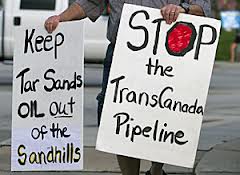
ERM Group – headquarted in the City of London – a square mile sub-section of Londoninfamous for its role in serving as a tax shelter for multinational corporations – has aided the tobacco industry in pushing the “Tobacco Playbook.”
Many fossil fuel industry public relations flacks learned the tactics of mass manipulation by reading the “tobacco playbook,” meticulously documented in Naomi Oreskes’ and Erik Conway’s classic book, “Merchants of Doubt.”
“Doubt is our product,” a tobacco industry document once laid out the playbook, “since it is the best means of competing with the ‘body of fact’ that exists in the minds of the general public. It is also the means of establishing a controversy.”
ERM has done studies on behalf of both R.J. Reynolds and Philip Morris, penning a report titled “Fundamentals of Environmental Management” for the latter.
It was also a former member of the American Tort Reform Association, a group that fights to limit the tort law rights of citizens to sue for damages inflicted upon them by corporations and featured in the documentary film, “Hot Coffee.”
ERM: In-Service to Big Oil, like Big Tobacco
In the 2000 version of its website, ERM referred to climate change advocates as having an “agenda.”
“[T]he gloabl (sic) climate change agenda has very specific implications for the oil and gas industry, and factoring CO2 emissions into operations is a key concern,” read ERM’s website at the time.
The firm has also boasted of doing its studies in service to the oil and gas industry’s bottom lines.
“ERM works around the world with the private sector assessing how their business is likely to be impacted by environmental and social issues, new regulations, consumer concerns, and supply chain issues and help companies develop appropriate policies and management systems to manage these business risks,” its website proclaimed in 2000.
This all sits, of course, in juxtaposition to the needs of the decaying ecosystem andincreasingly severe and horrifying climate crisis.
The ICF/New York Fracking Decision Connection
ICF Consulting is a thread tying the forthcoming fracking decision in New York by Democratic Party Gov. Andrew Cuomo to the Obama State Department decision on the Keystone XL.
Though ICF doesn’t list its clients on its website, its vice president Karl Hausker is the husband of Kathleen (“Katie”) McGinty, one of the members of the New York Department of Environmental Conservation (DEC) Hydraulic Fracturing Advisory Panel.
McGinty formerly served as Vice President Al Gore’s top climate aide under the Clinton Administration, segueing from that position into one as chair of the Clinton Council on Environmental Quality from 1993-1998. From 2003-2008, she served as head of the Pennsylvania Department of Environmental Protection under Democratic Gov. Ed Rendell, helping usher in the state’s ongoing fracking boom.
Named as a member of the industry-stacked Obama DOE fracking subcommittee in May 2011, McGinty now works as an Operating Partner alongside Rendell at Element Partners, a Philadelphia, PA-based firm that has capital investments in several firms operating in Pennsylvania’s portion of the Marcellus Shale. McGinty also serves on the Board of Directors of NRG Energy, an electricity-generating utilities corporation that owns natural gas-fired power plants around the U.S.
Tying it all together, Ernest Moniz is leaving his position on ICF’s Board and his professorship at Massachusetts Institute of Technology (MIT), where he was a major “frackademic,” to serve as head of the Obama DOE.
In chess, moves of this sort are known as “check” and “checkmate.”
The weeks and months ahead will demonstrate if the chess match is over with regards to the destiny of the Keystone XL pipeline and fracking in the Empire State.
Wealth Inequality in America
This video info-graphic is reposted from Portside.org.
This video presents a series of infographics on the distribution of wealth in America, highlighting both the inequality and the difference between our perception of inequality and the actual numbers. The reality is often not what we think it is.
While the information and graphics are very useful in visualizing the current wealth inequality in the US, some of the comments about redistribution are limiting. For instance, the video sort of dismisses the possibility of anything other than Capitalism, which is the reason why there is such inequality in America to begin with. The narrator points on the gap between CEO income and the average workers, and rightly criticizes it. However, such a disparity will not change until people organize at the workplace or start a revolution.

