Martin Luther King Jr and the State of the Dream 2013
“A nation that continues year after year to spend more money on military defense than on programs of social uplift is approaching spiritual death.”
Dr. Martin Luther King Jr. – Beyond Vietnam Speech

In his speech, Beyond Vietnam, Dr. King identified three aspects of American society that he named the Evil Triplets…………Racism, Militarism and Consumerism.
King identified these three themes as the major forms of institutionalized violence and oppression of his generation. Such an analysis by Dr. King reflected a maturation from the person who participated in the Montgomery Bus Boycotts and gave the “I Have a Dream Speech” in 1963.
For King, racial equality was no longer just about the right to vote, to use the same bathroom as Whites or to sit at the same lunch counter. King had moved beyond desegregation to racial justice, but he also understood that racial justice was not possible without economic justice. As King would say, “What good is it for us to sit at the lunch counter, if I can’t afford to buy the hamburger.”
In his Beyond Vietnam speech, King then sees the connection of racial and economic justice as tied to the demand for peace and an end to militarism. King called out the US government’s military spending in Vietnam and made it clear that this was a gross injustice, especially when so many communities of color were living in abject poverty.
The Evil Triplets in 2013
If we are serious about honoring the message and legacy of Dr. Martin Luther King Jr., then we cannot be content with just seeing more Black and Brown faces in positions of power. King made it clear at the end of his life that we have to change the systems of oppression.
In his Beyond Vietnam speech he states:
A true revolution of values will soon cause us to question the fairness and justice of many of our past and present policies. On the one hand, we are called to play the Good Samaritan on life’s roadside, but that will be only an initial act. One day we must come to see that the whole Jericho Road must be transformed so that men and women will not be constantly beaten and robbed as they make their journey on life’s highway. True compassion is more than flinging a coin to a beggar. It comes to see that an edifice, which produces beggars, needs restructuring.
If MLK were alive today, what might he say about the condition of this country, particularly as it related to the Evil Triplets?
Over the last decade, the organization United for a Fair Economy has been publishing an annual report called the State of the Dream. The title for the 2013 edition of the State of the Dream is, A Long Way Home: Housing, Asset Policy and the Racial Wealth Divide.
The report is highly critical of where we are as a nation today, particularly along the divide of race and class. Here is a summary of findings from the report:
- The average, or mean, net worth of White families is more than six times higher than the average net worth of Black families, and 5.7 times greater than the average net worth of Latino families.
- Black and Latino families faced a shocking loss of wealth during the Great Recession. Between 2007 and 2010, the average net wealth of White families decreased by 6.7 percent. By comparison, Black families lost 27.1% of their average net wealth and Latino families lost 41.3 percent.
- Black and Latino families came out of the Great Recession much more highly leveraged (holding more debt relative to their net assets) than White families. White families on average have a debt burden equal to just 17% of their net worth, while Black and Latino families owe 53% and 58%, respectively.
Such economic disparities are a reflection of the institutionalized racism that exits in America. These economic indicators, however, are not just because of institutionalized racism, but also include the other two evil triplets – consumerism and militarism.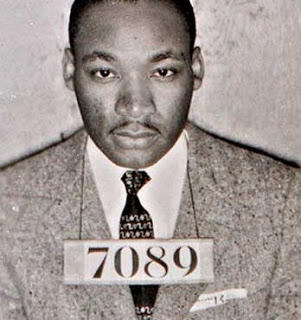
When King used the term consumerism in his Beyond Vietnam speech, he was really calling out our economic system, which he condemned as giving more worth to things than people. In other speeches, King mad it clear that he had a strong contempt for Capitalism.
We are now making demands that will cost the nation something. You can’t talk about solving the economic problem of the Negro without talking about billions of dollars. You can’t talk about ending slums without first saying profit must be taken out of slums. You’re really tampering and getting on dangerous ground because you are messing with folk then. You are messing with the captains of industry….Now this means that we are treading in difficult waters, because it really means that we are saying that something is wrong…with capitalism…there must be a better distribution of wealth and maybe America must move toward a Democratic Socialism.
In addition to the economic system, King named militarism as the other evil triplet. Again, in his Beyond Vietnam speech, “I knew that America would never invest the necessary funds or energies in rehabilitation of its poor so long as adventures like Vietnam continued to draw men and skills and money like some demonic destructive suction tube.”
The funding that could alleviate poverty is spent on war and militarism by the US even more so today. The cost of the US wars in Iraq and Afghanistan are roughly $1.5 Trillion, according to the National Priorities Project. Add to that the cost of recent wars in Libya, Yemen, Syria, the campaign against Iran, the thousands of US military bases abroad and the military weaponry this country provides around the world. All of this is an astounding amount of wealth that is taken from the poor and the oppressed.
The cost of the Evil Triplets is overwhelming.
If we applied King’s analysis to Kent County alone, it would be clear that institutionalized racism and economic oppression are apparent in this community as well.
The rates of poverty are higher in Black and Latino communities, income rates are lower, unemployment and underemployment are higher, funding for education is less and the number of Blacks and Latinos in the Prison Industrial Complex in Kent County is a higher percentage than the populations for both of those groups in this county.
My question to you is, if the speakers at the varying MLK events don’t address these aspects of King’s message (and they likely won’t), will you?
“A time has come when silence is betrayal.” Dr. King
Don’t You Dare Conflate MLK and Obama
This article by Glen Ford is re-posted from Black Agenda Report.
Back in 1964, under prodding from a BBC interviewer, Dr. Martin Luther King Jr. predicted that a Black person might be elected president “in 25 years or less.” Four years later, shortly before his assassination, King confided to actor/activist Harry Belafonte that he had “come to believe we’re integrating into a burning house.” We now see that the two notions are not at all contradictory. At least some African Americans have achieved deep penetration of the very pinnacles of white power structures – integrating the White House, itself – while conditions of life for masses of Black folks deteriorate and the society as a whole falls into deep decay.
The fires lit by the “giant triplets of racism, extreme materialism, and militarism” that Dr. King identified in his 1967 “Beyond Vietnam: Breaking the Silence” speech are consuming the world, now stoked by a Black arsonist-in-chief. Domestic poverty hovers only a fraction of a percentage below the levels of 1965, with “extreme poverty” the highest on record. Black household wealth has collapsed to one-twentieth that of whites. Today, more Black men are under the control of the criminal justice system than were slaves in the decade before the Civil War, according to Michelle Alexander, author of The New Jim Crow.
The intervening years have shown that Dr. King’s 1960s visions were not in conflict: the rooms at the top floors of the national house may have been integrated, but the building still burns.
The deepening crisis of capitalism, the triumph of Wall Street finance over industrial capital, the increasing imperial reversion to international lawlessness in a desperate bid to maintain global supremacy – all this was predictable under the laws of political economy. Had the assassin’s bullet not found him, Dr. King would have continued his implacable resistance to these unfolding evils, rejecting Barack Obama’s invasions, drones and Kill Lists with the same moral fervor and political courage that he broke with Lyndon Johnson over the Vietnam War. Absolutely nothing in King’s life and work indicates otherwise.
One school of thought holds that corporate servants like Obama could not have taken root in Black America if Dr. King, Malcolm X and a whole cadre of slain and imprisoned leaders of the Sixties had not been replaced by opportunistic representatives of a grasping Black acquisitive class. In any event, had King survived, his break with Obama would have come early. Surely, the Dr. King who, in his 1967 “Where Do We Go from Here” speech called for a guaranteed annual income would never have abided Obama’s targeting of Social Security, Medicare and Medicaid in the weeks before his 2009 inauguration. Forty-five years ago, King’s position was clear: “Our emphasis must be twofold: We must create full employment, or we must create incomes.” The very notion of a grand austerity bargain with the Right would have been anathema to MLK.
Were Martin alive, he would skewer the putative leftists and their “lesser evil” rationales for backing the corporatist, warmongering Obama. As both a theologian and a “revolutionary democrat,” as Temple University’s Prof. Anthony Monteiro has described him, MLK had no problem calling evil by its name – and in explicate triplicate. His militant approach to non-violent direct action required him to confront the underlying contradictions of society through the methodical application of creative tension. He would make Wall Street scream, and attempt to render the nation ungovernable under the dictatorship of the Lords of Capital. And he would deliver a withering condemnation of the base corruption and self-serving that saturates the Black Misleadership Class.
He would spend his birthday preparing a massive, disruptive action at the Inauguration.
Making Green A Threat Again
This article by Scott Parkin is re-posted from CounterPunch.
“The climate movement needs to have one hell of a comeback.” –Naomi Klein
The energy was there. It was an overcast spring morning in April 2011 in the nation’s capita1. Thousands had shown up to take action on climate change. The earlier march led us to the Chamber of Commerce, BP’s Washington D.C. offices, the American Petroleum Institute and other office buildings associated with oil spills, coal mining, carbon emissions and more. We heard speakers. We saw street theater. It was all very tame and managed. It lacked confrontation.
It was almost a year to the day after the Gulf oil spill, yet offshore drilling continued as usual with little consequence for oil giant British Petroleum. Out west, the Obama administration had just opened up thousands of acres for coal mining in the Powder River Basin. Appalachia’s mountains were still under attack by the coal industry. Natural gas extraction, also known as “fracking,” was spreading like an epidemic through the countryside.
Over 15,000 youth, students and climate activists had gathered at Powershift for weekend of education, networking and keynote speakers. There were keynote speeches by Al Gore and Bill McKibben, yet little was offered in the way of taking action against Big Oil and Big Coal. We are faced with the greatest crisis in the history of the world, so we were told, yet the Beltway green groups had only produced failure in Copenhagen and Washington.
Globally, we had watched the Arab Spring throw out dictators; anti-austerity movements in Iceland and Greece rise up against corrupted regimes and massive protests in the Wisconsin state house fighting for labor rights. We were only a few months away from Occupy Wall Street.
Needless to say, the North American climate movements wanted in on the action.
As the morning march ended that day at Lafayette Park, the unofficial march, spearheaded by Rising Tide North America, formed and headed into the streets of Washington D.C. Tim DeChristopher of Salt Lake City, who had become something of a folk hero to climate activists after derailing a federal land auction and protecting thousands of acres of southern Utah wilderness, announced on the microphone that it was time for more drastic action. Anyone that wanted to take that step should join the Rising Tide march that was heading down 17th St NW to the Dept. of Interior.
The crowd quickly swelled to over a thousand, both singing “We Shall Overcome” and chanting “Keep It in the Ground” and “Our Climate is Under Attack, What’ll We Do? Act Up, Fight Back!”
As we approached the Dept. of Interior, the small group of twenty that had been pre-organized to occupy the lobby began to more towards the doors. Then to much our surprise and shock, a crowd of over 300 stormed in after them and joined the sit-in. As they sat in, they chanted “We’ve got power! We’ve got power!” It was scary. It was exhilarating. It was powerful.
Direct action is supposed to push a person’s comfort zone, but even veteran direct action organizers felt their comfort zones pushed when many in the march joined the occupation.
In the end, 21 were arrested as part of the sit-in. The Dept. of Interior action began a shift for the youth and grassroots activists with the North American climate movements. Soon, they would become a force to be reckoned with.
Corporations and Politicians Stall, Nature Doesn’t
The clock is ticking and the science is not just a theory, its science. Yet, corporate and political decision-makers continue to ignore these warnings for short term profit.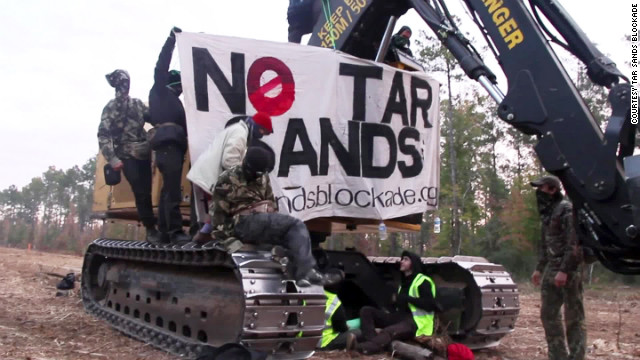
A new scientific report put out by the United Nations on the second day of the 18th Conference of the Parties to the UNFCCC (COP18) in Doha this week reports that thawing of the Arctic permafrost will “significantly amplify global warming.” Permafrost emission spurred by rising global temperature will contribute up to 39% of global emissions. On the third day of COP18 negotiations, the World Meteorological Organization warned the delegates that the Arctic ice melt had reached an alarming rate and that “far-reaching changes” would from climate change would impact the Earth.
Despite these dire warnings from the scientific community, wealthy industrialized nations continue to stall any sort of climate progress in Doha. The top topic at COP18 has been an extension of the Kyoto Protocol –up for renewal this year—to 2020. The Associated Press reports, a number of wealthy nations including Japan, Russia and Canada have joined the ranks of the U.S. and “refused to endorse the extension.” The U.S. has never endorsed Kyoto and continues to block any progress on agreements to reduce global emissions or pass legislation to regulate its own emissions.
Not surprisingly, the fossil fuel holds a chokehold on the American political system. In 2012, oil and gas industries combined with Big Coal to spend over $150 million elections to both parties.
U.S. deputy climate envoy Jonathan Pershing told the media in Doha that the Obama administration plans to stick to its 2009 goal of reducing emissions by 17% by 2020. Pershing went on to say that U.S. efforts to curb emissions are “enormous.”
Yet, Obama recently signed into law a bipartisan bill to shield the U.S. airline industry from a European Union carbon tax. Furthermore, Obama’s top candidate to replace Hillary Clinton at the State Dept., UN Ambassador Susan Rice, has been revealed to be a major investor in companies developing Canadian tar sands and building the Keystone XL pipeline.
While the politicians in Doha and Washington stall, Mother Nature has thoughts of her own. Global warming is no longer an abstract notion. Rising temperatures and extreme weather are spreading at unprecedented levels. 11 of the past 12 years are among the hottest since 1850. This summer in Colorado, wildfires brought on by scorching heat, high winds and drought conditions killed four people, displaced thousands and destroyed hundreds of homes.
In late Oct., Hurricane Sandy battered the Atlantic seaboard from the Caribbean to New England. It took over 100 lives and cost tens of billions of dollars in damage. Millions were displaced while politicians scrambled for photo ops and New York Mayor Michael Bloomberg’s finance network declared “It’s Global Warming, Stupid.”
Harnessing Rebel Energy
Presented with these stark facts, it begs the question: Why haven’t governments and corporations been forced to act on climate change?
To begin with, the mainstream strategy, which controls large portions of resources to fight climate change, is too rooted in working within the existing political and economic system. In 2009, the environmental establishment comprised of small grouping of donors and environmental non-profits primarily based in Washington D.C. (aka the Beltway Greens) placed its faith in the Obama administration. They hoped that his ability to regulate emissions through the Environmental Protection Agency, combined with lobbing Congress to pass meaningful climate legislation in 2010 and pressuring world governments to secure a unilateral agreement on climate at the 15th Conference of the Parties to the UNFCCC (COP15) in Copenhagen would turn the tide on global emissions. These strategies are fraught with compromise on a global crisis that pays no heed to politics as usual.
Second, the environmental establishment was completely unprepared for the power that Corporate America, particularly Big Oil and Big Coal, wielded in Washington D.C. In 2009, oil and gas companies spent $121 million to dispatch 745 lobbyists to Congress in 2009 to influence the climate bill. Before the 2010 election, Big Oil put $19,588,091 into the U.S. election cycle. Big Coal put in $10,423,347. The Beltway Greens were outgunned, outspent and outmatched.
Finally, turning the tide on the most powerful industry in history requires more than lobbyists and policy people. It requires rebel energy fueling people power and non-violent direct action. In the 1970’s when activists were doing battle to end the war in Vietnam and stop the proliferation of nuclear power, author and activist George Lakey wrote in the pamphlet “The Sword that Heals:”
“You can’t pull off powerful nonviolent direct action without rebel energy. You’ve run this campaign as a conventional lobbying operation and you can’t — at the last minute — switch gears and become a nonviolent protest movement!”
Political parties and non-profits did not drive the uprisings in Egypt, Tunisia or Iceland; it was People Power that had been organized for decades. In Egypt, the established opposition groups only joined in after the masses took over the streets in Cairo, Alexandria and Suez calling for President Hosni Mubarak’s ouster. In North America, Corporate America, the political establishment and the media has convinced us that national politicians and well paid non-profit staff are the change agents we’ve been waiting for. Thus far, they’ve only delivered epic failures in Copenhagen and Washington D.C. We mustn’t let the priorities of big well-resourced institutions trump planetary or community survival.
The momentum to stop climate change is going to come from the rebel energy that challenges not only the established order, but the established opposition as well.
Know Your History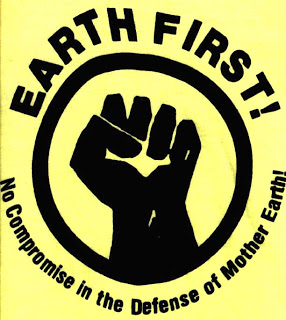
As daunting as it sounds, climate rebels wouldn’t be re-inventing the environmental movement’s wheel in building a grassroots mass climate movement. Far from it, in fact, greens have threatened corporate power with non-violent direct action and people power for decades.
During the 1970’s and early 1980’s, emerging from the anti-war and burgeoning environmental movement, the anti-nuclear, or “No Nukes,” movement rose up to challenge the Nixon administration’s plant to build 100 new nuclear power plants by the year 2000. In 1976 and 1977, thousands with the Clamshell Alliance used non-violent direct action to occupy the site of a proposed nuclear plant in Seabook, NH. Similar mass actions followed Seabrook. The Three Mile Island disaster was a watershed event that by the early 1980’s put millions into the streets against U.S. nuclear power. While Seabrook and few other plants were built, the vast majority of plants proposed remain halted.
Similarly, in the early 1980’s, a group of disgruntled redneck tree-huggers fed up with constant compromise on wilderness protection in western states by the Beltway Greens formed the radical ecological movement known as “Earth First!” Their politics of “No Compromise in Defense of Mother Earth” manifested into the direct action tactics of road blockades and tree-sits that strengthened and emboldened the environmental movement. Their campaigns and tactics targeted corporate logging and development companies, but also created much needed political space for grassroots activists on environmental issues
Former Sierra Club director and Friends of the Earth founder David Brower remarked “I thank God for the arrival of Earth First!, they make me look moderate.”
A third movement that challenged corporate power for the betterment of the environment was the global justice movement. This grassroots street wing of anti-austerity, human rights and environmental movements emerged from the World Trade Organization (WTO) protests in Seattle in 1999. Rooted in direct action, direct democracy and anti-capitalism of movements both in the U.S. and abroad, the global justice movement undermined global trade talks set to privatize labor, environmental and human rights protections across the globe.
In the laboratory of resistance we call “social change,” the “No Nukes” movement, Earth First! and the global justice movement all had at least one strategy that set them apart from the establishment: they did their most important work out of Washington D.C. The anti-nuclear movement didn’t organize their massive rallies in Washington until they had built power on the highways and byways of the country. Likewise Earth First! and the organizers coming out of the WTO protests rejected Beltway politics as usual to build and embolden their own anti-establishment movements.
Hope & Climate Change
Fortunately, the rebel energy is alive and well in today’s climate movement. Outside of Washington D.C., grassroots activists, direct action organizers, smaller environmental, faith-based and student groups, rank and file Sierra Club members and environmental and climate justice groups have mobilized a very different climate movement from the air conditioned offices of the Beltway Greens.
Climate activists, the youth climate movement in particular, are fed up and hungry to make some real change and take real action. Just this summer, numerous actions from a mass civil disobedience in West Virginia at the Hobet Mine to a week of civil disobediences opposing the western coal exports in the Montana state capitol to community-led direct actions against fracking in New York, Ohio and Pennsylvania have created space for groups to make meaningful progress both on their issues and internally within the movement. While this work has been complimentary and cumulative, it’s not always necessarily collaborative, nor should it be.
The fight over tar sands development and the Keystone XL pipeline has galvanized climate activists of all ages. Over the past year, we have witnessed people from the Lakota nation in South Dakota and from Moscow, Idaho putting their bodies in roads and highways blocking large transport trucks carrying oil refining equipment to develop further tar sands extraction.
In Texas a young marine veteran named Ben Kessler returned from the war in Afghanistan to witness oil and gas companies ravaging North and East Texas with fracking and the southern leg of the Keystone XL pipeline. He got involved in environmental and climate organizing, and with friends, formed a student environmental group at the University of North Texas. In April 2011, some of them attended Powershift in Washington D.C. At the Dept. of Interior, Kessler took his first civil disobedience arrest. But more importantly the group went back to Denton, TX and transformed their group into an anchor for a grassroots direct action campaign called the Tar Sands Blockade. The Tar Sands Blockade joined with Texas landowners to form the Tar Sands Blockade which has organized dozens of actions and a two month old tree blockade to stop the construction of the southern leg of the Keystone XL pipeline.
People are hungry for climate action that does more than asks you to send emails to your climate denying congressperson or update your Facebook status with some clever message about fossil fuels. Now, a new anti-establishment movement has broken with Washington’s embedded elites and has energized a new generation to stand in front of the bulldozers and coal trucks and, in the words of Naomi Klein to make “one hell of a comeback.”
Since November there has been stepped up efforts to get the State of Michigan to allow immigrant youth to obtain a drivers license.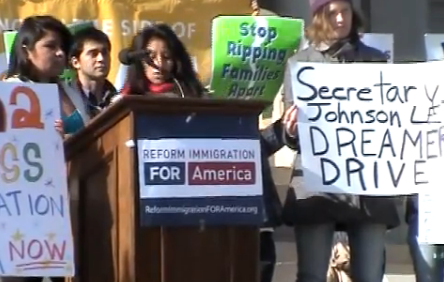
In November there was a rally to expose the reactionary position of Secretary of State Ruth Johnson. Since then there has been efforts to get local municipalities to pressure Gov. Snyder to overturn Johnson’s decision.
On Friday, the Michigan chapter of Americans for Immigration Reform (AIR) sent out a Press Release, that in part read:
“Today, the office of U.S. Citizenship and Immigration Services (USCIS) issued new guidelines that dismantle Secretary of State Ruth Johnson’s justification for denying driver’s licenses to students legalized under the President’s Deferred Action program.
Michigan is one of only three states, including Arizona, that currently are attempting to deny these newly legalized young people the right to drive.”
In the AIR Press Release was included the USCIS position on this issues, which states:
Although deferred action does not confer a lawful immigration status, your period of stay is authorized by the Department of Homeland Security while your deferred action is in effect and, for admissibility purposes, you are considered to be lawfully present in the United States during that time.
Deferred action for childhood arrivals is one form of deferred action. The relief an individual receives pursuant to the deferred action for childhood arrivals process is identical for immigration purposes to the relief obtained by any person who receives deferred action as an act of prosecutorial discretion.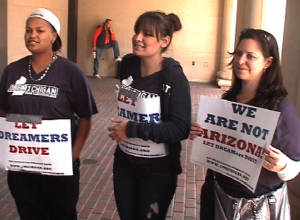
Elected leaders from across Michigan requested the guidance from USCIS in December after Johnson refused to issue the licenses to beneficiaries of the new program. The leaders, including State Rep. Rashida Tlaib, pointed out that Johnson’s office was already issuing licenses to other immigrants with deferred action, and that the Secretary’s discrimination against immigrant youth may have been illegal.
West Michigan immigrant rights activists are calling for people to contact Michigan Secretary of State Ruth Johnson, confirming that young people of DACA are legally in the country we want to demand an immediate response to the statement.
Action Alert
E-mail from Ruth Johnson is RJ4MI@comcast.net.
Online messages to the Michigan Secretary of State can be sent at http://www.michigan.gov/sos/0,4670,7-127-15049-25634–,00.html
And Ruth Johnson will also receive message via her Facebook page https://www.facebook.com/RuthJohnsonMI?ref=ts&fref=ts
Immigration Rights Alert: Contact Ruth Johnson
Since November there has been stepped up efforts to get the State of Michigan to allow immigrant youth to obtain a drivers license.
In November there was a rally to expose the reactionary position of Secretary of State Ruth Johnson. Since then there has been efforts to get local municipalities to pressure Gov. Snyder to overturn Johnson’s decision.
On Friday, the Michigan chapter of Americans for Immigration Reform (AIR) sent out a Press Release, that in part read:
“Today, the office of U.S. Citizenship and Immigration Services (USCIS) issued new guidelines that dismantle Secretary of State Ruth Johnson’s justification for denying driver’s licenses to students legalized under the President’s Deferred Action program.
Michigan is one of only three states, including Arizona, that currently are attempting to deny these newly legalized young people the right to drive.”
In the AIR Press Release was included the USCIS position on this issues, which states:
Although deferred action does not confer a lawful immigration status, your period of stay is authorized by the Department of Homeland Security while your deferred action is in effect and, for admissibility purposes, you are considered to be lawfully present in the United States during that time.
Deferred action for childhood arrivals is one form of deferred action. The relief an individual receives pursuant to the deferred action for childhood arrivals process is identical for immigration purposes to the relief obtained by any person who receives deferred action as an act of prosecutorial discretion.
Elected leaders from across Michigan requested the guidance from USCIS in December after Johnson refused to issue the licenses to beneficiaries of the new program. The leaders, including State Rep. Rashida Tlaib, pointed out that Johnson’s office was already issuing licenses to other immigrants with deferred action, and that the Secretary’s discrimination against immigrant youth may have been illegal.
West Michigan immigrant rights activists are calling for people to contact Michigan Secretary of State Ruth Johnson, confirming that young people of DACA are legally in the country we want to demand an immediate response to the statement.
Action Alert
E-mail from Ruth Johnson is RJ4MI@comcast.net.
Online messages to the Michigan Secretary of State can be sent at http://www.michigan.gov/sos/0,4670,7-127-15049-25634–,00.html
And Ruth Johnson will also receive message via her Facebook page https://www.facebook.com/RuthJohnsonMI?ref=ts&fref=ts
The New Jane Crow: Criminalizing Pregnancy As Roe Turns 40
This story is re-posted from Democracy Now. Editor’s Note: NOW Grand Rapids is having a celebration for the 40th Anniversary of Roe v Wade. Click here for details.
A new study shows hundreds of women in the United States have been arrested, forced to undergo unwanted medical procedures, and locked up in jails or psychiatric institutions, because they were pregnant.
National Advocates for Pregnant Women found 413 cases when pregnant women were deprived of their physical liberty between 1973, when Roe v. Wade was decided, and 2005. At least 250 more interventions have taken place since then. In one case, a court ordered a critically ill woman in Washington, D.C., to undergo a C-section against her will. Neither she nor the baby survived. In another case, a judge in Ohio kept a woman imprisoned to prevent her from having an abortion.
We’re joined by Lynn Paltrow, founder and executive director of the National Advocates for Pregnant Women. “We’ve had cases where lawyers have been appointed for a fetus before the woman herself, who’s been locked up, ever gets a lawyer,” Paltrow says. “[We’ve had] cases where they’ve ordered a procedure over women’s religious objections, and one court said, pregnant women of course have a right to religious freedom — unless it interferes with what we believe is best for the fetus or embryo.” The new study comes on the eve of the 40th anniversary of Roe v. Wade, the landmark Supreme Court decision on the right to abortion — a right that has been under siege ever since.
Industry Consultants Warn Frackers: Do Not Underestimate the Global Anti-Fracking Movement
This article by Mike Ludwig is re-posted from EcoWatch.
On July 28, more than 5,000 people from all over the U.S., and various parts of the world including Australia, united on the West Lawn of the U.S. Capitol demanding Congress take immediate action to stop fracking. Photo by Stefanie Spear
The bitter battle over fracking has gone global, and according to pro-business consultants, the oil and gas industry has every reason to be concerned.
Oil and gas rigs are popping up in communities across the world as the fossil fuels industry races to exploit reserves with the controversial drilling technique known as fracking. In response, a global anti-fracking movement has emerged, and activists are winning victories in countries across world.
A report recently released by the international consulting group Control Risks warns the oil and gas industry that it has underestimated the “sophistication, reach and influence” of the global anti-fracking movement. The report contends the opposition is not simply a spotty, not-in-my-backyard phenomenon “masquerading as environmentalism,” but a diverse and well-organized coalition that is unlikely to be swayed by the industry’s well-funded public relation campaigns.
The report’s findings may come as no surprise to activists. The grassroots anti-fracking movement spread “organically” across the world as drilling continued to expand and spark controversy in new areas, according to the Control Risks report. Online social networking, rising media coverage and widespread distribution of Josh Fox‘s controversial 2010 documentary Gasland has stimulated the movement, and now there are hundreds of anti-fracking groups in the U.S., Canada, Australia and countries across Africa and Europe.
Fracking Unites Activists and Communities
The global anti-fracking movement may be grassroots in nature, but communities and activists across the world share the same concerns about the “significant” impacts of fracking, according to Mark Schlosberg, an anti-fracking organizer with the U.S.-based group Food & Water Watch.
Environmentalists and drilling opponents say fracking threatens to drain and contaminate local water supplies, cause air pollution, industrialize pristine rural areas and contribute to global warming.
“The issues people are facing in different parts of the world are the [same] issues that people are facing in the U.S.,” Schlosberg said.
Schlosberg said fracking directly affects those living near the rigs, but climate change and dependence on fossil fuels affects everyone. Recent studies that fracking operations can release considerable amounts of methane, a greenhouse gas, and concerns over global warming have united climate change activists with the global anti-fracking movement.
In many parts of the world, activists also are pushing the industry to invest locally and provide better economic compensation to the communities where drilling is taking place, according to the Control Risks report.
Global Activism Puts Fracking at Risk
The most significant “risk” posed by the anti-fracking movement is bans and moratoriums on drilling, according to Control Risks.
In France, fracking was banned indefinitely in 2011 after significant public outcry, and the French government reaffirmed the ban in September 2012.
Food & Water Watch, which supports a national ban on fracking in the U.S., has tracked 308 local measures to address fracking in municipalities across the nation. Some communities banned fracking altogether, while others put limits on fracking activity or symbolically endorsed statewide bans.
Public outcry also has pushed some governments to conduct safety reviews of fracking that could pave the way for tighter regulations.
Under orders from Congress, the U.S. Environmental Protection Agency (EPA) is currently conducting a study on fracking and its potential impacts on water supplies. The agency recently released a progress report, but a final report will not be released until 2014. Meanwhile, fracking is rapidly expanding across much of the U.S. with little federal regulatory oversight.
The industry also should be wary of radical and direct action activists, according to Control Risks. Activists have peacefully blockaded fracking sites in the U.S., Canada, Australia and Poland as direct action-oriented environmental groups like Earth First! rally opposition to fracking. Isolated acts of minor vandalism and sabotage to drilling equipment also have been reported in the U.S. and Poland.
“They would not have commissioned this report if they didn’t think the anti-fracking movement was effective,” Schlosberg said.
Control Risks spokesman Chris Levy told Truthout the company released the report to attract the fracking industry to its consulting services. The firm helps companies and large industries manage “hostile environments” and threats to international business ranging from anti-corruption investigations to anti-industry activism, kidnappings, maritime piracy and even terrorism, according to the firm’s website.
Steve Everley, a spokesman for Energy In Depth, a U.S.-based information service created and funded by oil and gas industry groups, said the Control Risks report accepts that fracking can be done safely, and he is not convinced that the anti-fracking movement has been successful in stopping drilling with “false claims and manufactured science.”
“As for the supposed successes that opponents have had, I think they’re pretty much limited to headlines and maybe an uptick in their fundraising efforts, because they really haven’t stopped the industry from drilling wells,” said Everley, who added that fracking is creating jobs across the country and expanding domestic energy production.
Schlosberg, however, said the report demonstrates what activists already know—the global anti-fracking movement is a threat, and the industry will continue to ramp up its tactics to “ram this through.”
The Control Risks report advises the industry to quell the opposition by reforming its practices. Instead of flatly denying any wrongdoing and accusing reported fracking victims of spreading “fear” and “hysteria,” fracking companies should acknowledge the negative impacts of drilling and the grievances of those impacted, like residents who believe their water supplies have been contaminated. Frackers also should put more resources toward protecting the environment and disclose the chemicals they pump into the ground during drilling, the report said. Activists in the U.S. have fought for such disclosure for years.
Control Risks also suggests that simply telling the public that drilling will lower energy prices is not enough to gain support, and the industry should “create more winners” in the communities where fracking occurs. Drilling firms should invest in communities by buying local supplies, hiring and training local workers and paying all required taxes. Most crucially, drillers should make long-term local investments to ensure sustained economic benefits to communities, even after drilling is complete.
Schlosberg, however, said environmentalists and anti-fracking activists want long-term solutions to the world’s dependence on fossil fuels, not simple reforms offered by an already wealthy industry. Activists, he said, must remain “very vigilant, mobilized and organized” as the industry wakes up to the reality of the global anti-fracking movement.
This article by Brian Tashman is re-posted from Right Wing Watch. Editor’s Note: Former State Representative Dave Agema has also brought Kamal Saleem to West Michigan and toured with him around the state helping him spread lies.
The American Decency Association plans to host Kamal Saleem, who claims to be a former terrorist, at Calvin College as part of a tour of Michigan. Saleem’s story of working as a terrorist all over the globe has been thoroughly debunked, but he continues to be an idol of Religious Right groups. He even spoke at last year’s Values Voter Summit following Paul Ryan where he warned that Secretary of State Hillary Clinton plans to “shut down” churches and synagogues.
Saleem has argued that President Obama is a Muslim who is using Roe v. Wade “to bring Sharia law” to the U.S. He maintains that Obama wants to make sure that “Sharia law will be supreme in America” by working with “Hamas to import Muslim people to the United States” and “legalizing terrorism.” Saleem even claims that “there are many generals who swore to destroy the United States of America are generals in the United States [military]” and that an Islamic shadow government is secretly running the U.S. through the Obama family babysitter.
He spoke at Calvin College in 2007, where he met Professor Doug Howard, who went on to write an article for Christianity Today on the “bizarre” and fantastical claims that Saleem makes in his book, The Blood of Lambs.
Because Howard, like others, raised serious doubts about Saleem’s story, Saleem has accused him of working for the Muslim Brotherhood.
Michelle Goldberg of The Daily Beast reports that “Saleem told me that Howard is an agent of the Muslim Brotherhood” and in an interview with Tim Murphy of Mother Jones, Saleem asserted that Howard supports radical Islam:
But Saleem didn’t flinch. “He’s related to a special group called the Muslim Brotherhood, and he works with them, he went to DC, he was with CAIR,” he said.
I mentioned that Howard is a Christian, which makes him an odd fit for the Brotherhood.
“So? He’s a professor of history. Islamic history professor, and he’s writing on what? On Islamic history glory. So the group he’s with, there are different groups. He rallied with them in DC, and he invited an Iranian radical to Calvin University. They spoke right there.” That Iranian radical, it turns out, was Reza Aslan, who in addition to being an American citizen raised in the Bay Area, is famous mostly for suggesting that democracy is a useful weapon against terrorism.
(“I don’t know what to say! Maybe I should add that to my faculty web page,” joked Howard in an email, adding that as part of his semester in DC, he took students to meet with the US Conference of Catholic Bishops, AIPAC, the Mennonites Central Committee, and, yes, one trip to a mosque.)
But now, Saleem is once again set to speak at a college, which he believes is employing a Muslim Brotherhood agent who is part of an alliance between professors and terrorists.
This article by Lorne Stockman is re-posted from EcoWatch.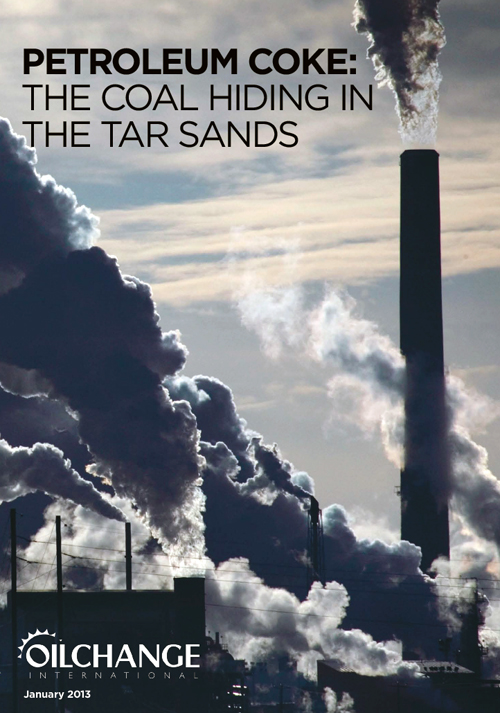
[Editor’s note: Today, scientists and advocates speaking at the National Press Club in Washington unveiled new research showing that the Keystone XL tar sands pipeline would damage the climate much more than previously thought, by dramatically expanding tar sands production and because it will lead to increased combustion of a particularly dirty form of oil. Two reports were presented today, including Petroleum Coke: The Coal Hiding in the Tar Sands revealing that current analyses of the impacts of tar sands fail to account for a high-carbon byproduct of the refining process that is a major source of climate change causing carbon emissions: petroleum coke—known as petcoke, and The Climate Implications of the Proposed Keystone XL Oilsands Pipeline from the Pembina Institute—a Canadian environmental think tank—revealing how the Keystone XL tar sands pipeline would accelerate expansion of the tar sands and significantly increase greenhouse gas emissions.
Energy and Commerce Committee Ranking Member Henry A. Waxman issued the following statement on these two reports: “The new reports show that TransCanada’s Keystone XL pipeline is the key that will unlock the tar sands. If the pipeline is approved, the world will face millions more tons of carbon pollution each year for decades to come. After Hurricane Sandy, devastating drought, unprecedented wildfires and the warmest year on record in the United States, we know that climate change is happening now, we have to fight it now, and we must say no to this pollution pipeline now.”]
The Canadian tar sands have been called the “most environmentally destructive project on earth,” with good reason.
But what if we told you that a significant proportion of the climate impact from exploiting the tar sands has been overlooked?
That’s the story told in our latest report Petroleum Coke: the Coal Hiding in the Tar Sands.
It turns out that analysts have been examining the liquid fuels derived from tar sands bitumen and calculating the emissions associated with producing those light liquid fuels (i.e. gasoline and diesel), and adding the emissions from burning those liquid fuels to derive a “well-to-wheels” analysis of emissions.
On this basis alone, the European Commission has determined that the emissions from tar sands derived fuel are 23 percent greater than fuel from conventional crude used in Europe.
But tar sands bitumen is a semi-solid hydrocarbon. In fact a barrel of bitumen contains 24 percent more carbon than a barrel of conventional light oil. This additional carbon does not make its way through to the gasoline and diesel manufactured from tar sands bitumen. It is removed.
This “removed” carbon doesn’t disappear; far from it. In fact 15 to 30 percent of a barrel of tar sands bitumen is converted during the refining process into a coal-like solid fuel called petroleum coke or “petcoke.” This is considered a byproduct of tar sands refining and most analysts assessing the climate impact of the tar sands have to date dismissed the emissions from burning this petcoke.
They have done this partly because they have not developed a methodology to include petcoke emissions into their calculations of the emissions from the liquid fuels. Some have recognized it’s there and have raised it as an issue for further study.
But industry analysts including IHS CERA, which has published two studies on tar sands greenhouse gas emissions entitled Getting the Numbers Right, consider the emissions from burning petcoke as “negligible.” The assumption is that petcoke simply replaces coal and therefore there is no net emissions rise.
This is a convenient but entirely misguided assumption.
Petcoke is like coal, but is in fact dirtier. Petcoke has even higher carbon emissions than already carbon-intensive coal, emitting between 5 to 10 percent more CO2 than coal per unit of energy produced. A ton of petcoke yields on average 53.6 percent more CO2 than a ton of coal.
So even if petcoke did simply replace coal, which is not the case, the net emissions from whichever activity the petcoke is fueling (eg: power generation) are higher.
But because petcoke is a byproduct refineries price it “to move.” It is selling into the market at around a 25 percent discount to coal.
Now we all know (don’t we?) the basic law of economics. More Supply = Lower Prices = More Demand. But growing supplies of petcoke are not only adding to the global supply of fuel for coal-fired power generators, they are undercutting coal on price.
Indeed industry analysts have shown that a typical 1 gigawatt coal plant can save around $120 million per year in fuel costs by blending petcoke with coal in their boilers. That sounds to us like a boon for coal-fired generators and a bad deal for cleaner fuels competing with coal in a tight market.
Our report reveals the following startling facts about the tar sands and petcoke.
Petcoke in the tar sands is turning American refineries into coal factories.
- There is 24 percent more CO2 embedded in a barrel of tar sands bitumen than in a barrel of light oil.
- 15 to 30 percent of a barrel of tar sands bitumen can end up as petcoke depending on the upgrading and refining process used.
- Of 134 operating U.S. refineries in 2012, 59 are equipped to produce petcoke.
- U.S. refineries produced more than 61.5 million tons of petcoke in 2011—enough to fuel 50 average U.S. coal plants each year.
- In 2011, more than 60 percent of U.S petcoke production was exported.
Keystone XL will fuel five coal plants and thus emit 13 percent more CO2 than the U.S. State Department has previously considered.
- Nine of the refineries close to the southern terminus of Keystone XL have nearly 30 percent of U.S. petcoke production capacity, over 50,000 tons a day.
- The petcoke produced from the Keystone XL pipeline would fuel 5 coal plants and produce 16.6 million metric tons of CO2 each year.
- These petcoke emissions have been excluded from State Department emissions estimates for the Keystone XL pipeline. Including these emissions raises the total annual emissions of the pipeline by 13 percent above the State Department’s calculations.
Cheap petcoke helps the coal industry.
- As a refinery byproduct, petcoke is “priced to move,” selling at roughly a 25 percent discount to conventional coal.
- Rising petcoke production associated with tar sands and heavy oil production is helping to make coal fired power generation dirtier and cheaper—globally.
- From January 2011 to September 2012, the U.S. exported more than 8.6 million tons of petcoke to China, most of which was likely burnt in coal-fired power plants.
“PetKoch”: The largest global petcoke trader in the world is Florida based Oxbow Corporation, owned by William Koch—the brother of Charles and David Koch.
- Oxbow Carbon has donated $4.25 million to GOP Super PAC s, making it the one of the largest corporate donors to super PACs.
- Oxbow also spent over $1.3 million on lobbyists in 2012.
As mentioned above, the impacts of petcoke on the local and global environment have not been considered by regulatory bodies in assessing the impacts of the tar sands.
Petcoke’s full impacts must be considered by the European Union in its debate on the Fuel Quality Directive, by the U.S. State Department in its consideration of the climate impacts of the Keystone XL pipeline, and by Canadian, American and European governments in tar sands policies across the board.
Increasing petcoke use is a clear result of the increasing production of tar sands bitumen. Petcoke is a seldom discussed yet highly important aspect of the full impacts of tar sands production. Factored into the equation, petcoke puts another strong nail in the coffin of any rational argument for the further exploitation of the tar sands.
Propagandist for Agri-business speaker at Calvin January Series
Earlier today I attended the lecture at Calvin College, which was part of the 2013 January Series.
The featured speaker today was Dr. W. Dwight Armstrong, who was speaking on behalf of the National FFA Organization. The title of his lecture was Feeding the World and the Future of Farming.
Dr. Armstrong began by saying he grew up on a family farm in Kentucky. He spoke with a southern draw and came across as a very charming man.
He talked about FFA and its mission to recruit youth into the agribusiness sector. Armstrong said the FFA reaches about 1 million students in the US every year, mostly middle school students and that the organization focuses on science, since agriculture is now based on technology.
The major mission of FFA, according to Armstrong, was to build a human capital pipeline for agriculture…..and this is exactly what Armstrong was doing with the audience.
The spokesperson for the FFA was essentially a propagandist for agri-business. Armstrong spoke about the need to use science and technology to improve food production and that meat, eggs and dairy were essential to the world.
He used a series of superficial slides with text that presented a very bi-polar world, with headings like Growth vs Sustainability. Armstrong would present such ideas, but not substantiate anything. Instead, he used the platform to defend agri-business or to maligned anything that challenged the current food system.
“Why is it when we use the word corporate with farming everyone thinks it is negative. 90% of farmers are family, most of which are big. People would like us to go back to the 50s and 60s style agriculture. It is not a sustainable solution.” This is just one example of how he framed the issues, with absurd statements that made any criticism of agri-business seem ridiculous.
Armstrong defended GMOs, Monsanto, the factory farm industry and made the claim that no meat in the US has hormones in it that has any negative impact on human health.
It was no surprise that the speaker spoke highly of Monsanto, since Monsanto is one of the main corporate sponsors of the National FFA Organization, along with Pfizer, Cargill, DuPont, Ford, John Deer, Archer Daniels Midland and Syngenta.
Armstrong kept referring to people who criticized agri-business as the “Food Morality Movement.” He lumped into this category, which he never defined, vegetarians, those who want organic food, sustainable farms, CSAs and those who opposed animal cruelty.
It was an amazing display of propaganda that was someone challenged during the Q & A. However, since the audience didn’t get to ask the questions directly, it was hard to know who the questions were coming from and what their intent was. Armstrong never did directly respond to questions. Instead, he danced around them or just deflected the question to reiterate his main talking points.
People asked him about farm subsidies, global warming and food production, a vegetarian diet, CSAs and global hunger. At one point Armstrong even said, “Don’t criticize those who don’t agree with you.”
Unfortunately, this spokesperson for corporate agriculture was given the last word, which was to say that the world could not feed itself if it wasn’t for the technological and scientific advances by the agribusiness system.
Calvin College should be widely challenged for inviting someone who not only didn’t substantiate his claims, but dismissed those who criticized his paymasters. People should contact the Director of the January Series and let her know that this speaker was completely unacceptable and intellectually insulting.
Contact Kristi Potter kpotter@calvin.edu.
 Grand Rapids Institute for Information Democracy