Disaster Capitalism: A Duty to Make Money off the Titanic in Grand Rapids and Beyond
This article is in memory of Kate Wheeler, former GRIID contributor, who passed away in 2012. Kate wrote an excellent piece last year entitled, The Capitalist Shame of the Titanic, for the 100th anniversary of the Titanic disaster.
On Saturday, the Titanic Artifact Exhibit opened at the Grand Rapids Public Museum, which was cause for the media to contact one of the owners of this collection of artifacts, local bar owner Mark Sellers.
On Sunday, MLive ran a story with Sellers, entitled, Bar owner Mark Seller reflects on ‘duty’ to protect Titanic shipwreck as exhibit opens in Grand Rapids. The article spending very little time on the exhibit itself and focuses on Seller’s motivation for buying the company that owns the Titanic artifacts, along with some history of the acquisition.
We learn from the MLive story that Sellers company, Sellers Capital Management Inc. (there is little public information about this company), had acquired Premier Exhibitions, the company responsible for the Titanic Exhibit, along with several others such as Bodies Revealed, Real Pirates, Cleopatra, Tutankhamun, America I Am and Dialogue in the Dark.
The MLive story presents some of the controversy around the acquisition and even cites Robert Ballard, the explorer who discovered the Titanic wreckage. Ballard, according to MLive, refers to Premier Exhibitions as “grave robbers.” Ballard has been very vocal in his opposition to taking anything from the wreckage. Here is a longer commit from an article in the National Geographic from last year.
Robert Ballard, who has long argued that the wreck and all its contents should be preserved in situ, has been particularly caustic in his criticism of RMST’s methodologies. “You don’t go to the Louvre and stick your finger on the Mona Lisa,” Ballard told me. “You don’t visit Gettysburg with a shovel. These guys are driven by greed—just look at their sordid history.”
Indeed, greed seems to be a theme surrounding the Titanic, from its inception to the profitability of the exhibits. Sellers argues in the MLive story that while the previous owners of the exhibit wanted to take more from the wreckage, since he and his partners took it over they have a commitment to leave the wreckage alone. Sellers even refers to the wreckage as, “sacred.”
However, we should not simply assume that this is what motivates those at Premier Exhibitions. Just look at the cast of characters that make up its board and one can see that profits seem to be the common denominator.
The Board of Directors at Premier Exhibitions is made up of seven white guys, all of which have a long history in investment capitalism. In addition to Sellers, the board consists of Sam Weiser, Bill Adams, Doug Banker, Ron Bernard, Steve Palley and Bruce Steinberg.
Weiser, before coming to Sellers Capital Management Inc, worked for the Hedge Fund Consulting Group within Citigroup Inc.’s Global Prime Brokerage division. Weiser, who also sits on the board of Paragon technologies, was paid $281,250 from Premier Exhibitions in 2011 for his services.
Bill Adams used to work for the Mitchell Madison Group, a global strategic consulting practice, and sits on the boards of Direct Marketing Solutions, Inc., CarHop, McKissock and YLighting.

Doug Banker is currently Vice President of McGhee Entertainment, which manages several musicians, including Ted Nugent and KISS. Banker was compensated by Premier Exhibitions with $150,000 in 2011 for his services.
Ronald Bernard has been involved with several large media companies over the years, as well as the National Football League. He was President of VIACOM Network Enterprises from 1987 – 1993. Bernard was compensated $90,000 in 2011 by Premier Exhibitions for his services on the board.
Steve Palley has also been involved with numerous media companies, most notably King World Productions, Inc., which manages TV shows like Oprah Winfrey and Rachel Ray.
Bruce Steinberg has been involved in the media world in his role as General Manager of Broadcasting at BSkyB and Chief Executive Officer of UK Gold and UK Living TV. Steinberg was also compensated $90,000 for his time on the board of Premier Exhibitions in 2011 alone.
What this look into those on the board of Premier Exhibitions reveals is that they are a well connected company to the world of finance and media, with several board members sitting on other boards, which solidifies inter-locking systems of power. These inter-locking systems of power function in such a way to create a network of private economic power that assures that their collective interests will be maintained.
It seems to this writer that the primary motivator, like that of the people who owned the Titanic before it sank, is greed. Those who own the artifacts and exhibit what has been salvaged seem to be acting, in the words of Naomi Klein, as disaster capitalists…….making money off the natural and human made disasters. In fact, one could argue that it is their duty as capitalists to do so.
The Dignity Campaign’s Alternative Vision for Immigration Reform
This article by David Bacon is re-posted from ZNet.
For some immigrant rights organizations, President Obama’s principles for comprehensive immigration reform sound familiar. “The idea of the three-part tradeoff, that is, that we get some legalization in trade for guest worker programs and increased immigration enforcement, has been around for a long time,” says Lillian Galedo, executive director of Filipino Advocates for Justice in the San Francisco Bay Area. “We need a new alternative, based on much more progressive ideas. I don’t think the Dignity Campaign is the only alternative, but it’s an effort to get us to talk about what we actually want, not just what politicians in Washington tell us is politically possible or necessary.”
The Dignity Campaign is a loose network of more than forty immigrant rights and community organizations, unions and churches that has crafted an immigration reform proposal based on “human, labor and civil rights for all.” (Full disclosure: I am an active supporter of the Dignity Campaign.) The campaign’s member organizations support it as an alternative to the political strategy behind the tradeoff because of what they call the bitter impact of earlier tradeoffs over the last thirty years.
In Tucson, Arizona, the Coalición de Derechos Humanos calls comprehensive immigration reform, the shorthand name for the tradeoff strategy, “primarily a vague promise used to attract immigrant and Latino voters, [while] border communities have suffered the costs of irresponsible and brutal enforcement-only policies, resulting in death and violence.” A recent study by the Migration Policy Institute found that the federal government spends more today on border and immigration enforcement than on all other law enforcement agencies combined.
When the first discussions of the Dignity Campaign proposal began four years ago, Derechos Humanos formulated the demands about border enforcement. Instead of even more immigration agents, walls and now drones, they call for dismantling the high-tech wall, removing the National Guard, closing private mass detention centers and restoring civil rights to people living in border communities.
Isabel Garcia is a public defender, and every day her fellow lawyers defend dozens of people brought into Tucson’s Operation Streamline courtroom in chains, where they’re sentenced to prison terms for crossing the border. “That courtroom should be closed,” she says, “and the money redirected to healthcare and education, which our state is now busy cutting.” Derechos Humanos wrote that demand into the Dignity Campaign proposal too.
Galedo and Garcia first saw the tradeoff in 1986, in the Immigration Reform and Control Act. That law, signed by President Ronald Reagan, set up an amnesty that gave legal status relatively quickly to almost 3 million people. Nevertheless, they and other immigration activists of the day, including Bert Corona—widely recognized as the father of the modern immigrant rights movement—campaigned against it. The bill also contained employer sanctions, a provision that made it illegal for employers to hire undocumented workers, and expanded a limited guest worker program into today’s H-2A visa scheme.
“We’ve lived with the consequences ever since,” Galedo says. “That’s why, when we look at Obama’s principles, or the CIR bills of the last decade, we think not just about our need for legalization, but that we’ll have another twenty-five years of enforcement and more guest workers. Because we’ve lived with those costs, we believe the best starting point for immigration reform is a discussion of what immigrant communities actually need and want, and what we know will actually solve the social problems around migration. That’s the source of the Dignity Campaign.”
Anoop Prasad, staff attorney at the Asian Law Caucus in San Francisco, worries that President Obama’s plan for mandatory national use of the E-Verify database (a tactic for enforcing employer sanctions) “would in effect compel employers to act as immigration agents, responsible for verifying employees’ immigration status. This approach has not only proven ineffective in deterring people from coming to the US, it inhibits workers from exercising their basic workplace rights and protections.”
Several local unions and labor councils support the Dignity Campaign because thousands of union members have been fired as a result of workplace enforcement, and the campaign calls for repealing employer sanctions.
Another leg of the tradeoff, expanded guest worker programs, are also hotly opposed by Dignity Campaign organizations. Some wanted them abolished immediately because of a long record of employer abuse, while others favored an approach based on ensuring that workers in those programs have rights. In the end, the proposal calls for their abolition after five years, and increased enforcement of worker rights during that period. The Labor Council for Latin American Advancement (the AFL-CIO’s constituency group for Latino union members) voted to support the Dignity Campaign because those programs treat migrants “as low wage workers with no rights.”
Changing trade policy especially separates the Dignity Campaign and other grassroots proposals from beltway CIR proposals. The Dignity Campaign proposal was modeled on the TRADE Act, introduced by Congressman Mike Michaud (D-ME), and calls for renegotiating all trade agreements to eliminate provisions that increase poverty abroad and displace workers and farmers or lower their living standards.
“Massive migration caused by poverty can only be addressed by changing those policies that cause poverty in the first place,” says Bill Chandler, executive director of the Mississippi Immigrant Rights Alliance. “President Obama promised to renegotiate NAFTA before his first election, and that promise must now be kept as part of a humane immigration policy.”
The Binational Front of Indigenous Organizations (FIOB) is an organization of Mexican indigenous communities with a base in Oaxaca, and chapters in California and Baja California where Oaxacans travel as migrant workers. For José González, its binational vice-coordinator in San Diego, “the economic policies of the U.S. must be changed, because they are an enormous factor displacing people from our communities, forcing us to leave as our only way to survive.”
Said FIOB on International Migrants Day last December, the Dignity Campaign “makes a clear demand for a broad immigration reform, and deals directly with the situation in which we live in our communities of origin.”
Finally, the Dignity Campaign calls for legal status for the undocumented, in a rapid and inclusive process, without excessive fees, fines, waiting periods or a preliminary temporary status. At the same time, it also calls for protecting the family reunification system and eliminating the current huge backlog by issuing all pending visas within a short period.
The Obama proposal, like most CIR bills of the last decade, pits people applying for family visas against those needing legalization. It proposes that the undocumented “must wait until the existing legal immigration backlogs are cleared before getting in line to apply for lawful permanent residency (i.e. a ‘green card’), and ultimately United States citizenship.” Today some applicants in Mexico City receiving family reunification visas applied over twenty years ago. In Manila the line is even longer. But no CIR proposal would issue more family visas to clear that backlog, while on the other hand they increase visas for guest workers.
“The only way to resolve this is by eliminating the backlogs,” Galedo says. “In our community we have people who have been waiting for years, and according to the federal government, 280,000 undocumented Filipinos as well. We need common ground here, not a fight.”
The groups that support the Dignity Campaign view the CIR proposals as products of an insider process in Washington, not the result of consultation with grassroots immigrant communities, unions and churches. “Now that there finally appears to be the political will to address immigration, it is critical that the voices of these communities be central in the debate,” Garcia urges.
Over the past few years, especially since the failure of the last big reform bills, this kind of process has taken place in many parts of the country. In addition to consultations with the FIOB, in Washington State, Community2Community and Pueblo Unido por la Dignidad organized over 30 Dignity Dialogues to get input from immigrant communities. The Mississippi Immigrants Rights Alliance has talked about an alternative to the CIR bills at its annual Unity Conferences of African-American and immigrant community leaders.
Even before the Dignity Campaign started, the American Friends Service Committee had extensive community meetings that resulted in a plan called A New Path. The Dignity Campaign proposal drew extensively on its ideas. There are others as well, but almost all have basic elements in common.
Campaign participants warn that the CIR proposals will move to the right as they go through Congress. This is what happened in the effort to pass the succession CIR bills over the last decade, and one reason why they died. It is also an important reason many groups outside of Washington have called for an alternative.
In the battles over those earlier bills, advocates for more progressive ideas were criticized for “making the perfect the enemy of the good,” discrediting what was politically possible, and dividing the base of support for CIR. But the Dignity Campaign believes that a progressive alternative gives the movement a goal and a vision to organize and educate the community. Instead of being “the enemy of the good,” Rosalinda Guillén of Community2Community says, “A good proposal will rescue immigration reform from bad ones.”
Many of the organizations that developed the Dignity Campaign supported a bill introduced by Congresswoman Sheila Jackson Lee at the height of the last Congressional debate over immigration that tied legalization to job training and creation programs, and bolstered workplace rights instead of increasing enforcement. “Finding common ground between African Americans and immigrants is a key to winning immigration reform,” according to Bill Chandler. “Fighting for jobs and rights is a much better way to do that than anti-immigrant enforcement and guest worker programs.”
Whether the Dignity Campaign proposal, and others like it, become the basis of an alternative bill in Congress this time around depends on the willingness of progressive members to act independently. In the face of pressure to line up behind the President, it is unclear whether that will happen.
Chandler says a movement-building strategy is necessary to produce real change. “It was the civil rights movement that ended the old bracero guest worker program, and won the 1965 immigration reform that repealed discriminatory quotas and set up the family reunification system,” he emphasizes.
The Dignity Campaign says, “We need to raise our aspirations, rather than simply criticize Congressional proposals.”
New Media We Recommend
Below is a list of new materials that we have read/watched in recent weeks. The comments are not a “review” of the material, instead sort of an endorsement of ideas and investigations that can provide solid analysis and even inspiration in the struggle for change. All these items are available at The Bloom Collective, so check them out and stimulate your mind.
They’re Bankrupting US: And 20 Other Myths about Unions, by Bill Fletcher Jr. – With all the recent attacks against organized labor, particularly the anti-union Right to Work law, this new book by Bill Fletcher Jr. is very timely. The 21 chapters are stand-alone responses to claims made by anti-labor sectors and often the news media. Some of the claims are that unions cost too much, workers are forced to join them and that unions are destroying the economy. Fletcher, who has written numerous books on labor history/labor struggles, does a solid job of responding to each of the claims and acknowledges the shortcomings and historical instances where unions have not defended working people. Fletcher does not do enough to honestly assess the majority of labor unions relationship to the Democratic Party, but the bulk of the book is a valuable read for those who are in unions and those who are looking for sound arguments to defend workplace democracy.
 Blood and Politics: The White Nationalist Movement from the Margins to the Mainstream, by Leonard Zeskind – White Nationalist movements have been in the US for centuries and one could certainly argue that the country is founded on White Nationalist principles. In Blood and Politics, author Leonard Zeskind investigates the White Nationalist movements since the mid-1970s. These movements include the KKK, Holocaust denial groups, the Aryan Nation, Christian Patriots and anti-immigration groups. Zeskind’s work is well researched and well written, with good analysis of how these movements have interacted with electoral politics since the Reagan years. Parts of the book are particularly useful for those of us who live in Michigan, since Michigan has been home to many of these White nationalist groups, particularly Militia groups and anti-immigration zealots. Blood and Politics provides analysis up to and including the first few years after the September 11, 2001 terrorist attacks in the US. A valuable resource for those wanting some history on the groups that continue to engage in hate crimes and influence the move the right nationally on issues such as race, immigration and economics.
Game Over: How Politics Has Turned the Sports World Upside Down, by Dave Zirin – Game Over is yet another literary gem from insurgent sports writer Dave Zirin. In this newest collection of essays, Zirin demonstrates once again that sports and politics do go together, even if the owners of the sports world do their best to prevent that from happening. Zirin not only tells the stories of heroic athletes who dare to challenge the “Jockocracy,” he provides analysis so powerful, its like being run over by Houston Texans defensive lineman J.J. Watt. Game Over dissects recent sports stories, like the Penn State scandal, soccer and the Arab Spring, class war against sports team owners, racism, sexism and homophobia in the sports world. What makes Zirin’s treatment of these topics so elucidating is his ability to weave history into the analysis, in order to demonstrate that sports and politics have always been intertwined. If you care about injustice and the struggles of people around the world, you would be missing out on a great deal by not reading this book.
Corporate FM: What Happened to Radio? (DVD) – Corporate FM is about what happens when a city loses a communal microphone. Radioʼs broad coverage gives it the ability to unify huge populations. Unlike Facebook, Satellite radio, or web-based music sharing apps, locally owned terrestrial radio can reach thousands of people across all incomes and ages in a local region at the same time with a message that is relevant to them at that moment. Worse, the death of privately operated local radio stations is not just destroying the stations that are bought up, but damning the future of all stations on the dial—the public and college stations as well. The entire medium of radio becomes threatened when there are only two stations worth listening to. By investigating how the financial system gutted commercial radio instead of growing it, documentary filmmakers Kevin McKinney and Jill McKeever reveal the problem and propose a solution that could revitalize the medium and rejuvenate the communities that radio is legally obliged to serve.
This video is re-posted from Specialty Studios.
Most Americans know little about the source of oil for the proposed Keystone Pipeline—the tar sands of Northern Alberta. The tar sands are not a traditional oil field. The oil is extracted and processed from the sands at a significant and devastating environmental and health cost to the land and people, and the process itself is a major contributor to climate change.
White Water, Black Gold follows Canadian adventurer David Lavallee on his three-year journey across Western Canada in search of the truth about the impact of the world’s dirtiest and thirstiest oil industry. This is a journey of jarring contrasts, from the pristine mountain ice fields that are the source of the industry’s water, to the tar sands tailing ponds, where thousands of migrating birds have unwittingly landed and died.
In the course of his journey Lavallee, backed by university scientists, makes a number of discoveries that raise serious concerns for Canada and the U.S.
Native peoples living downstream are contracting unusual cancers; new science shows that water resources in an era of climate change will be increasingly scarce; the proposed expansion of the oilfields to meet Keystone Pipeline demand could endanger multiple river systems across Canada that makeup about half of its water supply; and planned oil pipelines across British Columbia and the U.S. bring fresh threats to rivers, salmon and the Pacific Ocean.
White Water, Black Gold is a powerful tool for waking up Americans to the potential impact of the Keystone Pipeline, and clearly shows that we will be paying the environmental, social and public health costs long after the oil has run dry.
You can watch the 54 minute film online at http://vimeo.com/32526916.
Oil and Gas Sector Ranks Number Two in Global Warming Pollution
This article by Tom Kenworthy is re-posted from EcoWatch.
When it comes to greenhouse gas (GHG) emissions, power plants are the 800-pound gorilla in the room. But a new report from the U.S. Environmental Protection Agency (EPA) shows that oil and natural gas are a pretty sizable monkey on our climate back as well.
Reporting for the first time on GHGs from petroleum and natural gas systems, the U.S. EPA this week said that the oil and gas sector ranked second in emissions to power plants, releasing 225 million metric tons of carbon dioxide equivalent in 2011. More than a third of that came from methane, the main constituent of natural gas, and a far more potent global warming gas than carbon dioxide.
The oil and gas sector was responsible for 40 percent of total U.S. methane emissions. In terms of greenhouse gas equivalent, the sector’s overall emissions were only about one-tenth those of power plants.

Emissions from petroleum and natural gas systems come from a range of activities from drilling oil and gas wells both onshore and offshore, and the processing, transmission, storage and distribution of natural gas.
This was the second year that the U.S. EPA, directed by Congress, has reported U.S. GHG emission data. The 2011 data includes a total of 41 sources, 12 of them new in the second year of the program.
This year’s release of the data shows that power plant emissions, which account for about one-third of all U.S. emissions, were abut 4.6 percent lower than 2010 levels.
Refineries ranked number three on the list of biggest emitters, with about 182 million metric tons of carbon dioxide equivalent.
Drug War Mexico, NAFTA, and Why People Leave
This interview is re-posted from Dissident Voice.
In this interview with the Real News Network, Peter Watt, author of Drug War Mexico, talks about how US policy and neoliberal ‘reforms’ helped create conditions for the growth of drug cartels and the impoverishment of millions.
Watt also talks about the nearly twenty years of the North American Free Trade Agreement (NAFTA) and how millions of peasants have lost their land and have little alternative than to come to the US, often undocumented.
The content of this interview is important, particularly now as the US government is debating new immigration policy.
How Immigration Reform Could Expand Incarceration of Immigrants
This article by Seth Freed Wessler is re-posted from ColorLines.
The House made its first formal foray into immigration reform yesterday at a lengthy Judiciary Committee hearing in which Republicans struck a familiar chord. Despite record-setting deportation levels in recent years, Republican members of the committee were in broad agreement that they want even more enforcement before they could sign onto the comprehensive reform ideas laid out by Senate negotiators and President Obama.
“There is not in my opinion very much enforcement going on at all in the interior of the country,” said Judiciary Committee Chair Bob Goodlatte, a Virginia Republican.
The heightened enforcement that Goodlatte and others seek raises a thorny question for the immigration reform process: Will it address the dire concerns many have about the ways in which immigrants are detained while awaiting deportation?
Immigration reform advocates around the country are raising concerns about the sprawling complex of prisons and detention centers, run often by private corporations, that are used to lock up non-citizens. Today, a group of senators led by Judiciary Committee Chairman Patrick Leahy will release a strongly worded letter to colleagues calling for greater protections for immigrants inside those detention centers.
“Our laws mandate detention or deportation for many people, denying them access to a hearing before a judge, without guaranteeing legal counsel for those who cannot afford it,” the senators wrote, according to the Huffington Post. “Immigration enforcement measures frequently target minority and immigrant communities through impermissible racial profiling that instills fear and distrust of law enforcement and makes communities less safe. Our system is not fair. It is unnecessarily punitive and disproportionate.”
The tone at yesterday’s House Judiciary Committee hearing suggests Republicans in that chamber would disagree. The ideas swirling there would instead expand policies that tightly entwine the criminal justice and immigration systems. Though a large-scale legalization of undocumented immigrants would seem on its face to render detention facilities obsolete, efforts are already underway to keep them growing.
Detention Reform or Detention Expansion
In recent years, the Obama administration has detained and deported immigrants at a record-setting pace. Though the administration purports to target serious criminal offenders, critics say immigration laws paint “serious” in exceptionally broad strokes. The bulk of the 1.5 million people deported in the last four years were charged with minor violations, and many of these people would still find themselves subject to deportation even if they’re on track to legal status or have a green card.
And for immigrants pegged with a long list of convictions, detention before deportation is mandatory. Laws passed in the 1990’s took the power away from ICE agents and immigration judges to review the particulars of cases, release detainees or stop their deportation. Approximately two-thirds of the 400,000 detainees last year were held on a mandatory basis in one of the more than 300 facilities that dot the American landscape, without the possibility of release, according to the advocacy group Detention Watch Network.
Advocates hope that an immigration reform bill will begin to replace punitive lock up with alternative, community-based measures to keep track of non-citizens in deportation proceedings. Last week, President Obama nodded in that direction. The White House’s guiding principles for immigration reform note that the president’s proposal “allows DHS to better focus its detention resources on public safety and national security threats by expanding alternatives to detention and reducing overall detention costs.”
In 2012, the federal government spent over $2 billion on detention operations, a nearly 150 percent increase from just seven years ago. And the two leading private detention companies, Corrections Corporation of America and Geo Group, together netted about $425 million in revenues from their ICE contracts. The industry spends millions lobbying Congress.
Republicans yesterday made clear that they’re not interested in cuts.
Rep. Randy Forbes, a Virginia Republican on the House Judiciary Committee, asked San Antonio Mayor Julian Castro, who testified at the hearing, if the U.S. should be allowed to summarily deport people with gang affiliations “before they committed another criminal act.” In 2005, Rep. Forbes introduced the Alien Gang Removal Act, which would have led to the mandatory detention and deportation of anyone the government labeled a member of a gang, even if they’ve never been convicted of a crime. Similar language made it’s way into a comprehensive immigration reform bill considered by the Senate in 2006.
Belinda Escobosa Helzer, an attorney with the ACLU of Southern California, says that laws like these cast an overbroad net that encourages racial profiling. “What we’ve seen in practice in California is that a lot of youth of color are being documented as gang members because of where they live, who they went to school with, who they were walking with,” she said, not because they’ve committed a crime.
A provision like the one Forbes suggests would add to an already long list of exclusions Congress could build into a reform bill.
Civil liberties and immigrant rights groups, meanwhile, are advocating for reduced reliance on detention facilities in the immigration enforcement process and restored discretion to judges.
“It’s absolutely crucial Congress include a rollback of mandatory detention laws in any new immigration legislation,” said Emily Tucker, the advocacy director at Detention Watch Network, in a statement Tuesday.
The collateral effects of detention have only recently come into view. A 2011 Colorlines.com investigation revealed that the detention of parents regularly leaves children stuck in foster care or in other precarious situations.
“Because of the deportations that have taken place over the last few years there are anywhere from 5,000 to 6,000 children who have been placed in foster care because their parents have been deported. The children were citizens,” Rep. Karen Bass, a California Democratic and member of the House Judiciary Committee, said at the hearing yesterday, citing the findings of the Colorlines.com investigation.
Filling Federal Prisons
Democratic congressional staffers and Beltway advocates say they’re most concerned that in exchange for backing the legalization of undocumented immigrants, Republicans will demand an expansion of a program called Operation Streamline, which began in 2005 in counties along the U.S.-Mexico border to prosecute and incarcerate people crossing the border.
Advocates of the program say incarceration deters immigrants from crossing and contributes to the reported 40-year low in new migration over the border. There’s little evidence to support this claim, but Sen. John McCain, the leading GOP immigration reformer, and other border Republicans have nonetheless listed additional investments in Streamline as a key component of their border security demands in recent years.
Though congressional staffers and advocates say the demand has yet to appear on the table in the current round of Beltway trading, many expect it will.
Prosecutions for immigration-related offenses rose by 50 percent in just the last five years, and the federal Bureau of Prisons is building new facilities to make room. In the 1990’s the BOP began contracting out the operation of federal prisons to hold so called “criminal aliens,” who include people convicted of violations like reentry and of other crimes. Geo Group and Corrections Corporation of America now operate all 13 of the facilities that hold a cumulative 24,000 inmates. The companies took in over $460 million in revenue from federal contracts in 2011, the Huffington Post reports.
Advocates, journalists and the BOP’s own researchers have documented diminished quality and widespread abuse and neglect of inmates in private facilities and many are concerned that immigration reform could facilitate greater opportunities for these companies. Already, expansion looks likely.
In July the government put out a call for a 14th privately run facility—a 1,000 bed prison with a $25 million price tag. And a report released in September by the Government Accountability Office revealed that the BOP projects the addition of 1,500 more inmates to these facilities every year, increasing the population of the prisons by 50 percent by the end of the decade.
In a move that will help keep the prisons full, less than a month ago, California Rep. Darrell Issa, a Republican on the Judiciary Committee, introduced legislation to add long mandatory minimums to sentencing rules for reentry and other immigration related offenses. In one case, his bill sets a sentencing range between 10 and 20 years for people coming back to the country. If passed, either on its own or as part of a comprehensive immigration reform bill, it would drive up the time these inmates spend behind bars.
God made a farmer ad revised to reflect a more honest reality of who does the work in our food system

During last Sunday’s Super Bowl, millions of viewers saw the commercial by Dodge Trucks, featuring the voice of conservative radio personality Paul Harvey.
Most people this writer talked to thought the ad was going to be for one of the big agri-business companies like Cargill or Monsanto. Instead, Dodge Trucks made their own cultural case for associating their vehicles with the iconic image of American farmers.
The creative people at Brave New Films and Cuenteme took the same ad and altered it with different images, to make a point about who really does the bulk of the farm work in the US, the millions of migrant workers.
Here is the altered ad.
This article is re-posted from EcoWatch.
Caleb Behn is the young, eloquent and enigmatic subject of a new documentary-transmedia project Fractured Land. An experienced hunter trained on the land by his grandfathers, Caleb is a modern Dene warrior, and a law student at the University of Victoria, in British Columbia, Canada.
He is a part of a dynamic dialogue on sustainable, equitable energy development in Canada, a country whose antiquated resource extraction practices are systematically decimating a way of life reliant upon the air, water and land.
“One of B.C’s bright, emerging native political leaders,” said Mark Hume, The Globe and Mail, Caleb is among an inspiring new generation of Indigenous leaders, balancing their ancestral customs with the modern world to forge a path to a sustainable energy future.
Vancouver-based filmmakers Fiona Rayher and Damien Gillis have followed Caleb to places of largely unseen beauty—from his traditional territories in Northern British Columbia, where he’s fished and hunted moose his whole life, to Maori lands in New Zealand, where he sought to learn how Indigenous law could be blended with the current legal system in order to protect our sacred ecosystems.
Now back in Canada, Caleb’s making a lot of noise—touring the country to speak about his experiences and concerns, and applying his legal education toward building bridges across divided communities.
Caleb has been an active voice in the recent Idle No More movement, using social media to engage in constructive discourse with other leaders and participants across the country and the globe.
Background: Caleb Behn and energy development in British Columbia
Both Caleb’s mother’s and father’s territories are deeply affected by decades of heavy oil and gas industry development.
His mother, from the West Moberly Nation of the Peace Valley region has seen development as early as 1922, with large-scale commercial development beginning in the 1950s, and growing rapidly since. The third proposed dam on the Peace River, known as Site C, would flood an 80 km stretch of the valley to power natural gas and mining operations.
Meanwhile, in Caleb’s father’s Eh-cho Dene territory around Fort Nelson, there are plans for 20 long-term licenses to draw a trillion liters of water out of surrounding rivers and lakes to use for natural gas “fracking” operations in the nearby Horn River Basin.
Fracking is a method of natural gas extraction that involves drilling deep into the Earth, to blast the shale with vast amounts of water, toxic chemicals and sand at high-pressures, to crack open the shale and release the gas.
The process has been flagged worldwide for poisoning water tables and releasing noxious gases into the atmosphere, severely damaging the health of residents living in the regions and causing unequivocal environmental destruction, including earthquakes.
In 2012, The David Suzuki Foundation reported that scientists have analyzed 40 years of satellite images of British Columbia, discovering a rapidly growing network of hydrocarbon infrastructure development, directly undermining the governments proposed goal to drastically reduce carbon emissions by 2020.
To transport the natural gas from British Columbia to Asia, as proposed, it must first be converted to a liquid state, which would require approximately 14, 500 GWh of electricity, enough to power 75 percent of all residences in the province.
This sophisticated web of hydrocarbon project development between Alberta and British Columbia is being referred to as “Canada’s Carbon Corridor.” The infrastructure required for these projects forges an archaic cycle of abuse of the region’s resources that threatens to lock Canada into an unsustainable and destructive social, economic and environmental path.
This Day in Resistance History: Gay Liberation Front tears down hate speech sign from bar
On this day in 1970, about 100 activists descend on Barney’s Beanery in West Hollywood.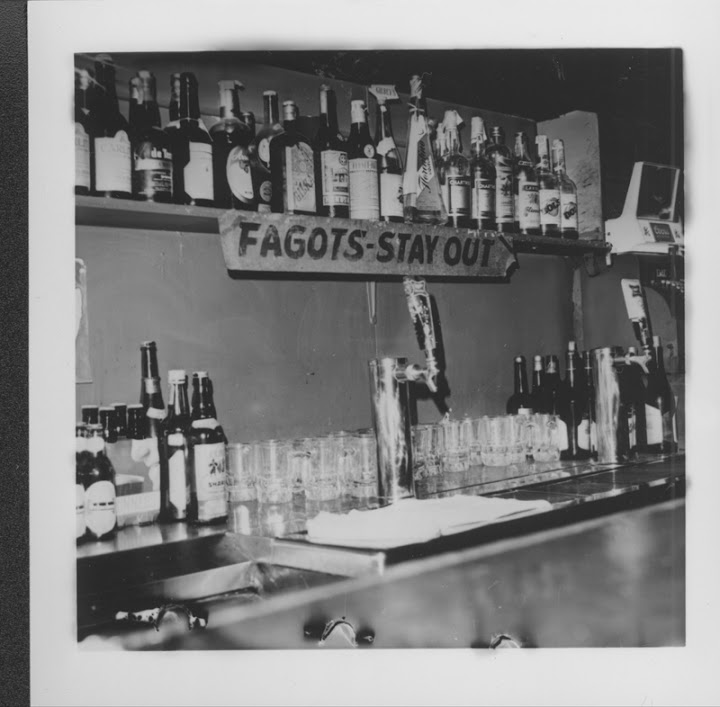
For 30 years the bar had posted a sign, “Faggots — Stay Out.” According to research done by Felice Picano on Gay activist Morris Knight, the Los Angeles branch of the GLF decided as one of its first actions was to target Barney’s Beanery.
The GLF had begun actions in January of 1970, just one month before, where they engaged in tactics such as shop-ins – getting people in the LGBTQ community to spend money there; change-ins – where people would come in dressed more hetero-normative, but change in the bathroom dressed how they wanted to be dressed; and sit-ins – where GLF members occupied space within the bar as a form of protest.
Management refused to remove the sign & even posted six additional warnings over a several week period. Because the bar owner refused to remove the hate speech sign, GLF activists on February 7, 1970 decided to physically remove the sign themselves.

This action brought out a significant number of the LAPD, which led to an additional confrontation on the streets.
However, the campaign did result in the bar finally removing any signage that the LGBTQ community found offensive.
There are several lessons that can be learned from such an action. First, the action by GLF members demonstrated that Direct Action is an important tactic to engage in. Secondly, the campaign against Barney’s Beanery gave momentum to the Los Angeles chapter of the GLF and other groups across the country.
According to Felice Picano, the success of the Barney’s Beanery action led to another 175 protests in the next two years by the GLF in Los Angeles alone, thus demonstrating the inspiring capacity and power of direct action to mobilize people against an injustice.
Lastly, the use of Direct Action in 1970 gave momentum to the national Gay Liberation Front, which wrote its manifesto the following year, a manifesto that reflected the radical call for ending systems of oppression.
Near the end of the manifesto it states:
The long-term goal of Gay Liberation, which inevitably brings us into conflict with the institutionalized sexism of this society, is to rid society of the gender-role system, which is at the root of our oppression. This can only be achieved by eliminating the social pressures on men and women to conform to narrowly defined gender roles.
The manifesto also encouraged an intersectional analysis and the need to build alliances with other oppressed groups.
As we cannot carry out this revolutionary change alone, and as the abolition of gender rotes is also a necessary condition of women’s liberation, we will work to form a strategic alliance with the women’s liberation movement, aiming to develop our ideas and our practice in close inter-relation. In order to build this alliance, the brothers in gay liberation will have to be prepared to sacrifice that degree of male chauvinism and male privilege that they still all possess.
On this day, February 7, we honor the courage of LGBTQ activists who not only challenged hate speech and discrimination, but eventually called for systemic change.

 Grand Rapids Institute for Information Democracy