Immigration Rights Advocates Host Organizing Event in Fight for Comprehensive Immigration Reform
Earlier today about 50 people gathered to discuss strategies and tactics in the national campaign to change immigration policy that would allow the estimate 11 million undocumented people to apply for citizenship.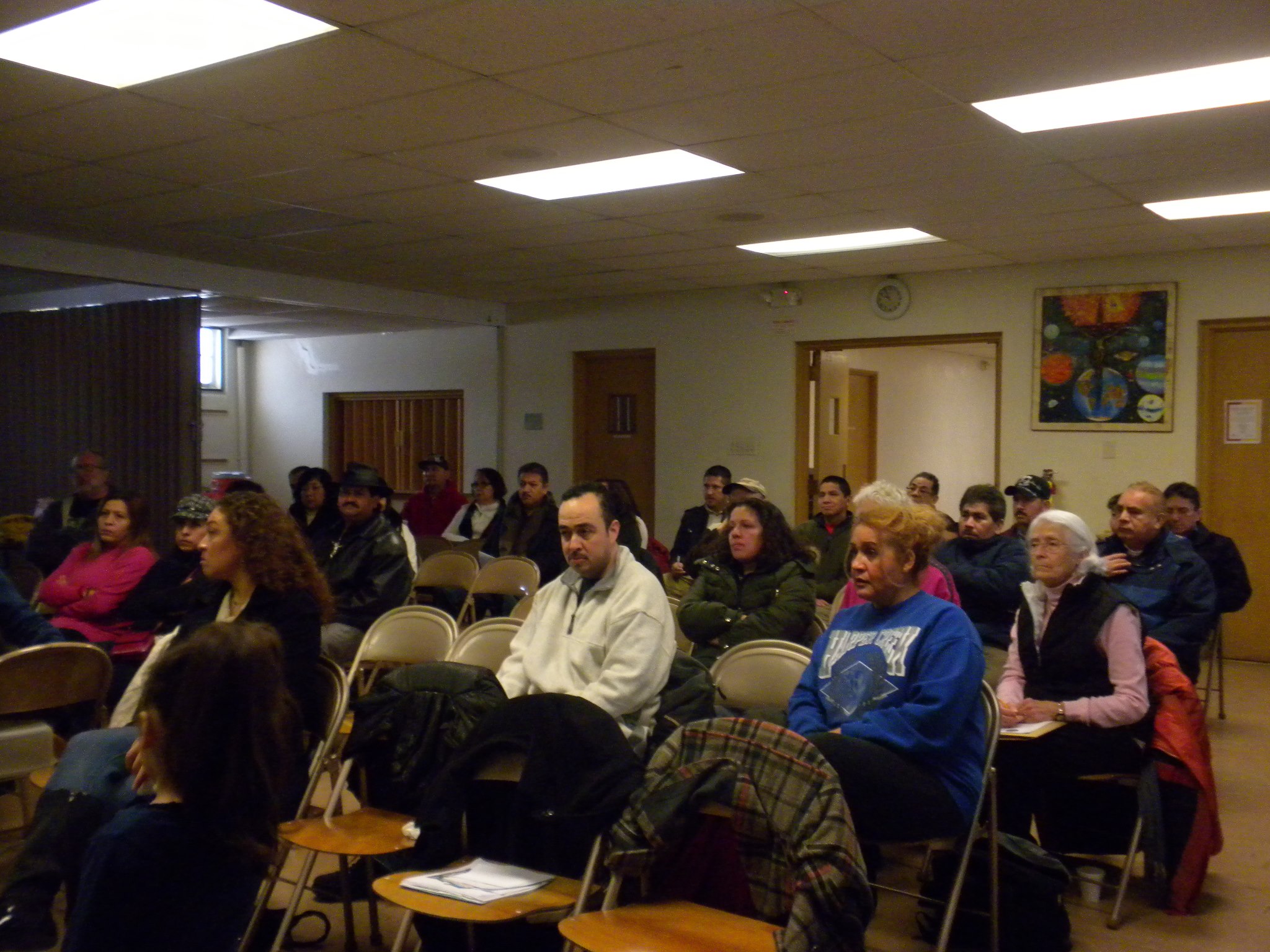
The movement for comprehensive immigration reform also includes to changes in the current immigration law that would prioritize family reunification, demilitarize borders, protest labor rights, stop ICE quotas and eliminate immigration detention.
Members of the Michigan Chapter of the Alliance for Immigration Reform (AIR) and the Michigan Organizing Project (MOP) hosted the organizing event. A team of facilitators broke down the 3 hour organizing session into several areas.
First, people discussed recent history of immigration reform, which began with organizing in opposition to the reactionary legislation proposed by Rep. Sensenbrenner in 2005. There were several large gatherings in Grand Rapids, which culminated in a demonstration with roughly 10,000 participants in late March of 2006.
The facilitator talked about the hope many in the Latino community had in 2008 after Barack Obama was elected. However, there was no follow through from the new administration to fulfill its commitment to comprehensive immigration reform. The issue was ignored, so people began organizing again around this issue with major marches in 2010.
People discussed how the government is not going to make the necessary changes in immigration legislation unless the people pressure them to do so. It was encouraging to hear people acknowledge this fact and to see people organizing from the premise that it is social movements that make changes, not the government.
After, recent immigration organizing history was covered, the group discussed a larger strategy for passing comprehensive immigration reform. People talked about the need to pressure legislators to adopt policies that the community wants. This kind of political pressure will involved getting all kinds of sectors to support comprehensive immigration reform, such as labor, faith communities and other civil rights sectors.
AIR and MOP are planning meetings with Michigan members of the federal government, educate them and get a commitment from them by whatever means necessary. People are organizing meetings in Michigan, community forums and a major march in Washington on April 10.
One other aspect of the strategy discussed was the need to both educate and mobilize larger numbers of the general public. People stated that we needed to counteract the misinformation from most media outlets and anti-immigration groups all across the country. This campaign will involved numerous ways of communication and education, but the tactic that this morning’s group spent most of their time on was the importance of having immigrants tell their stories.
In order to find effective ways to tell these stories, people broke into small groups and everyone in attendance told their own stories. Most of the people there were immigrants and many were undocumented. All of their stories were powerful and many of them were quite emotional, sharing stories of violence and constantly living in fear. The group agreed to share these stories on social media, in writing and at community forums in order to highlight what people have endured and why it is important that we see the human element of comprehensive immigration reform.
At the end of the organizing session, it was clear that people were motivated and passionate about this issue. People demonstrated their clear desire to be part of a movement that is urgent and will not be won without sacrifices.
For anyone interested in getting involved in this issue in West Michigan, you can contact AIR-MOP on Facebook.
The Power of Direct Action: Documentary on the Tar Sands Blockade
Blockadia Rising: Voices of the Tar Sands Blockade is an hour-long documentary film written and directed by Garrett Graham in collaboration with the Tar Sands Blockade and features exclusive video footage shot by the blockaders themselves during the course of over six months of sustained resistance.
In 2012, Texas landowners and environmental activists came together to organize resistance against a dangerous pipeline being built by a Canadian corporation to bring tar sands oil from Alberta Canada to refineries near the Gulf of Mexico. This hazardous project continues despite unprecedented opposition from indigenous communities, local farmers and even global environmental movements. From this struggle, a community of resistance was born that has attracted volunteers from around the continent who have successfully defied this multi-million dollar corporation with the power of non-violent direct action.
The film is meant to be both a celebration of the blockades’ achievements and a primer for those interested in joining the campaign. It explains the dangers of tar sands extraction and the risks to public health posed by the pipeline as well as the strategy of non-violent direct action that has been delaying the pipeline so far.
The story takes place in the backwoods of East Texas where the pipeline crosses farmlands and homesteads as well as aquifers and old growth forests. You will hear the voices of the blockaders who are risking their lives to stop this pipeline. In the Texas heat, they have locked themselves to heavy machinery, and braved the elements by living in trees. Hear these courageous folks in their own words.
Blockadia Rising is just the opening chapter in this ongoing movement to stop this pipeline and halt the extraction of the Canadian tar sands, but the blockaders see themselves as a part of a larger struggle against the consequences of run-away climate-change caused by unchecked extraction of natural resources by industry at the expense of both human and non-human communities. This film speaks to all movements for environmental and social justice and showcases direct action techniques that have never been attempted before.
Blockadia Rising: Voices from the tar Sands Blockade (2013) was written, edited and narrated by Garrett Graham, an active participant of the Tar Sands Blockade who continues to support their efforts. This film is dedicated to them, and everyone fighting for environmental and social justice.
The Campaign: tarsandsblockade.org The Filmmaker: garrettgrahamonline.wordpress.com
This article by Jon Queally is re-posted from Common Dreams.
Reports that President Obama is poised to nominate MIT professor Ernest Moniz to be the next head of the Department of Energy is raising serious concerns for those worried that the administration will betray its promise to take on the threat of the climate crisis by making a major domestic push for natural gas drilling using the controversial practice known as fracking.
The choice of Moniz, known for his adamant support for fracking—which he’s called “paradigm-shifting”—seems to confirm reporting last week that a major part of Obama’s plans for energy creation in his second term will be to “initiate widespread gas fracking in the US.”
“Mr. Moniz is affiliated with the industry-backed MIT Energy Initiative, so we shouldn’t be surprised about his favorable position on fracking,” said Mitch Jones from Food & Water Watch. “But President Obama could do a lot better.”
“Appointing Mr. Moniz,” Jones continued, “would be a nail in the coffin for one of his most lauded inaugural speech promises: a commitment to focus on climate solutions.”
And speaking with The Hill newspaper, Public Citizen’s Ty Slocum said: “Moniz is a status quo pick at a time when we can’t afford the status quo.”
Obama is expected to nominate new heads for both the Dept. of Energy and the Environmental Protection Agency as early as next week. Topping the expected list as the EPA’s next head is Gina McCarthy, who currently heads the agency’s Office of Air and Radiation under the outgoing Lisa Jackson.
McCarthy, whose focus on air quality and pollution from traditional coal and gas-fired plants will make her a target of the fossil fuel industry and its allies in Congress, appears cautiously agreeable to environmental groups though most have to weigh in strongly for or against the longtime Massachusetts energy regulator.
But for Moniz, coupled with the growing controversy over the dangers of groundwater pollution and climate impacts of the methane released by fracking, the most serious opposition will likely come from those who challenge the idea the natural gas is a “clean energy” or that a investing in a so-called “bridge fuel” is a better alternative than the swift transition to a truly renewable energy system.
“Mr. Moniz’s appointment to the DOE could set renewable energy development back years,” concluded Jones. “If we pursue our fossil fuel addiction by expanding fracking, which Mr. Moniz will likely advocate, the oil and gas industry will thrive while true energy efficiency and renewable solutions languish. Our water, public health and climate would suffer.”
And The Hill adds:
A major 2011 study the MIT energy program released said that environmental risks of developing gas from shale formations, which is achieved through fracking, are “challenging but manageable.”
Bill Snape, the senior counsel with the Center for Biological Diversity, said he’s concerned that Moniz’s support for natural gas could bring a shift in focus away from the development of renewable electricity and smart-grid technologies.
“The concern I have with him is, he has the veneer of this MIT PhD scientist, that somehow he is going to be objective, and in reality he could very well be a political hack for the natural gas industry,” Snape said.
Unmaking Equality
This article by Agnieszka Karoluk is re-posted from Counter Punch.
On Thursday, January 24th Defense Secretary Leon Panetta announced that the US military will lift the ban on women serving in combat. Many women’s groups and feminist activists saw this announcement as an unqualified victory. According to Kiki Cardenas writing in the popular blog feministing.com, “People asked me: “Well, do you know what you would be fighting for? DO you believe in the war?” Yes and No. I would have been fighting for women’s equality in the world and here in the U.S. and that was reason enough for me.”
Lurking in the background of sentiments such as these is the common perception that the United States military invasions into Iraq and Afghanistan were motivated by a desire to liberate burqa-clad women in these countries. Cardenas isn’t fighting for women’s equality, she’s fighting for the exploitation of her gender’s struggle to further the ends of imperialism via the military industrial complex. One way we may examine this idea is by way of post-colonialist philosopher Gayatri Spivak’s observation that, “White men will not save brown women from brown men.” This is not a racially reductionist formula—”white men are the root of all evil”—but rather a provocative entreaty to wake us from our imperialist dreams. The need for such reminders is exemplified by former First Lady Laura Bush, who on November 17, 2001 shortly after the invasion of Afghanistan addressed the American people on a radio show, “Civilized people throughout the world are speaking out in horror — not only because our hearts break for the women and children in Afghanistan, but also because in Afghanistan we see the world the terrorists would like to impose on the rest of us.”
Rather than “saving brown women”, allowing women to serve in combat roles is simply a false win for feminism and women’s rights in the US. It is nothing more than the advancement of normalization of the military industrial complex. When US military men and women are killing children in Yemen and Pakistan with Drone strikes, feminists and women’s rights activists should be actively organizing against these unjust and immoral actions rather than rallying around promoting the military and its death squads. The drone strike program is ever expanding, according to journalist Jeremy Scahill on his recent appearance on Democracy Now!, Obama had now sanctioned “signature strikes,”
“If an individual had contact with certain other individuals, if they were traveling in a certain area at certain times, if they were gathering with a certain number of people, that there was a presumption that they must be up to no good, that they are suspected militants or suspected terrorists and that the U.S. could take preemptive action against those people—and by “preemptive action,” I mean killing them with a missile”
The fight for women’s rights is far from over, and we certainly do not live in a post-feminist society, regardless of all the all too common view of the kind Carla Bruni-Sarkozy expressed when she remarked, “My generation doesn’t need feminism.” This might be easy to say for the former French first lady, but such lazy dismissals do little for the vast majority of women who still struggle for their basic rights.
In 2013, the fight for birth control and reproductive rights are under fire and workplace wage gaps are still the norm in many cases. There are bigger fish to fry than focuses on “opportunities” for women to fight in the military. The frontlines of the fight for women’s liberation should lie on labor opportunities, child care, housing and health- fundamental rights which all humans deserve, which unfortunately women and LGBTQ individuals are constantly denied due to various legal, social and economic barriers. According to the Center for American Progress, while women overall make 77 cents for every dollar the average white male makes, black women and Hispanic women only make 70 cents and 61 cents, respectively.
Lastly, another major issue regarding women in the military which is overlooked is Sexual assault. Studies suggest that as many as one in three female soldiers are raped during their US military service. Because of machismo and patriarchy which plagues American military culture and higher-ranked officers unwillingness to investigate allegations or rape and sexual assault, many times the victim who reports abuse is punished.
Military is culturally and functionally abhorrent to the interests of the women’s movement. Imperialist expansion under the guise of women’s liberation is degrading to all. As a feminist, I will say that allowing women into combat rolls does nothing for the advancement of women’s rights globally and refuse to allow this to go on in the name of women’s liberation.
Most Afghan and Iraqi women do not see it as a “win” that they or a loved one will now have the chance to be killed by a female American soldier.
-Zillah Eisenstein
10,000 Black Men Named George screening in Grand Rapids 2/26
On Tuesday, the group Left Forum, will be hosting a screening of the film, 10,000 Black Men Named George.
10,000 Black Men Named George is the powerful true story of the first black-controlled union, The Brotherhood of Sleeping Car Porters.
When the Great Depression struck America in the 1920s finding work was hard, but if you were poor and black it was virtually impossible. Working as a porter for the Pullman Rail Company was an option, but it meant taking home a third as much as white employees and working some days for free. You could forget about being called by your real name — all black porters were simply called “George” after George Pullman.
Philip Randolph, a black journalist and socialist trying to establish a voice for these forgotten workers, agrees to fight for the Pullman porters’ cause and form the first black union in America. Livelihoods and lives would be put at risk in the attempt to gain 10,000 signatures of the men known only as “George.” This is the true story of how a courageous leader came to be known as “the most dangerous man in America.”
Left Forum Film
10,000 Black Men Named George
Tuesday, February 26
7:00PM
Institute for Global Education
1118 Wealthy SE, Grand Rapids
This film is free and open to the public.
Management responds with business propaganda to IWW Star Tickets Workers Union efforts to organize in Grand Rapids
Last month we reported on an IWW union organizing effort at Star Tickets, here in Grand Rapids.
There have been two kinds of responses to this news. First, the community has communicated their support with messages on the IWW Star Tickets Workers Union Facebook page and lots of gifts, such as food and flowers. (Sounds like Bread & Roses).
The other response to the workers organizing effort has been from management and as expected it hasn’t been pretty. Star Tickets owner Jack Krasula has created his own business propaganda to share with workers to try to counter the pro-worker messages of the IWW Star Tickets Workers Union.
Krasula has been distributing his business propaganda to workers in the hopes of influencing enough of the workers to vote against a union on March 6. Here is a sample of what the company’s propaganda looks like.
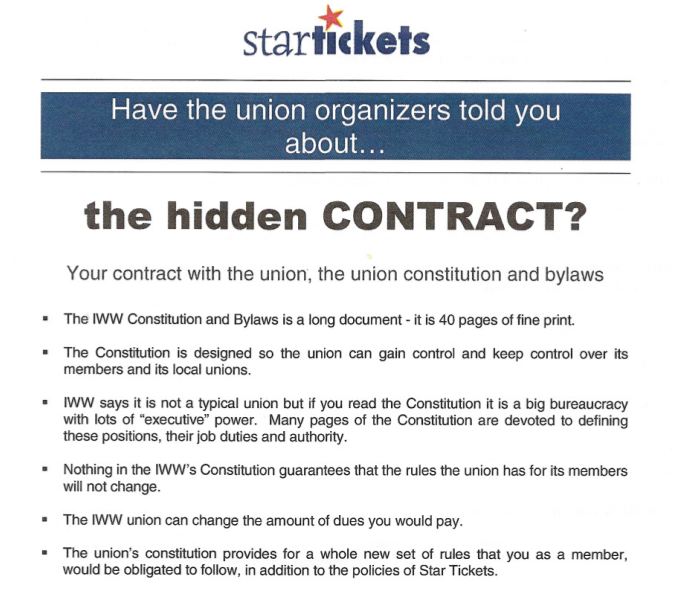
The IWW Star Tickets Workers Union has a fairly methodical response to Star Tickets management, which you can read on their Facebook Page, but we also asked some of the workers for their reaction to the anti-union propaganda. Here is what IWW Star Tickets Workers Union member Evelyn Stone had to say:
My reaction to the propaganda is that it’s really off-base, focusing on dues and bureaucracy when the IWW is different from other unions in exactly that regard. It also liberally applies double standards, accusing the union of not being able to guarantee we’ll get our demands, without holding Jack to that standard. Obviously HE’S not going to guarantee us anything if we’re on our own. We’ve been trying that one-on-one negotiation he prefers for years and nothing’s changed. And their argument seems to be “Star Tickets isn’t going to give you your demands either way so vote ‘no'”??
And trying to frame the IWW as some kind of outside entity is ironic, considering, while the union is just a bunch of people who’ve been working in this office who decided to form their own union, the firm that’s putting out all the anti-union material IS an outside entity. They know so little about our specific situation that they tried to use the scare tactic, “you might lose the benefits you have,” when almost no one in the office has benefits to begin with. And they tried to scare people by saying their dues could be as much as $27 a month, which is laughable, because nobody in this office makes anywhere near enough money to qualify for that level of dues. I’m sure we’d all be at the minimum dues level of $9 (or maybe even the sub-minimum level of $5). The firm is either being intentionally misleading there, or they are just using boilerplate anti-union arguments without bothering to research our specific office at all!
As for the reaction of coworkers, I know even though the propaganda urges people to “ask questions and get answers” the intention is not actually to get them to do that, and indeed people have been pretty silent on the topic during work hours. Though that may just be that they were annoyed by it and didn’t even bother to read it.
What do you anticipate happening with the campaign?
What I expect to happen between now and March 6th is that the company will allow things to deteriorate further and try to blame that on us. One of our demands is for them to hire more people for the Client Services department because they are so ridiculously understaffed that there’s no way for them to finish their work, which is obviously bad for the clients and therefore the whole company, and also causes problems in the operations of the Call Center.
It’s a tactic to shift the blame onto the overworked workers there for any mistakes they may make instead of placing it where it belongs, on the management that put them in a situation where it’s impossible for them to succeed. Management is going to blame the union for this, saying their hands are tied until after the election (they’ve actually claimed it’s illegal for them to make staffing changes until the election) but hopefully people are able to see through that, since, first of all, it’s not true–that staffing change is easily, easily framed as something they have to do anyway for their own good, outside of any negotiations with us. And secondly, they haven’t been afraid to make staffing changes in the call center during the election period. Not to mention, if they really believed this, and wanted to fix the situation, we gladly would have agreed to a much earlier election date.
They were the ones that wanted the maximum amount of time to campaign. To me, making things worse and blaming it on us is a transparent (and stupidly self-destructive) tactic. But it may be the most effective one they have.
Still, I am confident we will win the election, so our focus is going to have to shift to how to deal with similar tactics in our negotiations with Star Tickets as the recognized union.
The IWW Star Tickets Workers Union welcomes your continued support and solidarity and are even encouraging people to send messages to the owner and let him know that there is lots of public support for their right to organize.
Jack Krasula
Phone – 248-945-1127
Fax – 248-945-1129
Farmer vs. Monsanto Before US High Court
This article by Lauren McCauley is re-posted from Common Dreams. Editor’s Note: Another useful article to put Monsanto’s power in context can be found at Open Secrets, where their team documents not only which candidates the company contributes to, but which members of Congress have stock in the company. It is worth noting that both Michigan Congressmen Dave Camp and Fred Upton own stock in Monsanto.
Indiana soybean farmer, Hugh Bowman, is taking his one-man-war against agriculture giant Monsanto to the Supreme Court on Tuesday where both sides will present their arguments (.pdf) to the high court. The suit calls into question essential patent rights and, more importantly, challenges whether anyone can legally “control a product of life.”
A Monsanto customer for years, 75-year-old Bowman devotedly bought and planted their genetically modified (gm) ‘Roundup Ready’ soybean seeds each year. He crossed the corporation in 2007 when they accused Bowman of infringing on their seed patents after he planted an unmarked mix of soybeans which he purchased from a local grain elevator that supposedly contained the Monsanto gene.
After being ordered to pay $84,000, Bowman is appealing the charge and bringing his case to the high court where he will present before the chief justices, including former Monsanto attorney Justice Clarence Thomas.
“Bowman vs. Monsanto Co. will be decided based on the court’s interpretation of a complex web of seed and plant patent law,” writes Debbie Barker, Program Director for Save Our Seeds (SOS), and George Kimbrell, staff attorney for Center for Food Safety (CFS), in an op-ed published Tuesday, “but the case also reflects something much more basic: Should anyone, or any corporation, control a product of life?”
They continue:
[Monsanto’s] logic is troubling to many who point out that it is the nature of seeds and all living things, whether patented or not, to replicate. Monsanto’s claim that it has rights over a self-replicating natural product should raise concern. Seeds, unlike computer chips, for example, are essential to life. If people are denied a computer chip, they don’t go hungry. If people are denied seeds, the potential consequences are much more threatening.
The case has garnered national attention as it touches upon an essential debate between corporate ownership versus essential rights and sustainability.
In a supporting brief filed by the sustainable food advocacy group, the Center for Food Safety (CFS), they argue that intellectual property rules have spurred the privatization and concentration of the world’s seed supply with only ten companies controlling nearly two-thirds of all commercial seed for major crops, effectively driving up prices and dangerously limiting the variety of seeds planted. 
Bowman’s pro-bono representation Mark Walters, from the firm of Frommer Lawrence and Haug, is reportedly prepared to argue on the principle on “patent exhaustion” that the second-hand seeds are lawfully owned by the purchaser, not by the original patent holder.
As Walters explained to NPR, if you buy something that’s covered by a patent, you own it, outright. “You’re allowed to put it on Craigslist and sell it, you’re allowed to use it for your ‘ordinary pursuits of life’ is the quote from some of the old cases that we’re relying on. Imagine how commerce would work if patents owners could come out of nowhere and surprise purchasers and tell them, ‘Oh, you need to pay me a royalty, because I own a patent on this thing that you just bought.'”
The ramifications of this argument are widespread, as evidenced by the numerous other industries which have come to Monsanto’s defense including the biotech and computer software industries.
According to the Indiana Star, the Department of Justice is also siding with the corporate patent holders, reportedly asking the Supreme Court not to hear Bowman’s appeal on the basis that “the court’s decision could have repercussions for man-made cell lines, DNA molecules, some nanotechnologies and other technologies that involve self-replicating features.” Ahead of Tuesday’s hearing, CFS and SOS issued a report, “Seed Giants vs. U.S. Farmers,” (.pdf) which examines how the “current seed patent regime has led to a radical shift to consolidation and control of global seed supply and how these patents have abetted corporations, such as Monsanto, to sue U.S. farmers for alleged seed patent infringement.”
Some of the reports findings include:
- As of January 2013, Monsanto, alleging seed patent infringement, had filed 144 lawsuits involving 410 farmers and 56 small farm businesses in at least 27 different states.
- Today, three corporations control 53 percent of the global commercial seed market.
- Seed consolidation has led to market control resulting in dramatic increases in the price of seeds. From 1995-2011, the average cost to plant one acre of soybeans has risen 325 percent; for cotton prices spiked 516 percent and corn seed prices are up by 259 percent.
“Corporations did not create seeds,” said the reports lead author Debbie Barker, adding that their assertion of seed patents threatens a resource “that is vital to survival, and that, historically, has been in the public domain.”
LadyFestGR returns to Heartside on March 22 & 23!

Eight years ago, Tami Vandenberg and Sarah Scott organized a Women’s Event at the DAAC during Women’s History month and had a blast. When they heard Jes Kramer wanted to put together a women’s festival last year, they contacted her to see if it made sense to collaborate. “We decided to work together on Ladyfest 2012 and it was fantastic and hugely successful,” Vandenberg says. “The reason I helped make this event happen is to showcase the extremely talented women in our community and beyond, and to give the microphone to voices that we do not hear from often. From the workshops to the performers to the sponsors to the media, we are hoping to build a strong, confident community of women that can work together and celebrate together and collaborate together.
Ladyfest 2013 will include free workshops, a variety show, vendors and concerts featuring local, regional, and national performers. While all performers and presenters must self-identify as female, anyone is welcome to attend. Proceeds from the event will benefit Our Kitchen Table.
Performances
Jean Grae and Invincible- March 22 @The Pyramid Scheme (late show). Jean Grae rose to prominence in the underground hip-hop scene in NYC and has since built an international fan base. From Detroit, Invincible‘s spitfire wordplay has received acclaim from fans all across the world.

Night Jewel – March 22 @The Pyramid Scheme (early show). Despite its unpolished aesthetic and Ramona Gonzalez’s professed aversion to more conventional ideas about glamour, her music exists in the realm of gauzy fantasy: it is a dream world made reality.
Doctors’ Wives, the Bermudas and Claire Fisher. – March 23 @The Pyramid Scheme.
LadyFest Workshops
Workshops of LadyfestGR 2013 will take place at 3 locations in the Heartside neighborhood near The Pyramid Scheme, where Ladyfest concerts are held. The Bloom Collective’s 5th Annual Empowered Womyn’s Health Workshop will be hosting its workshop series as part of the Ladyfest line-up. OKT will present a gardening workshop, as well.
All workshops are FREE, open to the public and lead by Michigan women. Children are welcome to attend, but must be accompanied by an adult. Some mature content will be expressed/shown in workshops, so do your homework first, loves. Here’s the line-up
HEARTSIDE GALLERY AND STUDIO, 48 S. Division Ave:
12-1:30pm
Let’s Make Books! Bookmaking workshop with Victoria Marcetti and Toni Bal. Learn basic book-stitches and binding techniques, and leave with 2 finished books! Beginner-friendly, and all over 8yrs old welcome!
1:30-2pm
Get yr Tits Outta my Comics- a history of women superheroes, taught by Elyse Wild.
2-3pm
Draw your own Heroine! with Alysha Lach. The group will create our own female superheroes together, then you can draw out a comic using books made in the bookmaking workshop just beforehand!
20 person max per class, so be sure to show up on time!
(106) GALLERY, 106 S. Division Ave:
Women’s Health Workshops
2-2:45pm,
Transhealth Info, Jena Lewis from GVSU (main floor)
2-2:45pm
Legislation and reproductive rights, Dani Vilella from GR NOW (downstairs space)
3-3:45
Menstrual health/sew yr own pads with Rachel Hamilton of Bloom Collective and Mandi Creveling from Our Kitchen Table (main floor)
3-3:45
Basic Sex Ed, fertility, birth control options with Kym d from Planned Parenthood (downstairs space)
4-4:30
Aromatherapy for womyn with Deirdre and Kathy Cunningham from Bloom Collective (main floor)
4:00-4:30pm
Food Gardening in Containers with Mandi Creveling and Roni Van Buren from Our Kitchen Table (downstairs space)
4:30-5pm Yoga Nidra for deep rest and intention with Stelle Marie from The Bloom Collective (downstairs space)
30 per max per class!
THE DAAC, 115 S. Division Ave.
3-4 pm Women in Rock, presented by Shelley Salant
4-5 diy event organizing with marlee grace
5-6pm Media and advertising to girls and women, with Julia Mason from GVSU
40 person max per class!
After the workshops head to the Women’s Potluck from 5:30-6:30pm at Bloom Collective’s new space at 8 Jefferson.
Please visit LadyFestGR.com for a full schedule!
Earlier today, Democracy Now featured a story on a somewhat hidden group known as Donor’s Trust, which has created another layer of influence peddling in US policy and elections.
The featured guest on the Democracy Now segment was John Dunbar, politics editor at the Center for Public Integrity and co-author of the group’s months-long investigation into Donors Trust.
The article by the Center for Public Integrity report identifies usual suspects that channel money through Donor’s Trust, such as the Koch Brothers. However, if one looks at the graphic created by the Center, you can see that the Richard & Helen DeVos Foundation is the second largest contributor to Donor’s Trust, giving well over a million dollars.
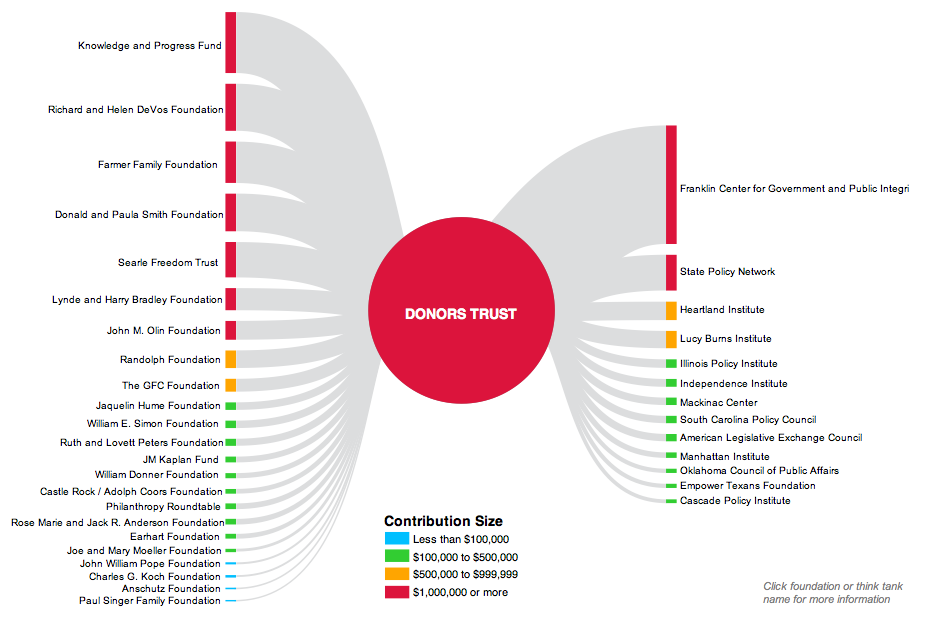
The Center for Public Integrity documents that much of the funding from foundations like the DeVos Foundation are channeled to far right Think Tanks, such as the Mackinac Center for Public Policy. Here is what their report says about Mackinac:
Ten state-level think tanks got a total of $200,000 from Donors Trust to attend ALEC meetings in 2011 including the Michigan-based Mackinac Center and the Arizona-based Goldwater Institute, which introduced a raft of anti-union model bills at ALEC’s spring 2012 conference.
The Mackinac Center has gotten $2.4 million from Donors Trust since 2008, according to the Bridge Project, a liberal think tank.
One Donors Trust grant to Mackinac Center was earmarked for “statehouse reporting” efforts. Mackinac put the money toward a media machine of blogs and research studies making the case for the state’s new “right-to-work” law.
The Mackinac Center works closely with other Donors Trust recipients, including the Franklin Center, which counts Mackinac’s “media” outlets in Michigan as affiliates.
The Franklin Center, Mackinac and another major recipient of Donors Trust cash, Americans for Prosperity, co-hosted a day-long training for “citizen watchdogs” featuring speakers on “school choice” and “union reform” from the Mackinac Center and Republican state Rep. Tom McMillin, who is also an ALEC member.
Besides the outright money that people like Richard DeVos give to candidates or the political parties to influence policy and election outcomes, they are finding other ways to channel even more funds from their foundations to an organization that is having a major impact on legislative policy across the country and right here in Michigan.
Fracking Alert: Shale Gas Bubble Looms, Aided by Wall Street
This article by Steve Horn is re-posted from DeSmogBlog.
Two long-awaited reports were published today at ShaleBubble.org by the Post Carbon Institute (PCI) and the Energy Policy Forum (EPF).
Together, the reports conclude that the hydraulic fracturing (“fracking”) boom could lead to a “bubble burst” akin to the housing bubble burst of 2008.
While most media attention towards fracking has focused on the threats to drinking water and health in communities throughout North America and the world, there is an even larger threat looming. The fracking industry has the ability – paralleling the housing bubble burst that served as a precursor to the 2008 economic crisis – to tank the global economy.
Playing the role of Cassandra, the reports conclude that “the so-called shale revolution is nothing more than a bubble, driven by record levels of drilling, speculative lease & flip practices on the part of shale energy companies, fee-driven promotion by the same investment banks that fomented the housing bubble…” a summary details. “Geological and economic constraints – not to mention the very serious environmental and health impacts of drilling – mean that shale gas and shale oil (tight oil) are far from the solution to our energy woes.”
PCI’s report is titled “Drill Baby, Drill,” authored by PCI Fellow and former oil and gas industry geoscientist J. Dave Hughes, while EPF’s report is titled “Shale Gas and Wall Street,” authored by EPF Director and former Wall Street financial analyst Deborah Rogers.
“100 Years of Natural Gas”? Uh huh…
In President Barack Obama’s 2012 State of the Union address, he repeated the fracking industry’s favorite mantra: there are “100 years” of natural gas sitting beneath us.
“We have a supply of natural gas that can last America nearly 100 years, and my administration will take every possible action to safely develop this energy,” he stated.
Hughes concludes that the “100 years” trope serves as a disinformation smokescreen and at current production rates, there are – at best – 25 years under the surface.
Industry proponents rely on a figure known as “technically recoverable reserves” when they promote the potential of shale basins. The figure that actually matters though, is production rates, or what the wells actually pull out of the reserves when fracked.
In the case of U.S. shale gas, the booked reserves are operating on what Hughes coins a “drilling treadmill,” suffering from the law of “diminishing returns.”
Hughes analyzed the industry’s production data for 65,000 wells from 31 shale basins nationwide utilizing the DI Desktop/HPDI database, widely used both by the industry and the U.S. government. He sums up the quagmire he discovered in doing so, writing,
Wells experience severe rates of depletion…This steep rate of depletion requires a frenetic pace of drilling…to offset declines. Roughly 7,200 new shale gas wells need to be drilled each year at a cost of over $42 billion simply to maintain current levels of production. And as the most productive well locations are drilled first, it’s likely that drilling rates and costs will only increase as time goes on.
The reality, he explains, is that five shale gas basins currently produce 80 percent of the U.S. shale gas bounty and those five are all in steep production rate decline.
And shale oil? More of the same.
Over 80 percent of the oil produced and marketed comes from two basins: Texas’ Eagle Ford Shale and North Dakota’s Bakken Shale, both of which are visible from outer space satellites.
“[T]aken together shale gas and tight oil require about 8,600 wells per year at a cost of over $48 billion to offset declines,” Hughes writes. “Tight oil production is projected to…peak in 2017 at 2.3 million barrels per day [and be tapped by about 2025]…In short, tight oil production from these plays will be a bubble of about ten years’ duration.”
At current production rates, Hughes concludes, there is 5 billion barrels of shale oil located underneath the Bakken and Eagle Ford, which equates to a measly ten months worth of oil at current runaway climate change-causing U.S. oil consumption rates.
PCI accompanied Hughes’ report with 43 charts and graphs and a digital U.S. map with the production data of all 65,000 fracking wells in the lower 48.
Wall Street’s Complicity
Roughly 17 months ago, activists from around the country set up encampments outside of Wall Street, coining themselves Occupy Wall Street. As Rogers’ report demonstrates, they had the right target in mind.
Rogers opens the report on a defiant note.
“The recent natural gas market glut was largely effected through overproduction of natural gas in order to meet financial analyst’s production targets,” she wrote. “Further, leases were bundled and flipped on unproved shale fields in much the same way as mortgage-backed securities had been bundled and sold on questionable underlying mortgage assets prior to the economic downturn of 2007.”
In its early days operating in the U.S., the industry cloaked itself as a “mom-and-pop” shop start-up venture.
Rogers unpacked the reality behind this rhetorical ploy, writing that Wall Street firms are “intricately married to [shale gas and oil corporations]…With the help of Wall Street analysts acting as primary proponents for shale gas and oil, themarkets were frothed into a frenzy.”
In other words, there are two spheres of economics unfolding: day-to-day in-field shale oil and gas production economics and Wall Street high finance economics. It’s the insane economics of Wall Street investors fueling the economic decisions of those working in the field, in what Rogers describes as a “financial co-dependency.”
Faulkner: “The past is never dead. It’s not even past.”
Are we witnessing another “Inside Job” of the sort Charles Ferguson portrayed in his Academy Award-winning documentary film by that namesake?
In his 1951 classic play, “Requiem for a Nun,” William Faulkner wrote, “The past is never dead. It’s not even past.”
These are the words of a sage, particularly given the past century of “The Great American Bubble Machine,” as Rolling Stone investigative journalist Matt Taibbi has documented of Wall Street’s behavior financing multiple economic spheres that have led to near system-wide collapse.
At the very least then, if it all “hits the fan,” we can’t say we weren’t forewarned.
 Grand Rapids Institute for Information Democracy