Bad Romance: Labor, Obama and the Democrats
This article by Samus Cooke is re-posted from Counter Punch.
The Democratic Party’s participation in the recent national “sequester” cuts is yet another big dent in their love affair with organized labor. But break-ups are often a protracted process. Before a relationship ends there is usually a gradual deterioration based on irreconcilable differences, until the split becomes inevitable. The decades-long marriage of labor unions and the Democratic Party is nearing such a divorce. Labor unions are becoming frustrated as the Democrats flaunt their affair with corporate America and Wall Street.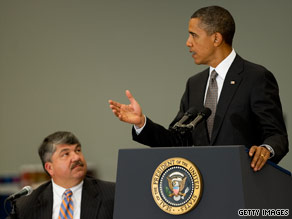
What are some of the issues driving towards separation? It just seems that no matter how much labor leaders shower the politicians with money and affection, the Democrats just aren’t returning the love.
Although the Democrats were always a fickle partner, their coldness evolved into aggression under Bill Clinton, who oversaw a slew of anti-worker legislation, most notably NAFTA and welfare “reform.”
Obama has continued this rightwards trajectory, while portraying himself brilliantly as the “lesser evil” compared with the more honest anti-union rhetoric of the Republicans. He fulfilled none of his promises to labor in 2008, and essentially ignored all labor issues in his 2012 campaign. Labor leaders misinterpreted Obama as playing “hard to get,” when in fact the Democratic Party had already moved on.
To prove his fidelity to his new crush, Wall Street, Obama has made it a pet project to target the most powerful union in the country — the teachers’ union — for destruction. Obama’s innocent-sounding Race to the Top education reform is in actuality an anti-union dismembering of public education, with its promotion of charter schools and its mass closings of public high schools that Obama labels as “failing.” Bush, Jr.’s anti-union No Child Left Behind looks innocent compared to Obama’s education “reform.”
In fact, Obama has overseen the worst environment for organized labor since Ronald Reagan. But the problem is bigger than Obama. It’s the entire Democratic Party. For example, Democratic governors across the United States continue to work in tandem with Republicans in weakening public employee unions — the last bastion of real strength in the labor movement.
The Democrats have chosen to blame labor unions for the economic crisis and the consequent budget deficits affecting the states. These deficits have been used to attack the wages, health care, and pensions of public employees on a state-by-state basis, fundamentally weakening these unions while skewing the labor market in favor of the employers.
What some labor leaders fail to understand is that political parties like the Democrats are centralized organizations that share certain beliefs, and execute these ideas in a united fashion. It isn’t merely a coincidence that every Democratic governor in the United States has chosen a similar anti-labor path, its policy. There has been a fundamental shift in the Democratic Party’s relation to labor unions, and it is on display for everyone to see.
Not all labor leaders are feigning blindness to these facts. The president of the nation’s largest teachers’ union, Dennis Van Roekel, summarized teachers’ experience with the Obama Administration: “Today our members face the most anti-educator, anti-union, anti-student environment I have ever experienced.” He was referring largely to Obama’s above-mentioned Race to the Top education program.
Van Roekel’s union, the National Education Association (NEA), also passed an excellent resolution at their national convention blasting Obama’s Education Secretary, Arne Duncan, for his anti-public education and anti-union policies.
But of course Arne Duncan is simply implementing the policies of his boss, President Obama. And Obama is simply implementing the policies of his boss, corporate America, which is insisting that market relations are imposed on public education. After passing the above resolution, the NEA leadership shamefully pressured its membership to campaign for the Obama Administration, akin to a survivor of domestic violence going to bat for the batterer.
The president of the large national public employee union American Federation of State, County and Municipal Employees (AFSCME), Lee Saunders, also lashed out against the Democrats recently:
I am sick and tired of the fair-weather Democrats. They date us, take us to the prom, marry us, and then divorce us right after the honeymoon. I am sick and tired of the so-called friends who commend us when they’re running for election, but condemn us after they’ve won. I am sick and tired of the politicians who stand with us behind closed doors, but kick us to the curb in front of the cameras. I’m here to tell you that’s bullshit and we’re not gonna take it anymore.
Accurate remarks, but they were limited to a couple of select Democratic mayors and governors. Again, there is more than a “few bad apple” Democrats who are anti-labor; the whole party is sick with this cancer.
In private, all labor leaders acknowledge this fact. Politico reports:
Top labor leaders excoriated President Barack Obama and Senate Majority Leader Harry Reid in a closed session of the AFL-CIO’s executive board meeting…Furious union presidents complained about budget cuts, a new [free] trade agreement and what some view as their abandonment, even by their typically reliable allies among Senate Democrats.
Presidents of several unions and an AFL-CIO spokesman declined to repeat their private criticism to a reporter Tuesday, a sign that labor feels it must still try to maintain a relationship with the Democratic Party, even if it’s deeply troubled.
So while the presidents of these unions speak honestly amongst themselves, they feel obligated to mis-educate their membership about the above facts. Labor leaders consistently minimize the Democrats’ role in anti-union policies, while exaggerating any morsel that can be construed to be pro-union. A mis-educated union membership makes for a weakened union movement.
When President Obama gave a largely right-wing state of the union address that included more corporate free trade agreements, more education “reform,” cuts to Medicare, and no plan to address the ongoing jobs crisis, AFL-CIO President Richard Trumka responded shamefully by saying:
Tonight, President Obama sent a clear message to the world that he will stand and fight for working America’s values and priorities.
Again, Trumka knows better. He should tell union members the truth. The AFL-CIO and other unions have lied about President Obama’s role in the national “sequester” cuts, blaming the whole thing on the Republicans. The truth, however, is that Obama formed the “the deficit reduction committee” that gave birth to the sequester. He failed to take any significant action to prevent the cuts, because he agrees with them.
Rank-and-file union members aren’t stupid. They realize it when their paychecks shrink, when their health care costs skyrocket, when their pensions are destroyed, when they’re laid off, or when they campaign for Democrats who betray them post-election. Union leaders are creating distrust within their membership as they continue down a political road that has left labor weakened and politically tied to a “partner” that’s abusing it.
The Democrats have gone “all in” with Wall Street and the corporations. The big banks now feel as comfortable throwing campaign donations towards the Democrats as the Republicans. Labor unions can’t compete with Wall Street’s cash.
Breaking with the Democrats is long overdue. And once this is done union members will likely choose the path taken by labor unions in nearly every developed country: the creation of a labor party, with its own platform, funding, and member activists.
Such a party could appeal directly to all working people by demanding that a federal jobs program be immediately implemented to put those unemployed to work as well as fighting to save and expand Social Security and Medicare, while taxing the rich and corporations to fully fund public education and other social services. Such a platform would create a massive contrast to the mainstream corporate-bought parties that exist today, and thus attract millions of members and millions more voters.
The Environmental Movement at the Crossroads
This article by Kevin Zeese and Dr. Margaret Flowers is re-posted from CounterPunch.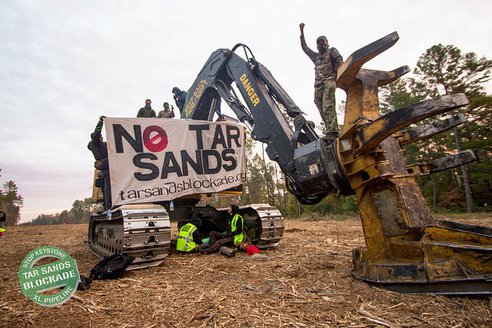
The old environmental movement,‘Gang Green,’ works inside the existing power structure, takes funding directly from polluting corporations and foundations funded by polluters, sometimes gets a seat at the table which ends up helping to pass inadequate regulation that becomes a license to pollute, while giving the law legitimacy. Some ‘Gang Green’ members show signs of realizing they are on the wrong path and need to re-make themselves to face the urgent ecological crisis of widespread toxins, species extinction, water and air pollution, soil depletion and climate change.
The ‘New Green’, often groups led by a new generation that realizes the extraction economy that allows us to continue the American way of life (AWOL) cannot continue. They see the ecological crisis caused by the carbon-nuclear based economy worsening with the “all of the above” strategy of President Obama and the corporate duopoly parties. The dangerous approaches to energy extraction including off shore drilling, mountain top removal, tar sands, hydraulic fracking and uranium mining (as well as the dangers and waste products these produce) are evidence that the human species needs to move quickly to a carbon-free nuclear free energy economy.
New Greens Rising
There is a growing culture of resistance in the environment movement as Rising Tide of North America reports. Last week the Guardian published an amazing video of the group “No Dash for Gas” in the UK occupying a gas power plant. The video showed the preparation they went through: training, intelligence gathering, practice; and then the meticulous execution of a very difficult occupation of two 300 foot chimneys of a massive gas plant. They occupied the plant for 8 days.
In a few days the video was removed from the Guardian website “pending an investigation.” At about the same time the power company, EDF, sued the activists for £5 ($7.53) million in damages. No Dash for Gas is reporting a backlash against the company and support for their cause. They point out the damages amount to .3% of the company’s profits and that within 48 hours 10,000 people signed their petition. The group makes a strong case for “disaster gas” which will bring the world closer to the climate tipping point.
In fact, we found in researching an article on hydraulic fracking, that one of the things the oil and gas companies do not want us to know is that methane, a key part of gas, leaks into the atmosphere in the fracking process. Methane is a more potent greenhouse gas than carbon dioxide by a factor of 30 to hundreds.
The anti-fracking movement in the US is growing and combative. Hundreds of thousands wrote to stop Governor Cuomo’s march toward widespread fracking and successfully stopped fracking pending research. And, More than 6,000 New Yorkers have already signed a pledge to commit acts of nonviolent civil resistance if Cuomo permits fracking. Americans Against Fracking reports more than 250 communities are taking action against fracking. Three were arrested last week in Pennsylvania blocking trees from being cut.
We have been consistently reporting on the direct action against the Tar Sands pipeline, the Keystone XL, since last August. The actions of the Tar Sands Blockade inspired people from Occupy Washington, DC at Freedom Plaza who have joined their actions. We urge you to support their upcoming national days of action March 16 to the 23. Now the blockaders are moving north to Oklahoma where they will have a training March 17 to 22rd.
We were pleased to see the Tar Sands Blockade link with Appalachia Rising to stop the operation of a hydro-fracking storage facility in Ohio. This is an important part of the ‘New Greens’ thinking – all issues are connected as we have a common enemy in corporate power that dominates government in the big finance capitalism of the United States.
Groups like Mountain Justice and RAMPS which focus on mountain top removal for coal, are now taking on fracking as well. Of course, both destroy the environment they live in. Mountain Justice is currently holding a spring break training until the 10th. Other groups like RAMPS (Radical Action for Mountain Peoples Surival) have escalated tactics against coal companies and worked with native Indians, vets, community residents and others against big coal..
We’ve also reported on the inspiring Idle No More movement since its inception and continue to do so. Last week native US Indians were occupying an area in Minnesota to block a pipeline going over their land.
A lot of these groups have fun with their protests like many of the spectacle actions of the Backbone Campaign. We enjoyed this one from the UK, protesting at a pro-fracking politicians office, putting up signs labeling him a fracking company and putting up a fracking site on the Green in front of his office. And this one from Flush The TPP, blocking their global corporate coup negotiation in Virginia.
The Uninspiring ‘Gang Green’
As inspiring as the ‘New Greens’ are the old ‘Gang Green’ is truly uninspiring. Many local environmental groups see them as selling out the environment for money and access. Some call them corporate environmentalists because they take money from polluting corporations, sometimes directly, sometimes through foundations. Of course, there are many good people in these organizations we hope they will turn these organizations around or get involved with the ‘New Greens.’
We wrote about this in our recent fracking article. There is a natural conflict between local groups that want fracking banned in their communities and ‘Gang Green’ that wants to work in the system and develop regulations that allow ‘safe’ fraking (something many think is impossible). Money undermines the credibility of ‘Gang Green’ as we wrote about regarding on group: “The Sierra Club learned a painful lesson after taking $26 million from Chesapeake Energy, a gas company involved in fracking, while using the rhetoric of gas as a clean fuel. Their new executive director, Michael Brune, refused a $30 million donation from the corporation because it undermined Sierra Club’s credibility. After the donation was made public, Brune wrote, ‘we need to leapfrog over gas whenever possible in favor of truly clean energy.’”
We hope Michael Brune brings a new direction to the Sierra Club, more aggressive challenges to the power structure, participation in direct action and no more corporate money.
These groups ally with the Democratic Party, a party that is deep in the pockets of the carbon and nuclear industries. Last week coal giant Duke Energy turned a $10 million loan for the Democratic Convention into a donation – for a convention Obama promised would take no corporate money. Then there is the nuclear industry, Sunlight Foundation reported on an Atlanta utility that hopes to get $8.3 billion in nuclear loan guarantee which miraculously is coming closer to reality after a $100,000 donation to Obama’s inauguration.
The refusal to break from the Democratic Party has been noticed with Bill McKibben’s 350.org. While they deserve credit for educating and organizing people (although there is criticism that 350 is too high a number, especially for small Island countries), they have been criticized for their ties to the Democrats. Their protests have included people wearing Obama buttons and signage that mimicks the Obama campaign. From the stage at the DC rally, Van Jones expressed his pride in working for Obama while Rev. Lennox Yearwood said, “we’re not here to protest Obama.”
Jill Stein the Green Party presidential candidate, marching in the crowd, many of who were from the ‘New Green” movement, said “Why should we have Obama’s back when he always stabs us in ours?”
Hopefully, the recent Draft Environmental Impact Statement will wake up ‘Gang Green’ to the truth that Obama and the Democrats are the other Wall Street party and not allies of the movement for a carbon-free, nuclear-free energy economy; and that we have to confront pollution profiteers not work with them.
No Time for Compromise
One of the characteristics of the ‘New Greens’ is they are welcoming. They look for the best, even in members of ‘Gang Green.’ We hope their instincts are right and the traditional environmental movement will re-make itself into the combative advocates the country needs.
This is not the time for compromise. It is not a time to be restricted by foundations or for partnerships with corporate polluters and the Democratic Party. The stakes are too high. The health of the planet is at serious risk from extreme corporate capitalism’s voracious appetite. It is time to cut off the gang green and start new.
“American neighborhoods are increasingly being policed by cops armed with the weapons and tactics of war,” says the ACLU.
This is nothing new for communities of color, immigrants and people who have been engaged in resisting state repression and global capitalism, but it is becoming more apparent to more and more people as local police departments are now using or signing up for drones.
Federal funding in the billions of dollars has allowed state and local police departments to gain access to weapons and tactics created for overseas combat theaters – and yet very little is known about exactly how many police departments have military weapons and training, how militarized the police have become, and how extensively federal money is incentivizing this trend. It’s time to understand the true scope of the militarization of policing in America and the impact it is having in our neighborhoods. On March 6th, ACLU affiliates in 23 states filed over 255 public records requests with law enforcement agencies and National Guard offices to determine the extent to which federal funding and support has fueled the militarization of state and local police departments. Stay tuned as this project develops.
Yesterday, the Michigan branch of the ACLU announced that Michigan and affiliates in 22 other states simultaneously filed 255 public records requests today to determine the extent to which local police departments are using federally subsidized military technology and tactics that are traditionally used overseas.
“Through federal grant programs, state and local police departments have virtually unlimited access to military equipment and training at no cost,” said Sarah Mehta, ACLU of Michigan staff attorney. “Although these wartime tools and tactics are free for cops, they come at great cost to communities.”
ACLU of Michigan filed five public records requests with police departments in Flint, Dearborn, Detroit and with the Michigan State Police to seek information on:
1) The use of SWAT (Special Weapons and Tactics) Teams, including:
Number and purpose of deployments
Types of weapons used during deployments
Injuries sustained by civilians during deployments
Training materials
Funding sources
2) The use of cutting edge weapons and technologies, including:
GPS tracking devices
Unmanned aerial vehicles (“drones”)
Augmented detainee restraint (“shock-cuffs”)
Military weaponry, equipment, and vehicles obtained from or funded by federal agencies such as the Departments of Defense and/or Homeland Security
A separate request, filed with the Michigan National Guard, seeks information regarding:
- Cooperative agreements between local police departments and the National Guard counter-drug program
- Incidents of National Guard contact with civilians
“Equipping state and local law enforcement with military weapons and vehicles, military tactical training, and actual military assistance to conduct traditional law enforcement erodes civil liberties and encourages increasingly aggressive policing, particularly in poor neighborhoods and communities of color,” said Kara Dansky, senior counsel for ACLU’s Center for Justice. “We’ve seen examples of this in several localities, but we don’t know the dimensions of the problem.”
In addition to the ACLU of Michigan, ACLU affiliates from Arizona, Connecticut, Delaware, Florida, Georgia, Hawaii, Maine, Massachusetts, Missouri, Mississippi, Montana, Nebraska, New Jersey, North Carolina, Pennsylvania, Rhode Island, South Carolina, Texas, Utah, West Virginia, Washington, and Wisconsin also filed the public records requests.
Once the information has been collected and analyzed, if needed, the ACLU will use the results to recommend changes in law and policy governing the use of military tactics and technology in local law enforcement.
Palestinian Priest to Speak in Grand Rapids on March 18
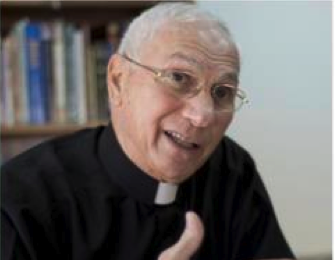
Healing Children of Conflict (HCC) is hosting two presentations by Naim Ateek in Grand Rapids on March 18. Naim is the author of several books on Israel/Palestine and on the topic of Liberation Theology.
The first lecture will take place on the Allendale Campus of GVSU, in Lake Michigan Hall, Room 114 at 3:00 PM. This talk is also co-sponsored by the Arab Culture Club, Middle East Studies Program, Peace MEans and the Religious Studies Program.
The second lecture will take place at St. Nicholas Church, located at 2250 East Paris Ave. SE in Grand Rapids at 7:00 PM.
Both talks are free and open to the public. For more information about Healing Children of Conflict, go to www.healingchildrenofconflict.org.
A Vision for Peace in Palestine/Israel
Monday, March 18
3:00PM lecture GVSU Allendale – Lake MI Hall Room 114
7:00PM lecture – St. Nicholas Church, 2250 East Paris Ave. SE
Star Tickets Workers Union Wins Election!
For the past month, we have been reporting on an effort by Star Tickets workers in Grand Rapids to form a union, as management has engaged in an increasing amount of labor abuses in recent years.
As was expected, the owner of the company responded with threats and business propaganda, which included misinformation and outright lies about the union efforts and the IWW.
Despite these efforts, on Wednesday, workers at the Star Tickets Call Center voted in favor of a union. We received a copy of a Media Release from the Star Tickets Workers Union, which reads in part:
While new Right to Work legislation has forced labor into retreat across Michigan, Grand Rapids workers made a rare advance Wednesday under the banner of the radical Industrial Workers of the World as employees of Star Tickets voted for unionization. The victorious union vote comes on the heels of a relentless anti-union campaign waged by owner Jack Krasula and an outside firm he retained.
Dubbed the IWW Star Tickets Workers Union employees came together over meager demands such as: adequate equipment, an end to understaffing, and a yearly pay evaluation.
“Our demands aim not only to benefit our workplace environment, but to improve our services to our valued clients as well.” said Deirdre Cunningham a Client Services Representative. 
Since the petition was filed owner Jack Krasula has responded by spending thousands of dollars to thwart his employees efforts. Workers have had to endure veiled threats, intimidation, and misinformation in a textbook anti-union campaign. Despite Krasula’s best efforts the workers unity has remained solid with flowers, candy, and best wishes sent from IWW branches and members from across the country.
The vote came just two days after a solidarity rally was held outside the Star Tickets building on Monday, where other IWW members and community supporters came out to send a message to the company that the Star Tickets workers had a right to form a union and create a democratic workplace.
Indeed, for weeks people have been showing their support with messages and gifts. People from other IWW chapters across the country and around the globe were sending messages of solidarity to their fellow workers in Grand Rapids.
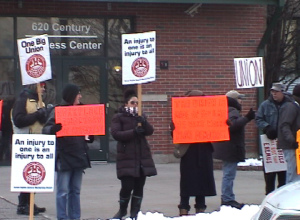
“What Mr. Krasula and this outside firm fail to realize is that when they disparage our efforts to organize with their barrage of memos they are disparaging their workers that have given years of their lives to make this company successful. We hope this is not how they intend on bargaining but either way we will continue to succeed with our solidarity and our union,” said Evelyn Stone a Call Service Representative.
The Industrial Workers of the World is a rank-and-file labor union open to all workers. Gaining prominence for the Starbucks Workers Union and the Jimmy Johns Workers Union the IWW has become the go-to union for workers not interested in the bureaucracy of traditional unions.
Lobbyists Battle Over Immigration Reform
This article by Peter Olsen-Phillips is re-posted from Open Secrets.
Seemingly everyone in Washington favors some kind of overhaul of the nation’s immigration system these days, and proposals are being polished by President Obama, the Senate’s bipartisan “Gang of Eight” and other lawmakers. But outside groups have been vigorously lobbying members of Congress on both sides of the immigration debate for some time.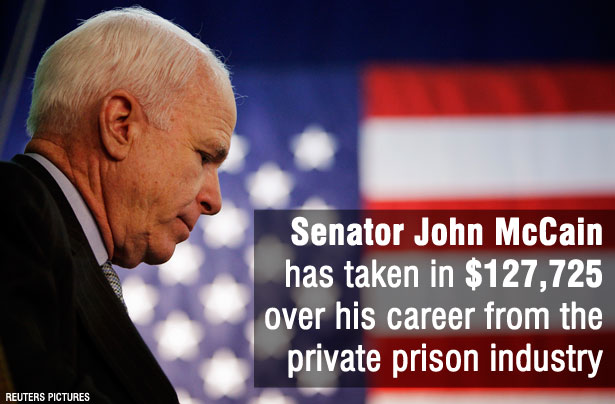
The number of clients lobbying on immigration jumped in 2012, from 317 to 355, OpenSecrets.org data shows. That’s the highest level since 2008. Just as in 2011, the tech industry was the most active on this issue. Out of the top ten organizations filing the most lobbying reports that mentioned the issue, six were tech companies or trade groups. Their big concern has to do with wanting more visas for highly skilled workers in the STEM (science, technology, engineering, and math) fields. While the national unemployment rate remains high, tech companies continually face problems in filling all of their available positions.
Microsoft in particular has been one of the industry’s strongest advocates of reform. The company spent some $8 million dollars lobbying in 2012, and filed a total of 33 reports mentioning immigration that year. Other members of the technology sector lobbying on this issue include the Consumer Electronics Association, Intel, Facebook, and Hewlett-Packard.
Beyond the tech giants, other organizations lobbying on immigration include NumbersUSA.com, Associated Builders & Contractors, and the National Roofing Contractors Association. NumbersUSA, an organization created explicitly to cut immigration to the U.S., has taken a hard stance against the proposed plans of the White House and the Senate Gang of Eight. In particular, the group faults path-to-citizenship proposals for the 11 million illegal immigrants currently living in the US. CRP data shows that NumbersUSA mentioned immigration in 12 different lobbying reports last year; the group’s $600,000 spent on lobbying last year is a far cry from the millions spent by tech giants like Microsoft or Intel — but then again, it’s a single-issue group.
Both the building and roofing contractors’ groups want any bill to include a temporary guest worker program for nonagricultural workers, so they can hire non-U.S. citizens for work that ebbs and flows. (Critics accuse the groups of wanting to pay lower wages than they’d have to pay American workers.)
Private prison contractors, such as the Corrections Corporation of America (CCA), and the GEO Group have sometimes made their case in other, more subtle ways, as the Associated Press and NBC Latino report. The private prison industry is responsible for 16% of federal prisoners in the US, and makes a substantial portion of its profits from detention centers for illegal immigrants. Tougher laws would mean higher profits, while a path to citizenship could shrink revenues.
While CCA, for example, claims corporate policy prevents it from lobbying on issues that would “determine the basis for an individual’s incarceration or detention,” OpenSecrets.org data shows the company lobbied explicitly on immigration in 2008 and 2009. And last year, work done for CCA by lobbyists at the firm Akin, Gump, Strauss, Hauer & Feld included “monitor immigration reform,” according to reports filed with the Senate. Other CCA lobbying reports last year indicated the company’s interest in budgets for the Department of Homeland Security and one of the agencies within it, Immigration and Customs Enforcement, with which CCA has contracts to house immigrant detainees.
In addition, the firm gave more than $870,000 in campaign contributions in the 2012 election cycle, OpenSecrets.org shows, with most of it going to Republicans. Top recipients of those contributions included Rep. Hal Rogers (R-Ky.) and Sen.Bob Corker (R-Tenn.), both known for having tough stances on immigration.
And the data shows Gang of Eight member Sen. John McCain — whose professed views on immigration have fluctuated over the years — is the fourth-highest career recipient of CCA campaign cash.
On the Legacy of Hugo Chávez
This article by Greg Grandin is re-posted from Common Dreams.
I first met Hugo Chávez in New York City in September 2006, just after his infamous appearance on the floor of the UN General Assembly, where he called George W. Bush the devil. “Yesterday, the devil came here,” he said, “Right here. Right here. And it smells of sulfur still today, this table that I am now standing in front of.” He then made the sign of the cross, kissed his hand, winked at his audience and looked to the sky. It was vintage Chávez, an outrageous remark leavened with just the right touch of detail (the lingering sulfur!) to make it something more than bombast, cutting through soporific nostrums of diplomatese and drawing fire away from Iran, which was in the cross hairs at that meeting.
The press of course went into high dudgeon, and not just for the obvious reason that it’s one thing for opponents in the Middle East to call the United States the Great Satan and another thing for the president of a Latin American country to personally single out its president as Beelzebub, on US soil no less.
I think what really rankled was that Chávez was claiming a privilege that had long belonged to the United States, that is, the right to paint its adversaries not as rational actors but as existential evil. Latin American populists, from Argentina’s Juan Perón to, most recently, Chávez, have long served as characters in a story the US tells about itself, reaffirming the maturity of its electorate and the moderation of its political culture. There are at most eleven political prisoners in Venezuela, and that’s taking the opposition’s broad definition of the term, which includes individuals who worked to overthrow the government in 2002, and yet it is not just the right in this country who regularly compared Chávez to the worst mass murderers and dictators in history. New Yorker critic Alex Ross, in an essay published a few years back celebrating the wunderkind Venezuelan conductor of the Los Angeles Philharmonic, Gustavo Dudamel, fretted about enjoying the fruits of Venezuela’s much-lauded government-funded system of music training: “Stalin, too, was a great believer in music for the people.”
Hugo Chávez was the second of seven children, born in 1954 in the rural village of Sabaneta, in the grassland state of Barinas, to a family of mixed European, Indian and Afro-Venezuelan race. Bart Jones’s excellent biography, Hugo! nicely captures the improbability of Chávez’s rise from dirt-floor poverty—he was sent to live with his grandmother since his parents couldn’t feed their children—through the military, where he became involved with left-wing politics, which in Venezuela meant a mix of international socialism and Latin America’s long history of revolutionary nationalism. It drew inspiration from well-known figures such as Simón Bolívar, as well as lesser-known insurgents, such as nineteenth-century peasant leader Ezequiel Zamora, in whose army Chávez’s great-great-grandfather had served. Born just a few days after the CIA drove reformist Guatemalan president Jacobo Arbenz from office, he was a young military cadet of 19 in September 1973 when he heard Fidel Castro on the radio announce yet another CIA-backed coup, this one toppling Salvador Allende in Chile.
Awash in oil wealth, Venezuela throughout the twentieth century enjoyed its own kind of exceptionalism, avoiding the extremes of left-wing radicalism and homicidal right-wing anticommunism that overtook many of its neighbors. In a way, the country became the anti-Cuba. In 1958, political elites negotiated a pact that maintained the trappings of democratic rule for four decades, as two ideological indistinguishable parties traded the presidency back and forth (sound familiar?). Where the State Department and its allied policy intellectuals isolated and condemned Havana, they celebrated Caracas as the end point of development. Samuel Huntington praised Venezuela as an example of “successful democratization,” while another political scientist, writing in the early 1980s, said it represented the “only trail to a democratic future for developing societies…a textbook case of step-by-step progress.”
We know now that its institutions were rotting from the inside out. Every sin that Chávez was accused of committing—governing without accountability, marginalizing the opposition, appointing partisan supporters to the judiciary, dominating labor unions, professional organizations and civil society, corruption and using oil revenue to dispense patronage—flourished in a system the United States held up as exemplary.
Petroleum prices began to fall in the mid-1980s. By this point, Venezuela had grown lopsidedly urban, with 16 million of its 19 million citizens living in cities, well over half of them below the poverty line, many in extreme poverty. In Caracas, combustible concentrations of poor people lived cut off from municipal services—such as sanitation and safe drinking water—and hence party and patronage control. The spark came in February 1989, when a recently inaugurated president who had run against the IMF said that he no choice but to submit to its dictates. He announced a plan to abolish food and fuel subsidies, increase gas prices, privatize state industries and cut spending on health care and education.
Three days of rioting and looting spread through the capital, an event that both marked the end of Venezuelan exceptionalism and the beginning of the hemisphere’s increasingly focused opposition to neoliberalism. Established parties, unions and government institutions proved entirely incapable of restoring legitimacy in austere times, committed as they were to upholding a profoundly unequal class structure.
Chávez emerged from the ruin, first with a failed putsch in 1992, which landed him in jail but turned him into a folk hero. Then in 1998, when he won 56 percent of the vote as a presidential candidate. Inaugurated in 1999, he took office committed to a broad yet vague anti-austerity program, a mild John Kenneth Galbraith–quoting reformer who at first had no power to reform anything. The esteem in which Chávez was held by the majority of Venezuelans, many of them dark-skinned, was matched by the rage he provoked among the country’s mostly white political and economic elites. But their maximalist program of opposition—a US-endorsed coup, an oil strike that destroyed the country’s economy, a recall election and an oligarch-media propaganda campaign that made Fox News seem like PBS—backfired. By 2005, Chávez had weathered the storm and was in control of the nation’s oil, allowing him to embark on an ambitious program of domestic and international transformation: massive social spending at home and “poly-polar equilibrium” abroad, a riff on what Bolívar once called “universal equilibrium,” an effort to break up the US’s historical monopoly of power in Latin America and force Washington to compete for influence.
Over the last fourteen years, Chávez has submitted himself and his agenda to fourteen national votes, winning thirteen of them by large margins, in polling deemed by Jimmy Carter to be “best in the world” out of the ninety-two elections that he has monitored. (It turns out it isn’t that difficult to have transparent elections: voters in Venezuela cast their ballot on an touch pad, which spits out a receipt they can check and then deposit in a box. At the end of the day, random polling stations are picked for ‘hot audits,’ to make sure the electronic and paper tallies add up). A case is made that this ballot-box proceduralism isn’t democratic, that Chávez dispenses patronage and dominates the media giving him an unfair advantage. But after the last presidential ballot—which Chávez won with the same percentage he did his first election yet with a greatly expanded electorate—even his opponents have admitted, despairingly, that a majority of Venezuelans liked, if not adored, the man.
I’m what they call a useful idiot when it comes to Hugo Chávez, if only because rank-and-file social organizations that to me seem worthy of support in Venezuela continued to support him until the end. My impressionistic sense is that this support breaks down roughly in half, between voters who think their lives and their families’ lives are better off because of Chávez’s massive expansion of state services, including healthcare and education, despite real problems of crime, corruption, shortages and inflation.
The other half of Chávez’s electoral majority is made up of organized citizens involved in one or the other of the country’s many grassroots organizations. Chávez’s social base was diverse and heterodox, what social scientists in the 1990s began to celebrate as “new social movements,” distinct from established trade unions and peasant organizations vertically linked to—and subordinated to—political parties or populist leaders: neighborhood councils; urban and rural homesteaders, feminists, gay and lesbian rights organizations, economic justice activists, environmental coalitions; breakaway unions and the like. It’s these organizations, in Venezuela and elsewhere throughout the region, that have over the last few decades done heroic work in democratizing society, in giving citizens venues to survive the extremes of neoliberalism and to fight against further depredations, turning Latin America into one of the last global bastion of the Enlightenment left.
Chávez’s detractors see this mobilized sector of the population much the way Mitt Romney saw 47 percent of the US electorate not as citizens but parasites, moochers sucking on the oil-rent teat. Those who accept that Chávez enjoyed majority support disparaged that support as emotional enthrallment. Voters, wrote one critic, see their own vulnerability in their leader and are entranced. Another talked about Chávez’s “magical realist” hold over his followers.
One anecdote alone should be enough to give the lie to the idea that poor Venezuelans voted for Chávez because they were fascinated by the baubles they dangled in front of them. During the 2006 presidential campaign, the signature pledge of Chávez’s opponent was to give 3,000,000 poor Venezuelans a black credit card (black as in the color of oil) from which they could withdraw up to $450 in cash a month, which would have drained over $16 billion dollars a year from the national treasury (call it neoliberal populism: give to the poor just enough to bankrupt the government and force the defunding of services). Over the years, there’s been a lot of heavy theoretically breathing by US academics about the miasma oil wealth creates in countries like Venezuela, lulling citizens into a dreamlike state that renders them into passive spectators. But in this election at least, Venezuelans managed to see through the mist. Chávez won with over 62 percent of the vote.
Let’s set aside for a moment the question of whether Chavismo’s social-welfare programs will endure now that Chávez is gone and shelve the left-wing hope that out of rank-and-file activism a new, sustainable way of organizing society will emerge. The participatory democracy that took place in barrios, in workplaces and in the countryside over the last fourteen years was a value in itself, even if it doesn’t lead to a better world.
There’s been great work done on the ground by scholars such as Alejandro Velasco, Sujatha Fernandes, Naomi Schiller and George Ciccariello-Maher on these social movements that, taken together, lead to the conclusion that Venezuela might be the most democratic country in the Western Hemisphere. One study found that organized Chavistas held to “liberal conceptions of democracy and held pluralistic norms,” believed in peaceful methods of conflict resolution and worked to ensure that their organizations functioned with high levels of “horizontal or non-hierarchical” democracy. What political scientists would criticize as a hyper dependency on a strongman, Venezuelan activists understand as mutual reliance, as well as an acute awareness of the limits and shortcomings of this reliance.
Over the years, this or that leftist has pronounced themselves “disillusioned” with Chávez, setting out some standard drawn, from theory or history, and then pronouncing the Venezuelan leader as falling short. He’s a Bonapartist, wrote one. He’s no Allende, sighs another. To paraphrase the radical Republican Thaddeus Stevens in Lincoln, nothing surprises these critics and therefore they are never surprising. But there are indeed many surprising things about Chavismo in relationship to Latin American history.
First, the military in Latin America is best known for its homicidal right-wing sadists, many of them trained by the United States, in places like the School of the Americas. But the region’s armed forces have occasionally thrown up anti-imperialists and economic nationalists. In this sense, Chávez is similar to Argentina’s Perón, as well as Guatemala’s Colonel Arbenz, Panama’s Omar Torrijos and Peru’s General Juan Francisco Velasco, who as president between 1968 and 1975 allied Lima with Moscow. But when they weren’t being either driven from office (Arbenz) or killed (Torrijos?), these military populists inevitably veered quickly to the right. Within a few years of his 1946 election, Perón was cracking down on unions, going as far as endorsing the overthrow of Arbenz in 1954. In Peru, the radical phase of Peru’s military government lasted seven years. Chávez, in contrast, was in office fourteen years, and he never turned nor repressed his base.
Second and related, for decades now social scientists have been telling us that the kind of mobilized regime Venezuela represents is pump-primed for violence, that such governments can only maintain energy through internal repression or external war. But after years of calling the oligarchy squalid traitors, Venezuela has seen remarkably little political repression—certainly less than Nicaragua in the 1980s under the Sandinistas and Cuba today, not to mention the United States.
Oil wealth has much to do with this exceptionalism, as it also did in the elite, top-down democracy that existed prior to Chávez. But so what? Chávez has done what rational actors in the neoliberal interstate order are supposed to do: he’s leveraged Venezuela’s comparative advantage not just to fund social organizations but give them unprecedented freedom and power.
Chávez was a strongman. He packed the courts, hounded the corporate media, legislated by decree and pretty much did away with any effective system of institutional checks or balances. But I’ll be perverse and argue that the biggest problem Venezuela faced during his rule was not that Chávez was authoritarian but that he wasn’t authoritarian enough. It wasn’t too much control that was the problem but too little.
Chavismo came to power through the ballot following the near total collapse of Venezuela’s existing establishment. It enjoyed overwhelming rhetorical and electoral hegemony, but not administrative hegemony. As such, it had to make significant compromises with existing power blocs in the military, the civil and educational bureaucracy and even the outgoing political elite, all of whom were loath to give up their illicit privileges and pleasures. It took near five years before Chávez’s government gained control of oil revenues, and then only after a protracted fight that nearly ruined the country.
Once it had access to the money, it opted not to confront these pockets of corruption and power but simply fund parallel institutions, including the social missions that provided healthcare, education and other welfare services being the most famous. This was both a blessing and a curse, the source of Chavismo’s strength and weakness.
Prior to Chávez, competition for government power and resources took place largely within the very narrow boundaries of two elite political parties. After Chávez’s election, political jockeying took place within “Chavismo.” Rather than forming a single-party dictatorship with an interventionist state bureaucracy controlling people’s lives, Chavismo has been pretty wide open and chaotic. But it significantly more inclusive than the old duopoly, comprised of at least five different currents: a new Bolivarian political class, older leftist parties, economic elites, military interests and the social movements mentioned above. Oil money gave Chávez the luxury of acting as a broker between these competing tendencies, allowing each to pursue their interests (sometimes, no doubt, their illicit interests) and deferring confrontations.
The high point of Chávez’s international agenda was his relationship with Brazil’s Luiz Inácio Lula da Silva, the Latin American leader whom US foreign policy and opinion makers tried to set as Chávez’s opposite. Where Chávez was reckless, Lula was moderate. Where Chávez was confrontational, Lula was pragmatic. Lula himself never bought this nonsense, consistently rising to Chávez’s defense and endorsing his election.
For a good eight years they worked something like a Laurel and Hardy routine, with Chávez acting the buffoon and Lula the straight man. But each was dependent on the other and each was aware of this dependency. Chávez often stressed the importance of Lula’s election in late 2002, just a few months after April’s failed coup attempt, which gave him his first real ally of consequence in a region then still dominated by neoliberals. Likewise, the confrontational Chávez made Lula’s reformism that much more palatable. Wikileak documents reveal the skill in which Lula’s diplomats gently but firmly rebuffed the Bush administration’s pressure to isolate Venezuela.
Their inside-outside rope-a-dope was on full display at the November 2005 Summit of the Americas in Argentina, where the United States hoped to lock in its deeply unfair economic advantage with a hemisphere-wide Free Trade Agreement. In the meeting hall, Lula lectured Bush on the hypocrisy of protecting corporate agriculture with subsidies and tariffs even as it pushed Latin America to open its markets. Meanwhile, on the street Chávez led 40,000 protesters promising to “bury” the free trade agreement. The treaty was indeed derailed, and in the years that followed, Venezuela and Brazil, along with other Latin American nations, have presided over a remarkable transformation in hemispheric relations, coming as close as ever to achieving Bolívar’s “universal equilibrium.”
When I met Chávez in 2006 after his controversial appearance in the UN, it was at a small lunch at the Venezuelan consulate. Danny Glover was there, and he and Chávez talked the possibility of producing a movie on the life of Toussaint L’Ouverture, the former slave who led the Haitian Revolution.
Also present was a friend and activist who works on the issue of debt relief for poor countries. At the time, a proposal to relieve the debt owed to the Inter-American Development Bank (IADB) by the poorest countries in the Americas had stalled, largely because mid-level bureaucrats from Argentina, Mexico and Brazil opposed the initiative. My friend lobbied Chávez to speak to Lula and Argentina’s president Néstor Kirchner, another of the region’s leftist leaders, and get them to jump-start the deal.
Chávez asked a number of thoughtful questions, at odds with the provocateur on display on the floor of the General Assembly. Why, he wanted to know, was the Bush administration in favor of the plan? My friend explained that some Treasury officials were libertarians who, if not in favor of debt relief, wouldn’t block the deal. “Besides,” he said, “they don’t give a shit about the IADB.” Chávez then asked why Brazil and Argentina were holding things up. Because, my friend said, their representatives to the IADB were functionaries deeply invested in the viability of the bank, and they thought debt abolition a dangerous precedent.
We later got word that Chávez had successfully lobbied Lula and Kirchner to support the deal. In November 2006, the IADB announced it would write off billions of dollars in debt to Nicaragua, Guyana, Honduras and Bolivia (Haiti would later be added to the list).
And so it was that the man routinely compared in the United States to Stalin quietly joined forces with the administration of the man he had just called Satan, helping to make the lives of some of the poorest people in America just a bit more bearable.
Foundation Profile: The Van Andel Family Foundations
This foundation profile is part of an ongoing series looking at both foundations and non-profits in West Michigan. The project is called the Grand Rapids Non-Profit Industrial Complex Project.
Today we are featuring several foundations based in the Van Andel Family.
Like the other Amway family (DeVos), the Van Andel’s have several family foundations with a significant amount of money. Unlike the DeVos Family foundations, the Van Andel’s have’t contributed as much money in recent years to organizations that are as overtly political or part of the religious right.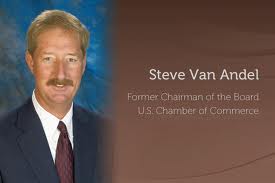
We have combined the data from the three most recent years of 990s for the Steve & Cindy Van Andel Family Foundation, the David & Carol Van Andel Foundation and the Van Andel Fund Inc.
The Van Andel Fund Inc. only contributed to two different entities between 2009 and 2011, the Public Museum of Grand Rapids ($28,342,500) and the Helen DeVos Children’s Hospital Foundation ($2 million). These are sizeable amounts in both cases and it is worth noting that Carol Van Andel sits on the Board of Directors at the Public Museum of Grand Rapids.
The Steve & Cindy Van Andel Foundation has also kept most of its contributions from the foundation local. However, there are a few exceptions that are important to note since they are part of the religious right and ultra conservatism in America.
The Steve & Cindy Van Andel Foundation contributed $30,000 to the Heritage Foundation between 2009 and 2011, a small donation to the Acton Institute ($2,500) and $2,520,000 to Hillsdale College.
Hillsdale College is one of the most conservative colleges in the country, which actively recruits those who embrace and promote what is referred to as Theocratic Dominionism. Theocratic Dominionism is a brand of Christian Right Theology that believes that the US Constitution should be replaced by the Ten Commandments and other Judeo-Christian Laws.

Hillsdale College has also had numerous Presidents with close relations with the far right. For instance, former Hillsdale President George Roche III, was a member of the World Anti-Communist League, an organization that has historical links to Nazis and Latin American Death Squads.
The Steve & Cindy Van Andel Foundation also contributed $10,000 to the ultra-right publication, The American Spectator.
The David & Carol Van Andel Foundation have also kept their contributions close to home and have funded numerous charity and social service agencies in West Michigan. They have contributed some money to far right and religious right groups such as the Acton Institute ($30,000), Prison Fellowship Ministries ($25,000) and the Dove Foundation ($25,000).
The Dove Foundation is a Conservative Christian Media Advocacy group that grades media, mostly movies, through a far right Christian lens. Their founder and President, Dick Rolfe, is a big proponent of censorship, as is fellow Dove Foundation board member Dar Vander Ark. Vander Ark is the head of the Michigan Decency Action Council, which also tries to limit and censor material they consider to be immoral.
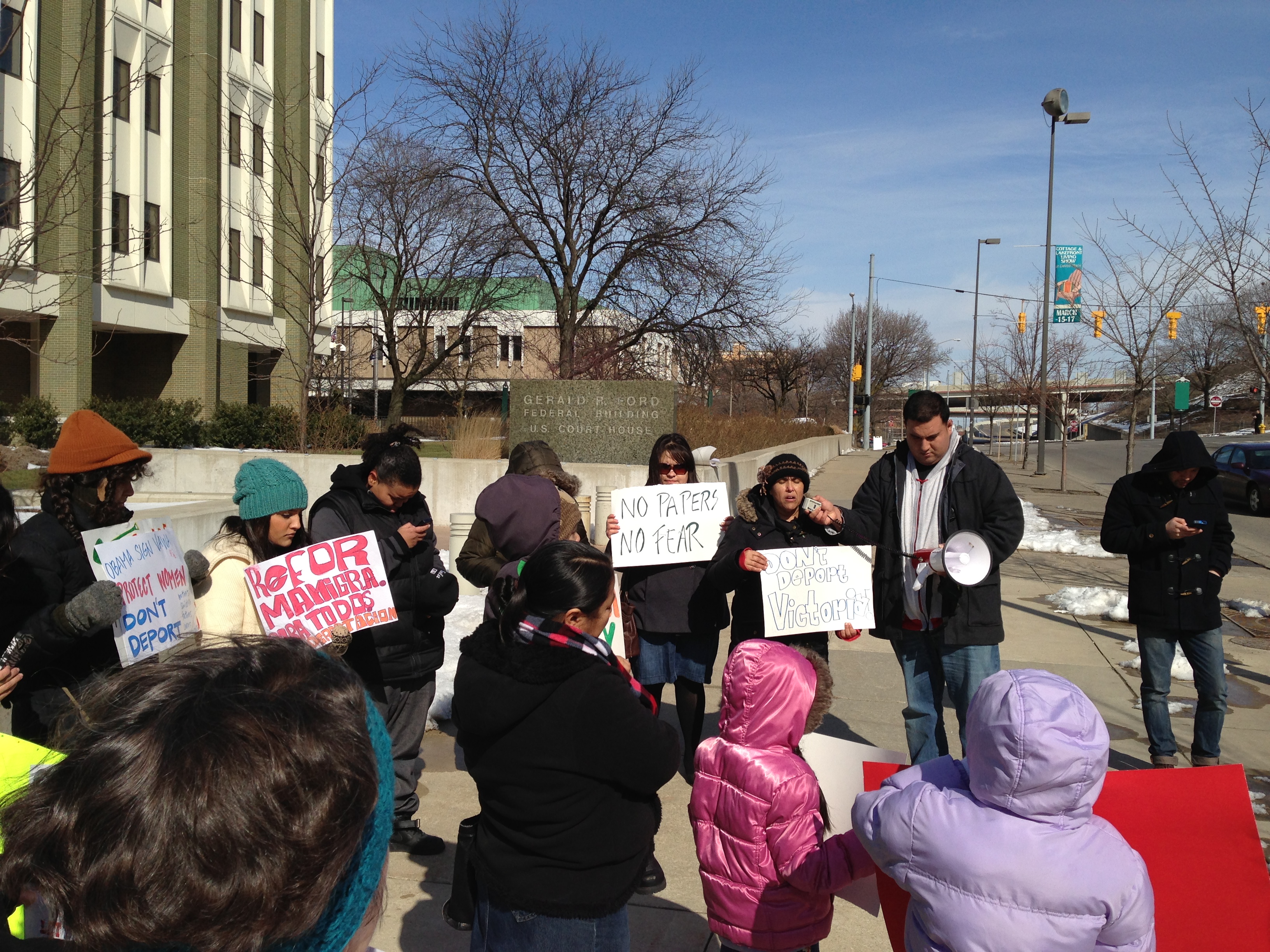
Supporters gather to hear Victoria speak
On Tuesday morning about 25 people gathered outside the federal building in downtown Grand Rapids to rally in support of Victoria Lorenzo-Calmo. Victoria is facing deportation to her native Guatemala as soon as Wednesday after unknowingly signing a voluntary deportation document, which will leave her three children either without a mother or without much needed medical care. All of Victoria’s children are U.S. citizens.
Victoria fled to the United States from an abusive husband in her homeland, wherein she was once beaten to the point of miscarriage four months into her pregnancy. Victoria, threatened with death and few options, fled to the States in 2001, where she has since found a loving partner who is the father of her three children. Two of Victoria’s children, Jaqueline, 7, and Jason, 2, have cochlear implants and will inevitably go deaf if forced to go to Guatemala with their mother, where proper medical care is not available.
At the ralley, one of Victories children held a sign reading “Don’t deport my mom”.
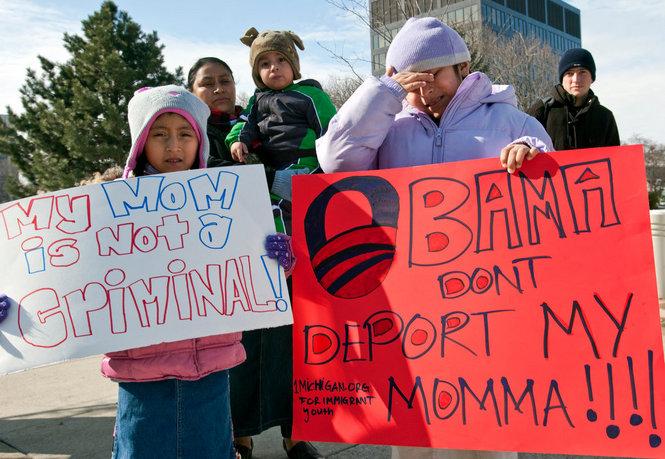
Victoria and her children, Mlive
As the community members gathered around Victoria and her children in the cold morning air, their mother pleaded to the crowd, passersby, and the press. “We will have no medicine, no means to meet our basic needs. We need each other and will fight for each other”. Victoria’s children are not being forced to leave the country, leaving their mother with the impossible choice of bringing them with her to a place where life will be a continual struggle and they will go deaf, or leave them here where she will never see them again. This rally could be some of the last time they will spend together as a family.
Left with few other options, protesters turned to prayer and the support from a higher power multiple times during the demonstration. One supporter said, “I know God will fill his purpose [and prevent deportation] of these innocent kids, who would get no medical attention.”
Victoria herself said she felt “very emotional that so many people came out in support [of her]” because of how difficult deportation will be on her family. Given the circumstances she fled from, Victoria believes her life will be at risk in Guatemala.
Immigration and Customs Enforcement (ICE) had initially given Victoria a “differed action”, effected prolonging her stay in the United States, however this action has been suddenly been denied and Victoria is expected to arrive at the ICE office on Wednesday, March 6th, prepared to leave the country.
Supporters are urged to call Khaalid Walls in Detroit at 313-226-0726 and John Morton at ICE @ 202-732-3000. The following script and talking points have been provided, as they have been effective in the past:
“I am calling to ask that you please use discretion in deporting Victoria Lorenzo-Calmo (A# 096-166-869). Her children need her and they cannot leave the country. Please do not deport Victoria.”
<> Victoria was once beaten so badly by her ex-husband that she lost the baby she had been carrying for four months.
<> If she returns to Guatemala with her children, all of their lives are in danger with the threats against her.
<> If she returns to Guatemala without her children, she will never see them again.
Obama’s Department of Fracking and Nukes
This article by Karl Grossman is re-posted from Counter Punch.
With the nomination of Ernest Moniz to be the next U.S. secretary of Energy, President Barack Obama has selected a man who is not only a booster of nuclear power but a big proponent of fracking, too. What happened to Obama’s call for “clean” energy in his 2013 State of the Union address?
Moniz, a physicist and director of the MIT Energy Initiative, heavily financed by energy industry giants including BP and Chevron, has long advocated nuclear power. He has continued arguing for it despite the multiple meltdowns at the Fukushima Daiichi nuclear plant complex, maintaining that the disaster in Japan should not cause a stop in nuclear power development.
In a 2011 essay in Foreign Affairs magazine titled “Why We Still Need Nuclear Power,” Moniz wrote: “In the years following the major accidents at Three Mile Island in 1979 and Chernobyl in 1986, nuclear power fell out of favor, and some countries applied the brakes to their nuclear programs. In the last decade, however, it began experiencing something of a renaissance….But the movement lost momentum in March, when a 9.0 magnitude earthquake and the massive tsunami it triggered devastated Japan’s Fukushima nuclear power plant…The event caused widespread public doubts about the safety of nuclear power to resurface. Germany announced an accelerated shutdown of its nuclear reactors, with broad public support.” But, insisted Moniz, “It would be a mistake…to let Fukushima cause governments to abandon nuclear power and its benefits.”
Moniz went on: “Nuclear power’s track record of providing clean and reliable electricity compares favorably with other energy sources.” Foreign Affairs is the publication of the Council on Foreign Relations, which regards itself an elite grouping of government officials, industry executives, scientists and media figures. Moniz is a member.
He also said in the essay that “the public needs to be convinced that nuclear power is safe.” As U.S. energy secretary, this will likely be a main thrust of Moniz. He would endeavor to lead the 16,000-employee Department of Energy with a budget of $27 billion for 2013 in trying to get the American public to believe in what decades ago the U.S. government promoted as “Citizen Atom.”
Likewise, when it comes to hydraulic fracturing or fracking—the process that uses hundreds of toxic chemicals and massive amounts of waste under high pressure to fracture shale formations to release gas captured in them—Moniz told the Senate Energy Committee in 2011 that the water and air pollution risks associated with fracking were “challenging but manageable” with appropriate regulation and oversight.
Fracking also can also lead to radioactive contamination. Many shale formations contain Radium-226 and other radioactive poisons unleashed in the fracking process.
Erich Pica, president of Friends of the Earth, declared after Obama’s nomination of Moniz on Monday, that the group “has grave concerns about Mr. Moniz’s history of support for both nuclear power and fracking.” Pica described Moniz’s support of nuclear power despite “the unfolding catastrophe” of Fukushima as “frightening.” On Moniz being “a big booster of fracking,” Pica said this has been “seemingly without due regard for the environmental and public health risks and impacts.”
Nevertheless, in Washington Monday, Obama, describing Moniz as a “brilliant scientist,” said: “Most importantly, Ernie knows that we can produce more energy and grow our economy while still taking care of our air, our water and our climate. And so I could not be more pleased to have Ernie join us.”
It’s not as if Obama wasn’t warned about Moniz.
For weeks, as reports spread that Moniz would be replacing Obama’s first energy secretary, the also staunchly pro-nuclear power Steven Chu, former director of Lawrence Berkeley National Laboratory, the organization Food & Water Watch circulated an online petition for people to send to Obama. It stated: “This is not the person we need as our country’s Energy Secretary at this critical moment. We need a visionary leader who can enact policies that move us away from intensive fossil fuel extraction, such as fracking, and toward a renewable energy future.” Other groups circulated similar petitions.
And it’s not as if Moniz was unfamiliar to Obama, or Washington. He has been a member of both Obama’s Council of Advisors on Science and Technology and Obama’s Blue Ribbon Commission on America’s Nuclear Future. And he was an undersecretary in the Department of Energy in the Clinton administration.
Obama’s stance as president on nuclear power has been a change from his position as candidate Obama. “I start off with the premise that nuclear energy is not optimal and so I am not a nuclear energy proponent,” Obama said campaigning in Iowa on 2007. He went on that unless the “nuclear industry can show that they can produce clean, safe energy without enormous subsidies from the U.S. government, I don’t think that’s the best option. I am much more interested in solar and wind and bio-diesel and strategies [for] alternative fuels.” As he told the editorial board of the Keene Sentinel in New Hampshire that year: “I don’t think there’s anything that we inevitably dislike about nuclear power. We just dislike the fact that it might blow up and irradiate us and kill us. That’s the problem.”
Nevertheless, in his first State of the Union speech he spoke about “building a new generation of safe, clean nuclear power plants in this country” and kept repeating that pitch. But in recent times, in the wake of the Fukushima disaster, Obama has increasingly avoided using the words nuclear power—he didn’t refer to it at all in his State of the Union address this January. Instead he has let Chu, and will let, if he is confirmed, Moniz, do the talking about nuclear power and pushing it as an energy source for the United States.
As to fracking, in his 2013 State of the Union address, Obama said “the natural gas boom has led to cleaner power and greater energy independence. That’s why my administration will keep cutting red tape and speeding up new oil and gas permits.”
 Grand Rapids Institute for Information Democracy