This week marks the 10th anniversary of the US invasion/occupation of Iraq. This is the first of a three-part series, where we will look at the media’s role in the invasion/occupation, the imperialist nature of the US invasion/occupation and the current status of Iraq and its people.
The role the US commercial media played in the lead up to and during the US invasion/occupation of Iraq cannot be understated. Most US commercial media outlets either acted as stenographers for US policy, often championing the invasion, or they promoted misinformation and lies about what was actually happening just prior and during the ongoing US occupation of Iraq.
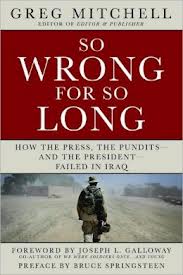
As is expected, there are numerous articles appearing on the 10th anniversary of the US invasion/occupation of Iraq. One excellent piece is by Greg Mitchell, who wrote a whole book about the complicity of the US media in regards to the Iraq war. Mitchell’s article looks at sixteen major media outrages that occurred in the US during the early months of the war, such as the statement from MSNBC’s Chris Matthews who said, “we are all neocons now.”
We conducted our own monitoring of Grand Rapids-based media during this time and produced a documentary and report entitled, Searching for the Smoking Gun: Local News Coverage of the US War in Iraq.
In our report of local news coverage (which included the Grand Rapids Press, WOOD TV 8, WZZM 13 and WXMI 17), we discovered that the local news media:
- Relied almost exclusively on US government officials and US military personnel as sources for reporting on the US invasion/occupation
- All four news outlets acted as a conduit for the US State Department Position
- None of the major claims by the US government or military were questioned or verified by the four local news agencies
- All four news stations took a public supportive position on the war
- Once the US invasion/occupation began, anti-war voices significantly diminished
- All four local news agencies almost exclusively focused on US military casualties and rarely reported on Iraqi civilian casualties.
The overall tone and content in the local news reporting was so much in line with the US government position, one would have thought they were being told what to report. And here is the sad reality. The local news media, just like the national press, was not being told what to report, which is what makes their complicity in promoting lies and misinformation so incredible.
Of course the major lies and misinformation mostly focused around the US State Department claim that Iraq possessed Weapons of Mass Destruction (WMDs). This was simply not true and no WMDs were ever found, despite the US administration’s constant claim to the contrary.
This claim was completed embraced by the US media, that when former US Secretary of State Colin Powell went before the United Nations in February of 2003, they did not question his presentation that proved Iraq was in possession of WMDs. Powell himself, once out of the government, admitted his presentation was false and that it was the lowest point of his political career.
Powell’s mea culpa aside, the US media’s failure to verify and to essentially cheerlead the US invasion/occupation led to massive war crimes in Iraq, with over 1 million Iraqi civilian deaths, according to one source.
Despite the massive human rights violations committed by the US in Iraq, no major US news media outlet admitted it was consistently complicit in these crimes. The same goes for the local news agencies based on what we documented early on in the US invasion/occupation of Iraq, nor years later in the subsequent studies we conducted in 2004, 2005 and 2007.
This was and is not merely nationalistic allegiance, it is gross complicity in the massive deaths and destruction wrought from the US invasion/occupation of Iraq. The US media is indeed partly responsible for these war crimes and needs to be held accountable for that role.

There are three organizations that are collaborating to host a public forum on fracking in Kent County, scheduled for next Monday, March 25.
The groups collaborating are, Kent County Water Conservation, Mutual Aid Grand Rapids and Citizens for Responsible Resource Management.
For several months these groups have been meeting to organize next Monday’s educational event. The groups plan to provide important information about fracking in Kent County, along with concrete things that residents can do to challenge and fight the fact that fracking will be coming to this area.
At the last Michigan DNR land auction held in Lansing in October, oil & gas companies bid on hundreds of plots of land in Kent County for future oil & gas exploration.
You can see from the map included here that land was leased by the DNR in Kent County, with concentrated areas being along the White Pine Trail, the Rogue River State Game Area and the Cannonsburg State Game Area. (the darkest areas on this map)

This forum is also to counteract the one that was held in Kent County last fall, when State Rep. MacGregor had DNR and DEQ representatives present on fracking and make the claim that it was completely safe.
For the March 25 forum the three groups have invited Maryann Lesert to give a presentation entitled, Fracking in the Forest, followed by information on ways that people can challenge and resist fracking coming to Kent County, along with time for questions.
Before and after the forum, the co-sponsoring groups will have information tables, where those in attendance can access more information on the dangers of fracking and ways to get involved in the international campaign to fight horizontal hydraulic fracturing in Kent County and across Michigan.
For more information or inquires go to the Facebook event page.
Fracking in Our Back Yard
Monday, March 25
7:00 PM (with doors and info tables ready at 6:30 PM)
Rockford High School cafeteria
4100 Kroes St. NE Rockford MI
NAFTA at 20: The New Spin
This article by Manuel Perez-Rocha and Javier Rojo is re-posted from Foreign Policy in Focus.
Only a few years ago, analysts were warning that Mexico was at risk of becoming a “failed state.” These days, the Mexican government appears to be doing a much better PR job. 
Despite the devastating and ongoing drug war, the story now goes that Mexico is poised to become a “middle-class” society. As establishment apostle Thomas Friedman put it in the New York Times, Mexico is now one of “the more dominant economic powers in the 21st century.”
But this spin is based on superficial assumptions. The small signs of economic recovery in Mexico are grounded largely on the return of maquiladora factories from China, where wages have been increasing as Mexican wages have stagnated. Under-cutting China on labor costs is hardly something to celebrate. This trend is nothing but the return of the same “free-trade” model that has failed the Mexican people for 20 years.
The North American Free Trade Agreement (NAFTA), which was ratified in 1993 and went into effect in 1994, was touted as the cure for Mexico’s economic “backwardness.” Promoters argued that the trilateral trade agreement would dig Mexico out of its economic rut and modernize it along the lines of its mighty neighbor, the United States.
The story went like this:
NAFTA was going to bring new U.S. technology and capital to complement Mexico’s surplus labor. This in turn would lead Mexico to industrialize and increase productivity, thereby making the country more competitive abroad. The spike in productivity and competiveness would automatically cause wages in Mexico to increase. The higher wages would expand economic opportunities in Mexico, slowing migration to the United States.
In the words of the former President Bill Clinton, NAFTA was going to “promote more growth, more equality and better preservation of the environment and a greater possibility of world peace.” Mexico’s president at the time, Carlos Salinas de Gortari, echoed Clinton’s sentiments during a commencement address at MIT: “NAFTA is a job-creating agreement,” he said. “It is an environment improvement agreement.” More importantly, Salinas boasted, “it is a wage-increasing agreement.”
As the 20th anniversary of NAFTA approaches, however, the verdict is indisputable: NAFTA failed to spur meaningful and inclusive economic growth in Mexico, pull Mexicans out of unemployment and underemployment, or reduce poverty. By all accounts, it has done just the opposite.
The Verdict Is In
Official statistics show that from 2006 to 2010, more than 12 million people joined the ranks of the impoverished in Mexico, causing the poverty level to jump to 51.3 percent of the population. According to the United Nations, in the past decade Mexico saw the slowest reduction in poverty in all of Latin America.
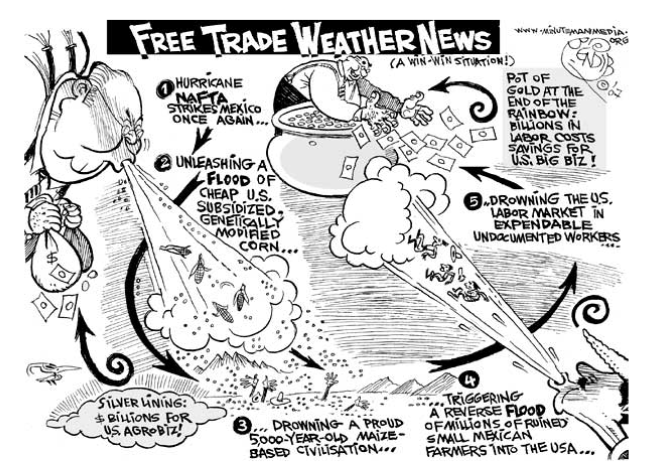
Rampant poverty in Mexico is a product of IMF and World Bank-led neoliberal policies—such as anti-inflationary policies that have kept wages stagnant—of which “free-trade” pacts like NAFTA are part and parcel. Another factor is the systematic failure to create good jobs in the formal sectors of the economy. During Felipe Calderon’s presidency, the share of the Mexican labor force relying on informal work—such as selling chewing gum and other low-cost products on the street—grew to nearly 50 percent.
Even the wages in the manufacturing sector, which NAFTA cheerleaders argued would benefit the most from trade liberalization, have remained extremely low. According to the Bureau of Labor Statistics, Mexican manufacturing workers made an average hourly wage of only $4.53 in 2011, compared to $26.87 for their U.S. counterparts. Between 1997 and 2011, the U.S.-Mexico manufacturing wage gap narrowed only slightly, with Mexican wages rising from 13 to 17 percent of the level earned by American workers. In Brazil, by contrast, manufacturing wages are almost double Mexico’s, and in Argentina almost triple.
Mexico’s stagnant wages are celebrated by free traders as an opportunity for U.S. businesses interested in outsourcing. According to one report by the McKinsey management consulting firm, “for a company motivated primarily by cost, Mexico holds the most attractive position among the Latin American countries we studied. … Mexico’s advantages start with low labor costs.”
But even as the damning evidence against NAFTA continues to roll in, entrenched advocates of the trade agreement have been busy crafting new arguments. In his recent book, Mexico: A Middle Class Society, NAFTA negotiator Luis De la Calle and his co-author argue that the trade agreement has given rise to a growing Mexican middle class by providing consumers with higher quality, U.S- made goods. The authors proclaim that “NAFTA has dramatically reduced the costs of goods for Mexican families at the same time that the quality and variety of goods and services in the country grew.”
Most of the economic indicators included in the book conveniently fail to account for the 2008-2009 financial crisis, which hit Mexico worse than almost any other Latin American country. The result has been skyrocketing inequality. As the Guardian reported last December, “ever more Mexican families have acquired the trappings of middle-class life such as cars, fridges, and washing machines, but about half of the population still lives in poverty.”
The indicators of consumption that suggest the rise of Mexico’s middle class also exclude the dramatic increase in food prices in recent years, which has condemned millions of Mexicans to hunger. Twenty-eight million Mexicans are facing “food poverty,” meaning they lack access to sufficient nutritious food. According to official statistics, more than 50,000 people died of malnutrition between 2006 and 2011. That’s almost as many as have died in Mexico’s drug war, which dramatically escalated under Calderon and has continued under President Enrique Peña Nieto.
The food crisis has coincided with the “Walmartization” of the country. In 1994 there were only 14 Walmart retail stores in all of Mexico. Now there are more than 1,724 retail and wholesale stores. This is almost half the number of U.S. Walmarts, and far more than any other country outside the United States. The proliferation of Walmart and other U.S. big-box stores in Mexico since NAFTA came into effect has ushered in a new era of consumerism—in part through an aggressive expansion built on political bribes and the destruction of ancient Aztec ruins.
The arguments developed prior to the signing of NAFTA focused primarily on the claim that the trade agreement would make Mexico a nation of producers and exporters. These initial promises failed to deliver. Throughout the NAFTA years, the bulk of Mexico’s manufacturing “exports” have come from transnational car and technology companies. Not surprisingly, Mexico’s intra-industry trade with the United Sates is the highest of any Latin American country. Yet the percentage of Mexican companies that are actually exporters is vanishingly small, and imports of food into Mexico have surged.
Same Snake Oil, Different Pitch
Because their initial promises utterly failed to deliver, the NAFTA pushers are now hyping “consumer benefits” to justify new trade agreements, including the Trans-Pacific Partnership. One of the most extreme examples of this spin is an article in The Washington Post that celebrates a “growing middle class” in Mexico that is “buying more U.S. goods than ever, while turning Mexico into a more democratic, dynamic and prosperous American ally.” Devoid of all logic, it goes on to say that “Mexico’s growth as a manufacturing hub is boosted by low wages.” How can low wages make people more prosperous?
The Post also boasts that in “Mexico’s Costco stores, staples such as tortilla chips and chipotle salsa are trucked in from factories in California and Texas that produce for both sides of the border.” Is this something to celebrate? The influx of traditional Mexican food staples, starting with maize, and goods from the United States has displaced and dislocated millions of Mexican small-scale farmers, producers, and small businesses. And not only that, Mexicans’ increasing consumption of processed foods and beverages from the United States has made the country the second-most obese in the world.
In essence, NAFTA advocates have been reduced to saying: “so maybe NAFTA didn’t help Mexico reduce poverty or increase wages. But hey! At least it gave it Walmart, Costcos, and sweat shops.”
The bankruptcy of NAFTA’s promises is only compounded by the poverty of this consolation.
GRIID classes for Spring 2013
This spring we are offering yet again two brand new classes, one on Indy Media Production and the other on Institutional Racism in Grand Rapids.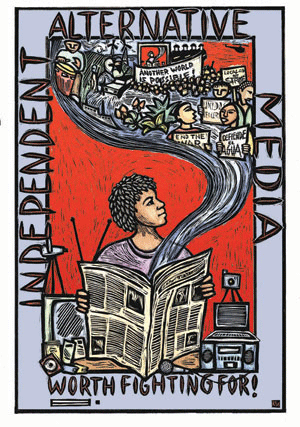
It is painfully clear from years of local news monitoring and analysis that there has been a decline in the level of journalism in West Michigan. The Indy Media Production class is being offered as an opportunity for people to learn independent journalism skills, media analysis and independent media production. For people wanting to be part of a growing movement of independent journalists, videographers, documentary makers, podcasters, zine makers or street media, then this class is for you.
This GRIID Class will primarily be project focused, and the group will be asked to work together to create local Indy media. The nature of this media, the form that it takes, the audience it speaks to, and so on, will be determined by the group. We will do a brief intro looking at the state media locally and nationally before beginning on the project.
The Indy Media Production class will take place on Mondays from 6 – 8pm, starting on Monday, April 8 and will last 7 weeks, ending on May 20.
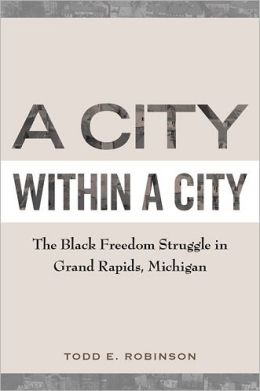
The second class we are offering, Institutional Racism in Grand Rapids, is an investigation into the function of institutional racism in Grand Rapids. We will be reading the recently released book, A City Within a City: The Black Freedom Struggle in Grand Rapids, MI, which covers the period from WWII through the early 1970s. The author of this book, Todd Robinson, names the institutional racism in Grand Rapids as a form of managerial racism.
In addition to using A City Within a City, we will investigate how institutional or managerial racism functions in Grand Rapids today, by looking at the economic, political and social condition of communities of color, as well as how White Supremacy is manifested in power structures.
The Institutional Racism in Grand Rapids class will take place on Wednesdays, from 7 – 9pm, beginning April 10 and will last 7 weeks, ending on May 22nd.
We are asking $20 for each class (does not include the cost of the book), but we will not turn anyone away for lack of funds. To sign up for either class, send an e-mail to jsmith@griid.org. Location for these class will be provided to those who sign up.
Whites Use More Drugs Than Blacks: The Great Narco Lie
This article by Auset Marian Lewis is re-posted from Black Agenda Report.
My husband is a Black man. He is one of the hardest working Americans I know, but he is wearing the face of crime in America. That means that if he is in an elevator with a white woman, she is apt to clutch her purse a little tighter. If he’s traveling down a dark deserted street, she might cross over to the other side. When he goes into a store, the security guard is likely to follow him, anticipating theft.
If you look at the prison system, it is filled with a whole lot of people who look like him. Indeed, it appears that these Black rascals are the culprits terrorizing honest, law-abiding Americans. These are the deadbeats who are sucking up all the drugs and thwarting the Drug War causing murder and mayhem in an otherwise civilized society. That is what many people think.
Although it may be of little comfort to know this, the Bernie Madoffs and Wall Street derivative junkies of the world are more likely to do you harm than my dapper husband walking to his car parked on St. Paul Street. At least we can be pretty sure that this Black man is not about to foreclose on your home due to predatory and tricky lending practices. He is not about to ship your young men off to war to be killed based on the Pinocchio principle—lying through your teeth. This Black man is not trying to rip off struggling, recession-weary Americans to give stuff to the rich. He is not likely to go to a school and unload an AR15 assault weapon on our children. Nonetheless, we easily see the criminal as the dark man whose TV images have flashed before our eyes in the Zero Tolerance Drug War aimed at black and brown communities. But isn’t that smart policing since that’s where all the criminals are? Are they really?
After Nixon launched the Drug War, there was much public conversation about drugs as an anathema to society and the need to “get tough” on drug criminals. I always thought this was because drugs were proliferating in society. As it turns out, that was not the case.
Kenneth B. Nunn, Professor of Law and Assistant Director of the Criminal Justice Center, wrote:
“In 1982, when the drug war began, the recreational use of illegal drugs was in decline…in 1982, surveys conducted by the National Institute on Drug Abuse showed significant drops in drug usage over long periods for a wide range of age groups. This decline impacted the use of both legal and illegal substances.”
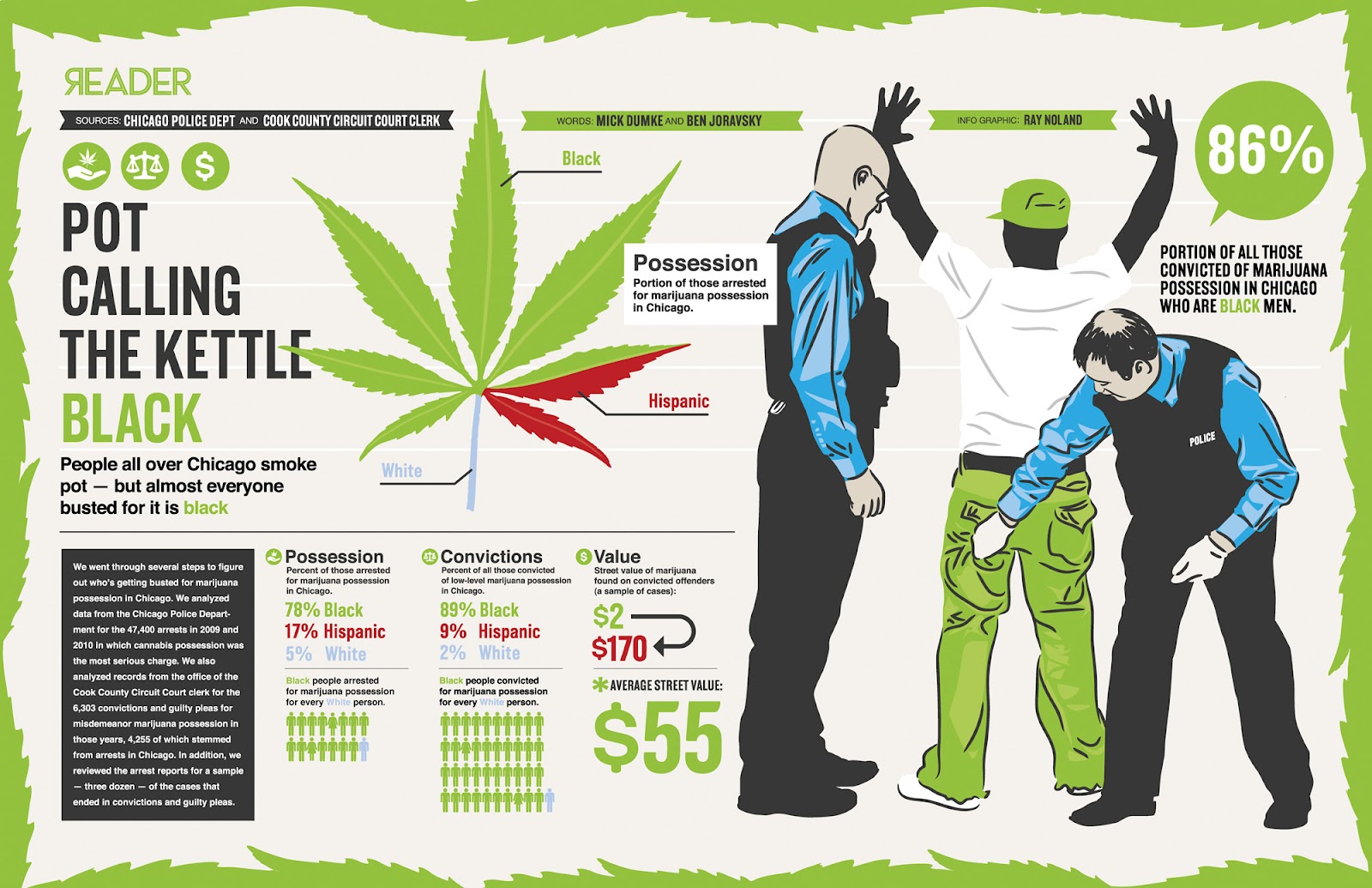
The intersection of drugs and race is striking when looking at drug arrest rates in 1988 and even in 2010. At the height of the drug war in 1988, the ratio of arrests regarding African Americans and Whites is very telling. Arrests for Black people were 1,033 per 100,000 people; Whites only 273. Over the years, the chart shows a steep decline in African American arrests, however, the ratio is still skewed—in 2010: Blacks, 723; Whites 492.
“Stop and Frisk” is a Drug War police tactic used to apprehend criminals by stopping and searching random people who cops view as suspicious. A 2011 New York Police Department study reported that in that year alone, 700,000 unfortunates were swept into this New York dragnet. Nearly ninety percent of those stopped were African American or Hispanic. With Bloomberg as Mayor, from 2003 to 2011, “stop and frisks” increased by 600 percent.
New York Civil Liberties Union Executive Director Donna Liebermann stated:
“While it appears at first blush to be a slick, fact-filled response, nothing in the report can dispute the reality that stop and frisk NYPD-style is targeted overwhelmingly at people of color, so innocent of any criminal wrongdoing, that all but 12 percent walk away without so much as a ticket.”
Is this very controversial racial profiling policy really the way to catch criminals and make our streets safer? A twelve percent yield is not a winning outcome.
So why haven’t Rambo tactics in black and brown communities, with police slamming people up against the wall to be spread-eagled, searched, insulted and demeaned, brought about better results?
White anti-racist Tim Wise, author and public speaker on White supremacy, wrote in his book Dear White America that Whites were more likely to use drugs than Blacks. When I read that, my mind went into a brain freeze. How is that possible? That can’t be true. Pictures flashed through my mind: crack addicts selling their babies, women trading shocking, deviant sex acts for drugs, and violent junkies terrorizing neighborhoods. All those faces were black.
In 2000, Tim Wise wrote, “According to the Department of Health and Human Services, Whites are eleven percent more likely to have used drugs than Blacks and twenty-five percent more likely to have done so than Hispanics.” He further reports that a National Drug Abuse Survey from the Centers for Disease Control found that Whites in high school were “seven times more likely than Blacks to have used cocaine or heroin, and six times more likely to have used methamphetamine.
In 2001, Wise revealed findings from the National Institutes on Drug Abuse, the Centers for Disease Control, and the Department of Health and Human Services, admitting the fact that contrary to popular belief, Whites were at least as likely, if not more likely, to use drugs than their black and brown stopped-and-frisked-like-a South-African kafir brethren.
Perhaps even more shocking came the statistic that it is more likely that a White male has carried a weapon in the last thirty days than…well, my husband.
As for drug dealers, according to the Justice Department, the culprits who are using and selling drugs are mostly White, middle-class males between the ages of 14 and 32. The image etched in my brain of crazy, scared White kids coming into black ghettoes to “score” exploded. Whites mostly buy from Whites and apparently keep it in their own middle-class suburbs or frat houses.
The obvious question at this point from all these government statistics is if a great deal of money has been spent to uncover these truths, why are the drug arrests and convictions so heavily skewed toward Black people. If the War on Drugs did not evolve out of a drug crisis, if the people targeted after a very racist media campaign are Black people and not Whites who are more likely to have drugs, if White people are toting guns (lest we not forget the gun-slinging NRA) more than Blacks, if they are guzzling drugs and selling them in the ‘burbs—and let’s not get into the wealthy who own the planes and banks that launder the money—if all that is true, then you mean to tell me that the face of crime in America is my Black husband. Really?
Using fear of “the other” as a chisel to carve out a hidden political agenda is boilerplate American strategy and nothing new. We can recognize this tactic today in the Republican racist dog whistles that serve to cement their political base. However, this Machiavellian strategy is as old as the scars of slavery itself.
It was in the beginning of the twentieth century that drugs became regulated. Before that, cocaine could be bought in a Sears Roebuck catalog for $1.50. Even though most of the addicted drug users were White women and war veterans whose doctors had prescribed the opiates, the face of drugs quickly became “the other.”
There was much racial animus toward the immigrant Chinese and their opium dens, which were seen as a corrupting influence on the morals of White women. The scare tactic was the myth that the Asians were seducing these women into debauchery. This culture war against the Chinese, accused of taking White people’s jobs, caused the city council of San Francisco to pass the first drug law. In 1875, they put a ban on smoking in the opium dens—meanwhile, the opiate laudunum, the drug of choice for many genteel White women (including Lincoln’s addicted wife) remained legal.
The illogical differentiation of drugs smacks of the modern cocaine/crack discriminatory sentencing guidelines. The minimum sentencing guidelines for crack cocaine were a hundred times harsher than sentencing for powder cocaine. Crack, the cheaper drug more available in poor communities, put a majority of Black people away. The media made it appear that it was mostly Black people addicted to the drug, not Whites. In 1994, 96.5% of sentences for crack abuse were applied to non-Whites. This is the tricky part, though. David B. Kopel & Michael Krause write in an article, “The Drug War Against Civil Liberty and Human Rights”:
“Yet statistics from the National Institute on Drug Abuse (NIDA) reveal that most crack users are White. Of person reporting cocaine use (in anonymous surveys) in 1991, 75% were White; 15% Black and 10% Hispanic. In the same year, persons reporting crack use were 52%, White, 38% Black, and 10% Hispanic.”
In 1914, when the federal government went on a campaign to regulate the production, sale, and distribution of opiates (an early twentieth century Drug War, so to speak) they knew that they did not have jurisdiction over criminal law. That was a matter for the states. However, they could tax, so they added a tax to the law. Further, in order to overcome objections by southern states-rights congressmen, they racialized the issue. Hence, the Harrison Narcotics Tax Act was born. A media campaign ensued to make the Black man the face of drug crime. Kopel and Krause report:
“The Harrison Act was…incited by newspapers which printed wildly racist headlines to drive up sales and to create panic about the rape of White women by Black men, high on cocaine. For example, a New York Times article titled, ‘Negro Cocaine Fiends, New Southern Menace’ claimed ‘most of the attacks upon White women in the South are the direct result of the ‘cocaine crazed’ Negro brain.”
They also warned against the Chinese and Hispanics who were charged with all kinds of vile characteristics that could threaten White people. They even said that the drug would create super-human powers and assigned police more lethal weaponry so that they could better subdue the “bogeymen”—shades of our militarized SWAT police force that developed as a result of the scare tactics of Reagan’s Drug War.
If the face of crime in America is not the Black man, then what does it look like? How can we adjust our thinking about this pervasive lie?
At its inception, the United States began as a criminal enterprise: genocide of Native Americans for land, and the enslavement of African people for profit. These are some of the greatest atrocities in human history. The effects of that cynical barbarism remain with us today in big ways and small. For some, it may seem like a small thing that my husband has to bear the face of crime in America, that people cannot see him without contemplating his criminal status. You might say that he just needs to “get over it.” Even if he could, I can’t.
What I resent the most is that I was programmed to believe a lie that denigrates my very family. A lie that I live with daily. Many people believe that the past no longer matters and that I just need to bask in the embrace of the new White liberalism. I need to embrace my peach-white, miscegenated grandchildren and call it a day. Maybe they’re right. However, I like the saying: “A lie can travel halfway around the world while the truth is still putting on its shoes.” In that regard, I take great care on how I put on my shoes in America, and tread ever so lightly on this bloody, appropriated soil.
This article by Kumar Ramanthan is re-posted from Political Research Associates. Editor’s Note: We checked with the college newspapers at Aquinas, GVSU, GRCC and Calvin and none of them ran the ad or had the Islamophobic ad sent to them.
Across college campuses last week, students were faced with a full-page ad promoting “Islamic Apartheid Week”. Funded and placed by the David Horowitz Freedom Center, it appeared during the annual “Israeli Apartheid Week” organized by pro-Palestinian groups on many of the same campuses.
The ad draws several disparate stories together under the title “Faces of Islamic Apartheid.” It shows six photos, as if seen through a sniper rifle, overlaid with the Islamic crescent and star. The photos depict a range of Muslim individuals who have been killed or sentenced to death in recent years, and the ad blames Islam for their deaths. The captions include “Texas teenagers shot dead by their father . . . an Egyptian-born Muslim” and “Sentenced to death by stoning in Iran for the crime of adultery.” A website for “Islamic Apartheid Week” is promoted at the bottom.
According to its mission statement, the David Horowitz Freedom Center “combats the efforts of the radical left and its Islamist allies to destroy American values.” The organization has come under fire repeatedly for Islamophobic rhetoric, and it funds Islamophobic media outlets such as Jihad Watch. It launched its Islamic Apartheid Week event last year as a “national campaign to expose the brutal discrimination that occurs under Islamic Sharia law.” Advertised speakers included extremist anti-Muslim leaders Pamela Geller and Robert Spencer. Geller, Spencer, and two other right-wing speakers were featured during the inaugural Islamic Apartheid Week at Temple University last April. According to the event’s website, seven other campuses have held similar events, though there has been no coverage of these events in the newspapers of those colleges.
The full-page ad appeared in the campus newspaper of at least seven colleges last week: Rutgers, Colorado State, George Washington, University of Texas at Austin, Tufts, University of North Carolina at Chapel Hill, and the University of Pennsylvania. Student groups on five of these campuses held Israeli Apartheid Week events, designed around the idea that Israeli policies towards Palestinians are unequal and segregationist, during the same week. According to an email sent to donors and supporters last week, the Center originally planned to target 40 campuses. Ultimately, a Center employee noted that nine college newspapers turned down the ad, including five in the University of California system.
Editors of three publications in which the ad appeared issued apologies. Susannah Jacob of the Daily Texan called the ad “a convoluted incitement to violence that preys upon existing prejudice,” and Tufts Daily editor Martha Shanahan wrote that “[publishing the ad] was irresponsible, and it gave voice to a party whose voice does not belong at Tufts.”
The Horowitz Freedom Center’s Daniel Greenfield defended the ad, claiming that “the campus culture of political correctness drowned out [the victims’] voices and apologized for even allowing their stories to be told.” Greenfield’s piece, published in a variety of right-wing media outlets, claims the goal of the ad is to “[address] bigotry threatening minorities in the Muslim world” and calls Israeli Apartheid Week events “a festival of hatred.”
The Pope and Politics
This article by Peter Hart is re-posted from Fairness & Accuracy in Reporting.
Argentine cardinal Jorge Mario Bergoglio was chosen as the new pope this week. But coverage often glossed over the most intense political controversies about him. 
On NBC Nightly News (3/13/13), the network’s Vatican analyst George Weigel told viewers that Pope Francis was “a man of God… a man who is a great defender of democracy in a country where democracy is under real stress right now in Argentina.”
He went on:
He is a very, very warm gentleman. I spent an hour with him in Buenos Aires last May. I was touched by his intelligence, by his manifestly deep interior life, his spiritual life. Got a very clear-eyed view of the troubled politics of his own country.
It’s hard to know exactly what Weigel means by the “stress” and “troubled politics” in Argentina. The major political dispute Bergoglio was involved in was his fervent opposition to gay marriage, which he called a “destructive attack on God’s plan.” Argentine democracy thought otherwise, and the senate passed a marriage equality law.
Weigel called him “a reformer his whole life,” saying, “I think the world is going to get to love this man very quickly.”
“Reformer his whole life” is a strange way to describe Bergoglio, given the intense controversy over his actions during the military junta that seized control of the country in the late 1970s. Thousands were killed, tortured and disappeared. According to his critics, Bergoglio–as head of the Jesuits in Argentina–failed to stand up to, or even conspired with, the brutal dictatorship.
A USA Today report (3/14/13) also touched lightly on that history, noting that Bergoglio was known for “tangling with the powerful leftists who have run Argentina for years.” The paper explained that he
never shared the political activism of some of his fellow Jesuits, especially during turbulent times in the ’70s. He fought fiercely against the left-leaning liberation theology movement that swept Latin America
As USA Today puts it, “He tried to repair the reputation of a church that lost many followers by failing to openly challenge Argentina’s former dictatorship.” The paper noted, “Under Bergoglio’s leadership, Argentina’s bishops issued a collective apology in October 2012 for the church’s failures to protect its flock. ”
Little more is mentioned. This is striking, because much of the piece comes from an Associated Press report (3/13/13) by Brian Murphy and Michael Warren that thoroughly discussed the accusations against Bergoglio. Right after the preceding comment about the apology, the AP reporters summarized some of the criticism of Bergoglio, including accusations that he refused to support two priests who were kidnapped in 1976, and that he was “accused of turning his back on a family that lost five relatives to state terror”– a story that involves the theft of a baby.
Whatever the specifics, the role of the church was vital in supporting the dictatorship. As human rights attorney Myriam Bregman put it, “The dictatorship could not have operated this way without this key support.”
USA Today omitted this damning information, but did include this characterization from Bergoglio’s official biographer:
Bergoglio almost never granted media interviews, limiting himself to speeches from the pulpit, and was reluctant to contradict his critics, even when he knew their allegations against him were false, he said.
While Pope Francis may be inclined to avoid speaking about his critics, that’s no reason for media not to speak with them. For a critical take, you can check out Democracy Now!‘s March 14 broadcast.
The Arithmetic of Desperation in Detroit
This article by Chris Lewis is re-posted from CounterPunch.
Lansing has it out for Detroiters. That’s William Scott’s estimation, at least. “The politicians in state government, in my opinion, care more about the suburbs than here in Detroit,” the retired auto worker told me a few years ago, sitting in a lawn chair perched alongside one of the city’s many barren avenues.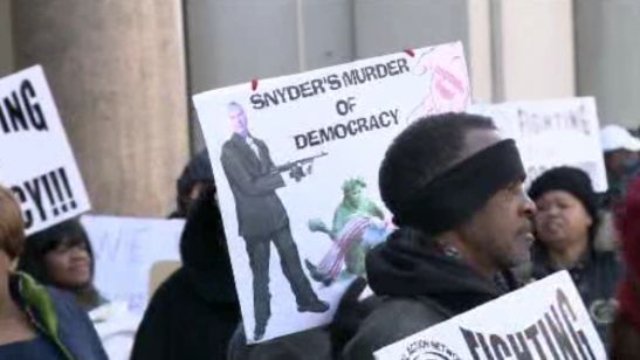
During the summer of 2009, I conducted ethnographic research in Detroit, speaking with dozens of residents about how they conceptualized their city’s economic strife. In my interviews, the perception of a hostile state and federal government was pervasive.
That finding might mean trouble for Kevyn Orr, the 54-year-old lawyer and business-restructuring specialist pegged by Michigan Governor Rick Snyder become emergency manager of Detroit’s finances. A Michigan law allows this state overseer to supersede local elected officials, cut costs, axe city departments, change union contracts, and sell public assets.
Detroit is chronically on the brink of running out of cash, and has over $14 billion in long-term debt. Governor Snyder declared a financial emergency on March 1st, and in public statements suggested that Detroit has brought the crisis upon itself by failing to spend within its means. “The city had 1.8 million people [in 1950], now it has 700,000 people, and government hasn’t adjusted accordingly,” he said in a video on his website. “We’re not going to bail out the City of Detroit financially,” he added in an interview.
But Detroit’s crisis is the product of decades of disinvestment and deindustrialization, forces of a scale greater than we can reasonably ask any city to adjust to. William Scott was right to be suspicious—Snyder’s tough talk suggests that Detroit is in for a destructive brand of number crunching.
Sixty years ago, Detroit was renowned as America’s industrial capital. Since then, a slow exodus of jobs—and after them, residents—has withered the city. “Most of the people who could afford to leave have already left,” Joe Darden, assistant professor of geography at Michigan State University told Remapping Debate. “Everybody who could, packed up and went to the suburbs years ago.”
The residents who remain are the portrait of an American underclass: over a third of Detroiters live in poverty and 17 percent of them are unemployed. Detroit is, to put it bluntly, a very impoverished city.
Because of such widespread hardship, the public services provided by the city government are essential, yet very difficult to fund. The city taxes both income and property at the highest rates Michigan law allows but Detroit residents hold little taxable wealth. The average home in the city is worth less than $80,000 and Detroiters still struggle to afford tax payments to the city—a color-coded map shows a fiery sea of delinquency and foreclosure.
Though it’s rarely recognized in state or national media, Detroit has already instituted its own program of devastating austerity in an attempt to regain solvency. The city has closed almost half of its schools since 2005, and 28 more closures were recently proposed. Police officer rolls were cut almost in half between 2000 and 2008. Half of the city’s bus service has been lost since 2005. Of Detroit’s over 300 parks, only 57 will open this year. The budget in place for 2012-13 cut $246 million, 2,600 jobs, and the entire health and human services departments.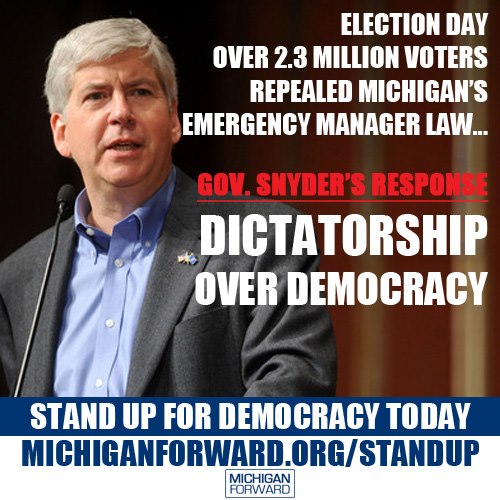
Despite all this hacking and slashing, Detroit still faces an imminent cash shortfall. That’s because the city faces a “structural deficit.” Detroit cannot pay for its own needs. It’s just too poor. The city’s budget is for all intents and purposes unbalanceable, at least not without drastic human cost.
Snyder’s determination to balance the budget without state revenue signals a willingness to pay that drastic human cost.
The governor has been thin on details about how exactly he will bring the city back into the black, but the Detroit Free Press reported that any plan would probably include “drastic cuts” to city services. The rumor mill is abuzz with suggestions that the state intends to privatize the city’s water department; in the past, Snyder has proposed converting beloved Belle Isle (the closest thing Detroit has to Manhattan’s Central Park) into a state park with an entrance fee; and materials put out by the Governor ominously highlight the costliness of pensions and health benefits for retired city workers.
The obvious counterargument is that the emergency manager will succeed instead by cutting waste and dysfunction. To be fair, Detroit’s budget likely has plenty of it.
In the western Michigan town of Muskegon an emergency manager for the school system was able to trim some fat, selling off school buses that were going unused by the district. But deeper cuts were also made to balance the books: the public school system was converted into a charter system run by a private company, prompting some teachers to leave for other districts.
Meanwhile, in Ecorse, an emergency manager cut 40 percent of city staff and privatized emergency medical service. And in Pontiac, a litany of city services have been privatized and public assets—even city hall—have been put up for sale.
Similar cuts in Detroit would make the city even less desirable to current and prospective residents, further compounding the city’s revenue problems. Plus, balanced books won’t make Detroit any less poor, blighted, or violent. For that, the city would need a massive investment of resources. As Mark Binelli suggested in the New York Times last month, the federal bailout of near-bankrupt New York City in the 1970s could serve as a model.
“Detroit needs money,” he wrote.
In my research in 2009, one pattern I found was an acute sense that Detroit and its people have been deserted by American society. “This is the land of forgotten,” one Detroit resident told me. “This is where people don’t supposed to exist.”
Among industrialized countries, America is unique for its willingness to let people slip through the cracks, to be left behind. These Americans are often scattered and invisible but in Detroit they are concentrated, the city’s borders functioning as a sort of economic sieve. The Motor City may be our clearest view of what “left behind” looks like in America.
For that reason, Detroit carries enormous symbolism. The way we treat this chronically impoverished, mostly-black city is a reflection of the way we treat America’s most underprivileged. Governor Snyder has decided to effectively depose Detroit’s elected leaders and has dismissed the suggestion that anyone should open their pocketbook to help the city recover. Not only that, he has done it with widespread public acquiescence. What does that say about us?
Meet the Private Prison Lobby
This article by Laura Carlsen is re-posted from CounterPunch.
As the immigration reform debate heats up, an important argument has been surprisingly missing. By granting legal status to immigrants and ordering future flows, the government could save billions of dollars. A shift to focus border security on real crime, both local and cross-border, would increase public safety and render a huge dividend to cash-strapped public coffers.
This kind of common-sense immigration reform has the multibillion-dollar private prison industry shaking in its boots. Its lobbyists are actively targeting members of congressional budget and appropriations committees to not only maintain, but increase incarceration of migrants — with or without comprehensive immigration reform.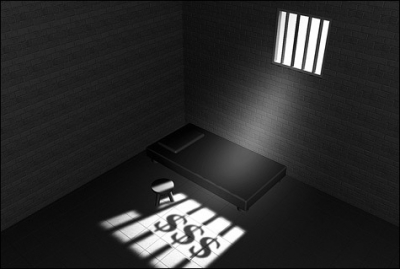
While a broad public consensus has formed around the need to legally integrate migrants into the communities where they live and work, private prison companies Corrections Corporation of America (CCA) and The GEO Group, thrive off laws that criminalize migrants, including mandatory detention and the definition of immigration violations as felonies.
CCA and GEO also know that in the current immigration debate they cannot come straight out and say ‘immigrants should be defined as criminals because it makes us rich’—even though it does. CCA comes pretty close to saying this in its 2010 Annual Report, when it warns that “any changes [in the laws] with respect to drugs and controlled substances or illegal immigration could affect the number of persons arrested, convicted and sentenced, thereby potentially reducing demand for correctional facilities to house them.”
So most of their work is behind the scenes. Their number-one goal: to assure that no matter what else happens, Operation Streamline—their goose of the golden eggs—survives, with more money than ever.
Border enforcement and immigration reform
Operation Streamline began in 2005, and it imprisons men and women for immigration violations, sometimes up to 10 months or more, and it channels more than $1 billion a year in federal funds to private-run detention centers.
Bob Libal, of Grassroots Leadership, which issued a major report on Operation Streamline’s migrant-to-prison pipeline last year, commented on Operation Streamline and related programs, “These are programs where immigrants lose years of their lives and taxpayers lose billions of dollars, but the private prison corporations are counting on these programs to make profits to pay their executives exorbitant salaries and reinvest their money in lobbying efforts.”
He notes that the problem of decoupling immigration reform from enforcement is a political—and economic—one. “There is no legal reason why we can’t fix our immigration system and legalize people who are here without increasing border militarization and criminal penalties.”
It would seem contradictory for a program that rounds up undocumented migrants to be funded alongside comprehensive immigration reform. Yet both President Obama’s plan and the plan put forward by the Gang of 8 senators call to increase Border Patrol enforcement programs.
Enlace, coordinator of the National Private Prison Detention Campaign, has compiled data on private prison industry money to pressure Congress for more enforcement business in any comprehensive immigration reform bill.
Lobbying for Lock Up
Private prison corporations, especially CCA and GEO, have begun a massive effort to assure that even if immigration reform goes through, the practice of locking people up for immigration infractions will continue.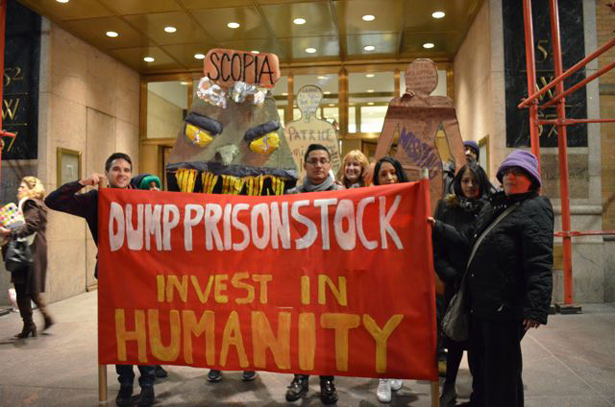
They have the money and the clout to push their agenda on the hill. Working without fanfare, the private prison lobby has targeted key Congressional representatives, especially on the finance, budget and judiciary committees. Using the lever of hefty campaign donations, lobbyists for these companies have been working for years to get Congress members in their pockets by slipping money into theirs.
First, a brief guide to the private prison lobby. Numbers are from their 2012 quarterly lobby disclosure reports filed with the Secretary of the Senate and Clerk of the House. The Center for Responsive Politics has a useful site where much of this information is posted.
Akin Gump Strauss Hauer & Feld, lobbyist for CCA, received $220,000 for its services for CCA in 2012.
Mehlman Vogel Castagnetti Inc., received $280,000 to lobby for CCA in 2012. McBee Strategic Consulting received $320,000 in 2012 from CCA. CCA in-house lobby registered $970,000 in lobbying for 2012.
Navigators Global lobbies for GEO. GEO paid Navigators Global $120,000 for lobbying in 2012. Lionel (Leo) Aguirre was also paid $120,000 for lobbying for GEO.
Among the gang of eight senators, all but Lindsay Graham and John McCain have received significant money from the private prison corporations. The transparency watchdog, Open Secrets, compiled the figures by adding contributions from members, employees, PACs or immediate family members of the organization.
* Chuck Schumer (D-N.Y.): Chair of the Rules Committee, Member of Judiciary and Chair of Subcommittee on Immigration and Border Enforcement. In 2012, Schumer received at least $64,000 from lobbyists Akin Gump et al, and $2,500 from Mehlman Vogel. He also received $34,500 from FMR (Fidelity), which owns 5.09 percent of CCA and 8.67 percent of GEO.
* Marco Rubio (R-Fla.): Member of the Commerce, Science, and Transportation Committee, and Foreign Relations, received $29,300 from the GEO Group. Wells Fargo (also heavily invested in private prisons) gave Rubio $16,150.
* Bob Menendez (D-N.J): Finance Committee, new chair of Foreign Relations, received more than $39,000 in documented money from private prison lobbyists, with $34,916 coming from Akin Gump, $6,300 from Mehlman Vogel Castagnetti Inc. and $1,000 from McBee Strategic Consulting.
* Michael Bennet (D-Colo.): Finance Committee, received at least $30,794 from Akin Gump.
The prison lobby also targeted other key members of Congress. Patty Murray (D-Wash.), chair of the Senate Budget committee and member of Appropriations, received $21,600 from Akin Gump; $74,700 from McBee Strategic Consulting.
Debbie Wasserman Schultz (D-Fla.), who is on the House Budget and Judiciary committees, received money from: Akin, Gump et al ($19,600); and contributions from Mehlman Vogel associates totaling $2,500.
What these lobbyists want for their money is an immigration reform bill that tightens, rather than loosens the criminal net for undocumented workers and their families.
The inhumane and illogical step of pre-deportation detention was invented by the private prison industry. Last year, the Obama administration spent more money on immigration enforcement, including detention, than all other federal law enforcement agencies combined — a staggering $18 billion. The detention centers receive $166 per person, per day in government funds — an amount that would be a godsend to a homeless family or unemployed worker.
Peter Cervantes-Gautschi, director of Enlace, notes, “The private prison industry is swamping the Senate Budget and Appropriations Committees to try to buy them to keep Operation Streamline so they can incarcerate more immigrants in private prisons despite immigration reform.” There is nothing surprising about that, he adds, “That’s their business.”
The national movement made up of local organizations against private detention centers has a simple demand — stop funding private immigrant detention centers. They have blocked construction of new prisons and pressured investment funds and individuals to divest from private prison stock. They have also turned their sights on the politicians that feed federal money into the system.
Maria Rodriguez of the Florida Immigrant Coalition, a member of the divestment campaign, explains that her group is meeting with Florida Congressional representatives to counteract the influence of the private prison lobby.
“In the broadest sense, what we’re trying to do is to show the financial impact on policies and the conversation in the context of immigration reform,” she says.
Are members of Congress being bought off? Rodriguez replies, “I think that when people are being heavily lobbied and when there’s financial interests involved and when our representatives are benefiting from those financial interests directly through lobbying, it compromises their ability to do what’s right for taxpayers and immigrant families.”
Campaign leaders say it’s important for constituents to know the kind of pressure their representatives are under. There’s a lot at stake for the private prison companies. CCA and GEO reported combined revenues of $3 billion dollars in 2011, with nearly half — $1.3 billion — coming directly from federal government, according to 2011 annual reports. They will fight hard for continued incarceration under immigration reform — whether it makes sense policy-wise or not.
The human rights issues involved in locking up migrants for profit, separating families and detaining individuals in poor and humiliating conditions rarely even make it into the debate. Instead, politicians are tempted to curry support among the prison industry and conservatives, with more talk of “enforcement” as the trading chip for citizenship and less talk of human rights.
Meanwhile, citizen groups are hoping that greater transparency and public awareness of the role of private prison corporations will lead to a more lasting and rights-based comprehensive immigration reform, one where for-profit immigrant detention centers become a relic of a crueler past.
This Day in Resistance History: Activists arrested in protest for the Americans with Disabilities Act in 1990
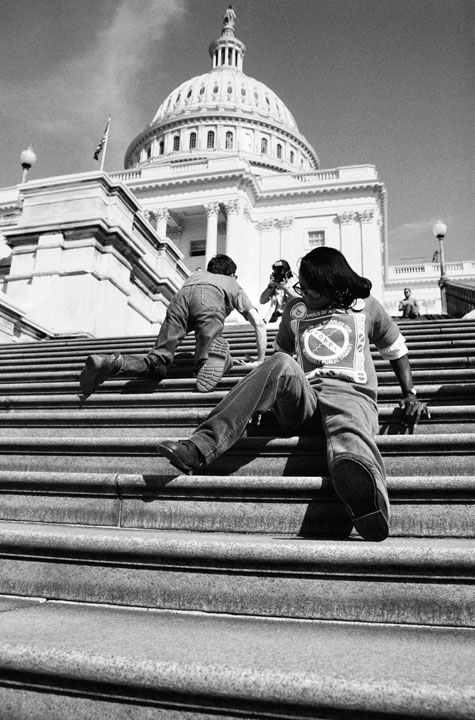
On this day, March 14, 1990, at least 16 activists were arrested in Washington, DC during a protest where people were demanding that the federal government pass the Americans with Disabilities Act.
There were numerous actions during that week in March of 1990 and one of those acts was organized by the group ADAPT. ADAPT is a disabilities rights group that was founded in 1983 and known for using non-violent direct action as a primary tactic for social change.

ADAPT organized what they called the DC Capitol Crawl in March of 1990, where people who were in normally in wheelchairs, got out of the wheelchairs and dragged themselves up the steps of the Capitol building in DC. This wasn’t just a symbolic protest against the systematic lack of accessibility in the US for people with disabilities, it was a direct confrontation against the federal government, which also did not make accessibility a priority before they were forced to face the Americans with Disabilities Act.
Other actions involved people chaining themselves to buses, since the public transit system did not make it a priority to have wheelchair lifts, making buses accessible to people with disabilities.
It was because of these kinds of actions that the federal government finally signed into law the Americans with Disabilities Act in July of 1990.
Today, we honor the courageous and committed members of ADAPT and others who fought for more rights and freedom to move about that the ableist world had denied them for too long.
 Grand Rapids Institute for Information Democracy