Foundation Profile: Edgar & Elsa Prince Foundation
This foundation profile is part of a series, which is part of our Grand Rapids Non-Profit Industrial Complex Project.
The Edgar & Elsa Prince Foundation have a long history of support for right and religious right causes, in Michigan, across the country and even around the world.
The foundation is primarily run by the children of Edgar & Elsa Prince, which includes Emily Wierda, Betsy DeVos and Erik Prince. The following information is based on the data we found from the foundation’s 990s for 2009 – 2011.
Some of the larger recipients of the Edgar & Elsa Prince Foundation money in the three most recent years of data are the Family Research Council ($1,753,850), Focus on the Family ($1,347,000) and the Haggai Institute ($1,400,000).
Focus on the Family has a long history of supporting repressive roles for women and has taken strong stances against women’s reproductive rights and LGBTQ equality. Their founder, James Dobson has been a leader in the religious right and even promotes a form of Christian Theocracy.
The Family Research Council has taken strong anti-LGBT stances over the years, along with advocating a male-dominated nuclear family model. The Southern Poverty Law Center has even identified as a hate group, particularly because of its anti-LGBT positions.
Other religious right groups that have been the recipients of contributions from the Edgar & Elsa Prince Foundation are the American Family Association ($20,000), the Dove Foundation ($20,000), Prison Fellowship Ministries ($170,000) the Promise Keepers ($25,000), the Rutherford Institute ($35,000) and the American Alliance of Jews and Christians ($10,000).

A few lesser known Christian Right groups to have received money from the Edgar & Elsa Prince Foundation are the Wycliff Bible Translators ($5,000) and the Bible League ($20,000). These two groups have a history together, since the Bible League provides translations of the Christian bible, which Wycliff translates and distributes globally. The Wycliff Bible Translators, also known as the Summer Institute of Linguistics, has a long history of going into indigenous communities to evangelize, collaborating with dictatorships and multinational corporations, which have at time led to cultural and physical genocide.
Some of the religious groups that the Edgar & Elsa Prince Foundation have funded are also anti-abortion facilities, such as the Pregnancy Resource Center ($65,000) and the Alternative Pregnancy Care Center ($30,000).
Like many of the DeVos Familyb Foudations, the Edgar & Elsa Prince Foundation has also funded organizations with strong free market capitalism missions. Pro-Capitalist groups that have been recipients are the Acton Institute ($105,000), Competitive Enterprise Institute ($15,000) the Mackinac Center for Public Policy ($50,000) and the National Right to Work Legal Defense Fund ($40,000). These organizations have fought to protect business and corporate interests, along with efforts to undermine workers rights and the power of labor unions.
A few last notable groups that have received funding from the Edgar & Elsa Prince Foundation are the Center for Military Readiness ($45,000) and the Council for National Policy (CNP) ($45,000). The Center for Military Readiness has worked on campaigns to limited LGBT citizens and women from being soldiers in the US military and the CNP, which seeks to promote Christian Theocracy in American public life.
Guerrilla research exposes sponsors of Israeli apartheid
This article by Therezia Cooper and Tom Anderson is re-posted from Electronic Intifada.

For the last three and a half years the UK-based research cooperative Corporate Watch has been running a project tracking corporate complicity in the occupation of Palestine.
After a research visit to Palestine in 2010, we wrote a handbook for activists who want to take action in line with the Palestinian call for boycott, divestment and sanctions (BDS) against Israel. In January and February this year, we returned to Palestine to find out what was new on the ground.
Much of Corporate Watch’s research has focused on entering Israeli settlements, seeing how they are financially sustaining themselves, what companies are operating or providing services there and how they are facilitating apartheid and colonization.
Surprisingly easy
A lot of people have asked us how we accomplish this. Although we do have a few simple tricks up our sleeves which have helped us in our research, basically it just requires a cover story and a lot of luck. We have explained our presence in the settlements by pretending to be confused tourists, curious students or enthusiastic Zionists, but, more often than not, our investigations have proved surprisingly easy and all of them could be replicated by other BDS activists.
For example we successfully established that one company, EDOM UK, was working with the settlements by turning up at export packing houses posing as travelers in search of organic fruit and vegetables to buy. We have often had to travel for hours to remote places, not knowing if we will find anything useful when we get there and have accepted the relatively small risk of running into problems with the authorities or encountering violence from settlers.
We have been detained a few times and have had a few threats from angry settlers. However, the net results of our research — a wealth of new information for the BDS movement — has definitely outweighed any difficulties we have faced.
We have also concentrated on providing contextual information for BDS campaigns on the effects of corporate activities on Palestinian communities living under occupation. By documenting settlement expansion and by interviewing people in communities threatened with ethnic cleansing, we endeavor to provide the context needed for BDS campaigners to win the arguments which inevitably arise when targeting the profits of complicit firms.
During the last five or so years, a huge amount of work has been done by Who Profits? (a project run by Palestinian and Israeli women), Corporate Watch and local BDS groups to document and catalogue as many of the companies profiteering from the occupation as possible. As a result, the movement now has a lot of resources to build campaigns from.
Although most major international corporations working in the area may be known by now, there is still a lot of work to be done around less obvious organizations, and often these are only found by going out there and looking for them.
Criminal “charity”
One example is Christian Friends of Israeli Communities, a relatively small “charity” with offices in Israel, the US, Germany and the Netherlands. Set up in opposition to the Oslo accords in 1995, Christian Friends is ideologically motivated and supports the settlements though fundraising for projects in the West Bank and encouraging Christian tourists to visit the settlements.
The first time we came across this charity was in 2010 when we spotted a “planted with the assistance of CFOIC” sign by a new olive grove in the Jordan Valley settlement of Maskiot. Maskiot is home to many of the Gush Katif settlers, who used to live in Gaza, and was recognized by the Israeli government as the first new settlement in the Jordan Valley for a decade in 2009.
Al-Maleh, the Bedouin community next to Maskiot, faces increased settler harassment and frequent house demolitions as its existence on the land is threatened by settlement expansion.
Christian Friends currently has 13 projects planned in settlements in the Jordan Valley, as well as in settlements such as Kfar Adumim and Susiya, which are strategically close to the vulnerable Palestinian communities Khan al-Ahmar and Susiya. On our most recent trip we came across a Christian Friends-sponsored playground in the Maale Efrayim settlement.
There is no doubt that any group supporting illegal settlements is complicit in the forced displacement of Palestinians from their land. In the UK, Christian Friends has recently been dropped by World Action Ministries, a charity which used to handle its UK donations, after it had received calls from the public about Christian Friends’ support for the settlements.
World Action Ministries told Corporate Watch that “this made us immediately feel very uncomfortable bearing in mind the advice being given by the United Nations and other bodies at the time [about involvement in the settlements].” Christian Friends has confirmed that donations to it from the UK are now handled by a Christian group called Stewardship Services (UKET).
If BDS activists in Israel, the US, Germany, the Netherlands and the UK collectively challenged Christian Friends’ “charitable” donations to settlements we might be surprisingly effective, and educate the public on the way.
“Occupation is everywhere”
Of course, Christian friends represent only one kind of involvement in the occupation. The fact is that the occupation is everywhere in Palestine and any situation you find yourself in can present an opportunity for information gathering of some description. We often discover companies to add to the boycott list by pure chance.
On our recent research trip we attended a demonstration against Israel’s wall in the West Bank and were arrested. As the police entered our details into a database, we were taking mental notes of the Sagem finger-print scanners, Canon camera system and Garrett metal detectors installed in the police station in the settlement of Shah Binyamin.
Finding new BDS targets and updated information on company activity are not the only reasons why research on the ground is important. It is also essential that existing international campaigns work closely with, and listen to, the people in Palestine who are directly affected by the companies targeted by BDS campaigns.
There is a growing BDS campaign against the British-Danish company G4S targeting its provision of equipment and services to the apartheid wall, the Israeli Prison Service and the settlements. As well as conducting research into G4S’ activities in the settlements, we carried out a series of interviews with Palestinians who had been in the jails where G4S provides equipment and services. Many of them gave us messages to send to the international BDS movement. Corporate Watch will be publishing these interviews in the coming weeks.
Soft drink spin
Companies which are at the receiving end of boycott campaigns are becoming increasingly public relations-savvy, and are putting a lot of effort into spreading disinformation regarding their activities. The most obvious example of this is SodaStream, a maker of fizzy drink machines, which has gone so far as to release a short video, Building Bridges – Not Walls, to show how “beneficial” its business in the West Bank is for the region.
On this visit we wanted to get the story from the communities around Mishor Adumim, the Israeli-controlled industrial zone where SodaStream is located. SodaStream’s main argument in favor of its investment in Mishor Adumim is that it provides essential employment for Palestinians in the area. However, you only have to take the example of Khan al-Ahmar, a Bedouin community next to Mishor Adumim, to debunk this myth.
Khan al-Ahmar is located in Area C, a zone covering more than 60 percent of the West Bank, where Palestinians are not allowed to build anything. The community is fighting a plan by the Israeli government to forcibly relocate it. If the plan is implemented, the Bedouins would be removed from the area where they have lived since the 1950s.
Far from providing jobs for the people there, the factories in Mishor Adumim are the reason their livelihood has been taken from them, built as they are on land previously used as grazing areas.
According to five interviewees in the wider Khan al-Ahmar area (Abu al-Helweh, Abu al-Mihtawish, Abu Fellah and Kurshan), people from these communities no longer get permission to work in Mishor Adumim at all. This rule was introduced as a collective punishment by the “regional council” for the settlement after the communities started building a school for their children in Khan al-Ahmar in defiance of the building restrictions imposed by Israel in Area C.
By complying with this order denying work permits to Palestinians from the area most affected by the expansion of the settlements Maale Adumim and Kafr Adumim, SodaStream and the other factories operating from within the industrial zone are directly encouraging the ethnic cleansing of the area.
“They destroyed our lives”
As one man who now lives near the Jerusalem suburb of Abu Dis after being displaced from the area in 1998 put it: “We are not allowed to go near them [the factories]. They took our livelihood to build them and we got evacuated for them to build their factories. After they built them there were no resources to live from for us. The gains are nothing compared to what was lost. They destroyed our lives and then gave a few people a job. It is nothing.”
SodaStream’s PR strategy relies on putting across an impression of openness. The company has paid for journalists to visit its Mishor Adumim factory and is planning to fly over Member of Parliament and the UK Conservative Party’s Mike Weatherley, whose constituency is close to the Sodastream shop in Brighton. We decided to call the firm’s bluff and offered to visit the factory on our own expense. SodaStream, clearly not keen to answer difficult questions, replied saying that, regrettably, it did not have capacity to facilitate our visit.
Excuses
Many companies take a very different approach to SodaStream and attempt to minimize or hide their role in working with the settlements. When corporate complicity in the occupation is exposed, PR executives respond by giving the same excuses — either that the companies were not aware that this was going on or that it was a temporary arrangement which came about through some novel circumstance that will not happen again.
When we were leaked evidence that the own-brand agricultural produce stocked by the British supermarket chain Morrisons was being packaged in an illegal settlement, we were told that this was a short-term arrangement necessitated by the lack of a suitable packing house inside Israel.
The lesson to be learned from this is that companies are very unlikely to consider justice and freedom for Palestinians of their own accord and that it is up to all of us to continue to find ways of obtaining and exposing this information. If we don’t, companies will continue to take advantage of the captive workforce provided by the occupation to make a fast buck.
The power of BDS is that everyone can contribute. If you are traveling to Palestine, consider spending time investigating those making money out of the occupation. If campaigning at home, use evidence gained by others and your own research to challenge companies locally. Remember: the fact that so many corporations now go out of their way to try to disassociate themselves from what we find means that we have come a long way already.
Big Oil buys Senate approval of Keystone XL Pipeline
This article is re-posted from EcoWatch.
The U.S. Senate voted in support (62 – 37) of the proposed Keystone XL tar sands pipeline on Friday, which would deepen our dependence on tar sands oil from Canada. The measure, introduced by Sen. John Hoeven (R-ND), signifies yet another attempt by Republicans to pressure President Obama to approve the TransCanada permit for the construction of the Keystone XL pipeline. However, 17 Democratic Senators also voted to approve the Keystone XL Pipeline.

According to Environment America, full production of the oil from tar sands would add 240 billion tons of carbon dioxide into our atmosphere, severely hampering any efforts to tackle global warming. Unchecked global warming will harm present and future generations of Americans in many ways, including more extreme weather events like superstorm Sandy, the worst drought since the Dust Bowl and wildfires raging in the West.
The vote was on an amendment (#494) to the Senate budget resolution, which is not binding, and the White House still has the ultimate authority for approving or rejecting the Keystone XL pipeline. “By voting in support of the reckless and dangerous Keystone XL tar sands pipeline, these Senators have turned a blind eye to the threats global warming poses to our country and sided with the fossil fuel industry over Americans, our environment and future generations,” said Nathan Willcox, Environment America’s global warming program director. “We are deeply disappointed in their vote tonight, and urge them to oppose any future measures on this or other bills which threaten Americans’ health or our environment.”
“Tar sands pipelines have no place in the debate over the federal budget and Congress has no business rubber stamping dangerous, unnecessary Big Oil projects,” said Michael Brune, executive director of the Sierra Club. “This vague, nonbinding resolution does nothing but show how eager these Senators are to please their Big Oil masters.”
New analysis from Oil Change International reveals that supporters of the non-binding Keystone XL pipeline amendment received 3.5 times more in campaign contributions from fossil fuel interests than those voting “no.” In total, researchers found that supporters took an average of $499,648 from the industry before voting for the pipeline, while sponsors took upwards of $800,000, for a staggering total of $30,978,153.
“Today’s vote presents yet another reason why Congress is less popular than root canals,” said David Turnbull, campaigns director for Oil Change International. “Every single effort from Congress to influence the Keystone XL pipeline decision has been backed by millions in dirty energy money, and today’s was no different. The vote today was nothing more than a 31 million dollar sideshow whose sole purpose was to kiss the rings of the Senate’s Big Oil benefactors.”
The amendment pre-judges but does not replace the ongoing process being undertaken by President Obama’s State Department to review the project which remains in place.
Ahead of the Senate’s vote, Oil Change International released analysis showing that the ten original co-sponsors of the Hoeven amendment received an average of $807,517 from the fossil fuel industry, 254 percent more than the average non-sponsoring Senator, for a total of $8 million dollars from the industry based on data from DirtyEnergyMoney.org.
According to the new analysis, those voting for the amendment received $499,648 from fossil fuel interests, on average, and nearly $31 million in total over their careers. Meanwhile, those voting against the amendment received $143,372 on average.
In other words, those voting for the pipeline received roughly 3.5 times more in fossil fuel industry contributions than their counterparts in the Senate.
“It’s high time for President Obama to publicly reject industry corruption of our politics and the toxic Keystone XL Pipeline,” concluded Turnbull.
This article is re-posted from Tar Sands Blockade.
One month after the largest climate rally in U.S. history urging President Obama to deny the permit for the Keystone XL pipeline’s northern segment, protesters in dozens of cities throughout the U.S. are confronting Keystone XL’s corporate backers directly.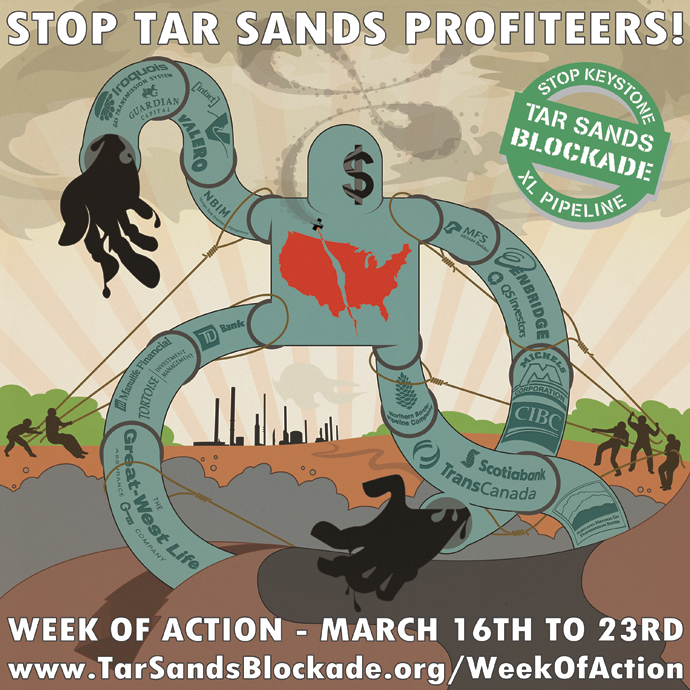
Thirty-seven have been arrested over the last 10 days for disrupting business as usual at TransCanada and their investors’ offices, with more actions planned over the next couple of days.
The March 16-23 Week of Action to Stop Tar Sands Profiteers, in solidarity with Great Plains Tar Sands Resistance’s Direct Action Camp in Ponca City, Oklahoma, is endorsed by more than 50 grassroots environmental organizations around the country. Organizers seek to expose green-washed corporations like TD Bank, a top shareholder in TransCanada, and force them to divest from the controversial Keystone XL tar sands pipeline.
“Its encouraging to see people around the country taking action to stop tar sands profiteers,” said Ron Seifert, spokesperson for Tar Sands Blockade. “No longer will we allow them to build Keystone XL and invest in toxic projects that endanger the health of low-income and communities of color. We will not allow ‘business as usual’ to continue.”
Here are a few highlights from this week:
- 100 people occupied a TransCanada’s office in Westborough, MA, holding a “Funeral for Our Future” and disrupting work for several hours. Twenty-five were arrested for locking themselves inside the office: http://www.tarsandsblockade.org/funeralforourfuture/
- TD Bank branches have seen protests at multiple locations including three people who were arrested for locking themselves inside a branch office in Washington, DC. http://www.tarsandsblockade.org/weekofaction-day4/
- Twelve people arrested for blockading a fracking pipeline in upstate New York: http://ourfutureisunfractured.wordpress.com/
- Portland, Oregon held a bike tour of the city’s worst polluters including a rally at a TransCanada office: http://www.tarsandsblockade.org/weekofaction-day3/
- Dozens of activists in grim-reaper garb surround Michels Corporate office in Kirkland, WA, demanding that Michels stop building KXL: http://www.tarsandsblockade.org/weekofaction-day3/
Religiously and spiritually rooted Americans of all traditions gathered yesterday at the White House to make clear to President Obama that addressing climate change is a moral imperative and that delivering on his inspired State of the Union pledge will require bold actions, including rejecting the Keystone XL tar sands pipeline. Further, Interfaith Moral Action on Climate Change urges President Obama to lead Americans away from reliance on the dirty fossils fuels that drive climate change and transition us to a renewable energy economy. The risk of inaction is so great that some Interfaith Moral Action on Climate Change members felt morally compelled to engage in peaceful civil disobedience, leading to their arrest.
MiBiz has just published a new magazine entitled, The New Michigan Deal, which focuses on the rise of venture capitalism in this state.
The first issue does stories on numerous stories on venture capitalists across the state, including Rick DeVos’ project known as Start Garden.
Included in the publication is an interview with Michigan Governor Rick Snyder, who at one point himself was a venture capitalist, but now oversees the state’s push adopt neoliberal austerity policies that primarily benefit the business community and devastate working class people and the public sector.
The interview with Snyder begins by stating:
These days, Michigan Gov. Rick Snyder is synonymous with cutting the state’s budget, evaluating Detroit’s need for an emergency manager and shepherding the new right-to-work legislation.
This is an interesting way to begin the article, before they start asking Snyder questions. However, in many ways it is telling. It’s as if, MIBiz editorial staff recognize that the Governor is associated with numerous anti-worker and anti-democratic policies, but what we really want to talk with him about is his enthusiasm for venture capitalism in the state.
MiBiz could have said a great deal more about Snyder’s policy, but since they are writing for the corporate community and the wealthier sectors of society, there is no need to be too forth coming with how the policies of Snyder have impacted working class people and communities.
We wrote back in September, when MLive was taking the position that Snyder did not support a Right to Work policy, what the business press doesn’t want to fully acknowledge:
In addition to Synder having never said he would veto Right to Work legislation, his commitment to anti-union policies and positions has been pretty clear. In fact, one could argue that Snyder has been following the game plan of the West MI Policy Forum and the Mackinac Center for Public Policy ever since he took office nearly two years ago.
Snyder signed onto the elimination of the Michigan Business Tax, implemented the Emergency Financial Manager Law, has tied revenue sharing for municipalities by their ability to downsize their workforce and privatize public services and has supported greater movement to privatize public education by attacking public education.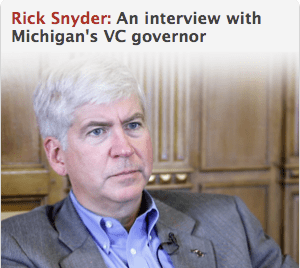
Snyder, Michigan and Venture Capitalism
The interview with Snyder revealed his enthusiasm for venture capitalism and how far the state has come in terms of the growing numbers of venture capitalists in recent years. Snyder talked about the need to change the “culture” of how business is done. This reference was to him being at a meeting with all suits and saying we needed a change, so he took his tie off.
Listen, changing ones clothing does not signify a change in culture. The same people who are the current venture capitalists might look like hipsters, but they are the same class of elites who come from the dominant class in this society. One indication that this is so, is looking at who else is featured in the issue of The New Michigan Deal. Of the 14 people who were interview or profiled, all 14 of them are White and 13 of the 14 are men. Doesn’t seem to be a change in the culture, at least not the dominant culture, to this writer.
This new publication from MiBiz, while it has a new title, is the same as their other publications in that it celebrates the achievements of the business class, while ignoring the impact on the working class.
The value of reading the publication and particularly the interview with Gov. Snyder, is that it makes clear what this class of people values…….wealth and the ability to make more of it.
Steubenville: This Is Rape Culture’s Abu Ghraib Moment
This article by Laurie Penny is re-posted from ZNet.
It lasted for hours. The pictures circulated online show the unconscious teenage girl hung like a shot steer between two laughing young men, Trent Mays and Ma’lik Richmond, who were convicted this week of driving her from party to party, raping her, assaulting her, and filming themselves doing so. Videos from the night include an extended tape of a friend of the attackers in drunken spasms of joy about just how ‘dead’ the girl looked as she was handed around. “She’s deader than OJ’s wife!” he giggles to himself as his mates film him. It was sadistic young men like this with whom the mainstream media expressed immediate sympathy following the guilty verdict.
Here, there was no question that Mays and Richmond are guilty: there is enough film, photographic and text message evidence to make the case clear. The arguments in their defence, instead, revolve around the notion that these boys, beloved athletes in a town where football is everything, did nothing wrong when they assaulted their helpless victim. They are tragic heroes who were just having fun, like young men do, and the pictures prove it. Everyone looks so happy. High-profile rape cases have happened in American football towns many times before – remember the cheerleader who was forced to cheer for her rapist? – but Steubenville is different. The pictures make it different. What the Steubenville footage recalls most chillingly is the torture photographs from Abu Ghraib prison almost a decade earlier, showing American soldiers in Iraq smiling chummily around the prone bodies of political prisoners.
Steubenville is rape culture’s Abu Ghraib moment. It’s the moment when America and the world are being forced, despite ourselves, to confront the real human horror of the rapes and sexual assaults that take place in their thousands every day in our communities.
Susan Sontag observed of the Abu Ghraib atrocities that “the horror of what is shown in the photographs cannot be separated from the horror that the photographs were taken – with the perpetrators posing, gloating, over their helpless captives. If there is something comparable to what these pictures show it would be some of the photographs of black victims of lynching taken between the 1880’s and 1930’s, which show Americans grinning beneath the naked mutilated body of a black man or woman hanging behind them from a tree. The lynching photographs were souvenirs of a collective action whose participants felt perfectly justified in what they had done. So are the pictures from Abu Ghraib.”
The pictures from Steubenville don’t just show a girl being raped. They show that rape being condoned, encouraged, celebrated. What type of culture could possibly produce such pictures? Only one in which women’s autonomy and right to safety counts for so little that these rapists, and those who held the cameras, felt themselves ‘perfectly justified’. Only one in which rape and sexual humiliation of women and girls is so normalised that it does not register as a crime in the minds of the assailants. Only one in which victims are powerless, silenced, dismissed. It is impossible to imagine that in such a culture, assault and humiliation of this kind would not be routine – and indeed, the most conservative estimates suggest that ninety thousand women and ten thousand men are raped in the United States alone every year. That’s what makes the Steubenville case so very uncomfortable – and so important.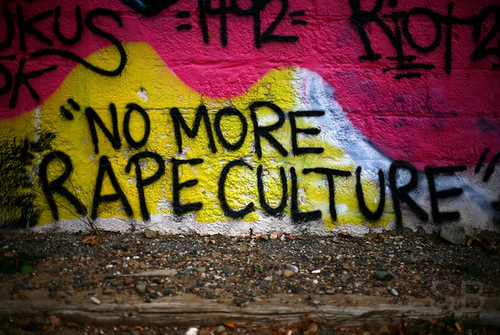
Here we have incontrovertible evidence of happy young people not only hurting and humiliating others, but taking pleasure in it, posing with their victims. The Abu Ghraib torture pictures were trophies. The Steubenville rape photos are trophies. They’re mementoes of what must have felt, at the time, like everyone was having the sort of fun they’d want to remember, the sort of fun they’d want to prove to themselves and others later. The Steubenville rapists had fun, and they broadcast that fun to the world. They were confident that nothing could touch them, so baffled by the idea of punishment that they wept like children in court.
Pictures don’t just record reality. They change it. They change us as we take them and consume them. It matters not just that we have photographic evidence of a girl being raped, but that someone took pictures of the assault happening to send to their friends as memories of a jolly night gone a bit hairy. The Ohio teenager who is now receiving death threats for reporting her rape is far from the only young woman to have her assault recorded for posterity. In the past five years, rapes and sexual assaults involving one or more attacker or involved bystander stepping back to pull out a smartphone have proliferated. What makes these men so sure of their inviolable right to stick their fingers and cocks into any part of any female they can hold down that they actually make and distribute images of each other doing so? Rape culture. That’s what rape culture is. The cultural acceptance of rape.
The Steubenville rapists claim that, when they drove a passed-out girl from party to party, slinging her into and out-of cars like a deflated sex-dolly and sticking their fingers inside her, they didn’t know they were doing anything wrong. That’s plausible, although it’s no defence. It’s a plausible if, and only if, you have internalised the assumption that women are not real human beings, just bodies to be manipulated with or without consent, pieces of wet and willing meat there for you to use for your pleasure. There’s a word for what happens when one group of people sees another as less than human and insists on its right to hurt and humiliate them for fun. It’s an everyday word that is often misused to refer to something outside of ourselves. The word is ‘evil’.
This particular evil has been rotting at the fractious heart of Western culture for so long that it barely registers as abnormal, and the initial emotion when it is challenged is rage. Rage that anyone dare question the notion that men’s ‘bright futures’ matter more than women’s right not to be attacked and degraded. It’s an evil that believes that men work and play sports and make an impact on the world and women are there to get fucked. America has been raised on that belief, and like any dogma it can turn ugly when challenged. Jane Doe, whose real name was revealed on Fox news yesterday, has been receiving death threats, and so have her family. After the verdict was handed down, the internet lit up with ugly messages of slut-shaming and solidarity with her attackers: “Remember, kids, if you’re drunk/slutty at a party and embarrassed later, just say you got raped!” wrote @jimmyontheradio. Another, @zJosiah, said: “I feel bad for the two young guys, Mays and Richmond, they did what most people in their situation would have done.”
Yes, it is possible to feel a sick spasm of pity for these young men whose tears in the courtroom were described at such melodramatic length by major news outlets. It is possible to feel pity for those who do violent acts, who hurt and shame others simply because they know nobody’s going to stop them and it seems like fun. Young people can get carried away in times of war, and here I include what we must surely think of in these circumstances as a gender war, especially when they’re on the winning team – and these boys were used to winning. Young people get carried away. But not always. And that ‘not always’ is where pity stops like bile in the throat.
In every situation where atrocity is normalised, in every death-camp and gulag and apartheid city, there are those who refuse to participate. The soldier who ignores the kill order. The prison guard who walks away. The families who risk their safety to shelter refugees. The men and boys who see rape and violence occurring and have the courage to say ‘stop’.
We have sympathy for those who lack that sort of courage only because we worry, even the best of us worry, that there might be circumstances in which we, too, would overlook evil. That’s the question facing every man and not a few women in America right now as the enormity of rape culture begins to dawn. It’s a question of cowardice, and of character. Something is going on – the casual rape and abuse and dehumanisation of women and girls, and some men – that’s so monstrous that to take its magnitude seriously would implicate a great many of us. The question is whether we have the courage to face it – this time.
Those attacking the Steubenville Jane Doe online, defending her rapists, lamenting the destruction of their ‘bright futures’, are cowards. They are cowards who are afraid of what will happen if systematic injustice is acknowledged, and human history is crawling with their kind. Right now that cowardice is being weaponised and used against women and girls, used to shame us into silence, to stop us from speaking out about rape culture as we have just begun to do in an organised fashion. So many of us wonder whether we would be brave enough to stand up in the face of evil. Whether we would allow it to continue or join in the rage. Well, this is the moment. This is our test. Anyone can be outspoken about Steubenville after the fact. The question is: who will stand up before the next Jane Doe is attacked, without expectation of thanks or acclaim, at risk of derision and ostracism or worse, and speak out about all the other Steubenvilles that are still taking place, and will continue to until enough people say ‘stop’?
So many of us wonder whether we would be brave enough to stand up in the face of evil. Whether we would allow it to continue. Well, this is the moment. This is our test. Before the next Jane Doe gets hurt, before more young rapists can tearfully claim ‘they didn’t know’, it’s on us all – men and boys and everyone who loves them – to stand and be counted.
Keystone XL Pipeline and the claim of Good Jobs
This article by Brentin Mock and Erin Zipper is re-posted from ColorLines.
If you’ve been following the controversy over the Keystone XL oil pipeline, recent events will either encourage you, disappoint you, or both.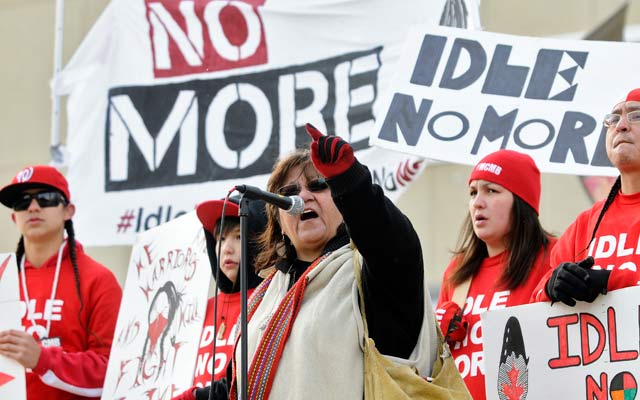
For a market that’s yet to be determined, this much ballyhooed project would transport hundreds of thousands of barrels of oil daily from Canadian tar sands compounds to the U.S. Gulf Coast for refining. What we do know is that the pipeline would dramatically increase the volume of climate change-causing greenhouse gas emissions, erasing what little progress North America has made in reducing its carbon footprint.
The State Department—which has final say in whether Keystone XL gets built—recently admitted as much in a highly publicized (and heavily criticized) preliminary draft of its environmental impact study. State acknowledged the climate-change risks but then argued that rejecting the project wouldn’t reduce the amount of emissions flowing into our atmosphere because Canada would still burn the tar sands and pipeline the oil elsewhere.
Since the State Department report dropped, Republicans and Democrats in both houses of Congress have been pressuring the Obama administration to approve the controversial pipeline, which is four years in the making. Similarly, AFL-CIO, one of the nation’s largest labor unions, all but endorsed the contentious project citing the jobs it would create. A recent budget proposal from Paul Ryan also trumpeted a high level of job creation. (President Obama recently said the jobs numbers have been exaggerated.)
Despite the growing drumbeat of support from oil-connected D.C., Indigenous and First Nation activists from the “Idle No More” movement continue to resist Keystone XL construction. They say the pipeline will destroy ecosystems vital to their treaty rights. Citing environmental justice concerns, Latino and African American activists in Texas have also joined Idle No More in their opposition to the project.
Now, in what may be the final days before the State Department makes an official decision, keep the following labor and environmental justice stats in mind.

Documentary about the role of women in the 1937 Flint GM Sit-Down Strike to be screened in Grand Rapids
The film that the group Left Forum is screening this month is With Babies and Banners: Story of the Women’s Emergency Brigade.
This film tells the story of women’s role in the victory of the United Auto Workers (UAW) sit-down strike From December 1936 to February 1937. The men occupied inside the General Motors Fisher Body 1 and 2 plants in Flint, Michigan. The women braved police and National Guard troops, forcing big auto to back down. Intercuts footage from 1937 with interviews with the same women 40 years later, still active and demanding the UAW acknowledge women as equals.
Left Forum Movie Night
Thursday, March 28, 2013
7:00 PM, movie starts at 7:15 PM
IGE Office 1118 Wealthy Street, SE Grand Rapids (next to Wealthy Street Theater)
Movie is free and shown on a TV
Unprecedented aggressive lobbying campaign by Canada to push Obama to say yes to XL pipeline

This video with author/activist Yves Engler is re-posted from The Real News Network. Editor’s Note: Yves Engler was in Grand Rapids in May of 2011, while on a speaking tour for his book Stop Signs: Cars and Capitalism on the road to economic, social and ecological decay.
GRIID had the opportunity to interview Yves Engler while on that book tour, an interview you can watch online. His most recent book is The Ugly Canadian, which is an expose of the Canada’s foreign policy.
Foundation Profile: Secchia Family Foundation
This foundation profile is part of a series of profiles on local foundations and is part of our Grand Rapids Non-Profit Industrial Complex Project.
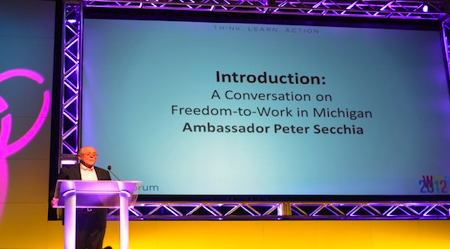
The Secchia Family Foundation is the foundation of Peter Secchia and his wife. Seechia is part of the West Michigan power elite, a major playing in the Republican Party, who is involved in numerous groups such as the West Michigan Policy Forum, which has been a champion of the anti-worker austerity measures implemented by Governor Snyder.
Most of the money that the Secchia Family Foundation has contributed during the years of 2009 – 2011 has been to Michigan organizations. Some of the larger recipients are the Helen DeVos Children’s Hospital, Michigan State University, the Van Andel Institute and Grand Valley State University.
The list of larger recipients is no surprise, since Secchia is an alumni of MSU, has a close relationship to the DeVos family and he and his wife site on the Board of Directors of the Van Andel Instiute.
Some other recipients of Secchia Family Foundation money that clearly fit into the political philosophy of the former Ambassador to Italy during the Reagan administration are: The Mackinac Center for Public Policy ($18,500) and the Grand Rapids Chamber of Commerce Foundation ($10,000). Both of these entities promote business interests above all else and actively work to weaken government regulations and worker rights.
However, there are some recipients of Secchia Foundation money that might raise some eyebrows. The Secchia Family Foundation has contributed some money to the Grand Rapids Chapter of the NAACP and the Grand Rapids Urban League, both less than one thousands dollars between 2009 – 2011.
Other surprising recipients have been Senior Neighbors ($2,500), Friend of Grand Rapids Parks ($7,000), Kids Food Basket ($2,000), Baxter Community Center ($2,000) and Steepletown Neighborhood Services ($1,000).
I say surprising, since the organizations listed do focus on some social justice work and environmental sustainability, although in a limited fashion. It does raise questions about the motives of the Secchia Family Foundation to donate money to organizations that are dealing with the fallout of economic policies that Secchia has endorsed and financed in electoral politics and through his participation in groups like the Chamber of Commerce, West Michigan Policy Forum and the Mackinac Center for Public Policy.
Such funding also raises questions about how this money impacts the recipients of the Secchia Family Foundation and their willingness to challenge public policy and private power in West Michigan. These are questions we hope to answer in the next phase of this project, which will involve interviewing representatives from the various Non-Profit organizations in the area.
 Grand Rapids Institute for Information Democracy