More media that promotes the dominant narrative about Grand Rapids
 It is instructive that the dominant narrative about Grand Rapids continues to only include the new “development” projects and the commercial aspects of certain neighborhoods throughout the city.
Within the past few days there have been two examples that reflect the dominant narrative growth in Grand Rapids, a narrative that in reality ignores large portions of the population.
The first example is a new video from Experience GR. The video begins with a few words from the new mayor and then includes several spokespersons who highlight the commercial and entertainment value of downtown Grand Rapids and the neighborhoods adjacent to the downtown.
This dominant narrative about Grand Rapids is further cemented if you go to the Experience GR neighborhoods section. Each of the neighborhoods highlighted in the video have their own section, but primarily feature place to eat, places to shop and entertainment options. Again, the commercial and entertainment aspects of neighborhoods are featured, with no real assessment of the residential aspects of those neighborhoods.
The video has limited voices in terms of racial and class representation, with the voices being dominated by people either connected to Experience GR or people who are business owners. Such a limited view of neighborhoods is quite attractive to investors, professionals and tourists who might be considering Grand Rapids as a destination, but it omits a large percentage of the working class residents who also live in some of the neighborhoods featured.
However, what is more alarming is the omission of voices and visual representation of neighborhoods in Grand Rapids where thousands of residents are struggling to make ends meet. I completely get that including these parts of the city and residents from those neighborhoods wouldn’t be beneficial in the marketing of Grand Rapids the way that Experience GR wants to, but having such voices and such spacial representation would at least be a more honest reflection of neighborhoods in Grand Rapids.
Why is it that we do not hear the voices of people who are experiencing poverty in Grand Rapids. After all, they make up almost one-third of the population, according to recent data? People experiencing poverty, working class people, migrant families and other marginalized communities contribute to this city in all kinds of ways. In fact, they are often the ones who wait tables at the restaurants that are featured at Experience GR, they cleaned the hotel rooms that attract the tourists, along with all the other service sector jobs. They are an integral part (although quite exploited) of what Experience GR wants to highlight in the video, yet they remain invisible.
These voices and where they live are excluded because in order to bring them into the conversation would mean we would have to come to terms with the economic and racial oppression that is quite pronounced in this city and that just doesn’t make for a fun or attractive video.
Celebrating New Development Projects
The other recent media piece that reflects the dominant narrative about what is happening in Grand Rapids – the new shiny aspects – was a feature story on Rapid Growth Media. The article is entitled, For better (or worse): 10 development projects that are changing the face of Grand Rapids. The headline suggests that there are positive and negative aspects of these new development projects, when in reality the article essentially celebrates each of the nine new development projects instead of trying to grapple with the ongoing tensions around gentrification, displacement and rent increases, all of which negatively impact communities of color and working class communities.
Now, I don’t expect that Experience GR or Rapid Growth Media would include these voices and any kind of alternative narrative, since both entities function within the framework of neoliberal urban development. Just look at all the renderings of the shiny new development projects Grand Rapids will see over the next year.

However, if people are seeking other perspectives of what these development projects mean, who they benefit and who they negatively impact, we recommend that you check out the analysis of recent development projects and other topics that challenge the dominant narrative about Grand Rapids, which are explored at If the River Swells.
The slums are the handiwork of a vicious system of white society: Seeing the world through the eyes of Dr. King – Part II
Last week we posted the first in a three-part series in honor of Dr. Martin Luther King Jr. The three-part series is modeled after a statement that Dr. King made in his Beyond Vietnam speech, where he identified the Evil Triplets – militarism, capitalism and racism. In Part I we looked at Dr. King’s message around militarism. Today’s posting looks at the economic system of capitalism. 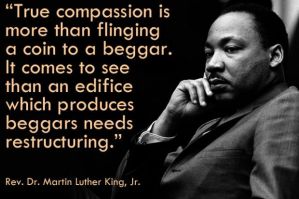
One day we must ask the question, “Why are there forty million poor people in America?” When you ask that question, you begin to question the capitalistic economy.
(Final speech to the Southern Christian Leadership Conference, 1967)
The evolution of Dr. King is vital for our understanding of the man who was often referred to as the conscience of the Black Freedom Struggle. Dr. King went from fighting for de-segregation and civil rights to fighting larger systems of oppression, particularly ones that he would refer to as the Evil Triplets – militarism, racism and capitalism.
His questioning of the economic system had begun early on, but it wasn’t until he moved his focus from the south to the north. King had moved to Chicago in 1965 and began organizing around campaigns that made clear to him the intersection of race and class.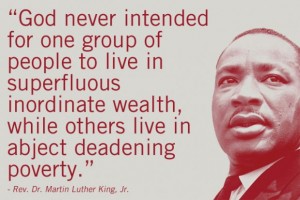
In 1966, Dr. King, along with numerous organizations began a campaign in Chicago to challenge poverty, particularly poverty in the form of housing. King often referred to communities were Blacks lived as slums and he began to organize tenants to fight for rights, particularly through various forms of direct action. One such action was the closing down of the Dan Ryan expressway, where hundreds of people took over the highway and shut down parts of the city in order to make a statement against the violence of slums.
Here is one reflection that King had on slums:
The slums are the handiwork of a vicious system of white society; Negroes live in them, but they do not make them, any more than a prisoner makes a prison. Let us say it boldly, that if the total slum violations of law by the white man over the years were calculated and were compared with the lawbreaking of a few days of riots, the hardened criminal would be the white man.” (The Triumph of Conscience)
Dr. King despised poverty, slums and the economic system that created such conditions. King recognized that poverty and slums for black people meant increased wealth for white people. King knew that modern day capitalism, more aptly called neoliberal capitalism, is like a virus that spreads, and like a virus it must cause harm in order to grow. Not everyone can prosper and neoliberal capitalism thrives when one small sector of society benefits at the expense of the majority. King acknowledges this dynamic in an observation he made in 1967, when he says:
“We are now making demands that will cost the nation something. You can’t talk about solving the economic problem of the Negro without talking about billions of dollars. You can’t talk about ending slums without first saying profit must be taken out of slums. You’re really tampering and getting on dangerous ground because you are messing with folk then. You are messing with the captains of industry. Now this means that we are treading in difficult waters, because it really means that we are saying that something is wrong with capitalism. There must be a better distribution of wealth and maybe America must move toward a Democratic Socialism.”
Maybe a more recent example of what Dr. King is referring to can help us understand how an economic system benefits one sector of society at the expense of others. Just yesterday on MLive, there appeared for a brief period of time (since the postings are always changing) two stories that appeared at the top of the news section that illustrates the contradiction of neoliberal capitalism.
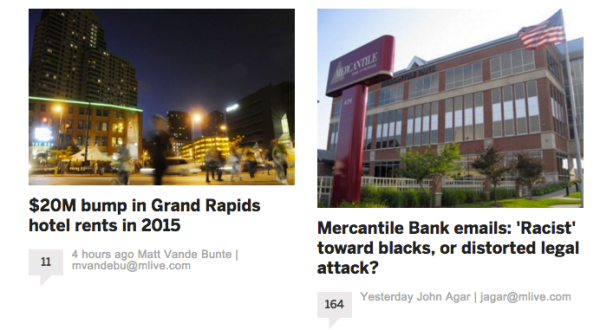
You can see from the screen shot here that there were two stories, one about the increase in hotel profits in Grand Rapids, juxtaposed with an article about the racist practices of Mercantile Bank.
The story on the hotel profits is in line with the ongoing narrative in Grand Rapids that there is lots of growth and that city has become a destination for the creative class and tourists. After all, how does one explain a $20 million increase in hotel sales in Grand Rapids as anything other than things are wonderful?
However, at the same time, there is this article about the racist practices of Mercantile Bank, based on newly released e-mails that demonstrate the contempt the bank has for Black business owners. Some may read this article as a critique of racism, not neoliberal capitalism. The reality is that race and class often intersect and in this case the predatory neoliberal practice of the bank had negative economic consequences for members of the black community.
The larger narrative that the economy is doing so well in Grand Rapids should always beg the question, “doing so well for whom?” A recent report on poverty statistics shows that 26.7% of the population is experiencing poverty according to the 2014 data, which is up from 21.9% from 2009. These numbers refer to the overall population that is experiencing poverty, but when one looks at the numbers for black and brown communities, the percentage of those living in poverty is over 30%. Again, the benefit of some is the cause of suffering for others.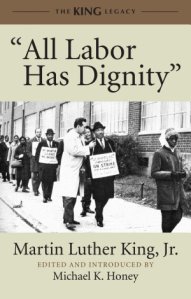
King was so convinced of the brutally immoral nature of neoliberal capitalism that he spent the last few years of his life engaged in work that focused on supporting working class and poor people. One can read about King’s growing connection to organized labor in the US, in the beautifully documented book, All Labor Has Dignity. Indeed, it was King’s support of the striking city sanitation workers that brought him to Memphis in April of 1968.
More importantly, beginning in 1967, Dr. King had begun organizing what he and others around the country referred to as the Poor People’s Campaign. The Poor People’s Campaign was calling for a mass action of people to come to Washington, DC to march and then to set up shanty towns (known as Resurrection City) to demand that the government pass what King called an Economic Bill of Rights.
King was assassinated weeks before the action in Washington, so it is hard to know exactly what the outcome of the campaign would have been had King not been murdered, but we have a pretty clear message from King about this Economic Bill of Rights.
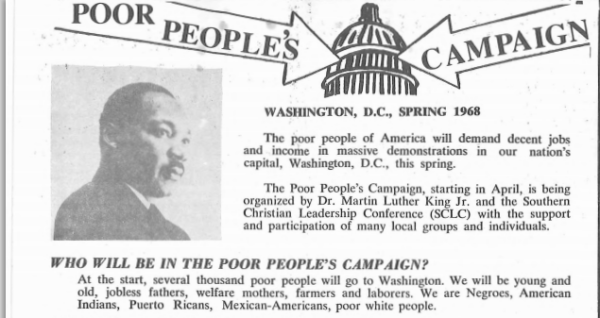
In his essay, Why We Can’t Wait, Dr. King calls for a massive redistribution of wealth, akin to reparations, that he felt was owed to the black community for several centuries of exploitation.
“No amount of gold could provide an adequate compensation for the exploitation and humiliation of the Negro in America down through the centuries. Not all the wealth of this affluent society could meet the bill. Yet a price can be placed on unpaid wages. The ancient common law has always provided a remedy for the appropriation of the labor of one human being by another. This law should be made to apply for American Negroes. The payment should be in the form of a massive program by the government of special, compensatory measures which could be regarded as a settlement in accordance with the accepted practice of common law. Such measures would certainly be less expensive than any computation based on two centuries of unpaid wages and accumulated interest. I am proposing, there- fore, that just as we granted a GI Bill of Rights to war veterans, America launch a broad-based and gigantic Bill of Rights for the Disadvantaged, our veterans of the long siege of denial.”
Seeing the world through the eyes of Dr. King – Part I
In 1967, Dr. Martin Luther King Jr. gave one of his most memorable and insightful speeches at Riverside Church in New York. 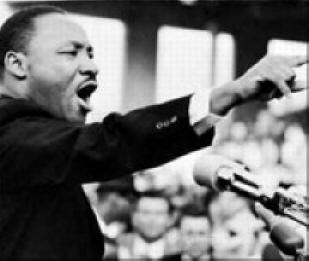
The speech, entitled, “Beyond Vietnam: A Time to Break the Silence,” was revolutionary on many levels. In this speech, which further marginalized him from the Civil Rights community, Dr. King identified what he called the Evil Triplets – racism, capitalism and militarism.
This reflection is the first in a three-part series that looks at the commentary of the Beyond Vietnam speech, the larger body of work by Dr. King and what relevance it has for us today. In other words, if King were alive today, how would he see racism, capitalism and militarism? What would we see if we were to look through his eyes or use the lens of someone who was assassinated because he dared to challenge the systems of power and oppression in the US?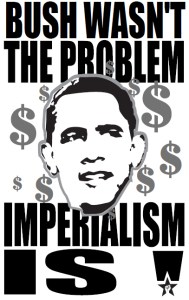
“This business of burning human beings with napalm, of filling our nation’s homes with orphans and widows, of injecting poisonous drugs of hate into the veins of peoples normally humane, of sending men home from dark and bloody battlefields physically handicapped and psychologically deranged, cannot be reconciled with wisdom, justice, and love. A nation that continues year after year to spend more money on military defense than on programs of social uplift is approaching spiritual death.”
With these words, Dr. King sheds light on several aspects of US militarism and Imperialism. As if wielding a sharp knife, King makes it painfully clear that there is no way to reconcile the realities of war with “wisdom, justice and love.” King points out that the harm done during war is lasting and impacts people on a physical and psychological level. King punctuates this moral discernment about war with the last sentence in this paragraph, in a statement that leaves no wiggle room for apologists of war.
“A nation that continues year after year to spend more money on military defense than on programs of social uplift is approaching spiritual death.”
In some ways King speaks to the whole world with this statement, yet it is clear that he is speaking specifically about the US. Such an assessment was haunting then and it continues to be so ever since in the US.
Every US administration since the Johnson administration in 1967, has spent more of the taxpayers money on militarism than on programs of social uplift. I emphasize every, because for some reason in 2016, there are lots of good willed people who think the current administration does not engage in the kind of militarism that Dr. King was condemning in 1967.
Lets look at the facts. The US budget, every year continues to spend more on militarism than anything else. In fact, the US spends nearly as much on militarism as it does on everything else combined. According to the War Resisters League research on the US budget, US military spending is roughly 45% of the budget.
Another resource on US military spending is the National Priorities Project, which has a running counter for numerous aspects of US militarism. If we were to look at the amount of money spent on militarism by the US since 2001, the total as of this posting is $1,633,820,000,000. This is a number that is hard to fathom, so another way of looking at it is that the US government has spent $8.36 million of taxpayers money on militarism every hour since 2001.
However, militarism is more than just money, it involves a larger system of oppression that one could identify as the Military Industrial Complex. But before we look at the details of current US militarism, lets look at other points that Dr. King made in his Beyond Vietnam speech.
“Then came the buildup in Vietnam, and I watched this program broken and eviscerated, as if it were some idle political plaything of a society gone mad on war, and I knew that America would never invest the necessary funds or energies in rehabilitation of its poor so long as adventures like Vietnam continued to draw men and skills and money like some demonic destructive suction tube. So, I was increasingly compelled to see the war as an enemy of the poor and to attack it as such.”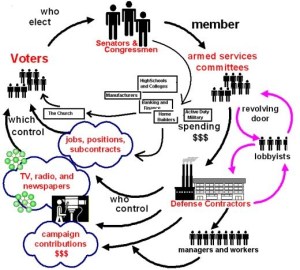
This comment by Dr. King re-enforces what he said earlier, but in a more descriptive way. His words are like a hot knife through butter when he says, “so long as adventures like Vietnam continued to draw men and skills and money like some demonic destructive suction tube.” This is a haunting visual about how US militarism impacts communities all across the country. It’s not just a suction tube, but a demonic suction tube. $8.36 million dollars are being sucked out of our communities every hour to fuel militarism.
So what is all this money being spent on and what does the US Military Industrial Complex look like? The graphic shown here is a good starting point, but it doesn’t provide a real picture of what the Military Industrial Complex looks like on the ground, especially what it looks like around the world.
Currently, the US has roughly 1,000 military bases around the world, with several hundred thousands soldiers, tens of thousands of private contractors (mercenaries), millions of vehicles that negatively impact the countries where these bases are located. The US is currently involved in military actions in Afghanistan, Iraq, Syria, Yemen, Colombia, parts of North Africa, in Cuba and Mexico. Then there are countries that the US provides weapons, advisors and military training, which number in the dozens.
The Military Industrial Complex includes operations under the guise of the War on Terror and the War on Drugs, which includes other agencies like the CIA, the DEA and the FBI.
On the domestic front, the Military Industrial Complex involves bases, training centers, military recruiters, defense contractors, lobbyists, virtually all members of congress, detention centers, border patrol and the massive advertising budget that is used to convince the public how wonderful the various branches of the US military are.
This last point, about how we are all indoctrinated to embrace the necessity of US militarism can only be counteracted when we exercise our critical thinking skills and see US militarism for what it is. In addition, since US militarism is so deeply entrenched in every facet of US society and culture, we can no longer afford to exclude US militarism in our analysis and actions against any and all systems of oppression – White Supremacy, Capitalism, Heterosexism, Ableism and all forms of ecological destruction.
However, ask yourself, how often does US militarism get connected to other forms of oppression in the US? How often to we employ an intersectional analysis that connects US militarism to police violence against communities of color, the detention and deportation of immigrant communities, rape culture, climate injustice, environmental racism, health disparities or food justice? The links are there, we just need to find them, expose them and act on them.
Making these connections is exactly what Dr. King did. He made it clear in his powerful 1967 speech that the Black Freedom Struggle in the US was directly connected to US militarism. Here is what King had to say:
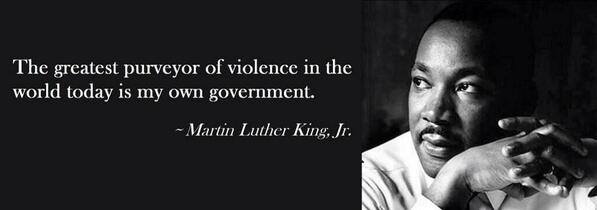
“My third reason moves to an even deeper level of awareness, for it grows out of my experience in the ghettoes of the North over the last three years — especially the last three summers. As I have walked among the desperate, rejected, and angry young men, I have told them that Molotov cocktails and rifles would not solve their problems. I have tried to offer them my deepest compassion while maintaining my conviction that social change comes most meaningfully through nonviolent action. But they ask — and rightly so — what about Vietnam? They ask if our own nation wasn’t using massive doses of violence to solve its problems, to bring about the changes it wanted. Their questions hit home, and I knew that I could never again raise my voice against the violence of the oppressed in the ghettos without having first spoken clearly to the greatest purveyor of violence in the world today — my own government.”
Again, the clarity of such analysis is sobering. King not only makes the connection between militarism and the struggle that Black and Brown people were engaged in on a daily basis, he called himself out by what he acknowledged in the last sentence. “I knew that I could never again raise my voice against the violence of the oppressed in the ghettos without having first spoken clearly to the greatest purveyor of violence in the world today — my own government.”
Indeed, if Dr. King were alive today, he would still be calling the US government the greatest purveyor of violence in the world today. Maybe it is time we start doing the same.
DeVos Family political money bought legislation in 2015 that allows them to spend even more money to influence Michigan politics
Remember in 2012, when the Michigan Legislature and Governor Snyder decided to ignore what voters had to say about the Emergency Manager ballot issue and pushed through legislation at the last minute? Well, the Michigan Legislature did it again.
Just hours before the last Michigan political session of 2015, Republicans revised a bill that will allow even more money to be pumped into the political process. Senate Bill 571 was then signed into law by Governor Snyder on December 31st and is now known as Public Act 269.
This new law will allow Political Action Committees and the super rich even greater opportunity to buy politicians and future legislation. Here are a few of the outcomes of Public Act 269:
- Prohibits public bodies like government agencies from distributing information about ballot proposals 60 days before the election.
- Elimination of a February filing deadline for independent and political committees and reestablishment of the requirement to file an annual report covering the period from October 21st through December 31st.
- Effective doubling of the amount of money PACs can donate to candidates for the second time in two years, effective quadrupling the limit since 2013.
- Prohibits corporations from collecting contributions from its employees to a union’s PAC.
Point three is particularly worth noting as it means that the amount of money that can be spent in politics will increase……again. Until 2013, individual donors could contribute only $3,400 per cycle, with PACs permitted to give up to $34,000. The amount changed two years ago when the legislature raised those ceilings to $6,800 for individuals and $68,000 for PACs. With Public Act 269, the amount that individuals can contribute is up to $13,600 and $136,000 for Political Action Committees.
This means that the DeVos Family and their disgustingly wealthy friends can contribute more directly to candidates and to PACs. The Michigan legislators who pushed through the revised version of SB 571 were Rep. Lisa Posthumus Lyons (R) and Rep. Kevin Cotter (R). Both of the state politicians had received $9,000 in the last election cycle from the DeVos Family, according to a report by the Michigan Campaign Finance Network. 
This is at least the third time this year that DeVos Family money has bought legislation in Michigan. We know that earlier in 2015, DeVos Family money paid for HB 4052, which takes away even more autonomy from local governments, particularly around issues such a living wage, wage theft and anti-discrimination ordinances. In addition, DeVos Family money helped pass HB 4188, legislation that allows adoption agencies to discriminate against LGBT families. We wrote about how DeVos money influenced the adoption of these state laws last fall.
DeVos Family political operative Greg McNeilly, Chairman of the Michigan Freedom Fund, was gloating over the passing of SB 571, especially since one of the provisions took some power away from unions. McNeilly had this to say:
“It’s one of those reforms that I think is positive for the state and allows employers to stay focused on their core business.”

What is to be done about the DeVos Family Political Influence?
There is already partisan rumblings from the Democratic Party suggesting that the way to stop these last minute legislative changes is to win the 2016 elections.
However, it seems that whether it is Public Act 269 or Citizens United, there is no real interest from the Democratic Party to take money out of politics. So what is to be done about the political influence of families like DeVos?

There are some tactics, which would be best discussed offline, but one strategy that might actually hurt the DeVos Family would be a boycott strategy. What if there was an organized campaign to boycott the following:
- Boycott all Amway Products
- Boycott ArtPrize
- A Boycott by Non-Profits to accept any DeVos Family Foundation money – you can find this information by going to GuideStar and looking at the 990s of all the DeVos Family Foundations. http://www.guidestar.org/Home.aspx
- Boycott DeVos owned Hotels in Grand Rapids
- Boycott DeVos owned Restaurants in Grand Rapids
- Boycott art and cultural organizations that the DeVos Family has funded – Grand Rapids Art Museum, UICA
- Boycott organizations where a DeVos or DeVos employee (Awmay, RDV Corp, Windquest, etc) is on the board of directors – Right Place Inc., GVSU Foundation, Grand Action, West Michigan Policy Forum, Alliance for Livability, Grand Rapids Chamber of Commerce, etc.
In addition, maybe some creative forms of direct action that would disrupt or shut down any of the entities targeted for boycott might also have a significant impact.
The point being, that we can not expect the influence and power of the DeVos Family to simply go away or be lessened simply by operating within the limits of the current political process.
GRIID Interviewed on Catalyst Radio

Just reposting an interview that Catalyst Radio, a program on WYCE, that aired on Friday. GRIID staff founded Catalyst Radio back in 2004, when GRIID was part of the Community Media Center.
Catalyst Radio has recently added new personnel and plans to include media literacy as part of the format, something that the show did in its early years. As a way of kicking off the revised Catalyst Radio show, they asked GRIID to be the guest to talk about the importance of critical thinking when it comes to the media we all consume.
To listen to the 30 minutes interview, click here.
GR Police Chief doesn’t hear community concerns on assault weapons or that people just don’t trust the cops
Over a hundred people filled part of the bar space where Equity Drinks held its latest forum, with a focus on the recent City Commission vote (5 – 2) to approve assault rifles for all 59 cruisers used by the Grand Rapids Police Department.
There was virtually no support in the room for allowing the cops to have even more weapons and many of the questions or comments directed at the Grand Rapids Police Chief were filled with disbelief and anger that the cops would try to justify the need for such weapons.
Many of people who spoke were from communities of color who made it very clear that they do not trust the GRPD and that they live in fear for themselves and for their family members on a daily basis. One African American woman glared at the cops and said, “I fear being killed by your officers.”
Other comments were directly specifically at the issue of assault weapons the GRPD will now have. One woman said that asking for and getting such weapons sends a clear message of intimidation to the community, especially communities of color. Another woman said, “you are proclaiming war on your own citizens.”
Most who spoke up were clearly angered by what the police had to say about the assault weapons, especially since the justifications offered seemed shallow and meaningless. On top of that, when several people spoke, particularly people of color, the Chief of Police would walk towards (as you can see if the picture here) them in what seemed to this writer as an intimidation tactic. In addition, there were several times where the cop interrupted people and tried to speak over them. 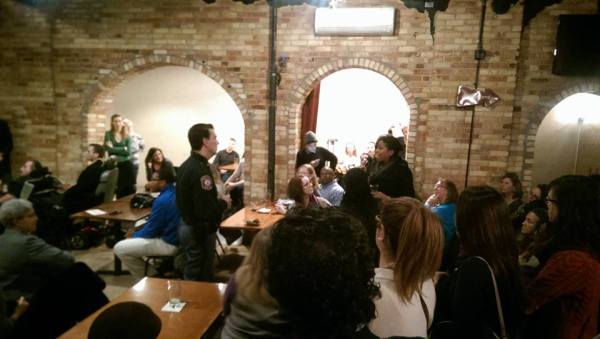
The arrogance demonstrated by the police was blatant, despite the fact that they were once again given the opportunity to speak first. Throughout the forum the cops were given an opportunity to respond to questions and statements made by members of the community. The Chief of Police gave the same tired answers that he gave at the forum held at the Wealthy Theater back in November, such as: we do work through the Boys & Girls Club, we teach young kids to play baseball and we host coffee with cops events.
The Chief of Police kept saying that Grand Rapids was so far ahead of any other city of comparable size in the US, in terms of community relations and training they provide for cops around cultural competency and implicit bias. When it came to justification for the assault weapons, they kept referring to incidents like Sandy Hook and others, which were acts of gun violence usually committed by a lone gunman. in other words, the cops NEVER mentioned or acknowledged the countless incidents where cops shot and killed civilians in the past 18 months, from Michael Brown to Tamir Rice.
So much of what the cops had to say was insulting. For instance, when the Chief first spoke he showed an ad from Cabellas for an assault rifle, which he claimed was just like the ones they will have in their cruisers. Therefore, if people can buy them at Cabellas, we should not be upset that the cops have them. Towards the end of the night the Chief of Police even invited people to be part of the Grand Rapids Citizen Police Academy, so we could all really understand how the police department works.
Such commentary from the cops prompted one participant to state, “It doesn’t seem like you all are prepared to have this discussion. What scares me is not the weapons but the leaders. You don’t seemed to be aware of our concerns. You want more guns and we are afraid we are going to be the recipients of the gun violence.”
Why is it that we keep organizing forums to talk about injustice and oppression, forums that invite the very institutions and structures that perpetuate the injustice and oppression? Why are we not have real dialogue that just involves the public?
This was the message from someone with Black Lives Matter GR, which made the point, “we are not talking about alternative solutions to violence in our community. Should the cops have guns or not? We have to go beyond that. The police are not the solution to the issues that I see.”
Indeed, this has been a message from Black Lives Matter chapters and other community-based groups around the country for years now. How do we create community safety that doesn’t rely on state violence, ie, the cops?
Instead of inviting the cops to our meetings or continuing to have expectations that if they have implicit bias trainings or hire more officers of color that somehow police violence will stop, maybe we need to have autonomous community meetings and tap into the creative and passionate energy of our own people.
This is not a new idea. In fact, there are great examples of what community safety programs or community anti-violence campaigns look like. In the last chapter of the book, Our Enemies in Blue: Police and Power in America, the author provides numerous examples throughout history. These examples can be found in the Afterword of the online version of the book, entitled, Making Police Obsolete.
Another great resource is put out by the national women of color organization INCITE!. They have a toolkit that investigates law enforcement violence and provides great examples by women of color and transgender people of color responses to police violence.
Such examples are not only inspiring, but it affirms the notion that we should not rely on systems of oppression to create community liberation.
GRIID Winter 2016 Class: Investigating the Religious and Political Right in West Michigan
Our Winter 2016 class will focus on the Religious and Political Right of West Michigan. Most people know that West Michigan is a highly conservative place, but the details and the depth of the connection between the religious and political right may not be as well know.
This class will use Russ Bellant’s book, The Religious Right in Michigan Politics. The book is 20 years old, but it provides solid background on the current religious and political right. We’ll be using a PDF of the book, so no one will have to purchase the book.
In addition to Bellant’s book, we will be using numerous reports produced from a variety of sources and we will be doing lots of our own investigation and monitoring of individuals, families and organizations that make up the political and religious right of West Michigan.
This investigation will include, but not be limited to people and entities that promote patriarchy, homophobia and heterosexism, white supremacy, capitalism, Zionism and the attack on public institutions like public education, public policy and public funding.
This class will be held on Mondays from 7 – 9pm, beginning on Monday, February 1. The classes will be held at the offices of the Institute for Global Education, located at 1118 Wealthy in Grand Rapids. The cost for the class is $25, but we will not turn anyone away based on their ability to pay. To sign up, contact GRIID at jsmith@griid.org.
MLive’s Managed Reporting on DeVos Family “Giving”
Yesterday, MLive published a series of articles that claimed to illuminate the philanthropic donations made by the DeVos Family.
There were a total of three articles from January 4 and a slide show with highlights of recipients of DeVos Family donations. One article focused on how much money the DeVos Family has contributed to GVSU, a second article provided a brief overview of how MLive conducted their research, with the third article entitled How and why Amway’s DeVos family gives away billions.
The articles are pretty straight forward and mostly data driven, yet the headline (How and why Amway’s DeVos family gives away billions) of the featured article suggests that there is some big reveal.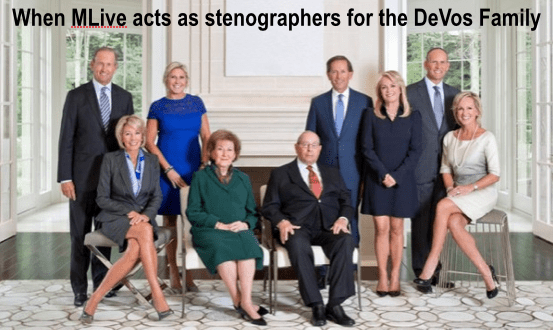
The featured story does what has come to be expected from commercial media. The story reads as a form of stenography, where the reporter reprints what people in power have to say without verifying or questioning said comments. Several sources are cited in the article:
- DeVos Family spokesperson John Truscott
- R.J. Shook, founder of the Philanthropic Research Institute
- Communications Director for Grand Rapids Public Schools, John Helmholdt
- Doug DeVos
- Marge Palmerlee, Degage’s Executive Director
- Dennis VanKampen, CEO of Mel Trotter Ministries
- Michael Kaiser, former Kennedy Center President
- Mike Guswiler, President, West Michigan Sports Commission
- Kyle Caldwell, Executive Director of GVSU’s Johnson Center for Philanthropy
- Tom Haas, GVSU President
- Jim Brooks, philanthropist and founder of the now-defunct West Michigan Strategic Alliance
- Steve Ford, son of the late President Gerald R. Ford
All of the sources speak glowingly of the DeVos family, which should raise red flags for any discerning reader. How is it that an article can be written about the most powerful family in West Michigan and not include some critical commentary or analysis?
Giving strategies
The “big reveal” from the MLive article is as follows:
The family has in the past instructed philanthropic organizations not to discuss the gifts. That restriction was lifted for this series, and three hallmarks emerged for the DeVos family foundations’ giving strategies:
- leveraging additional donations through peer pressure or organized giving among the family foundations.
- providing strategic advice to institutions receiving money.
- extending influence through board service and other connections.
The three strategies are interesting, but hardly a big reveal. People who have followed the DeVos Family over the years would have been aware of these “three hallmarks” for giving. However, even though the rest of the MLive article is an elaboration on the three strategies, there is really no new information provided about the real effects of the DeVos Family contributions. Sure, there is some commentary about how it has impacted various local and national organizations, but the commentary is superficial and highly managed.

For instance, GVSU President Tom Haas is quoted as saying, “We wouldn’t be the university we are today without his and the family’s support.” While such a statement is true, it fails to convey how DeVos money has impacted Grand Valley State University. One example is based upon our own research with the Grand Rapids LGBT People’s History Project, where the DeVos Family made it clear to GVSU in the mid 90s that, if the university were to allow domestic partner benefits, they would withhold funding for the new health sciences building on Michigan Avenue in Grand Rapids.
This kind of influence is exactly what the DeVos Family means by strategy number two – providing strategic advice to institutions receiving money. This is probably the most important strategy, since this is often the primary reason that wealthy families contribute to institutions and organizations…….to influence what those entities do.
This influence can take on various forms. First, the influence can be straight forward, where the funding is to simply affirm the ideological mission of the institution receiving the money. For instance, one of the entities mentioned in the MLive article is the Mackinac Center for Public Policy, which is referred to in the article as a conservative think tank. However, to not explore how DeVos money assists groups like the Mackinac Center is another way of not serving the public interest. For instance, in 2012 we wrote about how DeVos money supported the efforts of the Mackinac Center to get Right to Work Legislation passed in Michigan. 
It is this kind of journalism that is needed, where reporters take the information provided about those in power and then flesh out the details of how this impacts the public. This could have been done with any number of the organizations and institutions that received DeVos Family money that appear in the donation recipient slideshow on MLive. One of the recipients listed in the slideshow is the Grand Rapids Public School system, which has received a total of $2.6 million from the DeVos Family. The featured story also mentions that GRPS has been a recipient of DeVos money, where “funding paid for leadership development, teacher evaluation and teacher training,” along with funding for the Believe 2 Become project. The Believe 2 Become project is really a wedding of faith-based entities with the public schools system, something that again the DeVos Family ideologically supports.
The DeVos Family funding of the Grand Rapids Public Schools should also raise interesting questions for competent journalists. Why would a family that has been a national leader in private education, faith based education and the school voucher movement be contributing to public education? Unfortunately, these are not the kinds of questions or angles that are pursued in the MLive story.
A second major reason that families like the DeVos’s contribute money to institutions and organizations is to redirect or manage populations that have the potential to be involved in revolutionary and insurgent politics. For instance, as the MLive recipient slide show reveals, one of the local organizations that benefits from DeVos Family money is LINC Community Revitalization. The slide show information says the Doug and Maria DeVos Foundation contributed $905,000 to LINC in 2013. DeVos money does not mean that LINC doesn’t do good work in the community, rather the point is that instead of organizing people to engage in radical grassroots organizing for systemic change, LINC puts most of its energy into directing people into participating in acceptable political tactics that do not question systems of power, along with an emphasis on developing entrepreneurs.

A third reason for foundation and philanthropic contributions, in addition to ideological support of social management, is to buy silence and complicity. This consequence of funding from the wealthiest sectors of society is the least evident, but it is as equally impactful as the other reasons. The DeVos Family knows that if they give money to an organization or an institution that those groups receiving the money will not take a public stance that is either critical of the DeVos Family practices or critical of issues that the DeVos Family is attempting to influence.
For instance, in the summer of 2015, DeVos Family political contributions helped the Michigan legislature pass HB 4052, which allows organizations to discriminate against families wanting to adopt on religious grounds. This connection is made clear when one considers that the largest adoption agency in the state, Bethany Christian Services, is also a major recipient of DeVos Family money. This is not to suggest that Bethany would challenge DeVos’s political influence, but it does have a silencing effect on staff who may not agree with such discriminatory policies.
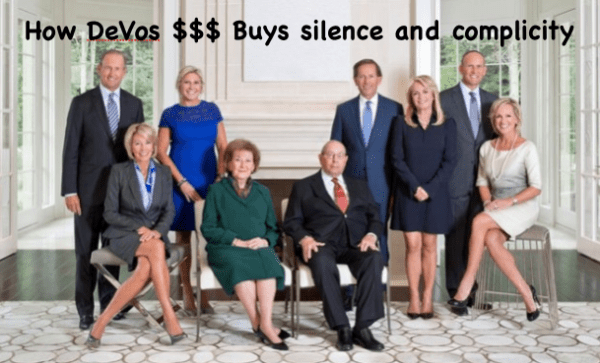
The last major issue that the MLive articles on the DeVos Family giving fail to address is what connections their major political contributions have with their philanthropic giving? This seems like an important question that journalism that serves the public interest would want to explore. We already raised the question about the DeVos Family funding of the Grand Rapids Public Schools, while at the same time being involved in funding and politically leading national groups that promote redirecting public funds away from public schools and into the hands of private and charter schools.
A larger and maybe more obvious question is how does their political funding for economic policies that benefit the rich then connect to their charitable funding for urban-based social services agencies? For instance, the state policies that the DeVos-influenced West Michigan Policy Forum have worked on in recent years – ending state business taxes, Right to Work and other anti-union/anti-worker policies – such policies contribute to creating poverty and widening the gap between the rich and the working class poor. So, the DeVos Family funds public policy that makes them and their friends richer by stealing public money, then they turn around and fund projects that provide some assistance to those experiencing poverty, but such programs redirect working class anger into pull-yourself-up-by-your-bootstraps practices. Sounds like a wonderful way to get richer while simultaneously convincing the public you are generous beyond compare. Seems to work.
Public Money Supports Israeli Military Contractor in West Michigan

A week and a half ago, MLive ran a story which announced that MDOT would be contributing nearly half a million dollars for road improvements because of two expanding companies in Kent and Ottawa county.
It is curious that state funding for road improvements would be used to reward businesses, but not surprising. The two companies which have the favor of the state department of transportation are Agape Plastics Inc. and Plasan North America.
Agape Plastics makes custom injection moldings and Plasan North America, “is a Tier One supplier to defense contractors and a leader in composite material technology in the design and development of a variety of military ground vehicles.”
Plasan is not just any military contractor, they are an Israeli-owned military contractor with facilities in the US, France and Israel. Plasan not only makes weapons, but provides “security resources and solutions” that focus on Border Protection, Special Forces Operations, Intelligence Missions, Disaster Management, and Convoy & VIP Protection. Here is a sample of “services” they offer with the products, which is taken from their own promotional material.
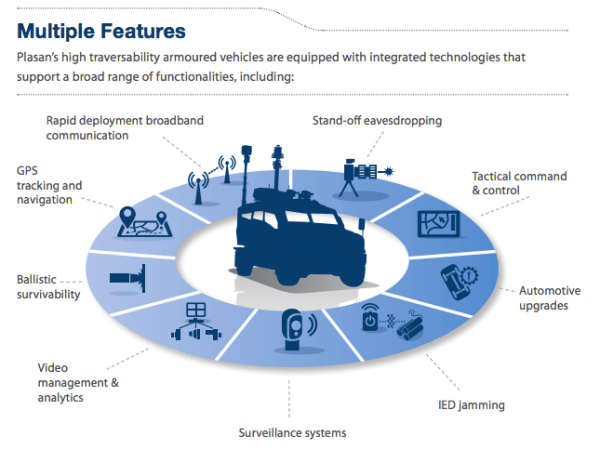
Plasan has a facility in Walker, Michigan and was recruited recently by The Right Place Inc. to set up shop in West Michigan. This fits within the larger role of The Right Place, which is to attract businesses to West Michigan, but it is also a reflection of the business agency’s growing relationship with the State of Israel.

This relationship between The Right Place and Israel is directly through the Michigan Israel Business Bridge (MIBB), a Bloomfield Hills-based entity which promotes business relationships between Michigan and Israeli businesses, including the promotion of Israeli products. The Right Place CEO Birgit Klohs is part of the Advisory Council for the MIBB.
It is bad enough that public funds are being used to directly support the private sector, but it is another thing to provide public funds to a company that plays a significant role in the illegal Israeli occupation of Palestine. Plasan military equipment and “security solutions” profits from the brutal Israeli repression of Palestinians and supports what is essentially a racist apartheid system.
Considering that there is a growing interest in the Palestinian-led Boycott, Divestment and Sanctions (BDS) movement around the world and in West Michigan, Plasan and supporters like The Right Place Inc, would be worthy targets of anti-apartheid organizing.
The Not So Glamorous Organizing Efforts of Grand Rapids Bus Drivers
Over the past couple of months, we have written a couple of articles about the Grand Rapids Bus Drivers Union, the ATUGR. One article was written for the national left publication, In These Times, and another piece was more recently published on this blog. 
As of this writing the ITP has refused to negotiate a contract with the bus drivers union, making the stalemate more than 6 months. Instead, the management of the ITP, along with the Board of Directors has decided to engaged in tactics that are antagonistic towards bus drivers who continue to fight for a just labor contract.
Earlier in the year there was lots of organizing around this campaign, with a fair amount of media attention, even from the commercial press. However, in recent weeks the attention has dissipated and participation from rank and file members has dwindled.
This is not to say that there isn’t any organizing going on. In fact, there have been a constant stream of actions and efforts in the struggle to get a just labor contract. In the past week, I attended to activities, where ATUGR members were engaged in the more mundane, yet equally important work of organizing.
A few weeks ago while ITP CEO Peter Varga was in DC, ATU members hand him a flyer while the song from The Grinch Who Stole Christmas played in the background. In addition, Grand Rapids Mayor George Heartwell was greeting by ATU members while attending the Paris Climate Summit. The ATU members wanted him to know that nearly 30% of the GR population lives in poverty and that the Rapid just raised bus fares by 16%.
On Wednesday, December 16, some members of the union attended the monthly board meeting for the Rapid. Two of the members spoke during public comment about the threats to their pension, while another member filmed some of the proceedings.
The Rapid board meeting was brief, but instructive. Rapid CEO Peter Varga spoke briefly at the front end of the meeting about “how he came up through the ranks,” even reflecting on his time as a bus driver in Grand Rapids. Varga also passed around a picture of when he was a bus driver, apparently attempting to present himself in a positive light as a man of the people.
One aspect of the ITP board meeting that was revealing was in the form of document they handed out to all those in attendance, a document that refers to Rules of Public Comment at Meetings. The document is clearly designed to censor people from challenging or confronting board members, since they “reserve the right to remove anyone who violates the rules.”
In addition, if you want to submit documents to the ITP board members there are also clear instructions. One of the guidelines states; “Position papers pr lengthy documents must be submitted to the office of the CEO for vetting.”
The board meeting lasted only about 30 minutes and then they went into a closed Executive Session. It made little sense to this writer why there would be part of the meeting held in private, especially when this is a public entity that relies on public tax dollars for operation. Transparency did not seem to be a priority.
Yesterday morning, the Rapid held a job fair at the central station in the same room that the ITP board meeting was held. Jay DeShane with the ATUGR was present to greet people who were there to apply for a job and hand out some information on their campaign to negotiate a contract. This is often the nuts and bolts of any organizing effort, talking to people face to face about your campaign.
I was impressed with Jay’s ability to connect with people and have an honest dialogue about the current political battle they were in with the ITP. When people were not coming in to fill out job applications, Jay would engage me in conversation around labor politics and history. It was a refreshing way to spend the morning and it was even somewhat inspirational to know there are people who are willing to do the not so glamorous work of organizing that rarely sees the light of day.
In the midst of all the chatter about the 2016 President race, it was comforting to know that people are not just putting blind faith in politicians. Instead, it seems that some of the members of the ATUGR are engaged in a process that will have a direct impact on their lives. In fact, the Bus Drivers Union is doing what labor organizers have done since the later part of the 19th century. These labor organizers are taking matters into their own hands, using their own power and not abdicating it to politicians or political parties which rarely act on behalf of working class people.
 Grand Rapids Institute for Information Democracy