Despite the headline, MLive article doesn’t really tell us how the DeVos family influences education policy in Michigan
On Saturday, MLive ran yet another questionable story on the political influence of the DeVos Family, entitled, How the DeVos family has helped shape education policy in Michigan. This story is on the heals of an article that MLive ran last Monday that also demonstrates lazy journalism on the leading Grand Rapids news source.
The article is centered around President-elect Donald Trump’s choice for Secretary of Education, Betsy DeVos. However, the story frames the issue in such a way as to soften, even minimize, the level of influence that the DeVos Family has had on education policy in Michigan.
In the second paragraph, the MLive article states:
“In addition to DeVos’ leadership roles for several education policy organizations, she and her family have used their money and influence as a means to shape major education policy initiatives in Michigan.”
The article never mentions what leadership roles Betsy DeVos plays in organizations that deal with education policy. It would serve the public well to have a better understanding of organizations like American Federation for Children , the Great Lakes Education Project (GLEP) and the Alliance for School Choice. Only GLEP is mentioned in the article.
In addition, the hyper-link provided in the MLive article takes readers to a 9 slide piece that does little to illuminate how the DeVos family has shaped education policy in Michigan. A few slides provide brief commentary on the role of the Great Lakes Education Project on Detroit Public Schools, one on the DeVos-led failed attempt to get a school voucher policy adopted in Michigan in 2000, along with several slides that make it sound as if the DeVos family philanthropy is purely benevolent. (See our article on the political nature of DeVos family philanthropy) 
The December 24 MLive article then talks about three education policy areas in Michigan that the DeVos family has had some influence; Detroit Public Schools, School Choice and Vouchers.
The section on the Detroit Public Schools is the first time in the article that we are informed about the deep involvement of the Great Lakes Education Project (GLEP). The MLive story does offer up some numbers on financial contributions by the DeVos family in regards to influencing the Detroit Public School policy outcome and even links to a Michigan Campaign Finance Network article about the family’s contribution to politicians that influenced the outcome of the Detroit Public Schools policy debate. However, what the MLive article doesn’t tell you is that in the November election, 49 of 53 candidates endorsed by GLEP won in the general election for the Michigan House of Representatives. Here is a list of those endorsed by GLEP that won in November.
• District #17: Rep-Elect Joe Bellino (Monroe)
• District #19: Rep. Laura Cox (Livonia)
• District #20: Rep-Elect Jeff Noble (Plymouth)
• District #24: Rep-Elect Steve Marino (Harrison Township)
• District #30: Rep-Elect Diana Farrington (Utica)
• District #32: Rep-Elect Pamela Hornberger (Chesterfield Township)
• District #33: Rep-Elect Jeff Yaroch (Richmond)
• District #38: Rep. Kathy Crawford (Lyon Township)
• District #39: Rep. Klint Kesto (Commerce Twp)
• District #42: Rep. Lana Theis (Brighton)
• District #44: Rep. Jim Runestad (Milford Township)
• District #45: Rep. Michael Webber (Rochester)
• District #47: Rep. Hank Vaupel (Howell)
• District #51: Rep. Joe Graves (Argentine Township)
• District #56: Rep. Jason Sheppard (Temperance)
• District #57: Rep-Elect Bronna Kahle (Adrian Township)
• District #58: Rep. Eric Leutheuser (Hillsdale)
• District #59: Rep. Aaron Miller (Sturgis)
• District #61: Rep. Brandt Iden (Oshtemo)
• District #63: Rep. David Maturen (Brady Township)
• District #64: Rep-Elect Julie Alexander (Hanover)
• District #66: Rep-Elect Beth Griffin (South Haven)
• District #70: Rep-Elect James Lower (Cedar Lake)
• District #71: Rep. Tom Barrett (Charlotte)
• District #72: Rep-Elect Steve Johnson (Shelbyville)
• District #73: Rep. Chris Afendoulis (Grand Rapids Township)
• District #74: Rep. Rob VerHeulen (Walker)
• District #79: Rep-Elect Kim LaSata (St. Joseph)
• District #80: Rep. Mary Whiteford (Casco Township)
• District #81: Rep. Dan Lauwers (Brockway Township)
• District #83: Rep-Elect Shane Hernandez (Port Huron)
• District #86: Rep-Elect Thomas Albert (Belding)
• District #87: Rep-Elect Julie Calley (Portland)
• District #89: Rep-Elect Jim Lilly (Park Township)
• District #90: Rep. Daniela Garcia (Holland)
• District #91: Rep. Holly Hughes (White River Township)
• District #93: Rep. Tom Leonard (DeWitt Township)
• District #94: Rep. Tim Kelly (Saginaw Township)
• District #97: Rep-Elect Jason Wentworth (Clare)
• District #98: Rep. Gary Glenn (Midland)
• District # 99: Rep-Elect Roger Hauck (Union Township)
• District #100: Rep-Elect Scott VanSingel (Grant)
• District #101: Rep-Elect Curt VanderWall (Ludington)
• District #102: Rep-Elect Michele Hoitenga (Manton)
• District #103: Rep-Elect Daire Rendon (Lake City)
• District #105: Rep. Triston Cole (Mancelona)
• District #106: Rep-Elect Sue Allor (Wolverine)
• District #107: Rep. Lee Chatfield (Levering)
• District #108: Rep-Elect Beau LaFave (Iron Mountain)
Lastly, the MLive information on the Detroit Public School issue doesn’t reflect anywhere near what independent, grassroots media has reported on this. See this powerful article from the Voice of Detroit on how the undermining of public education in Detroit is both an attack on black children and working class families.
School Choice and Vouchers
The remaining two sections of the MLive article are even thinner than the section on the Detroit Public Schools. On the matter of School Choice, the article states, “DeVos and her affiliated groups also supported a 2011 law that lifted Michigan’s cap on charter schools.” Unfortunately, the MLive article provides no specifics in terms of which candidates were provided with funding to promote the increase in the number of charter schools in Michigan.
The section on vouchers merely mentions the failed DeVos-led attempt to get a ballot initiative passed in 2000 that would divert money away from public education to private and religious schools.
While we have come to expect this type of journalism from MLive, it doesn’t mean we have to accept it. Time and time again, MLive makes sure that any reporting having to do with the DeVos family doesn’t ask any serious questions or even attempts to investigate the real power and influence they have on education and so many other aspects of life in Grand Rapids and throughout the state.
MLive, experts and Betsy DeVos as Education Secretary
On Monday, MLive ran another piece looking at President-elect Donald Trump’s choice for Secretary of Education, Betsy DeVos. 
The article on MLive follows a very binary pattern with conservative/liberal voices identified as experts. The story also sets up an overly simplistic framework for the article that does little to flesh out what Betsy DeVos as Education Secretary could actually accomplish.
However, before we look at the experts cited in the article it is important to note that the MLive writer uses words to describe Betsy DeVos that she would use herself in the opening sentence. It reads:
When president-elect Donald Trump nominated renowned philanthropist and school-choice advocate Betsy DeVos for U.S. Secretary of Education, waves of hope and anger swept through education circles nationwide.
The MLive reporter uses the terms “renowned philanthropist” and “school-choice advocate.” These are terms right out of the DeVos family playbook on how to present themselves to the public and demonstrates that more often than not, news media outlets play along with these terms.
People who make billions off the labor of others, rich people, don’t just give their money to organization or causes. Those who are super rich are strategic about who they give money to and that contribution serves very specific purposes. As we noted in an article about the DeVos Family philanthropy, their larger contributions go to institutions that they are politically aligned with. In the case of the Dick & Betsy DeVos Foundation we looked at the most recent 990 filings that foundations are required to submit and this is what we found:
The Dick & Betsy DeVos Foundation also contributes larger sums of money to the organizations that fit within their ideological and class warfare framework. One such entity is the Acton Institute. The Grand Rapids-based think tank, which believes that Capitalism and Christianity make good bed fellows, has received $505,000 from the Dick & Betsy DeVos Foundation according to the 990 reports for 2012 and 2013.
Another Capitalist entity that they have contributed to is Endeavor, which likes to refer to itself as a non-profit for entrepreneurs. The Dick & Betsy DeVos Foundation contributed $162,000 in 2013, according to their 990s, but they also play a significant role in having a staff person from their foundation sit on the regional board of Endeavor in Detroit, Nate Lowery.
However, the major area of philanthropy for Dick and Betsy DeVos is in the area of an attack on public education. They do this through several organizations with their funding. First, there is the DC-based entity called the Alliance for School Choice. In 2013, they contributed $250,000 to this group, which promotes the privatization of public education.
Another anti-public education source for DeVos philanthropy is the Foundation for Excellence in Education ($100,000 in 2013). Betsy DeVos sits on the board of directors, along with Condoleezza Rice and the board president, Jeb Bush.
Lastly, there is the Great Lakes Education Foundation, which has also received substantial funding from the Dick & Betsy DeVos Foundation. ($200,000 alone in 2013) The Great Lakes Education Foundation is a source of funding that supports the Great Lakes Education Project, of which Betsy DeVos is also a board member, along with the DeVos political operative, Greg McNeilly.
The other major effect that foundation giving can often have is to buy silence. The Dick & Betsy DeVos foundation knowns that if they give say $25,000 to a local non-profit, that organization will never say anything critical of the DeVos family. This outcome is equally problematic as contributions that go to groups they are ideologically aligned with, since the overall projects that the DeVos family are committed to – increasing their wealth by supporting neoliberal capitalism, attacking unions & LGBT rights – often are counter to the very efforts that non-profits are trying to counter.
Then there is there is the second label that the MLive article uses to describe Betsy DeVos…….”school-choice advocate.” More than many labels that have been used in recent decades, this one is Orwellian to the core. “School-Choice advocates” are not about choice, they are about promoting their own ideological agenda. This agenda includes taking public money away from public schools, attacking teacher unions, promoting racist and classist education policies and the desire to have religion back in the class room. This is anything but school choice.
Education Experts
The bulk of the MLive article was devoted to getting the opinions of four education policy “experts.” Two of the four experts were overtly in favor of charter schools and school privatization. The first was Michael Petrilli, president of the Thomas B. Fordham Institute. Fordham’s partners are a who’s who of school privatization groups, such as the American Enterprise Institute, the National Alliance for Public Charter Schools, the Foundation for Excellence in Education, the Hoover Institution, the American Federation for Children and the American Legislative Exchange Council (ALEC).
The second overtly pro-charter/private schools expert is Dan Quisenberry, president of the Michigan Association of Public School Academies. DeVos political operative Greg McNeilly, is on the board of directors of this group.
A third expert is Elizabeth Mann, a fellow at the nonpartisan Washington D.C.-based Brown Center on Education Policy at the Brookings Institution. Often viewed as a centrist think tank, the Brookings Institute embraces neoliberal economic policies and the Brown Center on Education Policy has as one of its main experts, former Secretary of Education Arne Duncan. For those thinking Duncan was a staunch defender of the public school system, please see the following links for clarification.
http://www.counterpunch.org/2008/12/18/arne-duncan-s-privatization-agenda/
http://www.counterpunch.org/2009/08/24/obama-and-duncan-s-education-policy-like-bush-s-only-worse/
https://dianeravitch.net/2016/10/28/arne-duncan-supports-privatization-measure-in-massachusetts/
The fourth expert the MLive article cites is Michigan Education Association spokesman Doug Pratt. Pratt is clearly not a support of DeVos as Education Secretary, but he is the only one who frames the qualifications of Betsy DeVos in a more honest way.
Lastly, it should be noted that the MLive article, while seeming to be neutral, actually just promotes the school-choice framework with the imbalance of experts that lean towards DeVos. The other major omission is that this article, like most commercial media sources, are missing the much larger view of why Betsy DeVos is an awful choice for Education Secretary, as noted in our longer article written just after she was named as Trump’s choice.
Facing Foreclosure in Grand Rapids: An Interview with Yvonne Johnson

Yvonne Johnson is facing foreclosure on a home that she has been living in for the past 18 years.
In this interview she talks about how the neighborhood has been transformed over the past ten years, a neighborhood that was once predominantly African American, is now mostly White.
This phenomenon is happening in many neighborhoods in Grand Rapids, where communities of color and working class families are being forced out and displaced from their neighborhoods by the gentrifying effects of development.
Yvonne’s story is the story of racism and White Supremacy.
There is now a fundraising effort for Yvonne. Just go to this link.
MLive, History and the Exclusion of Indigenous Reality
On Wednesday, December 14, MLive thought it would provide a short history lesson on something that took place 180 years ago.
Apparently, people from Ohio and delegates from the territory that would become Michigan met in Ann Arbor to work out a land deal.
Ohio ended up getting what was called the Toledo Strip, while Michigan ended up getting the Upper Peninsula.
This was not in an MLive news stories, but one of those photo galleries with brief captions. This photo gallery consists of 19 slides. In the first 6 slides they share some of this brief history between Ohio and Michigan. However, there was one glaring omission, the MLive piece never mentions that Indigenous people on the land that was “in dispute.”
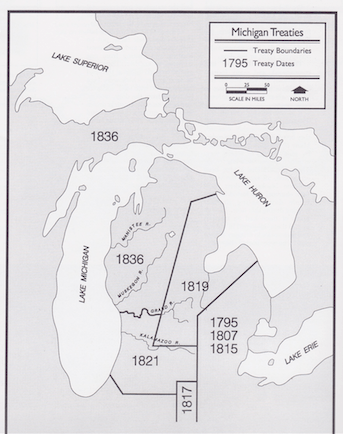
The reality is that thousands of indigenous people lived in what is now called Michigan prior to the European invasion. Most in these native communities experienced displacement by force, religious colonization, the flooding of their communities with alcohol and displacement through legal maneuvers known as treaties. There were numerous treaties that resulted in the takeover of Native land by settler colonialists throughout what is now called Michigan (see map on the right), but settler colonialists have a long history of violation of those treaties. So, to exclude any conversation or historical context about indigenous people is just another way of perpetuating the settler colonial narrative.
There is one mention of Native Americans in frame 16 of this photo gallery. The caption here read: Thanks to the rich history and immigration brought on by the mining boom years, the U.P. is also a cultural melting pot featuring Native Americans, Finns, Swedes, Italians, French Canadians and others.
Such a reference makes it sound like Native Americans just happen to come to the U.P., like all the other ethnic groups mentioned.
There are also a few other slides in the gallery that are instructive in terms of how it plays into the Settler Colonial narrative.
In frame number 7 we see a group of men who worked in the mines in the U.P. The caption refers to “Michigan striking it rich,” when talking about the level of mining taking place in the U.P. First, of all, Michigan didn’t strike it rich. Those who owned the mine struck it rich. In addition, the mines have contributed and continue to contributed to the contamination of water and soil in the U.P, which has disproportionately impact indigenous communities. (See Al Gedicks book, The New Resource Wars.)
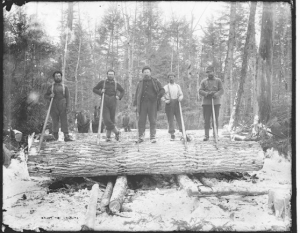 In frame 8 of the photo gallery, there is this picture of men standing on an old growth tree that was cut down. The caption reads: All that supposedly useless wilderness also turned out to be an important source of timber for the logging boom.
First, there wasn’t a logging boom, there were huge profits by logging companies, some of which were owned (in part) by Grand Rapids Furniture Barons who used the wood for furniture.Secondly, the amount of timber that was logged during the 19th century was astronomical, which is why there are essentially no old growth areas left in the U.P.
The rest of the photos in the gallery primarily focus on the majestic beauty of the Upper Peninsula. While the UP is beautiful and often breathtaking, the exclusion of indigenous history is unacceptable. I mean, one of the pictures even includes Tahquamenon Falls. The photo refers to is as a landmark, but fails to mention the name of the falls is Anishinaabe.
This MLive photo gallery that seeks to provide a history lesson, is just one example of how White Supremacy is practiced and why Settler Colonialism continues.

This winter we are offering an 8 week class that looks at the history of US treatment of Indigenous people from the perspective of Indigenous people.
The class will discuss colonialism, settler colonialism and Indigenous resistance. The primary sources we will use for this class are: An Indigenous People’s History of the United States, by Roxanne Dunbar-Ortiz; and a zine entitled Colonization and Decolonization: A Manual for Indigenous Liberation in the 21st Century. You can download the zine by going to this link
https://griid.org/wp-content/uploads/2009/04/colonization-decolonization.pdf.

We chose these two readings because they present US history through an Indigenous lens. We will also have some discussion about settler colonialism in Michigan, particularly West Michigan. The class is also primarily designed to inform and challenge Euro-Americans who are the beneficiaries of settler colonialism.
The class will be held on Wednesday nights from 6:30 – 8:30pm and will be held at Plymouth United Church of Christ, located at 4010 Kalamazoo Ave SE, Grand Rapids, MI 49508. The class will start on Wednesday, February 1 and go through March 22.
We are asking a suggested donation of $25 for the 8 week class, but we will not turn anyone away because of funds. To sign up, just send an e-mail to jsmith@griid.org.
City of Grand Rapids Hosts meeting on being a Sanctuary City
Yesterday, an estimated 30 people took part in a meeting to discuss the issue of Grand Rapids becoming a Sanctuary City. There were representatives from city government, the Mayor, the City Manager, members of the Community Relations Commission and the Chief of Police.
The community was represented by several immigration lawyers, non-profit workers, community organizers and members of the faith community.
The first person to be given the floor to start discussion was the Chief of Police. He started by saying, “we don’t work to enforce national immigration policy.” Rahinsky said that once they arrest someone and process them into the county jail they no longer have jurisdiction over what happens to that person. The Chief of Police inferred that the Sheriff’s Department has say on how much they will cooperate with federal law enforcement and then he made the point that Grand Rapids operates as a Sanctuary City, even though they have never declared themselves as one.
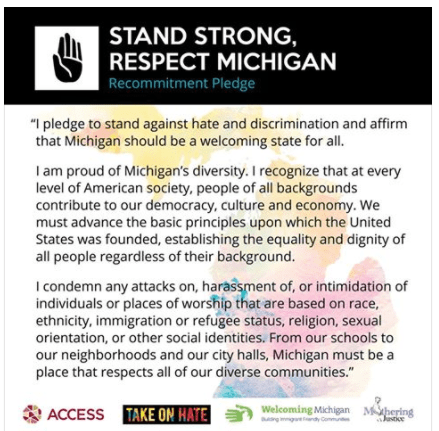
What Grand Rapids has declared themselves as is a Welcoming City. In fact, Grand Rapids is one of ten cities in Michigan that has signed on to what are now called Welcoming Communities. The Welcoming City pledge has lots of positive language and takes a clear stand against hate.
However, there was not a great deal of clarity about what a Welcoming Community means in concrete terms and there is no evidence from the website that becoming a Welcoming Community provides any protections for those who are undocumented.
The impact on undocumented immigrants was the major concern from the members of the community who were in attendance. Several immigration lawyers and an ACLU lawyer made it clear that the current practice of the Grand Rapids Police Department does contribute to undocumented immigrants ending up in detention or face deportation, even for minor non-violent offenses such as traffic violations or a suspended driver’s license.
Several lawyers suggested that the City and the GRPD need to look at developing a policy that would not treat suspended licenses and other minor traffic violation in such a way that does not result in undocumented people going to jail. In fact, a lawyer representing the Western Michigan Branch of the ACLU suggested that the City develop a “menu” of issues that might only result in fines or tickets so that people are not ending up in the County Jail. The ACLU even offered to assist the city in developing such a menu.
The other major issue that was discussed at this meeting was the issue of the potential risks associated with being a Sanctuary City. The specific risk to municipalities was in reference to proposed legislation that would result in the federal government withholding funds from cities that identify as a Sanctuary City. The Stop Dangerous Sanctuary Cities Act (S. 3100) was introduced by Pennsylvania Senator Pat Toomey earlier this year. Some of the federal funding that would be put at risk are identified as Economic Development Administration Grants and Community Development Black Grants, known as CDBG funds. President Elect Trump has also made it clear that he would defund cities that have declared themselves a Sanctuary.
The City Manager, the Mayor and other City staff were pretty clear that they did not want to risk losing federal funding by declaring Grand Rapids to be a Sanctuary City. The City Manager even made the point that much of the federal dollars that come to Grand Rapids benefit the poor.
While some might see the issue of federal funding being at risk if the City becomes a Sanctuary as a legitimate concern, what this really brings to the surface is the very limits of what governments can do.
This is why it is important for us to see the clear difference between Sanctuary Cities and Sanctuary Movements, as we noted in a recent posting. Sanctuary Movements do not have the limits that municipalities have and they also directly impact undocumented individuals and families by providing safety and solidarity in practice. Sanctuary Movements do not offer services, rather then enter into a relationship with those who are at risk of being detained, arrested or deported. Sanctuary Movements enter into this relationship even if it means that those involved in offering sanctuary are at risk of violating the law, because they adhere to values which says that human dignity is more important than laws.
The meeting did raise important questions, but one thing that was glaringly missing from the conversation were those who are most at risk of being arrested, detained or deported. What might the conversation have looked like if the voices of the undocumented were at the table? How might city officials have responded with their voices and their stories front and center? The reality is that those who are undocumented live in fear of the consequences of talking to those who have the power to arrest, detain and deport them. Again, the limits of what government can do are real.
Speaking afterwards with several immigration lawyers, they made it clear that the meeting went better than they expected and at least there was some willingness upon the part of the City of Grand Rapids to continue the conversation about looking at police policy. It was also suggested that a sub-committee be established that can further explore ways the city can adjust policy and procedure that minimizes the risk to those who are undocumented.

The Michigan Legislature is attempting to push through even more punitive bills before the holiday break. Just like the bill that seeks to end Public School teacher pensions and the legislation that seeks to limit picketing and protest in the state, the proposed legislation around ending refugee resettlement could pass before the end of the year.
The resolution, HCR 28, urges the President and Congress of the United States to comply with the Refugee Resettlement Act of 1980 and to halt further refugee placements until the Federal government is “able to comply” with appropriate screening and security checks and consult with local governments in future placements.
As many of you know, security checks already placed on refugees coming to the United States, are the most comprehensive screening process for anyone coming into our country. Secondly, there is already collaboration between the Federal, State, and Local governments regarding resettlement. The resolution would not have any legal effect, but remains of concern because it communicates false and misleading accusations of malfeasance and threat. Given the high level of coordination and security that currently exist, it is difficult to imagine any level of coordination and security that could satisfy the anti-refugee movement leaders promoting this kind of legislation. This legislation was introduced by Republican Mike McCready from the 40th District.
However, there are also several other organizations that have been lobbying for this type of anti-immigration/anti-resettlement legislation. First, there is the group known as Act for American, which, according to Sourcewatch, is one of the largest grassroots groups dedicated to targeting Muslims. Act for America uses hyper-nationalistic language and fear of terrorism as ways to influence public opinion. The Southern Poverty Law Center also lists Act for America as a Hate Group. Act for America has 6 chapters in Michigan.
Another group that has been behind the proposed legislation is the Refugee Resettlement Monitor – Michigan. This organization has ties to Act for America and uses some of the same information sources to update their members. One resource they promote is their Citizen Toolkit, which provides tips on passing local resolutions against refugee resettlement. The Refugee Resettlement Monitor – Michigan is also an anti-Islam group that believes that Muslims are trying to impose Sharia Law on people in the US.
Waterford Township passed an anti-refugee resettlement resolution in October of this year, specifically targeting Syrian refugees.
Whether the legislation becomes law in Michigan remains to be seen, but it is another indication that the far right is organized and attempting to push more anti-immigration policies.
With Grand Rapids Facing a Housing Crisis, Grand Action proposes to spend over $250 million for tourism and entertainment
Let’s be perfectly clear about what the new Grand Rapids Destination Asset Study will mean. It will mean that more public money gets directed at private projects that will result in increasing the wealth of a selected few in Grand Rapids.
In addition, the new study proposes that much of the need to expand certain assets that will primarily be used to attract more visitors/tourists to Grand Rapids. Not all that surprising, this will mean that the hotels, restaurants/bars, property management companies, construction companies, foundations, marketing firms and private parking businesses will be the primary beneficiaries of such projects. All one has to do is look at the list of people/entities that were interviewed in the process of the study and you understand which opinions are valued and which are not (see the last page of the study for list of those interviewed).
This new study was commissioned by the DeVos-created group known as Grand Action. Grand Action’s strategy has always been to use private and public funds for projects that will benefit many of the very same people (and the organizations they represent) that make up Grand Action Committee.
The projects that Grand Action has pushed in previous years have been the Arena, the convention center, the civic theater upgrade, much of the medical mile and most recently the Downtown Market.
Take the Downtown Market for example. This project was promoted from the very beginning with the idea of making Grand Rapids a tourist destination and creating what was referred to as a “Disnyland-like atmosphere.” The Downtown Market has always been about serving the culinary needs of those in the business/professional/ownership class than for working class people. In December of 2011, we reported on the millions of public dollars that would be used for the market, even though the public had little say in the project.
On Monday, MLive reported the Grand Action commissioned study, with the usual glowing remarks. The article even included a short video interview with the consultant who was hired by Grand Action to do the study. 
The Grand Rapids Business Journal and other major commercial media outlets also reported on the Grand Action study and simply restated what each source was saying. The major areas of asset improvement would be expand the convention center, add another new hotel downtown, upgrade transit options for downtown, making the Grand River more of a tourist/outdoor destination, build a professional soccer stadium and add other amateur sports options & destinations.
The expansion of the convention center can be seen in the image here on the right. You can see that the proposed expansion would utilize the space now currently occupied by the downtown post office and where the City & County buildings are located.
Another curious aspect of the Grand Rapids Destination Asset Study is what is referred to as Stressing Authentic: A Diverse and Inclusive Approach. The study says this about the idea of A Diverse and Inclusive Approach:
This initiative could effectively showcase diverse areas of the community, empower residents to participate in destination marketing efforts, and provide content that could potentially be used to inform future destination marketing efforts.
Ultimately it means maybe giving communities of color an opportunity to be involved in the marketing of their neighborhoods. Below is also major bullet points from the study having to do with diversity and inclusion.

My favorite is Minority Hospitality Incubator. Who comes up with this shit?
Lastly, the major issue that this new study raises is the cost. There are some hard figures and then there are some costs that are not as clear. However, based on the known costs, the budget for the proposed destination assets is roughly $278 million dollars.
This amount of money is somewhat staggering when we think about what that kind of money would mean for people who are struggling to make ends meet. Now, I know that some people will say that at least 50% or more will come from private sources and that is probably the case, but what it should say to us is that what those with tremendous wealth are preferring to invest in is making Grand Rapids a destination city. This equals, as we stated in the opening remarks, that those with tremendous wealth will have an opportunity to make even more if this proposal comes to fruition.
Imagine what $278 million could be spent on that would actually serve the needs to of so many. If one was thinking of housing, truly affordable housing, it would not be a stretch to suggest that 2,780 houses at $100,000 each, would mean that 2,780 families could have a healthy place to live.
Imagine if that kind of money was redirected to environmental cleanup and ecological sustainability? Think of how much food justice could be practiced with such a budget, which would result in more people eating better, thus reducing health care costs.
However, this would just be fantastical thinking, because those behind such projects are in no way interested in addressing social inequality or ways that would truly transform Grand Rapids that would make known as the Racial Justice City as opposed to Beer City.
Sanctuary Cities and Sanctuary Movements
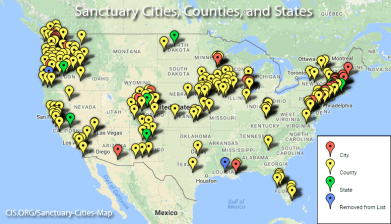
There has been a fair amount of discussion at the national and local level about the idea of Sanctuary Cities being a goal, especially since the November 8 election.
This renewed interest is completely understandable, considering what Donald Trump was saying about immigrants and an potential extension on an existing wall along the US/Mexican border.
In September, Trump and his advisors laid out their 10 Point Plan on immigration policy:
1. Build the wall
2. End “catch and release.”
3. Create a deportation task force and focus on criminals in the country illegally
4. Defund sanctuary cities
5. Cancel President Obama’s executive actions
6. Extreme vetting. Block immigration from some nations
7. Force other countries to take back those whom the U.S. wants to deport
8. Get biometric visa tracking system fully in place
9. Strengthen E-Verify, block jobs for the undocumented 10. Limit legal immigration, lower it to “historic norms,” and set new caps
Any number of these ten points would certainly be an attack on the immigrant community and create a climate of fear. However, it is important to note that the Obama administration has deported more people during his 8 years in office than any other president. So, the current discussion around sanctuary cities is not a new one, since millions of immigrants have already been living in fear. What has happened since the November election was really a wake up call to those of us not facing arrest, detention or deportation, about the harsh realities that immigrants face on a daily basis.
Sanctuary Cities
There are currently several dozen cities across the US that have declared themselves Sanctuary Cities. What this means is that those cities will limit the amount of cooperation they will offer to federal authorities when arresting, detaining or deporting immigrants, especially undocumented immigrants. There might be some nuances in some cities engaged in Sanctuary, but we should be clear that becoming a sanctuary city does little more than make a principled stand.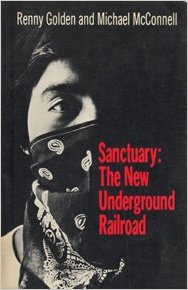
Sanctuary Movements
Sanctuary Movements are a completely different form of action from Sanctuary Cities. Sanctuary Movements are when people collectively work to provide a safe space for those most at risk of deportation and other forms of violence that are committed by the state or groups seeking to do harm to immigrants or those perceived to be immigrants. Sanctuary Movements have a long history in what is now called the United States. Indigenous communities/nations have been sanctuaries for Africans fleeing chattel slavery. An excellent resource that documents this relationship is William Loren Katz’s book, Black Indians: A Hidden Heritage.
Of course the most impactful example of sanctuary in US history was the underground railroad. Blacks that engaged in self-emancipation or were assisted in some way (usually by other blacks) were offered temporary or permanent sanctuary whether it was staying somewhere along the underground railroad for a night or ending up in a community in the northern part of the US or those who decided to go to Canada. Some excellent resources on this topic are The Underground Railroad: Authentic Narratives and First-Hand Accounts and Gateway to Freedom: The Hidden History of the Underground Railroad.
There have been other examples of those practicing sanctuary for people facing deportation and for those refusing to participate in war, but the most widespread example of a contemporary form of sanctuary, was the 1980s Central American Sanctuary Movement.
In the late 1970s and 1980s, US funded counter-insurgency wars were being waged in El Salvador and Guatemala, activists along the US/Mexican border began to see a sharp rise in the number of political refugees entering the country.
As communities began to offer safety to these refugees, they realized that all of them had a similar narrative. Each of the refugees told them that they fled their country because they either witnessed the torture and murder of family members or they themselves were torture survivors.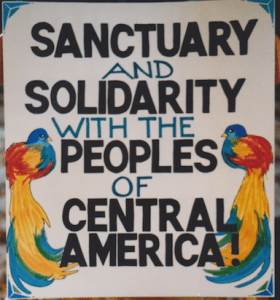
The US financed death squads in El Salvador and Guatemala was the primary source of the displacement of hundreds of thousands of people coming from Central America in the 1980s. US activists began to hear these stories in greater numbers and since the Reagan administration did not acknowledge Salvadoran or Guatemalan refugees as being political refugees, the US Sanctuary Movement was born.
The US Sanctuary Movement was begun by US faith-based communities that believed that they should offer sanitary for their fellow humans who were fleeing violence, even if it meant violating US laws.
Beginning in the Southwestern part of the country, Sanctuaries began popping up, where faith-based groups began to house people fleeing violence and to provide them with a forum to tell their stories.
Soon there were hundreds of places declaring themselves a sanctuary for Central American refugee, with three places declaring in Michigan alone – Detroit, Lansing and Grand Rapids.
The Grand Rapids Sanctuary was run by members of the Koinonia House, a housing collective that had begun in 1984 and did much of their organizing around resisting US Policy in Central America.

The seven members of the Koinonia House decided in the fall of 1985 to be part of the Central American Sanctuary Movement and traveled to Chicago to meet with the national coordinator of the project, the Chicago Religious Task Force on Central America. The Chicago group acted as a clearly house for groups wanting to declare themselves a sanctuary and to make sure that each group had the capacity to take such a project on.
The Grand Rapids Sanctuary need to get letters of support from organizations and individuals to demonstrate that they had a community of support behind them. Those involved in the sanctuary work also sought out lawyers who would be willing to led legal assistance if the political refugees in sanctuary were in need it. In addition, the Grand Rapids Sanctuary needed to seek out material and financial support for the ongoing needs of those living in sanctuary.
In April of 1987, six adults and one child arrived in Grand Rapids at the Koinonia House. A few days later a press conference was held on the front porch of the Koinonia House (pictured below) and this marked the beginning of several years that the Grand Rapids Sanctuary offered a safe haven for those who were fleeing violence in Central America. 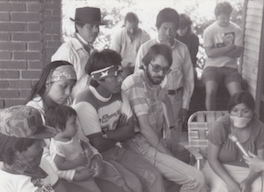
This is the fundamental difference between Sanctuary Cities and Sanctuary Movements. Sanctuary Movements are not symbolic, rather they seeking to offer concrete forms of safety and support, even if it means that those engaged in sanctuary work are at risk of state harassment or repression in the process.
Now, I am not arguing against Grand Rapids becoming a Sanctuary City, but the important work, the necessary work that needs to be done is when households, organizations and faith-based groups are willing to practice being sanctuaries for those at risk from state violence, hate groups and other manifestations of White Supremacy.

Last week we posted an article asking the question of why the Grand Rapids Public Schools Superintendent, Teresa Weatherall Neal, had responded so favorably to Donald Trump’s choice for Secretary of Education, Betsy DeVos.
The article was meant to raise questions and look at the what Superintendent Neal stated were ways in which what the DeVos family was doing in the Grand Rapids School District aligned with Neal’s goals.
I spoke with one GRPS board member on the phone who affirmed the analysis in the article, but two other board members felt that the article was misleading.
Last Tuesday, I sent the following e-mail to every member of the GRPS Board:
As a GRPS School Board Member, I would like to know what your reactions are to 1) the announcement that Betsy DeVos has been named as Secretary of Education, and 2) what impact might that have on GRPS?
If you could respond be the end of the week, that would be great. I plan to post your responses in their entirety on the griid.org blog.
I received two responses via e-mail. Pastor Nathaniel Moody and Monica Randles both replied with the message No Comment.
The remaining 7 members of the Grand Rapids Public School Board – Jen Schottke, Wendy Falb, Maureen Quinn Slade, Dr. Jose Flores, John Matias, Raynard Ross and Tony Baker – did not respond to our questions.
There continues to be a national outcry against Betsy DeVos becoming the Secretary of Education.
Lisa Graves with the Center for Media and Democracy wrote a solid piece on the Trump pick for Secretary of Education, entitled, 5 Things to Know about Billionaire Betsy DeVos, Trump Education Choice.
Democracy Now, also ran an important piece last week about Betsy DeVos, with several guests, but featuring Diane Ravitch, former Education Secretary and author of several books on the privatization of public education in the US.
It is unfortunate that the Grand Rapids School Board members are unwilling to take a position on the choice of Betsy DeVos as Secretary of Education, especially considering that it could mean further efforts to undermine the public school system throughout the country.
 Grand Rapids Institute for Information Democracy