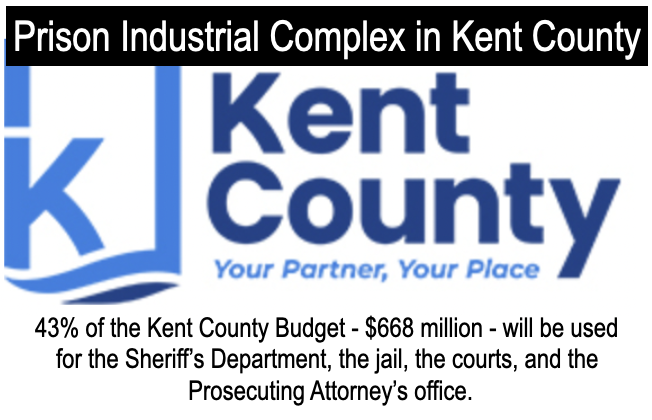
Kent County Commission adopts budget with the largest portion going to the Prison Industrial Complex
Last week, the Kent County Commission adopted a $668 million FY2026 Annual Budget, with a 16 – 4 vote in favor of that budget, with Commissioner Kallman absent from the vote.
The breakdown of the vote is instructive as well. All 9 of the Democratic members of the Kent County Commission voted for the $668 million FY2026 Annual Budget, while 7 Republican members of the County Commission also voted for the budget. Four Republican Kent County members voted no, but not because too much money was allocated towards the Prison Industrial Complex in Kent County. The four dissenting Republican members (Merchant, DeBoer, Burrill, and Bujak) voted no because they think the Kent County government is too big and their constituents are over taxed.
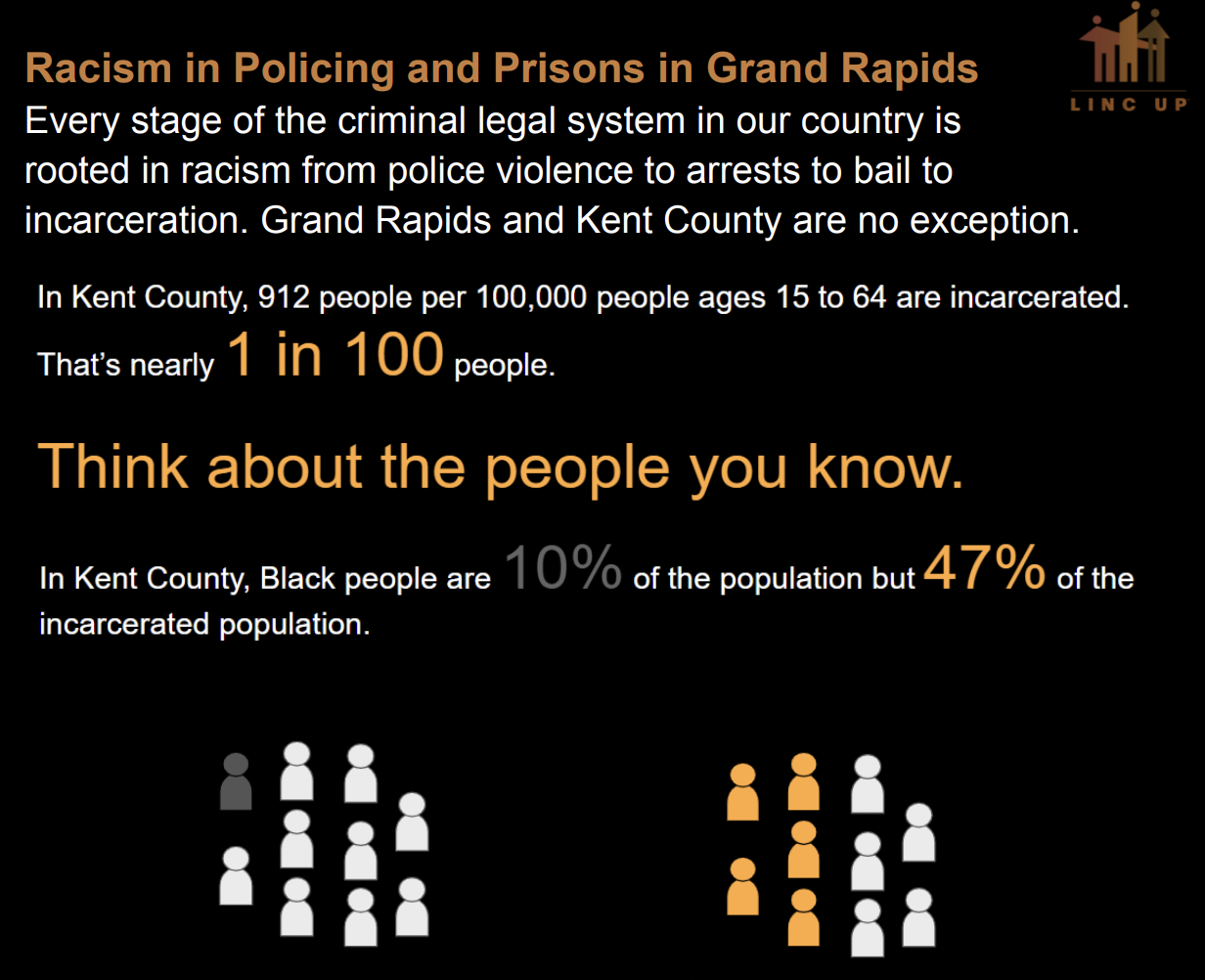
Despite some GOP member opposition, the majority of the Kent County Commissioners voted for the massive amount of funds that go towards the Prison Industrial Complex in Kent County – the Sheriff’s Department, the jail, the court system and the prosecuting attorney’s office. Voting for the Prison Industrial Complex in Kent County means they voted for the arrest and jailing of a disproportionate number of BIPOC residents and residents who live in poverty.
What was interesting to see from the Kent County Commission meeting last Thursday, was the fact that the Sheriff’s Department gave a big presentation prior to the vote, which also came with significant bipartisan praise for the so-called public safety people. Here is a link to the video of that meeting.
There was some interesting comments made by commissioners prior to the vote. Commissioner Faber suggested that the commission should involve the public more in the process of deciding the budget, without offer any concrete suggestions. Commissioner Ponstein pretty much dismissed the suggestion of involving the public in the budget discussion and Commissioner Stek said, “it’s the county’s budget that is up for approval, not the voters or the public.”
On the matter of voting for the Sheriff’s Department, the jail, the court system and the prosecuting attorney’s office, Commissioner Womack stated, “If we are not supporting public safety, public safety is not going to support us.” For someone who was involved in calling justice during the Schurr trial, Womack didn’t hesitate to vote for the arrest and incarceration of a large percentage of Black and Brown residents in Kent County.
Democratic Commissioner Monica Sparks went out of her way to make comments on social media about the bipartisan nature of the passage of the vote, saying:
“As your Kent County Commissioner for District 12, I’m proud to share- Today we have officially passed the annual $563 million Kent County budget! Thank you to my colleagues for coming together and working in a nonpartisan way to make this possible. This is what true public service looks like leaders setting aside differences and focusing on what really matters: the people we serve. Today, we celebrate collaboration, teamwork, and the shared commitment to do what’s best for our community. Together, we are making progress for our constituents and ensuring resources are directed where they are needed most. When we put people over politics, everybody wins.”
Black, Latino, immigrant and people living in poverty certainly don’t win.
The only Kent County Commissioner that questioned the disproportionately high amount of funding of the Prison Industrial Complex in Kent County was Commissioner McCloud, who stated, “43% of our budget is related to safety from courts to the sheriff’s office and these sorts of things and less than 1% s related to health and human services and mental health.” The vast gap between what the the authors of the book Beyond Courts refer to “administrative punishment” and basic human services from the County is glaring.
Unfortunately, Commissioner McCloud ended up voting for the the very things that she was critically pointing out. And therein lies the problem with politics – you talk a good game and provide a useful narrative, but then you vote for systems of power and oppression. Since actions speak louder than words, the entire Kent County Commission voted to endorse the Prison Industrial Complex in this county, for administrative punishment, and for the criminalizing of a disproportionate number of Black and Latino residents.
It’s more than Billionaires vs workers, it’s Capitalism!
The top billionaires in the US have a disgusting amount of wealth, most of which they made off of the labor or workers and in the speculative market, where nothing is made.
Billionaires like Bezos, Musk, Zuckerberg, the Waltons and the DeVos family all use their wealth to produced even more wealth, whether that is through influencing public policy, campaign financing, owning media or through foundations that are meant to con us into thinking they are generous.
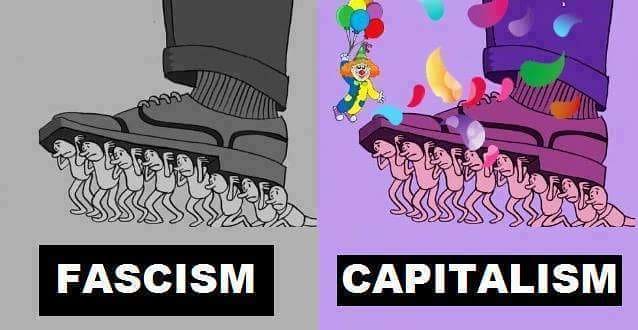
However, the only reason there are billionaires and millionaires is because of the economic system of Capitalism. Capitalism makes it possible to reward a small number of people, while the rest of us are either living paycheck to paycheck or worse, without a place to live, sick and food insecure.
I get that people are making this a billionaires vs workers narrative, especially with the current administration. Having said that, the wealth gap has grown under every US Administration since Nixon, as has the gap between workers and CEOs. For decades, regardless of who is in the White House, most of us are not earning a living wage, are having to cut corners in retirement, and have to agonize whether to pay the heat bill or put food on the table. Taxing billionaires more is a good start, but the problem is ultimately about billionaires, it is about Capitalism.
While most of this post will be discussing the nature of work within a capitalist system, it is critical that we think about and imagine work in a post-capitalist system. Part of the problem with labor/work in a capitalist system is that it is too often framed as jobs, specifically jobs that require bosses and owners.
Work, however, can be a liberating experience, if we see work as what people do when growing a garden, cooking, doing grassroots organizing, raising children, making music, art or any other activity that is uniquely human.
Unfortunately, before we can get to a more liberated notion of work, we need to create opportunities for people to see the possibilities of labor organizing within the current capitalist system.
Most of us have jobs, where we spend a great deal of time on a daily, weekly, monthly and yearly basis. However, how many of us go to a job where the workplace itself is based on cooperation, where the workplace is democratic?
Current estimates are that only 10% of those who have a job in the US are part of a labor union. This percentage is the lowest it has been in more than a century. If we want our workplaces to be more cooperative, more democratic, where people feel valued and have a voice in how things operate, then why not join a union or start your own?
How many people have been saying for years that they could do their job from home? Working from home has been a demand of those with disabilities for decades, but most employers were not interested in such ideas. Since the pandemic we have seen that indeed many people can work from home. If more labor unions existed, such a demand could have become a reality, way before we were in the midst of a pandemic. But here is thing, we have to make working from home a demand right now, even after the pandemic is over. What would employers use as an argument post-COVID-19 for not allowing people to work from home?
When people have labor unions, they have the possibility for workplace democracy. People can demand better wages, better benefits, better working conditions, plus they can advocate as workers to have greater say in day to day operations.
We know that labor unions have fought and won the 8 hour work day, workers compensation, workplace safety, better wages, pensions, improved workplace environment and the abolition of child labor. These were all victories that workers fought for, since they were never a gift from bosses, corporations or members of the capitalist class. For an important overview of this history, see From the Folks Who Brought You the Weekend, by Priscilla Murolo and A.B. Chitty.
However, since the end of WWII, labor union have been losing ground on numerous fronts. The number of workers in the US that are part of a labor union has steadily declined since the 1950s. The Taft-Hartley Act of 1947 was a major blow to workers, since it attempted to make strikes, particularly wildcat strikes illegal.
The de-industrialization in the US, also weakened worker unions, as did the rise of globalization, which included trade agreements that fundamentally undermined unions and workers rights in general. However, a major factor in the weakening of organized labor has been its decision to attach itself to the Democratic Party, especially in the past 50 years. Now, before people dismiss this point, I ask you to think about 2 things. First, how much money have unions and their members dished out in recent decades to support Democrats, and second, how has that money resulted in worker justice and increased workplace democracy?
Unions and the Financial backing of the Democratic Party
If we look at the data provided by the Center for Responsive Politics, we can see what the major unions have contributed to the Democratic Party since 1990. Lets take a look at four examples, especially four of the major labor unions in the US; the United Auto Workers, the AFL-CIO, the National Education Association and the American Federation of State, County and Municipal Employees.
- Since 1990, the UAW has contributed nearly $67 million to Democrats and spent another $47 million to lobby members of Congress.
- The AFL-CIO has contributed just shy of $51 million to Democrats and spent another $127 million lobbying Congress.
- AFSCME has contributed $180 million to mostly Democrats and another $64 million to lobby Congress.
- The National Education Association has contributed $134 million to Democrats and another $73 million on lobbying Congress.
This means that these four major unions combined have spent $432 million to influence elections and another $311 million to lobbying those already elected. What this says is that these four unions have used $743 million of their members money to try to influence election and policy at the federal level since 1990.
In Michigan, the trend is not much different. If you look at the data provided by the Michigan Campaign Finance Network (MCFN) for all the state races in the 2018 election, you will see that the Democratic candidates have received hundreds of thousands from various labor unions within the past 18 months and will continue to receive thousands more before the November election. In addition, some of the largest Political Action Committees in the state are labor unions, which you can also see from the MCFN.
A more specific example of how unions have spent money during an election cycle, was in 2012, when unions spent $21.9 million to pass Proposal 2. The business community however, spent $25.9 million to defeat the measure, which it did. Just after the November election in 2012, there was a major rally held in Lansing, where some 10,000 workers and allies came to protest the austerity measures being passed by the state, particularly making Michigan a Right to Work state. Unfortunately, instead of occupying the capitol building or shutting down Lansing, most of the rally organizers proposed that they get their people elected in 2014……….which didn’t happen.
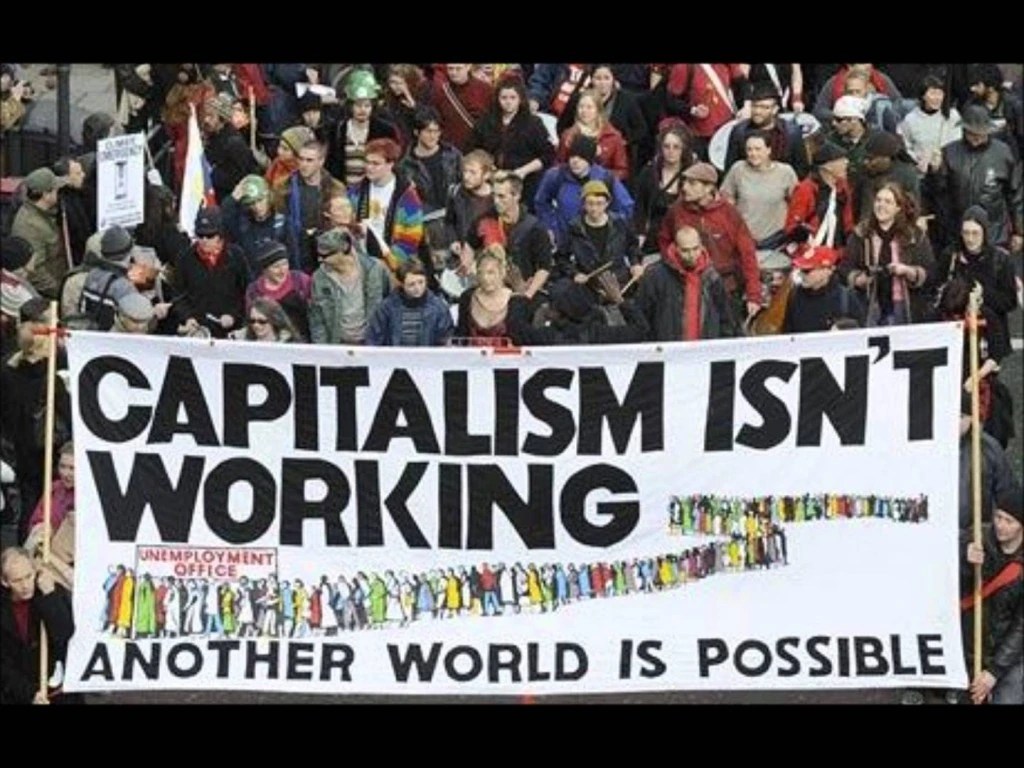
What have unions and workers won with millions going to the Democrats?
It will be argued that if unions did not support Democrats with millions during elections in recent decades that the GOP would have pass even more draconian laws to further weaken labor laws and give private capital even greater power. This may be true to some extent, but what such an argument doesn’t take into account, is the fact that in the heyday of the labor movement – late 19th Century through 1945 – is that workers won a great deal without primarily aligning themselves with the Democrats. In fact, what labor historians have made clear is that the labor movement, by engaging in massive organizing efforts and using direct action were the reasons why they won so many labor disputes.
In more recent decades, say during the 8 years of the Clinton administration and the 8 years of the Obama administration, or the 4 years of the Biden Administration we need to ask what major labor victories took place? My read on those years was that there were no major labor victories, but there was a steady decline of union membership and numerous set backs for working people. Think of the number of trade agreements that were enacted since 1992, when NAFTA went into effect. The massive WTO protest in Seattle took place in 1999, while Clinton was in the White House.
During the Obama years, the only significant thing that organized labor asked from the Obama administration was to not sign on to more trade policies like the TPP and to pass the Employee Free Choice Act (EFCA). The TPP did not pass, despite the Obama administration’s support of it and the EFCA never got any traction. Again, unions may argue that if they had not financially backed Democrats workers would have lost more ground, but the real question should be, what are labor union getting/winning by giving millions to Democrats?
Time for a new Labor Movement/Labor Strategy?
Ok, so let’s say that organized labor decides to stop funding the Democratic Party and instead focuses on movement building. Union members could still vote for Democrats if they chose, but they could be part of a new labor movement that would not be beholden to political parties and could actually affect change.
There are already some signs to workers and unions pushing for more transformative justice. There is the $15 an hour movement, the numerous teacher strikes across the country and there are efforts to organize workers from corporations like Amazon. However, these efforts are often unconnected and they are not primarily focused on workplace democracy.
First, what if organized labor used the funding that they would have put towards elections and use it for paying people to organize shops and other work places? Not only would this scare the shit out of the capitalist class, it would give more workers an opportunity to be part of a union that actually fought for them. This kind of union organizing should also take place outside of specialized work and organize migrant labor, service sectors, restaurant workers and the unemployed.
Second, workers could engage in wildcat strikes, walkouts or other forms of direct action that would force companies to the table. In demonstrating their power, workers could negotiate wages, benefits and workplace dynamics that would result in victories. As individual shops and work places win labor battles, these same unions could join other labor struggles and support workers who were fighting get get a union and all the possibilities that come with being organized.
Third, unions could re-direct the money that they were spending for elections and lobbying to provide mutual aid to families that are experiencing poverty, facing foreclosure or any other economic hardships, including the corporate-driven health care costs. Not only would this kind of mutual aid help build relationships with working class people, it could result in an increase in union membership.
Fourth, what if the labor movement began to develop their own independent media. The commercial media will not represent the collective struggles of workers, in large part because they are dependent on advertising dollars from the very entities that exploit workers. We used to have a lively labor press in the US, but so little of that exists now. We need an independent media that tells the stories of the people whom the commercial media ignores. With an independent media, more people will have access to information that the commercial media marginalizes or represses. I’m not talking about just online media, I’m talking about labor-based press, a newspaper that is run by and for workers. Such a tool and other forms of media are weapons we need in the war of propaganda that the capitalist press is winning.
These proposals are not necessarily new, since much of what we have been talking about has been done before, with a great deal of success. However, we do need to do some things differently from what organized labor has done in the past.
Fifth, the worker-led movement needs to also connect to other movements around fighting white supremacy, patriarchy, ablism, homophobia, transphobia and fighting for food justice, immigrant justice and climate justice. Class issues can bring us together, but only if we do not make class the center of all justice struggles. The new work-led movement needs to be intersectional and transformative and not settle for just fighting against capitalism, but creating new economic systems that are democratic, local and multifaceted. We can take a cue from the wobblies who believed that, “An injury to one is an injury to all.”
Organized Labor is Not Enough: We need a new economic system
As we noted in the beginning of this article, we need to radically re-imagine our beliefs about work and what is truly essential in a post-COVID-19 world. It seems that the COVID-19 crisis has demonstrated to millions around the world that the current system of capitalism primarily benefits the super rich and it is ecologically unsustainable.
Workers around the world have already been demanding more and going on strike in record numbers. Well, when I say record numbers, I mean for what we have seen in recent decades. However, if we look to a previous crisis in the US, say the Great Depression, then the amount of strikes that are happening now are minuscule, compared to then.
According to the book Strike!, by Jeremy Brecher, there were literally thousands of strikes that took place in the early and mid-1930s, mostly due to the growing unrest amongst workers and the Capitalist system. There was also lots of frustration with the American Federation of Labor (AFL), which was focused on craft unions and did not share the same anti-capitalist sentiment that a growing number of workers felt. This political climate is what gave birth to the Committee for Industrial Organizing (CIO).
It is also important to note that many of these strike in the post-Great Depression era were wildcat strikes or sit-down strikes, where workers were not outside of factories on a picket line, but where workers showed up for work and then refuse to do anything. Sometimes these wildcats strikes involved workers literally taking over a factory and not allowing bosses or owners to enter. According to Brecher, in 1936, there were 48 sit-down strikes and in 1937, there were 477. Not only did these strikes scare the shit out of the capitalist class, it forced the administration of FDR to adopt more labor-friendly policies in the 1930s. When the labor movement was well organized and engaged in direct action, that is when they were able to win legislative victories. They did not need to be tethered to a political party. 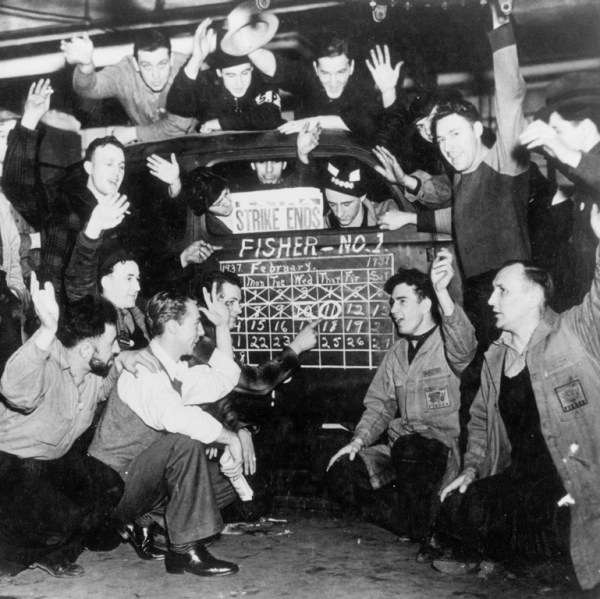
Labor strikes and General strikes can and should be a tactic that we use today. What would it look like if migrant farm workers went on strike and had millions of people supporting them? If our food system comes to a halt, then the chances of winning demands of farmworkers would likely become a reality.
However, all of these efforts should not limit un to thinking about a new economic system(s), where people and the planet are truly valued. Equally important is the idea that we cannot limit ourselves into thinking that doing work is the same as having a job. There are millions of people who hate their jobs. They hate their jobs because they are not financially compensated in a just way, they have no power, and for many people they hate their jobs because it is meaningless, often soul-crushing, work.
Let’s face it, there are millions of jobs that exist that perpetuate environmental destruction and the consumption of shitty products. In a radically imagined world, where work was truly valued and people were not forced to find a job, do you think people would willingly chose to build bombs or manufacture Monsanto products? Most of us have jobs to pay the bills, to pay off our student-loans and to have some form of health care coverage. In a radically re-imagined world we could all participate in doing doing work that was life affirming, that was nurturing, work that was creative and work that was not environmental destructive. In a radically re-imagined world we would all have more time for relaxation, for pursuing our creative interests and for play. Anything is possible if we are organized and practice direct action to win the kind of demands we want. Another World is possible!!!
What can we do?
There are no easy answer or quick fixes. One thing for sure is that whatever we do has to be a collective response. As an abolitionist, I am committed to not only dismantling the economic system of Capitalism, I want to practice collective liberation and cooperation. One way to think about this is from an excellent article by Stephen Dacy, Environmentalism as if Winning Mattered: A Self-Organization Strategy. Darcy suggests we need a two-pronged strategy of Resistance and Transition. Darcy argues that while we resist oppressive structures and systems, we need to simultaneously work to create autonomous systems and practices that reflect the kind of world we want to live in.
However, in the mean time, here are a few things that we can do collectively to promote and practice economic justice and foster cooperative practices that can lead to collective liberation.
- Most of us have jobs and are not bosses, therefore you can be organizing for workplace democracy and fight for better wages and benefits. You can join a union or you can start an independent one, like an autonomous IWW chapter. Once you are part of a union engage in direct action, like wildcat strikes, not the ineffective silly version of strikes known as picketing.
- Create worker-run cooperatives, where bosses are not needed and where those who do the work decide how funds are spent and how they are shared between those involved. See the book, For All the People: Uncovering the Hidden History of Cooperation, Cooperative Movements, and Communalism in America.
- Create or join a community garden. Growing food collectively will not only help us not rely as much on agribusiness and fake foods, but it helps to foster solid relationships and practice skill building. The same could be said for food cooperative, housing cooperative, childcare cooperatives, etc. For a great model, look at the example of Brazil’s Landless Workers Movement, Movimento dos Trabalhadores Rurais Sem Terra, where those who have been displaced and dispossessed, occupied land that was appropriated by the rich. The MST then creates their own autonomous communities. It is the largest organized social movement in the world.
- Make demands at the local, state and federal level to prioritize budgets – which are exclusively made up of the tax we collectively pay – that larger portions of public money be spent on uplifting people, creating more equity and moving away from funding things like policing, the prison industrial complex, the military industrial complex, etc. If government systems to not respond to our demands, then we can collectively engage in tax resistance. As Secretary of State George Shultz once said, “people can march all they want, as long as they pay their taxes.”
- Practice Mutual Aid. One of the fundamental principles of Mutual Aid is the idea that “we take care of each other.” Mutual Aid can be in the form of money, food, transportation, housing, caring for children, pretty much anything we can do that demonstrates ways of taking care of each other. I would highly encourage what Dean Spade has written on the topic of Mutual Aid.
- Engage in collective boycotts and economic sabotage. Systems of power and oppression rely on us to spend money on things that cause oppression. If we engage in collective boycotts and economic sabotage, we can wound the system of Capitalism, Militarism and White Supremacy, especially in our own communities.
- Practice skill sharing. We all know things, knowledge or skills that we can share. The more we share those skills, the more than we don’t have to collectively relying on someone else doing something for us. Again, skill sharing is most effective when we practice it collectively.
These are just some of the more important tactics and strategies we can implement and practice if we are going to create another kind of world to live in. None of it will be easy, much of it will mean that we need to take risks, but then again if we look at significant shifts in history, especially the kind where collective liberation was at the center, taking risks has always been necessary.
It has been 23 months since the Israeli government began their most recent assault on Gaza and the West Bank. The retaliation for the October 7, 2023 Hamas attack in Israel, has escalated to what the international community has called genocide, therefore, GRIID will be providing weekly links to information and analysis that we think can better inform us of what is happening, along with the role that the US government is playing. All of this information is to provide people with the capacity of what Noam Chomsky refers to as, intellectual self-defense.

Information
The Price of Genocide: How US Funding Sustains an Unraveling Israeli Economy
The War on Truth: Why Palestinian Journalists Are Being Systematically Erased
Netanyahu Far Outscores Putin and George W. Bush in Killing Innocent Civilians
Western Media Manufactured Consent for Israel’s Murder of Palestinian Journalists
Israel Is Forcing Parents in Gaza to Watch Their Children Die of Hunger
Microsoft Workers Arrested After Occupying C-Suite to Protest Israel’s Use of Azure in Gaza
Israel targets journalists, rescuers in double-tap strike on Gaza hospital
Analysis & History
UNICEF Report from Gaza City: U.N. Declares Famine as Children Starve
CHRIS HEDGES: ISRAEL’S ASSASSINATION OF MEMORY
Image used in this post is from https://visualizingpalestine.org/visual/deprivation-by-design/
How spiritual violence can impact us all: a family story
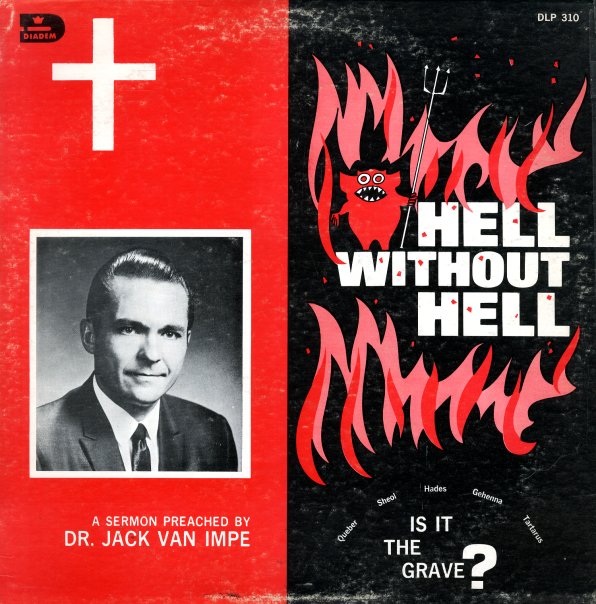 People who know me, know that I was once studying to be a Catholic priest in the early 1980s. By the end of that decade I no longer identified as a Catholic or a Christian. The reasons for leaving the church were many, but one of them was because of the harm of spiritual violence.
My introduction to organized religion as an adult, was because of my brother, who also introduced me to the Catholic Worker movement and other more radical aspects of the Christian tradition. My brother introduced me to Direct Action and fostered my growth in critical thinking. It is safe to say that if it wasn’t for my brother, I wouldn’t be the person I am today.
My brother has been a truck driver for some 30 years and he recently began posting videos where he talks about spiritual/religious violence and how he was traumatized by it while he was a teenager.
In the mid-1970s, our mother took us to a religious revival or sorts at the Hershey Arena. We heard the non-denominational preacher Jack Van Impe, a longtime televangelist. Van Impe was a fire and brimstone preacher and spoke in very black and white terms about heaven, hell and the influences of the devil.
The Van Impe revival that my brother and I attended also included an alter call, where people were invited to meet with spiritual counselors with the goal of dedicating your life to Jesus. I wasn’t buying what Van Impe was selling, not because I was skeptical, it was just not something that I could relate to. Unfortunately, my brother was deeply traumatized by the notions of hell and eternal suffering, which he discusses in this first video.
In his second video, my brother explores the impact of the spiritual violence he suffered, where he talks more about the concepts of hell, Dante’s depiction of hell, what other writers have had to say about it and how this apocalyptic view of the world has grown in the US, finding its way more and more into the dominant culture.
I am inviting people who read GRIID to check out these videos and to even offer some feedback in the comments section of the YouTube videos included in this post, as I think it would be welcomed by my brother. Thanks for your consideration.
A far right Christian blog just referred to GRIID as a left-wing website that isn’t committed to the truth
In March, I did an interview with a GVSU art professor about an art installation that a far right group of Christians tried to censor.

In that interview, the professor quoted the student who made the art piece and had written a statement:
“The murals are aimed at addressing societal challenges without undermining the core tenants of the Catholic Faith. These murals seek to confront gender-based violence, homophobia, and mental health disorders advocating for a nuanced reevaluation of certain aspects of Catholic teachings to foster a more inclusive and compassionate culture. The intent is not to criticize, but to encourage thoughtful reflection on interpretations that may inadvertently contribute to societal issues.”
The far right Christians did not agree with this statement, nor were they willing to budge on their attempts to get the mural censored.
A far right Christian blog has now weighed in on the issue in an article entitled, Michigan university reinstalls blasphemous pro-LGBT image mocking Our Lady. Actually, the far right Christian site – Christianity House – merely reposted an article from Kokx News, a site that has as it’s tag line – “All things Catholicism, all things politics, and everything in between.”
 Stephen Kokx is the founder of Kokx news and also included a video interview with one of the GVSU students who has been involved try to censor the student-created mural. In this video interview with GVSU student Noah Mullins, Kokx and Mullins both display blind allegiance to Catholic teaching in such a way that is very similar to the pro-fascist Catholic group known as Opus Dei. Mullins then says that, “the Grand Rapids Institute for Information Democracy is a very, very far left, and I would almost describe it as a Socialist press company.” Stephen Kokx simply labeled GRIID as “propaganda.”
Later on in the interview, Mullin again referred to “GRIID as in no way interested in the truth.” However, what is most concerning to me is the fact that they include in the video interview a photo of one of the GVSU professors and their contact information, essentially they were doxxing this professor.
Getting back to the article, here is the reference to GRIID:
In an interview with left-wing website Grand Rapids Institute for Information Democracy in March, Colley downplayed the blasphemous nature of the image. He claimed that it was simply meant to “promote dialogue” and that Catholic students at Grand Valley were overreacting. He also referred to Our Lady of Guadalupe not as a woman but as an “it.”
Ok, so I could care less if Christians are bad mouthing GRIID, especially since it wouldn’t be the first time. What I do object to is how both GVSU Student Noah Mullins and Kokx News founder, Stephen Kokx ,are doxxing GVSU professors.
I also object to how the Christianity House website normalizes hate and potential harm towards the LGBTQ community, how they normalize Patriarchy, how they normalize the genocide happening in Gaza and how their embrace of Christian Zionism has weaponized antisemitism. These issues are no laughing matter, which is why GRIID has made it a point to report on both the political and religious right in West Michigan for the past 15 years.
Last week, the Meijer Corporation had an employee arrested at one of their stores in Ohio for eating food that was going to be tossed anyway.
The arrest, along with bodycam footage made it’s way to social media, where people were outraged by what happened and some are calling for a boycott of the Grand Rapids-based hyper-market retailer.
I completely get why people are outraged over the treatment of a 19 year old employee. The Meijer Corporation humiliated the 19 year old and subjected him to arrest. Such treatment should piss us off. Yet, this is merely an isolated incident and what we need to be doing about corporations, indeed, about the economic system of Capitalism, is interrogate it on a systemic level.
While the treatment of the 19 year Meijer employee was abhorrent, we need to ask larger questions and have an analysis of why these kinds of incidents generate so much attention, but they daily exploitation of workers does not.
According to GlassDoor, which is an online job search platform, Meijer cashiers can make between $13 – $16/hr, Pharmacy Technicians $17 – $21/hr, Overnight Stocker $14 – $18/hr, Grocery Clerk $14 – $17/hr, and Produce Clerk $14 – $17/hr.
The wages for these jobs are not a livable wage, no in Michigan or anywhere else that Meijer stores are located. Right now in Michigan, according to the National Low Income Housing Coalition, you need to make more than $25 an hour just to afford the average cost of rent in this state. And that is just rent, so add on to that the cost of utilities, car payments, groceries, gas, and other basic necessities, and people out to be making at least $40 an hour to meet those needs.
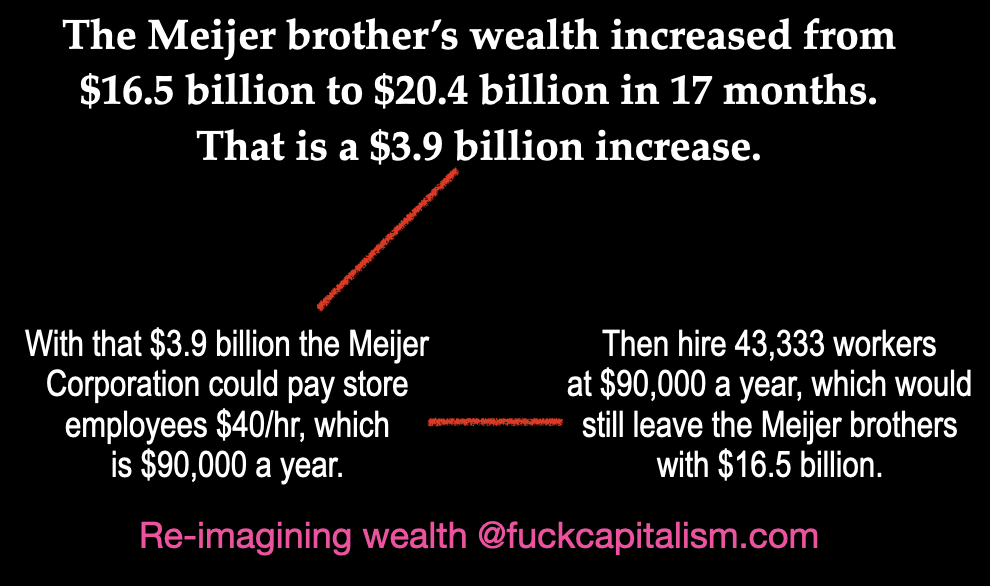
Now, lets compared what Meijer store employees are making and what the Meijer brothers are worth. According to the Forbes Real-Time Billionaires ranking, as of August 26th, Mark Meijer, Doug Meijer and Hank Meijer are each worth $6.8 billion, making their collective wealth a total of $20.4 billion.
A fundamental principle about Capitalism is that the ownership class makes most of the money, while the working class barely survives. In March of 2024, I wrote a post entitled, Meijer family wealth increases by $1.5 Billion, putting their combined wealth at $16.5 Billion. This means that over the past 17 months the three Meijer brothers increased their collective wealth by $3.9 billion.
If we take that $3.9 billion that the Meijer brother made in 17 months and used it to pay their stores workers $40/hr, that would be a $90,000 annual salary, which is more than double what most of their store employees make. With the $3.9 billion that the Meijer brothers made in 17 months, they could hire 43,333 employees at $40/hr. This would leave the Meijer bothers with a mere $16.5 billion. I think it is safe to say that they would be fine.
Of course, Meijer won’t do this, because this would send a really bad message to Capitalists, since workers everywhere would be demanding a livable wage. Since many people will be celebrating Labor Day this coming Monday, why don’t we talk with Meijer workers about this wealth gap, support them in organizing a labor union, with increased wages and whatever other demands they might want to fight for. This is how you fight against Oligarchy, and this is how you fight against Capitalism. Calling for a boycott in this instance is reactionary, not strategic.
Civil Rights activist and entertainer Dick Gregory spoke at Fountain Street Church in 1969
Editor’s note: I have been working with Fountain Street Church and looking at a substantial amount of archival materials they have. Today’s post is only possible because Fountain Street Church has provided me access to their archives and they want this information to be public and available to the community. I will be hosting the archival material on the Grand Rapids People’s History Project site, but also posting here on GRIID. This is the second in a series of postings from the archival material at Fountain Street Church.
Earlier this year I posted a transcript of a lecture from Kwame Ture, known as Stokely Carmichael when he spoke at Fountain Street Church in May of 1967, which you can read here. Last week, I posted an audio recording of civil rights activist James Meredith who spoke in 1967 at Fountain Street Church.

Today, I wanted to share an audio recording of the Comedian and Civil Rights activist Dick Gregory, who spoke at Fountain Street Church in January of 1969. Gregory was also a fierce critic of the US war in Vietnam and was arrested numerous times for civil rights and anti-war actions. Dick Gregory used humor as a tool to expose the absurdity of the American Empire. Gregory died in 2017.
Some of the issues and themes in Gregory’s talk at Fountain Street Church were his affirmation of youth, talking about old folks lying, systemic racism, and changing the system. Gregory also talked about how the 1968 Democratic Convention, where the the Democrat Mayor Daley used severe repression against those protesting at the convention. Gregory said that the response of the system during the 1968 Democratic Convention woke people up.
Once again the GR Chamber of Commerce wants us to believe that they are looking out for the little guy
Last week the Grand Rapids Chamber of Commerce hosted Neil Bradley. Bradley is the Executive Vice President, Chief Policy Officer, and Head of Strategic Advocacy for the U.S. Chamber of Commerce.

The Grand Rapids Chamber of Commerce posted some pictures of Bradley on their Facebook page, with the following comment:
Thank you to Neil Bradley, Chief Policy Officer at the U.S. Chamber of Commerce, for sharing your insights today on how policy changes, taxes, and tariffs impact small businesses.
It is instructive that the GR Chamber mentions how only small businesses would be impacted by taxes and tariffs. However, this is not surprising since the GR Chamber of Commerce always appears to act as the great defenders of small businesses. For example, the Grand Rapids Chamber of Commerce has come out against a ballot initiative in Michigan called Invest in MI Kids. The premise of this ballot initiative is to restructure the tax system in Michigan so that millionaires and billionaires will be more in taxes. The GR Chamber is claiming this would negatively impact small businesses, but in reality, they are opposed to any tax policy that would impact members of the Capitalist Class.
It is also instructive that the GR Chamber of Commerce only referred to Bradley as the Chief Policy Officer of the US Chamber of Commerce, where he is in fact so much more than this. According to his bio on the US Chamber of Commerce site:
As executive vice president, chief policy officer, and head of strategic advocacy at the U.S. Chamber of Commerce, Neil Bradley is responsible for the organization’s overall advocacy efforts. In addition to managing policy development for the Chamber, Bradley oversees its government affairs activities, political program, and relations with other business organizations.
Thus, it seems safe to say that Bradley was in Grand Rapids to talk with GR Chamber members, small medium and large. Equally important is the fact that Bradley, “Prior to joining the Chamber, Bradley spent nearly 20 years working in the House of Representatives, including 11 years working for the House Republican leadership. He served as deputy chief of staff for then-Majority Leader Kevin McCarthy (CA) where he developed the legislative agenda for House Republicans, oversaw policy formulation in the leader’s office, and coordinated committee activity in the House. Bradley held the same position for Eric Cantor (VA) during his tenure as majority leader. Before that, he was policy director for House Republican Whip Roy Blunt (MO).”

The Chamber of Commerce, whether local or national, generally back the GOP, but lets face it, both parties are fervent defenders of Capitalism. It is also worth noting that the US Chamber of Commerce the largest lobbying  organization in the United States, and also works to influence policy in many other countries. The Chamber of Commerce has a long history of defending business interests at the expense of working class people and eco-systems.
The Grand Rapids Chamber of Commerce has a long history of being anti-union, pro-cop, and opposed to any regulations against the business class. GRIID has written dozens of of articles about the GR Chamber of Commerce since 2010, which you can find here.
For excellent additional sources with critical analysis of the Chamber of Commerce, see Alyssa Katz’s book, The Influence Machine: The U.S. Chamber of Commerce and the Corporate Capture of American Life, and check out the SourceWatch page on the US Chamber of Commerce.
Monitoring the Rich and Powerful in Grand Rapids – Segment #6: Downtown development projects are NOT made for us
One of the 10 principles of journalism is that it must serve as an independent monitor of power.
Now, I don’t claim to be a journalist, more of a media watchdog, but I do engage in movement media. Movement media is reporting and documenting what social movements are doing, which is what I have been trying to do with GRIID since 2009.

However, since I have been monitoring what I call the Grand Rapids Power Structure for nearly two decades, I thought I would start a new segment – Monitoring the Rich and Powerful in Grand Rapids.
The Monitoring the Rich and Powerful in Grand Rapids segments will offer brief commentary on those who have power over others in this community. These segments will not replace my regular reporting on the Grand Rapids Power Structure, since those stories will offer more in depth writing.
As we navigate a second Trump Administration it seems like a perfect opportunity to shed some light on the rich and powerful of Grand Rapids, or to frame it the way that radical media from the 60s and 70s would do regarding the Capitalist Class, using the phrase, “up against the wall motherfucker!”
GRIID has written about the group GR& Riverfront, which is essentially a platform to showcase development projects in downtown Grand Rapids, projects which have benefited from hundreds of millions in public money, but are primarily owned by members of the Grand Rapids Power Structure.
In a recent GR& Riverfront Email, they included a video with the title, August Construction Updates.
This awful video, which has a bad 80’s-like song that accompanies it – which is probably AI generated – showcases the various development projects near the Grand River. Towards the end of the song the lyrics are:
The city’s growing,
yeah, we’re growing bold.
Turning dreams into stories
that will soon be told.
From the riverwalk to the sky so blue
It’s all coming together.
And it’s made for you!
I’m not really sure who the target audience is for this video, but it really is a poorly constructed propaganda piece. The main sell from this video, and what those who will profit heavily from the development projects that have used hundreds of millions in public money, is to convince people that all of these development projects are being made for us. That’s right, the Grand Action 2.0 crowd, the DeVos family and other members of the downtown business community all want us to buy the idea that all these new projects are for us.
Ok, ok, so let me get this straight. The members of the Capitalist Class, working in partnership with Grand Rapids and Kent County officials, using hundreds of millions of our tax dollars, are building the Amphitheater, the Soccer Stadium, improving Canal Park, upgrading the Gillett Bridge and giving the Public Museum a facelift are all supposed to be for us? Members of the Grand Rapids Power Structure are going to make a lot of money from these project, but they public is still going to have to buy tickets to concerts, tickets which will be managed by Live Nation, which is currently facing a federal lawsuit for price fixing. This means that tickets will not be cheap, as will tickets to attend professional soccer games at the Amway Stadium.
So, I suppose that the powers that be asked us, the public, what it is that we want to see happen in Grand Rapids. No, so you didn’t get asked? Ah, maybe because those in the Grand Rapids Power Structure intuitively know what the public wants, so naturally they decided to build an Amphitheater and Soccer Stadium, using our money. Wrong!
I know a lot of people and most of the people that I know and have met over the past 45 years in Grand Rapids it that they want things like:
- Making a living wage. Recent data shows that 47% of Grand Rapidians are living paycheck to paycheck.
- Being able to live in a home or an apartment that they can actually afford.
- Not having to work two jobs just to survive.
- Not be harassed by the GRPD, especially when they come downtown.
- Live in a City that does not practice structural racism.
- Live in a City that does not welcome trans and queer people, especially those that do not embrace the entrepreneurial I can pull myself up by my bootstraps bullshit.
- Live in a City that doesn’t criminalize the unhoused.
- Live in a City that doesn’t shoot or beat Black people because they don’t comply.
- Live in a City that doesn’t criminalize those who engage in dissent.
- Live in a City that doesn’t cooperate with Immigration and Customs Enforcement (ICE) and actually listens to immigrants who are demanding they stop collaborating with ICE.
- Live in a City that is more interested in attracting tourist than they are in supporting the people who actually live here.
Most people I know are tired of Grand Rapids City officials collaborating with the Capital Class to construct a a City that is essentially a playground for the Capitalist Class, a playground that will allow the rich to further expand their wealth.
What is happening in downtown Grand Rapids is not for us and it never has been, from the first incursions of Europeans settler colonialists that stole the land from the Anishinaabe, right up to the present day with Grand Rapids Chamber of Commerce-endorsed criminalization of the unhoused. And this reality will not change until we are collectively organized to change it, by any means necessary.
It has been more than 22 months since the Israeli government began their most recent assault on Gaza and the West Bank. The retaliation for the October 7, 2023 Hamas attack in Israel, has escalated to what the international community has called genocide, therefore, GRIID will be providing weekly links to information and analysis that we think can better inform us of what is happening, along with the role that the US government is playing. All of this information is to provide people with the capacity of what Noam Chomsky refers to as, intellectual self-defense.

Information
Israel escalates destruction of Gaza City
The world authority on food crisis officially declares famine for over 500,000 in Gaza
The Arab, the Left and Those Who Remained Silent: History Will Not Forgive You
When Genocide Denial Is the Norm
More Western Activists Are Traveling to Palestine — and Israel Is Deporting Them
Genocide in Gaza: A Stain on Us All
Analysis & History
West’s Complicity in Genocide: Q&A with Dan Steinbock
Famine Review Committee Gaza Strip
“The West Bank Is the Prize”: Israel Approves New Settlements to “Bury” Palestinian State
Image used in this post is from https://visualizingpalestine.org/visual/deprivation-by-design/
 Grand Rapids Institute for Information Democracy