Betsy DeVos encourages Community College graduates to be selfless and then talked a lot about God
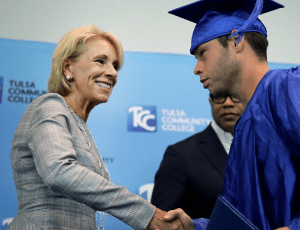 On Tuesday, Secretary of Education Betsy DeVos gave a commencement address for graduates from Tulsa Community College’s Second Chance program. The Second Chance program is a collaboration between Tulsa Community College and several jails/prisons in Oklahoma and was created in 2007.
The Second Chance program has received pell grants from the Department of Education beginning with the Obama administration and now the Trump administration wants to make it permanent.
Betsy DeVos’s comments during the commencement were not particularly enlightening and she said nothing about the fact that the US has more people in jail/prison that any other country on the planet. In fact, DeVos had no critique of the Prison Industrial Complex, instead she chose to focus on what the individual student who participated in the program could achieve. A lack of an systems analysis has been the norm for the current Secretary of Education, since she believes that everyone has the ability to make it on their own.
There were a few comments from DeVos’ commencement address that are worth discussing. First, she says:
And you’ll contribute to an economy—the strongest it’s been in years! There are about 8 million unfilled jobs today. Small businesses are opening at record numbers. Wages are growing and unemployment is shrinking—for everyone. Our economy is expanding faster than anyone predicted.
Remember, these are students who were taking classes in jail/prison, so getting hired is not an easy thing for people with a criminal record. In addition, DeVos does not back up her claims about the economy being strong and wages going up. This is because it just isn’t true. Wages have only grown in a significant way for the 1% and the .01%, according to the site Inequality.org.
Secondly, DeVos talks a great deal about God in the later part of the commencement speech, saying things like people are born in the likeness of God or that whatever talents people have are God given. To make matters worse, she then cites convicted criminal turned evangelical christian, Charles Colson as an example of someone who was “redeemed.”
 Using Charles Colson as an example of redemption is instructive, especially since Colson embraced the same kind of far right christian values that Betsy DeVos has. While alive, Charles Colson spoke out against gay marriage, against women’s reproductive rights, he endorsed US wars abroad and he was a frequent speaker for the pro-patriarchy group, The Promise Keepers. Thus, using Colson as an example of “redemption” was just another way of for DeVos to inject conservative religious values into her speech.
Lastly, near the end of her speech, the Secretary of Education encouraged the students to be “selfless.” Now, where I come from, the idea of being selfless means that you give of yourself for others and don’t do things to put yourself first. How is it that Betsy DeVos, who is from a millionaire family and married into a billionaire family, who owns jets, yachts and numerous homes, how can she encourage selflessness, when clearly she is part of the billionaire class?
The Immigration Crisis, Whiteness and the Power of Direct Action and Movement Building
 “Nobody in the world, nobody in history, has ever gotten their freedom by appealing to the moral sense of the people who were oppressing them.” Assata Shakur
Since President Trump announced that his administration would begin to round up and deport thousands of immigrants, communities all across the US have been taking action in preparation for the newest wave of ICE repression.
There are groups providing lots of Know Your Rights documents to distribute in the community, there are reports of some places announcing that they will offer sanctuary to individuals and families in the immigrant community, and there are numerous groups doing Rapid Response to ICE work letting people know that if they see ICE in their neighborhoods or at their workplace to call designated numbers to mobilize people in response. These are all useful and important tactics for people to engage in.
There has also been a great deal of social media responses that make you want to scratch your head and at times force us to painfully acknowledge that there are lots of white folks who either don’t get it or who are stuck in the same knee-jerk responses that have done very little for the immigrant and undocumented communities in the past.
When I say “social media responses that make you want to scratch your head,” I mean things like people pointing out that the Right to Lifers don’t seem to care about the plight of immigrant children in US detention camps. It is true that most Right to Lifers don’t care about immigrant children, but such a statement does nothing to move us to act in solidarity with immigrant children and families. What such a statement about Right to Life ends up doing, is usually just making us feel superior or staying in the Liberals are good, Conservatives are evil camp.
Another knee-jerk response to the current immigration crisis is to want to find a quick fix solution. These kinds of responses are common place because they are predicated upon the idea that there must be an easy solution that allows me (White people) to not have to risk anything or continue to allow me to engage in White Savior Politics. Is there a petition to sign or is there a group I can send money to so they can make the problem go away and I can feel special because I did something? So, what do these kind responses mean and how can we potentially bring those people into the immigrant justice movement?
First, we have to stop engaging in White Savior Politics and do some serious self-examination around White Privilege and White Supremacy. Second, sending petitions and calling members of Congress will NOT put an end to ICE/border patrol violence against the immigrant and undocumented communities. Those in power do not care, regardless of regardless of party affiliation, plus they are too politically compromised to take action that would have the results that are needed. Immigration and Customs Enforcement (ICE) is part of the Department of Homeland Security, which was created just after 9/11 with near unanimous Congressional support. There is a great deal of money to be made from how the Department of Homeland Security functions and very few politicians who want to take that on.
Third, there is no easy solution and no quick fix to the immigration crisis, which is really a crisis created by the systems of power in the US, both electoral and private. Therefore, we need to build powerful social movements to challenge and dismantle the existing systems of oppression that are being utilized to criminalize immigrants. In fact, there are groups and movements all over the country right now that are focused on immigrant justice. Groups like Mijente and Movimiento Cosecha are both immigrant led movements and those are the kinds of movements that those of us who are not part of the immigrant/undocumented community should look to for leadership. Also, it is important to note that building a powerful movement for immigrant justice will not be created overnight and will need to develop over time if it is to be effective. There may be revolutionary moments or openings that allow us to make major changes in a short period of time, but those moments are rare and the changes that come are often not lasting.

In order to build powerful movements there are numerous things that need to happen and since people like lists, I will provide yet another list of things that people can do in the Grand Rapids area to Abolish ICE and to be part of the immigrant justice movement.
- The immigrant justice movement must be led by those who are most impacted by ICE violence, thus this movement should be immigrant led.
- Educate yourself on the history of US immigration policy. A good place to start is by reading American Intolerance: Our Dark History of Demonizing Immigrants, by Robert Bartholomew and Anja Reumschuessel.
- We need to recognize that quite often US foreign policy is the root cause of so many people fleeing to the US. US military and trade policy has caused tremendous harm around the world and that harm has displaced people. Therefore, if we want to get to the root of the problem, we need radically alter US foreign policy.
- Familiarize yourself with the recent Immigrant Rights Movement in Grand Rapids, which we have been documenting in Part I and Part II.
- Support and get involved in the work of Movimiento Cosecha GR – donate money, attend general meetings, attend a Cosecha Ally Training and follow them on Facebook at www.facebook.com/cosechagr/.
- Get involved in the work of GR Rapid Response to ICE. Attend one of their regular trainings. Donate to the mutual aid fund, which directs money to individuals and families affected by ICE. Join their Abolish ICE campaign. Follow them on Facebook at www.facebook.com/RapidResponseGR/.
- Share the GR Rapid Response to ICE, “If you see ICE in your community or if ICE comes to your home” information. See graphic below.
- Learn about and participate in the Direct Actions in Grand Rapids, actions that are often organized by Movimiento Cosecha GR and GR Rapid Response to ICE. Direct Actions means that we take collective action to change our circumstances, without handing our power to a middle person, like politicians, bosses or cops.
- Bring friends, co-workers, members of your faith community or neighbors to an action organized by Movimiento Cosecha GR and GR Rapid Response to ICE.
- Ask your faith community to be a sanctuary for members of the undocumented immigrant community. Providing sanctuary is a great way to practice solidarity and it is a form of direct action that says that we will not allow ICE to do harm to our fellow community members. Right now we only have 1 declared sanctuary in the greater Grand Rapids area.
- Get trained in crowd safety, so that you can actively support the immigrant community when they engage in public actions. Contact Movimiento Cosecha GR for the dates of the next crowd safety training.
- Get your friends together or ask them online to donate money to Movimiento Cosecha GR and GR Rapid Response to ICE.
- Offer your skills/abilities to the immigrant justice movement – art work, transportation, media skills, translation skills, time, money, food and child care.

The US has been waging war against Iran since the 1950’s, but you wouldn’t know that by consuming US news
The most recent saber rattling by the Trump administration against the nation of Iran is nothing new. However, the way that the US news media and media pundits frame the issue, is that Iran simply hates America.
The reality is that Iran has good reason to hate the US, considering the fact that the US has been waging war against Iran since the CIA coup against the Iranian government in 1953. The President of Iran had nationalized the oil industry, which pissed off the British, so the British asked the US to help them overthrow the government of Mohammad Mossadegh.
This CIA coup is well documented in Stephen Kinzer’s book, All the Shah’s Men: An American Coup and the Roots of Middle East Terror. Another good source on the topic, is the 23 minute video produced by the Real News Network.
After the CIA overthrew Mossadegh, they helped to install the Shah of Iran. From the Eisenhower administration through the Carter administration, US presidents supported the Shah who brutalized the Iranian people, using his own death squads known as the Savak. The US government was well aware of the brutality of the Iranian government, but they didn’t care, because the Iranian government, under the leadership of the Shah was an excellent ally of the US in the Middle East.
In 1979, the Iranian people rose up against the Shah, with their own revolution. The US new media again painted the Iranians as evil people during the “hostage crisis,” yet provided little context to the US/Iranian history.
 The Reagan campaign used the hostage crisis in Iran to help it win the 1980 election in the US, even though US policy makers had known more about what was happening than what the US public was led to believe, as is revealed in the declassified documents from that period.
The Reagan administration then used the growing tension between the Iranian government and the Iraqi government to further destabilize the region. Although the US provided military aid to both Iran and Iraq during the 10 year war, the bulk of the US military aid went to Iraq. Iraq used chemical weapons against the Kurds in Iran, even though the US never made the use of those Weapons of Mass Destruction an issue like it would in 2003.
The US always wants to paint Iran as a terrorist country, yet the US has military bases completely surrounding Iran. This topic is explored in Dan Kovalik’s book, The Plot to Attack Iran: How the CIA and the Deep State Have Conspired to Vilify Iran. This ongoing vilification of Iran is well documented by the group Fairness & Accuracy in Reporting, a group which acts as a watchdog of the largest US news sources. In their most recent critique of US news coverage of US/Iranian relations, they make it clear how the US media tends to present the US State Department view of what is happening. For more on US media bias when reporting on Iran, check out FAIR’s Iran coverage archives.
Lastly, while Liberals are upset about the Bolton/Trump threats of war against Iran, one can not deny that the US position on Iran hasn’t changed much since the 1953 coup by the CIA. This 65-year relationship with Iran has been bi-partisan, no matter who occupies the White House. I am all in favor of opposing US imperial wars, but we can’t just be against war when a Republican sits in the White House.
 Over the past few months we have been posting articles about the various DeVos Family Foundations, including the Richard & Helen DeVos, Dick & Betsy DeVos and the foundation run by the main financial advisor to the DeVos family, Jerry Tubergen.
Today, we want to examine the Doug & Maria DeVos Foundation, since we recently obtained their 2017 foundation 990 financials. We will specifically be looking at 2015 – 2017, what is similar to the other DeVos foundations and what is different or unique about the Doug & Maria DeVos Foundation.
Capitalism, Conservative Politics and Christianity
Based on the 2015 – 2017 990 documents for the Doug & Maria DeVos Foundation, there are clear and consistent funding choices that are aligned with other DeVos family foundations.
The Doug & Maria DeVos Foundation has provided significant funding to several entities that promote a neoliberal brand of capitalism, such as the Mackinac Center for Public Policy, which received $1 million during the three years we looked at. However, the Mackinac Center doesn’t just promote neoliberal capitalism, they also craft public policy that is used by lawmakers and wealthy political donors like Doug & Maria DeVos, that push their ideological interests.
At the national level, the Doug & Maria DeVos Foundation contributed $4.5 million to the American Enterprise Institute (AEI), which does what the Mackinac Center does in Michigan, only AEI crafts and influences public policy in Washington, DC.
Other entities that the Doug & Maria Foundation substantially support at the national level are the National Constitution Center ($6 million), Wake Forest University ($13 million) and the Purdue Research Foundation ($10 million).
The National Constitution Center promotes and celebrates a more conservative view of US history, which is why Doug DeVos is Chairman of the Executive Committee for the Board of Trustees.
Wake Forest University embraces and promotes conservative politics, particularly with education policy. The Wake Forest Review wrote a story in early 2017, which ardently defending the Trump administration’s choice for Secretary of Education, Betsy DeVos. The article was headlined, Betsy DeVos is a Hope for School Choice. The article cites several neoliberal education organizations and claims that Betsy DeVos is committed to making sure that low-income students have access to quality education. Such a claim is erroneous and is not supported with actual data.
The Purdue Research Foundation (PRF) receives so much money from the Doug & Maria DeVos Foundation because one of the areas of concentration of the PRF is competition and entrepreneurship. According to the PRF site, Near the University’s main campus is PRF’s flagship incubator, Purdue Research Park (PRP), which is the largest university-affiliated business incubation complex in the country. https://prf.org/about/areas-concentration.html This is exactly the kind of projects that the DeVos family loves to support, since they believe that everyone should be an entrepreneur.
Different & Unique
What makes the Doug & Maria DeVos Foundation somewhat different and unique from the other DeVos foundations, are their creation/funding of the group Amplify GR and the role that the foundation plays in the Grand Rapids Public Schools.
We have written numerous stories about Amplify GR, but what makes this DeVos-funded project so unique is that it seeks to fulfill what LINC could not for the Doug & Maria DeVos Foundation.
Someone from LINC told me in 2017, that the substantial funding they were receiving from the Doug & Maria DeVos Foundation was not fulfilling the goals of the DeVos agenda fast enough. Creating Amplify GR was a way to directly influence an area of the city that combined the core goals of the DeVos family, such as creating more businesses, promoting entrepreneurism and pushing a neoliberal educational model. Now, Amplify GR does provide some basic services that are beneficial to residents in southeast part of Grand Rapids, but they do it in such a way as to avoid having to deal with the history of systemic racism or exploitation that has plagued the area for decades. In addition, the Doug & Maria DeVos Foundation fund other social services in the southeast part of GR, which helps to downplay the role that the DeVos Family political funding has played in creating poverty and undermining civil rights.
In addition, the DeVos family and Amplify GR has partnered with ICCF by funding the purchase of 177 homes throughout the city, homes that were previously gobbled up by investment companies during the economic crash of 2007 – 2008. We wrote about that purchase of 177 homes in late 2017 and asked how much money the DeVos family gave ICCF for those purchases. ICCF never responded to our request, but now that we have the 990s of several of the DeVos family foundations, we know that at least four of the family foundations each contributed $1,250,000 to ICCF, totaling $5 million. Providing $5 million to the largest affordable housing organization in Grand Rapids raises all kinds of questions, but it also means that it buys a great deal of silence, since ICCF would never dare to question or publicly oppose the racist and oppressive political machinations of the DeVos family, like the campaign contributions to an outwardly racist Senator from Mississippi.

A second unique endeavor of the Doug & Maria DeVos Foundation has been the direct and indirect funding they have provided to the Grand Rapids Public Schools. People would expect the DeVos family to fund Christian Schools, which they do, at both the K-12 and college levels, but funding public education might seem contrary to the casual observer. However, their funding of public schools is very strategic and calculating.
According to their 990s between 2015 – 2017, the Doug & Maria DeVos Foundation provided $1,328,513 directly to the Grand Rapids Public Schools. However, there are several other major contributions to education-related entities within Grand Rapids, that are either directly connected to the GRPS or collaborates with the GRPS. These organizations are (followed by the contribution amount from the Doug & Maria DeVos Foundation):
Grand Rapids Student Advancement Foundation $1,122,800
Believe 2 Become $3,534,050
First Steps Kent $410,000
K-Connect $600,000
Kent Services Network $107,000
Leading Educators Inc. $2,145,000
Now, not only has the Doug & Maria DeVos Foundation contributed nearly $10 million to the GRPS and programs that work with the GRPS, the DeVos family also has direct involvement in the decision making of the entities listed above.
- Maria DeVos sit on the Board of Directors of the Grand Rapids Student Advancement Foundation.
- Believe 2 Become was created by the Doug & Maria DeVos Foundation.
- Doug DeVos sits on the Commission of First Steps Kent.
- The Doug & Maria DeVos Foundation is part of the pre-natal to 3rd grade working group and the Equity & Inclusion working group of K-Connect. In addition, a member of the DeVos Family Foundation is on the Board of Trustees.
- Along with several other major conservative foundations, the Doug & Maria DeVos Foundation was able to get the group Leading Educators Inc. to make Grand Rapids one of their regions of influence. In fact, this is what Leading Educators Inc. says about Grand Rapids:
Thanks to a generous grant from the Doug & Maria DeVos Foundation, Leading Educators expanded to Greater Grand Rapids, Michigan, where the first cohort of principals and teacher leaders began training in the summer of 2017. Our approach is the backbone of an ambitious strategy to significantly increase academic achievement among economically-disadvantaged young people who attend the nearly 120 district, charter, and religious schools in the Greater Grand Rapids urban area.
For anyone concerned about the future of public education in the Grand Rapids area, they need to pay attention to the deeply entrenched role that the Doug & Maria Foundation and the DeVos family in general, plays in promoting a neoliberal education model, which ultimately undermines the traditional values of public education.
 Last week, Secretary of Education Betsy DeVos, announced that the US Treasury Department released final regulations on charitable contributions and state and local tax credits.
In a statement that DeVos released, she said:
“America’s families need more education freedom, not less. This week’s actions demonstrate that this Administration continues to listen to students and taxpayers. One of the most important aspects of the final rules and additional guidance will be to ensure taxpayers who choose to donate to state tax-credit scholarships are not penalized.
We are deeply grateful to the families, donors, non-profits, and state and federal policymakers who raised their voices about the benefits of education freedom and who articulated the unintended consequences of the proposed rule during the public comment process. The final rules and additional guidance announced this week are fair to students and taxpayers alike.”
As we reported on in March, what DeVos is conveying in this statement is that the new regulations by the US Treasury Department are paving the way for the Education Freedom Scholarships, which will ultimately allow more public money to be directed to private and charter schools. The Freedom Scholarship Programs are similar to the kinds of tax credit scholarship programs that are already used in 18 states to provide students with the opportunity to attend schools other than their nearest public school. These programs allow people and corporations to donate to a designated scholarship granting organization (SGO) and be reimbursed in the form of a tax credit. With the DeVos plan, states would designate the eligible SGOs, but the federal government would fund the tax credit reimbursement, up to $5 billion total.
According to the US Treasury Department, which released a statement about these new regulations on June 11:
The regulations provide exceptions for dollar-for-dollar state tax deductions and for tax credits of no more than 15 percent of the amount transferred. Thus, a taxpayer who receives a state tax deduction of $1,000 for a contribution of $1,000 is not required to reduce the federal income tax deduction to take into account the state tax deduction; and a taxpayer who makes a $1,000 contribution is not required to reduce the $1,000 federal income tax deduction if the state or local tax credit received or expected to be received is no more than $150. The final regulations are effective August 11, 2019, but apply to contributions made after August 27, 2018.
So, it appears that the US Treasury Department is working hand in hand with the Department of Education to facilitate a massive transfer of public dollars into the private and charter school system.
These are the kinds of policies that the American Legislative Exchange Council (ALEC), along with the State Policy Network have been working on for the past two decades. You can see from the graphic below that the State Policy Network has a radical agenda to undermine numerous issues at the state level and now they have a federal government that is even more zealous about pushing these kinds of policies like defunding and privatizing public education.

Lastly, it should be noted that these kinds of policies are connected to what is happening at the Grand Rapids Public Schools, as we noted in yesterday’s post.
GRPS Superintendent Neal is ready to step down, but not before pushing questionable policies
 Yesterday, MLive posted a story on the 2019-2020 budget for the Grand Rapids Public Schools that was approved on Monday at the School Board meeting.
The MLive article mostly focuses on the decline in GRPS enrollment, thus a reduced budget. However, there are several other questions that should be raised about the budget, such as, why the GRPS Foundation has a line for allowances to 23 Charter Schools, funding disparities between different schools and several line items that are vague and unspecified.
I spoke with someone after the public hearing for the school budget, and was told about a few other issues that were disconcerting. First, was the issue of what happened at a recent school board meeting where the Interim GRPS Supervisor, Ron Gorman, was operating on the assumption that he would be able to bring in his own administrative staff. Theresa Weatherall Neal, who was the Superintendent until last Monday’s meeting, stepped in and said that she was picking the administrative staff for Gorman, which was almost the same as the personnel that Neal has had.
A second issue that should raise red flags for people who care about public education is the issue of the Grand Rapids Promise. Grand Rapids is now in line to become a Promise Zone and will have to follow the guidelines of the Michigan Promise Zones. The Michigan Legislature appoints people to the Michigan Promise Zones Authority and Michigan House Speaker Lee Chatfield, has appointed J.C. Huizenga to the Authority. Huizenga is founder and chairman of the board of National Heritage Academies Inc., a for-profit charter school management company. Huizenga, besides being the head of a for-profit Charter School company, is also an influential member of the Grand Rapids Power Structure and a close associate of Betsy DeVos.
At a meeting on June 10, Teresa Weatherall Neal proposed an 9 – member panel that would be in charge of the Grand Rapids Promise, which are listed here:
• Mayor Rosalynn Bliss, who has led the city since 2016 and been a city commissioner since 2006. She is also is an adjunct professor at Grand Valley State University’s School of Social Work.
• Ron Gorman, assistant superintendent of Pre-K-12 Institutional Support for Grand Rapids, who will become the interim superintendent when Neal retires effective July 1.
• City Manager Mark Washington, who joined the city Oct. 1, 2018. He has worked in local government about 23 years, most recently as assistant city manager in Austin, TX.
• Kristian Grant, president of the Grand Rapids Board of Education, who was elected to a four-year term in 2016. She is a district parent and founder of Mini Mogul Academy, a curriculum for students focused on business and entrepreneurship.
• Kate Pew Wolters is president of the Kate and Richard Wolters Foundation, a member of the Board of Directors of Steelcase Inc., and chair of the Steelcase Foundation. Steelcase, the leading furniture manufacturer, was founded by her grandfather, Walter Idema. She has been a Grand Valley State University Board of Trustee member since 2004.
• Omar Cuevas a longtime district parent and vice president of Sales and Marketing for the Grand Rapids Chamber of Commerce.
• David Faber is superintendent of the Catholic schools in the Diocese of Grand Rapids – 26 elementary schools and five high schools.
• Diana Sieger is president of the Grand Rapids Community Foundation. She has been responsible for the foundation’s leadership, management, strategic planning and development for more than 30 years. The foundation awards more than $1 million annually in higher education scholarship to hundreds of students.
• Tom DeJonge is superintendent of Grand Rapids Christian Schools, a private, faith-based school system that enrolls more than 2,300 students in preschool through 12th Grade on five campuses throughout the city.
At Monday’s school budget hearing, one parent of the school district asked a question about the Grand Rapids Promise, “why would it include those who attend private schools, where is the money coming from and who would benefit from this funding. This program should be specifically for GRPS students and not for the private school students.”
This question is an important one, and looking at who Neal wants to make the decisions about the Grand Rapids Promise, it seems clear what her goals are. There are the heads of two private/religious schools on the list, at least three who come from the private sector, with other business friendly entities.
When the Kalamazoo Promise was first adopted, it was specifically for Public School students, yet the Grand Rapids Promise will include private and charter school students as potential beneficiaries of the funding.
If I didn’t know any better, it would seem that the Grand Rapids Promise will be used as another tool in the Neo-liberal Education Reform movement to further weaken public schools and provide greater leverage to those who are in Secretary of Education Betsy DeVos’s camp, like Huizenga and Teresa Weatherall Neal.
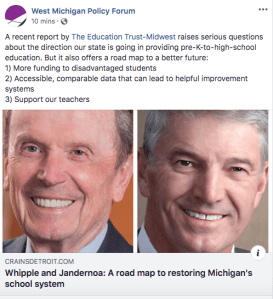 The West Michigan Policy Forum recently posted on their Facebook page a link to an opinion piece in Crain’s Detroit Business, with this headline, A road map to restoring Michigan’s school system.
The article was co-authored by Michael Jandernoa and Ken Whipple. Jandernoa is one of the wealthiest men in West Michigan, is a member of the West Michigan Policy Forum, is one of the largest political contributors to the GOP in the area, is a CEO Council member of the group Talent 2025 and is one of the key people in the Grand Rapids Power Structure.
Ken Whipple is a former executive of the Ford Motor Company, the former CEO of Consumers Energy, sits on the Detroit Financial Advisory Board and now runs his own consulting firm.
The basis of these two rich, white guys’ opinion piece is a recent report from the group, The Education Trust – Midwest. Their opinion piece provides some talking points on how bad the current education system in Michigan is, along with some recommendations on how to fix it. In reality, Whipple and Jandernoa didn’t write the opinion piece, they just cut and pasted information from the report, which you can download from this link.
A few things about the report that should raise red flags for anyone who supports public education. First, there is no real acknowledgement of the root causes of why Michigan schools are failing, with particular omission of funding history and the how this decline has happened during the rise in policy supported Charter Schools. Second, the report talks about supporting teachers, but doesn’t advocate for an increase in teacher salaries or small class rooms. Third, there is no overview or acknowledgement of the attacks on public education from the right, from think tanks and from legislators over the past two decades. Fourth, it is instructive that in Whipple and Jandernoa’s opinion piece, they NEVER use the word public when talking about the failing education system in Michigan, even though the report from The Education Trust makes that explicit.
Both Whipple and Jandernoa also happen to sit on the Leadership Council of The Education Trust – Midwest, which is acknowledged at the end of their opinion piece. However, what is not acknowledged is that The Education Trust is a national entity nor who it is bankrolled by. Some of the largest foundations backing The Education Trust are the Walton Family, Jeff Bezos and the Bill & Melinda Gates Foundation. Each of these foundation have a history of undermining public education and supporting Charter Schools or the privatization of education.
According to Mercedes Schneider, author of numerous books that critique so-called education reform and school choice:
The Gates Foundation clearly states on its website, “We do not make grants outside our funding priorities.” Thus, for Gates to foot the bill for a public-education-influencing organization’s payroll, rent, and utilities must mean that the declared agenda of said organization complements the Gates education agenda, which is top-heavy with the Common Core State Standards (CCSS) and evaluating teachers using CCSS-related tests- but he is willing to put off evaluating teachers using those CCSS tests- for now.
The Gates Foundation has provided over $50 million to The Education Trust.
In contrast, what seems to be working, in terms of healthy public schools, is reflected in the fabulous book by Eric Blanc, Red State Revolt: The Teacher Strike Waves and Working Class Politics. We need to stop listening to what people like Whipple and Jandernoa, members of the capitalist class, have to say about education and listen to teachers, students and communities around the country that have decided to organize to get what their school districts need. We need to critically access the neo-liberal “education reform” strategies that are being put forth by the Gates Foundation, The Education Trust and Betsy DeVos, and start fight for real improvements to public education across the country and right here in Michigan.
 Last Wednesday, while Grand Rapids and communities across Michigan were getting ready to celebrate Pride, the Acton Institute posted an article under their Acton Commentary section, entitled, Anti-religious hostility takes aim at foster care and adoption agencies.
The article talks about the recent decision of Michigan’s Attorney General, Dana Nessel, to overturn previous Michigan legislation, which would allow faith-based agencies to deny same sex couples from adopting.
HB 4188 was passed in 2015 and often framed as a religious freedom bill. The legislation allowed adoption agencies in Michigan the ability to deny LGBT couples/partners/families from adopting because it violated the “sincerely held religious beliefs” of most of the adoption agencies in Michigan, like Bethany Christian Services and Catholic Charities of West Michigan.
We reported on this piece of legislation in 2015, since the bill was introduced by Rep. Andrea LaFontaine (R). Rep. LaFontaine received $8,100 in campaign contribution in 2014 from the DeVos family, as did many of the cosponsors of HB 4188.
The Acton Institute post referenced above frames the issue as an anti-religious issue, what the author of the post says is “because of rampant anti-religious bias in American society today.”
The Acton Institute post is full of misinformation, when it claims that “LGBT activists groups, are seeking to shut down some of the most effective foster care and adoption providers in the country.” The truth is that LGBT groups are not trying to shut down faith-based foster care and adoption providers, they are simply trying to prevent these groups from denying same sex couples from adopting from those agencies. This is significant in Michigan, since many of the foster care and adoption agencies in Michigan are faith-based.
We reported in late April, that Catholic Charities of West Michigan had filed a lawsuit against the State of Michigan because of Attorney Nessel’s decision. The legal group that Catholic Charities hired is Alliance Defending Freedom.
We also reported in April that Alliance Defending Freedom was on the Southern Poverty Law Center’s hate map, listing these claims:
- Supported the recriminalization of homosexuality in the U.S. and criminalization abroad
- Defended state-sanctioned sterilization of trans people abroad
- Linked homosexuality to pedophilia
- Claims that a “homosexual agenda” will destroy Christianity and society
 Therefore, it should not be a surprise when one sees that the Acton Institute article that is talking about this issue is authored by Kate Anderson, who serves as legal counsel for Alliance Defending Freedom.
Not only does the Acton Institute promote homophobia, they allow hate groups to use their online presence as a mechanism to spread hate, all on the pretext that there is, “rampant anti-religious bias in American society today.”
This is further evidence to the analysis we provided last Thursday, where we argued that Acton University being held in Grand Rapids this week will do as much if not more harm that a bunch of neo-Nazis coming to town.
 Next week, from June 18 – 21, the Acton Institute for the Study of Religion and Liberty, will hold its annual conference, in what is called Acton University.
The four day gathering will bring over a thousand people to Grand Rapids, people who will be presenting the 110 classes and those who have come to learn. Acton University costs a mere $800 for the registration, plus travel and lodging for the four days, which should give you an indication of the kind of people who will have access to such a gathering.
The 110 courses that people can chose from are primarily centered around a theological justification of capitalism, but there are also numerous courses that argue the benefits of small government, an end to state run welfare systems, education policy and how the private sector can save society from the evils of socialism.
The title of this article suggests that those who will be attending Acton University next week are arguably more dangerous than neo-Nazis coming to Grand Rapids. What follows is why I think this is the case.
- It is important to recognize that the Acton Institute is primarily a Think Tank that is part of a larger network of organization on the far right that are committed to change public policy that fits within their ideological framework. The Acton Institute is part of the State Policy Network is a nation entity which coordinates efforts around the county to influence state policy and works in tandem with the American Legislative Exchange Council (ALEC).
- The Acton Institute has been the recipient of millions from the DeVos and Prince families. There have been several members of the DeVos family that have sat on the Acton Board of Directors (currently Rick DeVos) and Else Prince Broekhuizen is currently a board member.
- Now that we have established their funding base and the national networks that they are part of, it is important to acknowledge that the Acton Institute is a staunch defender of capitalism. This means they support the accumulation of wealth by a hand full of mostly rich white men, while billions around the world, meaning mostly people of color, live in poverty are displaced and face hunger and malnutrition on a daily basis. In fact, the founder of the Acton Institute, Rev. Robert Sirico, at their 2017 annual dinner was quoted as saying, “We don’t have the right to condemn the rich. We don’t believe in class struggle and class warfare. We believe in class encounter. Where the rich save the poor and the poor save the rich.” In other words, Sirico believes that the capitalist class are the ones that “save” poor people, specifically through charity. We also know that under the economic system of capitalism, black and brown communities in the US disproportionately experience poverty at higher rates than white people do.
- The Acton Institute, through many of the people who write for them, defends the politics of Islamophobia.
- The Acton Institute has been a staunch defender of the privatization of education and Charter Schools.
- The Acton Institute has received money from Exxon/Mobil to deny the existence of climate change, which is causing species extinction and significant human suffering.
- The Acton Institute defends the current violence being perpetrated against the immigrant community, both in a story from 2017 and 2018.
This is just a sampling of the kinds of policies that the Acton Institute endorses, policies that fit within the framework of Neo-liberal Capitalism. Now, I think that whenever neo-Nazis come to Grand Rapids, they should be protested and confronted. However, the Acton Institute promotes and influences public policy that directly harms more people than neo-Nazis. We can and should oppose those who have Nazi tattoos, but we should also oppose those who wear suits or those that sport a religious collar from hosting an event that will sure have a negatively broader impact on people in this community and throughout the world.
 Last week Tuesday, MLive reported that the Grand Rapids City’s fiscal committee voted to spend $21,268 to send two GRPD officers to Boston for a 2 week training on “racial reconciliation.”
This decision is based upon one of the recommendations that came out of the 21st Century Policing Solutions from last year.
The two GRPD officers who are going are Captains Geoff Collard and Dave Schnurstein. Captain Collard made headlines earlier this year when he said at a press conference that the Grand Rapids City leaders:
“will dismiss any actions by members of the Grand Rapids Police Department that are in compliance with established laws, policies and recognized best practices in law enforcement and will instead cower to ‘mob rule’ behavior of any organizations that raise vocal opposition.”
In the same written statement, Collard goes as far to suggest that the City of Grand Rapids has been in collusion with Movimiento Cosecha GR:
“On May 1, 2018, during a large protest, leaders of Movimiento Cosecha GR intentionally overran a police position for the second year in a row. Warrants were sought, sworn to, and issued by a judge for the arrests of two individuals. Shortly thereafter, the Acting City Manager and the Mayor became involved and the warrants were squashed. There is no clearer example that our city leadership would rather appease these groups who intentionally violate the law to purposely disrupt businesses and residents in Grand Rapids while endangering the lives of our officers, the general public, and their own protestors. Having known about this obstruction of justice, of which the current City Manager has also been notified, we are only left to believe that support for our personnel while acting with great restraint and being overrun by law breaking individuals does not and will not exist.”
Such a claim is patently absurd, yet the fiscal committee wants to spend over $21,000 to send Collard and another captain to Boston to get training that will somehow build trust between black and brown communities and the GRPD.
A description of the training can be found at the Police Executive Research Forum site, which says of the training:
The policing profession is changing like never before. New technologies and privacy issues, the implications of cybercrime, and the constantly evolving terror threat represent new and difficult challenges for police that did not exist a generation ago. Communities also expect more from their police departments in terms of procedural justice, increased accountability and transparency, appropriate use of force and racial reconciliation. Plus, today’s recruits differ in significant ways from previous generations. Chiefs must find new ways to address these issues and deliver a wider scope of services, often with fewer resources.
Does racial reconciliation training work for police?
Beyond the amount of money the City of Grand Rapids is spending on these two officers, we have to ask ourselves if this kind of training will actually achieve the goal of creating racial reconciliation. In an article in The Atlantic some 18 months ago it states:
But even as the classes spread, it’s not clear whether they actually work. Few specific guidelines exist for what courses should include, how the material should be taught, or how to measure its effects. Indeed, little data exist about their efficacy over the long term. The Obama administration’s Task Force on 21st Century Policing included implicit-bias training on its list of best practices for law enforcement, but without specifics. That ambiguity leaves each agency to decide what the classes should look like—and whether they’re succeeding.
At their root, the trainings spring from one basic proposition: that unconscious biases—including those linked to factors like economic class and gender, but especially racial biases—are the inevitable product of growing up in a society where stereotypes are woven into the fabric of everyday life. Beneath the surface of the conscious mind, biases influence how people frame and interpret those around them—from whether a smile is shy or sarcastic, to whether a hand is reaching for a wallet or a gun.
In his important book, The End of Policing, author Alex Vitale writes:
Diversity and multicultural training is not a new idea, nor is it terrible effective. Most officers have already been through some form of diversity training and tend to describe it as politically motivated, feel-good programming divorced from the realities of street policing. Researchers have found no impact on problems like racial disparities in traffic stops or marijuana arrests: both implicit and explicit bias remain, even after targeted and intensive training. This is not necessarily because officers remain committed to their racial biases, though this can be true, but because institutional pressures remain intact.
Lastly, Vitale also makes the distinction about what the institutional function of police department are, which is to protect power and business as usual. Vital states, “Well-trained police following proper procedure are still going to be arresting people for mostly low-level offenses, and the burden will continue to fall primarily on communities of color because that is how the system is designed to operate – not because of the biases or misunderstandings of officers.”
Therefore, we should in no way be fooled by or expect that Captain’s Collard and Schnurstein will significantly alter how they interact with black and brown communities or how they will respond to activists and organizers who are exposing police violence.

