Reporting on Climate Change while taking money from Enbridge
 In the most recent issue of MiBiz, there is a short article about statewide Climate Change goals on page 29, headlined, Climate Change Outlook: Advocates expect ambitious statewide climate change goals in 2020.
The article is not particularly compelling, since it provides just a few comments from DEQ staffer and the Director of the Michigan Climate Action Network. The Michigan Climate Action Network director, Kate Madigan, is using the “good 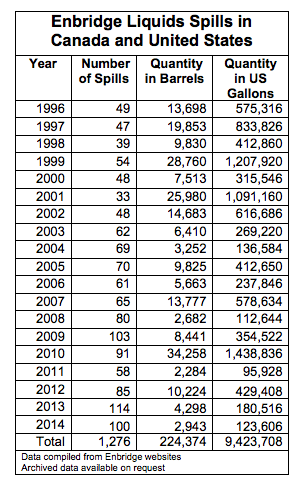 climate policy is good for Michigan’s economy” argument, although the reporter doesn’t press her on what that means or how their goals will be achieved. In fact, the article doesn’t address how the state legislature is pretty compromised, especially considering how much elected officials get from energy corporations during election cycles. The Michigan Campaign Finance Network provides all that data, which you can search by elected officials here.
However, it makes complete sense that MiBiz would not really want to ask hard questions about Climate Change, especially considering that on two pages before the article with Michigan Climate Action Network, there was a full page ad from energy giant and Line 5 operator, Enbridge.
The Enbridge ad was presenting the global energy company like all there ads do, as a responsible company, essentially guaranteeing that the oil tunnel they are proposing to build under Lake Michigan will not leak. Enbridge makes this promise, despite the fact that there are hundreds of documented incidents of pipeline malfunction that Enbridge is responsible for in the past, according to World350.org.
Unfortunately, MiBiz is more interested in advertising dollars than they are in facts.
 On Thursday, January 9th at 1pm, there will be a public hearing at the Grand Rapids Planning Commission for a new development project being proposed by AmplifyGR in the Boston Square neighborhood. The public hearing will be held at 1120 Monroe Ave NW in the city’s Development Center, in the Public Hearing Room on the 2nd floor.
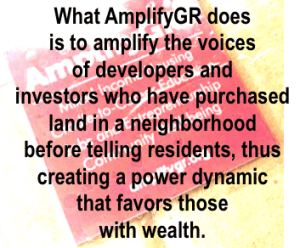
This is the first concrete proposal that AmplifyGR has submitted to the City, since the public first became aware of their existence in May of 2017. GRIID was the first to write about AmplifyGR and the fact that is was a creation of the Doug & Maria DeVos Foundation. AmplifyGR had been meeting with the Southtown Corridor Improvement District, based on documents we found from January of 2017. However, most of the people in the Boston Square neighborhood were completely unaware of the fact that the Doug & Maria DeVos Foundation had been funding this new entity called AmplifyGR and was working with the Rockford Construction Company to purchase 22 separate pieces of property at the cost of $10 million. You can read a breakdown of the property costs for all 22 pieces of land at this link.
It is important to recognize that the DeVos/Rockford Construction land grab took place with little knowledge of residents in the area, yet AmplifyGR wants people to trust that they have the best intentions. Are we to believe that the wealthiest family in West Michigan has nothing but noble intentions? The Doug & Maria DeVos Foundation and Rockford Construction Company, both white-owned and operated entities, have nothing but good intentions by spending $10 million to purchase land in a mostly black neighbor?
In late June of 2017, AmplifyGR held its first public meeting, with over 200 in attendance. People came with lots of concerns and questions about what was happening in their neighborhood without their knowledge. A second meeting was then held in late July of 2017, with even more pushback from the community. At one point during this second public meeting, someone asked what if there was 70% opposition to this project? The Executive Director of AmplifyGR, John Ippel responded by saying, “even if 70% of the community opposed this, we would just have to get back up and move forward and do it better.” You could heard several people in the audience gasp in horror and the level of arrogance they heard coming from the AmplifyGR spokesperson.
After a few more meetings, AmplifyGR decided to put an end to public meetings and try a new tactic to engage people. After cancelling other public meetings AmplifyGR posted on the website the following statement:
“Still, those of us on the front lines agree: If going slower is the price of getting this right… of NOT repeating the mistakes of the past… it’s worth it. You’re worth it. Our community is worth it. And our commitment and passion to achieving the above priorities has never been greater.”
One could certainly conclude that the DeVos create/funded entity was going to do whatever it is they set out to do, regardless of community pushback.
This tactical shift, by not holding town hall-style meetings, has been effective. What AmplifyGR has done is to hold open door gatherings, where there are refreshment, displays of project proposals and people there to answer questions from anyone who has them. What this means is that people don’t hear the questions or concerns being voiced by other people, since the interaction is more one on one. The problem with this meeting style is that it not only prevents people from hearing important questions/objections, it denies people the opportunity to hear questions/objections that maybe they had never thought of. In addition, if there are people who raise hard questions, it is easier to isolate them, since they are asking these questions without any public response.
According to AmplifyGR, they have held three of these kinds of meetings, which were coordinated by the PR firm Lambert. You can read their FAQ document for the meetings here.
A few days ago, MiBiz reported on the proposed AmligyGR project. In that article, it states that AmplifyGR, “has worked on the plans for the redevelopment project with Boston Square Together, which includes Oakdale Neighbors, a community development organization; the Early Learning Neighborhood Collaborative; and the Boston Square Neighborhood Association.”
The Boston Square Neighborhood Association only has a Facebook page and there is no information on who sits on their board of directors. Oakdale Neighbors and the Early Learning Neighborhood Collaborative have both received substantial amounts of funding from various DeVos family foundations. Between 2013 and 2017, Oakdale Neighbors has received a total of $273,500 from the DeVos family and the Early Learning Neighborhood Collaborative has received $1,070,800 from the Doug & Maria DeVos Foundation alone. It would be hard for any reasonable person to think that either of these entities is not compromised in this process.
The Grand Rapids Planning Commission already has a packet for the January 9th public hearing, which you can read here. The pages that are specific to the AmplifyGR development proposal can be found on pages 67 through 343. Most of the documentations is made up of traffic data, but is was instructive to see that on pages 71 – 74, Kurt Hassberger has signed several documents giving permission to AmplifyGR to rezone parts of the Boston Square neighborhood. These page refer to Hassberger as the being connected to an entity called Boston Square Residential LLC. Hassberger is in fact legal counsel for the Rockford Construction Company, the same company that bought all of the property in the Boston Square neighborhood for $10 million in partnership with the Doug & Maria DeVos Foundation. Upon further investigation, I found that Boston Square Residential LLC’s address is 601 First Street NW, Grand Rapids, 49504, which is also the address for Rockford Construction.

The Public Hearing is Thursday, January 9 and 1pm, 1120 Monroe Ave NW in the city’s Development Center, in the Public Hearing Room on the 2nd floor. This would be a great time for people to ask some poignant questions or make statements. GRIID will be there to report on the public hearing.
 This is the last (and third) post for our GRIID end of the year in review. In Part I, we provided a summary of some of the significant social movements active in Grand Rapids in 2019. In Part II, we demonstrate the importance of monitoring those in power and provide some analysis of the individuals, families and organizations in Grand Rapids that have the most political and economic power.
In this final post in our end of the year in review series, we want to look at the numerous articles we posted that dissected the local news media. In many ways, monitoring the news media is similar to holding centers of power accountable, especially since most commercial media is owned by large, multinational corporations.
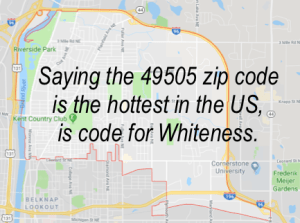
In 2019, we wrote dozens of articles critiquing commercial news stories. One theme that we critiqued was the local media’s propensity to run stories about how Grand Rapids is so wonderful. One example was a January article about how Grand Rapids is a hotbed for entrepreneurs. Another example was from a story that WGVU radio did in August, where they referred to Grand Rapids as a “superstar city.” A similar story was also aired in August, on WXMI 17, where they stated that 49505 was the “hottest zip code in the country.” Of course, none of these stories provide any critical assessment of the claims they make or repeat in their coverage.
A second important theme with how local news reports is their propensity to act as stenographers for the rich and powerful. For example, when MLive reported on the 60th anniversary of the Amway corporation it was as if they let Amway write the story. Another example of the local news coddling the rich and powerful, was a story on MLive where Dick DeVos was complaining about the Governor cutting funding for Charter Schools. One last example in this category was how MLive reported on the DeVos family philanthropy in a late November story.
However, most of our critiques of local news media were centered around how local news reported on immigration issues, including the GRPD, the Kent County Sheriff’s Department and Immigration and Customs Enforcement (ICE). One example is how the local news reported on the arrest and eventual deportation of a DACA student.
A great deal of the local news reporting on immigration and ICE, also tends to center the voices of law enforcement, as we pointed out in a March 5th critique.
 The same bias was reflected in the late July coverage of a 3rd Congressional District candidate who visited the US/Mexican border and then praised law enforcement officials for their work. In late August, MLive ran a story, where they essentially reprinted the content of an ICE Press Release.
Additionally, how the local news reported on the suspension of GRPD Captain Vanderkooi is reflective of how the commercial news media sees police as a force for good.
Lastly, the local news media often fails us when reporting on economic development, as was the case with their reporting on the lack of investment into the southeast part of Grand Rapids. Even the editorial staff at MLive perpetuated structural racism in their editorial piece in late October, regarding the lack of investment in the southeast part of Grand Rapids.
To view all of the stories we posted under the category of Dissecting the Local News, go to this link.
For 2020, we plan to continue to document the efforts of local social movements, shine light on what the Grand Rapids Power Structure is up to and to act as a media watchdog, documenting the bias and lack of critical reporting.
GRIID End of the Year in Review: Part II – Monitoring the Powerful in Grand Rapids
In their book The Elements of Journalism, Bill Kovach and Tom Rosenstiel identify the essential principles and practices of journalism. One of those principles is to monitor power.
Kovach and Rosensteil write:
Journalism has an unusual capacity to serve as watchdog over those whose power and position most affect citizens. It may also offer voice to the voiceless. Being an independent monitor of power means watching over the powerful few in society on behalf of the many to guard against tyranny.
Being a watchdog of those with power is something that GRIID was founded on and continues to do. Here is an overview of the ways we monitored power in Grand Rapids in 2019.
As we wrote in Part I of this series, there were several local social movements that confronted and held power accountable, specifically local governments, private entities collaborating with ICE and the Grand Rapids School Board, in the case of Grand Rapids for Education Justice.
In January of 2019, we posted a story about former Michigan Representative Daniela Garcia, being hired to work for the Department of Education. In that post we noted that Garcia was a longtime recipient of DeVos money while working in Lansing, so her transition to the Department of Education was fairly seamless, now working for Betsy DeVos. In fact, one of our regular posts was to monitor, critique and provide analysis of what Betsy DeVos was doing with education policy, specifically in our series entitled, Betsy DeVos Watch.
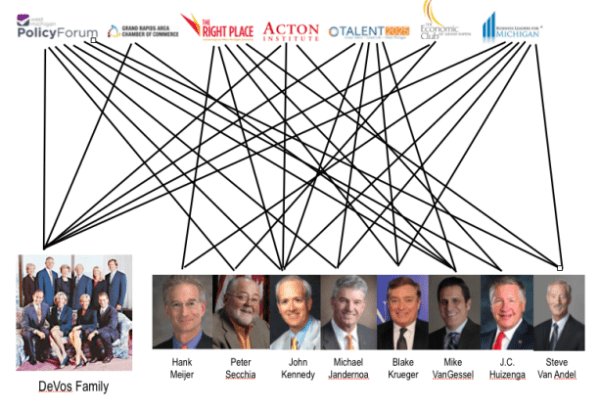
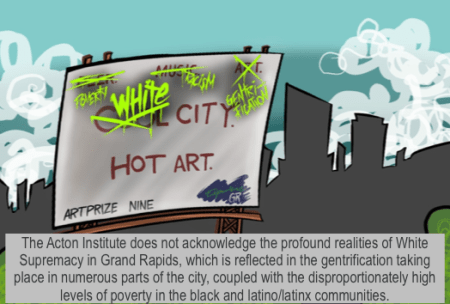 There are several organizations that make up that Grand Rapids Power Structure and GRIID continued to monitor their activities. One of those groups is the Acton Institute. In February, we posted a story about a presentation that the Acton Institute hosted, which featured a speaker from AmplifyGR, talking about the neo-liberal education model.
The Acton Institute used the Trump visit to Grand Rapids to say that cities like Flint and Detroit need to be more like Grand Rapids. During Pride month, the Acton Institute demonstrated their organization’s homophobia and we wrote another piece on Acton in June making the claim that they are more dangerous than neo-nazis.
The far right think tank, the Acton Institute, also used their website to dismiss the 1619 Project and later referred to climate activist Greta Thunberg as pathological.
We also reported on another prominent group within the Grand Rapids Power Structure, the West Michigan Policy Forum. In February, we posted a critique of their push to eliminate public sector pension for government employees in Michigan, calling them unfunded liabilities. In April the West Michigan Policy Forum teamed up with the Mackinac Center to push for continued work requirements for those receiving Medicaid in Michigan and beginning in July the WMPF was proposing that the state borrow money from the Michigan Teacher’s pension and put it towards road construction.
 GRIID also did a series of articles on several of the West Michigan-based foundations, specifically the foundations run by the most powerful families in the area. We reported on the Richard & Helen DeVos Foundation contributions, the Edgar & Elsa Prince Foundation, the Jerry & Marcia Tubergen Foundation, the Dick & Betsy DeVos Foundation, the Doug & Maria DeVos Foundation, the Van Andel family Foundations, the Cheri DeVos Foundation, the Peter Cook Foundation and the Jandernoa Foundation.
In addition, we continued our monitoring of the most powerful family in Grand Rapids, the DeVos family. We posted numerous stories on their funding of candidates at the state level, their influence in local politics, the wealth expansion and their role in the religious right. All of these articles, along with every article we have ever written about the DeVos family, can be found at the ever growing DeVos Family Reader publication at this link.
GRIID End of the Year in Review: Part I – Reporting on Social Movements in Grand Rapids
Social Movements in the greater Grand Rapids area have continued to develop and flourish in many ways. One movement in particular, the immigrant justice movement, has continued to fight against state violence and build a movement to fight for the undocumented community.
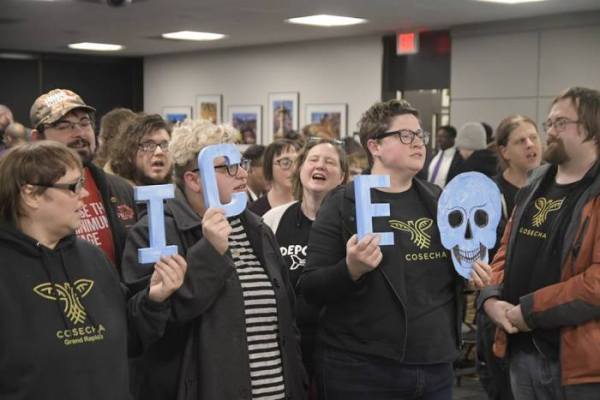
Movimiento Cosehca GR continued to build capacity amongst the immigrant community and to engage allies to work in solidarity with them. GR Rapid Response to ICE has continued to work closely with Cosecha GR in a variety of ways, and specifically in the fight against ICE violence in Kent County.
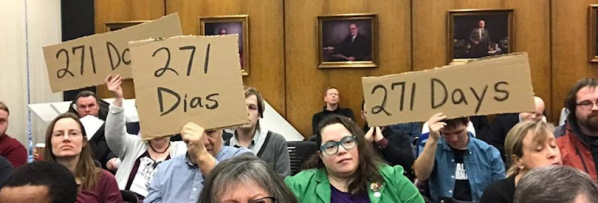
2019 began with an action at the Kent County Commission meeting, where immigrant activists and allies were continuing their call for end end to the contract with ICE.
Kent County’s contract with ICE had been receiving national news near the end of 2018, when the GRPD called ICE on Jilmar Ramos-Gomez, a former US Marine. The arrest of Ramos-Gomez was an embarrassment for the GRPD and for the Kent County Sheriff’s Department, both of whom have been collaborating with ICE to arrest and detain immigrants in Kent County.
 However, in late January, after ongoing pressure from Movimiento Cosecha GR, GR Rapid Response to ICE, the ACLU and MIRC, the Kent County Sheriff announced that they would now be requiring ICE to obtain a judicial warrant in order for the Kent County Jail to put a hold on immigrants being detained. This announcement was clearly a victory for the immigrant justice movement, since Kent County and the Sheriff’s Department would never have had to make these kinds of decisions without the campaign to End the Contract with ICE, a campaign that began in June of 2018.
The City of Grand Rapids also came under greater scrutiny because of the GRPDs role in the Jilmar Ramos-Gomez campaign. The ALCU and MIRC demanded transparency on the arrest of Ramos-Gomez, seeking to find out the role that the GRPD played in this case.
Movimiento Cosecha GR and GR Rapid Response to ICE then began to pressure the Grand Rapids City Commission on the GRPD’s collaboration with ICE and to make several clear demands at a commission meeting in early February.
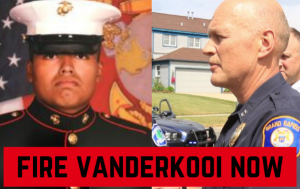
Movimiento Cosecha GR and GR Rapid Response to ICE then escalated their efforts with the City of Grand Rapids during a February 26th commission meeting, effectively shutting it down over the GRPD’s role in the Jilmar Ramos-Gomze case. Both groups were calling for the City to fire Captain Kurt VanderKooi, the GRPD’s ICE liaison and the officer who called ICE on Jilmar Ramos Gomez.
The GRPD union pushed back on this pressure from immigrant justice groups and released a statement on February 28th on how city officials were cowering before immigration activists.
At the same time that the cops were complaining of immigrant activists, the GRPD was coming under greater scrutiny, because of specific acts of violence against black and brown residents. This violence was receiving a great deal of attention from the news media and on social media, but it also led to an effort amongst several groups in the immigrant justice community and the African American community to come together to make even more demands from the city. These demands were laid out in press conference held near the end of March.
In late April the City of Grand Rapids reinstated Captain Kurt VanderKooi, after the officer had been put on administrative leave in late February. The ACLU and MIRC submitted a FOIA request on the role that VanderKooi played and GRIID reported on those findings in late April. The FOIA documents revealed more details on the GRPD’s collaboration with ICE and it exposed the GRPD’s role in monitoring Movimiento Cosecha GR and GR Rapid Response to ICE.
On May 1st, Cosecha GR organized another successful march to mobilize people to demand driver’s licenses for all in Michigan. The City of Grand Rapids tried to force Cosecha to obtain a permit for their march, but Cosecha held firm in their commitment to not dance with politicians.
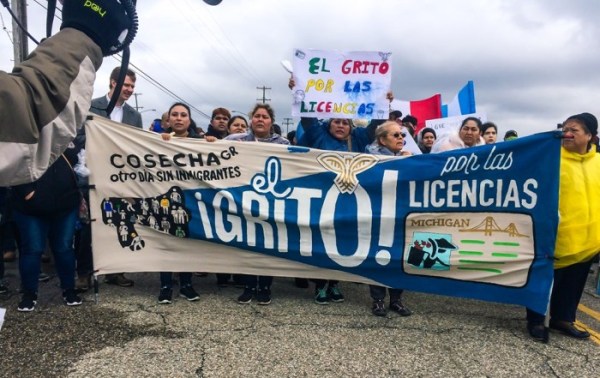
The City of Grand Rapids continued to ignore immigration activists demands, so the groups released a statement in response to the City’s failure to act. The statement was sent in mid-May, the day before the Civilians Appeals board voted to reverse the GRPD’s decision to reinstate Captain VanderKooi.
All across the US there was growing involvement from the Jewish community to confront ICE oppression, with actions happening in several cities. In July, the Jewish Community organized an anti-ICE action in Grand Rapids, specifically at one of the ICE offices on Ottawa NW. Later that month, GR Rapid Response to ICE organized another action at the same ICE office, specifically to draw attention to how ICE was separating families in Kent County.
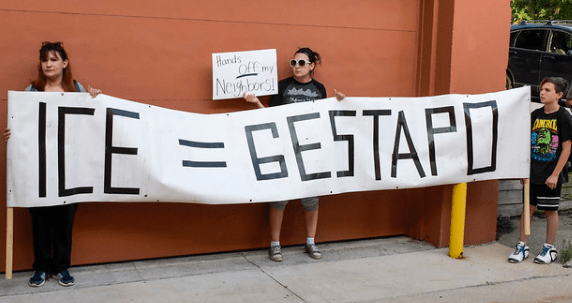
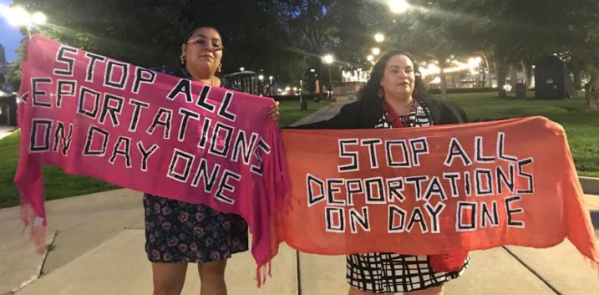
In early August, the Democratic Presidential candidates held a debate in Detroit and immigration activists from all over the state came to Detroit to confront the candidates on US immigration policy. Several people were arrested for blockading the tunnel between the US and Canada, while other activist interrupted the candidate debate with powerful immigrant justice messages.
In late August, another action was organized at the Kent County Jail, to demand an end to the ICE contract and to expose the Kent County Sheriff’s Department in their continued collaboration with ICE. That same day, ICE released a statement saying that they would not be renewing their contract with Kent County. Too much bad press had been created in the past 13 months, because of the work of Movimiento Cosecha GR and GR Rapid Response to ICE. The Kent County Sheriff’s Department did release a statement about how they would continue to cooperate with ICE, even though ICE did not want to renew their contract.
In mid-September, GR Rapid Response to ICE organized a demonstration at the GRPD headquarters, as a response to the City’s decision to only give Captain VanderKooi a 20 hour suspension in his role in the arrest and detention of Jilmar Ramos-Gomez.
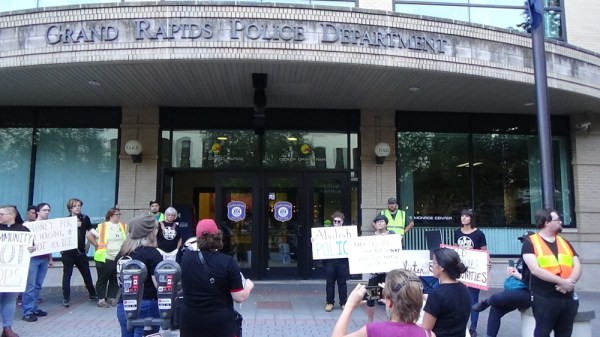
Movimiento Cosecha GR continued its campaign to get driver’s licenses for all in Michigan and organized an action in late October to pressure the City to formally support the statewide campaign.
The following week, Movimiento Cosecha celebrated their role in getting state lawmakers to introduce new legislation to allow undocumented immigrants to obtain a driver’s license at a press conference.
Grand Rapids for education Justice
In late July, we posted a story about local education activists who had submitted a FOIA request with the Grand Rapids Public Schools. The activists talked about how the GRPS had been dragging their feet on the request, which raised serious questions about what the school district was hiding.
These activists were actually part of a new movement in Grand Rapids, calling themselves Grand Rapids for Education Justice (GREJ). This new group went public when they held a press conference before a school board meeting in early October.
The GREJ continued to make waves at subsequent school board meetings, one in early November. Several school board members were dismissive of the group, so GREJ created a video response to the school board’s inaction on demands they laid out in early October.
In late November, the GREJ released another video statement, this time challenging the curriculum that will be used at the new Hospitality and Tourism Academy, which is essentially a school designed to train students to work in the service sector.
The GREJ group is still relatively new, but already they have forced a larger community conversation around the role of public education in the age of Neo-Liberal education policies, policies that are being pushed at the federal level by Betsy DeVos.
There certain have been other organized efforts for social justice in Grand Rapids, including some organizing around climate justice, but the movements cited above are the only ones that have been consistent and have had an impact locally.
 Ever since it was announced that Nancy Pelosi would pursue impeachment proceedings against Donald Trump, this news has dominated much of the commercial media coverage and the interest within liberal circles.
Let me say that I believe that Trump should be impeached and that his administration has not only violated numerous domestic and international laws, the policies under the Trump administration have caused tremendous harm……harm to immigrants, refugees, the black community, the latinx community, indigenous communities, the LGBTQ community, women and the disability community.
Mehdi Hasan, who writes for the Intercept, has laid out a long list of reasons that Trump should be impeached in his article, The A to Z of Things Trump Could and Should Have Been Impeached For.
However, even if Donald Trump is impeached, it will not move us in the direction of dismantling systems of oppression, corruption and violence, systems which got Trump elected in the first place. The brilliant Indian writer, Arundhati Roy, articles this sentiment, in the meme here on the right.
The system that produced the election of Donald Trump, is a complex and intertwining systems of systems, such as, 1) the US political system, which is so dominated by private money, corporate money and lobbyists, that few politicians can actually represent the interests of the communities they represent; 2) a commercial media system which is not only subservient to its owners, but treats journalism as a spectacle that is driven by advertising dollars and is rarely interested in holding systems of power accountable; 3) the system of White Supremacy, which permeates all institutions in the US and does not allow communities of color to threaten the wealth, land and other assets that are almost exclusively owned and controlled by white people; and 4) the system of capitalism, which also permeates all sectors of US society, constantly re-directing wealth upward and smashing any efforts from people to engaging in radically imagining life in ways that do not include the profit motive.
These systems (and their are many more) are wreaking havoc on the planet in the form of imperialist wars, settler colonialism, climate disaster, gentrification, mass incarceration and an increasingly larger wealth gap.
If Trump is impeached, these systems will still to function and will not miss a beat. So, what is problematic about our obsession (to us Arundhati’s description) with just getting Trump impeached or defeated in the 2020 election?
There are numerous problems with our failure to have a systems analysis of the current state of affairs. I want to explore three of those failures:
- putting our faith into a political system that has demonstrated over and over again that it is not interested in challenging systems of power and oppression.
- not addressing the consequences/harm of the existing systems of power and oppression, and
- not focusing our energy on direct action, movement building and radical imagination.
Giving our power away
Putting our faith in the current political system means we ultimately give away our power. When was the last time you attended a Kent County Commission meeting, a Grand Rapids City Commission meeting or a Grand Rapids School Board meeting? These elected bodies often do most of their decision-making in secret or in committee meetings that the public rarely attends. At the public meetings, they often feel like an exercise in bureaucracy, where elected officials formally vote on agenda items that were already decided up at an earlier meeting. The public does get an opportunity to speak, but the 3 minutes they are granted is met with silence, since these government bodies do not participate in dialogue at these meetings, leaving one feeling as if their participation was ineffectual. At the state and federal level, the access to politicians is further diminished, unless of course you contribute handsomely to their campaigns or have lobbying groups that have deep pockets.
Electoral politics has all shifted to the right since the Reagan years, with Democratic Party administrations acting as one branch of the Capitalist Party. Think about many of the major policies adopted by the Clinton and Obama administrations, such as expanding the police state, making the prison industrial complex a growth industry, removing social welfare support for working class people, implementing NAFTA & CAFTA, punishing the undocumented community, continuing the racist war on drugs, bailing out Wall Street, expanding the Military Industrial Complex and paying lip service to environmental concerns while allowing the fossil fuel industry to destroy the planet. This system will remain after Trump is impeached and there is no indication that either party will take seriously matters like climate catastrophe, gentrification, an end to oil pipelines, dismantling the prison industrial complex or ending the detention and deportation of immigrants.
Addressing the harm done by these systems
Humans and other species suffer the harm of these systems of power and oppression on a daily basis. Instead of just voting, we need to spend more time and energy on reducing and ending the harm being caused. How many people suffer under mass incarceration? The US has the largest percentage of its population in jail, prison, on parole or probation that any other country on the planet. Most people are charged with non-violent crimes, yet they are often subjected to the violence of the prison industrial complex. What if we spent less money on policing and punishing and more on education, health care and housing that gives people the dignity they deserve? This is what good community organizers do, they work on addressing the harm that the system causes and then provides people with the opportunities to collectively organize to demand more.
From Solidarity to Movement Building and Radical Imagination
This type of organizing is an act of solidarity, not charity. It sees the inherent value in every person and then takes direct action to create the kind of change we want to see in the world. Direct Action means we use our collective power to get the results we want to see in the world. It’s one thing to be concerned about affordable housing, but direct action would mean that we provide hospitality for those who are homeless, create tenant unions, re-direct government subsidies that normally go to developers and give them directly to families and communities most affected by gentrification.
A concrete example of solidarity that has moved towards movement building is the work of Movimiento Cosecha and GR Rapid Response to ICE. These autonomous movements begin with the premise that all immigrants should have dignity, respect and be given permanent protection from arrest, detention and deportation. These movements to not wait for politicians to create immigration policy that is just and fair, they take matters into their own hands to provide mutual aid to immigrants who are being harmed by government agents, they organize those most affected by racist anti-immigration policies to fight for what they need (like driver’s licenses) and the directly confront the systems of oppression like ICE, law enforcement agencies that collaborate with ICE or companies that profit from the harm done to immigrants.
People often see the marches, the protests or disruptions these groups engage in, but they don’t see the amount of time that goes into creating a movement culture, where people are equal, where people are heard, where everyone has a say and where we look at for each other. In addition, movement culture also creates space for radical imagination to take place. This means that people are encouraged to imagine that another world is possible and to create practices and structures that are not limited to representative democracy or the non-profit industrial complex.
Another world is indeed possible, but this requires us to stop limiting ourselves to thinking that the current political system works or that by simply voting someone into office or impeaching someone out of office that it will result in the kind of collective liberation we need. As long as the political system that gave us Donald Trump is allowed to continue, we are not likely to have a future worth fighting for.
MLive doesn’t verify the claims made by Trump on immigration policy during his speech in Battle Creek
 Donald Trump was in Battle Creek on Tuesday, where he gave a speech to his supporters during a rally. MLive wrote several different articles about the Trump visit, but posted one on late Tuesday, because President Trump mentioned Kent County in his remarks.
Trump actually mentioned that there were “sanctuary cities” in Michigan and then he talked about how dangerous and criminal these undocumented people are.
MLive wrote:
The president told the crowd he was surprised to learn Michigan had sanctuary cities.
The Center for Immigration Studies lists Ingham County, Kalamazoo County, Kent County and Wayne County as having “laws, ordinances, regulations, resolutions, policies, or other practices that obstruct immigration enforcement and shield criminals from ICE,” according to its website.
What MLive did NOT do was to verify the claims made by the Center for Immigration Studies on whether or not the communities cites are actually sanctuary cities. The fact is that none of the four counties cited are actual sanctuary cities, since they all cooperate with ICE to arrest and detain undocumented immigrants. There are certainly immigrant-led movements in each of those four counties that have been resisting ICE repression, but the counties themselves continue to collaborate with ICE.
MLive also didn’t tell us anything about the Center for Immigration Studies. The Center for Immigration Studies is actually an anti-immigration policy organization that is part of the racist John Tanton network, according to Sourcewatch.
Towards the end of the MLive article, it states that Trump, “bashed Kent County for its “sanctuary” policy after Sheriff Michelle LaJoye-Young told ICE that her department will not agree to immigrant detainer requests from ICE unless they have a judicial warrant from a judge.” However, this is misleading, since Trump did not say this during the speech in Battle Creek. Trump’s comments about Kent County were actually from March of 2019, when the White House and ICE expressed their displeasure that the Kent County Sheriff was now requiring judicial warrants in order to hold undocumented immigrants.
What Trump actually said about Kent County in his speech in Battle Creek on Tuesday, was this:
Earlier this year, authorities in the sanctuary, jurisdiction of Kent County, Michigan — anybody know Kent County? Released an illegal alien charged with assault with intent to murder after he repeatedly and viciously stabbed a man in the head with a broken bottle. They let him go to roam free in Michigan communities.
Now, this statement is also unsubstantiated, but it is a significantly different statement than the one MLive included in their article on Trump, Kent County and immigration policy.
City data on the GRPD and Trust is not reflective of the lived experience on communities of color in Grand Rapids
 On Tuesday, the City of Grand Rapids posted information about their new resource to gauge public trust of the GRPD.
The data that the City is collecting is being done through a new digital polling tool, from the company called Elucd. Elucd features a quote from former GRPD Chief Rahinsky, who says that the way law enforcement is being judged is changing.
Currently, the GRPD scores 68 out of 100 in terms of public trust.
There is no breakdown of this score, so we have no idea who is saying they trust or don’t trust the GRPD or even how many people have actually taken part in the polling. According to the research done by Alex Vitale, author of the book, The End of Policing, public trust of local law enforcement is at an all-time low in the US. This lack of trust stems from the fact that corruption in law enforcement is high, police brutality is high and the lived experience of communities of color and poor working class white people says that the police serve power & privilege.
The City’s post from Tuesday, also quotes the CEO of Elucd, Michael Simon:
“The Grand Rapids Police Department is a national leader in its commitment to fostering greater transparency as it works to build trust with the residents it serves. By leveraging 21st century technology, Grand Rapids leaders are prioritizing hearing from everyone in their city as they improve both safety and quality of life in every neighborhood.”
To suggest that the GRPD makes transparency a priority or improving the safety and quality of life in every neighborhood is simply a joke. Recent history would suggest otherwise, with numerous reports of police abuse in black and latinx neighborhoods, which have led to numerous protests and press conferences denouncing the GRPD.
It is instructive that the city posted this new information about public trust and the GRPD, especially in light of the headlines from yesterday. In one story, the City is looking to purchase the ShotSpotter system and drones. According to an article on MLive, the GRPD wants to role out a pilot program with these new proposed technology solutions, which suggests to this writer that it is already a done deal. Technology does not reduce crime and there are plenty of other community-based solution to reducing violence and crime that do not rely heavily on police, rather they rely on what the Movement for Black Lives calls Community Control.
In other news, it was announced on Wednesday that, Grand Rapids will pay $225,000 to the American Civil Liberties Union of Michigan as part of a settlement that will end the legal battle over the police department’s former trespassing policy. MLive reported that this agreement to pay $225,000, stems from a case in 2013. If you add that to the recent announcement that the City of Grand Rapids will pay out $190,000 in a settlement over racial bias, where the GRPD called ICE on a former US Marine.
These news stories, along with numerous reported incidents of police violence against black and latinx residents, in no way suggests that there is a high level of trust between the community and the GRPD.
Cosecha GR talks about the importance of the driver’s licenses for all victory in New Jersey
 On Monday, Movimiento Cosecha New Jersey won their campaign to get driver’s licenses for the undocumented community.
Movimiento Cosecha GR has been working on a similar campaign here in Michigan. In light of the victory in New Jersey, Cosecha GR posted this commented:
The NJ immigrant community has giving us an example of people power. We are celebrating their victory for #LicensesForAll. A great deal of respect for Cosecha New Jersey for their restless fight and we are realizing that in Michigan we have a lot of work to do so that one day we will have a historical video like this one.
Last night GRIID spoke with an organizer with Movimiento Cosecha GR, Ana Isabel, about the significance of the victory in New Jersey and what impact it can have for the current campaign here in Michigan.
 A new report from the Network for Public Education, entitled, Still Asleep at the Wheel: How the Federal Charter Schools Program Results in a Pile of Fraud and Waste, identifies Michigan as having the worst record on Charter School abuse of funds.
The report, which looks at the Charter Schools at the national level, begins their report with an example of how undemocratic the Charter Schools are in Michigan.
“In May of 2019, the Michigan State Board of Education voted to stop the disbursement of a $47 million grant from the federal Charter Schools Program (CSP). The duly elected Board had good reason to take action, especially given that the Michigan Department of Education had applied for the money without the Board’s consent. Ironically, just three years before, the Michigan Department’s 2015 grant application had been rejected by the CSP; reviewers of the application noted the lack of supervision of the 44 authorizers that approve and monitor the state’s charter schools. Charter school authorizing had become a lucrative business for colleges and universities that enjoy a three percent cut of the millions of tax dollars that charter schools receive each year. Nearly 80 percent of the charters in Michigan are controlled by for-profits that have their vested interest in growth as well. But Washington had changed, and now Michigan billionaire Betsy DeVos was in charge. Previous reservations about oversight were set aside and her home state got the grant.
State Board of Education President, Casandra Ulbrich, explained to us why the Board tried to block the grant.
The State Board of Education was presented with a set of grant criteria to ultimately spend up to $47 million expanding and creating new charters in Michigan. The Board was never consulted when the state applied for the funds, and had severe reservations focusing on two areas. The first was concern over previous use of the grant funds. The second was whether a state with a 17-year record of student enrollment declines, and parallel declines in student achievement, needed to open more charter schools. Following the vote, I began reviewing previous grant information and today, am even more alarmed by what I have found.
Despite the objections of the state’s elected Board, the Michigan Attorney General ruled that the grant must be dispersed.”
Some of the major finds from the report are listed here:
- The disbursement of over one billion dollars during the program’s first decade was never monitored for its impact or results. There is no record of which schools received the funds.
- Although the overall rate of failed charter projects was 37 percent, in some states the rate of failure was much higher. The Michigan failure rate was over 44 percent ($21 million).
- Five hundred thirty-seven (537) schools listed in the database never opened at all. Many received over $100,000 in federal funds. In Michigan 77 Charter Schools never opened.
- Although Congress forbids for-profit operators from directly receiving CSP grants, they still benefit by having their schools apply.
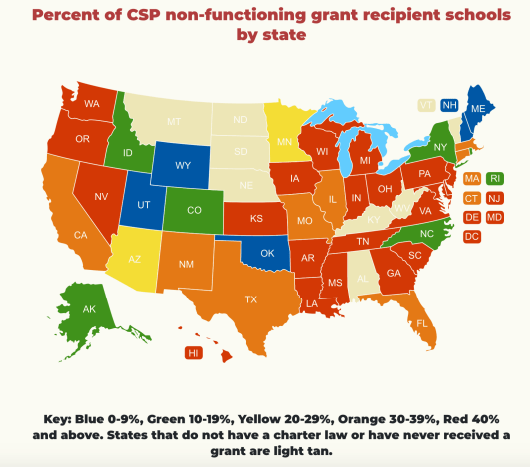
The report has lots of great case studies, data and clear recommendations on how to move forward. The two most important recommendations are:
- that Congress end appropriations for new charter school grants in the upcoming budget and continue funding only for obligated amounts only to legitimate projects.
- thorough audits by Congress of previous grant awards, the establishment of regulations to ensure grant awards still under term are being responsibly carried out and that misspent money is returned to the federal coffers.
West Michigan is the home of Secretary of Education Betsy DeVos, yet we have seen limited news coverage or investigation on funding for Charter Schools or Charter School performance evaluations.
One of the largest Charter School operations is run by the National Heritage Academies Inc. The CEO of the National Heritage Academies is JC Huizenga, a person who is part of the Grand Rapids Power Structure and a major player in far right politics, especially as a board member of the Mackinac Center for Public Policy, the Acton Institute and the West Michigan Policy Forum.