A response to Mayor LaGrand’s statement on the death of Mario David Coronado Juarez
Last Sunday Mario David Coronado Juarez died while ICE was pursuing him along Century, near the US 131 exit for Burton St. SW.
On Tuesday, just prior to the Grand Rapids City Commission meeting a representative of the local Guatemalan community, Movimiento Cosecha, GR Rapid Response to ICE and No Detention Centers in Michigan held a Press Conference about the death of Mario David Coronado Juarez. During the Grand Rapids City Commission dozens of people demanded justice for Mario during public comment, along with calls to ban Flock cameras and for the City to adopt the 6 sanctuary policy demands that Cosecha has put forth since the beginning of 2025.
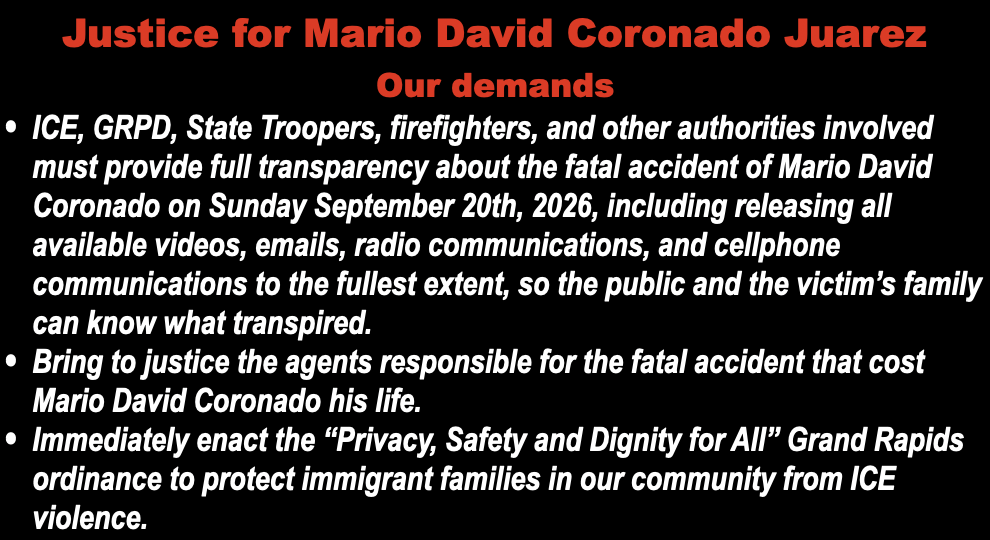
I say all of this to provide context for the fact that Mayor LaGrand did not release a statement about the death of Mario David Coronado Juarez until Thursday, September 24, days after immigrant justice groups had already done so with very clear demands listed here above.
What follows is Mayor LaGrand’s statement is italics, with a response after each paragraph in bold.
Earlier this week, we lost a valued member of our community, Mario David Coronado Juarez, in a vehicle crash. Mario was a member of our Grand Rapids community, but he was also the breadwinner for his family back in Guatemala, who will have to mourn him from afar. We mourn with them. His life deserves to be remembered with dignity, and his family deserves compassion, answers, and justice. The first paragraph might seem sincere and heartfelt, but the reality is that it is anything but sincere. Mayor LaGrand has been been dismissive of Movimiento Cosecha and GR Rapid Response to ICE since he first took office in 2025. Mayor LaGrand has ignored the demands around sanctuary policies and has outright refused to implement them.
This tragedy is under investigation. While there are many unanswered questions, it is clear that Mario fled from ICE agents prior to the crash. GRPD officers were not involved in this pursuit and only arrived on scene in response to the reported crash. While we don’t know what Mario was thinking and feeling, we know that his death happened in the context of a national effort to create fear among our immigrant neighbors. The elevated activities of ICE across our country have been central to this increased fear. It is true that the Federal Government has created the climate of fear and terrorism perpetrated by ICE, but Mayor LaGrand has refused to acknowledge that this fear and terror has been ongoing. Movimiento Cosecha and GR Rapid Response to ICE has been telling him and the City Commissioners about what ICE has been doing in Grand Rapids and that it has exponentially increased in recent months. Equally important is the fact that the GRPD has assisted and collaborated with ICE agents in the abduction of immigrants and their transport to the detention center in Baldwin Michigan, a fact that Mayor LaGrand and Chief Trigg continue to deny.
City Manager Washington, Police Chief Trigg, and I decided that in order to push for answers about this tragedy, we should request that Michigan State Police be engaged in the investigation, and I want to thank our Governor for directing our State Police to provide assistance in the investigation. Involving the Michigan State Police will not bring about any meaningful notion of justice in this instance. Mayor LaGrand should follow the lead of affected communities which are demanding the release of all available videos, emails, radio communications, and cellphone communications to the fullest extent, so the public and the victim’s family can know what transpired.
The reality is, we cannot keep Federal agencies out of our city, however they act. But let me be clear: no law enforcement entity that traffics in fear is welcome here. ICE’s national pattern of intimidation, harassment, and killing has to stop. This is a moment when we all have to stand for justice and real work for public safety. When government agencies cause harm instead of reducing harm, they are worse than useless. They cannot be allowed to continue unchecked. First, the Mayor throws his hands up and says there is nothing the city can do. This is utter bullshit, since the sanctuary policy demands from Cosecha and GR Rapid Response to ICE would make it so that the City would not provide information, Flock camera images and make sure the GRPD will NOT cooperate or collaborate in any way. Second, Mayor LaGrand fails to mention that Cosecha and GR Rapid Response to ICE are not giving in to ICE terrorism in Grand Rapids and are actively resisting ICE and providing a whole range of Mutual Aid resources for families that have been directly impacted by ICE. Third, the GRPD has engaged in a pattern of intimidation and harassment of BIPOC residents and activists for years. If there Mayor wants to critique government agencies he needs to include the GRPD as engaging in harm as well.
My colleagues and I work every day to help every resident feel safe and supported. We want everyone living in our city to trust our City, to feel like they can ask for help when they need it, and to know that they are valued and wanted. All of us are safer when everyone – regardless of their status – in our community feels safe and is safe. I call on the federal government to take steps similar to those we’ve done locally, including body-worn cameras, civilian oversight, and appeals processes in the pursuit of becoming more transparent and safe. These reform ideas are supported by our members of Congress – Senators Peters and Slotkin, and Representative Scholten, as well as many of my colleagues in the U.S. Conference of Mayors. Every law enforcement agency operating in our city should share our commitment to making our community feel safe and to community-oriented transparency. First, Grand Rapids City officials do NOT work everyday to make sure that everyone living in this city feels safe. Again, BIPOC residents, immigrants, unhoused people, along with queer and trans people do NOT feel safe in this city. Second, calling on federal officials that represent Michigan will not benefit those most affected by ICE, since Peters, Slotkin and Scholten have all been terrible of responding to ICE violence in Grand Rapids. Third, calling for ICE to use body-worn cameras and other weak reforms will not create more transparency, but more importantly it will not do what so many people are currently demanding, which is to Abolish ICE!
Helping our neighbors feel safe isn’t something City government can do alone, and government action isn’t enough. I call on all of us to continually renew our commitment to keeping our neighbors safe, with all the tools we have available to us at all levels of government, and in partnership with everyone willing to join us in this ongoing work. Here Mayor LaGrand could have shared the GR Rapid Response to ICE hotline 616-238-0081 so that trained people can respond to ICE activity in Grand Rapids. The Mayor could encourage people to get trained through Cosecha and GR Rapid Response to ICE so that people could respond to calls, participate in patrols and accompaniment for immigrants living in fear. The Mayor could tell people that GR Rapid Response to ICE provides transportation for immigrants for fear of driving alone, along with providing food and other household items on a weekly basis and assisting with financial support for immigrant families who can’t afford rent and other costs because the main income earner has been abducted, sent to detention or has been deported. The Mayor could also have told his constituents that there are sanctuary spaces in this city for people in fear of being the next target of ICE.
We will get through this moment in our country’s history. We will do so by building trust, by acting in unity, and in courage. We mourn Mario’s death. We can honor him by resisting fear and hate, and building a better, safer, more open community every day. We will not get through this moment in history if people follow the actions of the City of Grand Rapids. People can mourn Mario’s death by donating to a fund that would cover the costs associated to have his body send back to Guatemala and allow his family to bury him their village. Here is the link for those wanting to contribute https://chuffed.org/project/202891-justice-for-mario-david-coronado-juarez.
It must be said that Mayor LaGrand did come to the vigil for Mario David Coronado Juarez on Thursday night, but several people stated that he spent a fair amount of time on his phone, thus not being present in the moment of signifiant community grief, nor the words share by a pastor, representatives of the Guatemalan community and a spokesperson for Movimiento Cosecha.
Lastly, if Mayor LaGrand truly wants to build a better, safer, more open community then he needs to start listening to members of the affected community and to do what he can as Mayor of Grand Rapids, which would be to adopt policies that would prevent the city from assisting, cooperating or collaborating with ICE and in any way.
Justice for Mario!
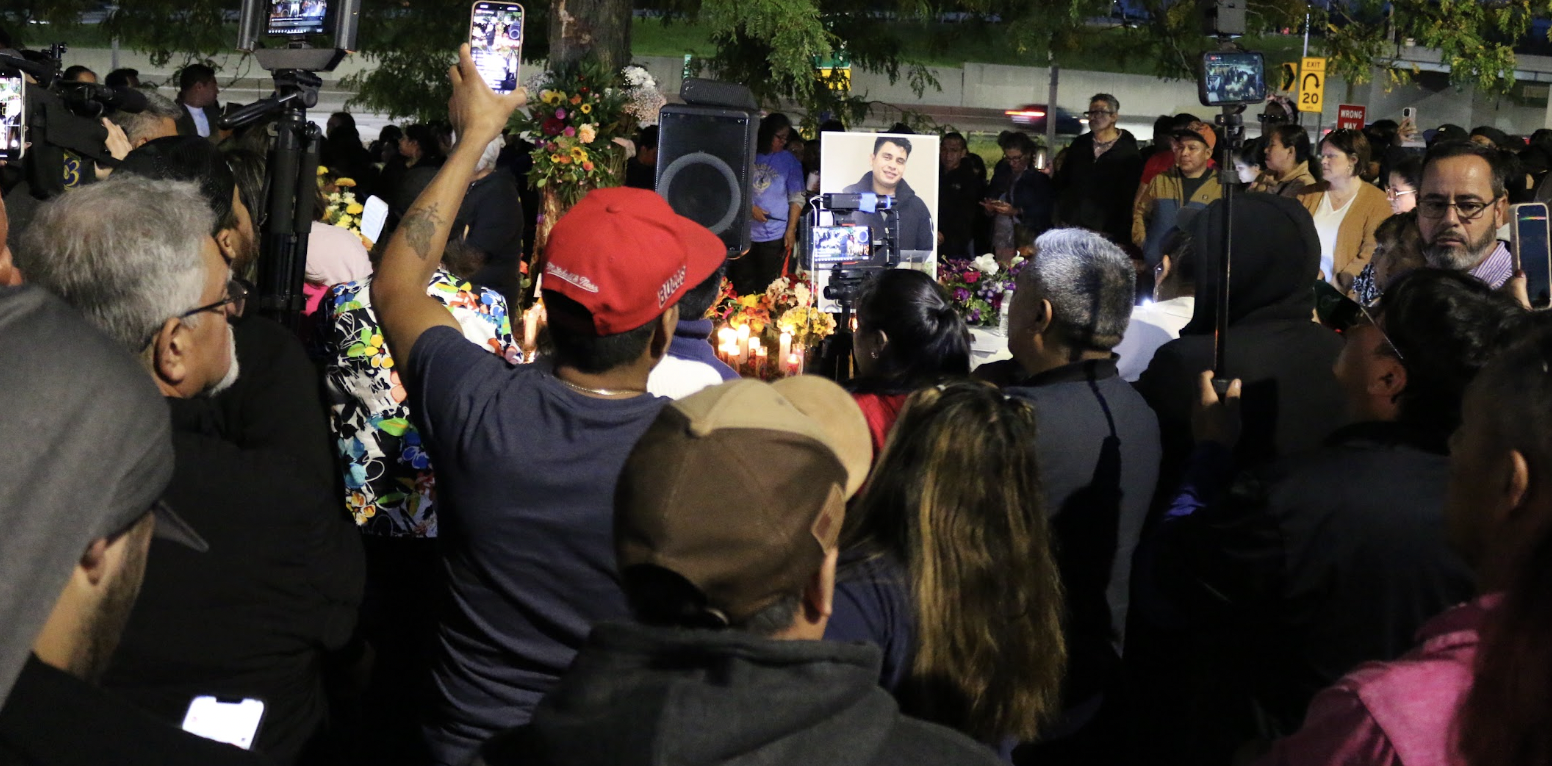
The Guatemalan community showed up last night to mourn the loss of Mario David Coronado Juarez and to demand justice in Grand Rapids
Photos were provided by Viviana Rubio
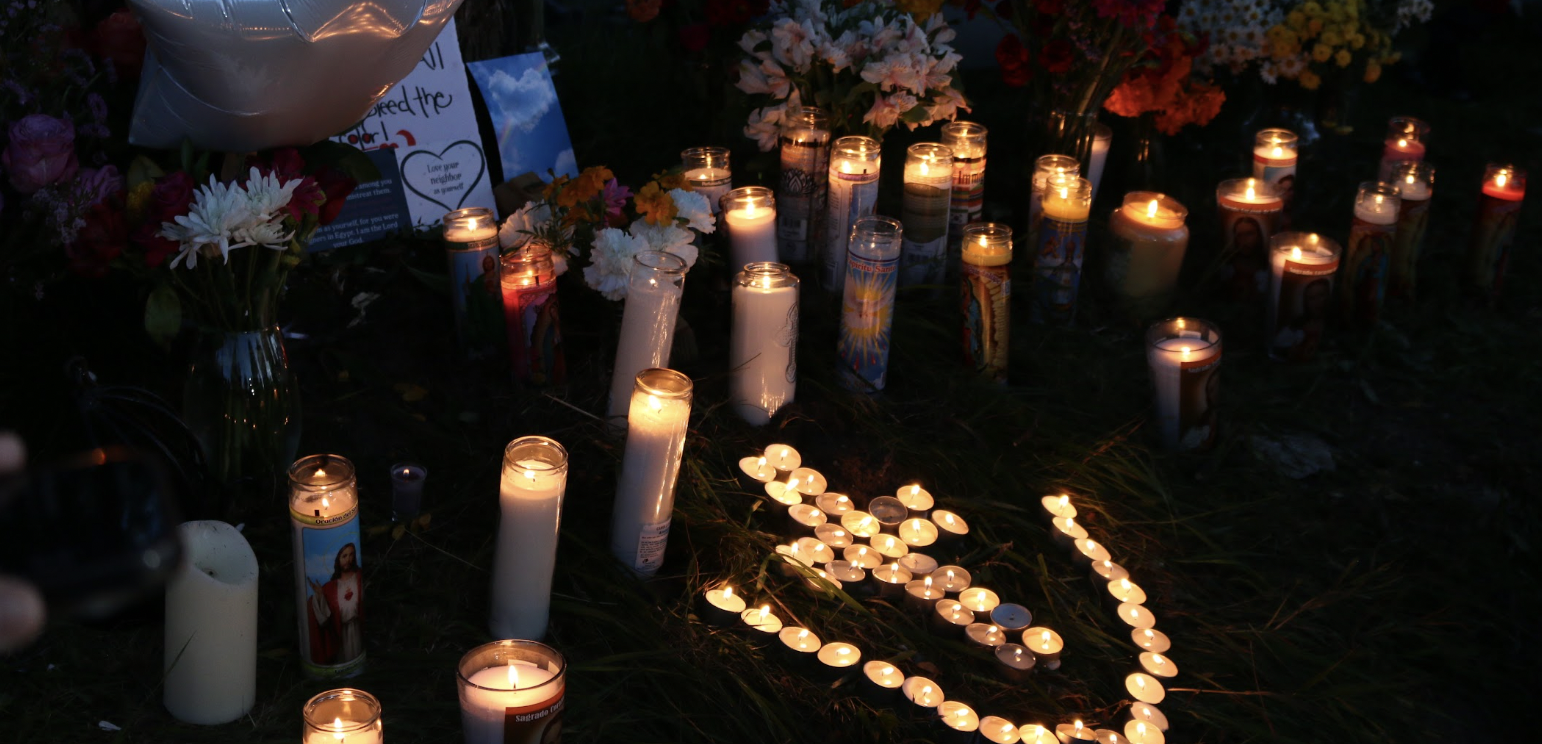
Mario David Coronado Juarez died at this spot on Sunday.
Last night hundreds gathered to mourn, to grieve and to rage against Immigration and Customs Enforcement (ICE).
Mario David Coronado Juarez was a Guatemalan national from the state of San Marcos, which is on the western side of the country. Roughly two thirds of the residents of Guatemala are of Mayan descent.
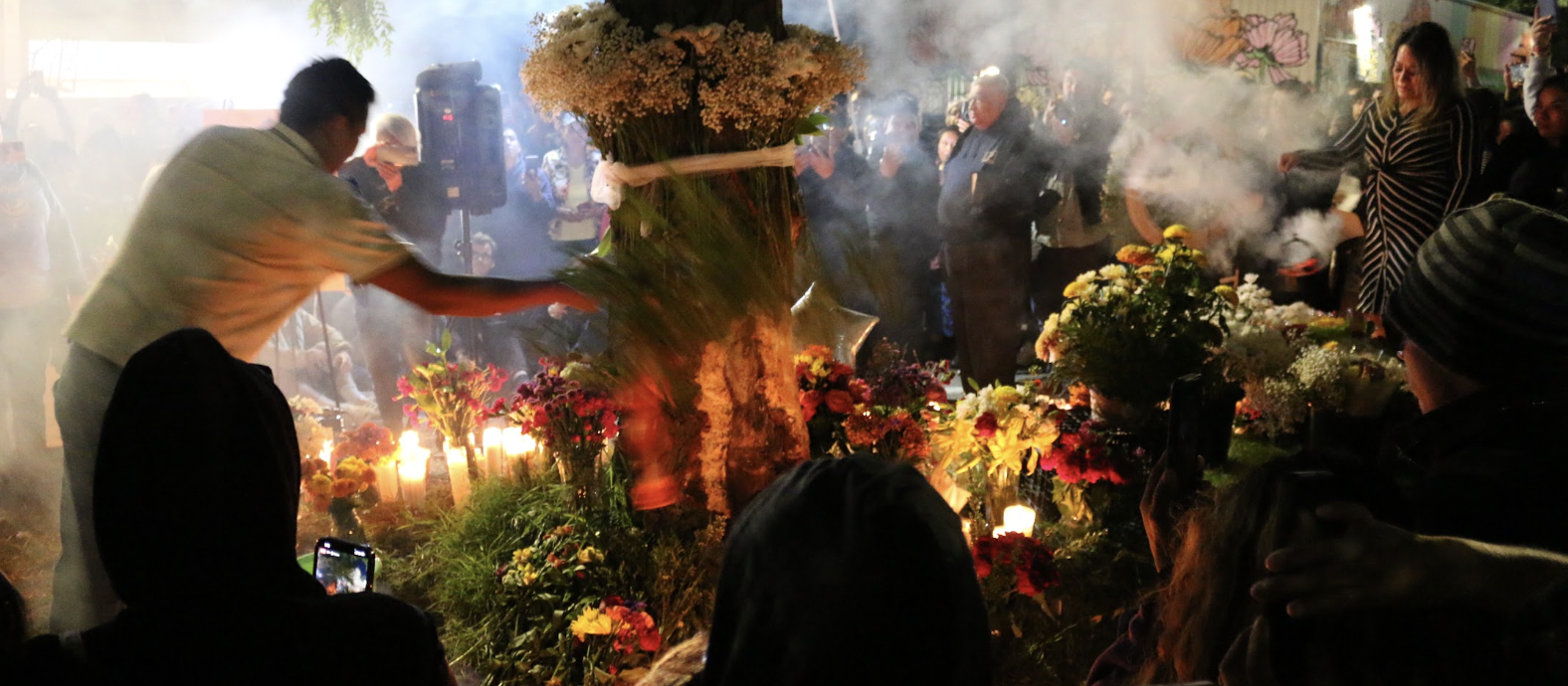
Mario was Mayan and the Mayan community showed up last night. If you closed your eyes it felt like being in the altiplano in Guatemala, with all the candles and pom (Mayan word for incense), with incantations being offered in a Mayan dialect, while marimba music floated in the background.
Mario David Coronado Juarez died at this spot.
Members of Movimiento Cosecha and the Guatemalan community arrived early to decorate the site where Mario died. They brought ribbons, flowers, candles and images of Mario. The items were arraigned with care and respect.
I watched a video that featured Mario’s family in Guatemala, going back and forth speaking in a Mayan dialect and in Spanish, pleading for assistance from anyone who was watching to find ways to raise funds that would allow Mario’s body to be sent home and buried in soil of the Land of Eternal Spring.
Mario David Coronado Juarez died at this spot.
A Guatemalan pastor offered up prayers last night. Members of Movimiento Cosecha spoke about the collective fear and the terrorism created by ICE in Grand Rapids, the very same fear that resulted in Mario’s death.
Karla, a fellow Guatemalan also spoke during the vigil. She talked about the pain and the hurt that the Guatemalan community is experiencing. You could see the pain on her face as she held back tears while speaking in English. Karla spoke in English so that those who were not part of her community would hear her condemn the ICE agents that were responsible for Mario’s death.
Mario David Coronado Juarez died at this spot.
The crowd that had gathered by the tree that Mario’s car hit was so vast that it overflowed into the road taking over the northbound lane. Crowd safety people did their best to keep everyone safe from motorists and cops. A GRPD cruiser came by several times yelling at the safety people to get everyone out of the road, but they ignored his words, choosing instead to focus on the safety of those who came to publicly grieve.
Several elected officials and political candidates showed up, but there was no platform for them to speak or to offer up empty political promises or performative actions that everyone knows are shallow and offensive.
The vigil came to a close more than 3 hours after it started. People took flowers and embraced each other. What else can we do when confronted by the violence perpetrated by ICE and protected by the state.
Mario David Coronado Juarez died at this spot and our souls are wounded.
Please support the family and help bring Mario home and donate to this link:
https://chuffed.org/project/202891-justice-for-mario-david-coronado-juarez
What do you do when people who are ignorant, uninformed and hateful respond to an announcement about a vigil for someone who died because of ICE?
Tonight the community is coming together to collectively mourn the death of Mario David Coronado, who died while attempting to get away from ICE.
I wrote about the Press Conference that was held on Tuesday regarding the death of Mario David Coronado. On Wednesday I shared a graphic that invited the community to attend the vigil being held at the location where his death occurred.
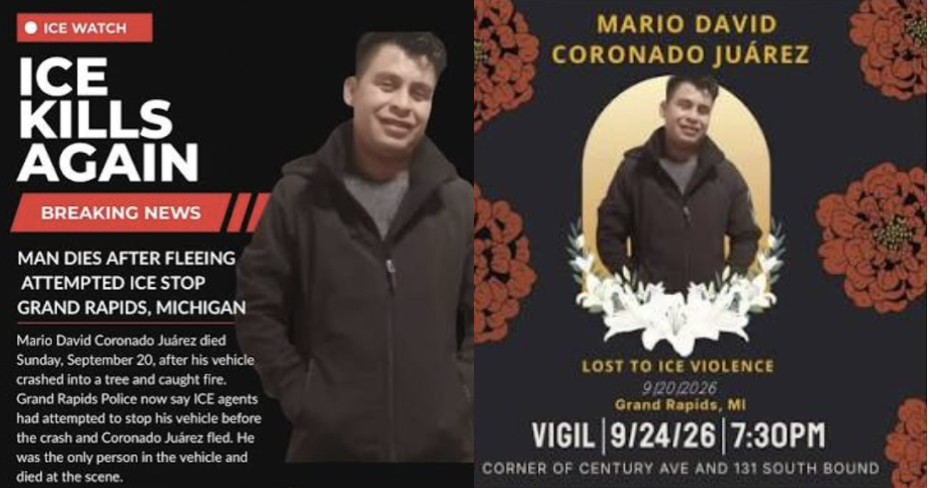
In just the last 24 hours there have been dozens of people responding with care emojis and other people have commented with kind words regarding the death of Mario David Coronado. However, at the same time there have been dozens of people who have posted ignorant, uninformed, hateful and just plain despicable comments.
Now, I have been removing them as quickly as possible, but I have never seen this many hate-filled and ignorant comments on a single post on my page. I know some people have responded to these comments, but those also get deleted when the hateful comments are removed. Here is a sampling of what people wrote:
One less illegal alien to deport 15 million to go
Or dont run when being pursued by law enforcement. I know he lost his life, yes thats a tragedy but being illegal and not stopping for law enforcement probably didn’t help. Why were you running? Because you’re illegally here? What if this dude rape or murdered someone? Itd be completely silent…. save your bullshit sympathy. Stupid leftist as always.
Shouldn’t have been in the country illegally and shouldn’t have tried to flee. It’s his own fault. Spare me the outrage.
I’m just glad that when he was avoiding justice, it was a tree he ran into and not an innocent person
ha ha ha and stupid
Illegal
refried
Break a bunch of laws and the Democrats will honor you
they can all move in with you and you can personally support them!
Sneaking into our country illegally, taking a citizens job and living off our tax infrastructure, then fleeing enforcement endangering people around him…….it’s unacceptable!
Sad he died but being an illegal alien fleeing law enforcement doesn’t call for abolishing the agency tasked with upholding our LAWS
Now, more than half of the hate-filled comments that were posted were from people outside of Michigan, which likely means they are bots or trolls who get paid to respond to topics like immigration and ICE, and/or because of the shitty algorithmic nature of social media. However, there were plenty of people who were from Michigan, even West Michigan who appeared to be real people who just happened to be awful and hate-filled people.
Beyond the banality of these comments and the utter lack of any real knowledge of US immigration policy, what bothers me the most is that people took the time to actually come on my page (or any page with similar content) and say the despicable things they said. I mean, who the fuck intentionally decides to go on a social media post about a vigil for a man who died while trying to avoid being subjected to the repressive clutches of ICE, the concentration camp-like ICE detention system or deportation – and then write ignorant, hateful and cruel comments?
Such behavior cannot simply be laid at the feet of the GOP or the MAGA bots. This type of behavior is systemic and it is rooted in the Settler Colonial, white supremacist dominant culture that is the US.
If you are able to attend tonight, please show up. We need to demonstrate that solidarity is more powerful than ignorance, hate and those who act as apologists for ICE.
History of US Immigration Policy: Summary of GRIID Class week #1
For anyone who could not join the class tonight or who couldn’t find time to be part of this class, I want to share a summary of what was discussed. I also want to provide links and resources for anyone who wants to do their own investigation on the history of US immigration policy.
As with each of the 8 weeks of this class we will rely on the Popular Education resource I created and update regularly. The Popular Education resource provides an important overview of this history, along with a list of books and online resources that can help us with developing a robust analysis of the history of US immigration policy and how to frame it.
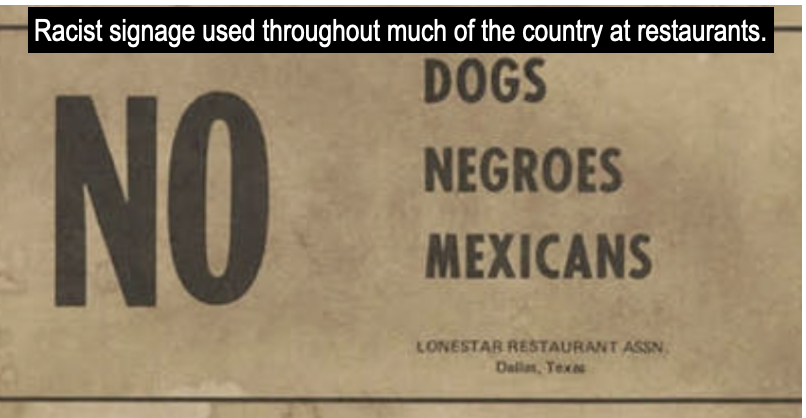
For week #1 we read sections from the book, American Intolerance: Our Dark History of Demonizing Immigrants. The sections we read collectively and discussed covered the demonizing of Mexicans, Chinese, Germans, the Japanese and members of the jewish community.
For Mexicans, the demonization escalated after the US invaded Mexico and eventually occupied the northern part of Mexico and claimed it for the US. For the Mexican people living in that region, they were then treated as inferior, subjected to ongoing discrimination and were forced off the land that they were born into.
The chapter on the Chinese dealt mostly with xenophobia on the west coast, where Chinese immigrants lived. Chinese immigrants built the railroads in the US, along with developing most of the agriculture sector in California as well, yet white communities and white politicians did not want them to stay nor to bring their families, so the Chinese Exclusion Act was passed and remained in place for decades.
Then there was a chapter on anti-German discrimination, which happened in the years just before and during WWI, where Germans were now called Huns. The discrimination wasn’t as bad as what many non-European communities experienced, but it demonstrated the fact that anyone can be demonized to serve a political purpose.
A fourth chapter looked at the treatment of Japanese Americans, referred to as the “Yellow Peril.” After Pearl Harbor Japanese Americans were rounded up and put into internment camps, most losing the homes and businesses in the process.
The the last chapter we discussed it dealt with how the growing antisemitism impacted the Jewish community, where people believed that they were spying for Hitler. This discrimination was directed at Jews from Europe. However, the worst aspect of this anti-Jewish position was that the FDR administration would not accept a shipped filled with Jewish immigrants that had fled Nazi Germany. They were forced from docking and had to return to Europe, where most of them were killed.
We discussed that the current anti-immigrant position of the Trump Administration is rooted in xenophobic immigration policies and practices that have existed since the US was founded.
Activists once again shut down Grand Rapids City Commission over sanctuary policies and the ongoing GRPD collaboration with ICE
Right after the Press Conference that Cosecha, GR Rapid Response to ICE and No Detention Centers in Michigan hosted last night, activists and many supporters attended the Grand Rapids City Commission meeting.
The City Commission meeting itself was not very long, regarding city business. However, when it got to public comment, it became somewhat of a shit show, even before people demanding the city adopt sanctuary policies.
For years there has been a Christian minister (or so he says) who speaks whenever he can about the evils of abortion or the evils of cannabis. However, during the last public comment session, the god-fearing man brought up the midterm elections, specifically to encourage people to not vote for Abdul El-Sayed, who is running for the soon to be vacated Senate seat on Michigan.
The Jesus is my lord guy said that voting for Abdul would bring us closer to Sharia Law, where Muslims will do evil things and even cut off people’s hands. Many people called him out on his bullshit, some even referred to his comments as hate speech or outright Islamophobia. Commissioner Kilgore then spoke up and asked for the meeting to recess so the City Attorney to make a ruling on whether or not this was hate speech. Mayor LaGrand then stepped in and because he is a lawyer, he said that the Jesus guy has the right to say what he wanted as long as it did not threaten anyone.
It went back and forth for a few minutes and eventually the Mayor gave the Jesus guy another minute to end his comments. The preacher then went after Jocelyn Benson and essentially used the talking points from an attack ad claiming the gubernatorial candidate while on the board of the Southern Poverty Law Center gave funds to the KKK.
Once the rantings of the Jesus guy was over, other people were finally allowed to speak, I counted 35 people who spoke specifically about the sanctuary policies that Cosecha has been demanding since the beginning of 2025, a ban on Flock cameras, an end to GRPD collaboration with ICE and the death of Mario David Coronado.
People addressed these issues from a variety of angles, which included they following:
- Discussion of conditions at the North Lake Processing Center in Baldwin, Michigan, which is the GEO Group ICE detention center.
- Dropping the charges against the 5 arrested by the GRPD for trying to stop ICE abduction of immigrants during the September 9 protest.
- One of those who was arrested during the 9/12 protest talked about being arrested, that the GRPD threatened to shoot people with their Pepper Ball Air Rifles, that they threw her to the ground before cuffing her. This person ended their comments by saying, “To tell us that the GRPD is not cooperating with ICE is simply bullshit!”
- Another person read a statement from another person arrested on September 12, as they could not attend the meeting.
- Someone asked the Commissioners and Mayor LaGrand, “Where are your hearts and souls for our fellow human beings?”
- Another powerful comment was, “If you are on the side of hate, then get the hell out of the way!”
- An organizer with Cosecha asked the commissioners to look at their hands, then said, “Your hands are stained with the blood of one of the members of our immigrant community.” They said this while holding a picture of Mario David Coronado.
- Another person said that refusing to meet with Cosecha is disrespectful. “What the hell are you hiding?” They then read off a list of GRPD cops who were present on 9/12 and treated protesters with violence and contempt.
- Another organizer said that the GRPD was holding the 5 arrested in their cruisers just blocks away from 517 Ottawa and deciding what to do with them before taking them to the Kent County Jail.
When it came to the 35th person who spoke about these issues, the Mayor tried to shut them down, but then people began chanting and making statements you can hear in the video below.
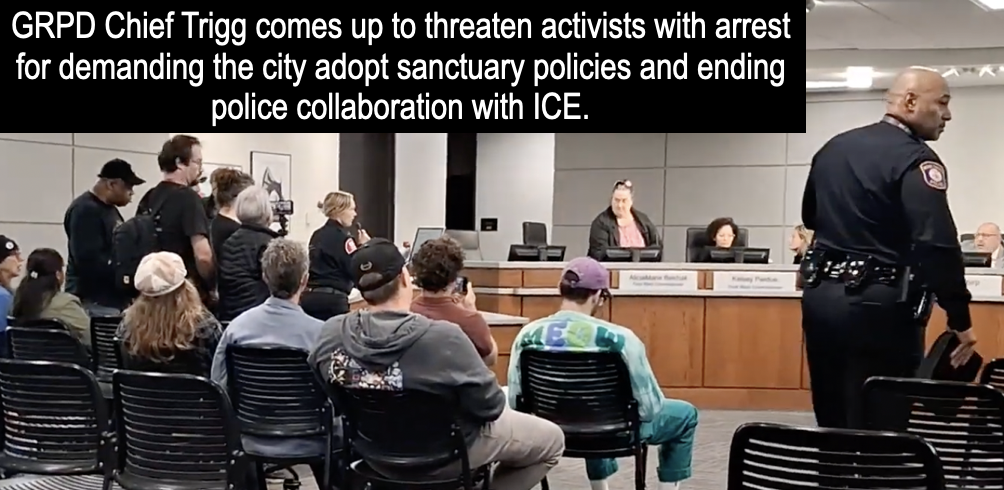
The Mayor then got the GRPD, include Chief Trigg, to come up and stand between the activists and the city officials and threaten people with arrest. This went on for several minutes and eventually Mayor LaGrand decided to end the meeting. Not only did the disruption of the meeting get it shut down, it didn’t allow the Mayor time for his 13 minute long speeches where he claims he wants to sit down with Cosecha to talk about the sanctuary policies.
Interestingly enough, while everyone was gathering by the elevators to leave the building, 3rd Ward Commissioner Kilgore asked to speak with Cosecha organizers and agreed to a meeting to talk about sanctuary policies that they have been demanding since the beginning of 2025. Someone is actually listening!
Press Conference demands an end to GRPD collaboration with ICE and justice for a Guatemalan man who died while attempting to flee ICE abduction
Earlier today Movimiento Cosecha, GR Rapid Response to ICE and No Detention Centers in Michigan held a Press Conference on Calder Plaza to call attention to the recent death of Mario David Coronado.
Mario David Coronado was a Guatemalan national who died on Sunday while attempting to avoid ICE who has attempting to abduct him on Century, near US 131 and Burton SW.
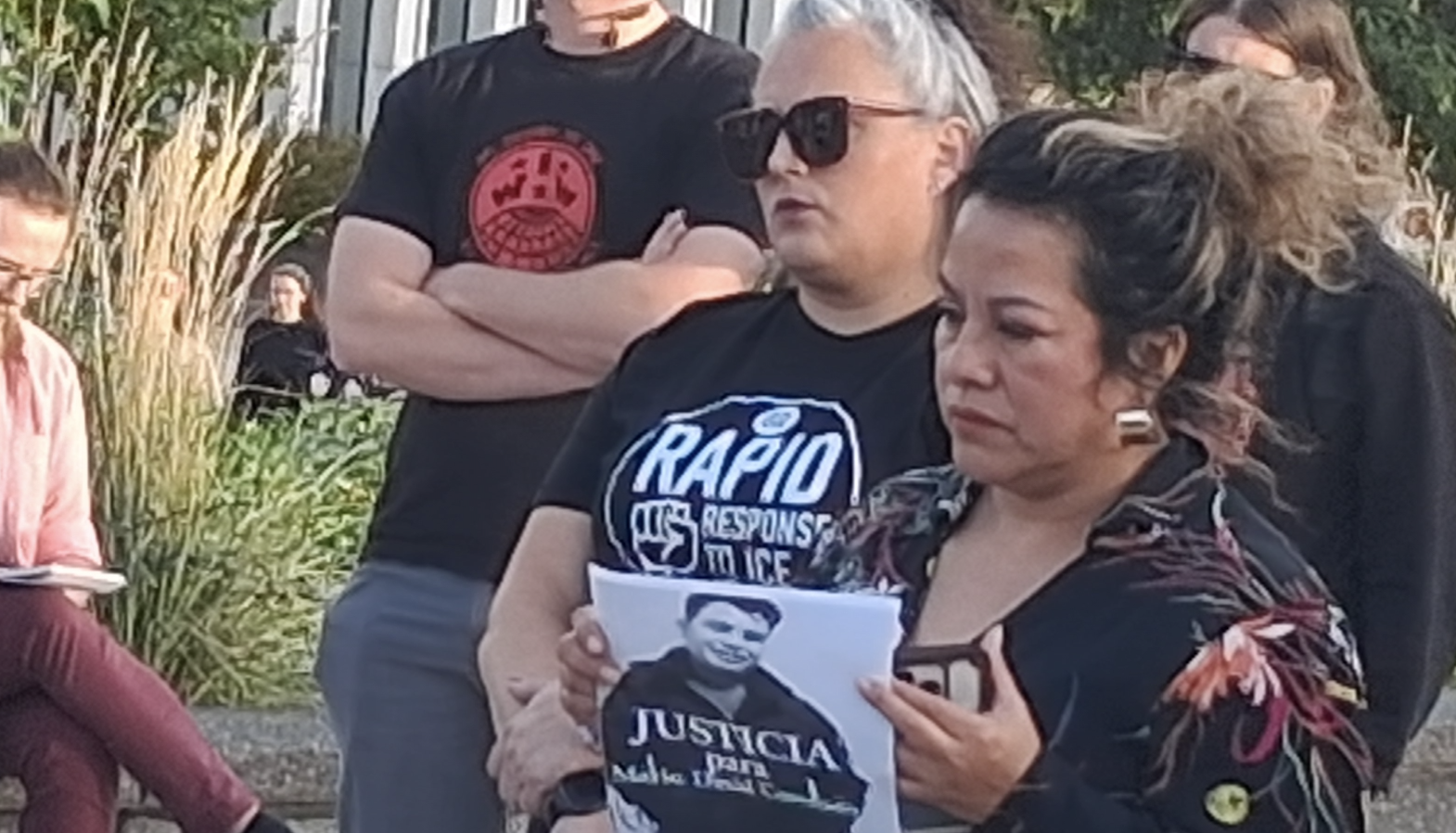
Karla Barbari also spoke during the Press Conference as a member of the Guatemalan community. Barbari spoke about the fact that the immigrant community, specifically the Guatemalan community, live in constant fear of ICE. She said that Coronado’s death was a direct result of the terror that immigrants face on a daily basis. Barbari also said that many in the immigrant community also fear and have little trust in the GRPD, which continues to collaborate with ICE.
Movimiento Cosecha organizer Gema Lowe invited the community to attend a vigil for Mario David Coronado on Thursday at 7:30pm at the spot where he died while attempting to avoid abduction by ICE – on Century, near US 131 and Burton SW. Lowe stated that Coronado’s family gave permission for the vigil to take place and they welcome public support in the fight for justice for Mario.
GRPD and ICE go hand in hand
The following statement was read by a volunteer organizer with GR Rapid Response to ICE. In their statement they address what happened to Mario David Coronado, the increased ICE abductions in Grand Rapids, the abolish ICE action on September 12th and a list of demands.
On Sunday, September 20th, 2026, Mario David Coronado died in a tragic car accident that ended in hitting a tree, because ICE agents, Immigrations and Customs Enforcement Agents, were chasing him and he was terrified.
For the last couple of days, GRPD claimed they had no idea what had happened and an ask for Silent Observer tips from the public went out.
It was evident from the moment footage was shown that the same vehicles we at GR Rapid Response to ICE see kidnapping our neighbors all over Grand Rapids and parking at 517 Ottawa, were at the scene – that ICE was in fact involved in this accident and the reason that Mario is no longer with us.
Over 1,000 immigrants have been kidnapped in Michigan, just this year. 500 since mid-July.
The Grand Rapids Police Department, Mayor David LaGrand and the city commissioners will all tell you that GRPD does not work with ICE, we know for a fact that they do. We have been witnessing it with our own eyes for the past two years.
The same Grand Rapids Police Department that responded to Mario’s tragic death on September 20th, is the exact same Grand Rapids Police Department that arrested 5 community members that were resisting ICE on September 12th and threatened the rest of the crowd with chemical munitions right outside of the 517 Ottawa office in a public alleyway.
ICE and cops go hand in hand. The GRPD is complicit in collaboration with ICE. Pass the sanctuary policies that Movimiento Cosecha and GR Rapid Response have been calling for since 2025 so we can stop this horrific behavior and protect our community.
It is no longer acceptable to just say what is going on is wrong, it is time to ACT on it.
Our demands:
- ICE, GRPD, State Troopers, firefighters, and other authorities involved must provide full transparency about the fatal accident of Mario David Coronado on Sunday September 20th, 2026, including releasing all available videos, emails, radio communications, and cellphone communications to the fullest extent, so the public and the victim’s family can know what transpired.
- Bring to justice the agents responsible for the fatal accident that cost Mario David Coronado his life.
- Immediately enact the “Privacy, Safety and Dignity for All” Grand Rapids ordinance to protect immigrant families in our community from ICE violence.
Tomorrow morning GRIID will be posting a story about the City Commission meeting, where community members attend after the Press Conference and speak to the GRPD collaboration and complicity with ICE abductions in Grand Rapids.
Monitoring the Rich and Powerful in Grand Rapids – Segment #12: More downtown hotels, subsidizing developers and Amway pays a fine
One of the 10 principles of journalism is that it must serve as an independent monitor of power.
Now, I don’t claim to be a journalist, more of a media watchdog, but I do engage in movement media. Movement media is reporting and documenting what social movements are doing, which is what I have been trying to do with GRIID since 2009.
However, since I have been monitoring what I call the Grand Rapids Power Structure for nearly two decades, it seems like a good idea to do a Monitoring the Rich and Powerful in Grand Rapids segment.

There are three issues in this segment of Monitoring the Rich and Powerful in Grand Rapids that I want to draw attention to.
The first item I want to look at is the Grand Rapids-Kent County Convention/Arena Authority (CAA) plans to have a new hotel built in downtown Grand Rapids so that the city can stay competitive when it comes to “offering ballroom and meeting spaces.” At least this is what Richard Winn, who is chair of the CCA board of directors and president of AHC Hospitality. AHC Hospitality is owned by the DeVos family, which begs the question of whether or not Winn and other CCA board members are wanting additional hotel space that would also be owned by the DeVos family?
A second example of what members of the Grand Rapids Power Structure are up to has to do with a new partnership between Houghton-based Braveworks Inc. and CWD Real Estate Investment to convert part of the historic Trust Building in downtown Grand Rapids into a 63-room boutique hotel, according to Crain’s Grand Rapids Business.
CWD Real Estate Investment is owned by Sam Cummings and Dan DeVos, both of which have benefited from lots of public money through the Brownfield Redevelopment Financing Act. Those public dollars have provided wealthy developers like Cummings and DeVos the opportunity to use public funds to expand how much property they own, which is recent years has been rental units, condos and now hotel rooms in downtown Grand Rapids. Ironically, Cummings and DeVos both signed on to the the GR Chamber of Commerce proposed ordinance that would criminalize unhoused people in the downtown area. CWD loves it when public funds are used to expand their wealth but will oppose public funds for truly affordable housing.
Our third and last example of what the GR Power Structure is up to has to do with a recent court ruling, which states:
“The Amway Corp. and two affiliates have agreed to pay $225 million to resolve allegations from the Federal Trade Commission and Washington state that they used deceptive tactics to recruit members to the direct-selling and multilevel marketing business.”
The Crain’s article goes on to say, “We fundamentally disagree with the agencies’ characterization of our business, This settlement, like all settlements, required compromise. Resolution positions us to move forward and focus our energy where it belongs: on our customers, IBOs and employees.” Of course Amway disagrees with the court ruling,, but if it means just paying a fine and keeping how they do business out of the public eye, then that is a win for them. The Crain’s article does not include details from the Federal Trade Commission, which made three major complaints against the Amway Corporation:
- Falsely telling IBOs that they are likely to earn substantial income, exceeding $40,000 a year, or that they are likely to earn income that will replace their full-time job or allow them to retire early, when most IBOs who joined WWG or LTD after 2020 spent more money on Amway products and training than they received from Amway
- Falsely telling IBOs that they are likely to recruit multiple IBOs into the business to help them succeed, when in fact most consumers who joined Amway and WWG or LTD did not recruit multiple participants
- Falsely telling IBOs that they are joining an exclusive opportunity in which they will get access to mentoring from highly successful leaders, when in fact the Amway opportunity is open to any prospective IBO who follows the instructions of their recruiter, and the “mentors” IBOs work with are typically not highly successful
Sharing these kinds of details are a PR nightmare for Amway, since they ultimately affirm what many people have been saying for decades, which is that the company is a pyramid scheme. This was the thesis of a book by Stephen Butterfield in 1985, entitled, Amway: The Cult of Free Enterprise.
The community will once again present concrete evidence that the GRPD is coordinating and collaborating with ICE during the City Commission meeting
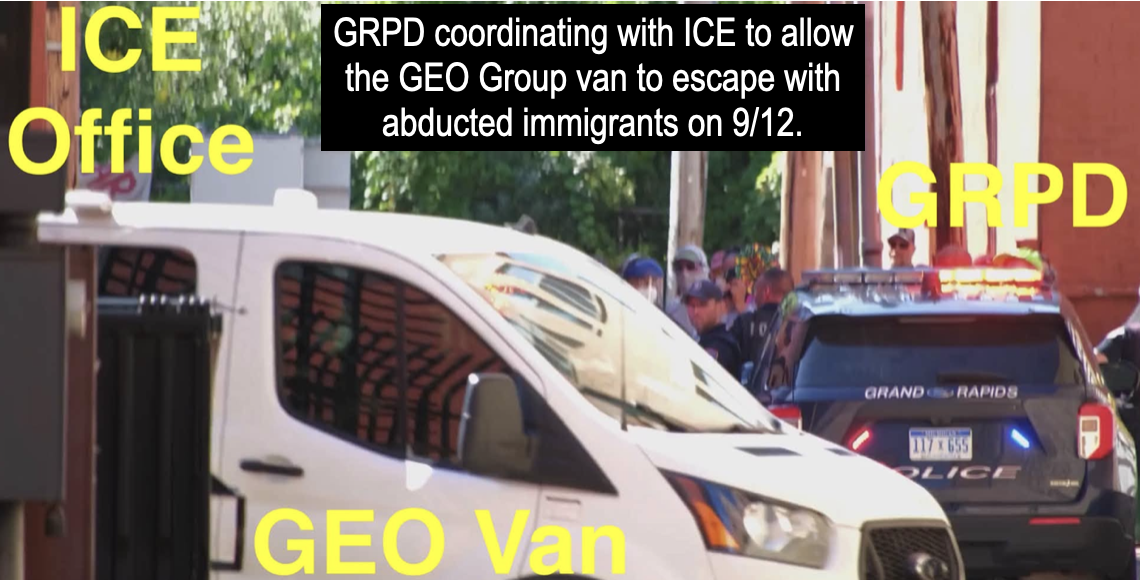
This Tuesday at 7pm, Grand Rapids City Commissioner and Mayor LaGrand will get an earful of information, personal testimony, and photographic evidence that the GRPD was actively coordinating with ICE on September 12th to make sure that immigrants that had been abducted by ICE would be transported from the ICE office at 517 Ottawa by the GEO Group van in order to be taken to the North Lake Processing Center in Baldwin, Michigan.
Movimiento Cosecha and GR Rapid Response to ICE are encouraging people to attend the Grand Rapids City Commission meeting on Tuesday, September 22nd at 7pm to speak during public comment and to witness how the City Commission and the Mayor respond to first hand accounts of GRPD cooperation with ICE.
Over 100 people took part in an anti-ICE action on September 12th, plus thousands more have seen the evidence that has been shared on social media.
The action took place in the alley behind the 517 Ottawa NW ICE building, which is their deployment office, meaning the office where ICE agents work out of to abduct immigrants, process them and then put them on a GEO Group van for transport to Baldwin, Michigan.
People noticed that the GEO Group van was in the ICE parking lot just north of the ICE building, which was around 11am, when most of the people who were resisting ICE had arrived. The GRPD arrived just minutes after those protesting ICE were on the scene, although the GRPD had a presence in the area at least an hour prior to the protest. Several first hand accounts said that GRPD cruisers were staging nearby, with many reports stating that as many as a dozen GRPD cruisers were seen.
Several GRPD cruisers pulled in the alley from the north entrance and blocked the alley right about where the ICE parking lot and the building that includes the ICE office begins. The GRPD cruisers parked diagonally in two different directions, making it nearly impossible for people to go north in the alley. At the same time the GRPD had cruisers near the south entrance of the alley.
Activists have been documenting for months that the GEO Group van then moves from the ICE parking lot and pulls into the garage of the ICE building at 517 Ottawa NW. Immigrants that are being abducted on a daily basis by ICE are put in a holding cell in the 517 Ottawa NW. ICE then loads abducted immigrants into the GEO Group van, which then departs from the garage to head to Baldwin, Michigan.
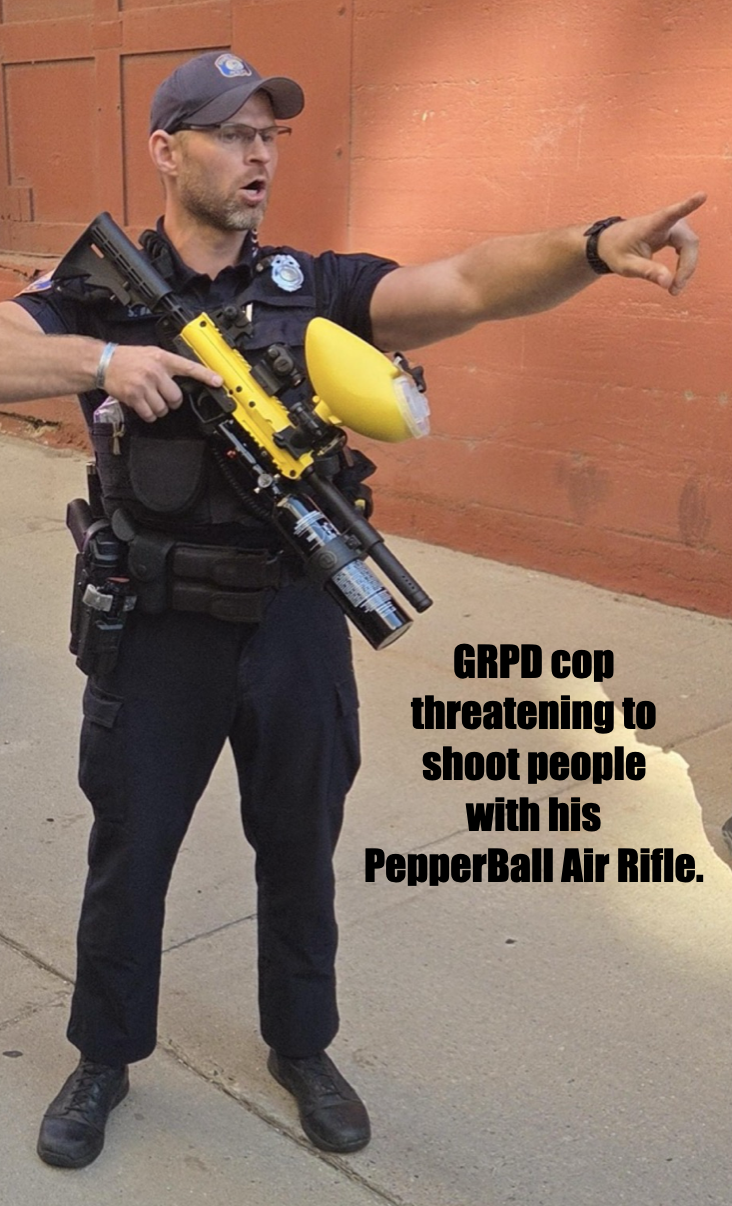 However, since there was activist presence by the gated ICE parking lot and near the garage entrance, ICE decided to bring the abducted immigrants out of a door that leads to their parking lot north of the building. Before doing that and to make sure that the GEO Van could get out of the ICE parking lot the GRPD cruisers blocked the alley way and got out of their cars to issue warnings to the crowd about leaving the area. All of the GRPD cops were brandishing weapons, with some of the them holding PepperBall Air Rifles, as shown in this picture that was taken during the action.
The GRPD not only pushed activists down to the southern end of the alley behind the 517 Ottawa NW ICE office building, they did so by threatening people with excessive force in order to create space for the GEO Group van to exit the ICE parking lot and make their get away.
Once the GEO Group van exited the ICE parking lot several GRPD cruiser provided an escort north bound in the alley, along with fact that GRPD cops were position at the north end of the alley to make sure that activists could not block the GEO Group van as it was crossing Trowbridge St. The GRPD continued to escort the GEO Group van down to Corewell Drive making sure that ICE abducted immigrants would be transported to the detention facility in Baldwin, Michigan.
In late July, GRPD Chief Trigg denied that his department cooperates with ICE when questioned during a public forum. In fact Chrief Trigg stated, “that in his 25 years with the Grand Rapids Police Department he has never seen an ICE agent.”
The six Grand Rapids City Commissioners usually remain silent on the issue of GRPD cooperation with ICE and have definitely never acknowledged this cooperation.
Mayor LaGrand has repeatedly denied any GRPD collaboration with ICE. Last month when Mayor LaGrand was presented with evidence of GRPD cooperation with ICE he stated: “Every City that I have looked at for policies has allowed the GRPD to keep ICE agents safe. They are also humans.”
Let’s see what new justifications Mayor LaGrand can come up when the community tries to stop ICE agents and the GEO Group from abducting immigrants while the GRPD assists them in maintaining state carceral violence at the City Commission meeting.
Get the public to pay for it while billionaire families get their name on the Amway Stadium and make the bulk of the profits once it is open
Wednesday was a day for showing off the progress of the soon to be completed Amway Soccer Stadium in Grand Rapids. Crain’s Grand Rapids Business did a story on it, along with the recently created Amway Stadium Facebook page, which was also share by the social media page GR&Riverfront, which promotes downtown development projects.
The new soccer stadium will be open in March to host its first professional soccer league game. There has been a great deal of publicity about the Amway Stadium, along with the usual claims that it will boost the local economy.
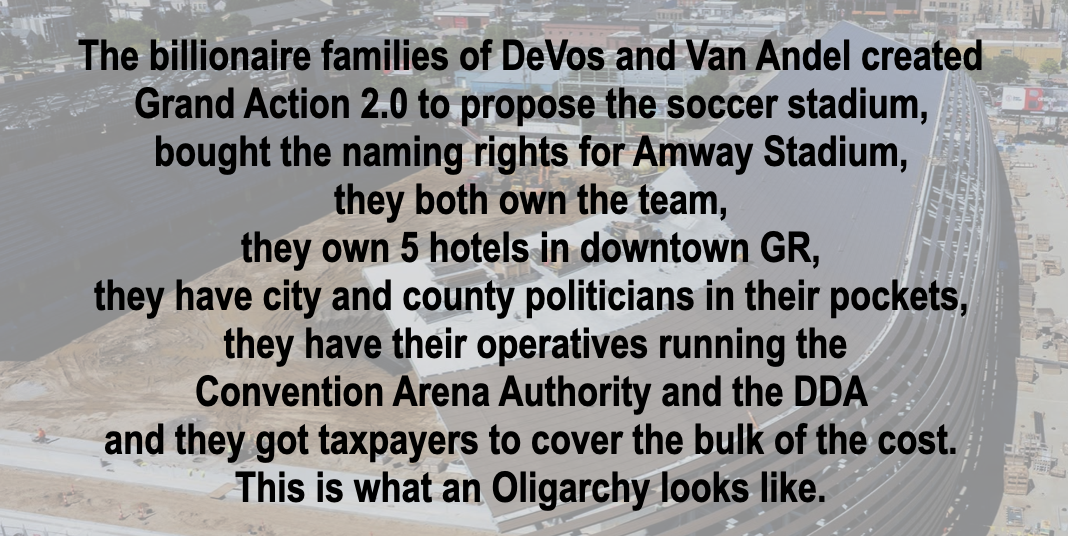
Of course, when groups like Grand Action 2.0 first pitched the soccer stadium idea they were the first to make the claim that the stadium will benefit the local economy. It is true that the Amway stadium will generate lots of money, but the real question is who will be the primary beneficiaries. Like all Grand Rapids downtown development projects the Amway Stadium will benefit members of the Grand Rapids Power Structure and business owners in the area.
Those who will not benefit from the Soccer Stadium will be working class communities in Grand Rapids and West Michigan. In fact, working class communities have provided millions for the Amway Stadium, mostly from tax incentives from the State of Michigan, Kent County and the City of Grand Rapids.
Amway Soccer Stadium Timeline
Grand Action 2.0, which was created in the 1990s by both the DeVos and Van Andel families, first pitched the Amway Stadium idea before the pandemic.
In 2022, it was first reported that the soccer stadium project was in the works, but that a site had not yet been determined. However, at the same time that this was first reported that DP Fox Ventures LLC (DeVos owned) had acquired 407 Pearl St. NW, the site of the Big Boy restaurant on Pearl St. Several months later Grand Action 2.0 announced that the soccer stadium would be built along US 131 by Pearl St., which GRIID reported on.
Once the soccer stadium project was finalized, it would be owned by the Grand Rapids-Kent County Convention/Arena Authority (CAA). The CAA Chairman, Richard Winn, is the President of AHC Hospitality, which is the name of a hotel chain owned by the DeVos family, including the 5 hotels they own/manage in downtown Grand Rapids.
In August of 2024, those who would economically benefit most from the new soccer stadium funded the Hotel Tax ballot initiative. Check out the list of people and orgs that funded the campaign.
In November of 2024, it was announced that the name of the soccer stadium would be the Amway Stadium. The local news omitted the fact that the DDA – which approved using lots of public tax money for the project, has a DeVos family operative on that unelected board and the fact that the Kent County and Grand Rapids City Commissions are in the pocket of the DeVos family. Both of these governing bodies approved $100 million in public subsidies for the Soccer Stadium, which I reported on.
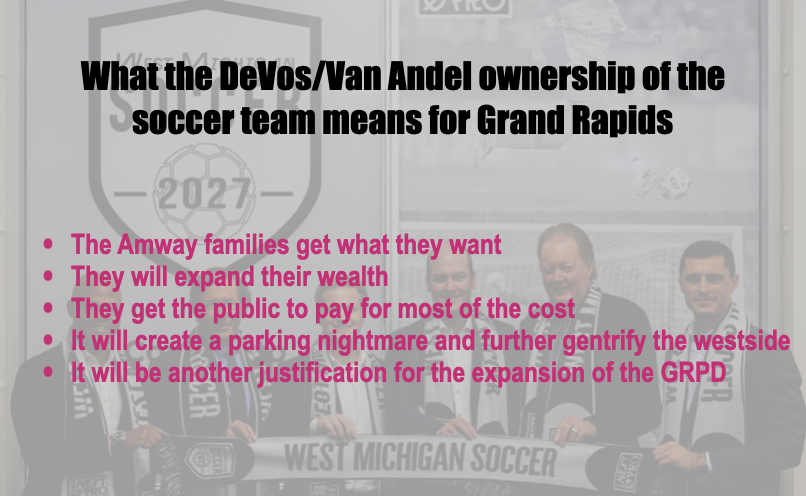
In December of 2024, it was announced that the DeVos and Van Andel families would own the professional soccer team that will play at the Amway Stadium. I wrote a post entitled, What the DeVos/Van Andel ownership of the soccer team means for Grand Rapids.
In May of 2026, Grand Rapids Mayor David LaGrand signed one of the metal beams used to construct the Amway Stadium, which was considered news.
I write all of this to say that this city is run by the DeVos families, their close friends and they will be the primary beneficiaries of the soon to be open Amway Stadium, just like the Amphitheater, the Downtown Market and the Van Andel Arena. Billionaires put their name on the building and get the public to pay for the bulk of the cost of whichever new project that Grand Action 2.0 is pushing down our throats.
For the group Talent First education is only about creating workers to fill the needs of the businesses in the Grand Rapids area
On Wednesday, Crain’s Grand Rapids Business ran an article with the headline, West Michigan talent gap widens as automation and AI reshape workforce needs.
The headline suggests that automation and AI are changing the kind of employees that businesses are looking for. However, the article is based on a new report by the Grand Rapids-based group Talent First. Their current Board of Directors is taken straight from the Grand Rapids Power Structure.
Talent First was created shortly after the economic crash of 2008/09 and was the brainchild of 40 CEOs who met to discuss how they could develop strategies to recruit the kind of employees they need.
So, after the working class was devastated from the economic crash, which also involved the US government bailing out the banks and Wall Street, local CEOs met to figure out ways to change the direction of education systems to create future workers that they would benefit from.
The Talent First report bemoans the lack of graduates from area colleges that would fit the kind of workers they need. The report states, “West Michigan is producing four graduates with the needed credentials for every 10 job openings — a shift from 15 per 10 jobs just 15 years ago — as automation and AI accelerate employer demands faster than the region’s workforce development systems can adapt.”
The report also has a section with the heading of K-20 pipeline: Leakages limit skilled talent supply. This section uses a graphic (shown on page 20 of their report) but frames the issue as employer driven and employer needs. Of course this all makes sense, since Crain’s Grand Rapids Business is a pro-business publication and Talent First was created by members of the Capitalist Class. It’s instructive to note how the Capitalist Class fails to understand that workers are the ones that create wealth and that without them there would be no millionaires of billionaires.
Influencing Education to create a labor pool
During the decade after the economic crash there was a DeVos-funded group called Believe to Become, which initiated a K-12 effort to influence education and mold students to meet the needs of the business community. GRIID reported on this in 2017, first in May and followed by an article in June.
A second example of how K-12 education, specifically in the Grand Rapids Public School District is reflected in these FOIA documents related to their curriculum around offering classes on Hospitality and Tourism for High School students.
At the university level there has been a long-standing tradition of having the business community fund departments and programs in the Grand Rapids area. However, in 2023, Grand Valley State University began a program called the Laker Accelerated Talent Link. This program involved certain businesses that partnered with GVSU in order to generate labor to fill the needs of those companies.
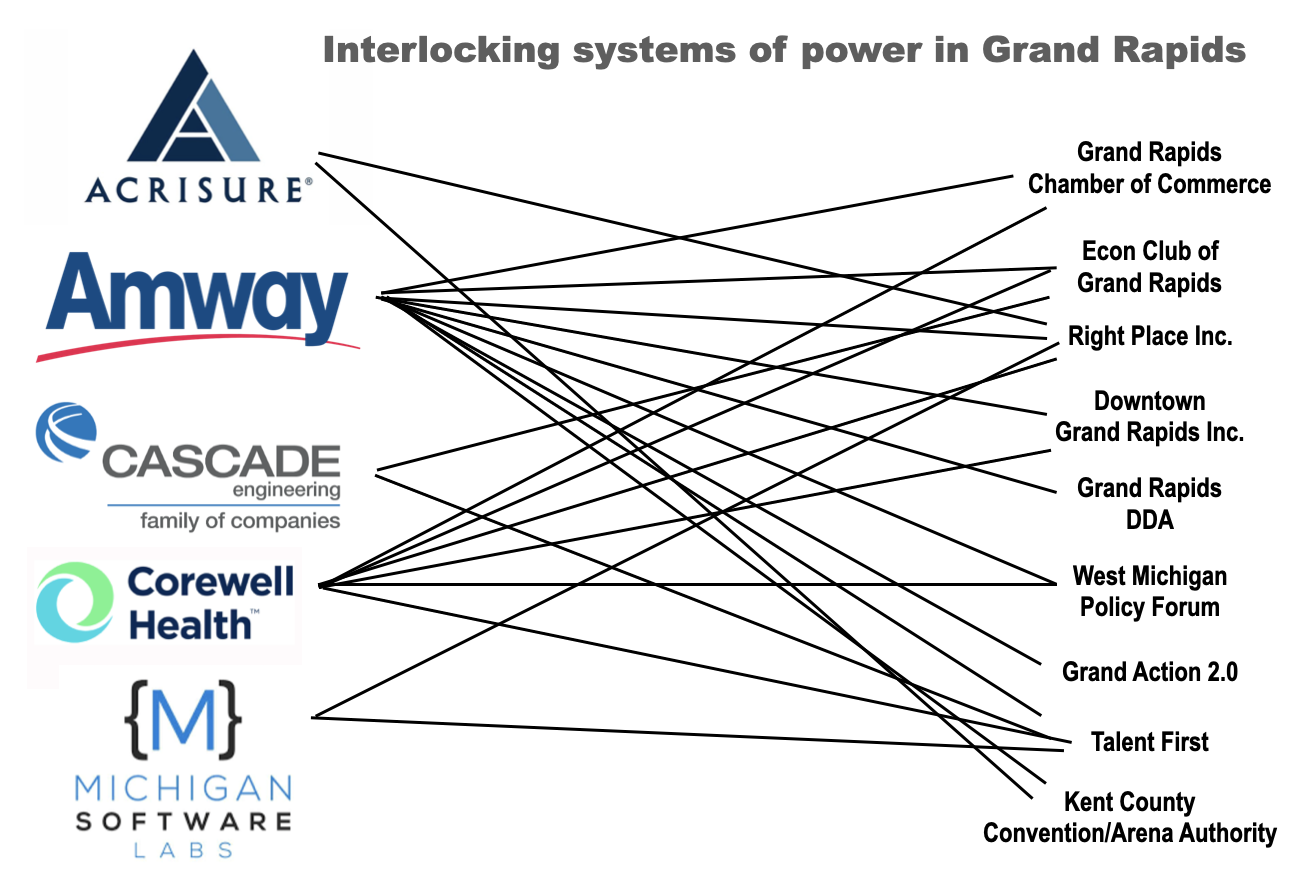
The five companies that are partnering with GVSU are, Acrisure, Amway, Cascade Engineering, Corewell Health and Michigan Software Labs. Now, these aren’t just random companies that will be partnering with GVSU, they are companies that are deeply tied to the Grand Rapids Power Structure, which is essentially an interlocking system of power, as is reflected in the graphic above. For the purposes of this post, we will attach the DeVos name to Amway, since the DeVos family is at the top of the Grand Rapids Power Structure and has dozens of subsidiaries that are represented in the groups that make up the local power structure.

