In her most recent “Straight Talk with Scholten”, the 3rd Congressional District Representative says she will not vote for another “penny for ICE funding until we have reforms.”
Before we get to the reforms that Rep. Scholten is calling for, she also said near the end of her weekly video – these reforms are already what the American public are asking for. Actually, what many Americans are calling for is to ABOLISH ICE. All across the country, especially since ICE murdered several people in Minneapolis, there is a growing call for ICE to be abolished, especially from immigrant-led groups like Mijente, United We Dream Network and Movimiento Cosecha, Other groups calling for the abolition of ICE are: ACLU, American Friends Service Committee, NAACP, Amnesty International, Detention Watch Network and CASA.
Here are the so-called reforms that Democrats are calling for:
- Requiring a judicial warrant to enter private property (as the Constitution’s Fourth Amendment already requires) – this sounds nice, but ICE tactics have been to wait til people they are after leave their house/apartment and then apprehend them and send them to a detention center.
- Verification of non-citizenship before detention and banning racial profiling and profiling based on job, language, and accent – again, this sounds nice, but immigrants from the global south have been racially profiled ever since the US passed the Chinese Exclusion Act in 1882. US immigration practices is rooted in racial profiling and simply verifying non-citizenship will not stop ICE from racial profiling.
- Prohibiting immigration enforcement officers from wearing masks and requiring them to wear ID and body-worn cameras – this is all about optics and does nothing to stop ICE from terrorizing immigrants. Making ICE have badges and not covering their faces makes white people feel better, but will do nothing to prevent ICE from arresting, detaining and deporting immigrants.
- Prohibiting arrests at hospitals, schools, daycares, churches, polling places, and courts – a nice sentiment, but why limit ICE from arresting immigrants at just these locations? Terrorizing immigrants at their homes, their workplaces or when they are out shopping and going to the pharmacy are equally cruel. Again, this demand is about optics and makes white people feel better about ICE .
- Allowing states to investigate potential crimes committed by DHS and to sue DHS over detention conditions, and requiring state coordination for large-scale operations – This isn’t a bad idea, but how will this be enforced? Also, we know that local police are cooperative with ICE all around the country, so will people/communities be able to sue local police departments for assisting ICE in their terrorizing of immigrants?
- Safeguards including immediate access to attorneys for detainees, allowing states to sue DHS for violations, and unlimited congressional access to ICE facilities – also not a bad idea, but why didn’t Democrats demand this during the Biden and Obama Administrations? Immigrant detainees were being mistreated and many of them died under those administrations as well.
- Prohibit tracking and databases of individuals engaged in activities protected by the First Amendment – Again, these activities have happened under Democratic Administrations, plus government surveillance of people in the US has been happening for a very long time regardless of who sits in the White House.
- Codification and enforcement of a use of force policy – Use of force policies by ICE and local law enforcement always protects the cops. This is why groups like Cosecha and GR Rapid Response to ICE use the phrase – ICE and Cops go hand in hand. The carceral state has always used the threat of force to manage populations, especially BIPOC populations, so simply codifying use of force policies will provide even greater legal protections for ICE and local cops.
What Rep. Scholten and the Democratic Party want is for ICE to operate the way it did during the Obama and Biden Administration’s, which was to arrest, detain and deport immigrants by the millions. The Democrats don’t have a problem with ICE, they simply don’t like how the Trump Administration uses ICE. Do you actually think for a second that undocumented immigrants and their families that have been terrorized by ICE since 2003 when that agency was created want to reform ICE or abolish ICE?
Consumers Energy gets permission for largest electric rate increase in decades! This was the headline for an MLive article from Saturday, March 28th.
I know that my electricity bill has increased by $40 a month in the last year and now the government regulatory entity, the Michigan Public Service Commission, has given Consumer’s Energy the green light to charge even more. Think of how these increases will impact families across the state, especially since we know that 41% of people in Michigan are living paycheck to paycheck.
The MLive article is primarily a justification for the increase in electric utility costs, with members of the Michigan Public Service Commission and Michigan politicians acting as apologists for the increase.
As of this writing there have been no comments made by Michigan Legislators regarding the electricity rate hike, besides the weak comments from Michigan Attorney General Dana Nessel.
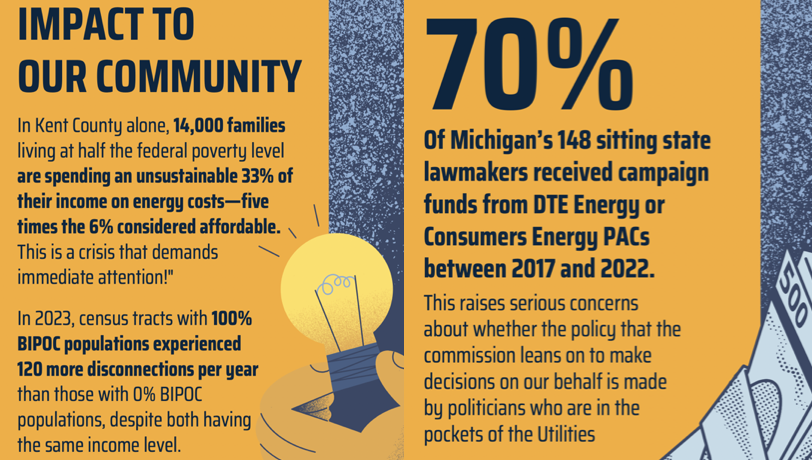
Of course Michigan politicians are not going to be critical of electricity rate hike from Consumer’s Energy, especially since 70% or them receive campaign funding from Consumer’s and DTE.
The other major flaw in the commercial news media coverage was how these kinds of utility rate hikes impact working class families, particularly BIPOC customers, as GRIID noted about a year ago in a post based on a Press Conference hosted by the Urban Core Collective.
“Besides the less than transparent regulatory process, there are also concerns surrounding reliability and disproportionate disconnection rates tied to race. Consumers Energy ranks among the lowest performers nationwide when it comes to reliability, but most alarming are the systematic disconnections disproportionately targeting BIPOC communities. In his rebuttal testimony to the Michigan Public Service Commission, Boratha Tan on behalf of the Ecology Center, The Environmental Law & Policy Center, The Union of Concerned Scientists and Vote Solar, found a direct correlation between the percentage of people of color living in a census-tract and disconnections by Consumers Energy, even when the area median income was the same. In 2023 “census tracts with a 100% BIPOC population would experience about 120 more residential disconnections compared to a 0% BIPOC population census tract with the same income level.” In other words (using Consumers Energy’s own data), disconnections happen more often in BIPOC communities than in non-BIPOC communities, even when both communities have the same income level.”
Another significant omission in the Consumer’s rate hike coverage has been the failure to look at the three members of the Michigan Public Service Commission. All three members are political or corporate insiders. According to the bio for Commissioner Dan Scripps, “he worked with state and national clean energy trade and philanthropic organizations and practiced law in the Washington D.C. office of a leading global law firm, where he advised regulated utilities, project developers, and financial institutions on cutting edge domestic and international energy projects.”
Commissioner Peretick previously served as Director of Engineering at NRStor Inc., an international energy storage project developer, and Commissioner Myers led former Speaker Joe Tate’s office as chief of staff.
People from all over the state might consider showing up to the next Michigan Public Service Commission meeting, which will be held on April 17th in Lansing. Details can be found here.
However, instead of simply voicing concerns how about if people show up to disrupt the meeting unless public demands are met. A good example would be when people attended Michigan Department of Natural Resources land auction in 2012, because that governmental body was planning on leasing mineral rights for oil & gas companies across the state. We need to start showing up to these meetings with pitchforks or whatever contemporary instruments would be appropriate today.
Last week Grand Rapids Mayor David LaGrand held his second State of the City address. Like last year it was also by invitation only.
LaGrand, like most politicians these days, only wanted people in the room that agree with him, along with not wanting to be challenged by community members who have a fundamentally different lived experience in this city. You can watch the State of the City address at this link, but what follows is my response to what LaGrand had to say.
First, it was important to note that the gathering was held in a church. Second, it is worth noting that like last year LaGrand solicited funds from the groups shown in the slide below, entities that have the most access to the Mayor of Grand Rapids. LaGrand made a comment about these sponsors claiming he didn’t want to host an event that put a “burden on taxpayers.”

Next, LaGrand took time to name and recognize other elected officials, since this is what politicians do by giving attention to people in positions of power.
Once the Mayor got past all of the obligatory recognitions he then put up a slide that quoted the global professional networking corporation LinkedIn stating Grand Rapids was the number one rising city in the US. It makes complete sense for LaGrand to celebrate what a global professional networking corporation has to say about Grand Rapids, since this only furthers the narrative about making Grand Rapids a destination city for those with class privilege.
However, what LaGrand said next is really what I want to talk about. The Mayor followed up the warm fuzzy declaration from LinkedIn about Grand Rapids by saying:
For a city to rise and to grow there has to be a foundation and that foundation is public safety.
LaGrand did acknowledge briefly the importance of the GR Fire Department, but he mostly talked about the GRPD, beginning at 12:48 into the video. Mayor LaGrand gleefully talks about the GRPD and says he has been on several ride-alongs and has seen how they treat people with “respect, empathy and concern.” Is the mayor so naive as to think that the GRPD officers he did ride alongs with would reveal their own prejudices or treat people with disrespect while the Mayor was present? Mayor LaGrand then invited everyone present to do a ride along with the GRPD.
LaGrand continued to praise the GRPD and to a rousing applause he said they are adding, “Community Police Officers who are going to be building relationships and community trust person by person.”
Mayor LaGrand didn’t completely gloss over the harm that the GRPD has done recently. At 14:42 into the video he says:
At the same time we know there is more work to do. This last year we have seen incidents that have sparked real concerns about our policing policies and have shown the limits of what our police force can do to intervene preventatively in crimes such as domestic violence. Those tragic cases underscore our need to continue hard conversations about how we can make our public safety programs maximize the safety of all of our residents equally and fairly and how we deliver safety for all of our residence.
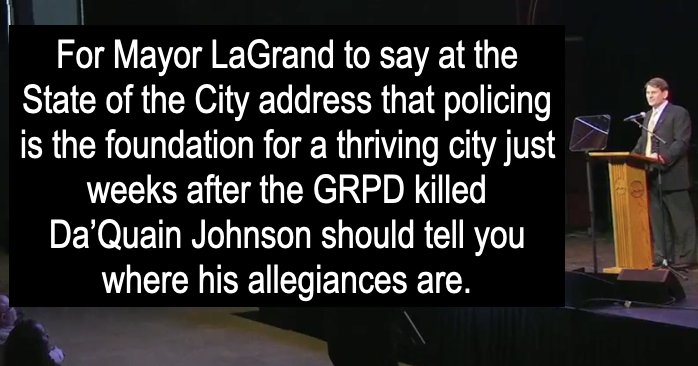
So, it would seem that Mayor LaGrand can’t bring himself to even acknowledge that the GRPD killed Da’Quain Johnson or that some in the community have been organizing around this to demand justice. Mayor LaGrand said nothing about the fact that over the past 15 months there has been an organized effort, with thousands of letters being sent, to get the City of Grand Rapids to adopt 6 sanctuary policies, which are fundamentally public safety policies for immigrants. Mayor LaGrand also said nothing about how the GRPD harasses, surveil’s and arrests people engaged in organizing against violence and structural racism in this city.
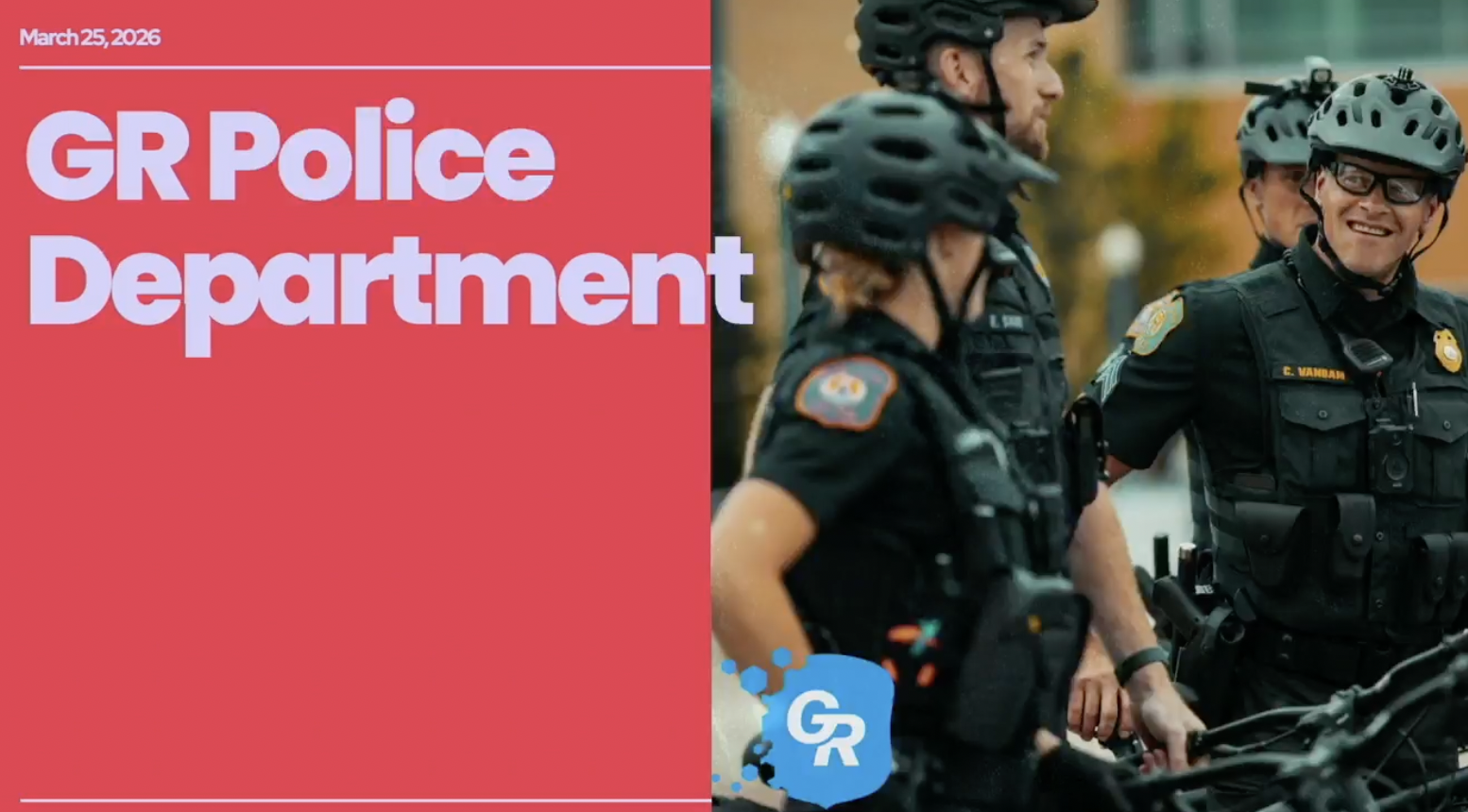
It is also worth noting that while the mayor was talking about the GRPD he used the above slide image. However, when he talk about “incidents that have sparked real concerns about our policing policies”, the Mayor used this slide below.
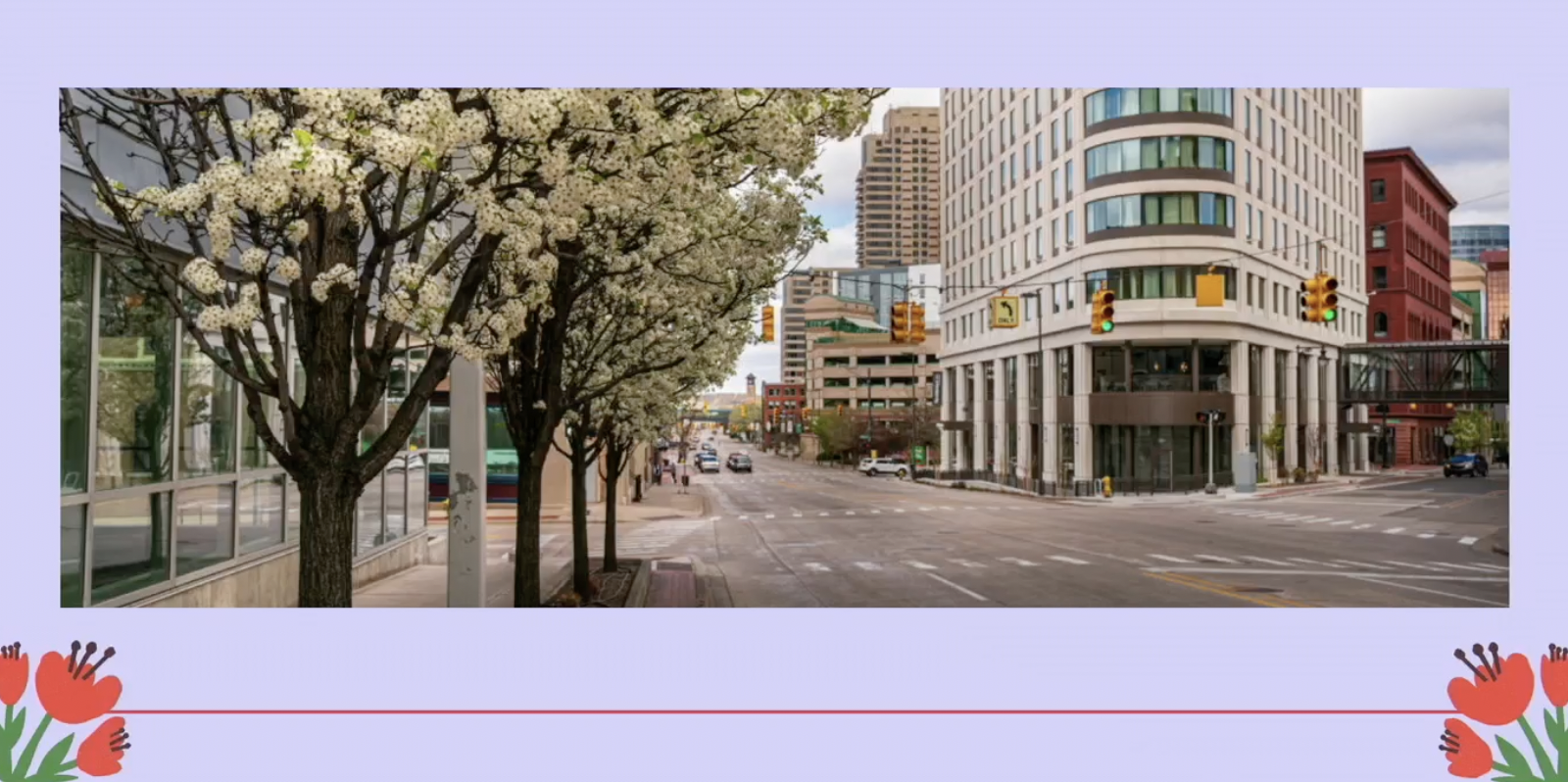
Using a slide with flowering trees and shiny office buildings is just another way for the Mayor and other city officials to sweep under the rug the realities of how the GRPD has been causing harm in this city. Do you think that the mother of Da’Quain Johnson thinks Grand Rapids is a city on the rise? How about the elderly couple whose home was trashed by the GRPD while looking for a suspect, or the young Black motorists who were stopped by the GRPD, with at least 6 other police cruisers arriving? Do these people think that Grand Rapids is a city on the rise?
If Mayor LaGrand had held his State of the City talk in a public venue and made it open to the general public, you can be damn well sure that people would have shown up to challenge his version of public safety in Grand Rapids.
An invitation to allies and accomplices to show up for the May 1st march in Grand Rapids organized by Movimiento Cosecha

In recent months all across the US we have seen a growing movement of people demanding that ICE be abolished! We have all seen the videos and we all know how brutal ICE is, which is exactly why the immigrant justice movement is calling for the abolition of ICE.
In Grand Rapids, the immigrant-led group Movimiento Cosecha is inviting people to join them in three days of protest, three days of striking and three days to demand dignity, respect and permanent protection for the millions of undocumented immigrants living in the US.
Movimiento Cosecha is inviting people to join their annual May Day march. In In 2018 and 2019, there were thousands of people who joined their marches and when those kinds of numbers show up it makes it safer for immigrants to participate. Unfortunately, last year’s May Day march saw about 150 people showing up to support immigrants.
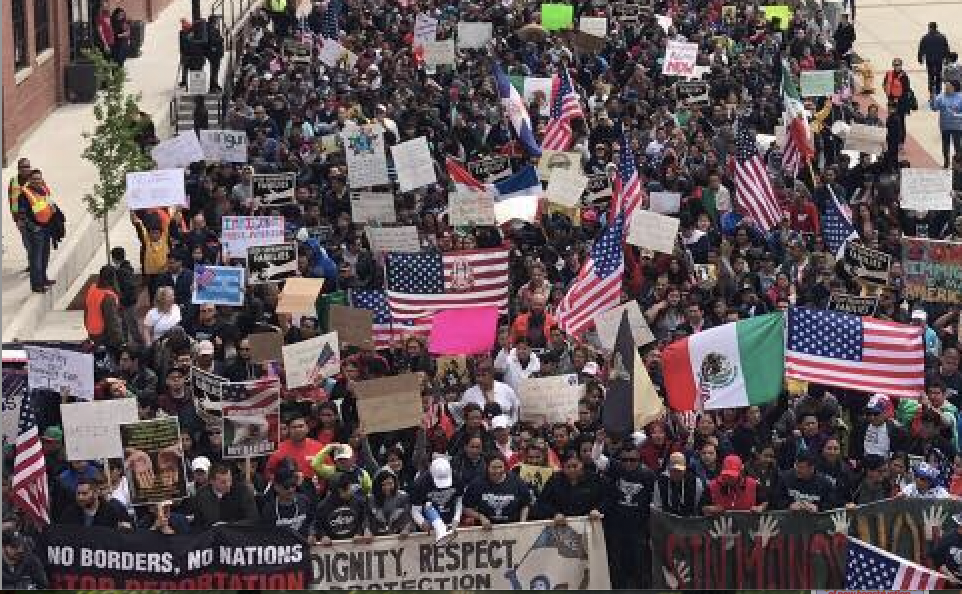
It is imperative that allies, especially white allies, show up on May 1st this year in large numbers to support the demands of the immigrant communities, Movimiento Cosecha and those being targeted by ICE.
We just saw thousands of people show up for the No Kings rally in Grand Rapids, so it would be fabulous if people showed up to the May Day march. It is vitally important that those of us who call ourselves allies show up now and not wait for Grand Rapids to become another Minneapolis. Immigrants in this community are being arrested, detained and deported and have been since 2003, when ICE was created.
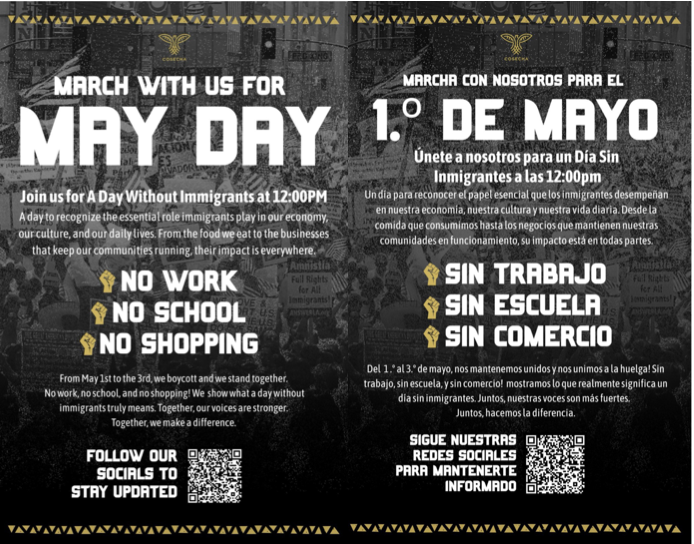
Let’s practice some real solidarity by showing up on May Day and march with Movimiento Cosecha. Let’s also remember this is a three day strike, so besides marching we are not going to work, not sending our kids to school and no spending money.
You can however show up to the May Day march with donations to support the work of Movimiento Cosecha and to contribute to the GR Rapid Response to ICE Mutual Aid work, which supports immigrant families who have been directly impacted by ICE. One hundred perfect of the funds that GR Rapid Response to ICE raises goes directly to immigrants who have experienced family separation at the hands of ICE.

Also, if you are not already involved in the work of Cosecha and GR Rapid Response to ICE, here is a list of things you can do right now to practice immigrant justice and resist ICE:
- You can follow the work of Movimiento Cosecha https://www.facebook.com/cosechagr and GR Rapid Response to ICE https://www.facebook.com/RapidResponseGR/
- You can share our What to do if ICE comes to your door cards.
- If you suspect that you are seeing an ICE presence somewhere, call our hotline 616-238-0081 and document what you can. Use the Salute card, but don’t post on social media as it can create more fear and panic for immigrant communities.
- If you know an immigrant that has an appointment to check in with ICE or immigration court cases you can have them call the hotline 616-238-0081 and have them request someone to accompany them to their appointments.
- You can support immigrant families that have been affected by ICE violence in Kent County by sharing and contributing funds through the Mutual Aid requests on the GR Rapid Response to ICE Facebook page https://www.facebook.com/RapidResponseGR/
- You can organize a fundraising event like a house party or get 10 of your friends to contribute to a specific Mutual Aid request that can be found on the GR Rapid Response to ICE Facebook page https://www.facebook.com/RapidResponseGR/
- If you know of immigrant community groups that are living in fear of ICE, Cosecha will offer to do a Know Your Rights training, which provides tips on how to keep yourself, your family and your community safe from ICE. Send an Email to movimientocosechagr@gmail.com.
- You can begin a conversation with leaders in your faith community and local non-profits about offering sanctuary to members of the affected community. If there is an interest members of Cosecha and GR Rapid Response to ICE can meet with you or you can attend one of our regular Community Sanctuary sessions.
- You can sign up to take the GR Rapid Response to ICE training to learn skills and be part of our daily work.
- You can encourage your church to host a GR Rapid Response to ICE training. If there is an interest they can send an Email to info@grrapidresponsetoice.org.
- You can host an educational session on the History of US Immigration Policy. Just send an Email to info@grrapidresponsetoice.org.
- You can support the 6 sanctuary policies campaign that Cosecha and GR Rapids Response to ICE are trying to get the City of Grand Rapids and Kent County to adopt.
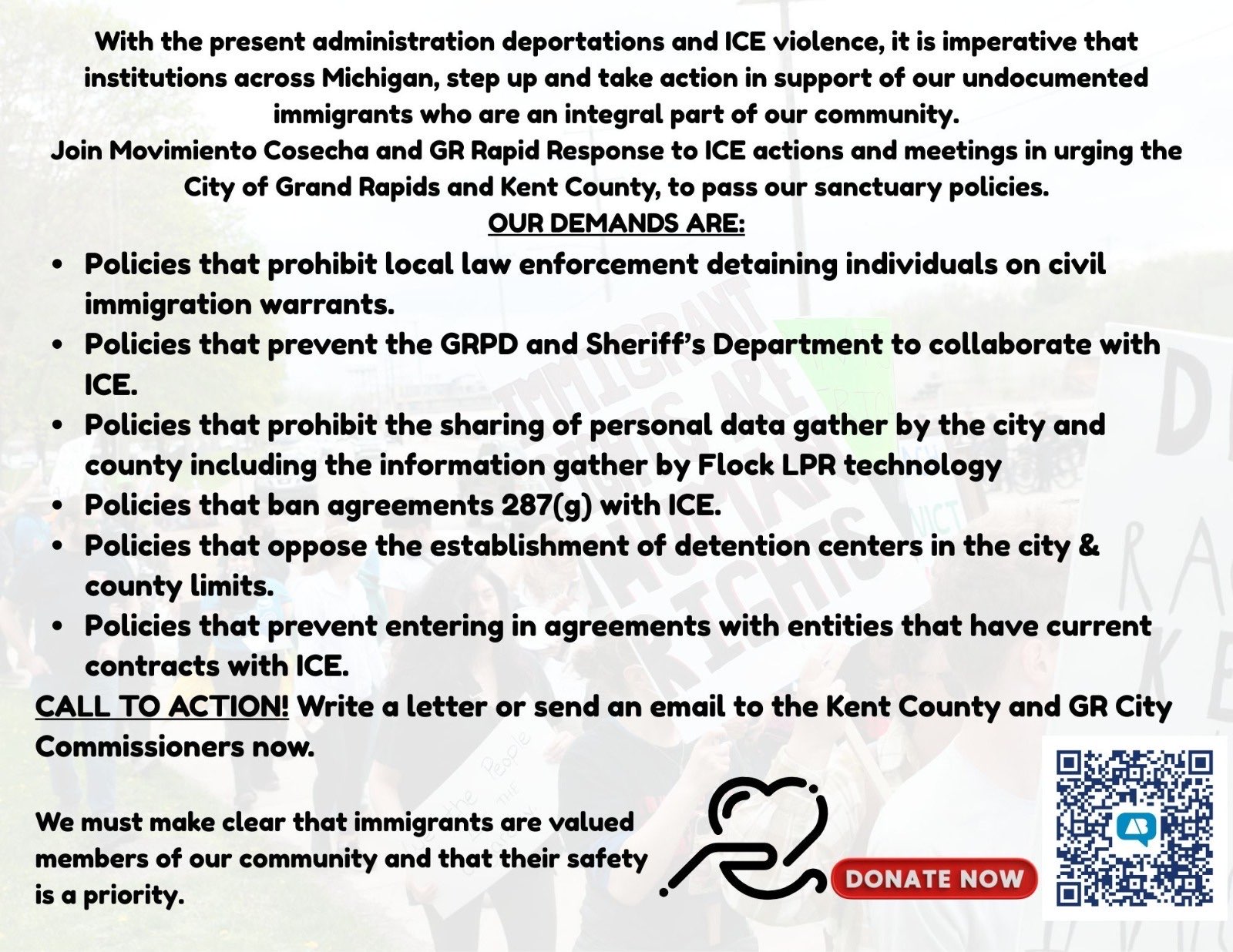
Some things to think about before you attend a No Kings rally this Saturday in Grand Rapids
It is likely that several thousand people will gather this weekend in Grand Rapids for the various No Kings events that are planned downtown.
I have been critical of these large gatherings over the past year, such as my post that was written after 6 months of the current Trump Administration around the issue of resistance.

Last October, after the last No Kings rally, I also made several points about what was said prior to the rally and then some thoughts about how it could have been more impactful.
If you attend the No Kings events in Grand Rapids this Saturday you should think of this as an opportunity to invite people to join in on the actual resistance work being done in the community. This weekend could also be an opportunity to influence people or to radicalize them in the same way that many have been radicalized at previous events.
Many of us remember the moment when we first encountered radical politics. Maybe yours was the alter-globalization movement, Occupy, the George Floyd Uprising, or the Student Intifada. Some participants at No Kings are not going to be open to hearing radical critiques of capitalism and the state, but make it your mission to find the ones who are ready to join the struggle, who just need a framework and an idea of where to begin. Talk to them about their views and how those might fit within a larger global history of resistance. It’s not about convincing them, but sharing tools to give a name to their longing for liberation.
There is a good article from Crimethinc with the headline – No Kings, No Masters: Building the Resistance: A Call to Mobilize at the March 28 No Kings Rallies. This article is filled with excellent examples and ideas of how these kinds of rallies can provide people with opportunities to expand resistance work and reduce the chances of people showing up for photo ops or simply performative actions.
What’s Different Now?
Before I discuss a bit about how we can see No Kings as an opportunity to expand movement work that is not limited to just opposing the Trump Administration, I want to say something about what is different now compared to where we were last October.
The Trump Administration kidnapped the President of Venezuela and his family and has been holding them in prison in the US without formal charges. The Trump Administration began bombing Iran recently and continues to assault the sovereign nation of Iran killing thousands and displacing many more. The Trump Administration has also continued to support the Israeli genocide in Gaza, which now includes Israeli attacks on Lebanon. This administration has ramped up the economic blockade against Cuba, with threats to invade the small island nation, along with future possible military interventions throughout Latin America.
On the domestic front people are finally waking up to what undocumented immigrants have been experiencing since ICE was founded in 2003. People saw what happened in Minneapolis, both the brutality of ICE, but also the powerful organized resistance to ICE.
People have seen how Capitalism brutalizes families and communities, often with government collaboration.
People are also seeing how institutionalized racism in housing, employment and the carceral system brutalizes BIPOC individuals and communities. The billionaire class keeps growing while more and more people are living paycheck to paycheck. The Climate crisis continues unabated, wreaking havoc on humans and other species alike. Lastly, it is painfully clear that we do not have an opposition political party in this country, we have the Democrats and they have either been complicit in what the Trump Administration has been doing or they have only been able to offer mild, reformist rhetoric and policies that doesn’t excite the masses.

Things to think about when you show up to the No Kings rally
- Listen to the people who are speaking, especially BIPOC, queer and immigrant speakers.
- Visit the tables and get information from the groups that are actually resisting the shit that is going on in Grand Rapids, in Michigan, across the US and around the world.
- Come with a commitment to provide funds for the groups that are doing Mutual Aid work and supporting grassroots organizers. GR Rapid Response to ICE raises money for families affected by ICE violence and they are seeing an increase in Mutual Aid requests.
- Get involved in pressuring the Grand Rapids City Commission around the demands being presented by the mother of Da’Quain Johnson, the Black man who was murdered by the GRPD. White allies need to step up and leverage their privilege for this family.
- Support the campaign led by Movimiento Cosecha and GR Rapid Response to ICE to get the City of Grand Rapids and Kent County to adopt the 6 sanctuary policies that have been demanding for over a year.
- Get involved with local queer and trans solidarity work, since state and federal policies are threatening their lives.
- Join the numerous local campaigns to prevent data centers from being built in West Michigan.
- Organize and engage in Direct Action against US Imperialism and militarism in Iran, in Gaza, Venezuela, Cuba just to name a few. Occupy the offices of members of Congress in West Michigan, disrupt the manufacturing of weapons and weapons systems at companies in West Michigan.
- Don’t put your faith in political parties or politicians if you really want to change things. We must resist business as usual and organize in such a way as to radically change our communities that always tolerate – no matter if it is Republicans or Democrats – white supremacy, homophobia and transphobia, ICE terrorism, ecological destruction, the climate crisis, housing injustice, the health care system, capitalism and the massive US Military spending that always takes priority over human needs.
Don’t settle for photo ops or performative actions. Allow yourself to be inspired and radicalized. Join a movement(s) that are led by BIPOC people and then don’t just protest, but resist what systems of power do in this community. We all need to radically imagine a better world!
Monitoring the Rich and Powerful in Grand Rapids – Segment #10: Riverfront development and hosting far right speakers
One of the 10 principles of journalism is that it must serve as an independent monitor of power.
Now, I don’t claim to be a journalist, more of a media watchdog, but I do engage in movement media. Movement media is reporting and documenting what social movements are doing, which is what I have been trying to do with GRIID since 2009.
However, since I have been monitoring what I call the Grand Rapids Power Structure for nearly two decades, it seems like a good idea to do a Monitoring the Rich and Powerful in Grand Rapids segment.
There are three issues in this segment of Monitoring the Rich and Powerful in Grand Rapids that I want to draw attention to.
First, is the issue of the Grand River Revitalization project, which just received $11 million from the U.S. Department of Agriculture, as was mentioned in a recent Crain’s Grand Rapids Business article. The only people cited in this article are Mayor LaGrand, Rep. Hillary Scholten and Matt Chapman, executive director of Grand Rapids Whitewater.
Grand Rapids Whitewater has been leading the charge on this issue, so it is important to know who these people are. The people involved in the project are mostly connected to or are part of the business community, which makes sense since this primary function of the Grand River Revitalization project is about development along the Grand River and ways to financially capitalize on the new businesses, along with attracting tourists. Plus, their financial backers are primarily made up of those in the Grand Rapids Power Structure.
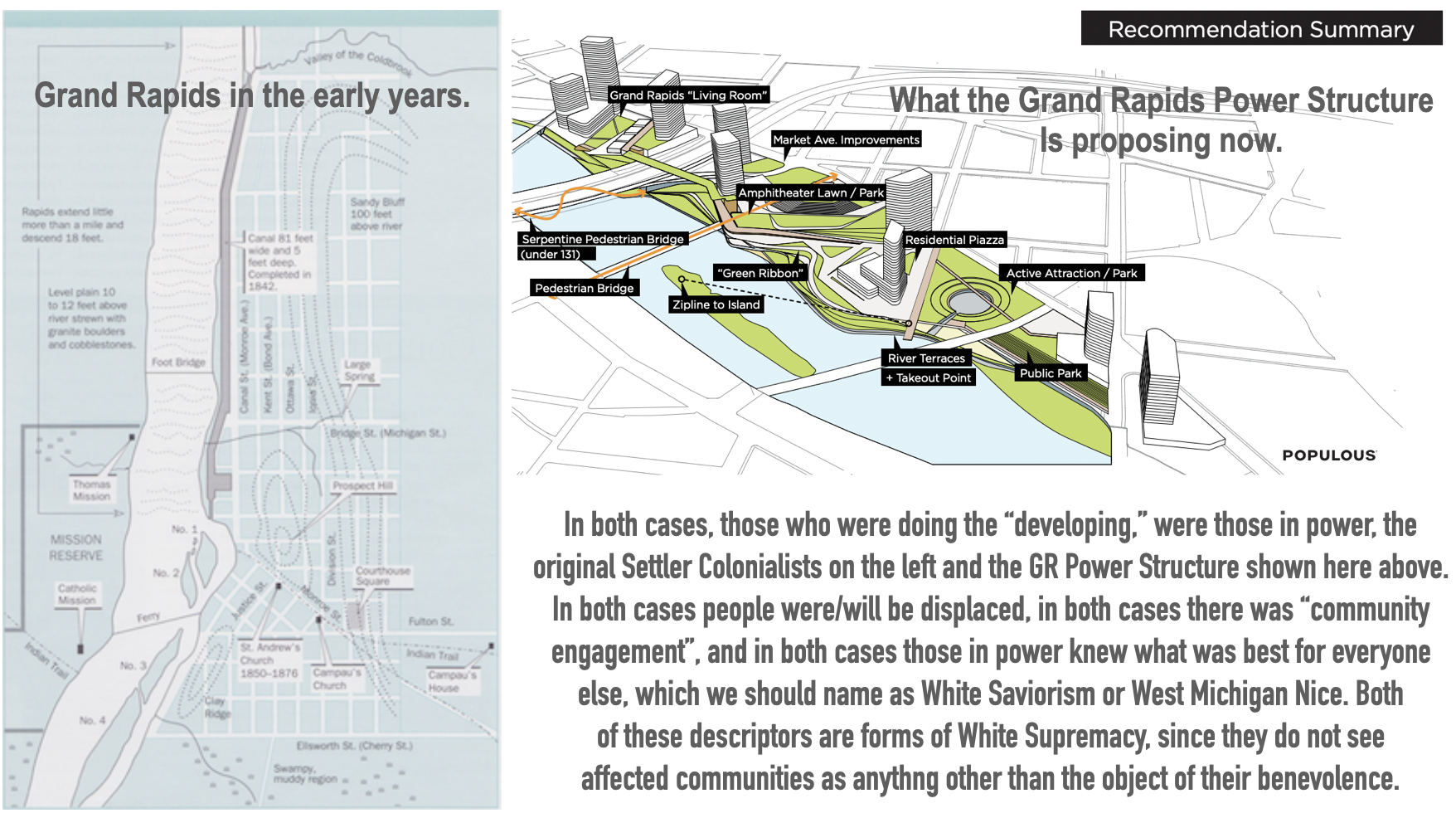
Then there is the connection to Grand Action 2.0, which produced a study back in 2021. The study also centers the development aspect along the Grand River. With this most recent study, we could discuss what is fundamentally wrong with the process and how it will disproportionately benefit the business class. However, instead to going down that path, I think what we all need to come to terms with is that the land that they are talking about developing along the Grand River, was taken from the Indigenous communities who had been living along the river long before Settler Colonialists arrived.
Maybe we need to start talking about how White Europeans who came to the area we now call Grand Rapids and how they: 1) disrespected Indigenous spiritual traditions by trying to convert them – the earliest Settler Colonialist were Catholic and Baptist Missions; 2) used legalized violence, also known as treaties to take land, such as the Treaty of Washington in 1836, which allowed Settler Colonialists to acquire an additional 13,837,207 acres of land; and 3) to displace most of the Indigenous population through force, coercion and attrition.
In addition to taking this land, Settler Colonialists have been doing serious harm to the Grand River in this area over the past 2 centuries, by polluting the river with industrial waste, constructing damns, using the river for logging purposes during the heyday of the furniture industry and constructing a highway system that crisscrosses over the river. Now, Settler Colonialists want to re-develop the area along the river, despite the decades of harm we have done.
A second example to look at is that the West Michigan Policy Forum will be hosting a representative from the American Legislative Exchange Council (ALEC) in May as part of their Freedom Series Luncheon. Jonathan Williams is President and Chief Economist of ALEC and used to work for the Tax Foundation, another pro-capitalism entity that also works closely with ALEC and the State Policy Network.
ALEC is a corporate bill mill. It is not just a lobby or a front group; it is much more powerful than that. Through ALEC, corporations hand state legislators their wishlists to benefit their bottom line. Corporations fund almost all of ALEC’s operations. They pay for a seat on ALEC task forces where corporate lobbyists and special interest reps vote with elected officials to approve “model” bills. Learn more at the Center for Media and Democracy’s ALECexposed.org.

The third and final example is a video that is posted on the Facebook page of GR& Riverfront, which is a page created by the following entities: City of Grand Rapids, Experience Grand Rapids, Grand Action 2.0, Grand Rapids-Kent County Convention/Arena Authority (CAA), Grand Rapids Public Museum, Grand Rapids WhiteWater, Kent County, Pioneer, Progressive Companies, RDV Corp. and Rockford Construction. GR& Riverfront posted another awful video, with bad lyrics that names the soccer stadium and the Amphitheater.
West Michigan Billionaire Doug Meijer is now selling really expensive balls, golf balls to be exact

In a recent Crain’s Grand Rapids Business article it states:
Doug Meijer is joining actor Mark Wahlberg and a host of others launching The Underground, a society of sorts in which golf-obsessed members get access to branded swag and several dozen new precision golf balls, designed to be a step or two above the already expensive offerings on the market from mainstream brands like Titleist and Callaway.
It costs $2,800 for a year’s worth of high-end golf balls, gear and bragging rights.
So, Doug Meijer, who is worth $6.5 billion (along with his two brothers are worth $16.5 billion) is partnering with other rich people to sell golf balls that will cost more than what millions of people make every payday. This is about as arrogant and ridiculous it is when corporations host golf tournaments and build in a chance for people to donate food items. Oh wait, this is exactly what the Meijer Corporation does.
 Meijer and his partners decided to build an invitation-only “golf society” around it, one that signals membership in an exclusive club that exists quietly beneath the surface of the mainstream game, according to a Forbes article.
If you go to The Underground site it uses phrases like:
- An ultra-premium design for those who refuse to compromise.
- Membership is the ultimate statement.
- Created for the inner circle.
None of this should be surprising, since this is how members of the Capitalist Class think, which oozes of arrogance and contempt for working class people.
I leave you with some biting commentary by George Carlin to how golf is primarily played by elitists.
Last month I wrote a piece about how the Grand Rapids Chamber of Commerce has publicly endorsed Data Centers. I cited a recent report from Data Center Watch there has been $64 billion of data center projects that have been blocked because communities have become organized.
Two weeks ago I wrote a piece about the GR Chamber of Commerce annual Policy Conference, where they hosted a panel of pro-data center apologists. Last week I wrote about how Doug DeVos thinks that AI and Data Centers would be ok, as long as Christians were in charge of them.

In the past few days Crain’s Grand Rapids Business has posted three stories on data centers that are working looking at. The first article is entitled, Michigan’s data center boom offers a lifeline to construction companies post-EV bust. The article is essentially presenting the idea that since the EV projects across the state did not work out for the construction industry, data centers might provide them with construction contracts. The article make this point by talking about data center construction opportunities:
Outlays for general office projects have headed downward, while construction spending for data centers has climbed steadily, U.S. Census data shows. The two crossed paths in December, with roughly $3.57 billion spent on data centers that month, compared with $3.49 billion for offices, according to preliminary estimates.
The article also tells us that Consumers Energy ( a major beneficiary of data centers) commissioned the Anderson Economic Group to craft a study about the economic impact of data center construction. This is always the argument that development projects will “benefit the economy” when in fact the disproportionate beneficiaries are developers and other members of the Capitalist class.
A second article about data centers was posted on March 23rd, with the headline, Construction leaders counter claims that data center jobs are only short-term. This article also touts the economic impact of data centers, using the Anderson Economic Group study once again, but also including support from the West Michigan Plumbers, Fitters and Service Trades Local Union No. 174.
This Crain’s article also cited the senior director of government affairs and infrastructure at Microsoft, said during a March 6 conference in Grand Rapids. This was the same conference that had nothing but pro-data center panelists. In addition, the article cites the president of the Fisen Corporation, which also attributes their recent growth to data centers.
The third and final Crain’s article that focused on data centers is entitled, AI’s expanding footprint comes with a big thirst for water. The headline suggests that there should be public concern, but the article primarily relies on businesses that benefit from data centers, a few government spokespersons and several environmental organizations.
The article also includes lots of data and several graphics on data centers and water use, but there are two important things that are omitted from this article. First, while the article acknowledges that the more recent proposed data center projects will be much larger that other existing ones on Michigan, there is no real conversation or analysis about land use. For instance, Microsoft purchased 340 acres in Gaines Township for a proposed data center, 272 acres in nearby Dorr Township and is pursuing a 237-acre property in Lowell Township. Those three combined would mean that Microsoft will own and control 849 acres in Kent County, all land that is either currently unused or farmland.
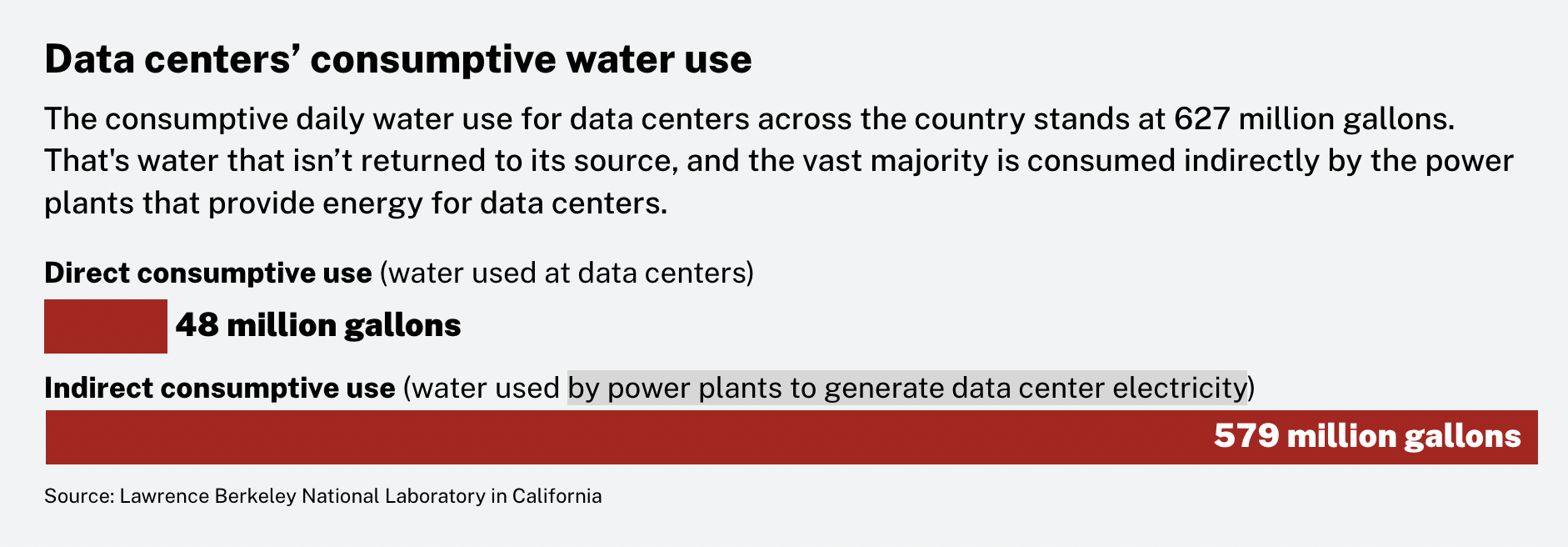
There was one useful graphic included (above) in the Crain’s article, which compared how much water data centers use with how much water is used by power plants to generate data center electricity. This is essential public information, which speaks not only to the concerns about the electric grid in Michigan, but how it will further impact the cost of electricity for residents in Michigan.
Lastly, it is important to note that the readership of Crain’s Grand Rapids Business is primarily members of the business sector, most of which support data centers. The other commercial news media sources in West MI are not dedicating enough coverage to this issue, beyond the drama of public meetings. We need lots more public conversation and public awareness around data centers and not leave decisions in the hands of corporations and politicians.
Grand Rapids is moving towards a mediaopoly with WOODTV8’s parent company purchase of WZZM 13
The consolidation of media in the US has been a major issue since the 1980s, when Ben Bagdikian first wrote his book, The New Media Monopoly.
Since the early 1980s there are fewer and fewer media companies, which own more and more of of the entertainment and news media. Part of this is has been due to Congressional policies that have also deregulated the media industry, like the Telecom Act of 1996 that was signed into law under President Clinton. The Telecom Act essentially created radio monopolies that gave rise to the likes of Rush Limbaugh and other right wing shock jocks.

Another dynamic with the consolidation of media ownership has been with non-media corporations buying news outlets, along with members of the billionaire class like Jeff Bezos. Check out this source on media ownership consolidation and how few companies control most of the media, specifically the news media.
WOODTV8/Nexstar Buys WZZM 13
According to a recent Crain’s Grand Rapids Business article from March 20th:
The Federal Communications Commission (FCC) has granted approval for Nexstar Media Group Inc. to complete its $3.5 billion acquisition of TV station operator Tegna Inc., waiving an anti-consolidation rule that would’ve prevented the combination.
The parent company of WOODTV8 is Nextstar and before the purchase of WZZM 13, their Grand Rapids TV market was 43rd in the country. The purchase of channel 13 will likely propel their control of the GR TV market into the top 25 for Nexstar.
Certainly one of the consequences of the consolidation of media ownership will mean less diversity of how news is reported and what sources are used. There will also likely be a downsizing of staff at WZZM 13, which is often the consequence of media consolidation as well. In addition, since Nexstar owns a fair amount of TV news stations across the country it will allow them to share content from other markets, thus making more of the news look and sound homogenous.
Now, this is not to say that the Grand Rapids commercial TV market was great before the buyout. I have been methodically monitoring local news for the past 30 years and have written dozens of reports on topics such as local media coverage of elections, public safety, public education, war coverage, race and gender representation. My last two reports from 2024 (a 12 month study) and 2025 (a 6 month study) both show that there isn’t much difference between the three Grand Rapids commercial TV stations in terms of content and narrative.
One example from my 2024 report is:
Local TV news coverage of local elections was so bad that all of the 21 Kent County Commission races were not covered, nor were candidates for judicial races, the Sheriff, Prosecutor, Clerk, Treasurer, and Drain Commissioner. Local TV news never reported on campaign finances for all local election candidates.
Another example from my 2025 report is:
Despite the fact that the first half of 2025 was one of the hottest on record, in the 9 local news stories that deal with extreme heat and extreme weather, only once were the words “Climate Change” used.
I understand that people will point to Nexstar’s conservative politics, which certainly plays a role in their news output. However, most of the news monitoring I have done over the past few decades has shown that all local TV news favors systems of power, rarely questions dominant narratives and does more to entertain and pacify people than empower them.
From my 2024 study, I also did a comparative study between local news coverage of local elections and contrasted that to the amount of stories on the annual event known as ArtPrize. I looked at the coverage from MLive, WOODTV8, WZZM13, and WXMI 17 between September 8 and September 29. During that 3-week period, I found the following. There were a total of nine stories done about local elections (by local elections, I mean elections happening for seats within Kent County). This graphic below shows the disparity in election coverage compared to stories about ArtPrize.
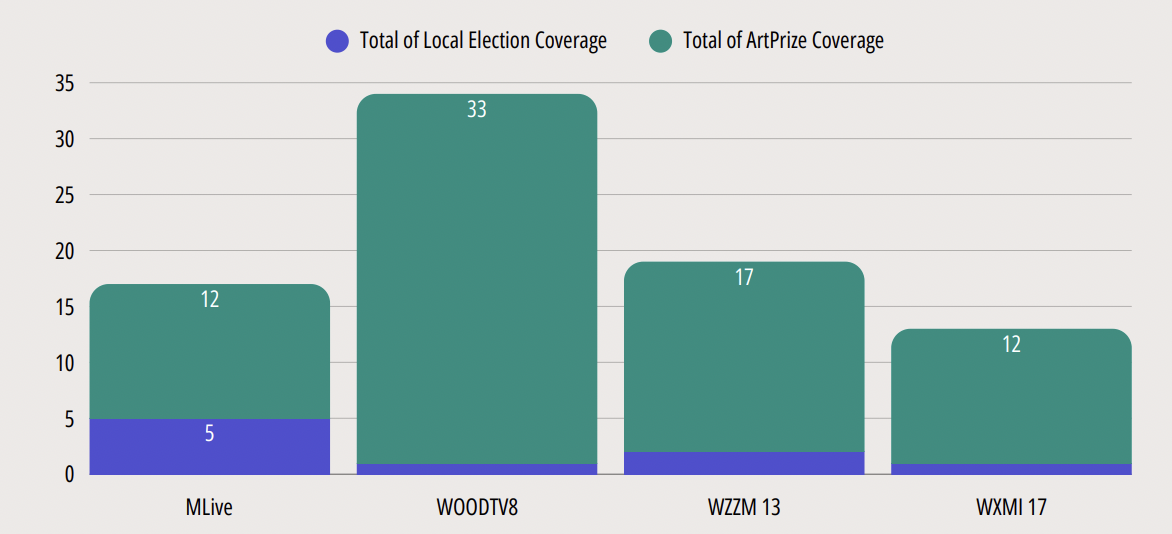
Therefore, it is unlikely that a major shift in local TV coverage with WOODTV8 and WZZM 13 will differ, it’s just that they will now share more resources and consolidate staffing in order to capture more of the market in West Michigan.
Here is a wonderful animated piece created for Saturday Night Live in the 1990s, which lays out the ways in which media consolidation is bad for the public.
Recent comments from Rep. Scholten further demonstrates her hypocrisy when it comes to war and militarism
 Over the past few days Rep. Hillary Scholten has shared her thoughts and opinions on her Facebook page about the US/Israeli war on Iran and how it relates to US domestic realities.
The most recent post includes a meme – here on the right – which included this commentary:
You’re making tough financial choices every day trying to afford groceries, rent, and gas. You shouldn’t be asked to fund another endless war while doing it. We need to get our priorities straight.
I fully agree with these sentiments. However, how in the hell does Rep. Scholten have the audacity to make such a statement without even acknowledging the fact that she supported the same thing when Biden was president?
Rep. Hillary Scholten has voted for the massive US military budget every year she has been in Congress starting in 2023.
Rep. Hillary Scholten has voted to provide $3.8 billion in US military aid to Israel each year she has been a member of Congress and she voted in 2024 to provide an additional $15.3 billion is additional US military aid to Israel.
Not once did Rep. Scholten post a meme condemning the Biden Administration for funding war, militarism and genocide, while Americans are struggling to make ends meet. According to the National Priorities Project $2.1 billion in tax dollars la year eaves the 3rd Congressional District, Rep. Scholten’s district, to fund US militarism abroad.
In another recent post on her Facebook page, Rep. Scholten once again engages in Hypocritical commentary. Here Rep. Scholten is talking about the US bombing of the Iranian school that resulted in killing at least Iranian school girls. Rep. Scholten refers to this bombing as unconscionable, which she says twice. Again, I agree with this sentiment, but all throughout the time that Rep. Scholten has unconditionally supported Israel”s genocide not once has she condemned the Israeli military killing of Palestinian children or referred to those deaths as unconscionable. On the 2nd anniversary of the Israeli genocide at least 20,000 Palestinian children were killed by the Israeli military.

The hypocrisy of Rep. Scholten is so evident in her recent posts. When the Trump Administration commits war crimes it is unconscionable. However, when the Biden Administration was doing it supplying weapons to Israel, it was always about “defending our ally in the Middle East.” Only people with partisan blinders are dumb enough to not see this double standard from Rep. Scholten.
Infographic above is from https://visualizingpalestine.org/visual/177-school-buses/.
 Grand Rapids Institute for Information Democracy