At last night’s Grand Rapids School Board meeting, there were several social movement groups that addressed issues specific to their struggles.
Before there was public comment, members of the Grand Rapids Student Advancement Foundation (GRSAF) spoke briefly, just to provide an update on how much money they have raised for the GRPS in 2019. They stated that over $900,000 was raised this year, but unfortunately there was no clear indication of where that money was coming from, even though we know that in recent years a large chunk of what is raised by the GRSAF has come from members of the DeVos family and other members of the Grand Rapids Power Structure.
Gema Lowe, an organizer with Movimiento Cosecha GR and also a parent of a child in the Grand Rapids Public Schools, addressed the issue of Driver’s Licenses for All. State legislators have recently introduced legislation to allow members of the undocumented community to obtain a driver’s license. Gema spoke to how important it is for the GRPS board to adopt such a resolution and that it would be a big help in encouraging other school boards to adopt similar resolutions across the state.
Some of the GRPS School Board members did respond to the Driver’s License issue, all in support of the campaign that has been led by Movimiento Cosecha. After additional conversation, the board voted unanimously to approve a resolution to support a Driver’s Licenses for All policy in Michigan, as is being proposed by recent state legislation.
The other group that addressed the GRPS boards members were those with the recently formed movement known as Grand Rapids for Education Justice (GREJ). One member of the group made it clear that members of GREJ, who brought their initial concerns before the board on October 7, has not heard back from the GRPS School Board, despite requesting a formal response within 30 days. This did not happen, despite the fact that members of the GREJ believe that their issues are urgent and were presented in a clear and diplomatic fashion.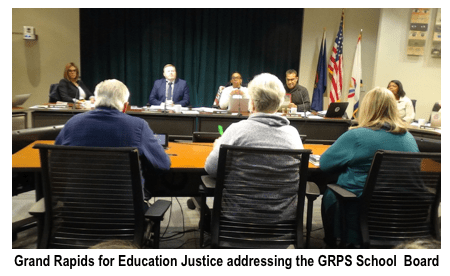
Another member of GREJ spoke to the fact that despite their non-combative approach, when the news media spoke with GRPS director of communications, John Helmholt, he was dismissive of the group and said that their data was inaccurate and out of context. However, as GREJ pointed out, their data was based on Michigan’s Center for Educational Performance and Information website, as well as data provided from FOIA’d documents directly from the Grand Rapids Public Schools.
Other members of the GREJ highlighted the two-tiered system that the GRPS currently operates under, where students of color and students from low income families were not afforded the same opportunities, resources and commitment that students at City High or a few other theme schools have. One aspect of the two-tiered system, there is an issue of student safety, particularly at schools that are part of the lower tiered schools.
In addition, based on the comments from people who came to a recent GREJ community meeting, there were people from the Latino and Native American communities that raised issues around their efforts to get culturally relevant curriculum implemented in the GRPS, considering there are a substantial amount of Latino students and the fact that Native students have a right to this type of curriculum based on Title VI policies.
Another member of GREJ provided a response to the issue of what plan the group has or what solutions they would offer to deal with the two-tiered system. Some of those solutions were to:
- Develop a committee that would include school staff, board members, teachers, students, parents and community members to look into how the current two-tiered system works and how to address it.
- Make all curriculum and other educational resources currently used available for all to see, preferably online, so that greater transparency could be practiced.
- The district should provide up to date data on incidents of violence and bullying at the schools, so that students, parents and community members have a better understanding on issues of safety at the schools.
- Class size should be reduced and be worked out with teacher input.
One retired teacher with the GRPS and a member of the GREJ addressed the lack of response from the GRPS School Board. He also addressed the way that the school responded in the news media on the issues raised by GREJ on October 7, which was nothing short of combative. Because of the lack of response, the GREJ is going to continue to submit FOIA requests for issues like where the funding from the Students Advancement is coming from, copies of the curriculum being used in the new academies, which businesses/corporations are part of the established advisory council that exists in the GRPS, along with many other requests that will be brought forth in the near future.
Billionaire Dick DeVos complains that more public money isn’t funding his charter school
 When you are a billionaire in this society, 99% of the time you get what you want. This has been the case for the DeVos family members, like Dick DeVos.
Last week, MLive provided a platform for Dick DeVos to have a public temper tantrum, since the he finds it unacceptable that more public money isn’t channeled to him and his friends and their precious charter schools.
The headline of the MLive article read, Dick DeVos calls governor’s veto of charter school funding increase ‘unacceptable’.
Dick DeVos, who owns and operates the West Michigan Aviation Academy, crafted a press release calling Governor Whitmer’s decision to not include increased funding for Charter Schools in the education budget. DeVos was quoted in the MLive article are saying, “Our students deserve better and should not be used as political pawns.” Such a statement would have any honest reporter burst out in laughter, considering how Dick & Betsy DeVos have devoted the past three decades in Michigan into making students political pawns for their own gains.
Dick DeVos, Betsy DeVos and the rest of the DeVos family members have been working on changing education policy in the state of Michigan for nearly 30 years. Here are just some of the ways they have been undermining public education in Michigan:
- According to the Michigan Campaign Finance Network, the DeVos family has contributed $25 million in the past two election cycles alone, and most of those candidates have supported charter schools and the re-directing of public money to charter schools.
- Dick & Betsy DeVos led a ballot effort that would allow for school vouchers in 2000. That effort lost on a vote of 2,767, 320 (NO) to 1,235,533 (YES), meaning the public voted more than 2 to 1 to reject such a plan.
- Dick & Betsy DeVos created the Great Lakes Education Project (GLEP) shortly after the defeat of the 2000 Pro-School Voucher ballot initiative. GLEP is essentially a pro-charter school front group that lobbies the Michigan legislature on education policy and has been crafting education policy for nearly 2 decades, policy that promotes a Neo-Liberal Education framework.
- Great Lakes Education Project also supported a 2011 law that lifted Michigan’s cap on charter schools. Under the law, the number of authorized charter schools was raised to 300 through 2012 and 500 through 2014, after which the cap was lifted.
- Despite two decades of charter-school growth, the state’s overall academic progress has failed to keep pace with other states: Michigan ranks near the bottom for fourth- and eighth-grade math and fourth-grade reading on a nationally representative test, nicknamed the “Nation’s Report Card.” Notably, the state’s charter schools scored worse on that test than their traditional public-school counterparts, according to an analysis of federal data. (According to an article from Politico, just before Betsy DeVos became the Secretary of education.)
- The DeVos Family, through the Great Lakes Education Project, has been one of the main political contributors in the fight over Detroit Public Schools.
It should be acknowledged that Dick DeVos was not the only voice, opposing Governor Whitmer’s decision on education funding. Other voices that were quoted in the MLive article were Dan Quisenberry – president of the Michigan Association of Public School Academies, Leah Nixon – director of communications for National Heritage Academies, and Rob Kimball – associate vice president for charter schools for Grand Valley State University.
Curiously, there was not one single voice defending the Governor’s decision, no one from the Governor’s office, no one from Michigan Public Schools and no one from the Michigan Education Association.
Immigrant organizers claim victory in their push to get Driver’s Licenses for All, as legislation is introduced in Michigan
 Yesterday, Movimiento Cosecha and a coalition known as Drive Forward Michigan, held a press conference to announce that after two years of organizing, Michigan legislators have finally introduced legislation in both the Michigan Senate and the House to allow undocumented immigrants to obtain a Michigan driver’s license.
The Drive Safe bills, introduced today by Senator’s Stephanie Chang and Winnie Brinks in the Senate and Reps. Alex Garza and Rachel Hood in the House, would restore access to driver’s licenses for immigrants in Michigan. The bills are – Senate Bills 631 and 632 and House Bills 5192 and 5193.
Movimiento Cosecha GR organizer Gema Lowe welcomed people (in Spanish & English) to the press conference and introduced Idalia Tinoco, a local restaurant owner and member of Movimiento Cosecha GR to speak first. Idalia spoke about why having a driver’s license is important to immigrants and how this is one step closer in the process of immigrant justice in Michigan.
The second speaker, Ana Isabel, also an organizer with Movimiento Cosecha GR, talked about why it is imperative for undocumented immigrants to obtain a driver’s license and how it is the culmination of two years of struggle to raise awareness and mobilize communities across the state.
There were also speakers from the Michigan Immigrant Rights Center and the ACLU, both of which are part of the coalition known as Drive Forward Michigan.
In the coming weeks and months it will be interesting to see which legislators support these bills and how quickly the state will act on the matter of driver’s licenses for all. If there is one thing that we have learned about Movimiento Cosecha over the past two years is that they will continue to apply pressure to in a variety of ways to make sure this legislation is passed.
The Acton Institute thinks the Chicago Teachers’ Strike is Immoral
For those of you who have followed this blog over the years, you know that we have regularly written about the Acton Institute for the Study of Religion and Liberty.
In fact, I have been writing about the Acton Institute for longer than GRIID has been around. If you look at the hyperlink above, which takes you to the site SourceWatch, you can see at the bottom of their information about the Acton Institute, there are numerous references to article written by me and by Media Mouse in the 1990s and early 2000s.

The fact that the Acton Institute just posted an article calling the Chicago Teachers’ strike “immoral” is no surprise to this writer, since they have long demonstrated their far-right, anti-worker, anti-union position since their founding. However, it is always worth looking at how entities like the Acton Institute view the efforts of people who come together for organized collective liberation, such as what we are seeing with the Chicago Teachers’ strike.
Before getting into an analysis of the 5 reasons the Chicago teachers’ strike is immoral, it is worth noting that the Acton writer did source the CTU list of demands that are the driving force behind the teachers’ strike. However, right after citing the list of demands, the Acton writer refers to Mayor Lightfoot’s offer as “generous.” If you scroll down the CTU link, you can see a comparison to what the striking teachers are demanding and what the Mayor of Chicago is offering.
Now, we can get to the 5 reasons the Chicago teachers’ strike is immoral, which the writer prefaces by saying, A school strike is not a moral reaction for the following reasons:
Teacher strikes harm children’s education. This argument completely misses the point, since the very reasons the teachers are on strike is so that they can better serve the students. In fact, students have been very vocal in their support of the teachers’ strike. However, this is the same argument made by members of the capitalist class when they say that strikes hurt working class families. Those in position of power and privilege will always use this argument, when the exact opposite is true. It is the system of power and privilege that is and has been doing harm to students in the Chicago Public Schools for a long time, specifically by not providing adequate funding, resources and support to the school district, even though the funding has always been available.
The teachers union would lock poor children out of high-performing charter schools. This is a line right out of the playbook of the Charter School industry and Betsy DeVos. Study after study has demonstrated that Charter Schools do NOT provide better opportunities for children from families living in poverty, such as the two that are linked here. https://chalkbeat.org/posts/us/2019/06/11/charter-schools-costs-districts-research/
Of course, the Acton Institute cites their own study in the article, which happens to be funded by the Walton Family, which has a long history of endorsing Charter Schools.
 Chicago Teachers Union’s demands break the budget. Again, this is a fallacy, since the the City of Chicago has plenty of public money to spend on development projects. The issue is always about priorities, not lack of funding. And of course the Acton writer mentions the teachers’ pensions, which are always referred to as “unfunded liabilities.” Public sector pensions were fought for by public sector unions decades ago and it would be a crime to all of a sudden say that the City of Chicago no longer honors those pensions, considering that teachers who are retired or nearing retirement deserve the pensions that the unions fought for.
Smaller class sizes are a panacea, not a solution. This reason is coming from a priest who has never taught in public schools and has no idea how classroom size can make a difference. Of course it is not a solution, because it is connected with the other teacher demands, which means you can not dismiss any one of these demands without comprehending the entirety of the demands.
Public sector strikes shut down vital government functions. No shit. This is the point of strikes. Labor strikes are designed to interrupt, to throw a monkey wrench into business as usual. Of course, the Chicago Teachers’ strike will have an impact on how Chicago’s municipal government functions…….and that is the point. Organized workers use strikes as leverage to fight for just and fair agreements.
So, you can see for yourself that the argues that the Acton writer provides are weak and just part of the standard capitalist class argument. However, the Acton writer, Rev. Ben Johnson, doesn’t end there. He ends his article by writing:
The Catechism of the Catholic Church teaches that a strike “becomes morally unacceptable” when it is “contrary to the common good.” Under that criteria, the latest Chicago teachers’ strike is immoral.
Since when does the Catechism of the Catholic Church govern public affairs? A rather childish ending to another reactionary posting from one of Grand Rapids’ far right organizations.
While commercial media focuses on Betsy DeVos’ contempt of court case, she continues to push her Neo-Liberal Education model virtually unnoticed
 There have been dozens of news stories in recent weeks about how a US federal judge is holding Secretary of Education Betsy DeVos in contempt of court. According to one article, she is being held in contempt of court, “for failing to comply with an order to stop collecting loan payments from former students of Corinthian Colleges, a defunct for-profit college company that defrauded tens of thousands of borrowers.”
This is an important matter to report on, especially considering DeVos’ involvement. The judge issued an 8-page ruling, a ruling that is worth reading. The judge also ruled that the Department of Education must pay the $100,000 fine, instead of DeVos directly.
Right after Betsy DeVos was found in contempt for defrauding students, A. Wayne Johnson, who was in charge of the Department of Education’s financial aid and student loan system, resigned and is now running for the Senate in Georgia, with a major platform piece being that he wants to cancel student debt.
Again, this is also newsworthy, especially considering how massive student debt is in the US. However, what all of this news coverage means is that the ongoing efforts on the part of the Department of Education to impose a Neo-Liberal Education model doesn’t garner the kinds of headlines that this court case has.
It was completely appropriate for news agencies to report on the recent federal court ruling that resulted in DeVos being held in contempt, but it is no less important to provide ongoing coverage and analysis of what this Neo-Liberal Education model looks like.
It is worth noting that this Neo-Liberal Education model did not begin with Betsy DeVos, it has only been accelerated under the current Secretary of Education. As Diane Ravitch has stated:
Previous education secretaries, including Arne Duncan under President Obama and Rod Paige under President George W. Bush, have pushed school choice policies based on free-market ideology. But during the Obama years, the Department of Education vocally supported charter schools while pretending it could draw the line at vouchers. DeVos, to the contrary, makes no bones about her goal of clearing the path for vouchers.
Since Betsy DeVos was nominated in early 2017, we have been writing about her policy decision as the Secretary of Education in our section entitled Betsy DeVos Watch. We have reported on the disastrous Titled IX changes her department has made, changes that provide greater protections for perpetrators of sexual assault.
However, what we have noticed over the past two and a half years, is that the Secretary of Education has spent virtually all of her time going to schools, conferences and other events that are being hosted by entities that fully embrace the Neo-Liberal Education model. The Neo-Liberal Education model includes a concerted effort to undermine public teacher unions, push public school into looking more like charter schools, a redirecting of funds towards charter schools, promoting private schools and the promotion of school voucher programs. In these past 30 months DeVos has made it her goal to virtually avoid going to public schools and just attend private or charter schools across the country.
Just as the news about DeVos being found in contempt of court was breaking, the Secretary of Education was once again at an event celebrating the 15th anniversary of the DC Opportunity Scholarship Program. You can read her speech from that night on October 23rd, but essentially DeVos doesn’t stray from her ongoing mantras about school choice and how education must serve parents and students. One of the talking points was to push her Freedom Education Scholarships program, which will divert more funding to private and charter schools.
DeVos needs to stick to these kinds of narrow talking points, since when she is asked questions that fall outside of her Neo-Liberal Education model comfort zone, she ends up sounding like she doesn’t know what she is talking about, as was the case with her 60 Minutes interview from March of 2018.
The thing is, Betsy DeVos will continue to follow this playbook of promoting a Neo-Liberal Education model until, 1) there is both of movement in the US to challenge this anti-public education model, and 2) the news media provides ongoing analysis of what how this education model doesn’t work and has actually had devastating effects on communities across the country.
There is a growing movement to challenge the Neo-Liberal model. Just look at the Chicago Teachers strike is doing and what their demands are. This same reactions has been happening in numerous states in the last two years, where teachers have been going on strike with clear demands and winning. In Grand Rapids, there is the newly formed Grand Rapids for Education Justice, which is attempting to inform the community about how the Grand Rapids Public Schools have been embracing a Neo-Liberal Education model for more than a decade, along with wanting to push for policy changes.
Unfortunately, most of the commercial news media is not writing about or providing ongoing analysis of the Neo-Liberal Education model that Betsy DeVos is wanting to impose on the rest of the country. Reporting on the contempt of court case, while important, doesn’t address the larger, more systemic changes of the Neo-Liberal Education model. We need news sources and reporters who are willing to look closely at this model and to provide the public with robust analysis to understand how a Neo-Liberal Education model will impact our communities.
What do campaign finance documents tell us about the November 5th elections in Grand Rapids?
 Campaign finances are not the only thing that determine elections, but money does carry a great deal of weight, even in local races.
People, organizations or other entities that contribute significant sums to candidates are buying access, if their candidate is elected or re-elected. In addition, those who finance candidates are almost always guaranteed that the recipients of election contributions will embrace the issue or position of those making the contribution. If it didn’t work that way, then those with money would not be contributing directly to candidates.
During the primary, we posted a piece about the campaign finances for the 2nd Ward Grand Rapids City Commission race, since it was the only one that has more than two candidates running for that position.
For the November 5th election, there are candidates looking to win city commission and mayoral seats. Third Ward Commissioner Moody is running unopposed, so he has filed a waiver for campaign finances, since he didn’t need to raise much.
The Mayoral challenger to Rosalynn Bliss, Daniel Schutte, also submitted a waiver for campaign finances, which means the only candidates to submit campaign finance documents are Rosalynn Bliss, 1st Ward candidates Jon O’Connor and Allison Lutz, plus second ward candidates Wendy Falb and Milinda Ysasi. We are providing links to the complete documents submitted for the deadline of October 25 and will provide a summary of some of the larger contributions or other notable contributors.
Incumbent Mayor Rosalynn Bliss reported raising $39,637 for the current time period. Some of the larger contributions came from members of the Grand Rapids Power Structure and a few PACs:
- Realtors PAC of MI $2,500
- Vince Novak $1,175
- Sam Cummings $675
- Steve Heacock $550
- Charlie Secchia $500
- Mike VanGessel $500
- J.C. Huizenga $500
- Rental Property Owners Association $500
- Friends of West MI Business $500
- ITC Holdings PAC $500
There were at least 25 other $500 contributions and most of those came from the business and professional class. Mayor Bliss also received contributions from numerous current or former elected officials and candidates such as Dave Bulkowski, Wendy Falb, Ruth Kelly, Jon O’Connor, Jim Talen, Mary Alice Williams, Milinda Ysasi, George Heartwell, Joe Jones, Nathaniel Moody and Stephen Wooden.
For Mayor Bliss to receive funding from major power brokers in this community, just like she did in her first bid for Mayor, suggests that they are in no way threatened by the positions and policies she has championed during her tenure as Mayor.
First Ward City Commission
The First Ward race is between incumbent Jon O’Connor and first time candidate Allison Lutz.
During this current filing period, O”Connor had raised $20,025. Notable contributions to Jon O’Connor were from:
- Grand Rapids Police Officers Labor Council $5,000
- Realtors PAC MI $2,000
- Nico Pento Terrapin Care Station (Cannabis) $1,000
- Leah Bailey CEO Fluresh LLC (Cannabis) $1,000
- Scott Bowen Attorney $1,000
- Johnny Brann $650
- Grand Rapids Chamber of Commerce $500
- Rental Property Owners Association $500
- Jeff Edwards/Rockford Construction $500
- Paul Flynn Gentex $500
- Steve Pestka Attorney $500
- Dan Hibma $250
- GCSI 21st Century PAC $250
- Marlin Feyen Feyen Zylstra $250
- Mike VanGessel Rockford Construction $100
Current or former elected officials who hae contributed to O’Connor are Brandon Dillon, Carol Hennessy, George Heartwell, Roy Schmidt, Tony Baker, Ruth Kelly, Rosalynn Bliss and Wendy Falb.
 O’Connor has been the recipient of funding from the police union in the past, but this time also got money from one of the more vocal supporters of the GRPD, Johnny Brann. This is no surprise, considering that O’Connor has been a defender of the GRPD and supports adding new officers.
One can see that O’Connor has received funds from real estate and rental property owners, which is also consistent with his position on how to deal with issues like lack of affordable housing and gentrification in this city. The first ward incumbent also received significant funds from the cannabis industry, which is something we should pay attention to in the near future.
Allison Lutz only raised $1.952. Most of her contributions came from small donations, with the largest being from herself ($500) and Equity PAC contributing $250. Lutz has certainly taken a more progressive position on numerous key issues in the city, which is in part why Equity PAC decided to endorse her campaign.
There is a clear difference in terms of which segments of the society are backing O’Connor verses Lutz.
Second Ward City Commission
Wendy Falb raised $27,362 during the current filing period. Some of her notable contributors were:
- Wendy Falb $7,600
- Grand Rapids Police Officers Association PAC $5,000
- Grand Rapids Fire Fighters Union $5000
- Johnny Brann $1,000
- Scott Bowen Attorney $500
- John Hunting $500
- Paul Flynn Gentex $500
- West MI Plumbers & Pipe Fitters $500
The current or former elected officials who contributed were Brandon Dillon, George Heartwell and Nathaniel Moody.
Falb also was the beneficiary of $5000 from the police union to support her campaign in the primary election and based on her campaign literature – where she supports hiring more police – the police union again was her number one contributor, with notable funding from Johnny Brann as well.
Milinda Ysasi raised a total of $10,597 during the current filing period. Some of the notable contributors were:
- Progressive Women’s Alliance $2,500
- Lynn Rabaut $1,000
- Darrel Ross Start Garden $500
- David Sawinski Compass GLP $500
- Peter Albertini Peter Albertini Properties $250
- Rosalyn Bliss $250
Milinda Ysasi’s campaign has received funding from the following former or current elected officials: Ruth Kelly, Jane Gietzen, Terri Handlin, Linda Samuelson, Mary Alice Williams, Rosalynn Bliss and Lynn Rabaut.
The campaign finance data for Ysasi shows that she has received more small donations that Falb, including significant contributions from the Latino/Latinx community. Ysasi was also endorsed by Equity PAC and as you can see has won the support of the Progressive Women’s Alliance.
Based on the campaign finance data for the second ward race, there seems to be a clear demarcation between the two candidates in terms of which interests they represent.
Anti-Sanctuary Commissioner Zach Lahring ran on the campaign slogan, Make Muskegon Great Again
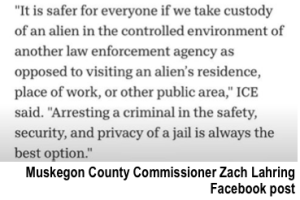 Muskegon County Commission Zach Lahring has been getting a great deal of press lately.
The County Commissioner has made a name for himself in recent months for taking two major political stands. First, Lahring pushed the commission to vote against continuing a lease for Planned Parenthood, which had been leasing space from Muskegon County. The conservative county commissioner framed Planned Parenthood as a “political” organization, even though he, and his supporter, objected to Planned Parenthood on religious grounds.
The second, and more recent controversy, involves Lahring’s effort to challenge Muskegon’s County’s decision to be a “Welcoming Community.” Lahring believes that being a Welcoming Community means that Muskegon County is a sanctuary community, which it is not. However, Lahring, has been successful in raising this point, since his goal was to talk about the need for Muskegon County official to cooperate with ICE and to push his anti-immigration agenda.
Zach Lahring was only elected to the Muskegon County Commission last November, but he is following the Trump school of political organizing, both by being brash in public and by pushing overtly racist policies. Lahring campaign slogan last year was, Make Muskegon Great Again.
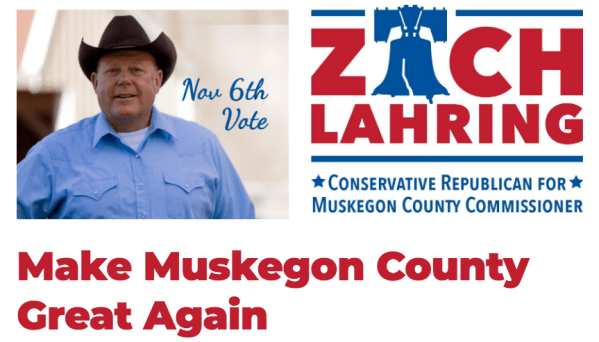
Lahring promotes many of the same Neo-Liberal policies that groups like the West Michigan Policy Forum, the Acton Institute or the Mackinac Center for Public Policy does, policies that benefit the business class and penalizes everyone else. In March, Lahring challenged the county’s policy of only hiring companies with unionized workers, arguing that it costs taxpayers more. However, the playbook of the Neo-Liberals is not to really defend taxpayers, but to undermine unions.
Lahring brags about how he was trained at the Institute on the Constitution (IOTC), an entity founded by former Constitutional Party Presidential candidate, Michael Peroutka. This is how the IOTC sums up their mission, “There is a God, our rights come from him and the purpose of civil government is to protect our God-given rights.”
If you go to Lahring’s Facebook page, you get a clear sense of where he is coming from, with regular posts that vilify immigrants and Muslims. Lahring also was endorsed by Michigan Right to Life and regularly posts about abortion, links to pro-gun sites and why socialism is not Christian. In short, Muskegon County Commissioner Zach Lahring is the kind of politician that normalizes violence against the most vulnerable people in society and he is clearly committed to imposing a broad Neo-Liberal agenda on the residents of Muskegon County.
The New Gilded Age in Grand Rapids: Why so few, control so much
 We are living in an era that could easily be described as the New Gilded Age. A small faction of the world’s population controls over half of the world’s wealth.
This vast wealth gap was confirmed in a recent document published by the Global Wealth Report, which says that the number of millionaires has grown to 47 million. The report also stated that this growing class of rich people, which makes up 0.9% of the world’s population, now controls nearly half of the global wealth, estimated to be $361 Trillion.
In many ways these numbers make it difficult to even fathom the vast amounts of wealth that so few have, while billions struggle to survive. If we just looked at Kent County, we know that there were at least 600 millionaires in 2014, compared to just 407 in 2010. There are also a few billionaires living in Kent County, with names that are familiar to most.
The DeVos and Meijer families are both worth billions. According to Forbes, Doug & Hank Meijer are worth $10.7 Billion and the now deceased Richard DeVos was worth $5.7 Billion upon his death. We don’t know the combined wealth of all the DeVos family members, but if we just look at the wealth of the two Meijer heirs and Richard DeVos, the total comes to $16.4 Billion.
Now there are roughly 200,000 people who live in Grand Rapids. If we divided up the wealth of these two families amongst the entire population of Grand Rapids, that would mean that every person, not every household, every person would get $72,500. For some people this may not seem like a great deal of money, but there are tens of thousands of people in Grand Rapids who make less than $72,500 a year and that amount of money would radically improve their quality of life.
How about housing? If we say that on average a house in Grand Rapids goes for $200,000, 72,500 homes could be purchased with the wealth of Meijer and DeVos. This would mean that 72,500 homes could be paid for, which would mean pretty much all of the homes in the city, since the average family size is 4. This would eliminate homelessness, people having to work 2 jobs to pay rent, people facing foreclosure or having to decide if they have heat in the winter or can afford their current mortgage.
 Imagine what $16.4 Billion would do to cover health care costs for people in Grand Rapids? How about paying for a mass transit system that would radically reduce the need for cars in the city? $16.4 billion could pay for solar energy for the entire city. $16.4 Billion could provide every student who is currently in K-12 with free college tuition. What would $16.4 Billion do to pay for dealing with lead exposure for children in Grand Rapids, making sure that every family ate healthy food or that no senior citizen had to worry about paying for prescription drugs. $16.4 Billion would go a long way to pay for reparations for African Americans in Grand Rapids. Hell, $16.4 Billion would wipe away the debt of every African American in Grand Rapids, pay for a new home, health care costs, education and pretty much anything else, just from the wealth of these two families.
Now, if so much could be done to not only alleviate suffering in Grand Rapids, from the wealth of just two families, plus the few other billionaires and the 600 millionaires in Kent County, but could radically improve the lives of everyone living in Grand Rapids, then wouldn’t it stand to reason that so few people controlling so much wealth is an absolute injustice.
In addition, the class of people, the millionaires and the billionaires are constantly buying politicians to keep re-directing more public money into their pockets. So, the question we should be asking ourselves is why are we not rioting? Do we actually think that this much wealth was actually earned by these two families? We know their names and they have addresses.
Movimiento Cosecha GR asks the City of Grand Rapids to pass a resolution in favor of drivers licenses for the undocumented community
 Last night 18 people spoke during the public comment at the Grand Rapids City Commission meeting to encourage the commissioners to pass a resolution that would endorse the statewide campaign known as Drivers Licenses for All.
Some people spoke in Spanish and some in English. Those who spoke addressed all aspects – safety, economic, mobility, social and how having a drivers license would significantly reduce the fear of being detained by ICE – of the Drivers Licenses for All campaign, which you can read in both English and Spanish at the document linked here.
One of the organizers with Movimiento Cosecha GR, Gema Lowe, shared a story about a friend who was stopped by police and then arrested for not having a drivers license. The woman who was stopped has children, which also meant that those children experienced trauma because their mother was arrested and detained by ICE.
 Gema also told the commission that she recently had surgery and had to ask friends and family to driver her daughter to school, so she knows how important it is for immigrants to be able to obtain a license and meet the needs of their families.
Cosecha organizers from Kalamazoo also spoke, since Kalamazoo recently passed a resolution at the city and county level, demonstrating that local government bodies can indeed support these kinds of efforts.
Sr. Klingman, a member of the Grand Rapids Dominicans, addressed the commission and and urged them to support the resolution. Her religious order has endorsed the Drivers Licenses for All campaign and believes this issue is critical if the city believes in equity and justice for all.
 There were several other people who spoke during public comment, who came to address other issues, but added that they too supported Cosecha’s desire to have the City pass a resolution in support of Drivers Licenses for All. One of those who spoke was Russ Olmstead, who is on the board of Equity PAC. He read a document from the city, which made clear that the city government must support the drivers licenses campaign, based on City’s own previous statements.
Commissioner O’Connor read a letter sent by the Mayor in April in support of changing the law in Michigan to allow undocumented immigrants to obtain drivers licenses. O’Connor read it in such a way to suggest that they don’t need to do anything. Two commissioners followed up this comment by suggesting that the letter should be made into a resolution that could be adopted by the City Commission.
Who are the some of the largest donors to the Student Advancement Foundation and what does that mean for the GRPS?
 The Grand Rapids Student Advancement Foundation is an independent nonprofit organization serving as the strategic fundraising partner of the Grand Rapids Public Schools. Our purpose is to raise, grow and steward funds and other community resources to support the Grand Rapids Public Schools for the benefit of its students.
This above statement is directly from the website of the Grand Rapids Student Advancement Foundation. As someone who constantly examines the members of the Grand Rapids Power Structure and how they use their money to influence public policy, we are regularly looking at the foundations of those who seek to impose their will on the rest of us.
According to the 990 documents of foundations run by some of the most wealthy families in West Michigan, the Grand Rapids Student Advancement Foundation has received roughly $2.5 million from the very sector that is working to undermine teacher’s unions and the very sector that supports a Neo-Liberal education model. Here is a list of the major donors to the Grand Rapids Students Advancement Foundation, based on Foundation records between 2015 & 2017.
- Doug & Maria DeVos Foundation $1,122,800
- Cheri DeVos/CDV 5 Foundation $770,000
- Steven & Amy Van Andel Foundation $250,000
- Jandernoa Foundation $109,500
- Richard & Helen DeVos Foundation $30,000
- Peter Secchia Foundation $25,035
- David & Carol Van Andel Foundation $5,700
I sent an e-mail to the Grand Rapids Student Advancement Foundation (GRSAF), asking them if those who contribute large sums of money have any say in what the money is used for. I will post a response, once they respond.
It is a safe assumption, however, given how foundation money often has strings attached, that these members of the Grand Rapids Power Structure would have some influence in what the GRSAF funds are used for at the Grand Rapids Public Schools. In fact, we should all be asking how this money is used by the GRPS. Does major funding from those within the Grand Rapids Power Structure, who’s members have been promoting a Neo-Liberal education model for years, impact the GRPS in any significant way? Are these wealthy families behind the push to further privatize the GRPS and create charter-like schools? Are they part of the business advisory council that the GRPS has admitted to having and do they have any saying in the curriculum at the new academies, which are clearly designed to create future workers in very specific fields?
The public deserves to know the answers to these questions and students, parents, teachers and community members demand that the Grand Rapids Public Schools practice complete transparency on all of these issues.
 Grand Rapids Institute for Information Democracy