Interview with Joe Cadreau on the Indigenous People’s Day Action this Saturday in Grand Rapids
 GRIID – What was the motivating factor behind organizing the We Are Still Here action for this Saturday?
Joe – The city has buried this resolution in committee after committee for the last 4-5 years. There has been no communication from the city or the group it claims to be working with, as to where or why this resolution has sat idle.
Also this past summer the city adopted Juneteenth in a matter of 2 days , without any public comments, or committee input etc. Many elders in my community felt shunned because of this and reached out to me.
GRIID – In Grand Rapids, there has been an effort since the late 1980s to replace Columbus Day with Indigenous People’s Day. Why do you think Grand Rapids is so resistant to the idea?
Joe – Grand Rapids would be forced to admit the inequity that they are responsible for creating in my community. We can look through the history of the city and see time after time where they removed us, and forgotten us. Just look at the westside , and the Ford museum.
Grand Rapids is not as diverse as it claims to be , they have done all they can to keep the white power structures in place, from administration to administration, this one is no different.
I don’t think people realize or fully understand the effort and power that the families have in this city. It baffles me why this resolution has taken so long and been buried for so long. I wrote the Indigenous Peoples Day Resolution at GVSU in 2017 and it was passed and adopted by the university. We thought for sure that would have been a catalyst to getting the city to pass the Resolution that have had for years.
GRIID – Have you received any push back since you announced the We Are Still Here action?
Joe – Yes I have both internally and externally. That is why it was important for me to make this event inclusive and a work of allyship.
GRIID – Why is having an Indigenous People’s Day so important for both the anishinnabek community and for everyone else?
Joe – It is the first step in truly creating equity for the indigenous people of this area. Michigan is one of the most populated states with a native presence and population. Columbus is the symbol of colonization and white supremacy.
GRIID – Having an Indigenous People’s Day would be a good first step, but what else needs to change for people to come to terms with Settler Colonialism and do you see this action as a catalyst to make even larger demands?
Joe – There are many things that need to change in relation to the city and its relationship with the anishinnabek community. First thing that needs to change is funding for social programs for indigenous people. We are often forgotten or never mentioned in these social programs that the city develops or implements. The continued purge of dollars and space from the GRPS NAEP needs to end and be fully funded. Those are just a few things , but there are many issues that my community faces in this city on a daily basis.
The city also needs to realize and understand that one organization can not fulfill all the gaps in the anishinnabek community. They need to offer Grant’s to other native led organizations that do important work as well.
Reversing the Missionary Position: Learning Solidarity on Mayan Time – A Film discussion/fundraiser for GR Rapid Response to ICE
 In 2006, I produced a documentary film about my experience of doing accompaniment work in Guatemala and Chiapas, Mexico between 1988 and 2005. I had worked with Peace Brigades International in Guatemala and Enlace Civil in Chiapas on numerous solidarity trips I took in those years.
The film I made, Reversing the Missionary Position: Learning Solidarity on Mayan Time, was really based on my own development and understanding about what solidarity really means. I was not in those countries to tell people what to do, to help them build houses, to preach any message, but to walk with them in their struggle for justice and liberation.
Most of the time I spent doing accompaniment work, meant that I was just present with local organizers, leveraging my privilege as a white male from the United States. As an organizer with Grupo Apoyo de Mutual told me years after my first solidarity trip to Guatemala, “your presence provided us some emotional and physical space to do the work we needed to do. It didn’t eliminate the death threats we faced on a daily basis, but it did provide us with more room to maneuver in the midst of the threats.”
GR Rapid Response is hosting a discussion of the film, Reversing the Missionary Position: Learning Solidarity on Mayan Time, on Monday, September 21st. at 7pm in an online forum. You can watch the film anytime, since it is online here:
Once you have watched the film, GR Rapid Response to ICE is inviting people to be part of a discussion about the content of the documentary and the importance of doing accompaniment work, which is part of work of GR Rapid Response to ICE. To join the discussion go to this link https://us02web.zoom.us/j/87485219485 by 7pm on Monday the 21st.
This event is also a fundraiser for GR Rapid Response to ICE, which provides funds for families impacted by ICE violence, which includes arrest, detention and deportation. You can contribute to GR Rapid Response to ICE b y going to this link bit.ly/RR-mutualaid.
Please help GR Rapid Response to ICE by contributing to their Mutual Aid Fund and by help them to spread the work about this event, which you can find on Facebook at this link.
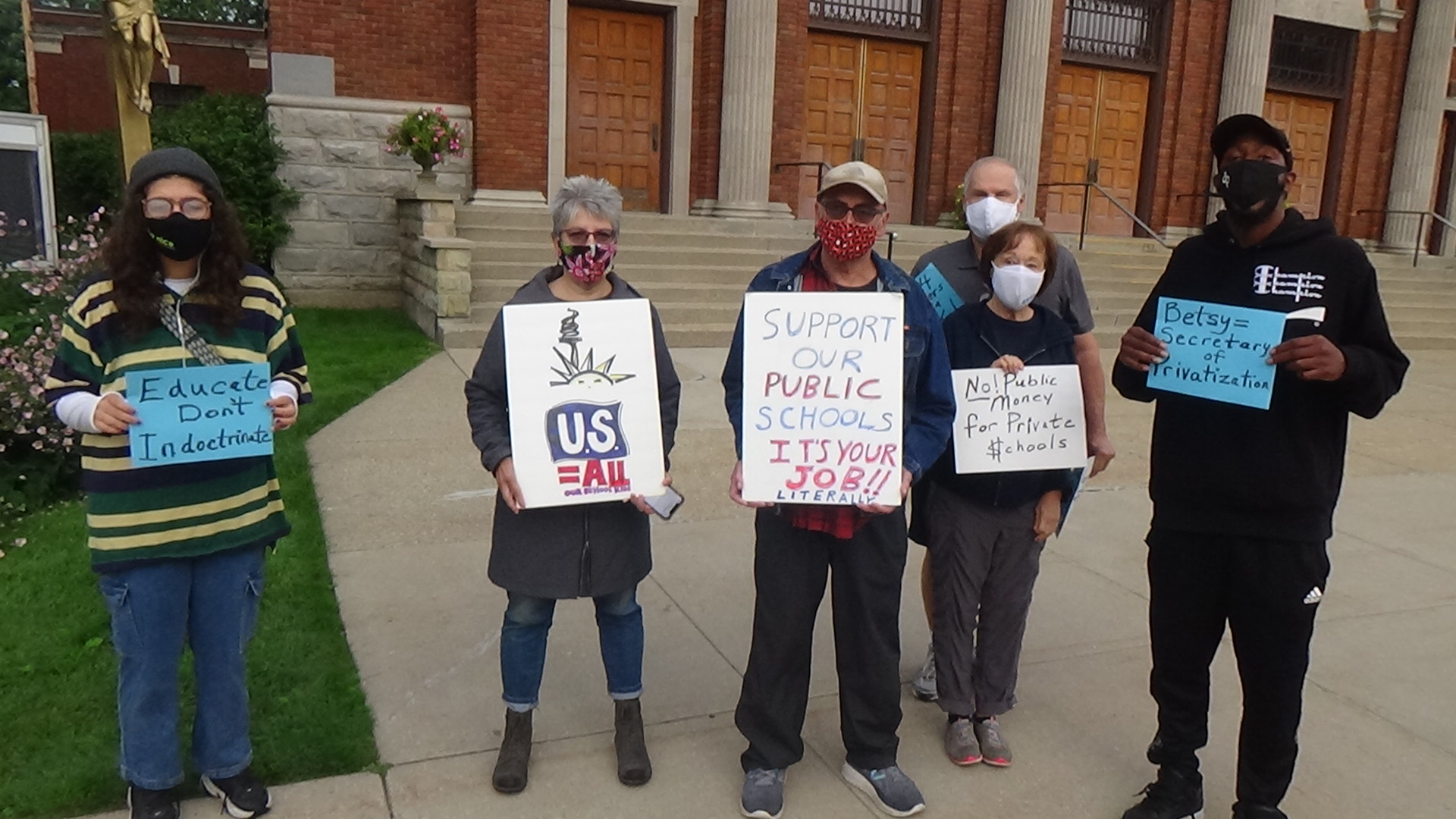
Small group of protesters send a message to Betsy DeVos while leaving the private school she visited today in Grand Rapids
As was mentioned in our previous post, Betsy DeVos was at Sacred Heart Academy this morning to meeting with staff, students and founder of the Acton Institute, Rev. Robert Sirico.
DeVos arrived at the school earlier than MLive had suggested in their article from Saturday, so when protesters arrived there was already GRPD presence and the black SUVs parked next to the school entrance. The black SUVs also included members of the US Secret Service, which have been guarding Betsy DeVos almost since the beginning of her tenure as Secretary of Education, especially since she has been confronted by protests where ever she goes.

In the picture above, Acton Institute founder, Rev. Sirico, is seen talking to DeVos who had already entered the black SUV. Sirico is the shorter of the two priests that can be seen in the above photo.
Several protesters arrived just before 8am to confront DeVos on her policies as Secretary of Education. Jack Prince, with Grand Rapids for Education Justice (GREJ) made the point that DeVos has been pushing her school privatization plan, and that it was an insult to students in the Grand Rapids Public Schools, for DeVos to visit a private Catholic school.
Some of the other talking points that GREJ brought up were:
1. We object to the fact that Secretary DeVos is visiting a private school to see how coping with the pandemic is going, when so many other schools, which are financially struggling should be getting attention.
2. We object to the fact that all throughout the pandemic, Betsy DeVos has been advocating that public money should go to private schools.
3. DeVos chose Sacred Heart Academy, specifically to elevate a private school that is run by the founder of the Acton Institute, Rev. Sirico, who is ideologically aligned with Betsy DeVos on education matters.
4. That Betsy DeVos is coming to a private school during a pandemic and has been pushing for more public money for private education, is consistent with this administration, which has done very little to provide financial relief to working class families, Black families and other families of color, many of which are unemployed and facing eviction, while the wealth of billionaires – like the DeVos family – has increased during the pandemic.
Betsy DeVos in Grand Rapids to visit a Private School, with ties to the Acton Institute
 On Saturday, MLive reported that US Secretary of Education Betsy DeVos would be in Grand Rapids to visit a school, “with the intent of showcasing how the school safely reopened during the coronavirus pandemic.”
DeVos has come under fire since she first began pushing for schools to re-open in mid-July. Then on August 31st, DeVos wrote an opinion piece for the Detroit News, which was framed as a letter to parents across the country. The letter follows the same mantra from DeVos, always claiming that it all comes down to parental choice. However, Betsy DeVos didn’t miss the opportunity to push her “school choice” message, which is essentially the promotion of school vouchers, the expansion of charter schools and other private school options.
Coming to Sacred Heart Academy
Therefore, it should not be surprising to anyone that the school Betsy DeVos is visiting on Monday morning is Sacred Heart Academy. Sacred Heart Academy is a Catholic School that requires tuition.
The MLive article says that they reached out to the Superintendent of Catholic Schools for the Diocese of Grand Rapids, but did not receive any response before they posted the story. However, MLive could have contacted another source, more directly related to Sacred Heart Academy, the pastor of Sacred Heart Church, the Rev. Robert Sirico. Of course, Rev. Sirico is also the founder and President of the Acton Institute.
Since Sirico took over as the priest at Sacred Heart, he has had a significant influence on the direction of Sacred Heart Academy, with major changes in the curriculum during the 2013 – 2014 school year. The fact that Betsy DeVos is visiting the school that the founder of the Acton Institute has control over makes complete sense.
Betsy DeVos and Rev. Sirico have a long history together. Sirico presided over the wedding of her brother Erik Prince, the DeVos family has contributed millions to the Acton Institute since 1990, and Betsy DeVos, her mother and her son Rick DeVos, have all served on the Acton Institute’s Board of Directors.
Betsy DeVos was the keynote speaker at the Acton Institute’s Annual gala in 2017, plus Sirico has gone out of his way to defend the Secretary of Education on numerous occasions, like he did in June of 2018, in an opinion piece the Acton founder wrote in the Detroit News.
However, the relationship between Rev. Sirico and Betsy DeVos can best be summed up by their commitment to Capitalism.
It is also worth noting that the Sacred Heart Academy Board of Directors is made up of people who embrace the same ideological values that DeVos and Sirico embrace. First, there is J.T. Weis, who is the CEO of Arbor Industries, a company based in Holland. Weis participated in a panel hosted by the Econ Club of Grand Rapids last year, which talked about the importance of hiring people out of prison, because it opens up a whole new pool of potential employees. Weis and his family are involved in the conservative Catholic radio station Holy Family Radio and they are active participants in the anti-abortion March for Life actions.
Then there is Michael Miller, who is the Director of Acton Media and a Research Fellow at the Acton Institute. Miller has written a great deal for the Acton Institute’s blog, plus he influences much of the media content for Acton.
Lastly, there is Patrick Kilchermann, who is the founder of the national Concealed Carry University, which provides training for people who want to own guns. Kilchermann believes that God called him to start Concealed Carry University.
Let’s be clear about the fact that Betsy DeVos, the Secretary of Education, is in Grand Rapids to visit a private school, with direct ties to the Acton Institute, which the DeVos and Prince families have supported with millions of dollars for decades.
West Michigan Far Right Watch for September 11
 Welcome to the next installment of West Michigan Far Right Watch, where we keep tabs on the far right in this area and provide a summary of what they are up to and what kind of messages they are promoting in this community.
We have 2 examples to share with you this week. The first comes to us from the Acton Institute, with their ongoing war against anything that is not Capitalism. The founder of the Acton Institute, Rev. Robert Sirico, has a brief article on the Acton website entitled, the deceit of democratic socialism. Like most of Sirico’s writing, he attempts to sound deeply intellectual, when in fact his arguments are weak and overly simplistic. Sirico uses Hebrew and Christian scriptures to bolster his argument, especially since he doesn’t really have a grasp of what socialism is. In the end, Rev. Sirico can only argue in favor of Capitalism by saying, “In a market economy, stewards of resources are rewarded by their best use in meeting human needs through – get ready for it – profit.”
The second example of Far Right activity, comes to us from the newly rebranded group called, the American Patriot Council. The American Patriot Council is calling for Freedom Marches all across the US on October 24, just prior to the November election. Here is what their Facebook event post says about this event:
Undoubtedly, the very fabric of America is calling out to her beloved Patriots once again to protect our great nation. Oct 24th 3:00 PM EST, We The People gather across America in a show of solidarity and demand emancipation from the bondage of tyranny. Days before the 2020 election, this Freedom March will be remembered such as the days of 1776. Be a part of the new Founding Fathers & Mothers. The American Patriot Council is calling all American Patriots to step up and lead. It’s now or never, Let’s Go America!
Ryan Kelly, who calls himself the founding father of the American Patriot Council, has been posting videos and promoting this event for the past two weeks, with overly simplistic references to the US Constitution and Freedom, when in fact, his position and that of the American Patriot Council is just a form of White Supremacy and White Nationalism.
Also, just a reminder that today is the 19th anniversary of 9/11/2001. The US initiate two wars because of this attack, with bipartisan support, wars that have devastated Iraq and Afghanistan, along with destabilizing much of that region of the world. The US also passed the Patriot Act, which created the Department of Homeland Security, Immigration and Customs Enforcement, plus it gave the federal government unlimited powers to spy on US residents and even charge those using civil disobedience as a political tactic, with domestic terrorism.
If we don’t want the DeVos family to own our community, then we need to take away their political an economic power
 Over the past several weeks we have written a 5 Part series on the contributions of the DeVos family foundations based on 2018 data from the online resource GuideStar.
We talked a great deal about how their foundation contributions are strategically aligned with their political contributions, in order to further their ideological interests and to wage class warfare on the masses.
Today, we want to take a more systems approach to looking at the five DeVos family foundations, by looking at how these foundations are financially beneficial to the DeVos family.
First, it is important to note that the DeVos family foundations have millions in assets, while only contributing a small percentage of their assets on an annual basis. For instance, in 2018, the Doug & Maria DeVos Foundation had $71.5 million in that foundation, but only contributed just under $9 million that year. We nee to understand that one of the reasons that members of the Capitalist Class put their money in foundations is to avoid having to pay taxes on that wealth.
Tax policy since the 1950s has increasingly benefited members of the Capitalist Class, and the funding that Congress has provided since the pandemic began, has primarily benefited the wealthiest. In April, we reported on how the super rich, because of tax policy loop holes, would benefit massively from the Cares Act.
We wrote:
More than 80 percent of the benefits of a tax change tucked into the coronavirus relief package Congress passed last month will go to those who earn more than $1 million annually, according to a report by a nonpartisan congressional body expected to be released Tuesday. This information is based on the research done by group known as the Joint Committee on Taxation (JCT), a nonpartisan Congressional body. Forbes reported that the 43,000 millionaires and billionaires in the US will get on average $1.7 million because of the Cares Act.
Of course, the DeVos family is the wealthiest in Grand Rapids, so they would benefit the most from this policy decision.
Now, lets be clear, the DeVos family and their billionaire friends have a ridiculous amount of money. In May of this year, we wrote about the wealth of the DeVos and Meijer families an what that could mean for Kent County:
The DeVos and Meijer families are not the only billionaires in Grand Rapids, but they are the wealthiest and the families that have tremendous political influence.
According to the 2017 Forbes 400 list, the combined wealth of these two families was $12.6 Billion – Doug & Hank Meijer were worth $7.2 Billion in 2018 and Richard DeVos was worth $5.4 Billion in 2018, the same year he died. Now, this doesn’t include the wealth of the other DeVos family members, which would easily put the total over $15 Billion between these two families.
What the combined wealth of the Meijer and DeVos family could translate into, is that NO ONE in Grand Rapids would have to worry about not working during the COVID-19 crisis, EVERYONE would have access to testing, proper health care, food, housing and any other basic needs. The JW Marriott just announced that they were closing, which means there are hundreds of empty bed that could be used by individuals and families who are facing a housing crisis right now. The wealth of the Meijer and DeVos families could translate into our ability in Kent County to truly flatten the curve and minimize the number of deaths from COVID-19.
Unfortunately, we know that the Meijer and DeVos families will not give up significant amounts of their combined $15 Billion in order to save lives in Kent County. These two families have demonstrated for decades that they are more interested in maintaining and expanding their wealth than they are in the well being of all residents of Kent County.
It is important that we see the wealth of families, like the DeVos family, not just about money, but about power. I was on a panel a few years back, at a national non-profit conference that was being hosted in Grand Rapids. The panel session was entitled, Grassroots Responses to Big Philanthropy: Grand Rapids Activism in the Shadow of Amway, ArtPrize and DeVos.
The basic premise of what I discussed in this panel session was that the DeVos family uses their wealth in an extremely strategic fashion, with some of the main goals being:
Contribute funding to organizations that share their ideological worldview.
Use the contributions to non-profits as PR leverage, despite the fact that none of those non-profits are challenging the root causes of the injustice they have organized around.
Use the contributions to religious groups, centers of education and non-profits in order to manage content and practices in such a way as to discourage these entities from being involved in fighting systems of power and oppression.
One of the reasons why I chose to monitor and investigate the power of families, like the DeVos family, is because it is important that we understand how systems of power and privilege function, and I can’t think of a better example in West Michigan than the example of the DeVos family.
Any social movement that is ultimately a threat to the power structure has to do two things. First, they have to do a power analysis, preferably in their own community, and that would require us to look closely at the DeVos family. The other thing that social movement need to do, in order to make those in power very nervous, is to work towards taking that power away, both economic and political power.
This would mean lots of education, political resistance work, exposing the DeVos family, AND it would mean redistributing the wealth they acquired over the last 50 years. How we redistribute their wealth, is best left to discussions/planning sessions for people who really want to make this happen.
A conduit for the cops: MLive only cites police experts in article about confrontation between anti-racists organizers and the Proud Boys
 Three weeks ago, we post an article that provided some analysis on how the dominant news media reported on the Proud Boys coming to Kalamazoo. One of the main points we made in this analysis is that the dominant news media presented the Proud Boys and the anti-racist demonstrators simply as two opposing forces that the Kalamazoo Police had to deal with.
Another important take away from the confrontation between the Proud Boys and anti-racist demonstrators was that the police only arrested those in the anti-racist camp, thus leaving the Proud Boys free to spew their hate and White Supremacist values.
There have been several articles, particularly in MLive, since that action in Kalamazoo in mid-August. On Friday, MLive ran another story with a headline that read, Police need to keep opposing protest groups separated, experts say after Proud Boys rally.
The problem with this most recent article by MLive is two-fold. First, the article relies exclusively on “experts” that have a history in law enforcement or are connected to research-based organization that are pro-police.
In addition to relying on Public Safety Chief Karianne Thomas, the MLive reported also cited someone from the National Police Foundation, the Center for Violence Prevention and Community Safety, as well as citing a document from the 2015 Presidents Task Force on 21st Century Policing Recommendations. Therefore, the MLive reporter only utilized experts that are not only pro-police, but experts who have internalized the belief that policing in the US is essentially a force for good.
It is not surprising that a member of the dominant news media would consider using only experts that are pro-police, but it certainly does harm by not presenting experts who would provide a counter balance to these pro-police views. The MLive reporter could have contacted people like Michelle Alexander, author of The New Jim Crow: Mass Incarceration in the Age of Colorblindness, Alex Vitale, author of the book, The End of Policing, or historian Kristian Williams, who is author of the book, Our Enemies in Blue: Police and Power in America.
The other main reason that this article is problematic, is that it makes it clear that MLive sees the police as a neutral entity that ultimately keeps the peace in our society. It’s bad enough that the MLive reporter relies exclusively on pro-police “experts”, but they also reprint the suggestions from these experts as sound logic. Early on in the MLive article is reads, “Policing experts, contacted by MLive this week, said police can take several steps, while affording First Amendment rights, to discourage violence in these situations.” Then the MLive reporter includes these steps. Here are those “steps” that the police can use on the left, which were featured in the MLive article. On the right, in red, is a more honest assessment of what these steps mean.

Lastly, towards the end of the MLive article is says:
Back in 1998, the Ku Klux Klan held a rally in Kalamazoo. An 8-foot chain-link fence and a line of police officers in riot gear kept the Klan away from others who showed up. Former City Commissioner Zadie Jackson recalled it turned into a non-event because no one really reacted to the Klan’s presence.
This is not always the case when the KKK or other White Supremacists groups, like the Proud Boys come to town. Back in 2007, when White Supremacists came to Kalamazoo , they were outnumber by anti-racist activists three to one. As someone who was involved in that action, the police created “free speech spaces” for the White Supremacists, which consisted of 10 ft. high chain link fencing that was set up so as to create three separate zones. The White Supremacists were in one zone and the cops wanted us to enter one of the other zones, but we refused. This meant that the cops spent the entire time with their backs to the White Supremacists, thus facing those who were were there to confront the White Supremacists, as was reported on by the indy news source Media Mouse.
What the dominant news sources fail to understand is that anti-racist groups, like antifa, will always confront White Supremacists when they come into communities, because their very presence does harm. Anti-racists groups confront White Supremacists to send them a message that they are never welcomed. This is what real community safety groups do, they try to stop hate from entering our communities.
Why we can’t go back to the way things were in Grand Rapids: Part V – Demand Housing Justice
In April, we posted an article arguing that in the midst of the COVID-19 pandemic, we could not return to normal. In early May, we posted Part II in this series, focusing on the Food System and then in late May, we wrote Part III, which focuses on labor and a new economy. In Part IV, our focus was on Climate Justice, with an emphasis on White Supremacy. In today’s post we want to look at housing and why we can’t go back to normal.
 One common theme in each of these posts was that the pandemic exposed the serious flaws in Capitalism and how millions in the US are clearly considered expendable by the systems of power and oppression.
In addition, it is important to acknowledge that you cannot achieve housing justice without economic justice, racial justice and gender justice. In fact, you cannot achieve housing justice within the current political climate which rewards “the market”, but doesn’t care about the well being of people.
Right now, all across the US and in Gran Rapids, thousands of families are facing the possibility of eviction. The COVID 19 pandemic has caused thousands of people in Grand Rapids to lose their jobs, plus many families are taking care of children, since many school districts have gone to online instruction. Parents are home with their children, some working and some not working. Despite the difficulty that is compounded by the pandemic, landlords and property management companies are wanting to make profits. As was said earlier, the pandemic has exposed the brutality of the market, the brutality of capitalism, and why we can’t go back to the way things were before.
What we are proposing in this article is nothing new, since it has been practiced in many communities and societies throughout the world, as it relates to housing justice.
We have to move away from this idea that housing should be dictated by the market. Housing, like other basic needs, should not be left up to the market, but should be something that everyone has access to. Housing is not only a right for individuals and families, but it should be something that is shared and is available to all. Like food, health care, education and other basic necessities, housing should not be a commodity, instead housing should be practiced as a necessary component of what it means to be human. The fact that thousands are homeless or are experiencing housing insecurity in the Grand Rapids area is criminal.
Another important point is that the history of housing in Grand Rapids begins with the theft of land from indigenous people by those practicing Settler Colonialism. In fact, throughout the history of this community, housing has always been intertwined with White Supremacy, classism, displacement and gentrification, as we have documented in our post entitled Housing Justice through a Historic and Intersectional Lens: Looking back, imagining forward and fighting right now.
However, until we can move as a society away from market-based housing to housing justice, there are things that people can do to that will get us to housing justice.
- We need to stop allowing public money, in the form of tax breaks or subsidies, to go to housing developers. Literally millions of dollars are given to developers in the form of tax breaks or subsidies in Grand Rapids on an annual basis. If housing, as we are constantly reminded, is driven by the market, then make developers foot the bill for new housing on their own. We don’t give home owners or renters the same benefits or incentives as we do for companies that construct housing.
- Redirect the public money that currently goes to developers and provide that public money to people who are facing housing insecurity. The City should set aside the amount of money that currently goes to developers – tax breaks, subsidies – and make it available for people who are struggling to pay their rent or maintain their mortgage. In addition, this pool of funds should not only be given to people who are facing housing insecurity, but this pool of public money should be allocated based on the collective decisions made by people who have previously benefitted from this fund……meaning those who make the decisions of how the public money gets used should be made up of people who are or have recently been housing insecure.
- There are currently lots of property in the Grand Rapids area, both residential and commercial, that people could occupy. Yes, I am advocating that people engage in squatting. Squatting is a long standing tradition in many countries and societies and the basic premise of squatting is that people are using buildings that are not occupied by other humans. See the book, The Autonomous City: A History of Urban Squatting, by Alex Vasudevan.
- We should promote more cooperative housing. There are a few cooperative housing ventures in Grand Rapids, but this way of living could be expanded. Cooperative housing can reduce housing costs for individuals and families, so that they are not spending a significant percent of their income on housing. In addition, cooperative housing promotes cooperation and can lead to people cooperating in other areas of life, like food, child care, transportation, education and work cooperatives.
 People is Grand Rapids should seriously investigate and pursue the practice of Community Land Trusts. Community Land Trusts operate on the idea that people go in collectively to access land, homes and work spaces that are collectively owned and/or have written into the trusts that this land/property can never be gentrified, bought out by developers or used for unjust or unsustainable purposes. Community Land Trusts can include just 2 plots of land, a city block or larger. For more information on Community Land Trusts go to https://www.localhousingsolutions.org/act/housing-policy-library/community-land-trusts-overview/community-land-trusts/
- One last strategy that people can employe is the creation of Tenant Unions. Tenant unions are a way for people to demonstrate their collective power by fighting for housing justice against exploitative landlords and property management companies. Tenant unions can fight for rent control, fight against unsafe housing conditions, fight against discriminatory and abusive property owners, plus they provide an opportunity to build community through mutual aid with other tenants. Earlier this year, a tenant union was formed in the greater Grand Rapids area, called the Grand Rapids Area Tenant Union/Unión de inquilinos del área de Grand Rapids. In fact, this tenant union is hosting an in person meeting this Saturday, September 12 in Gran Rapids. For details, go to this link.

If we are serious about fighting displacement, gentrification and market-based housing companies, then these are some of the tactics/strategies that we can employe in the struggle for housing justice.
When the Labor Movement was more radical in Grand Rapids
 Grand Rapids is not unlike most of the US in many aspects of our history. The same can definitely be said about the labor movement.
Like much of the rest of the country, when the labor movement was more independent and autonomous from political parties, they tended to be more radical, meaning they fought for working people and their families.
The 8 hour work day struggle is generally connect to the 1886 Haymarket Uprising in Chicago, and rightly so (more on this later). However, the fight for 8 hours came decades before 1886, even in Grand Rapids.
An effort to organize for an 8 hour work day in Grand Rapids was actually adopted for city workers in 1867, but it was repealed the very next year. (The Story of Grand Rapids: A Narrative of Grand Rapids, Michigan, by Z.Z. Lydens)
Labor organizers were fighting to win a shortened work day as early as 1881. According to a story in the Grand Rapids Daily Eagle in 1881, workers were attempting to fight for a 10 hour work day. These efforts were eventually fought in a highly organized manner from the capitalist class, with the creation of the Grand Rapids Furniture Manufacturers Association, the first of its kind, in 1881.
However, the struggle for the 8 hour work day continued, despite the efforts of the furniture barons and Dutch immigrants embracing a protestant work ethic.
In 1886, there was threat of a major strike in Grand Rapids, according to the New York Times:
The threatened strike at Grand Rapids is finally averted, and to-day is given up to a holiday there. The employers accept eight hours as a day’s work with a corresponding reduction in wages on all workmen above $1 per day. On this basis an advance of 5 per cent is made, with the promise of as much more in two months. No question is raised over the employers’ announcement that they will run their factories in their own way, employing and discharging whom they please. These matters are expected to adjust themselves.
In addition to the threat of a strike by workers in 1886, Grand Rapids hosted an 8 hour a day/May Day parade in the downtown, only four years after the first May Day parade was held in New York City.
Local labor historian MichaelJohnston’s thesis, Non-Union Grand Rapids: 150 Years of the Big Lie, sheds some light on the organizing for an 8 hour work day that preceded the May 1886 parade.
“The Furniture WorkersProtective Association, under the skillful leadership of Charles Johnston, began agitating for an eight hour day at nine hours pay in March and succeeded in reducing the workday to eight hours a day for several weeks before and then after May 1, 1886. This May Day affair would be the largest labor action in the city prior to the great 1911 furniture strike and one of national significance.”
Johnston notes that all throughout March and leading up to June of 1886, there were efforts to organize walkouts at several Grand Rapids factories, to picket and even use the threat of violence in numerous instances. However, some union presidents advocated against such practices and Johnston cities this as maybe the first instance of where the term “Company Union” was given to the more mainstream unions in Grand Rapids.
However, not all unions adopted such complacent policies and there were plenty of recent immigrants to Grand Rapids who were much more open to socialist and anarchist approaches to organizing in the later part of the 19th century and early part of the 20th century. This was in part due to the city’s proximity to Chicago, which was in many ways the center of radical labor organizing.
Chicago not only was the place of the famous Haymarket Uprising, it was home to numerous militant socialist and anarchist groups that had been organizing amongst workers throughout the city and traveled throughout the Midwest, to places like Grand Rapids. Several of the people who were charged with “inciting violence” at the Haymarket Uprising, like August Spies and Albert Parsons, wrote and spoke frequently throughout the Midwest. August Spies even came to Grand Rapids on more than one occasion to share his views on radical organizing and anarchist politics. For a more detailed discussion of the Chicago/Grand Rapids connection we highly recommend the well researched zine entitled, Mob Work: Anarchists in Grand Rapids Vol. 1, published by Sprout Distro.
Both cable and horse car workers went on strike May 10, 1891, for higher wages and union contracts. The company began hiring scab workers immediately. As the week progressed, workers tried to keep cars from running, first by inducing others not to take their jobs, but later also by blocking the cars. As the strike continued, there were other actions taken by striking workers, including marches and attempts to shut down roads, like what happened on South Division one night, where workers placed a large iron bar across the tracks to prevent it from moving.
 Probably the most famous labor strike in Grand Rapids history is the 1911 furniture workers strike. Over 6,000 workers went on strike in April of 1911 against poor wages, long hours and exploitative working conditions. The furniture barons responded by bringing in scab workers from out of town and to engage in a strategy of attrition, by wearing down the workers and holding out against their demands.
The strike lasted for several months and the workers did not win what they set out to accomplish with the strike, but the historic strike had a significant impact on relations between the working class and the capitalist class for decades to come. For more on the 1911 furniture workers strike see Part I and Part II from the Grand Rapids People’s History Project.
When social movements engage in direct action, it usually has a larger impact, often providing people with inspiration and examples of how they do not have to follow official channels to get what they want. The 1930s saw a revival of radical labor organizing in the aftermath of the Great Depression. Labor Unions became more militant again and used the power of strikes, along with what was known as a wildcat strike, where workers would occupy their place of employment so as to prevent companies from using scab labor. One of the most famous examples of a wildcat strike took place in Flint in 1936-37.
The labor radicalism seen in Flint had a direct impact in Grand Rapids. In the Spring of 1937 the UAW called for strikes at the Robert Irwin Co., the Macey Co., and Irwin Seating, which involved roughly 1,000 workers over a five week period. In September of that same year more strikes would break out at the Furniture Shops of America, John Widdicomb, Grand Rapids Chair and other furniture factories. In each of these instances the union got a closed shop contract, a check-off procedure and wages increases.
After a failed attempt to organize a union at the Kelvinator plant, the UAW tried again in 1937 and won their first contract, which included the recognition of the union and wage increases. Known as Local 206, this UAW organizing effort became a model for many of the other labor organizing efforts across the city.
 In some cases workers defied an anti-picketing injunction that the local courts imposed and many workers went to jail for brief periods in order to win labor contracts and build worker power from the ground up. In the photo included here, you see striking workers being booked at the Kent County Jail in June of 1937.
Each of these examples of labor organizing in Grand Rapids continued to build upon the growing push for workers to join unions. After the UAW and the CIO began organizing in Grand Rapids, union membership grew significantly. However, union leadership at the national level cut a deal with business leaders and the Roosevelt administration and agreed to not strike while the US was involved in World War II.
Then in November 1945, the UAW called its first major strike against GM since the company was unionized in 1937. Nearly a quarter of a million men walked out. In Grand Rapids, this same dynamic began where workers who had years of frustrations during the no-strike pledge of WWII began to challenge the capitalist class by engaging in walk outs and strikes.
In 1946, workers at the UAW Local 730 at the GM plant in Wyoming, Michigan were part of the national UAW strike that lasted for 113 days. (see photos above and below, sourced from The Story of the UAW Region 1-D) The UAW striking workers were fighting for better wages, pensions and improved working conditions, all of which were denied them during the no-strike pledge during WWII.
The business community began applying more pressure on the federal government in order to deal with the “pesky union.” There were two major factors that hurt organized labor after WWII, the passage of the Taft-Hartley Act, which made it illegal for workers to strike and the McCarthy anti-communist purges, which purged most of the radical elements of the labor movement.
Since then, the US labor movement has declined, with less than 10% of the labor force as part of a union throughout the US. The same thing has been true in Grand Rapids, where union membership has decline for decades, while union contributions to the Democratic Party have increased.
There are examples of labor organizing in more recent decades that reflect a more radical element of the labor movement, but overall the labor movement has become an empty shell of its former self, despite the fact that workplace organizing is still one of the most effective ways to bring about significant change and to demonstrate people power.
 We were recently able to access the 2018 990 documents from the various DeVos family foundations, through GuideStar.org. These foundations include, the Richard & Helen DeVos Foundation, the Dick & Betsy DeVos Foundation, the Doug & Maria DeVos Foundation, the Dan & Pamela DeVos Foundation and the CDV5 Foundation.
We have been tracking the DeVos family foundations for years, since it provides useful information on how the family strategically uses their money to influence the world around us. It is important to recognize that when people generally think of philanthropy, they think of money going from those with tremendous wealth to non-profits who provide needed services in the community. While there is some truth to this, what we will demonstrate in this series of articles, is that the DeVos family uses their foundation money to primarily wage ideological and class warfare.
In Part I of this series, we looked at how the DeVos family foundation funded and influenced educational institutions in West Michigan and across the US. In Part II, we looked at how the DeVos family foundations funded far right Christian organizations, and in today’s post we want to take a look at how these same foundation have funded Think Tanks and other groups that influence public policy, along with organizations that practice far right and Neoliberal policies. In Part III, we looked how the DeVos foundations are funding far right think tanks and other public policy influencing organizations. In Part IV, we looked at how much the DeVos foundations have contributed to organizations which they have created themselves during the 2018 fiscal year alone.
In today’s post, we will look at which non-profits in Grand Rapids received funding from the DeVos foundations in 2018, and how that prevents them from challenging power and oppression in this community.
It is important to point out that the following non-profits provide services to individuals and families that have been marginalized in this community. A great deal of the marginalization is rooted in poverty, where families struggle to feed, house and provided the basic necessities required to have a full life.
What is interesting about this dynamic with non-profits who provides basic social services, is that the DeVos family has spent millions of dollars over several decades to fund think tanks that create policies that do serious harm to families, and fund candidates who pass legislation that enacts the harmful policies that the think tanks created. Therefore, the DeVos family funds public policy that harms families and then contributes to non-profits who provide social services to families who have been harmed by the very policies the DeVos family has financed. The main difference in this process is that the non-profits that the DeVos family funds generally do not challenge the public policies that the DeVos money has financed in the first place. In other words, there is no systemic analysis or efforts on the part of these non-profits to dismantle the root causes of the issues they are dealing with – housing, refugees, disabilities and hunger.
To be clear, these organization provide charity work, but little justice work. More often than not, these organization are a buffer between people who are marginalized and the systems of power and oppression that caused the very marginalization people are facing.
Inner City Christian Federation (ICCF) – $1,757,500 – ICCF using language in the mission statement, such as Housing Justice, and they do build homes for families who are experiencing poverty. However, there is no real commitment to ending poverty or commitment to a living wages or to challenging the systems of capitalism and White Supremacy, which are at the root of housing injustice, displacement and gentrification. ICCF is also working with AmplifyGR, the DeVos-created entity, which bought up millions of dollars of property to develop before even telling residents what they were up to. In a neighborhood where I lived for 27 years, ICCF also bought up land and displaced families, despite previously committing to not displacing families in the Wealthy/Jefferson area of Grand Rapids.
Hope Network – $857,500 – Hope Network claims to be advocates for those who have serious injuries and need long-term therapy or permanent assistance from accidents that have caused significant disabilities. Hope Network does practice some form of disability rights, but they do not promote disability justice, plus they do not pay most of their staff a living wage.
Bethany Christian Services – $815,000 – Bethany Christian Services serves vulnerable kids in the US, refugees, immigrants and they do international adoption. However, Bethany does not challenge systemic or structural racism, they do not question the economic system of capitalism and they do not question US foreign policy, which contributes significantly to the creation of refugees and immigrants around the world.
Kids Food Basket – $607,500 – Kids Food Basket provides food to school age children in West Michigan. However, despite KFB’s claim that they want to end hunger, no where in their mission or work do they have a plan to dismantle poverty or to challenge the system of capitalism, particularly in the food system.
Next Step of West Michigan – $365,000 – Next Step of West Michigan does construction and property maintenance work, hiring men and women coming out of rehab or prison. This non-profit does not question or challenge capitalism or the Prison Industrial Complex.
Guiding Light Mission Inc. – $241,000 – The Guiding Light Mission provides temporary , emergency housing for people who are experiencing homelessness. They do not challenge the market-driven housing system or advocate for housing justice or an end to the root causes of homelessness.
Mel Trotter Ministries – $126,000 – Mel Trotter Ministries, like Guiding Light Mission, provides temporary/emergency housing for people who are experiencing homelessness, but they do not challenge the market-driven housing system or advocate for housing justice or an end to the root causes of homelessness.
The DeVos family foundations contribute to each of these local non-profits, and many more, precisely because these non-profits do not challenge systems of power and oppression. Whether or not there is any clear mandate from the DeVos family foundations about not challenging systems of power and oppression, the fact remains that these groups do not challenge systems of power and oppression, thus the DeVos family foundation money is ultimately hush money.

