Why does the GRPD want to use drones?
 Since last year, the Grand Rapids Police Department has been saying that they wanted to include the use of drones into their department.
MLive ran an article in late December discussing this issue, an article that included the use of a video about drones from another police department. In that same MLive story, it was stated that the GRPD would be hosting public meetings in the Spring of 2020 to talk about the use of drones and to give the public a chance to offer feedback.
In fact, there were meetings scheduled about the GRPD and drones for last week, but they were cancelled because of the COVID 19 outbreak. Here is the text from one of those scheduled meetings:
The Grand Rapids Police Department (GRPD) and Grand Rapids Fire Department (GRFD) are inviting the community to learn more about the proposed use of Unmanned Aerial Vehicles (UAV) in their public safety efforts.
The presentations will include information about the role of drones in public safety, how they can be used as first responders and how the departments would ensure privacy and individual liberties for community members. Attendees also will have the opportunity to ask questions and offer feedback on the proposed program.
It is not surprising at all that the GRPD would present the use of drones within a “public safety” framework. As someone who has been part of the immigrant justice movement in recent years, the constant police harassment, intimidation and surveillance is always presented as, “we are here to keep you safe.” If drones are not really about public safety, then why are police departments and the GRPD in particular, interested in their use?
The Electronic Frontier Foundation (EFF) has some good information about the capabilities of drones and why police departments are using them.
According to EFF, drones are:
Drones are unmanned aerial vehicles that can be equipped with high definition, live-feed video cameras, thermal infrared video cameras, heat sensors, and radar—all of which allow for sophisticated and persistent surveillance. Drones can record video or still images in daylight or infrared. They can also be equipped with other capabilities, such as cell-phone interception technology, as well as backend software tools like license plate readers, face recognition, and GPS trackers. There have been proposals for law enforcement to attach lethal and non-lethal weapons to drones.
EFF also states that between 2009 and 2017, there has been a substantial increase in local police and sheriff departments using drones, with nearly 350 departments incorporating them into use during that 8 year period. “Law enforcement agencies use drones for mass surveillance, crime investigation, search and rescue operations, locating stolen goods, and surveying land and infrastructure.”
 Most states, including Michigan, do not require search warrants before using drones for search or surveillance, even if people have not been accused of a crime. Drones can be use as surveillance and to collect data on people, even when they are involved in constitutionally-protected activities.
So what can the residents of Grand Rapids do about the GRPD’s desire to use drones? First, whenever the public meetings are rescheduled, we should turn out in big numbers to say no to mass surveillance. If that doesn’t stop the GRPD in their desire to use drones, then we can work with groups like the Electronic Frontier Foundations, which encourages people to file public records requests with their own police agencies.
Like all technology, it can be used for good or it can be used as another tool for systems of power and oppression. We cannot allow the GRPD to use drones. Drones will definitely be used as a tool of mass surveillance and as a weapons against social movements that are challenging systems of power and oppression.
Detention Watch Network creates Toolkit to Support Local Demands for Mass Release of People in ICE Custody
 The Chicago-based grassroots organization Detention Watch Network has created an excellent toolkit for organizers who are doing Abolish ICE work in their community.
The toolkit is entitled, Toolkit to Support Local Demands for Mass Release of People in ICE Custody.
The Introduction to this Toolkit provides a clear explanation for why the toolkit was created:
In response to the growing public health crisis caused by the COVID-19 pandemic and the United States government’s inadequate response, we have developed this working toolkit to help guide and support the work of organizations and individuals looking to demand the release of people in ICE custody. Organizations and individuals should assess their capacity and determine what strategies and targets fit best with the resources they have available and the number of people involved. This is by no means an exhaustive list of options and existing tools, its an attempt to centralize what has already been created and make it accessible to different local and regional contexts.
The toolkit includes:
- Strategies for federal, state, regional and local organizing work
- Templates & Resources for Lawyers
- Communication Resources
- Media Coverage and Resources to Support Your Demands
- Tracking Outbreaks in your Area
- Calls to Action from Organizations fighting Mass Incarceration
- Coordinated your Community to Welcome People being Released
- Existing Petitions/Calls to Action by State
- National Petitions
The resources and strategies included in this toolkit are very clear, practical, plus they push the sense of urgency that people in detention centers, jails or prisons, whether they are undocumented immigrants or victims of mass incarceration, should be released immediately because of the Covid-19 pandemic.
The Toolkit also is available in Spanish at this link.
Neo-Liberal Capitalist project Grand Action makes a comeback
 While we are all faced with an uncertain future with Covid – 19, we also have to pay attention to what systems of power are up to. Scholar/activist Naomi Klein calls these moments Disaster Capitalism, where governments use a disaster to push further austerity measures.
GRIID hopes to spend time looking at how local systems of power might also try to take advantage of the current crisis to further their own agendas.
Grand Action 2.0
Despite their announcement a few years ago to shut down, Grand Action recently announced that they are coming back.
The business press reported on this announcement, with the headline, Grand Action reboots to tackle new transformational projects in GR. I’m not sure how “transformational” the work of Grand Action can be, unless by transformational they mean it will transform more public money to fund private projects.
The previous version of Grand Action was led by David Frey, John Canepa and and Dick DeVos. DeVos is the only holdover with Grand Action, but he will be joined by Carol Van Andel and Tom Welch. Carol is the wife of David Van Andel, the current CEO of the Van Andel Institute. Tom Welch is the regional president of Fifth Third Bank.
The reporter from MiBiz, which ran a short article on Grand Action’s return, only ran a brief intro and then asked several questions, which we deconstruct below.

DeVos Family Electoral Contributions: Financing far right politics and political sycophants
 The electoral process is a highly compromised process, with issues around voter fraud, gerrymandering and the power that the Democratic and Republican parties have when it comes to allowing other political parties from forming.
However, possibly the most problematic aspect of the current electoral process is how members of the capitalist class can dictate what happens via campaign contributions. In West Michigan, one need look no further than the DeVos family, to see how wealth can infect the electoral process.
According to data collected by the Michigan Campaign Finance Network, the DeVos family has contributed more money to electoral politics in Michigan over the past several decades than any other family.
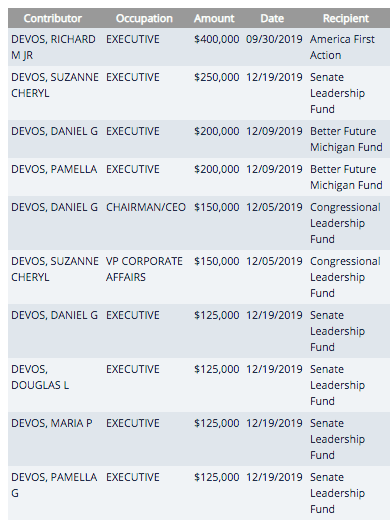
However, the DeVos family is also committed to using their vast wealth to influence electoral outcomes across the US, specifically in federal races. According to the Center for Responsible Politics, which tracks political contributions by state, by city and by zip code, the DeVos family dominates campaign contributions for the current electoral cycle. Based on the latest FEC filings, you can see how much the DeVos family has contributed so far to national elections for the 2020 election cycle.
With just these 10 contributions by the DeVos family, they have contributed $1,850,000. That is an incredible amount of money, considering this was only in the top 10 listings for 2019.
Some people might be familiar with the organizations listed as recipients of the DeVos money, but these are not necessarily household names, like America First Action, the Senate Leadership Fund, the Congressional Leadership Fund and Better Future Michigan Fund.
The Better Future Michigan Fund is primarily a fund that has gone to support Republic Senatorial candidate John James, or more specifically to attack his opponent Senator Gary Peters. However, the website and the Facebook page also seek to discredit proposals like Medicare for All and the Green New Deal.
America First Action is a PAC that also endorses a GOP platform and attacks Democratic candidates. Their mission statement is rather instructive:
For eight long years, America was held hostage by an administration where our hopes, dreams and values were sold, piece by piece. Winning became a bad word and apologies, the norm. Our jobs went overseas, our products made by foreign companies. We no longer were a first place America.
The statement is very misleading, since jobs going overseas has happened under both Republican and Democratic administrations, as well as a GOP or Democratic controlled Congress.
The Congressional Leadership Fund and the Senate Leadership Fund are both designed to gain Republican control of the House and the Senate. In addition, the candidates and the platforms that they promote are platforms that favor the Capitalist class, disproportionately hurt black and brown communities, to not support expanding worker protections or workplace democracy, do not support the LGBTQ community, are anti-environmental and do not support policies like Medicaid for All.
Since the DeVos family are major contributors to these organizations, they also support the candidates and the policies they put forth, policies that are far right and promote white supremacist, anti-labor and anti-environmental values. Remember this the next time you look fondly on Start Garden, AmplifyGR, Artprize or any of the other DeVos funded projects. The DeVos family is Michigan’s #1 Robber Baron family that should be vilified.
My Letter to the GR City Commission in support of a Driver’s Licenses for All Resolution
 Today, the Grand Rapids City Commission will be voting on a “resolution urging the Michigan Legislature to amend state law to allow qualified undocumented immigrants to obtain a driver’s license. If you support Driver’s Licenses for All, please send a letter to the Grand Rapids City Clerk (cityclerk@grcity.us) before 5pm today (Tuesday, March 17) and include as your E-mail heading “Committee of the Whole item 3.”
Grand Rapids City Commissioners and Mayor Bliss
For the past three years I have been working with Movimiento Cosecha GR and GR Rapid Response to ICE on immigrant justice issues. A great deal of this work has been to resist the very real harm being done to the undocumented/under-documented community, harm in the form of arrest, detention and often deportation.
In addition, most of the ICE arrests have targeted the primary income earners within immigrant families, thus leaving these families faced with an extremely insecure economic future. Add to this reality is the fact that having a family member arrested, detained or deported by ICE, also causes significant trauma, especially for children. The effects of the ICE-induced trauma on immigrant families is something that many of us have seen directly, but one of the things we know about trauma is that it will continue to impact these families for years to come.
Another major aspect of the work of Movimiento Cosecha GR and GR Rapid Response to ICE, is to center the lived experience of the undocumented/under-documented community. This is exactly why Movimiento Cosecha GR is an immigrant-led movement, which has been hearing for at least the last 2 years that getting driver’s licenses for undocumented/under-documented immigrants has been the number one priority.
We also know that one of the main ways that undocumented/under-documented immigrants end up in ICE custody is because they have been stopped by local law enforcement for something like a faulty tail light. Once members of the undocumented/under-documented community are stopped by local cops, they either ended up in the Kent County Jail or get a citation to appear in court. In both cases, ICE is notified and undocumented/under-documented immigrants are then being detained by ICE.
Therefore, if the City of Grand Rapids is committed to supporting the undocumented/under-documented community and reducing the amount of ICE violence, then it is urgent that the City adopt a resolution in support of Driver’s Licenses for All.
GRIID Interview on the creation and purpose of the Grand Rapids Area Mutual Aid Network
 We posed a few questions to those who have been instrumental in facilitating the creation of the Grand Rapids Area Mutual Aid Network.
The work of the Grand Rapids Area Mutual Aid Network is still evolving, with new ideas and new opportunities being posted daily. We encourage you to like the page, to share the information with your networks and to think about how we can organize ourselves outside of the limiting capitalist framework and promote cooperation and collective liberation.
In January, we reported on Medicaid Work Requirements that Michigan had adopted in 2018, but were to begin on January 1st of this year. The Medicaid Work Requirements bill was supported by the West Michigan Policy Forum, which is made up of the most powerful individuals and families in West Michigan.
Yesterday )March 12), the Michigan House of Representatives voted on Concurrent Resolution 17, which would, “urge the United States Secretary of Health and Human Services to appeal the federal court ruling invalidating the waiver for Michigan’s Medicaid work requirements, defend the waiver, and uphold its intended purpose of encouraging self-sufficiency.”
Yesterday’s vote was a response to a judge’s ruling, which invalidated the waiver for the work requirements on March 4.

What is instructive about the vote, but not surprising, is that of the 56 Republican legislators that vote in favor of the resolution, 36 of them have members of the Grand Rapids Power Structure listed as major campaign contributors.
Most of those who received campaign contributions from members of the Grand Rapids Power Structure, received money from the DeVos family. However, there were some who voted to continue Medicaid Work Requirements that received campaign funding from other powerful people in West Michigan, such as Peter Cecchia, John Kennedy, the Meijer family and Michael Jandernoa. All of these men are also involved in the West Michigan Policy Forum.
It is important that we acknowledge that these men who have tremendous political, economic and social influence in the Greater Grand Rapids Area, are funding politicians that does harm to working class individuals and families, primarily because it fits within their ideological framework and because it directs money away from working people.
In addition, it is clear that these politicians do not care about the well being of working people, especially now with the coronavirus crisis. Those that voted in favor of Medicaid Work Requirements is nothing short of cruelty.
Below is a listing of the Republicans in Michigan that voted for the resolution, along with a link to their campaign funding history. Those who have an N after their name, did not receive campaign funds from those who are part of the Grand Rapids Power Structure.
Afendoulis http://mcfn.org/donor-tracking?candidate=137
Albert http://mcfn.org/donor-tracking?candidate=104
Alexander http://mcfn.org/donor-tracking?candidate=129
Allor http://mcfn.org/donor-tracking?candidate=94
Bellino (N) http://mcfn.org/donor-tracking?candidate=68
Berman http://mcfn.org/donor-tracking?candidate=17
Bollin (N) http://mcfn.org/donor-tracking?candidate=122
Brann http://mcfn.org/donor-tracking?candidate=133
Calley (N) http://mcfn.org/donor-tracking?candidate=105
Chatfield http://mcfn.org/donor-tracking?candidate=88
Cole http://mcfn.org/donor-tracking?candidate=90
Crawford http://mcfn.org/donor-tracking?candidate=79
Eisen (N) http://mcfn.org/donor-tracking?candidate=100
Farrington http://mcfn.org/donor-tracking?candidate=78
Filler (N) http://mcfn.org/donor-tracking?candidate=115
Frederick http://mcfn.org/donor-tracking?candidate=103
Glenn http://mcfn.org/donor-tracking?candidate=109
Green http://mcfn.org/donor-tracking?candidate=102
Griffin http://mcfn.org/donor-tracking?candidate=10
Hall http://mcfn.org/donor-tracking?candidate=119
Hauck http://mcfn.org/donor-tracking?candidate=4
Hernandez (N) http://mcfn.org/donor-tracking?candidate=101
Hoitenga http://mcfn.org/donor-tracking?candidate=6
Hornberger http://mcfn.org/donor-tracking?candidate=84
Howell http://mcfn.org/donor-tracking?candidate=97
Huizenga http://mcfn.org/donor-tracking?candidate=116
Iden http://mcfn.org/donor-tracking?candidate=118
Johnson http://mcfn.org/donor-tracking?candidate=138
Kahle http://mcfn.org/donor-tracking?candidate=130
LaFave http://mcfn.org/donor-tracking?candidate=91
Leutheuser (N) http://mcfn.org/donor-tracking?candidate=120
Lightner http://mcfn.org/donor-tracking?candidate=13
Lilly http://mcfn.org/donor-tracking?candidate=106
Lower http://mcfn.org/donor-tracking?candidate=136
Maddock (N) http://mcfn.org/donor-tracking?candidate=121
Marino http://mcfn.org/donor-tracking?candidate=75
Markkanen (N) http://mcfn.org/donor-tracking?candidate=87
Meerman (N) http://mcfn.org/donor-tracking?candidate=9
Miller (N) http://mcfn.org/donor-tracking?candidate=125
Mueller http://mcfn.org/donor-tracking?candidate=148
O’Malley http://mcfn.org/donor-tracking?candidate=95
Paquette http://mcfn.org/donor-tracking?candidate=128
Reilly (N) http://mcfn.org/donor-tracking?candidate=144
Rendon http://mcfn.org/donor-tracking?candidate=93
Sheppard (N) http://mcfn.org/donor-tracking?candidate=131
Slagh http://mcfn.org/donor-tracking?candidate=108
VanSingel (N) http://mcfn.org/donor-tracking?candidate=96
VanWoerkom http://mcfn.org/donor-tracking?candidate=113
Vaupel (N) http://mcfn.org/donor-tracking?candidate=123
Wakeman (N) http://mcfn.org/donor-tracking?candidate=112
Webber http://mcfn.org/donor-tracking?candidate=141
Wendzel (N) http://mcfn.org/donor-tracking?candidate=98
Wentworth http://mcfn.org/donor-tracking?candidate=110
Whiteford (N) http://mcfn.org/donor-tracking?candidate=99
Wozniak (N) http://mcfn.org/donor-tracking?candidate=81
Yaroch (N) http://mcfn.org/donor-tracking?candidate=86
How the revolutionary priest & poet, Ernesto Cardenal, helped to radicalize my life nearly 40 years ago
 On March 1st, Ernesto Cardenal, the Nicaraguan priest & poet, died at the age of 95. Cardenal is known in some circles as the Minister of Culture in the Sandinista government, after the Sandinistas ousted the US-backed dictator Anastasio Somoza in July of 1979.
Other people know about Cardenal, because of his role in founding the religious community in Nicaragua, known as Solentiname.
I first came to know of Cardenal when I was reading he works of Thomas Merton, the Trappist Monk who’s writings were very influential in my early 20s. I was living in Puerto Rico in 1981 and teaching in a barrio school. I was exploring Catholicism and was encouraged to read the numerous books by Thomas Merton.
Cardenal had participated in a failed uprising against Somoza in the 1950s, which resulted in the death of many of Cardenal’s friends. Cardinal decided to leave Nicaragua and he came to the US and entered the same monastery that Merton was part of, the Trappist Monastery of Gethsemane in Kentucky. Cardenal was a novice and Merton was one of his teachers. Cardenal did not stay, but his time there was rather impactful, since he influenced his decision to go back to Nicaragua and help found the religious community in Solentiname.
Solentiname adopted some monastic qualities, but it was also influenced by liberation theology, a theology that was initially developed by Peruvian theologian, Fr. Gustavo Gutierrez.
However, Cardenal did not believe in divorcing himself from the world and he maintained a connection to the growing revolutionary movement that was organizing in the 1970, particularly around the FSLN, the Frente Sandinista de Liberacion Nacional. After the Sandinistas overthrew the Somozan dictatorship, Cardenal was asked to be the Minister of Culture. In fact, several other priests were asked to be part of the Sandinista government, including Cardenal’s brother and Fr. Miguel D’Escoto.
After teaching in Puerto Rico for a year, I moved to Grand Rapids in the summer of 1982. I was hired by St. James Catholic Church on the westside to be their youth minister. I quickly became friends with Tom Pieri, who was the head of the Social Justice committee at St. James. Tim had organized an evening of clarification, which consisted of a simple meal and focused theme for discussion, which also included two priests from Grand Rapids who had just returned from Nicaragua on a fact finding mission after the Sandinista revolution.
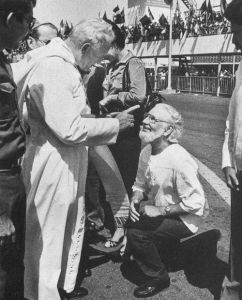
The two priests spoke favorably about the changes that had taken place in Nicaragua. They also shared that the Catholic hierarchy was not terribly supportive of what the Sandinistas were doing and that there were so many priests involved. The same time that these two priests were in Nicaragua, Pope John Paul II was visiting in Managua. Ernesto Cardenal went to be part of the delegation to greet the Pope. When the Pope descended from the airplane, Cardenal knelt on the tarmac, as was customary when greeting the pontiff. Cardenal attempted to kiss the Pope’s ring, but John Paul II did not extend his hand, instead he waved his finger at Cardenal and scolded him for being involved in politics.
 Upon hearing this story I was puzzled that the head of the Catholic Church would reprimand people for being involved in trying to create a more just form of government. Why would the Pope chastise priests who were trying to insert gospel principles in their various positions in government?
Well, the priest at St. James heard about the evening of clarification and was livid, in part because he was not informed that there would be two priests speaking, but mostly because he took the Pope’s side on this matter.
A few months went by and I went to mass one Sunday morning at St. James. The priest did not give the sermon that day. Instead, the priest had invited a Nicaraguan to speak, a Nicaraguan who was living in Ann Arbor, Michigan in exile. This Nicaraguan was not a supporter of the Sandinista revolution and in fact was part of a far-right Catholic Charismatic community that was bank-rolled by Domino’s Pizza owner Tom Monaghan.
A few weeks later, the priest I worked for, then told me that he had arranged for me to go to Ann Arbor to stay at this religious community to “get my mind right.” I told him that I already had several commitments as youth minister, but he told me that I could cancel whatever plans I had and that this was more important. I resisted and told him that I did not want to go and that I was hear to work with the youth of the congregation. He told me that he could not have people working for him that were disobedient and he fired me on the spot and said I needed to pack my things and leave immediately.
I was pissed, but gladly packed my things, since I no longer wanted to work for such an authoritarian. I found out years later that this same priest had sexually assaulted several people while I St. James.
Fortunately, I found a place to stay temporarily and this incident led me to the decision to enter the seminary in the Grand Rapids diocese. While I was in the seminary, I read a series of letters that were exchanged between Ernesto Cardenal and Dan Berrigan. Cardenal was first writing about the importance of the Sandinista revolution, but Berrigan had criticized the Nicaraguan poet for supporting a revolution that involved the killing of people. Cardenal responded back to Berrigan, saying that his moral judgement was from a position of privilege and that unless he had experienced the repression of living under a dictatorship, he could not comprehend why Cardenal fully endorsed the Sandinista revolution.
I was only in the seminary for one year, but the incident at St. James, centered around differing ideological positions on Nicaragua, would have a tremendous impact on me, since Central American solidarity work became a large part of the organizing work I did from 1984 through the present. Until I went to do solidarity and accompaniment work in Guatemala in 1988, I was pretty committed to non-violence, both ideologically and in practice. However, after seeing the level of repression that people experienced and listening to labor organizers, campensinos, widow’s groups, the Mothers of the Disappeared and student organizers, I understood Cardenal’s response to Berrigan.
Then, in 2009, Ernesto Cardenal came to West Michigan to speak and read his poetry at several venues. He read his poetry at Fountain St. Church and one of the organizers of this event ask several people if they would read his poems in English, after Cardenal had read them in Spanish. I was honored to be one of those people.
After the event, I was able to visit with Ernesto briefly, listening him talk about what he had been doing in recent years. I brought a copy of a book of his poetry and asked him to sign it to my brother, especially since my brother was the one who introduced me to Merton in 1981, which led me directly to Cardenal’s work.
I stopped identifying with the Judeo-Christian tradition nearly 30 years ago, but I recognize the impact that those early years had in my formation, plus I continue to try to practice the kind of collective liberation that Cardenal and so many others introduced me to. Gracias Companero Ernesto. Descansa en paz.
Grand Rapids Police Officers Association uses William Barr’s comments in an attempt to silence critics
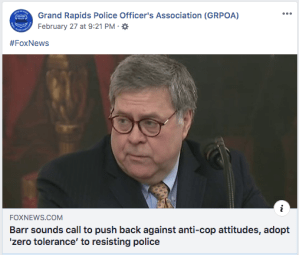 “Being a police officer is more difficult than it’s ever been before, One reason is the emergence of a deeply troubling attitude towards police in some parts of our society. Far from respecting the men and women who put their lives on the line to protect us, it is becoming common in some quarters to scapegoat the police … and disparage the vital role played by law enforcement in our society.” US Attorney General William Barr
The above statement from William Barr, is from a speech he gave at the International Association of Chiefs of Police event in Miami at the end of February.
The GRPD police union, the Grand Rapids Police Officers Association, liked so much what Barr had to say, they posted a Fox News story about the speech in late February on their Facebook page.
That’s right, the police union in Grand Rapids is using the words of William Barr as a defense against any criticisms of the GRPD. Let’s be clear, William Barr is a man who has been complicit in the criminal actions, the fear mongering and the white supremacy of the Trump administration since he became the US Attorney General in February of 2019.
Yet, the GRPD union feels it’s necessary to use the words of a man who protects the White House from being prosecuted for criminal behavior. Put another way, you have the top lawyer in the nation, who protects Trumps crimes, telling the Association of Police Chiefs that we should not tolerate any criticism of police.
On top of that you have the Grand Rapids Police Officers Association holding up Barr as a great defender of law & order, which is rather ironic, considering that the GRPD union has in recent years gone after anyone – elected officials, community groups, social movements – that have challenged the harassing, intimidating and violent actions of the Grand Rapids Police Department.
It is well known that the GRPD has targeted black and brown youth in recent years, pulling guns on these young people, have engaged in racial profiling, have been caught on video beating residents and have gone out of their way to harass, threaten, intimidate, spy on groups like Movimiento Cosecha GR and GR Rapid Response to ICE.
Despite the well documented practices of the GRPD using violence and intimidation against communities of color, the Grand Rapids Police Officers Association has the audacity to use Barr’s comments in an attempt to silence critics. If the cop union doesn’t want people to be critical of their actions, then it might be time for the GRPD to stop harassing, intimidating, traumatizing and brutalizing people of color in this city.
MLive only asks the Mayor of Grand Rapids if there has been progress made after her first term
 On Tuesday, MLive posted an article with the headline, A look back at Rosalynn Bliss’ first term as Grand Rapids mayor.
Near the beginning of that article it states:
Those priorities were wide in scope, including to improve racial equity and community-police relations, increase affordable housing, reduce homelessness, strengthen local schools and grow the local economy, among others.
The MLive story provides a fairly clear path for readers to determine whether or not Mayor Bliss was able to achieve the goals she laid out in 2016, with the 6 areas listed above. The question we should be asking ourselves is whether the MLive article provides us with an accurate assessment of whether or not the Mayor met those goals.
The MLive article is laid out in sections that deal with most of the 6 areas identified, but the only source cited in the article was Mayor. This type of journalism tends to provide a forum for those with political power, but without much verification. For instance, Mayor Bliss is quoted as saying:
“Our local economy is strong. You’ve seen a lot of development and energy downtown, and you see a lot of energy and vibrancy and growth in our neighborhoods. A lot of people want to move to our city and I think that’s a positive thing.”
What the Mayor said might sound nice, but the MLive writer provides no verification of whether or not the economy in Grand Rapids is doing well. It is true that more people are moving into the city, but that does not necessarily reflect how well the economy is doing and it certainly doesn’t take into consideration “for whom” is the economy doing well.
This begs the question as to why no other sources were cited. Wouldn’t it be more accurate or more complete to get feedback from people in the community, especially people who are working on these issues and those who are directly affected by them?
Affordable Housing
The MLive ariticle acknowledges that the Mayor established a Housing Advisory Committee and that most of the 11 recommendations were adopted. (The Housing Advisory Committee was made up of developers and non-profits representatives, but did not include those who are experiencing housing insecurity) However, just because a committee was created and some of their recommendations were adopted is not an indication that more affordable housing was created in the city. The City of Grand Rapids does list what has been accomplished in regards to affordable housing between 2012 and 2016, but this is not current data that would apply to the first term of Mayor Bliss. In addition, there is no data that reflects how many people have left Grand Rapids, especially renters who could no longer afford the increased cost of renting.
Homelessness
The MLive article suggests that veterans are no longer homeless in Kent County because they are now connected to resources, but this is not a clear indication that no US military veterans are homeless.
In regards to non-veteran homelessness, the Mayor acknowledges that there are lots of families with children who “are struggling” with housing stability and that there needs to be a more systemic solution. Unfortunately, there is no data provided on how many people are experiencing homelessness or housing instability. The article does say that the Mayor is working with the county and private partner to address the issue of homelessness. This is also not an answer and it doesn’t provide a clear benchmark as to how the problem will be solved. Will there be a push by the city to adopt a living wage policy, so people can afford stable housing, especially since the Mayor acknowledges that the problem is systemic. You cannot solve the housing crisis of any kind without having economic justice.
Racial Equity
Again, Mayor Bliss is the only source on the topic of Racial Equity cited in the MLive article. On the matter of racial equity it is mentioned that there was a commitment by the City to hire more minority-owned businesses. This is a good thing, but the reality is that most black and brown people in this community don’t own businesses and are, like most people, workers.
The article also states that the City just came out with an Equitable Economic Development & Mobility Strategic Plan. However, this plan leans heavy towards creating and providing support to minority-owned businesses and does not address the wealth gap that exists between white people and minorities. In addition, like the Housing Advisory Committee, those involved in creating the strategic plan are not people who are economically struggling, meaning people whose lived experience could offer ideas about how to create economic justice.
Lastly, on the matter of “growing the economy,” the MLive article cites Bliss saying she is proud of getting a Food Truck ordinance, economic development around Medical Mile and getting the insurance company, Acrisure, to move to Grand Rapids. The question we should ask here is how are any of these three things creating more racial equity in the City of Grand Rapids?
Living in a Safe Community
The last area mentioned in the MLive article has to do with public safety and strengthening relations between the police and the community. Bliss again is cited as saying that she commended the GRPD for establishing its youth-interaction policy in 2018 and foreign nationals policy in 2019. Here, the question should be asked whether or not either policy has led to less police abuse of children of color or of undocumented immigrants? Again, no evidence is provided to support these policy changes or whether or not black and brown communities feel safe with the police in their neighborhoods. This is where having other voices would not only be useful, but critical for actually being able to determine if any change has been made that the public can identify.
 This MLive article falls short in so many ways. It fails to include real data or evidence to support any of the claims made by the Mayor. The article does not include other voices, which would provide a greater perspective on what has or hasn’t been accomplished in Grand Rapids over the past 4 years. Lastly, those most impacted by the housing crisis, racial inequity or police abuse are not included in the article. In fact, one could argue that these perspectives are equally or even more important than what the Mayor thinks, since these are the people who have actually experienced harm because of the larger structural issues of housing instability, racial inequity and police abuse. Maybe the City should invest in getting input from the entire community on these matters. Until then, its all political speak and doesn’t mean anything to people who are being displaced, who are homeless, who are experiencing poverty and who have little or no trust in law enforcement in this city. How would you grade the City of Grand Rapids on these matters???
(Note: On Tuesday, March 3, the Grand Rapids Mayor gave her annual State of the City speech at a private venue to an invite only crowd. I’ll bet that those who are homeless, experiencing housing instability, those experiencing poverty or living in fear of the GRPD were not on the invite list.)
 Grand Rapids Institute for Information Democracy