The Devil is in the Details 4/27/2021: How the GRPD responds to protests, or as they like to call them – expressive speech events
This is our latest installment of The Devil is in the Details, which takes a critical look at Grand Rapids politics and policies, based primarily on the public record, such as committee agendas and minutes.
There are two main issues we want to draw your attention to, with involving the GRPD and the other has to do with the City’s Legislative Agenda for the coming year.
On pages 6 – 7 from the packet for the Public Safety Committee, Police Chief Payne is providing a report to the committee on what he is calling, expressive speech events. This is the GRPD language for protests. It’s a bullshit term – expressive speech events, since it not only minimizes the seriousness of the issues being addressed during protests, but it works in there GRPD’s favor, since it provides them with an excuse to suppress protests that do not following city code.
According to the Chief Payne’s document, someone contacted the police on March 27, complaining about a noise ordinance violation, because members of Justice for Black Lives had gathered on the steps of the art museum, without a permit and were using amplified sound, thus violating the City’s noise ordinance. What Chief Payne does not disclose is that a cop came up from behind one of the protesters, knocked him down to the ground and then arrested him. There was no warning about amplified sound, the cops just tackled him and then tried to arrest other individuals.
Later in the document, Chief Payne then lays out 4 bullet points on what his officers will do related to expressive speech events:
Protect the Free Speech and Assembly Rights of individuals and groups within the parameters of the City Code. By including the words, “within the parameters of the City Code,” the GRPD then can chose to enforce whatever city code they want that they think is being violated at any time. In the past 40 years that I have organized or attended a protest in downtown Grand Rapids, the GRPD has always selectively enforced city code violations. There have been times when hundreds of people have walked in the streets and then GRPD has done nothing. And there have been times when smaller groups attempted to walk in the street and they arrested people.
Then there is the issue of noise ordinances and sound amplification. You mean to tell me that flying helicopters in neighborhoods at night time is not a city code violation? The fact is that when the GRPD uses helicopters in neighborhoods, they are except from violating the noise ordinance, because they are supposedly promoting public safety. In other words, the GRPD gets to enforce the ordinances when they want, with whom they want, plus they can choice to apply these city codes if and when they feel that those protesting are disrupting business as usual. The GRPD has the power and they can do whatever the hell they want.
Encourage all groups and individuals to follow the permitting process and expressive speech policies set by the City. It’s a fucking protest, so people do not need the City’s permission.
Only step in when there are violations of the expressive speech policies or other applicable laws, statues and ordinances. This is just to say they will arrest you when they want, with whatever justification they chose.
Hold all members of the Department to the highest standard of accountability and transparency. Sorry, but the GRPD rarely does this and in the few incidents that they do hold cops accountable, the Grand Rapids Police Officer’s Association will step in a file an appeal, which gets the cop off the hook. See the case of Captain Kurt VanderKooi.
On page 6 in the Public Safety Committee document Chief Payne said that he personally reviewed the Internal Affairs Unit investigation of the March 8th protest by Justice for Black Lives and found that his officers “followed policies.”
This is exactly why there needs to be an independent and autonomous entity to review these cases, with the intent to share this information publicly. When I say publicly, I mean with full transparency and not just something you say to a government committee.
As was stated earlier, there was a second issue, the City’s legislative priorities for the coming year, but since that topic is a bit lengthy, we’ll talk about in Part II of the Devil is in the Details.
Interview with Louis Moore on his book, We Will Win the Day: The Civil Rights Movement, the Black Athlete, and the Quest for Equality
We recently interviewed GVSU Professor Louis Moore on his book, We Will Win the Day: The Civil Rights Movement, the Black Athlete, and the Quest for Equality.
The book originally came out in 2017 in hardback, but will be republished in paperback form later this year. The new edition will also have a forward, which talks about all of the activism by Black athletes since 2016, plus it includes illustrations by another GVSU Professor, Brett Colley, some of which are included here.

The interview below is just over 28 minutes in length, and some of the questions we asked Professor Moore were:
What motivated you to write this book?
While people are probably familiar with Jackie Robinson, they may not have heard about Althea Gibson or the fact that there was also a color-barrier in the sport of bowling. Can you talk about these arenas of Black activism?
What makes the area of sports, particularly professional sports, such an important area for Black athletes to either make a statement or to support existing movements, like the Movement for Black Lives?
What is the same about the Black Athletes who were part of the movement in the 50s and 60s and the Black Athletes who are fight for racial justice today? And how are they different?
Acton Institute on the Derek Chauvin trial verdict: Black Lives Matter riots are the real problem
On the day of the Derek Chauvin trial verdict, the Grand Rapids-based Acton Institute once again shows us what they really stand for.
In an article posted just after the verdict was read, the Rev. Ben Johnson, who is the Executive Editor of the Acton Institute’s main journal Religion & Liberty, wrote, Derek Chauvin guilty, but riots will hurt Minneapolis for generations.
Like the article that Rev. Johnson wrote last June, where he condemned the Movement for Black Lives, this most recent piece demonstrates his commitment to White Supremacy.
In Rev. Johnson’s article, he begins by attacking Black clergy and Black politicians, then makes the claim that they spent weeks bullying the jurors into finding Derek Chauvin guilty of murdering George Floyd.
The Action Institute editor then goes on to claim that several mainstream news sources were doxxing jury members, which caused them to bring the guilty verdict upon Derek Chauvin.
Much of the rest of the article by Rev. Johnson then condemns both BLM and Antifa for the riots that broke out after Chauvin murdered George Floyd. In addition to blaming BLM for the riots, Rev. Johnson then claims that the riots primarily hurt the poor and Black neighborhoods. Of course, Johnson offers no real evidence to support such claims.
Rev. Johnson, who is a Catholic priest, then says that BLM-inspired protestors have been burning churches.
What is instructive about the article by Rev. Johnson, is that George Floyd’s name isn’t mentioned once, nor are the number of cases where police officers have killed Black people in the past year. It is obvious to most people, that the riots/rebellions that have taken place since last year are the direct result of cops killing Black and Brown residents in Minneapolis and other cities across the country.
This most recent article by the Acton Institute simply demonstrates their ideologically driven commitment to White Supremacy. Maybe it’s time we start holding protests outside of the Acton Institute headquarters, which is right on the corner of E. Fulton and Sheldon in Grand Rapids, just one block away from the GRPD headquarters.

City of Grand Rapids and GRPD release memo that threatens those who would protest the outcome of the Derek Chauvin trial
On Monday, City Manager Mark Washington and Police Chief Eric Payne released a memo that despite its rhetoric, is nothing short of a threat against those who would disrupt business as usual once the outcome of the Derek Chauvin trial has been decided.
The memo begins by saying, “As the murder trial of Derek Chauvin comes to an end, the City of Grand Rapids reaffirms its steadfast commitment to improve policing in our community, enhance our service, building trust and partnerships, and working to be a model in community-police relations.”
These comments are meant to divert people away from the rage and frustration they feel about precisely how policing is done across the country and in Grand Rapids. These opening words also demonstrate that City officials and the GRPD are desperately hoping that the community will not respond the way they did on May 30th last year.
In fact, it is my contention that the only reason that the GRPD adopted mild reformist policies in their new strategic plan, is precisely because they knew they had to throw the public a bone so as to appear to want to build trust with the community. One could certainly argue that the hundreds of people who protested in the streets last May, along with the burning of cop cars, broken windows and appropriation of wealth that took place was the real cause of the GRPD adopting any mild reformist policies. Had the protest on May 30th been another quiet vigil or another march with nothing more than chants, the GRPD would not have felt compelled to change a damn thing.
The City/GRPD memo goes on to say, “Whatever the outcome of this trial, we know people will be emotional and passionate in their reactions. We know people will want to express that emotion and have their voices heard. And as always, we stand ready to protect the rights of free speech and peaceful assembly. We must also be on guard for those who seek to exploit these events to undermine the work we’ve already begun.”
First, the GRPD does not really protect free speech rights and peaceful assembly. For the past 40 years, I have witnessed how the police always show up to a protest to either try to manage what people want to do, or they outright use intimidation, threats and force to prevent people from speaking their minds or gathering with others who are pissed off about some injustice. Just look at the recent examples of how the GRPD has targeted Justice for Black Lives organizers and you can see how they don’t give a shit about people’s rights. Second, the GRPD, on the behest of the Grand Rapids Power Structure, will only allow people to protest if it is done in a way that doesn’t threaten power. They want people to talk to the GRPD before the protest, get a permit, stay out of the street, be nice, talk about unity, say some prayers and then go home. Anything form of protest that doesn’t fit inside that model will be scrutinized and the organizers will be harassed, intimidated, threatened and possibly arrested. Third, when the City/GRPD says people will seek to exploit these events, they are really saying that anyone who doesn’t follow their orders will be dealt with harshly. Also, what work has the City/GRPD already begun? They still want to dictate how things happen and have resisted any and all efforts from the community for accountability, alternatives to policing and have vehemently opposed any possibility of defunding the GRPD.
The City/GRPD memo then makes clear what the real intention of the memo, by stating:
We should not and will not allow our community to be further divided by those whose aims are not healing but harm – to our people, our businesses and our City. We have come too far together in these last eight months.
We have made the necessary preparations to respond as needed.
For those who are planning to take part in the protest after the results of the Derek Chauvin trial, the GRPD will not allow people to do anything that does not fit into their pre-determined and acceptable forms of dissent. People should expect to see a massive police presence for the protest, with the likelihood that other municipal police and the Sheriff’s Department will also be involved. People should also be prepared and on the lookout for cops in plainclothes, acting as infiltrators, for the purpose of gathering information and arresting people who say or do the wrong thing.
Last year, after months of pressure, Movimiento Cosecha GR and GR Rapid Response were able to get some Freedom of Information Act (FOIA) documents pertaining to the GRPD’s preparations for the non-violent march that was organized for May 1st, 2019. You can read the entire FOIA documents at this link, but here below was what the GRPD was planning before the march even began.
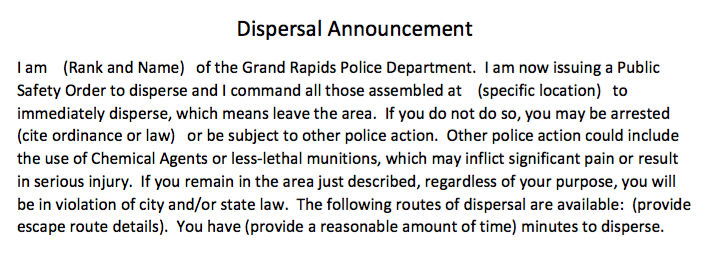
One can expect that the GRPD will do something similar when there is a protest following the verdict in the Derek Chauvin trial.
The City/GRPD memo should demonstrate to the public that the local power structure will not tolerate any disruption in this city and that they are prepared to use deadly force if necessary to prevent efforts to engage in any kind of resistance, disruption or righteous indignation.
What the City officials and the GRPD do not understand is that people who resist, who disobey, who disrupt will not just be responding to the outcome of the Derek Chauvin trial, but to the cumulative rage over the numerous incidents of police murder and police brutality mostly directed towards the Black community. In addition to the actions of police departments all across the US and right here in Grand Rapids, the righteous indignation is also a reflection of the cumulative frustration that people have over systemic forms of discrimination, being forced to live in poverty, being subjected to mass incarceration, inadequate educational opportunities, living in substandard housing, the affects of gentrification and a whole host of other forms of injustice that takes a toll on our collective humanity.
In the book, Why Don’t American Cities Burn?, by Michael Katz, the author argues that whenever there are riots, uprisings or rebellions in the US, “in almost every instance, police actions had ignited long-standing grievances whose roots lay in racism and economic deprivation.”
People don’t riot in a vacuum, they riot because of much larger grievances. This was the case with the 1967 riots and the uprising that began last May in Grand Rapids. Police actions and police repression are just the spark that people need to take matters into their own hands.
For those wanting to engage in righteous indignation after the outcome of the Derek Chauvin trial, Justice For Black Lives is calling for people to gather in downtown Grand Rapids on Breonna Taylor Way at 5pm on the day of the trial verdict.
Senator Peters visits the US/Mexican Border, praises US Customs and Border officials, gets excited about new border security weaponry
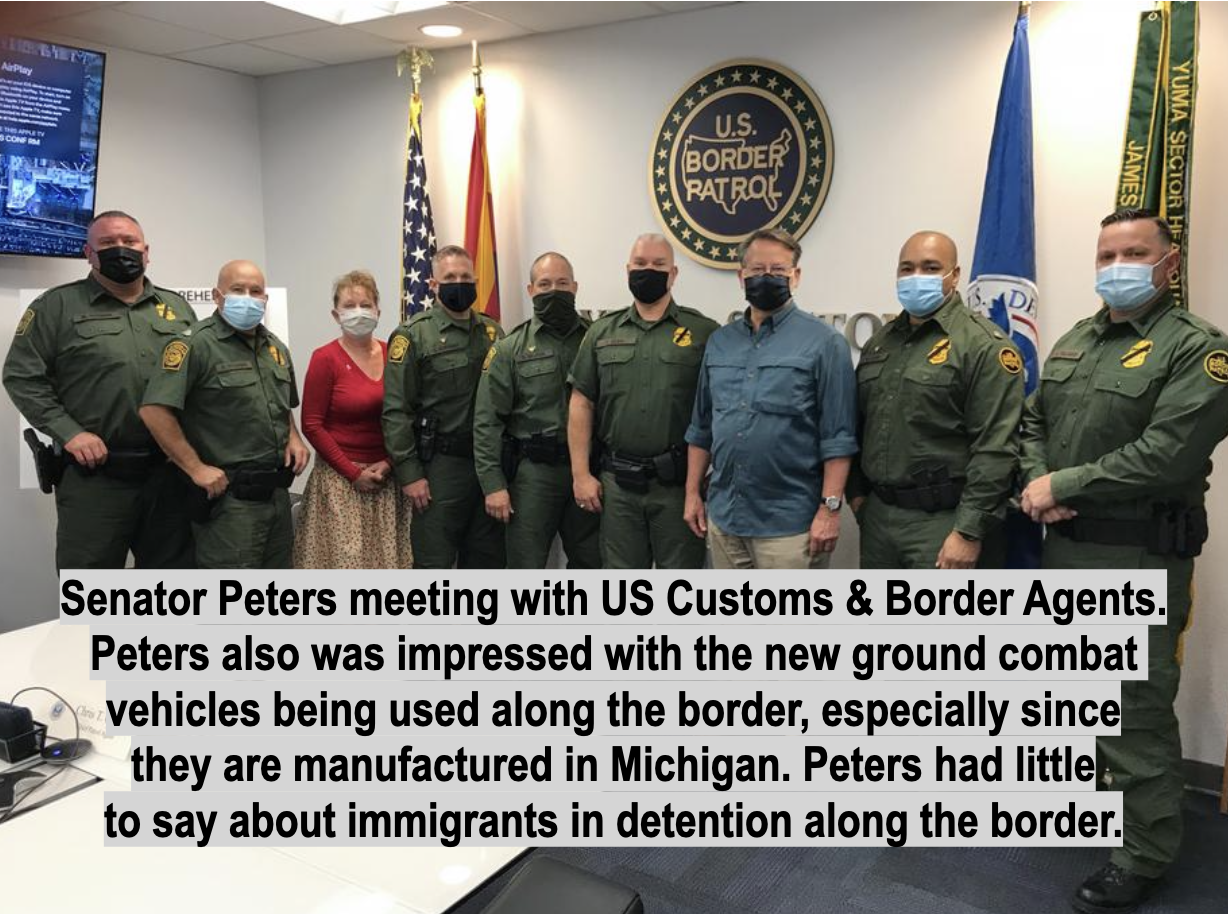
Earlier this month, Michigan Senator Gary Peters visited the US/Mexican border to meet with US Customs and Border officials.
The trip by Peters didn’t receive much media attention, especially by Michigan-based news sources.
We only came across this story by reading a Media Release from Senator Peters’ website, which stated in part:
“I appreciated the opportunity to visit the Southern Border and to hear from officials on the ground about the work they’re doing to meet our security and humanitarian challenges,” said Senator Peters, Chairman of the Senate Homeland Security and Governmental Affairs Committee. “I’ll continue to work with the Biden Administration, my colleagues in Congress, and relevant officials and agencies to ensure our borders are secure and that unaccompanied children and asylum seekers are treated in a humane way and can have their applications processed efficiently.”
According to a story in the Dallas Morning News, the trip was closed to the news media. That same article in the Dallas Morning News also spent a great deal of time discussing the immigration crisis, sharing stories from immigrants who are in detention and discussing the Mexican government’s compliance with the Biden administration’s request to increase the militarization of their borders.
Senator Peters alludes to the militarization of the US/Mexican border as well, but in a positive fashion, by stating in his Media Release:
“I was impressed by the Yuma Proving Ground and the critical testing of new technologies there that will define the future of warfare,” said Senator Peters, who is a member of the Senate Armed Services Subcommittee on Emerging Threats and Capabilities. “Ensuring that our military is prepared to face ever-evolving threats will continue to be one of my top priorities.”
Such a statement from Peters is not surprising, not just because he is Chairman of the Homeland Security, but because he is deeply committed to funneling Pentagon contracts to private companies, like the one based in Warren, Michigan, which makes combat vehicles used by the US Border Patrol, mentioned in the Senator’s Media Release.
This dynamic of supporting the militarization of the US/Mexican border has been part of the Democratic Party’s platform for decades. Sure, the Democrats were against the Trump wall along the US/Mexican border, but that was just a tactical difference and good optics, The fact is that the Democratic Party has not only been supporting an increase of militarization of the border, which escalated during the Clinton administration, they have made “border security” a priority for a very long time.
Even when the Democrats talk about Comprehensive Immigration Reform, it always includes additional funding for border security, just like it did in the prosed 2013 bill that was defeated. When you hear border security, what that really means is an increase in funding to militarize the border, the use of technology – like the use of drones, an increase in surveillance, and a more punitive approach to dealing with undocumented immigrants attempting to enter the US. This is a theme that is well documented in Todd Miller’s latest book, Build Bridges, Not Walls: A Journey to a World Without Borders.
It is imperative that we come to terms with the fact that the militarization of the US/Mexican border, and immigration policy in general, is fundamentally a bipartisan affair. I encourage people to read Daniel Denvir’s book, All-American Nativism: How the Bipartisan War on Immigrants Explains Politics as We Know It.
The most recent visit by Senator Peters to the US/Mexican border, which was primarily about supporting US Customs and Border agents, along with praising new weapons technology along the border, should be seen as consistent with the bipartisan border policy that Denvir documents so well in his book.
One hundred and ten years ago this week, some 600-700 furniture workers in Grand Rapids went on strike for better pay, better working conditions and the right to form a union.
There is plenty to learn about the 1911 Grand Rapids Furniture Workers strike and we would recommend that people read Jeffrey Kleiman’s book, Strike: How the Furniture Workers Strike of 1911 Changed Grand Rapids, along with what the Grand Rapids People’s History Project has written about the topic.
It is worth noting that the 1911 strike lasted for several months, was supported by the Catholic Bishop, along with lots of residents, resulting in 10,000 people turning out for the Labor Day Parade just weeks after the strike ended. In fact, the furniture barons were so threatened by 1911 furniture workers strike, that they then ran a campaign to change the Grand Rapids City Charter in 1916, reducing the number of political wards in the city from 12 to 3.
As we reflect on the 1911 Grand Rapids Furniture Workers Strike, it is important to acknowledge that the strikers did not win. Despite not winning their demands, the furniture workers strike demonstrated to people in Grand Rapids that power can be challenged and that change can happen. The 1911 strike also made it clear to workers in the area that having the right to collective bargaining is extremely important and that anything is possible when organizing with your fellow workers.
Now the US labor movement has been on a stead decline since the 1950s, for a variety of reasons, such as the deindustrialization of the US, the lack of international worker solidarity, federal and state policies that have undermined labor unions and the mainstream union allegiance to the Democratic Party.
However, there is a growing interest in labor organizing, particularly amongst younger people, as can be seen in the $15 an hour campaign, the fast food worker campaign, the restaurant worker campaigns, the Coalition of Immokalee Workers, the public sector teacher union campaigns in several states and the most recent campaign to unionize Amazon workers.
Forming a labor union, a workplace union, is a powerful strategy to democratize any workplace. It’s important to have collective power in the places that we spend so much of our life, even if we make a livable wage and have good benefits, we should never underestimate the power that the business class has in our places of employment.
The percentage of people who are part of a union has been hovering around 10% of the labor force in the US, which is a far cry from the 40% of workers that were organized in the 40s and 50s. So, what can we do to promote more organizing amongst those who are not part of the business/capitalist class?
First, people should really consider starting a union in their place of work. When we organize where we are, not only can we make our work place more democratic, we demonstrate that direct action doesn’t rely on the existence of laws or policies. We can take collective power into our own hands and not wait for local, state or federal politicians to adopt policies that are labor friendly.
Second, joining a union doesn’t have to be limited to being part of a particular craft. We should adopt the same mindset that has governed the IWW since it was founded, which is to say that anyone could join as long as you were not a boss. That means that everyone else could be part of a union, whether you have a job or not, whether you are employed or not, whether you work in the home and take care of children or not, anyone who is not a boss can be organized.
Third, we need to develop better forms of international solidarity. For too long, business unions have supported capitalist policies abroad, which often undermines worker rights around the world. We have to stop buying into the idea that Vietnamese or Mexican workers are in competition with us. Instead, if we have solidarity with people around the world, then we realize it is the business/capitalist class that is against us. The more cross-border organizing we can do, the more likely we will be able to engage in actions that benefit workers everywhere and not just ourselves.
Fourth, those of us who are not part of the business/capitalist class are in the majority. Therefore, we can use our collective leverage to make larger social, political and economic demands. We need to stop just voting for the lesser of two evils and start making politicians bend to our will. This could take the form of creating worker-centered political parties, but it could also mean that if we are part of a union that we should demand that instead of making massive campaign contributions to the Democrats or Democratic candidates, we should use that money to support worker-led mutual aid project or pay people to organize workers in our communities.
In 2012, there were 10,000 people protesting the Right to Work law that the Snyder administration pushed through. I was part of a crowd of 250 people who went into the Lansing State Capitol to occupy the building to force the State government to rescind the Right to Work law. Most of the 10,000 stayed outside and made speeches, but what if all 10,000 had entered the building to demand that the Right to Work law be done away with? Instead, those who stayed outside pushed a strategy to get a Democrat elected as Governor. Why do we put our energy into electoral strategies that do not result in significant improvements in the lives of workers and their families?
In 2012, Labor groups spent $21.9 million to defeat the Right to Work law in Michigan, but lost anyway. Imagine if that $21.9 million had been spent to support mutual aid project for families and to provide funds to pay people to organize labor unions all across the state?
Fifth, building on this idea of workers using their collective wealth to support worker and their families, according to OpenSecrets.org, labor groups spent roughly $220 million dollars in the 2020 Presidential election. This amount, does not include how much labor groups spent at the state level on Congressional, State and local races. Again, imagine how $220 million could be used to provide mutual aid projects for families and how many people could be paid to organize in their workplace.
Besides engaging in direct democracy through labor organizing, we also have to ask ourselves how spending $220 million on elections has really benefited workers and their families across the country, particularly in terms of economics? I mean, we can’t even get the Democratic Party to adopt a $15 an hour minimum wage policy, which in all reality is grossly inadequate in terms of what the cost of living is no matter where you reside.
Sixth, the labor movement needs to make the wealth gap a major part of their analysis and strategy. We are all aware of how the billionaire class has expanded their wealth during the COVID pandemic. This is not some anomaly, rather it is the nature of the capitalist system to continue to direct massive sums of wealth to a small percentage of people, while most of the world’s population struggles to survive. Therefore, the labor movement has to adopt an anti-capitalist platform and stop believing that the system of capitalism can really benefit workers.
Seventh, the labor movement cannot operate in a silo and must see that their struggle is deeply connected to the struggles for Climate Justice and Immigrant Justice. The labor movement has to see that they cannot stand on the sidelines in the fight against White Supremacy or the anti-LGBTQ campaigns – particularly the anti-trans campaigns – that are happening all over the US. The labor movement has to see that the millions of families who are facing eviction, gentrification or homelessness are also people that do most of the actual work in this country. The labor movement must not only take a stand against all of these intersecting injustices, they have to be part of the larger coalitions to dismantle White Supremacy, anti-trans policies, fossil fuel extraction and other Neo-liberal policies that are attempting to privatize everything.
On the 110th anniversary of the Grand Rapids Furniture Workers Strike, let’s take inspiration from the hundreds of workers who took part in that strike, in their belief that when we practice solidarity we can achieve so much more, plus the value in seeing that, as the anti-globalization movement has taught us – Another World is Possible!
Image below was created by Ricardo Levins Morales.

Protest in Grand Rapids focuses on the police lynching of Daunte Wright, GRPD again threatens people for not being obedient
Yesterday, I attended the Justice for Black Lives rally/march centered around the police lynching of Daunte Wright.
A brief Media Release stated in part:
Protestors are demanding that justice be served, and that control of the police be given to the communities they claim to serve. The movement for Black liberation will not stand by and allow the police to murder people with impunity. If there is no justice, there will be no peace.
The event featured several speakers, some with Justice for Black Lives, as well as other people representing other organizations in the area. The organizers also offered an open mic opportunity for anyone to speak. One of the organizers with Justice for Black Lives, who had been arrested twice in the past month by the GRPD and was banned from being at Rosa Parks Circle, spoke via his phone and amplified with a bullhorn. His comments seemed to get people fired up and then all of a sudden this person started speaking loudly, because he was actually standing just north of Rosa Parks Circle. The crowd shifted from focusing on the stage at Rosa Parks Circle and had now moved in the direction that the “surprise” speaker who had been banned was talking. His appearance further energized the crowd, with a clear act of defiance.
After the speakers there was a 23 second moment of silence followed by a march that began at Rosa Parks Circle going east on Breonna Taylor Way, then west on Fulton, across the blue bridge, past the public museum, east on Pearl St and back to Rosa Parks Circle.
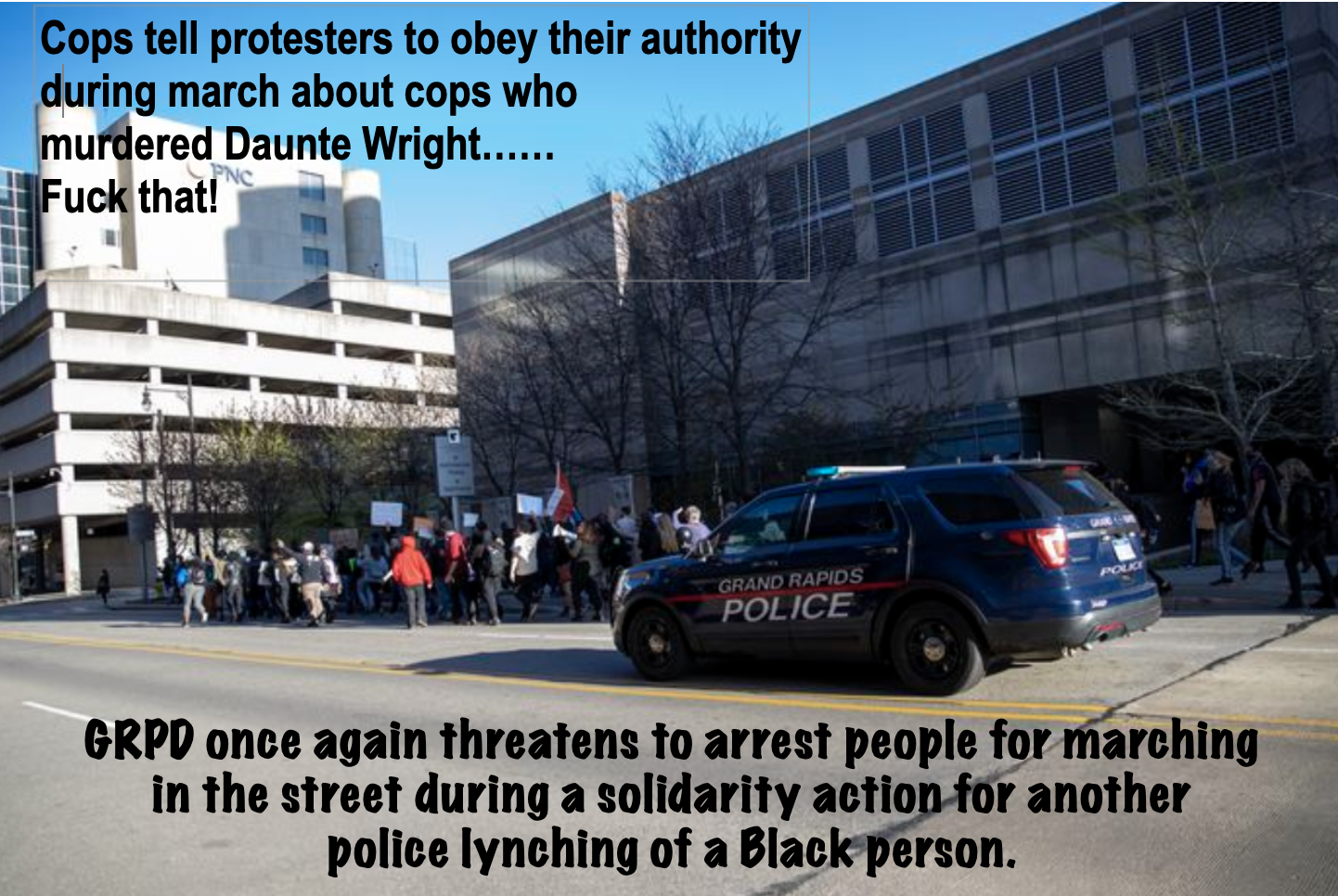
The march was mostly on the sidewalk, until it got to Pearl Street, where most of the roughly 150 people walked in the street. Within a minute, the GRPD showed up in cruisers demanding that those marching in the street get off the road and back on the sidewalk, with maybe half of the marchers complying.
It is a strange world we live in where cops try to dictate how people protest during a march that was calling out cops who murder Black people.
When the march got back to Rosa Parks Circle, there was a confrontation with a guy who came with a Blue Lives Matter flag. There was lots of yelling, by the white guy with the Blue Lives Matter flag and several of those who came to the protest yelled right back.
There was local news coverage from MLive, WZZM 13 and WXMI 17, all with the typical protest coverage. Some of the news stories included the usual, “it was a peaceful protest” language, which is code for the protestors didn’t do anything to disrupt business as usual.
What was instructive about the news coverage is that both WZZM 13 and the MLive story did acknowledge that Justice for Black Lives did get a permit for this action, even though that information was never posted on the Facebook event page. I get that people are frustrated with the GRPD harassment and targeting of some of the organizers, but in the end what is to be gained by obtaining a permit, especially since it puts provides the GRPD with more justification to harass and intimidate protesters that refuse to get a permit for future actions.
WZZM 13 airs story about what to do if cops pull you over, but say nothing about what is wrong with the police
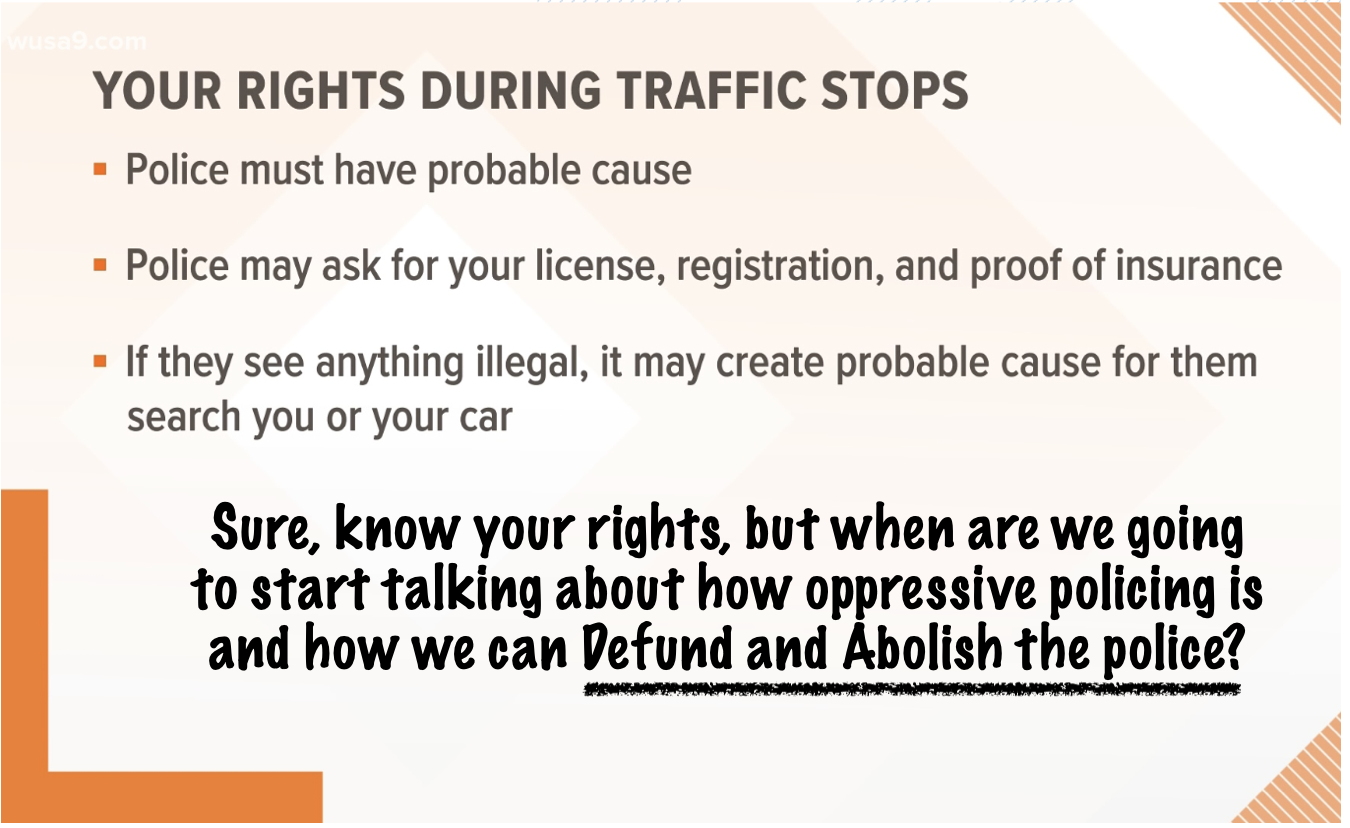
On Wednesday, WZZM 13 aired a story from one of their sister stations in Washington, DC, about what to do if you are “Black and Brown” and the police pull you over.
The story is centered primarily around knowing your rights when being pulled over by cops and features someone from the Alliance for Safe Traffic Stops. The story even promotes an app from the Alliance for Safe Traffic Stops, which is essentially a tool to help aid drivers during traffic stops called ‘Not Reaching.’
I am all in favor of people knowing what their rights are and having any resources that might reduce the possibility that the police won’t harass, intimidate, beat or kill people that they pull over.
What’s instructive about this tv story is that it is prefaced by the reporter talking about the Black/latinx military man who was pulled over by a cop and the police lynching of Daunte Wright, both stories that have been dominating the news this week. However, there is no discussion in this story nor commentary from experts and community organizers about what is wrong with the cops!
Telling people what to do when cops pull you over is centering the behavior of motorists. It’s like how the news often reports on rape and sexual assault. The news instructs people what to do to stay safe or how to defend yourself, but doesn’t talk about why so many men in this culture commit rape or other forms of sexual assault against women, children and other men.
When news agencies focus on the behavior of victims or those who are potential victims, it allows us to not think about the behavior of those perpetrating the harm. In the case of the story aired by WZZM 13, the focus should be on getting people to think about what is wrong with policing in the US. Why is it that the police disproportionately pull over Black and latinx people? Why is it that the police disproportionately murder Black people? Why is it that the police who kill Black people rarely are held accountable? Why are news agencies critiquing police funding and the massive movement to defund the cops that is happening all across the US? Stop victim blaming and shaming! Defund and Abolish the Police!
Grand Rapids City Officials vote to give themselves a substantial wage increase over the next 2 years, so how does that promote equity?
Last month, the Local Officers Compensation Commission adopted a resolution to increase the pay of Grand Rapids City Commissioners, the Mayor and the City Comptroller, based on the Agenda Packet for the City Commission meeting for April 13. (Pages 99 – 111)
On April 13, during the City Commission meeting, the pay increase resolution was adopted. The current pay for City Commissioners, which is a part-time job, is $25,397. City Commissioners will receive $28,000 for 2022 and $31,000 for 2023. This means that the City Commissioners will be receiving on average $2,800 for each of the next two years.
The Mayor of Grand Rapids current receives $44.188 for a part-time position. In 2022, the Mayor will receive $52,000 and in 2023, the pay for the Mayor position will be $60,000. This means that the Local Officers Compensation Commission decided that the Mayor should get an increase of $8,000 for each of the next two years.
Now, let me say that in many ways I have no problem that the City Commissioners and the Mayor of Grand Rapids will receiving substantial pay increases over the next two years. I think they deserve to make a more livable wage for their work. However, I think we all deserve to make a more livable wage for the work that we do, regardless of the type of work we are engaged in. However, their wage increases should have a major condition(s).
Therefore, I would like to see the Mayor of Grand Rapids and the entire City Commission make a collective public statement that they support and are committed to making sure that every resident of Grand Rapids, especially those who are subjected to poverty, should get the same rate of wage increase over the next two years. Grand Rapids City Commissioners will be receiving a 10.25% wage increase for 2022 and a 10.71% wage increase for 2023. The Mayor of Grand Rapids will be receiving a 17.68% wage increase in 2022 and a 15.38% wage increase for 2023.
As a comparison, I made the same amount of money in 2020 as the City Commissioners did, except that my job is full time, while theirs is part time. I do direct care for residents who have had closed head injuries and need assistance with their daily care. It would make a significant improvement in my life to receive a 10% increase in wages each of the next two years. I have no doubt that most people would welcome the same type of increase, since it would make all of our lives a little bit less stressful.
Since the Grand Rapids Elected Officials are being paid by our collective tax dollars, I want to see them make a public statement in support of a livable wage for all residents of Grand Rapids, particularly for the thousands of people who currently do not make enough money for the cost of living in Grand Rapids. In 2017, according to the National Low Income Housing Coalition (NLIHC), an individual must make at least $20.98 per hour working a full-time job to afford a three-bedroom apartment at market rate in the Grand Rapids area.
Now I know that Grand Rapids Elected Officials don’t have the legal authority to make employers pay a livable wage, but making a public statement would go a long way to building momentum for a livable wage in Grand Rapids. In addition, the City of Grand Rapids could make sure that everyone who is employed by the City, makes a livable wage, regardless of the work they do.
Grand Rapids Elected Officials are always talking about equity, so here is their chance to take a public stance about equitable income. If they don’t come out as champions of a livable wage, then their acceptance of the pay increases is nothing short of hypocrisy.
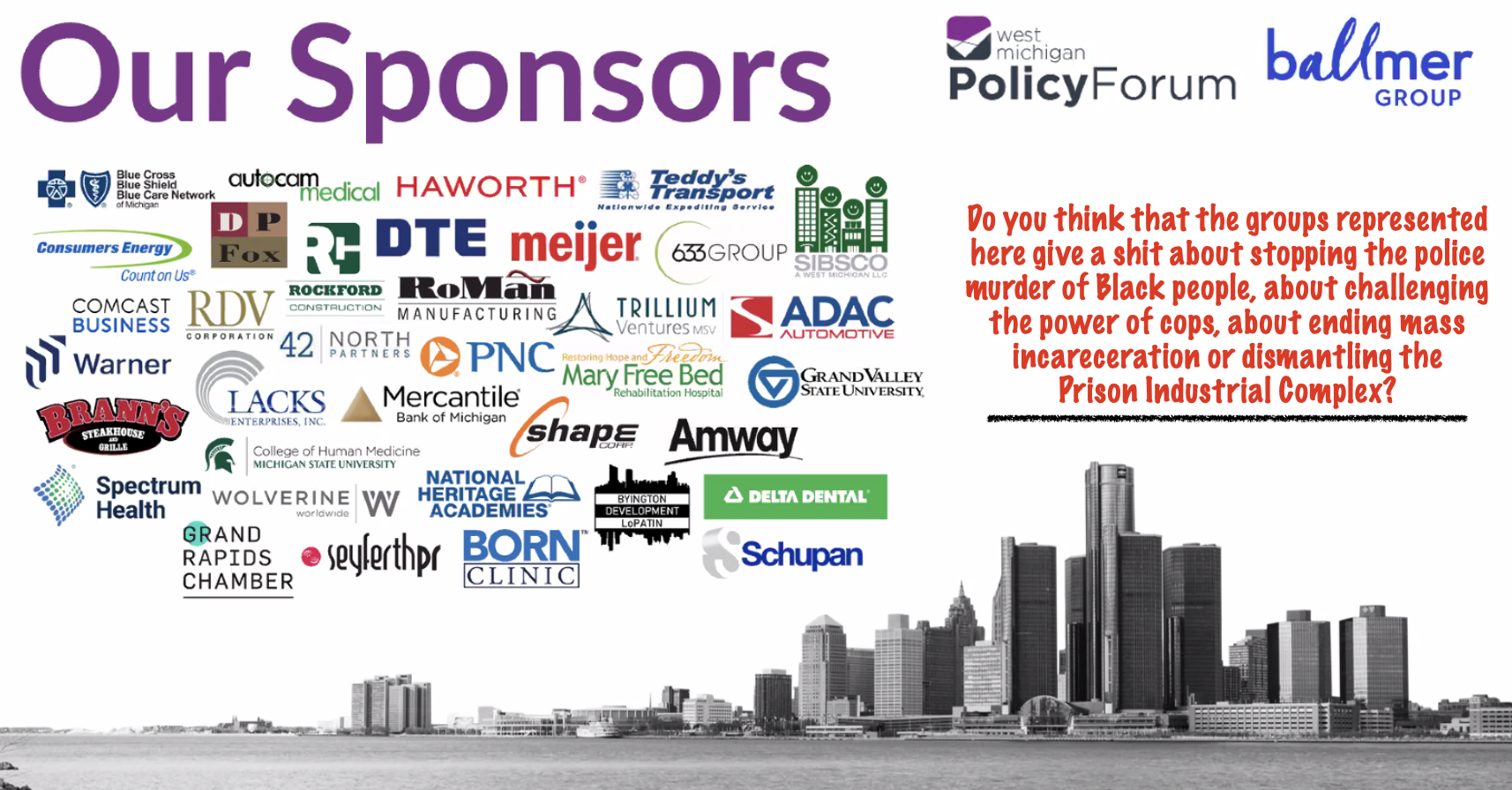
On Tuesday, the West Michigan Policy Forum (WMPF) host an event centered around the theme of Criminal Justice Reform.
This is not the first time that WMPF has made criminal justice reform a priority. We wrote about WMPF efforts in 2018. In that article we wrote:
The West Michigan Policy Forum is NOT going to be advocating for the end of police surveillance of the black and latinx communities, they are not going to be calling for an end to mass incarceration, they are NOT going to be calling for the end of the privatization of prisons and prison services, they are NOT going to be calling for the end of criminal history to determine eligibility for housing, education, licenses, voting, loans, employment, and other services and needs, they are NOT going to be calling for an end to ICE raids, they are NOT calling for changes in the condition of jails, prisons, juvenile detention facilities or immigration detention and they are NOT going to be calling for the end of capital punishment.
The other important thing about why WMPF was getting into the criminal justice reform game, is because, by their own admission, if too many people are locked up, it reduces the labor pool for the business sector.
At Tuesday’s event, the WMPF had as keynote speakers CNN commentator Van Jones and Mark Holden, who has a long history of working with the Koch brothers, specifically with Americans for Prosperity.
This is not the first time that Van Jones and Mark Holden are sharing the mic at an event on criminal justice reform. These two men have been front and center in the campaign to get the First Step Act passed during the Trump Administration.
After year one of the First Step Act, here is what the Sentencing Project had to say:
Congress passed and President Donald Trump signed the First Step Act one year ago on December 21, 2018, to limit mandatory minimums for low-level drug offenses, provide retroactive sentence reductions to people imprisoned under the 100 to 1 crack cocaine disparity, and expand rehabilitation in federal prisons. Implementation of the new law has been mixed. While sentence reductions have been approved by judges, the Department of Justice (DOJ) has attempted to block hundreds of eligible beneficiaries. There has also been a problematic rollout of the risk and needs assessment tool to determine earned-time credit eligibility and limited programming for rehabilitation.
The American Friends Service Committee (AFSC) had a more critical response to the First Step Act, stating:
But the measure falls far short of forging a true “first step” toward fundamental change and addressing racial disparities in our criminal justice system.
What’s more, several provisions are deeply problematic and would exacerbate racial disparities in the sentencing of individuals and encourage the expansion of the prison industrial complex. And as the bill passes through Congress, terrible amendments that stand in stark contrast to the supposed goal of the bill are being proposed to placate members who seek to be “tough on crime.”
In addition, the AFSC states that the First Step Act Reinforces Structural Racism, Excludes Immigrants from Reforms, protects private prisons, perpetuates re-incarceration and privileges religious participation.
Then there is the astute analysis offered in the book, Prison By Any Other Name: The Harmful Consequences of Popular Reforms, which said, “Reforms like the First Step Act and the Rights on Crime modifications might allow for some improvements, but they also entrench the underlying harm to those still ensnared in the carceral web.”
The fact the the Koch brothers have been pushing a “criminal justice reform” agenda should raise all sorts of red flags.
In 2015, the Center for Media & Democracy wrote an excellent investigative piece on the real motives behind the Koch industries involvement in criminal justice reform and how it would benefit them. https://www.prwatch.org/news/2015/12/13002/koch-criminal-justice-reform-trojan-horse
The bill’s default criminal intent standard is strikingly similar to the ALEC “Criminal Intent Protection Act,” and tracks policies promoted by Koch-backed organizations for the past five years. As the Center for Media and Democracy has documented, Koch Industries is a major funder and leader of ALEC, and the Koch brothers have underwritten ALEC through foundations they control and organizations they fund.The proposal “would make it much harder for prosecutors to criminally prosecute companies that swindle the public, endanger their workers, poison the environment or otherwise imperil consumers,” said Rob Weissman, President of the public interest group Public Citizen.
In the same article, it states, that the some of the Kochs’ proposed changes in criminal justice reform would “make it harder to hold executives and their employees responsible for violating U.S. laws and would protect their financial interests, at the public’s expense.”
So it appears that the Koch-led initiatives around criminal justice reform is simply a cover for a much larger agenda of protecting and expanding the wealth of the Capitalist Class. We shouldn’t be fooled by what the West Michigan Policy Forum group is up to, since they, like the Koch Industries, has not come out and publicly condemned the police murder of Black people in recent years, they have not challenged the function of policing in the US and they certainly have not come out in support of the Movement for Black Lives, with the strong calls for prison abolition and the defunding of police department. In the end, these are the kinds of policies and platforms we need to be supporting, since criminal justice reform efforts are deeply committed to defending the criminal justice system and the Prison Industrial Complex.
Oh, Doug DeVos introduced the WMPF event speakers and he laid out three reasons for doing criminal justice work:
Improves Public Safety for All – exactly how does criminal justice reform keep Black people in the US safe?
It Allows for Redemption – always injecting religious bullshit into whatever they do!
Returns individuals to productive members of society – this is simply code for get a job and comply with those in power.
 Grand Rapids Institute for Information Democracy