Serial Offender: NAACP Legal Defense Fund submits a brief against GRPD’s Captain VanderKooi for violating the rights of two Black teenagers….again
 (Editors Note: While this post is primarily centered around the person of Capitan Curt VanderKooi, we do not subscribe to the one bad apple in the barrel theory. The GRPD, like all police departments, are designed to protect power and property, along with criminalizing Black and other communities of color.)
A few weeks ago, “the NAACP Legal Defense and Educational Fund, Inc. (LDF) and counsel Janey Lanier filed an amicus brief in the Michigan Supreme Court in support of Keyon Harrison and Denishio Johnson, two Black teenagers who, on separate occasions, were stopped, interrogated, searched, photographed, and fingerprinted by the Grand Rapids Police Department even though neither teen committed any offense. The case challenges the Grand Rapids Police Department’s official policy of taking photographs and collecting fingerprints of people who are stopped and lack identification, even if they are never charged with a crime, and then storing their information for future use is unconstitutional. The Department’s long-standing policy has been disproportionally used in interactions and field interrogations with the City’s Black residents.”
There are two GRPD officers named in the brief, Elliot Bargas and Captain VanderKooi. As some of our readers might remember, Captain VanderKooi was the GRPD liaison with Immigration and Customs Enforcement, who in 2018, called ICE while he was off duty, because he saw Jilmar Ramos Gomez on TV while at Spectrum Health. The ACLU and MIRC released documents in February of 2019 pertaining to the ICE arrest of Jilmar Ramos Gomez, documents that demonstrated that VanderKooi was racially profiling Gomez because he looked “Latino”. VanderKooi even asked ICE to check his immigration status, even though it was already known that Jilmar Ramos Gomez was a US Marine and had been born in the US.
During a campaign to get Captain VanderKooi fired from his position in the GRPD, Movimiento Cosecha GR and GR Rapid Response to ICE attended a Grand Rapids City Commission meeting to demand that VanderKooi be removed. During that City Commission meeting, many people spoke during public comment about how VanderKooi had a history of racially profiling other immigrants in the community, as well as being involved in harassing and targeting Black youth.
With this new brief submitted by the NAACP Legal Defense and Educational Fund, which also names Captain VanderKooi, it further demonstrates that VanderKooi has repeatedly engaged in racially profiling as a GRPD officer. The City of Grand Rapids then reinstated VanderKooi in April of 2019 and the Grand Rapids Police Department chose to exonerate VanderKooi.
However, in May of 2019, the Civilian Appeals Board found VanderKooi guilty of racial profiling and voted to reverse the GRPD’s decision. VanderKooi ended up being suspended for only 2 days, even though that was less time than Jilmar Ramos Gomez spent in ICE custody after VanderKooi called the Department of Homeland Security agency on the former Marine. Despite VanderKooi only receiving a minor slap on the wrist, the Grand Rapids Police Officer’s Association found this unacceptable and released a statement in defense of VanderKooi in August of 2019, stating:
“The Grand Rapids Police Command Officer’s Association is shocked and dismayed at how the rights of Captain Curt VanderKooi, who has served the City of Grand Rapids for nearly 40 years with honor and integrity, could have his rights so blatantly violated in an effort to discipline him for the first time in his career. His due process rights, the GRPCOA collective bargaining agreement, along with state law were trampled on throughout the Citizen’s Appeal Board process and now by the final disposition issued by the City Manager. He, and many others in City Hall, were put on notice and advised of these violations in the form of our grievance which was originally filed May 23, 2019. We were forced to file this grievance after he was cleared of the most serious accusations following an unprecedented three iterations of the same investigation.
Captain VanderKooi was given a two day suspension, which has recently been served. The City Manager advised the GRPCOA that he was willing to uphold the original exoneration in exchange for his agreement to retire. This discipline was unwarranted and is clearly an attempt to appease a vocal group of activists who made him a scape goat for their own political gain. We will be amending the grievance to appeal this most recent decision by the City Manager. We are also awaiting a very copious FOIA request involving all the communication reference this investigation and those involved in it. Captain VanderKooi is pleased to announce he has decided to postpone his original retirement date in 2020 and looks forward to serving the citizens and crime victims in the City of Grand Rapids as Commander of the Investigations Unit for an additional year.”
Captain VanderKooi is once again the subject of a legal brief, which further demonstrates that he makes it a practice to racially profile residents in Grand Rapids. It will be interesting to see what the courts decide on this new amicus brief that was filed by the NAACP. However, to this writer, it seems pretty clear that the GRPD will do whatever is necessary to defend their officer’s actions and that Grand Rapids City officials are unwilling to hold cops like Captain VanderKooi accountable.
 GRIID – In late July, you submitted a Freedom of Information Act (FOIA) request to the City of Grand Rapids regarding their newly announced program called Clergy on Patrol. What was your motivation for submitting such a request?
MACRA: John F. Kennedy wrote, “I believe in an America where the separation of church and state is absolute,” and we could not agree more. Government religion is antithetical to freedom of conscience and to freedom in general. Just look wherever religion is in power, theocracies like Saudi Arabia, Iran, India, Pakistan, and Afghanistan, or where religion has undue influence on laws, in places like Ireland and the United States. The Grand Rapids Police Department (GRPD) Clergy on Patrol program is likely unconstitutional and MACRA aims to find out by reviewing communications between GRPD and clergy invited to participate. For example, were all locally represented religions invited to participate? Were Muslims, Hindus, Buddhists, Wiccans, Satanists, Humanists, and atheists or agnostics invited and/or given equal opportunity to participate?
GRIID – What exactly did you [specify] in the FOIA request?
MACRA: The exact language of our FOIA request is as follows: Any and all written communications, including, but not limited to letters, text, social media messages, and/or email, including any enclosures, attachments, etc., to or from, by or between, the City of Grand Rapids, the City of Grand Rapids Police Department (GRPD), and/or any other department thereof, including, but not limited to, the GRPD Chaplaincy, or any other representative, agent, officer, or employee of the City of Grand Rapids, and/or the City of Grand Rapids Police Department, and any clergy, priest, nun, pastor, minister, chaplain, rabbi, imam, shaman, witch doctor, palm reader, and/or psychic, and/or any church, synagogue, mosque, temple, coven, or other religious sect and/or cult, institution, and/or organization, and/or any representative, agent, and/or employee thereof, and/or any other person, and/or organization with respect to the City of Grand Rapids Police Department’s “Clergy on Patrol” program from January 1, through July 30, 2021.
GRIID – You received a response from the GRPD on August 6. What was the content of their response? And did they alter the language of your request?
MACRA: In its response, GRPD informed MACRA the department would require an extra 10 days (allowed under the FOIA) to respond. GRPD improperly and unlawfully edited the language of our request to read as follows: Any and all written communications, text, social media messages, emails including all attachments, to or from, by or between the City of Grand Rapids, GRPD and any other department and any member/associate or relation to Clergy on Patrol from January 1, 2021 to July 30, 2021. GRPD provided no explanation for editing our specific language, which was admittedly written to be both specific and to ‘poke the bear.’
GRIID – Two weeks later the GRPD sent you the cost of the documents, but they also said they said there would be costs for redacting the documents. Why would they redact information regarding the Clergy on Patrol docs requested?
MACRA: In its response, GRPD estimated 2 hours for labor, to “search, locate, and examine” the documents, which is fair, but then estimated a full 5 hours for “redaction”, and 3.5 hours for “duplication,” for a total estimate of 10.5 hours. GRPD also said it would take 2-3 months to fulfill the request. How does 10.5 hours become 2-3 months? Because there can be no substantive redaction of communications with the public, including clergy, the estimate of 5 hours for redaction is excessive on its face. We believe GRPD has attempted to use excessive charges, the threat of redaction, and inordinate delay to dissuade members of the public from pursuing disclosure of documents relating to the controversial Clergy on Patrol program.
GRIID – You also decided to appeal the costs, since they were substantial. What was the GRPD’s response to that?
MACRA: GRPD estimated it would cost $333.85 to locate, redact, and duplicate the documents requested, with a 50% deposit required prior to fulfillment, and the balance due before disclosure. Therefore MACRA filed an appeal to City Manager Mark Washington. To their credit, the Grand Rapids City Commission’s Committee on FOIA Appeal scheduled a timely hearing for September 2 at 9:00 AM at City Hall. An attorney representing the City and GRPD then filed a 5-page response that was virtually devoid of legal substance, citing no specific laws to justify the improper editing, threatened redactions, excessive costs, and inordinate delay (2-3 months) to disclose the documents. To their response, MACRA filed a detailed opposition memo on the eve of the hearing.
GRIID – The City then scheduled a meeting to hear your appeal on September 2nd. What happened during that meeting?
MACRA: The City’s Committee on FOIA Appeal denied our appeal after less than 5 minutes deliberation, but the Commissioners did question GRPD about editing the language of our request and instructed the department to respond to our specific request, not their improperly edited version. We argued that any redaction would violate open records laws. MACRA informed GRPD at the hearing that it must respond with all the requested non-exempt documents within 10 days, as the law requires, and promised to appeal to the Circuit Court if any communications with clergy are redacted in any way whatsoever.
GRIID – What do you plan to do moving forward?
MACRA: Going forward MACRA will file additional FOIA requests and pursue a thorough investigation of GRPD’s Clergy on Patrol program, from its inception through implementation, and publicly share all of the documents and records uncovered. We ask members of the public who may encounter or interact with police and clergy on the streets or in their homes or businesses, to contact MACRA at macrainfo@gmail.com or send private message to our @gomacra Facebook page.
GRIID – Why is the issue of transparency so important in this case and what do you think is motivating their failure to be completely transparent with the Clergy on Patrol program?
MACRA: The Freedom of Information Act (FOIA) is one of the most power tools the public is granted by law to audit government activities. Anyone can use this law to force the government, including police departments, to be open and transparent in publicly funded programs. Although, as this case illustrates, government may not appreciate it when members of the public exercises their rights in this way. We encourage every person to read Michigan Attorney General Dana Nessel’s FOIA Handbook, available online at https://www.michigan.gov/documents/ag/FOIA_Handbook_2019_644053_7.pdf, and to use the FOIA whenever necessary or desired.
As to what is motivating GRPD to employ excessive charges, redaction, and delay, in responding to our request to review communications with clergy, we believe the writing is on the wall—they know the “Clergy on Patrol” will not withstand public scrutiny and exposure. The First Amendment does not permit favoritism or preference for one religion over others or for religion generally over non-religion, nor excessive entanglement with religion. How does the program even function on the streets of Grand Rapids? What are the rules for clergy on these “ride alongs” with police? Clergy are not trained social workers or counselors. Each time police deliver a preacher to a traffic stop, emergency call, or crime scene, the constitutional rights of all involved are violated.
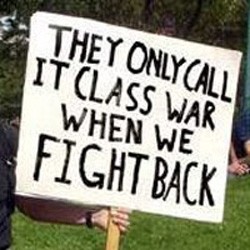 As we approach the Labor Day weekend, some will certainly be reflecting on the status of workers in the US. There will be Labor Day parades and other events to celebrate the role of the working class in this country, but how much of that celebration or reflection will take a hard look at how the system of Capitalism impacts those who sell their labor?
We all know that during the pandemic, that the Billionaire Class has continued to amass a tremendous amount of wealth, while millions of workers are unemployed, underemployed or work for less than a living wage.
A few weeks ago, we wrote about how much Doug & Hank Meijer’s wealth has grown since the beginning of the pandemic. In fact, within the past 4 months alone, Doug & Hank Meijer’s wealth has increased by $900 million. During the same time, the retailing giant continues to pay workers in their stores an average $11 an hour.
This massive wealth gap between CEOs and workers is continuing to grow across the US. A new report from the Economic Policy Institute, documents that CEO pay has skyrocketed 1,322% since 1978, and that the average CEO makes 351 times more than the average worker.
The AFL-CIO has also come out with their annual CEO to workers pay ration data for 2020, which is rather sobering. The company that has the highest CEO to worker pay ration in the US is the Abercrombie & Fitch Co., where the CEO makes 6,565 times more than the average worker. You can investigate the data they have compiled for hundreds of US-based corporations and see that the disparity between CEO and worker pay is rampant.
You can also search by state, so we looked at some of the most glaring examples of CEO/Worker pay ratios in a state that has historically had a fairly strong organized labor movement.
According to the AFL-CIO data, some of the companies in Michigan that have the largest gap between CEO and worker pay are:
Lear Corporation 1,627:1
Whirlpool Corporation 772:1
Sun Communities Inc. 572:1
Other household company names are:
Dominos Pizza 285:1
Kellogg Company 279:1
Ford Motor Company 202:1
General Motors Company 201:1
Stryker Corporation 181:1
Wolverine World Wide Inc. 160:1
Dow Inc. 141:1
Steelcase Inc. 131:1
Herman Miller 88:1
CMS Energy Corporation 72:1
DTE Energy Company 67:1
SpartanNash Company 58:1
The CEO to worker pay ratio exposes one of the many flaws within the Capitalist system. This huge disparity between CEOs and worker pay will not change, no matter who we elect to office. If workers really want to demand better wages, livable wages, then they need to do what they have done for nearly 200 years, they need to organize in their workplace and use whatever tactics necessary to achieve those demands.
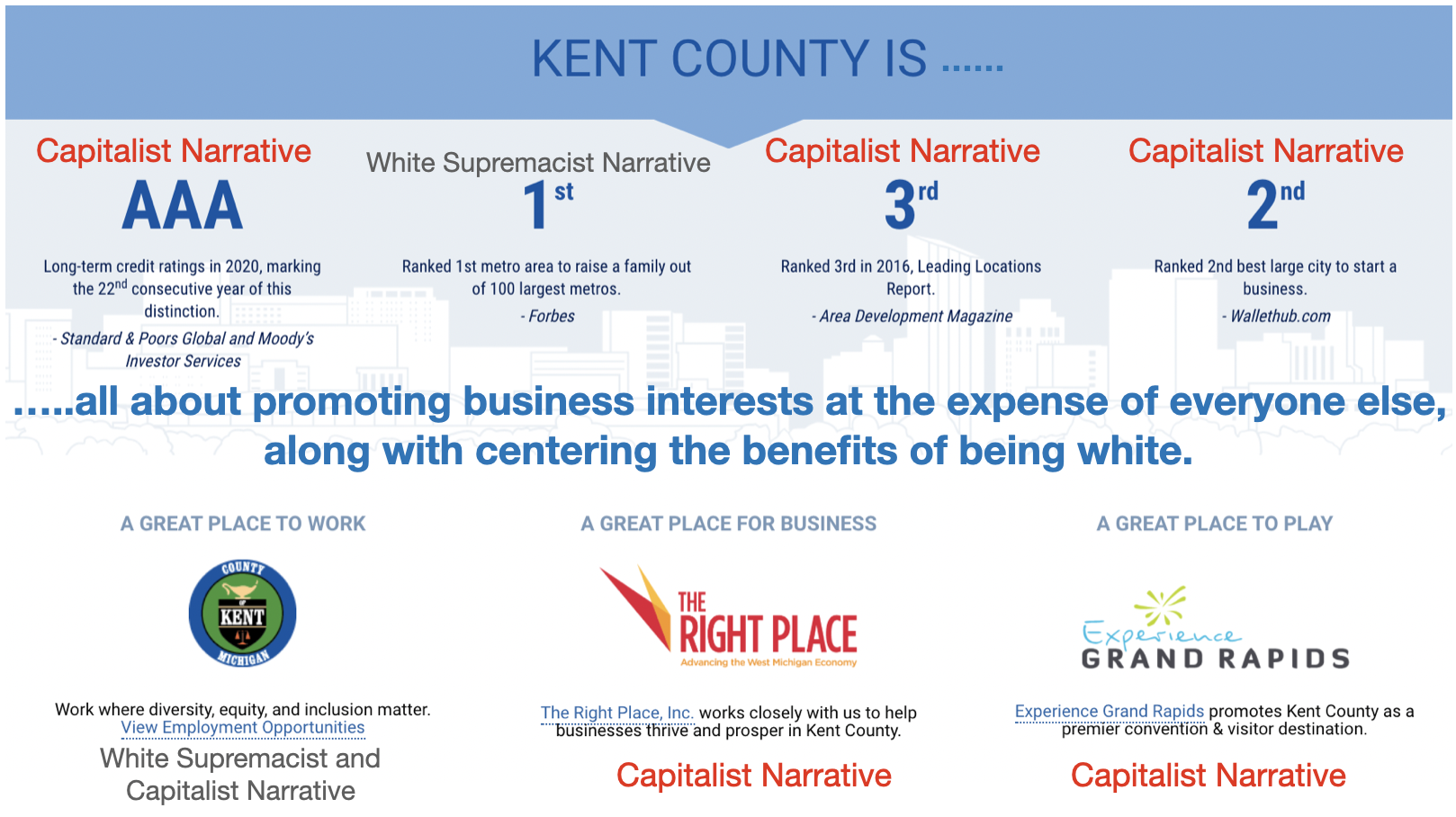
Kent County: A great place to start a business and raise your family…..if you’re white
Last week, while several hundred people who oppose a mask mandate issue by the local Health Department addressed Kent County Commissioners, I went on the County’s site to look for some information.
While looking for information about the Commission meeting, I came across what you see here below, which is a screen shot that appears at the bottom of the Kent County Government site. This is how those at the Kent County government level want us to see the county, through these numbers and the organizations included here. Let’s take a critical look at this information and deconstruct it, since this is not the lived experience of thousands of people who live in this county.
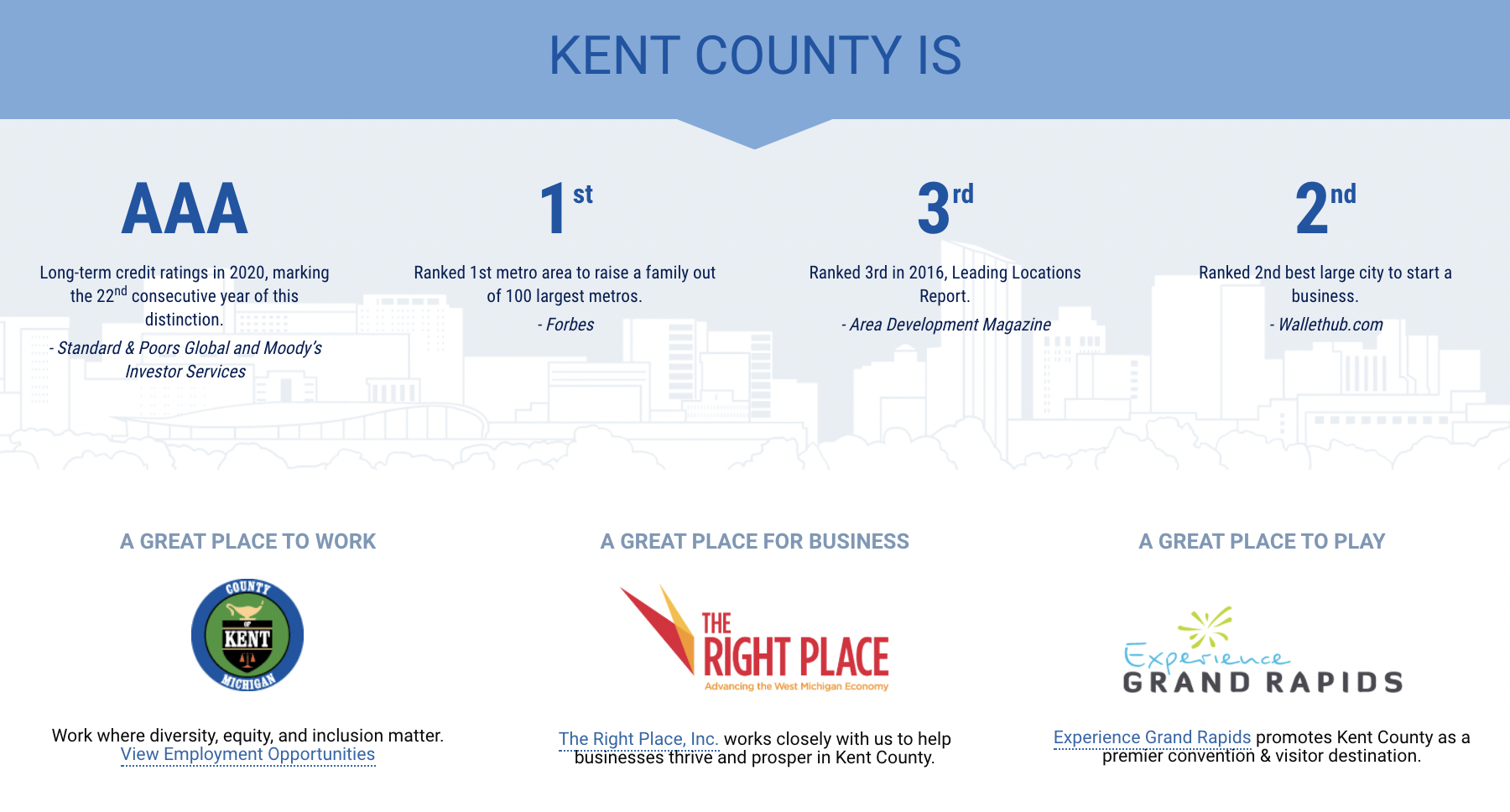
So, there are seven ways that the county wants us to see them, and thus, the residents of this area. First, they present a Triple-A credit rating from Standard & Poors Global and from Moody’s Investor Services. Both entities are integral parts of the larger capitalist/investor sector, providing ratings on how financially sound an entity is. The metrics they use are biased in favor of what the capitalist/investor sector holds dear. Think of it like the GPD, the Gross Domestic Product, which is how countries often measure themselves. However, such measurements often do not take into account the quality of life for communities.
The Kent County government might be considered fiscally sound, but how do we measure that in terms of the quality of life for the residents in Kent County? The county has a reserve of funds and has for years, so why is that money not invested in the most marginalized families in the county? For example, if we look at a report released in March of 2021, the Kent County Community Health Needs Assessment, we see a much different picture of the quality of life for people in this county. One major statistic from the report, focusing on economic security stands in sharp contrast to the Triple-A credit rating. The economic security statistic found in the report states, “1 in 4 people were unable to pay for housing, utilities, food or medical care in the past year.” This is a sobering contrast to how the County values fiscal security.
The second selling point from Kent County is that this county is “ranked #1 metro area to raise a family out of 100 largest metros, according to Forbes. Again, what are the metrics being used to measure this reality? More importantly, the question should be which families are more likely to have a good quality of life in Kent County? Again, the Kent County Community Health Needs Assessment report can provide us with some useful comparisons. For white people, the unemployment rate is 3.5%, whereas for African Americans the number is 11.1%, more than 3 times higher. Another instructive statistic shows that the median household income for white families is $67,324, but for African Americans that number drops to $35,203. Kent County might be ranked #1 for white people to raise a family, but this is not the case for Black, Indigenous and other communities of color.
The third point that the County’s website brags about states, “Ranked #3 in Leading Locations Report,” from the Area Development Magazine. This designation has to do with best markets to do business in, as well as development projects. Kent County, and Grand Rapids in particular, have excelled in the going business and development arenas, since owning a business in this community as sacrosanct.
Here, we could compare this ranking with housing in the community. Once again, the Kent County Community Health Needs Assessment report released earlier this year can provide us with some important information. The report identifies the following 4 points of input from the community:
- Gentrification of Grand Rapids neighborhoods
- Increasing rent prices
- Rental process is burdensome, competitive, and expensive when having to apply for multiple rental units
- Racial inequities in home ownership
An additional piece of data from the report states:
“In Kent County, non-Hispanic Whites make up 87.3% of all homeowners and 73.8% of the population. In Grand Rapids, this gap is even larger, despite a higher proportion of non-White homeowners in the city (21.6%), 78.4% of homeowners are non-Hispanic White compared to just 59.0% of the population.”
Once again, the ranking is only a benefit to certain sectors of those who live in Kent County.
The fourth point listed on the county’s site says, “2nd Best large city to start a business.” Again, the question should be asked if this is the case for everyone, or primarily for white people. We all know about the report from 2015, where Grand Rapids is the second worst city for African Americans economically, which also applied to Black businesses. There have been efforts to change that dynamic, in terms of Black people starting new businesses, but this has been slow going, especially with the onset of COVID in March of 2020. In some ways, it seems like this fourth ranking is especially insulting, since there isn’t much evidence that Black-run businesses are on the rise in a substantial way. One last point about the socio-economic condition of Black people in Kent County, is that according to the 2020 Census, Black people comprise 9.2% of the population, yet roughly 30% of those in the Kent County Jail are Black.
The bottom row, which includes three additional points that Kent County wants to celebrate, are instructive on a different level. None of the three points are about ranking, but they do make certain claims.
The fifth point says that Kent County is “A Great Place to Work.” This point includes as a sub-heading, which says, “Work where diversity, equity and inclusion matter.” I personally detest such phrases, but the point here is that there are literally thousands of people who work in Kent County who would disagree with such a statement. There are thousands of people who make minimum wage in Kent County, and thousands more who work for even less, especially wait staff and agricultural workers, where minimum wages laws don’t apply. Here the Kent County Community Health Needs Assessment report states that 20% of white people could not afford to pay for housing, utilities, food or medical care over the past year. When we look at African Americans the number rises to 41% and 47% for Latinos. Again, for whom is Kent County a great place to work?
The last two points made are just promotional statement for two organizations. Under the heading of, A Great Place for Business, it lists The Right Place Inc., which we identify as part of the Grand Rapids Power Structure. GRIID has also written numerous articles that have been critical of the practices of The Right Place Inc, which are numerous. In addition, it is instructive that the plug for The Right Place Inc, means that four out of seven of the points that Kent County wants to celebrate, are centered around business.
The last point has the heading, A Great Place to Play, with a link to Experience Grand Rapids. Now, a great deal of what Experience posts for play are things that cost money and disproportionately bring people to downtown Grand Rapids, which again leaves lots of people out of the equation.
So, while we are all focused on the anti-mask contingent who are hell-bent on putting us all at risk of COVID exposure, the government of Kent County quietly promotes this area as pro-business, along with a thinly veiled notion that this community is a great place to raise a family……if you are white.
West Michigan Foundation Watch: Jerry & Marcia Tubergen Foundation – Practicing the politics of White Saviorism
To date, we have looked at the 990 documents for local foundations in 2021 for the Prince Family, the Richard & Helen DeVos Foundation, the Doug & Maria DeVos Foundation, the Dick & Betsy DeVos Foundation, the Dan and Pamela DeVos Foundation. the Cheri DeVos Foundation, also known as the CDV5 Foundation. Today, we want to look at the Jerry & Marcia Tubergen Foundation.
 The Jerry & Marcia Tubergen Foundation may seem out of place, as they are not a household name, at least not the way that the DeVos family is. However, we are including them in this list, since Jerry Tubergen is an integral part of the DeVos family empire.
Jerry Tubergen is the CEO of one of the largest components of the DeVos empire, the RDV Corporation. In addition to being the CEO of RDV Corporation, Jerry Tubergen is listed as a trustee for every DeVos family foundation, according to the 990 reports that you can find on GuideStar.org Thus Jerry Tubergen is a trustee of the Dick & Betsy DeVos Foundation, the Doug & Maria DeVos Foundation, the Dan & Pamela DeVos Foundation, the Richard & Helen DeVos Foundation and the Cheri DeVos Foundation – known as the CDV5 Foundation. Lastly, Tubergen is the CEO of Ottawa Private Capital LLC, an entity which manages all of the DeVos family investments.
As you can see, Jerry Tubergen is deeply embedded in the DeVos family empire. Therefore, it is worth looking at the foundation that is named after him and his wife.
The Jerry & Marcia Tubergen Foundation is not as large as the various DeVos family foundations, but the foundation’s assets are listed at just over $18 million. According to the most recent 990 document (2019) for the Jerry & Marcia Tubergen Foundation, this foundation contributed $3,784,970.
So where does an integral part of the DeVos empire chose to contribute part of the money he makes managing the wealth of the wealthiest family in West Michigan?
A review of the 990 records (2019) for the Jerry & Marcia Tubergen Foundation, clearly shows that they contributed to a lot of Christian organizations, particularly the kind that engage in White Savior politics and can be classified as part of the Religious Right. When we say White Saviorism, we mean White centered organizations that are making decisions about how to help communities of color, without 1) asking those communities what they want, and 2) without addressing the root causes of poverty or the structural racism that plagues these communities.
Here are some of those Christian groups they contribute to, along with the amount they contributed in 2019.
Ada Bible Church $20,000
Alpha USA $33,000
Cornerstone University $205.000
Cure International Inc. $2,500,000
God’s World Publications, Inc. $5,000
Guiding Light Mission Inc. $5,000
Hope International $10,000
Mel Trotter Ministries $25,000
Moriah Ministries $15,000
Museum of the Bible Inc. $100,000
North Coast Christian Ministries Inc $10,000
Open Doors With Brother Andrew Inc. $125,000
Potters House $30,000
Pregnancy Resource Center $15,000
Relational Concepts, Inc. $25,000
Right to Life Educational Fund $5,000
That Day $61,000
The Cause Inc. $57,500
Truth for Life $20,000
As you can see, the majority of the organizations that the Jerry & Marcia Tubergen Foundation have contributed to fall under the categories of Conservative Christian groups and those that practice White Saviorism, with the largest contribution going to Cure International Inc – $2,500,000.
While there might not appear to be anything unusual about where the Jerry & Marcia Tubergen Foundation directs their contributions, it is important to think about one glaring fact. The person who manages all of the DeVos family investments, Jerry Tubergen, makes it a point to direct the bulk of the contributions from his foundation to Conservative Christian organizations, many of which practice White Saviorism.
Update on Grand Rapids Participatory Budgeting Project: Will marginalized voices really be at the table?
In early June, the City of Grand Rapids had announced that it would be engaging in a Participatory Budgeting Pilot Project. We wrote about the announcement at that time and expressed some skepticism of what the experiment would result in.
We expressed four reasons for skepticism, such as 1) pre-determined parameters for how the money could be spent, 2) the creation of steering committees for each of the three city wards, 3) a timeline that was too short, and 4) limiting the amount of influence the public can have on determining how the City’s annual budget will be spent.
On Tuesday, during the Committee of the Whole meeting, the city staffer who has been overseeing the Participatory Budgeting Pilot Project, provided an update. One glaring thing that was evident, is that the original timeline was way off target. The initial timeline had the public input and vote to be completed by August 29. As of the Tuesday’s presentation, the steering committees had only been able to complete some goals for the outcome of the project.
As was acknowledged in the original document from June, other cities had allotted 9 – 12 months for the process, but Grand Rapids was still committed to a shorter timeline. Their new timeline projects that there would be public engagement in September and October, which begins in less than a week and there are no planned dates as of yet. There would be a public voting process, but as of right now, there is no timeline set for when that will happen.
Those who have agreed to be on the three steering committees are somewhat representative of the community, but there are people who are too connected to power that are involved. One example is Kristian Grant, who is the President of the Grand Rapids School Board. What many other Participatory Budgeting Projects have found is that it is critical to have people who are normally not at the table, play a much larger role than just attending the public input meetings. In fact, one of the goals that the steering committee members came up with was, “to amplify marginalized voices,” which voices who are not already in positions of influence.
In addition, the steering committees have come up with a vision statement, which reads:
Our work will be guided by the value of equity, with an intentional and transparent process designed to include marginalized voices, people with lived experience, and diverse groups. This process will be structured to remove barriers and build community capacity.
Such a statement sounds good, but it is another thing to make sure that such a vision is implemented. For instance, how will the City engage people to be part of the process? How will people who are marginalized have the time to participate in such a project. To her credit, Commissioner Ysasi did say during the discussion at Tuesday’s meeting that paying people to participate is a good faith demonstration that you want marginalized voices to participate. One could go further by saying that the City would not just pay people to participate, but provide free transportation, child care and food for those who are able to attend. Of course, community engagement should always practice full accessibility, which includes physical accessibility, thinking about the process being multi-lingual, and lots of options for people to attend and participate that provide people with lots of opportunity to be involved.
In contrast, during the Tuesday morning Committee of the Whole meeting, 3rd Ward Commissioner Moody stated that he wanted to have a larger role in the process. Having those with power have a larger role is a fundamental violation of the Participatory Budgeting Process, which leads me to think that some of the Commissioners do not fully understand what Participatory Budgeting really looks like. You can watch the Participatory Budgeting update during the Committee of the Whole meeting, which begins at 2:35:40 into the meeting.

Deconstructing the argument against Critical Race Theory from a DeVos operative and President of the Michigan Freedom Fund, Greg McNeilly
 Last week, Chairman of the Michigan Freedom Fund and DeVos-operative Greg McNeilly, wrote an opinion piece for the Detroit News, entitled, Where do Michigan leaders stand on critical race theory?
Now, we all know that the far right loves to use wedge issues to rally their base and to attack their political opponents. Therefore, it is no surprise that the head of the Michigan Freedom Fund would write an opinion piece in one of Michigan’s largest newspapers use one of the major wedge issues of 2021, Critical Race Theory (CRT).
However, it is useful to deconstruct the argument that McNeilly presents, which ultimately demonstrates how weak their arguments are. The DeVos-operative begins the opinion piece with this paragraph:
There’s a debate raging in Washington, D.C., Lansing, local governments and school districts over the merits of individual freedom, equality and even capitalism: Do we embrace the American dream and our commitment to liberty — the qualities that have long made the United States “a shining city on a hill,” or are equality and opportunity no longer worth protecting?
From the very get go, McNeilly wants to frame Critical Race Theory as being in opposition to freedom, equality and capitalism, without initially using the term Critical Race Theory. This is a standard approach when attempting to discredit an issue, by making sweeping generalizations or misrepresenting the issue you are attacking. While it is true that Critical Race Theory is highly critical of the economic system of Capitalism, saying that it is in opposition to equality and freedom is nothing short of ridiculous. Critical Race Theory challenges the dominant narrative about US history, one that is centered around privilege and White Supremacy. In fact, Critical Race Theory is deeply committed to freedom and equality, since it demonstrates that the those with power and privilege in the US, which are primary white people, have obtained their wealth and privilege at the expense of Black, indigenous and other communities that have been exploited and oppressed since the US was founded.
McNeilly’s “evidence” to back up his position on CRT, is to cite a critic, which is nothing more than a single article written in the New York Post by a writer from the Manhattan Institute. Now, the Manhattan Institute is a far right Think Tank that was founded by Reagan’s CIA Director, William Casey. Naturally, the Manhattan Institute would be opposed to CRT, since their existence is based on defending Capitalism.
McNeilly continues his argument by stating that, “high-ranking Michigan politicos, from Gov. Gretchen Whitmer to prominent metro Detroit members of Congress,” have avoided talking about CRT when confronted.
However, before McNeilly provides any evidence of this claim he says that we should really be concerned about where CRT is being pushed……”kindergarten classrooms.” Now, such a claim is absurd, but McNeilly wants readers to believe his point because he cites another Manhattan Institute writer, who claims to have “more than 1,000 stories in schools and other public institutions, where CRT policies have directed kids do things like celebrate communism.” However, the source that McNeilly is citing, which was an article that appeared in Newsweek, only has a few school examples, not 1,000 that McNeilly claims.
McNeilly then presents another sentence that misrepresents CRT, with language that is sure to wind up anyone who doesn’t believe in thinking for themselves, saying:
CRT advocates claim the American system is broken. They say our nation was never great, and it can’t be until things like capitalism, federalism and individual responsibility are upended.
The Chair of the Michigan Freedom Fund continues his weak argument by presenting a poll taken in January of this year, which appeared in The Economist. McNeilly says the “poll shows the overwhelming majority oppose CRT.” Overwhelming majority is a bit of a stretch and McNeilly omits that in the same poll most people those racism was not so much an individual problem, rather a larger structural problem.
In the rest of the opinion piece, McNeilly then goes after Gov. Whitmer and two Metro Detroit Democratic Congress members. To “discredit” these Democratic officials, McNeilly cites an article from the Washington Free Beacon and The Center Square. Not surprising, both of these news sources embrace a far right political perspective.
Therefore, as anyone can see, Greg McNeilly has no real argument against Critical Race Theory. McNeilly simply presents a series of weak positions that are all coming from sources that embrace and defend far right political policies. However, if people didn’t know who these sources were, then it would be easy to buy into their rhetoric about how scary Critical Race Theory is.
Besides not presenting an accurate view of what Critical Race Theory is all about, McNeilly conveniently omits the fact that Republican state legislators introduced a bill in the Michigan Senate to ban Critical Race Theory from being taught in public schools.
Lastly, it is important to point out that Greg McNeilly is the Windquest Group’s Chief Operating Officer (owned by Dick & Betsy DeVos), has served on the Board of Directors of the DeVos-created Great Lakes Education Project, and is a board member of the Grand Rapids Downtown Development Authority. So, it is very clear that in every aspect of Greg McNeilly’s professional life, he would want to oppose Critical Race Theory, since he works to defend the system of Capitalism and those that benefit from it.
Grand Rapids participates in the 1963 March on Washington: Media Coverage and White Paternalism
Fifty-eight years ago this week, hundreds of thousands of people participated in the 1963 March on Washington. Dozens of people from Grand Rapids also made the trek to demand racial justice, jobs and freedom. In what follows we take a look at the Grand Rapids Press coverage of the march in Detroit (in June of 1963) and the larger march on August 28th in Washington, DC. Here is a link to all of the articles from the GR Press for both marches in 1963.
Detroit march was a testing ground for DC
 There were two articles in the Grand Rapids Press (Pages 1 – 4) about the march on Detroit in June of 1963, some two months before the march on Washington. Neither of the articles on the Detroit march were on the front page and a great deal of the focus was on whether or not the march was peaceful. There was some coverage of the fact that a list of demands on civil rights were made, but only a few of those demands were mentioned in the articles.
The June 23, 1963 march on Detroit was organized primarily by Dr. King’s organization, the Southern Christian Leadership Conference and the UAW. Both Dr. Martin Luther King Jr. and the UAW President Walter Reuther were featured speakers at the march.
In many ways, the Detroit march was held as sort of a test run to see if these organizations could pull off a march with hundreds of thousands of people. Detroit was chosen because the UAW had a large number of union members in the Motor City and Detroit was also one of the most critical northern cities with a major black population that was representative of police violence against blacks and other forms of structural racism.
In Preparation for the 1963 March on Washington
The first article on the 1963 march on Washington, DC, is a piece about the various groups that were organizing delegations to participate. The GR Press article (on page 5) states that the UAW, the NAACP and the Congress on Racial Equality (CORE), were all sending people to participate in the historic march.
The same article in the GR Press mentions that the AFL-CIO, the Grand Rapids Urban League and the Human Relations Commission from the City of Grand Rapids, did not send their members to the historic march.
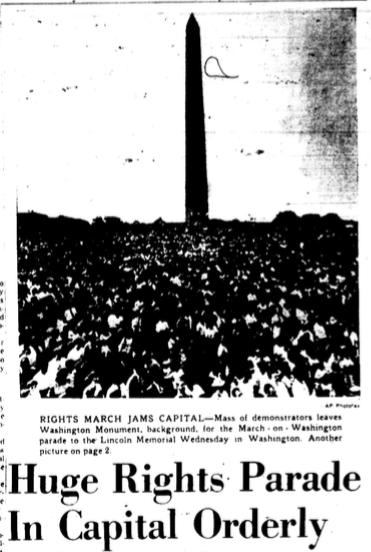 The first article on the march in August of 1963 (page 6) uses a photo of marchers with the Washington Monument in the background, with the headline that read, “Huge Rights Parade in Capital Orderly.”
The national mainstream news coverage of the march on Washington was obsessed with the idea that the only way that the march could be successful would be if it was passive and orderly. In fact, most of the major labor organizations and the Catholic Church told Dr. King and the other Civil Rights leaders that if civil disobedience would be part of the march, they would pull their support.
Another aspect of the march on Washington, DC in 1963, which is rarely discussed or even acknowledged, is that the Federal government had mobilized the military and law enforcement to make sure that people were not going to disrupt business as usual in the nation’s capital.
According to Gary Younge’s book, The Speech, the White House codenamed the March on Washington, Operation Steep Hill. Younge writes, “One thousand troops and 30 helicopters were deployed in the DC area. The Pentagon put 19,000 troops on stand by. The Eighty Second Airborne Division, based in Fort Bragg, North Carolina, stood by with C-82 boxcars loaded with guns, ammunition, and food, ready at a moment’s notice to make the 320 mile trip to Andrews Air Force Base in Maryland, from which soldiers would be dispatched to the Mall by helicopter to quell riots. About six thousand law enforcement officers of different kinds would be deployed that day, all armed with guns, clubs and tear gas. The one concession to civil rights sensitivities was that there would be no dogs.”
This was the context in which the march took place, in terms of what the state was willing to allow, for those that took part in the historic march.
On page 10 of the document, the Grand Rapids Press did publish a list of the 10 demands that the marchers were bringing to the nation’s capital that day.

The very next article on page 11 & 12, shows marchers from Grand Rapids meeting with then Congressman Gerald R. Ford, with a headline reflecting how Congress was not in a hurry to listed to the demands of the marchers.
The subsequent article on page 13 provides some feedback from the Kennedy Administration on the historic march. Kennedy is quoted as saying he thinks the march help to further the “Negro cause.” What the GR Press article does not mention is that President Kennedy pleaded with the organizers of the 1963 march to stress personal responsibility. “It seems to me with all the influence that all you gentlemen have in the Negro community, that we could emphasize, which I think the Jewish community has done, on educating their children, on making them study, making them stay in school and all the rest.” Such sentiment is in direct contradiction of what the march organizers were demanding.
 One final article from the Grand Rapids Press coverage of the 1963 March on Washington, was written after the marchers had returned from DC. The photo that accompanies the article shows 5 people, 4 with the NAACP and one from the UAW, looking at newspaper coverage of the march.
The article that accompanied the photo provided some basic reflection from the 5 featured in the article, about what they liked and what they were impressed by. Unfortunately, the article did not reflect any sense of urgency that the marchers had brought to DC that day, not much of a sense of the efforts put into making the march happen or the larger historical context of the 1963 march on Washington. Besides Gary Younge’s book, The Speech, another excellent resource is, Nobody Turn Me Around: A People’s History of the 1963 March on Washington, by Charles Euchner.
The Grand Rapids Press editorial and White Paternalism
In Jeanne Theoharis’s important book, A More Beautiful and Terrible History: The Uses and Misuses of Civil Rights History, she makes the point that we often look back to events like the 1963 march on Washington and think that the majority of the country supported such events.
The reality is much different. In fact, the federal government was monitoring the organizing leading up to the march and the event that day on August 28, 1963. The federal government was so concerned about what might be said, that they had it set up that they could cut the sound system when necessary, to make sure people were not calling for an uprising that day.
The major news outlets around the country reported on the march with some suspicion, specifically how the march was too polarizing and that it did not reflect what most Americans wanted. This sentiment was true, based on polls taken during the 1960s. According to Theoharis, a Gallup Poll taken in 1961, showed that only 22 percent of Americans polled supported the Freedom Rides. In 1968, another poll that was taken by Gallop, shortly after Dr. King was assassinated, showed that 73% of whites said that blacks in their community were treated the same as whites.
As an example of how the news media played a role in forming public opinion about the Black Freedom Struggle, let’s take a look an editorial from the Grand Rapids Press about the 1963 March on Washington.

Besides the Grand Rapids Press editorial on the 1963 march on Washington, we include three opinion pieces from non-Grand Rapids sources. We include these pieces, because this is what people were reading in the Grand Rapids Press in the editorial section, which also influences how people understand what took place in the summer of 1963 – which are linked here.
The Grand Rapids Press editorial uses supportive language and taken out of context might seem like those who wrote this editorial were endorsing the 1963 march on Washington. However, upon closer review, within historic context, we can see that this editorial is really framed through the lens of White Paternalism.
The Press editorial staff practices White Paternalism by using phrases like, “more orderly and better controlled.” This signals that had there been any civil resistance, the marchers would have lost all credibility in the eyes of the GR Press editorial staff. The fact is, that the Southern Christian Leadership Conference and other black groups involved wanted to have civil disobedience as part of the march, but they were pressured by the Kennedy administration, the AFL-CIO and the Catholic Church not to engage in that kind of action.
The Press editorial writer then goes on to say that “this was a responsible assembly,” and then he compares it to the negative response from David Lawrence’s commentary, which the Press published alongside their editorial. (see link above).
Apparently the restraint exhibited in the marchers was also a demonstration to the world that these kinds of actions need not be violent, which would surely have been the case if this took place in Russia, at least according to the GR Press editorial.
The rest of the editorial again valorizes the fact that there was no violence expressed on the part of the marchers. Nothing is included in the editorial about what it was that those who spoke or the march organizers were demanding from the federal government. In fact, the only person identified by name in the editorial, was Congressman Gerald Ford. Black voices were not centered in this editorial, indeed they were completely absent and seemingly irrelevant.
 Ironically, there was violence at the 1963 march on Washington. The violence was demonstrated on the part of the state, by rigging the microphone to cut off if what was said was not found acceptable. There was the threat of violence with the presence of over 1,000 cops ready to arrest people if they were not “orderly.” Then there was the violence of state surveillance, since we know that the communications between organizers was being monitored and their hotel rooms were being bugged by the FBI. In fact, there were an estimated 150 FBI agents there, just to monitor the crowd, according to Gary Younge’s book, The Speech.
In addition, there was the systemic violence, which is why thousands came to DC, to express their grievances. The segregation, the white supremacy and the brutality of police violence that black people experienced on a regular basis, were the grievances people brought to the nation’s capitol, as Dr. King pointed out in his speech at the march on Washington. King also made it clear that the federal government failed to make good on its promissory note to blacks to be granted equal rights. King makes it clear that the violence of poverty, poor housing and lack of jobs for black people was the violence that the system imposed on black people every day.
As we remember the historic march on Washington in 1963, we should all be asking ourselves why the same grievances are at the forefront of the Black Freedom Struggle 58 years later?
 To date, we have looked at the 990 documents for local foundations in 2021 for the Prince Family, the Richard & Helen DeVos Foundation, the Doug & Maria DeVos Foundation, the Dick & Betsy DeVos Foundation and the Dan and Pamela DeVos Foundation. Today, we want to examine the most recent 990 documents for the Cheri DeVos Foundation, also known as the CDV5 Foundation.
Of all of the DeVos family foundations, CDV5 is the one that people are least likely to know about. Named after Cheri DeVos VanderWeide. She is also a sibling of Dick, Dan and Doug DeVos, yet she has managed to not have the same kind of name recognition that the other children of Richard & Helen DeVos. Despite Cheri’s anonymity, the CDV5 Foundation has assets of $62 million dollars, according to GuideStar. Cheri DeVos has been involved in Amway, RDV Corp and other DeVos-owned entities. She attended 4 years at Hope College and like her siblings, makes significant contributions to the Republican Party every election cycle.
The CDV5 Foundation contributes to many of the same sectors that the other DeVos family foundations do, with a bit more emphasis on contributions that stay in West Michigan. Here is a breakdown of the CDV5 Foundation contributions for 2019, which is the most recent 990 document available to the public.
Conservative Christian groups
Hope Academy of West Michigan $292,885
Base Camp Urban Outreach $40,000
Bridge Street House of Prayer $115,000
Grand Rapids Initiative for Leaders $22,000
Keystone Community Church $400,000
Potters House $75,000
Rehoboth Christian School Association $100,000
Young Life $75,000
Think Tanks and Policy Organizations – These groups all have a documented history of promoting Capitalism, opposing labor unions, undermining public education, and create policy positions that are often adopted by state and federal lawmakers.
Mackinac Center for Public Policy $100,000
Higher Education – Many of these universities or colleges have buildings or business schools named after the DeVos family.
Grand Rapids Community College Foundation $750,000
Grand Valley State University $500,000
Hope College $150,000
Organizations that are run by DeVos Family members
West Michigan Aviation Academy $365,000
ArtPrize $50,000
Orlando Magic Youth Foundation $270,000
The three largest donations from the CDV5 Foundation are Kids Food Basket – $600,000, Grand Rapids White Water Inc. – $525,000, and the George W. Bush Foundation – $500,000. All three of these entities fit within the framework of DeVos foundation contributions, with Kids Food Basket being a charity that does not deal with root causes of hunger; Grand Rapids White Water Inc., which will promote business development/gentrification along the Grand River, particularly in the downtown corridor; and the George W. Bush Foundation, which props up the legacy of a President that embraced Corporate Capitalism and US Militarism.
 Yesterday, the national organization, Moms for America, held a press conference in Grand Rapids, to protest the growing number of schools that now have mask mandates in place because of the growing COVID threat.
Kimberly Fletcher, founder of Moms For America, along with Cindy Chafian, director of coalitions and engagement for Moms for America Action, both spoke during the press conference and were the only sources cited in an MLive article, headlined: Moms for America Action group calls for parents to ‘strike’ against K-12 schools that mandate masking.
Besides quoting two members of Moms for America, the MLive story provided minimal context on mask mandates in West Michigan schools. More importantly, the MLive article provides no information on the history and politics of Moms for America. This omission is significant, especially since Mom’s for America is very much a part of the far right movement in the US that embraces an ideology that places people in danger and contributes to real harm being done to some of the most vulnerable communities in the country.
According to the Moms for America website, it says that the group was founded in 2004 and originally operated out of Dayton Ohio. However, as the organization grew, Mom’s for American now lists Mansfield, Texas as its headquarters.
Moms for America’s mission states:
Our Mission is to build a foundation of liberty in the homes of America, through the mothers of America, to raise a new generation of patriots, and heal our nation from the inside out.
While the mission statement is rather vague, it is clear that Moms for America embrace a far right political perspective. All one has to do is investigate their website, their Facebook page, their Instagram account and their YouTube channel to get a sense of what their organization is all about.
I looked at their Facebook page going back as far as the Spring of 2020, and here are some of the things Mom’s for America has posted:
- Moms for America clearly condemns the Black-led uprisings that took place all over the country after the police murdered George Floyd. In fact, Moms for America regularly refers to Black Lives Matter as a Marxist entity that hates America.
- Moms for America made numerous posts in support of the nomination of Amy Coney Barrett, then celebrated her appointment to the US Supreme Court. Many of their posts also celebrated Barrett’s far right religious views.
- Moms for America condemns the teaching of Critical Race Theory and often posts that the country is being overrun with Socialist, because Marxism is being taught in the public schools.
- In March of 2021, Moms for America held a rally along the US/Mexican border called Secure Our Borders. At this rally they condemned the undocumented immigrants who enter the US, denote the fact that so many of the immigrants coming from Central America and Mexico are mothers with children.
- Moms for America was an integral part of the Stop the Steal protest around the US, thus clearly demonstrating their partisan bias in support of the GOP.
- Moms for America also held a rally near the US Capitol in Washington, DC, on January 5th, the day before hundreds of people stormed the Capitol building. The Mom’s for America organized rally on January 5th was called, Save the Republic.
These bullet points provide a pretty clear picture of what Moms for America is all about. So what about their leadership? The most visible leader within Moms for America is Kimberly Fletcher, who is the founder of the group and the person who spoke yesterday in Grand Rapids. Fletcher is a regular columnist for the online forum called Townhall, which also features columnists such as Ben Shapiro, Ann Coulter, Dinesh D’Souza, John Stossel and Pat Buchanan.
Other members of the leadership team of Moms for America include: Meredith Iler, President of The Strategic Alliance; Rose Tennent, the host of the radio show called Rose Unplugged https://www.roseunplugged.com/; Rebecca Friedrichs, who wrote the book, Standing Up to Goliath: Battling State and National Teachers’ Unions for the Heart and Soul of Our Kids.
All of the information we just provided is the kind of information that the MLive writer should have provided, yet didn’t. In addition, the mLive writer should have asked why Moms for America, a group that is based in Texas, would hold a press conference in Grand Rapids. In fact, this is an important question for all of us, especially for parents, students and community members who have serious concerns about public health and public safety. With Covid cases on the rise in Kent County, we should all be concerned about groups like Moms for America who claim to advocate for freedom, but in reality they threaten the health and safety of everyone in this community.
 Grand Rapids Institute for Information Democracy