GRIID Class – The Function of Policing in the US and how we can work towards a world Without Police: Part VIII
 For week #8, the final week our the GRIID class, we read chapters one and six from the book written by Angela Davis, entitled, Are Prisons Obsolete? Since policing is connected to the larger Prison Industrial Complex, it is important for us to continue to investigate the function of prisons through an abolitionist lens.
In chapter one, Davis lays out for us the scope of the Prison Industrial Complex, how prisons have become a growth industry and how many components there are to this system. In addition, she discussed the increase in the prison population, where the US now has the largest percentage of their population incarcerated than any other country on the world. Davis also provides astute analysis of the economic factors behind the prison industrial complex:
The prison has become a black hole into which the detritus of contemporary capitalism is deposited. Mass imprisonment generates profits as it devours social wealth, and thus it tends to reproduce the very conditions that lead people to prison. There are thus real and often quite complicated connections between the deindustrialization of the economy-a process that reached its peak during the 1980s-and the rise of mass imprisonment, which also began to spiral during the Reagan-Bush era.
The class also discussed the fact that beginning with the Reagan years, there has been significant pushback against the gains made by the Black Freedom Struggle, with the dismantling of the Welfare System that began in the 1980s and ended in 1994 with the Clinton administration.
In chapter 6, Davis challenges and invites readers to radically imagine what a world would look like without the Prison Industrial Complex, and what we need to do create alternatives to mass incarceration:
What, then, would it mean to imagine a system in which punishment is not allowed to become the source of corporate profit? How can we imagine a society in which race and class are not primary determinants of punishment? Or one in which punishment itself is no longer the central concern in the making of justice?
The class participants had a lively discussion about how all forms of popular media are filled with narratives about crime, criminals, courtrooms and prisons. In fact, as one person noted, these themes are so normalized, that it is hard to imagine them no longer existing.
We ended our discussion around the urgency and importance of reparative and restorative justice. Reparative and restorative justice are counter to the punitive approaches of justice that the state dishes out, where the main response is a carceral response. Everyone also discussed the importance of practicing restorative and reparative justice, not just as something that other do, but as a collective practice that brings us all closer to liberation.
For those who are interested, here are links to the other seven classes, which also include all of the reading material used:
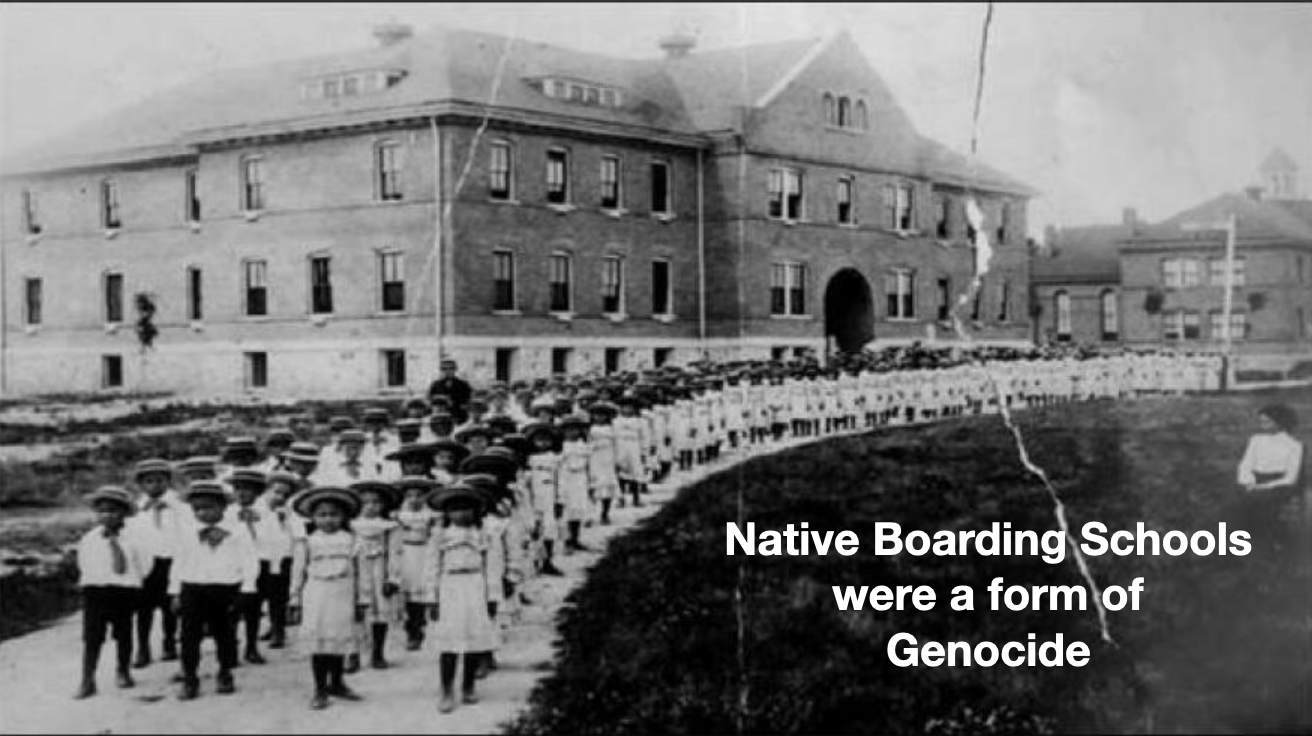 Last Monday, MLive reported that there is currently a bill in the State Legislature that would “encourage” public schools in Michigan to teach about the history of Native Boarding Schools.
The MLive article states:
Sen. Wayne Schmidt, R-Traverse City, introduced Senate Bill 876 in February in an effort to raise awareness about the history of Indian boarding schools in Michigan and encourage the State Board of Education to include the material in statewide curriculum standards.
Senator Schmidt goes on to say:
“It is important to recognize the fact that Indian boarding schools did exist in our state — even as recent as the mid-1980s. Working with tribal leaders, educators, and Indian boarding school survivors and their families, we introduced this legislation so we do not forget, nor repeat, this dark part of our state and nation’s history.”
Such an admission is encouraging, especially considering all of the pushback against Critical Race Theory across the country and in Michigan. Two of the major aspects of Critical Race Theory includes 1) the enslavement of Black people, followed by Jim Crow laws, and 2) the genocidal policies by the US government against Indigenous people.
It is interesting that if one reads the language of the proposed legislation, it is unclear how Native Boarding Schools will be presented in public schools. Those cited in the MLive article never used the term genocide when referring to the Native Boarding Schools. The language of the proposed legislation reads:
The state board shall ensure 25 that the recommended model core academic curriculum content standards for history for grades 8 to 12 include learning objectives concerning genocide, including, but not limited to, the Holocaust and the Armenian Genocide. The state board is strongly encouraged to ensure that the recommended model core academic curriculum content standards for history for grades 8 to 12 include learning objectives concerning Indian boarding schools.
The text acknowledges the Holocaust – referring to the 6 Million Jewish people murdered by the German government during WWII and the Armenian Genocide, but the word genocide is not directly connected to the words “Indian boarding schools.” This issue should not be in question, since Native Boarding Schools were a form of genocide, as is laid out in the 1948 Convention on Genocide. Article II of the Genocide Convention states:
In the present Convention, genocide means any of the following acts committed with intent to destroy, in whole or in part, a national, ethnical, racial or religious group, as such:
- Killing members of the group;
- Causing serious bodily or mental harm to members of the group;
- Deliberately inflicting on the group conditions of life calculated to bring about its physical destruction in whole or in part;
- Imposing measures intended to prevent births within the group;
- Forcibly transferring children of the group to another group.
Forcibly transferring children of the group to another group is exactly what both the State and Christian/Catholic Churches did to Native communities all across the country. Therefore, Native Boarding Schools should always be designated as a form of genocide.
I reached out to Joe Cadreau, an Indigenous activist in Grand Rapids, asking him to respond to this proposed legislation. He said:
I mean it’s great that they are bringing it, and it is a step, not the end game. But to deny it was genocide is a concern of mine. My only hope is that more people like me who go into the schools to do these presentations, continue to call it exactly what it was, a genocide.
They keep saying equity but only give us baby steps and tell us to be patient, I’m done being patient on this subject, you know? But I wonder if the whole vagueness is being used to not offend white feels, or to get the backlash that CRT is currently getting?
I also reached out to Senator Winnie Brinks to ask why she was co-sponsoring the legislation. As of this writing, I have not heard back from her office.
It is too early to know if this proposed legislation will pass and I highly doubt that it will be a priority for those who co-sponsored the bill. Plus, with all of anti-Critical Race Theory rhetoric and HB 5097, which essentially would ban Critical Race Theory from being taught in Michigan Public Schools. What is particularly instructive is that the anti-CRT legislation HB 5097 is exactly the same as SB 876, except for this one line:
The state board is strongly encouraged to ensure that the recommended model core academic curriculum content standards for history for grades 8 to 12 include learning objectives concerning Indian boarding schools.
The very fact that the proposed legislation to add teaching about Native Boarding Schools is essentially the same text that is used for the anti-CRT proposed legislation, demonstrates that State Legislators would at best want to water down the genocidal policies of the US government towards Indigenous people by never using the term genocide. If this legislation goes through it would be nothing short of revisionist history, or to more accurately put it, present history through the lens of Settler Colonialists.
A Brief history of Women-led Movements in Grand Rapids: Part I – The Women’s Suffrage Movement
(Editor’s Note: During the month of March, GRIID will highlight three Social Movements that were led by women in Grand Rapids. These three posts will be part of a chapter that will be included in the book, A People’s History of Grand Rapids.)
International Women’s Day
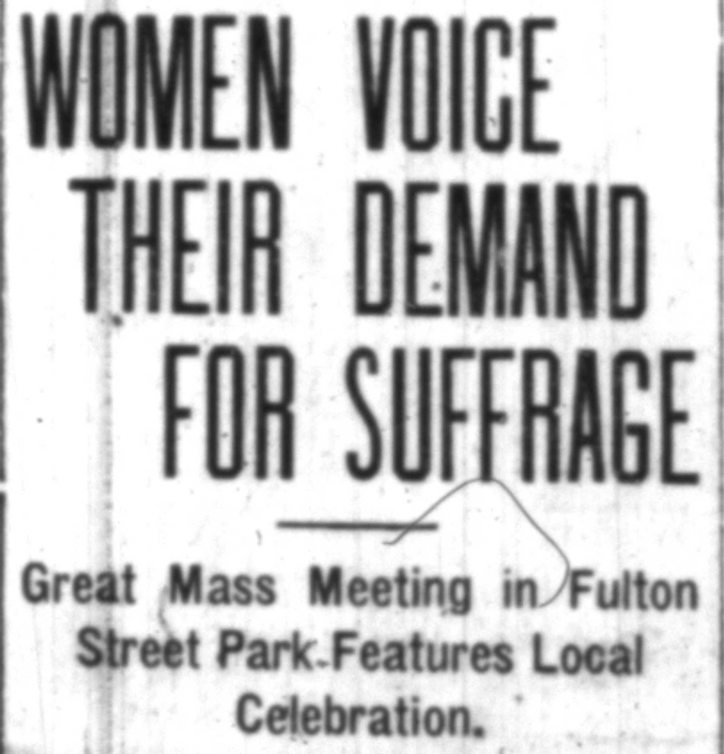 International Women’s Day evolved out of a growing effort amongst women’s and socialist groups to fight for more equality for women at the end of the 19th century and the beginning of the 20th century.
In 1908, 15,000 women marched in New York City demanding shorter work hours, better wages and the right to vote. In 1909, the Socialist Party of America designated February 28 as the first National Women’s Day, which was to be celebrated on the last Sunday of every February.
In 1910, at the Second International Conference for Working Women, there was a proposal to have an international women’s day, where women around the world would press for their demands on the same day. The proposal was not adopted until the following year and International Women’s Day (IWD) was celebrated in several countries around the world. However, something happened just one week later that would galvanize this new international movement.
On March 25, a fire began at the Triangle factory in New York City. It was common practice for factory owners to lock the workers inside until the work day ended and because of that practice 140 women, most Jewish and Italian immigrants, burned to death in that fire. The international women’s movement, labor and socialist movements mobilized around the world to mourn these women and to organize for worker and women’s rights.
For years after the first, the Triangle factory fire became the focus of International Women’s Day and gave birth to the Bread and Roses Campaign. The Bread and Roses Campaign was begun by workers (mostly women) who went on strike at a textile factory in Lawrence, Massachusetts. This strike was organized by the Industrial Workers of the World (IWW) with the slogan, “We want Bread, but we want Roses too!”
The Grand Rapids Women’s Suffrage Movement
Just two years before Grand Rapids officially became a city, there was a large gathering of women being held in Seneca Falls, New York. Some historians identify the 1848 Women’s Convention as the beginning of the Women’s Suffrage Movement in the US.
However, abolitionist feminist Lucretia Mott suggests that the first women’s conference was held in 1837. The focus of the 1837 conference, also held in New York, was an Anti-Slavery Convention. The historian and author Helen LaKelly Hunt, argues that the 1837 Anti-Slavery Convention was the real origin of the modern Women’s Rights Movement, since those early suffragettes were equally committed to the end of chattel slavery as they were to women’s liberation.
In 1874, there was a campaign by the Michigan State Woman Suffrage Association (MSWSA) to get the Michigan legislature to adopt a referendum to allow women the right to vote. 1874, was also the year that the Grand Rapids Women’s Suffrage Association (GRWSA) was founded. The president of GRWSA was Judge Solomon L. Whitney, although some women did play a role on the leadership team.
A few months after their founding, the Grand Rapids Women’s Suffrage Association brought to town Elizabeth Cady Stanton, who spoke to an audience of 1,000 people at the Pearl Street Universalist Church on Pearl St.
In order to continue to build capacity to get Michigan to support the right of women to vote, local communities needed to increase their numbers. In 1880, Grand Rapids held its first Suffrage Convention, with delegates attending from across the state. Within the next year, the efforts of those fighting for suffrage was beginning to pay off, with the State Legislature granting some women the right to vote in local school board elections. However, this did not apply in communities with larger school districts, like Grand Rapids, which did not allow women to vote in school elections until 1885. In addition, women also won the right to run as candidates for school board.
The 20th Century began and women had still not won the right to vote in all elections. However, there was continued persistence, continued organization and fighting against the male-dominated political landscape. In 1908, at the State Constitutional Convention, women won the right to vote on bond measures and local taxation proposals.
In 1909, there was a major push to put women’s suffrage on the national stage, with Michigan Suffrage organizers vowing to collect 100,000 signatures from Michigan residents. Michigan women fighting for suffrage did not get the 100,000 signatures they had hoped, but they did secure 30,000, and sent delegates to Washington, DC to participate in a parade, which ended with a half a million signatures being presented to the US Congress.
In January of 1911, another attempt to win the right for women to vote was defeated in Michigan. A few months later, thousands of Grand Rapids Furniture workers went on strike, demanding better wages, better working conditions and the right to organize. In the midst of the strike, the Women’s Suffrage Movement invited English activist Sylvia Pankhurst. Pankhurst and many of the English women who were park of the Suffrage Movement, did not limit themselves to acceptable channels to make change. Even the news coverage of Pankhurst’s lecture, reported that she and others had engaged in various forms of direct action to force the British Parliament to deal with the issue of Women’s Suffrage. Diane Atkinson vividly documents the tactics and strategies used by the British Suffrage Movement in her powerful book, Rise Up Women! Other tactics that were employed were smashing windows at the British Parliament, fasting, hounding the liberal members of Parliament to take a stance on the issue, marches, and using targeted arson to force the issue. It is worth noting that the British Suffrage Movement won the right to vote in 1918, two years prior to their US counterparts. 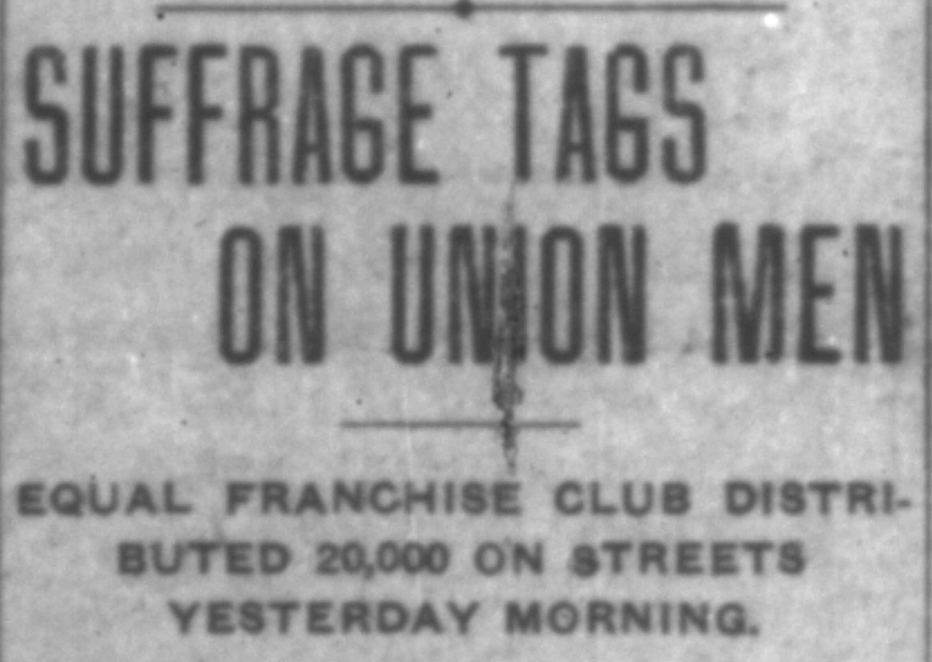
The Grand Rapids-based Suffrage Movement didn’t seem to embrace the more direct action approach to winning the right to vote, but they did eventually realize that they needed to build allies in the fight.
The Labor Day parade in Grand Rapids in 1911, involved 10,000 participants, with thousands more as spectators. The Labor Day parade was on the heels of a furniture workers strike, demonstrating there was substantial support for worker rights. Some of those in the Grand Rapids Suffrage Movement took notice of this and decided it would be a smart move to participate in the 1912 Labor Day march.
The Equal Franchise Club did indeed participate in the 1912 Labor Day parade, with a a float, that was fully decorated, with a banner that hung from the side, which said, “A Square Deal,” advocating fair wages for workers. In addition, about 40 women involved in the Suffrage Movement, handed out 20,000 tags to those in attendance, with one side saying “Votes for Women” and the other side with the same message as the banner on the float. The newspaper reported. “The suffragists met with a most encouraging reception from the men.”
As the Grand Rapids Suffrage Movement was growing in numbers and getting their message out, not everyone was welcoming to the idea that women should vote. Some Grand Rapids officials verbally opposed Women’s Suffrage, which included the City Attorney. In November of 1912, there was an election to allow women to vote in City elections, but more men voted against the giving women the right to vote over those that opposed. One of the leading sectors of men who voted against Women’s Suffrage, were men who were members of the Grand Rapids Christian Reformed Church.
Organizing continued in the following years, but in 1913, the Suffrage Movement was dealt a blow at the state level. There was also a major push for vote verification, which resulted in numerous counties, including Kent County, which saw a reduction of votes for Women’s Suffrage.
The US then entered WWI and many of the Women’s Suffrage groups, including those in West Michigan, decided to support the war effort and take an active part, particularly in the area of encouraging people to buy war bonds.There were some Women’s Suffrage groups that did not jump to aid in the US entry to WWI. The National Women’s Party came out against the war, which was met by a strong denunciation from the Grand Rapids Equal Franchise Club.
As WWI was winding down, the fight for Women’s Suffrage again took center stage, with a new vote in Grand Rapids in November of 1918. This time voters for Woman’s Suffrage won out. At the national level, the 19th Amendment was finally ratified in 1920. However, the ratification of the 19th Amendment did not mean all women could vote, just white women. As was mentioned earlier, had the National Women’s Suffrage Movement kept their original commitment to racial equality, along with gender equality, all women would have benefited. This has always been a major criticism of the Women’s Suffrage Movement in the US, which was essential a movement that benefited white women and created long-standing tensions between white women and women of color who did not trust that white women would have their back in all gender justice fights.
For more details on the Grand Rapids Women’s Suffrage Movement go to https://www.ggrwhc.org/suffrage-grand-rapids/.
Next week, in Part II, we will take a look at the Reproductive Justice Movement in Grand Rapids.
(Editor’s note: While we are focusing on MLive in this article, the other major commercial news outlets also Whitewashed the GRPD and Chief Payne in recent years.)
On Friday, MLive reported on the retirement send-off for the now former Grand Rapids Chief of Police Eric Payne. The headline for the story was, After 34-year career, retiring Grand Rapids police chief says building trust was priority.
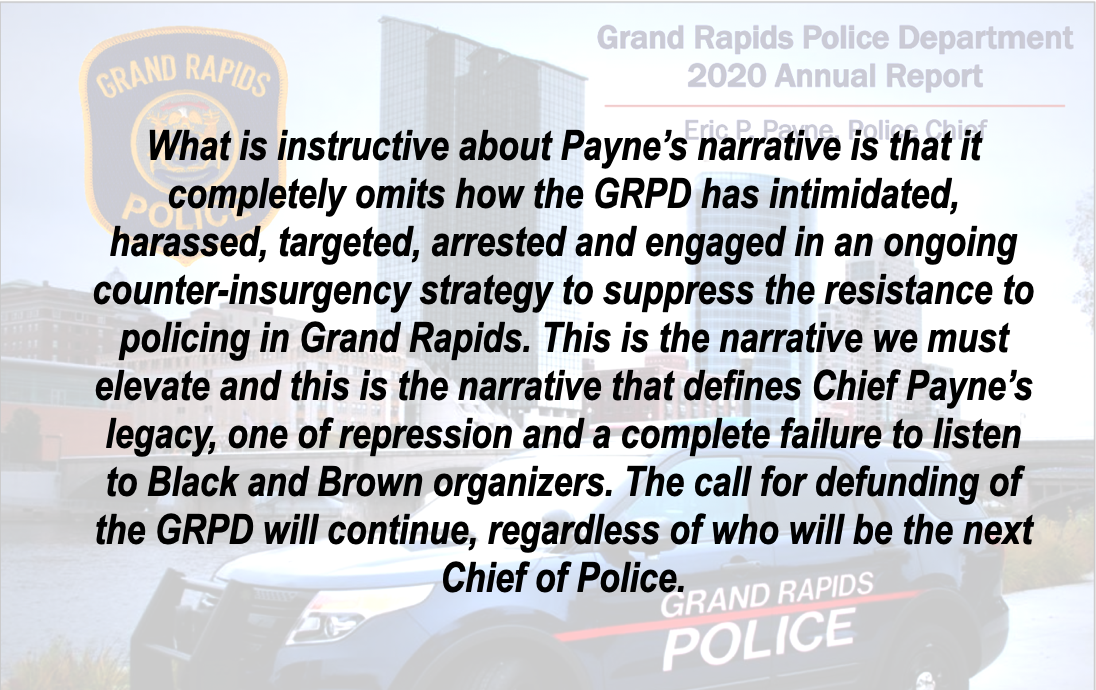
The article was not only about Payne’s retirement, it was a complete whitewash of his tenure as Chief of Police. Payne was the only person cited in the story, so there are no other perspectives included. Payne also makes several claims in the article, claims that are never verified.
For example, the article states:
Payne said he was always willing to listen to those calling for reforms, but noted that certain tactics such as chokeholds and “no knock” warrants have long been against Grand Rapids police practices.
“That was the difficulty for me when screams for reform were being made. I don’t know how to reform something we’re not doing,” he said. “But we listened to the community and we came up with our strategic plan and I think that’s a good road map moving forward.”
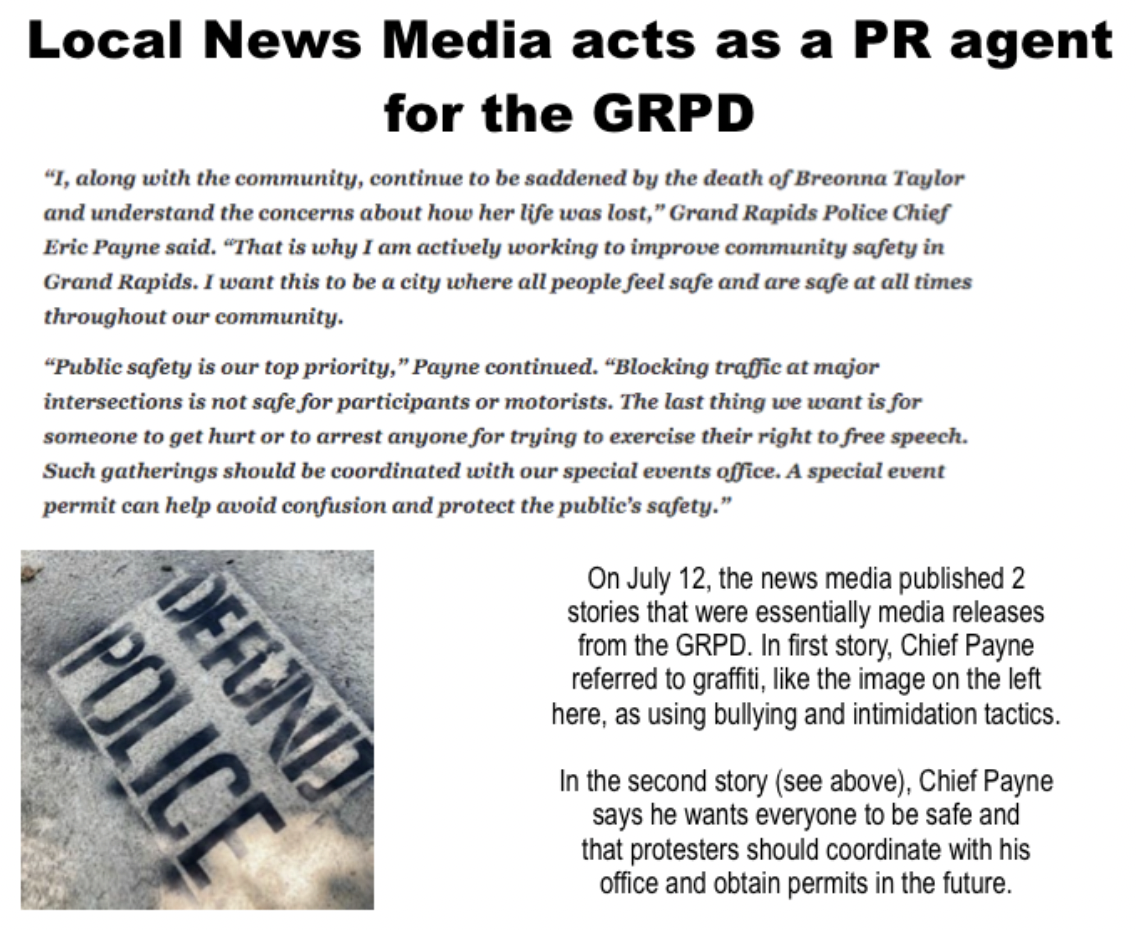 First, Payne was NOT always willing to listen to people calling for reforms. Numerous community-based groups and a larger movement pushing for defunding the GRPD were repeatedly ignored over the past several years. Groups like Movimiento Cosecha GR and GR Rapid Response to ICE were making demands on GRPD collaboration and complicity with Immigration and Customs Enforcement (ICE). Those demands were ignored. Groups like Defund the GRPD, Justice for Black Lives, the Urban Core Collective, the ACLU, the NAACP and Linc Up were also calling for more structural changes to the GRPD, which were also ignored.
Chief Payne was being challenged even before the May 30th, 2020 uprising that took place in downtown Grand Rapids in response to the police murder of George Floyd. The MLive reported said of the George Floyd murder by police:
The coronavirus pandemic and the national strife that came with the death of George Floyd, a Black man who died after a Minneapolis police officer knelt on his neck, brought complications to the job.
Officer Dereck Chauvin didn’t merely kneel on Floyd’s neck, it was an intentional action to punish yet another Black person who would not submit to the demands of a white cop.
At one point in the article Chief Payne says that 3,000 people were screaming at him. It is true that people were angry and screaming, but neither Payne nor the MLive reporter provided any context. The May 30th protest led to an uprising, when GRPD officers showed up in riot gear, began pushing protestors and even fired 40mm chemical rounds, known as spede heat into the group, hitting at least one person, with the intent to disperse those protesting the police murder of George Floyd.
For several months after the May 30th, 2020 uprising, GRIID documented how Grand Rapids City Officials and Chief Payne attempted to control the narrative about policing in Grand Rapids. One of the points we made in that documentation was the fact that the local news media often acts as a Public Relation arms of the GRPD. In fact, we have documented on numerous instances that the local news media has simply repeated GRPD Media Releases as fact, without seeking input or a counter perspective from the numerous groups demanding more accountability from the Police Department.
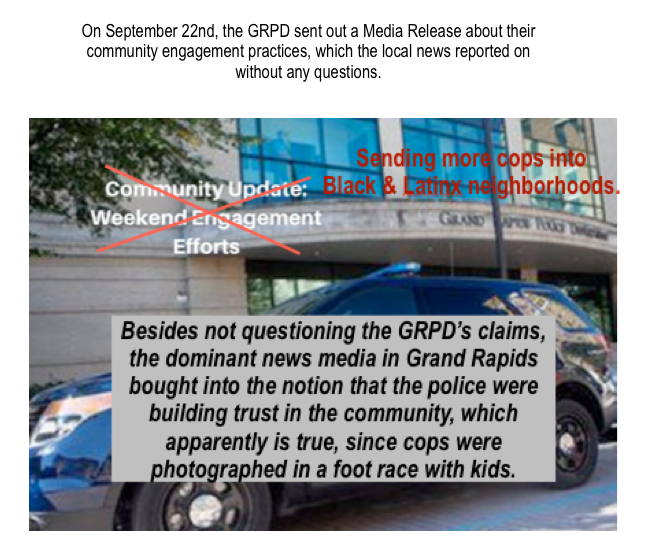
As the headline in the MLive article suggests, Payne claims to have made building trust in the community a goal, which to even the most modest observer, would be considered a cruel joke.
Under Payne’s two and a half year tenure as police chief, he made it a point to have his officers harass, intimidate, monitor and arrest activists who were challenging the very function of policing in Grand Rapids. The GRPD would show up to protests and provoke people, despite the fact that protests were overwhelmingly non-violent. Under orders from Chief Payne, the GRPD would selectively enforce permit rules and noises ordinances, which everyone involved knew were selectively enforced.
In addition, there were numerous high profile incidents where GRPD officers used unnecessary force on Black and Brown residents, where Chief Payne consistently defended the police abuse, saying that the cops involved “always follow proper procedure.” Here are a couple of examples where Payne defends his officers use of violence against Black people:
The GRPD once again demonstrates that they can wrongfully arrest Black people with impunity
 The MLive article on the retirement of Chief Payne also omitted the fact that through significant community pressure, Grand Rapids City officials decided to not use COVID relief funding that was being offered through Kent County to purchase the ShotSpotter technology for the GRPD.
The whitewashing by MLive and the other commercial news outlets on the official end of Eric Payne’s tenure as Police Chief comes as no surprise. The local news media has consistently demonstrated their allegiance to systems of power in this city, plus the local media outlets all internalize the belief that the police are here to protect and to serve.
GRIID Class – The Function of Policing in the US and how we can work towards a world Without Police: Part VII
 For week #7, we finished our conversation on the Movement for Black Lives Defund the Police Toolkit, which was created in 2020, while millions across the country and the world were engaged in an uprising against more police murders of Black people and the carceral state in general.
We covered pages 8 – 26 from the Defund the Police Toolkit, which included things to be concerned about, steps to take, common demands that communities were making across the country, and a look a lots of alternatives to policing. On page 13, the question is asked, what do we want to fund instead of policing. Part of that narrative reads:
We know, and the research shows, that what actually brings peace and safety is safe, accessible, quality, and stable housing, well-funded public schools and other public institutions like libraries and cultural centers, accessible and quality health care for all, including community-based, non-coercive mental health services, and ending the criminalization of unmet mental health needs and drug use. Additionally, many communities are already relying on non-police intervention and violence prevention programs that we know to be both effective and highly under-resourced compared to police.
There was also a lively discussion around the need to practice radical imagination when it came to what we could fund instead of policing and why it is so important to allow ourselves the space to truly imagine.
Then on page 18 – 20, we discussed what the toolkit referred to as tips for how to deal with pushbacks, threats and challenges to defunding the police. This was also a vitally important conversation, as there are people in power, pro-police groups and even liberal and progressive sectors that will want to convince us that defunding police departments is a bad idea or they will want to water down the message to one of a reformist position.
The other reading we discussed was an excellent document from the group Interrupting Criminalization. The document is entitled, Cops Don’t Stop Violence, which deconstructs the whole notion of crime, how crime data is misused to serve policing interests and how police consistently engage in their own crimes against people they stop, detain and arrest.
The report is well researched and full of data, that is presented in a very readable fashion. The report concludes with the following statement:
It’s time to recognize that decades of pouring more money, resources, and legitimacy into policing in an effort to increase safety have failed — because policing is functioning as it is intended to: to contain, control, and criminalize Black and Brown communities rather than to prevent and reduce violence. It’s time to invest in meeting community needs and building non-police community safety strategies. It’s time to invest in just recovery.
For week #8, we will be reading parts of the amazing book written by Angela Davis, entitled, Are Prisons Obsolete? Since policing is connected to the larger Prison Industrial Complex, it is important for us to continue to investigate the function of prisons through an abolitionist lens.
New Climate Report calls for immediate massive reduction in fossil fuels and carbon emissions, but does anyone really care?
 While the commercial news media has us all focused on the Russian invasion of Ukraine, little attention has been given to the latest report from the Intergovernmental Panel on Climate Change (IPCC).
The United Nations Secretary General responded to the lasted Climate Change report and stated:
Today’s IPCC report is an atlas of human suffering and a damning indictment of failed climate leadership. With fact upon fact, this report reveals how people and the planet are getting clobbered by climate change. Nearly half of humanity is living in the danger zone now. Many ecosystems are at the point of no return now. Unchecked carbon pollution is forcing the world’s most vulnerable on a frogmarch to destruction now. The facts are undeniable. This abdication of leadership is criminal. The world’s biggest polluters are guilty of arson on our only home.
These are harsh words, but they honestly reflect the realities of the catastrophic predicament we are facing and they make it clear that those in power, both political and economic, have been the ones who have prevented the serious reduction of the greenhouses gases and carbon reduction from happening.
In the United States, there has been for decades, a Bi-partisan effort to take serious the calls for Climate Justice. Both Republicans and Democrats refuse to pass a Green New Deal, yet they allow massive subsidies to the fossil fuels industry, along with passing massive military spending bill on an annual bases.
In Michigan, the fossil fuel giant Enbridge is continuing to move forward, with State support, to construct a tunnel under Lake Michigan for the Line 5 oil pipeline. Fracking continues to take place throughout Michigan, keeping natural gas consumption flowing, and Michigan is still importing coal to burn for electricity production.
The auto industry continues to get massive bi-partisan support for car production and we should not be deceived by the GM announcement for increased electric car production.
Agriculture in Michigan is still dominated by agri-business interests, with crops for export rather than feeding those who live locally. If you look at the Farm Bill in Michigan, you see that the primary beneficiaries are larger farms, along with those that grow single food items, known as mono-crops.
In Grand Rapids and Kent County, the local governments have done little to significantly reduce to use of fossil fuels and practice real sustainability. Resident-led efforts to push for a more Climate Justice center approaches were generally ignored. Grand Rapids claims it has a world class transit system, but all one has to do is observe the level of single passenger vehicles during rush hour and the amount of parking lots that dominate the downtown area. At the same time Black and Brown neighborhoods have the least amount of greenspace and have limited access to healthy, fresh foods, thereby suffering from Food Apartheid.
On a Global scale, the IPCC report also makes it clear that those most vulnerable around the world are Indigenous, Black, Latino and Asian communities that make up a significant portion of the Global South.
Neither Prayer nor Technology will save humanity from the Climate Crisis
 I’ll admit that after reading the recent IPCC report, I felt depressed and wondered what the future holds for us. I’m just a few months from Turing 62, but what about future generations? We CANNOT rely on the political class to solve these problems and we CANNOT rely on the Capitalist Class either, since both of these classes bear most of the responsibility of getting us into this mess to begin with.
I am reminded of the recent study done by the Indigenous Environmental Network, Indigenous Climate Action, and Oil Change International, which concludes that Indigenous communities resisting the more than 20 fossil fuel projects analyzed have stopped or delayed greenhouse gas pollution equivalent to at least 25 percent of annual U.S. and Canadian emissions. This is a powerful example of the importance of engaging in Direct Action and to not be lulled into the illusion that we just need the right set of politicians to fix things.
I do believe is developing strategies of resistance and there are plenty of people who have been working in that arena for a long time. On organizational approach I would suggest, is what environmental strategist Stephen D’Arcy lays out for us in his essay, Environmentalism as if Winning Mattered: A Self-Organization Strategy.
D’Arcy suggests a two-pronged strategic approach, the Resistance Phase and a Transition Phase. Keep in mind that D’Arcy is focusing on environmental outcomes, but he also makes clear that his approach is fundamentally an anti-capitalist strategy.
The Resistance Phase would include some of the following strategic objectives:
- To construct an anti-corporate alliance of Indigenous communities, workers’ organizations, and environmental protest groups, based on a serious, sustained commitment to practical solidarity at the grassroots level.
- To build cost-raising protest movements, directed against all forms of environmental destruction, framing these struggles whenever possible as struggles for environmental justice, including Indigenous self-determination, economic justice and public welfare.
- To promote prefigurative community-based alternatives to capitalist production that model sustainability, solidarity, popular autonomy, and environmental justice.
- To re-establish vital currents of ecologically oriented anti-capitalist radicalism, for instance, eco-socialism, anarcho-Indigenism; social ecology; left eco-feminism; and so on.
The Transition phase would also have four strategic objectives:
- To organize anti-capitalist environmentalists into a common front of radical community organizations (SMOs, CCOs, PAOs), capable of tactical concentration for united action;
- To establish the hegemony of the anti-capitalist common front within the mass environmental movement, so that it exercises a consensual, acknowledged leadership role in pointing the way forward for large sections of the broader movement;
- To gain for the common front and its allies a degree of community-based “social” power, resting on the capacity to deploy general strikes, mass protest, and mass civil disobedience campaigns, on such a scale that the community-based opposition constitutes a community-based counter-power that can effectively challenge the economic power of corporations and the coercive power of the state;
- To secure the transfer of ever more extensive governance functions to community-based self-organization (SMOs, CCOs, PAOs), so that “social” sector institutions ultimately displace — rapidly whenever possible, gradually whenever necessary — both “private” and “state” sector institutions from their role in running the economy, the healthcare and education systems, providing social services, etc.
This is just one model for how we move forward, but the point I want to emphasize is that based upon the recent IPCC report, we need to collectively reduce carbon emissions by 90% of their current levels within the next few decades or we will leave a world for our children that will be hell. In order to achieve the 90% reduction, we will need to radically alter how society currently functions. We will have to end militarism and military spending, dismantle the agri-business system, expose and dismantle the system of White Supremacy, create real mass transit and come to terms with the fact that we cannot produce enough energy, even through solar or wind, to power our communities and not expect to have to make more fundamental changes to how we live.
MLive uncritically presents development projects as transformational, but fails to ask who really benefits
Last Thursday, MLive posted an article entitled, 12 ‘transformational’ projects identified by Grand Rapids economic development group. In the second paragraph of the article it states:
Working with city, business and tourism leaders, The Right Place identified 12 “transformational” projects. The projects, some of which have been discussed for years, would benefit Grand Rapids, and build on its reputation as a city where people want to live, work and visit, officials say.

The primary sources used in the article are spokespersons from both the Right Place Inc. and the Grand Rapids Chamber of Commerce. These two groups are both private sector entities that make up part of what GRIID identifies as the Grand Rapids Power Structure. What we mean by Grand Rapids Power Structure, is that there are organizations and individuals that wield tremendous political, economic, social and cultural power in this community, most often without the public’s consent.
Then there is the issue of MLive using the term transformational to describe these so-called development projects. Transformational or transformative often means, causing a marked change in someone or something. Thus the use of the term is not inaccurate. However, what critical aspect of what the MLive article fails to address, something that journalism should always do, is to always ask the question, who benefits? We all should be asking ourselves: 1) Who will be the primary beneficiaries from these 12 projects, 2) how much money, both public and private, will be used for these projects, and 3) what could that money be used for that would be truly transformational for communities most affected by the constant emphasis on Neoliberal Capitalism, development and entrepreneurial ventures in this city?
The MLive lists the 12 “transformational projects, with a brief description. We will list the 12 projects and provide a brief counter analysis of each.
- Convention Center Expansion and Hotel – This project will primarily benefit those who own and operate the downtown hotels, parking lots, bars, restaurants and entertainment spaces. People will often say, like they do during ArtPrize, that those who do most of the work in these spaces – parking attendants, wait staff, those who clean hotel rooms, line cooks, dish washers, valets, etc, will also benefit. The truth is that those who do the hard work do not make a living wage, many pf them do not have good benefits, work long hours and are deeply undervalued. In contrast, those who own the hotels and other businesses in the downtown will continue to reap huge profits from the Convention Center Expansion and Hotel.
- Countywide Affordable Housing – MLive does not clearly define what this means or who is behind such a plan, but I believe it is the Housing Kent project that is facilitated through KConnect. You can read their 50-page strategic plan here. This item has the potential to be transformative, but some of the people involved and those funding the strategy are also members of the Grand Rapids Power Structure, which should raise red flags for those most affected.
- Downtown Post Office Relocation – Those who own and control a great deal of the property in the downtown area have been wanting the post office relocation for the better part of two-decades. While relocating the post office might make sense, it will free up real estate that those who are part of the local power structure will definitely benefit from.
- Grand Rapids Aquarium – This project is seen as working to make GR a more attractive tourist destination, which it no doubt would. However, who will own and operate the aquarium, and which businesses already benefit from tourism in this city?
- Grand River Greenway Initiative – This project intends to create a waterfront area into a 5-mile outdoor recreation corridor. This project will primarily benefit the businesses along the waterfront, plus it will disproportionately attract communities who have more mobility and more privilege for recreating along the Grand River. Also, see our post from last year about the development project along the Grand River.
- Grand Rapids Community College Public Safety Training Center – Lets call this what it is, a center that will primarily train people to be cops. Public safety has nothing to do with it.
- Gerald R. Ford International Airport Control Tower Relocation – This project will just expand the amount of air travel to and from Kent County. The increased air travel primarily benefits members of the business/Capitalist Class and has significant ecological consequences, particularly around escalation of Climate Change.
- Grand Valley State University Digital Learning Epicenter – When has a GVSU project really been a benefit to those most affected by structural racism or poverty? This will primarily benefit the business class, by developing future skilled laborers with Digital skills.
- Market Avenue Gateway – This project is directly connected to the Grand Action 2.0 Outdoor Amphitheater proposal, which is definitely happening. The area between Fulton and Wealthy Streets along the Grand River will be of massive benefit to the already grotesquely rich, like the DeVos family. This whole effort has seen the City of Grand Rapids spend millions of public dollars to benefit yet another private venture.
- Outdoor Amphitheater – As was just mentioned above, but see the following link for more analysis.
- Michigan State University Innovation Center Campus Expansion – The claim is that this project will address health disparities and health equity, but more research pointing out what we already know will not actually address health disparities, not while the Medical Industrial Complex is controlled in large part by hospital conglomerates, the Insurance Industry and the Pharmaceutical Cartel.
- Soccer Stadium – This is another Grand Action 2.0 effort that is being led primarily by Dick DeVos and Carol Van Andel. How much public money be spent on such a construction project, while the team will likely be owned privately?
Now, all of these projects combined will cost hundreds of millions of dollars. Imagine for a moment, what hundreds of millions of dollars could do to alleviate poverty in this city and provide a guaranteed living wage to all those families currently experiencing poverty. Imagine how those hundreds of millions of dollars could be used to build good housing for the thousands of families who are experiencing housing insecurity in this city. Imagine if the City invested millions into urban agriculture, that would provide healthy produce to thousands of families experiencing food insecurity. Imagine if hundreds of millions of dollars were invested in dismantling Structural Racism, which could lead to abolishing the Prison Industrial Complex in Kent County.
Again, we have to always ask who benefits from these so-called development projects, plus we have to radically imagine what would truly be transformational in this city. Remember, it is not a question of there being insufficient funds to address the serious social problems we face, it is always a matter of priorities. Those who run the City of Grand Rapids currently prioritize profit making over ending poverty, expanding their own wealth over dismantling Structural Racism.
(In the coming weeks, GRIID will be providing a series of posts covering a broad range of issues as it relates to the US, NATO, Russia and the Ukraine.)
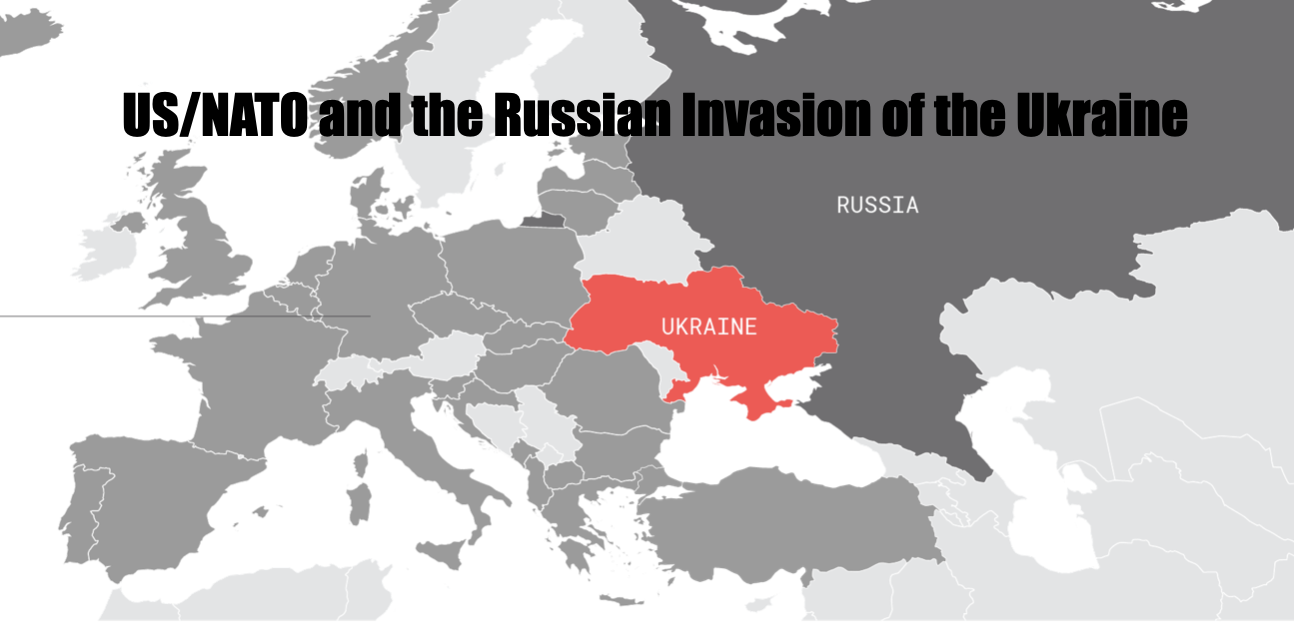
“In war, truth is the first casualty.” Aeschylus, the ancient Greek playwright.
Just days before the Russian invasion of the Ukraine, Patrick Cockburn, an author and longtime journalist that specializes on covering issues related to the Middle East, but has also covered Washington and Moscow, wrote an important article entitled, Russia-Ukraine is an Information War, So Government Intelligence Needs More Scrutiny Than Ever.
The point I want to make is not so much that the evidence for Russia plots to provide a casus belli is shaky, but that intelligence service information is often dubious, and always partisan. The bias is in-built because intelligence agencies are, first and foremost, a component of the government machine and they forget this at their institutional peril.
Pundits occasionally say in shocked tones that intelligence has been “politicized”, but this is automatically correct on all occasions. Yet intelligence sources are often cited as if they were to be held to academic standards of objectivity and are not pursuing some personal, institutional or national aim.
It takes a high degree of naivety not to realize that this must be the case and information wars are always part of cold wars and shooting wars.
As someone who has been monitoring the local news coverage of the 1980s US Wars in Central American, the 1990 US bombing of Panama, the 1991 Gulf War, the War in former Yugoslavia, the US invasion of Afghanistan and the 2003 US War against Iraq, the bias, sourcing and framing of the coverage is awful. For example, you can watch a documentary GRIID produced in 2003, which was based on the local news media coverage of the Iraq War for the first six weeks. GRIID also conducted a 100 day study of the Grand Rapids Press coverage of Afghanistan in 2009.
Studies that have been done by groups like the Center for Media & Democracy, have also demonstrated that the more that people in the US relied on the mainstream commercial news media around war coverage, the less they really knew, particularly about the larger context of any given war.
 The dominant US commercial news media relies almost exclusively on US government sources and former US military personnel, without providing a counter perspective or verifying the validity of the government information.
The local news media will also tend to run stories that are either a lazy form of journalism, journalism that is sensationalized or journalism that perpetuates a government narrative. For example, MLive has run several stories in the last week, stories which illustrate this type of reporting. On February 24, MLive posted a story about Michigan State lawmakers views about the Russian invasion of Ukraine. It is worth asking here, why does what state lawmakers, who make no decisions about US foreign policy, why their opinion should matter.
On February 25th, MLive posted a story with the headline, Congressman Fred Upton calls Putin a ‘thug,’ supports sanctions as Russia invades Ukraine. The article doesn’t provide any information that would challenge or counter Upton’s point of view. Also, the headline supports the dominant narrative, since you did not find a headline in US commercial media during the George W. Bush years referring to Bush as a thug, even though in both cases – with Putin and Bush – they invaded a sovereign nation.
Then there was the MLive post from February 24, where a Grand Rapids Bar owner pulled some brands of vodka from the bar in protest of the Russian invasion of the Ukraine. l The article even acknowledges that the brans are no longer Russian owned, so why post such a story when it is simply a knee-jerk position to take that is not based in fact.
On the national news front, thankfully there are groups like Fairness & Accuracy in Reporting (FAIR) , which has been acting as a media watchdog since the 1980s. Here are four articles that FAIR ran just prior to the Russian invasion, which demonstrates the US media bias and over-reliance on government sources for stories.
https://fair.org/home/bryce-greene-on-ukraine/
https://fair.org/home/western-media-fall-in-lockstep-for-neo-nazi-publicity-stunt-in-ukraine/
https://fair.org/home/what-you-should-really-know-about-ukraine/
https://fair.org/home/hawkish-pundits-downplay-threat-of-war-ukraines-nazi-ties/
It is also worth looking at the link on FAIR that focuses on how the US media has reported on Russia over the past four decades.
Moving forward it is imperative that we have well sourced, well documented news and information that is independent of commercial influences, over-reliance on government sources and internalizing pro-USA narratives. If people are not clear what I mean by pro-USA or dominant narratives, here is an excellent post from Paul Street, entitled, 15 Bad Ukraine Narratives.
In addition, below are a few sources I have found to provide solid analysis and use sources that are not motivated by partisan politics, sources to read and then compare to the dominant commercial media coverage.
Like his father, Doug DeVos wants us all to just Believe: A member of the Grand Rapids Power Structure and his Podcast
 In early December, Doug DeVos, the head of Amway and RDV Corp, announced that he was going to host a podcast. The name of the podcast would be called Believe!
Calling his podcast Believe! Is a nod to his deceased father who wrote a book by the same title in 1975. Richard DeVos Sr. wrote Believe!, according to the publishers blurb, “as a fresh and much-needed reaffirmation of the tried and true traditional values that can make you the success you want to be.” The tried and true traditional values of which the DeVos patriarch spoke of was his brand of Conservative Christianity and a deep belief in the system of free market Capitalism.
The DeVos belief in Capitalism has worked out well for the family, initially with the creation of the pyramid scheme known as Amway and it’s cult-like approach to selling products. The DeVos family has since diversified, adding new companies, creating a massive investment portfolio to go along with the numerous family foundations – another scheme to hide some of their wealth from being taxed and to engage in social management of populations that are in need of their philanthropy, since they have spent millions of dollars to influence public policy that has created a massive wealth gap over the past 50 years.
Doug DeVos says that he was starting this podcast to talk about his values, to inspire people to Believe, and to communicate the idea that anyone can do anything if they set their mind to it. Ok, so why is it that people, especially rich bastards, always have such a perky optimism? And I don’t mean the perky optimism of Mrs. Maisel, I mean the kind of optimism that is born out of class privilege, where you see the world as something to conquer no matter how many lives you destroy in the process.
Anyway, Doug DeVos’ podcast has produced 4 episodes as of this writing. The first episode doesn’t seem to count, since Doug is interviewed by two of his children. However, the next three episodes provide us with a clear indication of what this show is really about.
Episode #2 features Alan Smolinsky, who is identified as a serial entrepreneur and the owner of the Los Angeles Dodgers professional baseball team. The theme of that conversation centers around the question, “What is the American Dream?” So, episode #2 is two rich guys talking about the American Dream, while the majority of the people who live in this country are experiencing what Malcolm X referred to as the American Nightmare.
Episode #3 features Blake Masters, who is identified as a Tech Entrepreneur and a Senate Candidate in Arizona. Doug and Blake talk about silicon valley, the future of tech and entrepreneurism in the US. Also, Blake Masters is exactly the kind of candidates that the DeVos family likes to make massive campaign contributions to. For those who are interested, Blake Masters wants secure borders, believes that police are under attack, that crime is out of control, opposes Critical Race Theory, and believes that public schools for progressive indoctrination.
Episode #4 features Michael Anton, a research fellow at the hyper-conservative Hillsdale College. Anton also writes for the Claremont Institute, which is a far right think tank. One of his more recent articles is entitled, The Case for Trump, which makes complete sense, since Anton was a national security official in the Trump administration.

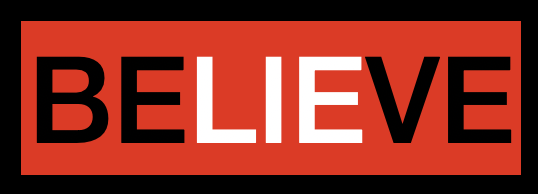
I remember an interesting observation from the late John Trudell, the former national spokesperson for the American Indian Movement, who was also a poet and a musician. Trudell once said that those in power always want us to believe in lies they tell. They want us to believe in a Western, Christian world view which has taken our land from us. Ironically, Trudell says, that the word Believe itself contains the word lie within it.
The Believe! Podcast from Doug DeVos has so far featured people who are aligned with his religious views, other members of the Capitalist Class and those who defend the far right ideological values that are the very embodiment of the DeVos family. So, instead of blindly believing anything that people like Doug DeVos have to say, lets adopt solid critical thinking skills, skills which will allow us to see through the lies those in power want us to BeLIEve!
GRIID Class – The Function of Policing in the US and how we can work towards a world Without Police: Part VI
 For week #6, we finished our conversation on the vision document that was created by the Movement for Black Lives in 2015.
The conversation on the 2015 vision document centered mostly around how these demands would be beneficial to most people, except for those with the most political and economic power, since they would have to give up that power and influence. In addition, there was discussion and exploration around what real community control would look like, as well as a shift from representative democracy, to full participatory democracy.
We also read and discussed the Movement for Black Lives Defund the Police Toolkit, which was created in 2020, while millions across the country and the world were engaged in an uprising against more police murders of Black people and the carceral state in general.
The toolkit provides not only some clear and concrete steps on how to Defund your local Police Department, it provides a clear narrative and framework upfront about what the Movement for Black Lives means when they say Defund the Police. Here is one powerful sentence from that introduction:
It is a demand to #DefendBlackLives by shutting off resources to institutions that harm Black people and redirecting them to meeting Black communities’ needs and increasing our collective safety.
Such a statement clearly defines what is meant by Defund the Police, along with dismantling all the liberal “re-interpretations” of what Defunding the Police means to those who have by en large refused to listen to Black-led movements and haven’t even bothered to read the toolkit on Defunding the Police. Last year, we posted one of the “this is what defunding the police really means” memes, then dissected it to demonstrate that what they think it means is not at all what the Movement for Black Lives is calling for.
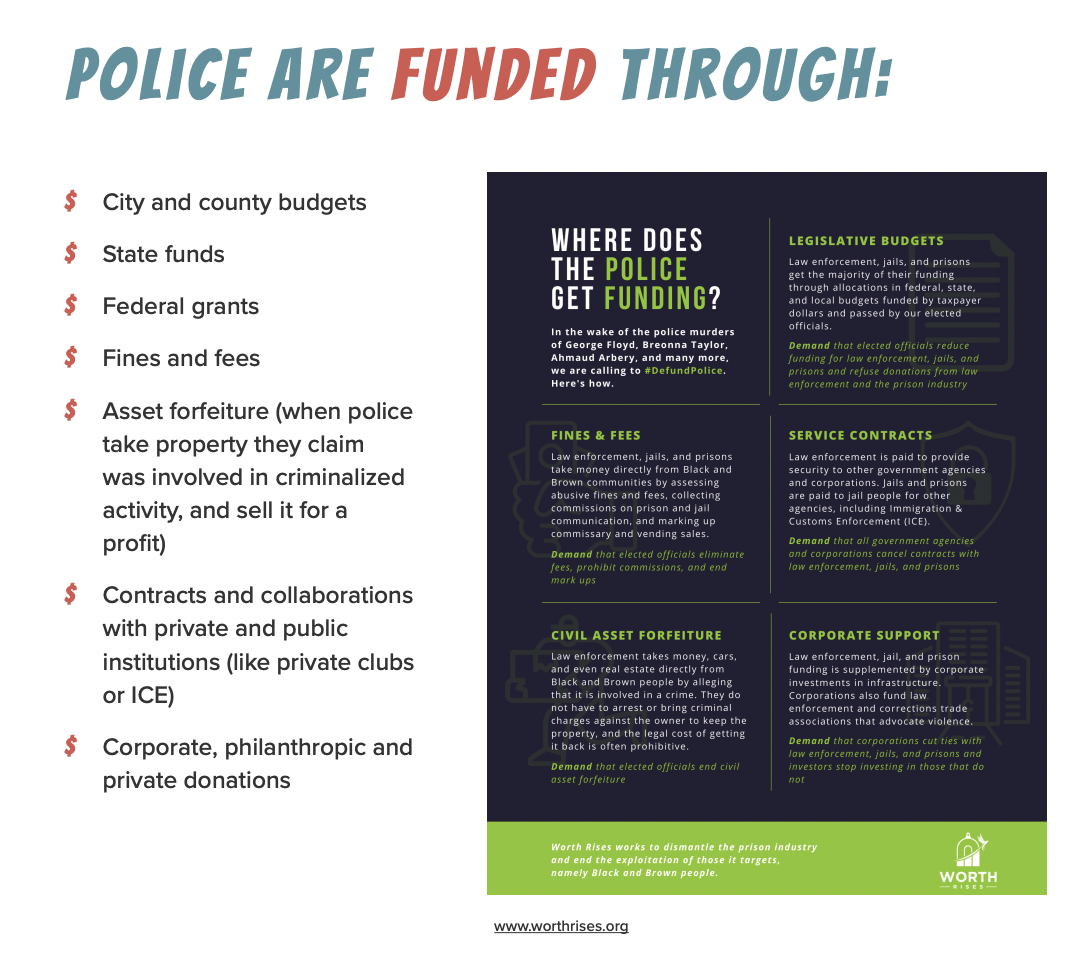
We also discussed the useful way that the creators of the toolkit provided language around ways to discuss what defunding the police means, which often means talking about things like how to police department even generate funding, as can be seen on this graphic from page 6 of the toolkit.
We ended the class with discussion of page 7 from the toolkit, which has 10 clear things we can do to Defund the Police. As always, there was great conversation, lots of questions and the benefits of collective learning, where people felt challenged to expand their thinking without being judged.
For week #7, we will continued to discuss the DeFund the Police Toolkit, along with some other documents that deconstruct how Police don’t actually prevent crime, along with an example from Los Angeles of a People’s Budget.
 Grand Rapids Institute for Information Democracy