Michigan Legislators vote to repeal Right to Work, but the Far Right in Michigan has other plans that MLive doesn’t tell us about
On Tuesday, March 14th, MLive posted a story entitled, Michigan’s ‘right to work’ is at death’s door. What will its legacy be?

The MLive article, which is much longer than post articles, cites labor union representatives who support the repeal of Right to Work, plus the obligatory pro-Right to Work position from a few politicians and a spokesperson for the Mackinac Center for Public Policy, which is a Far Right Think Tank.
In addition, there were three university professors cited in the article, all of which claimed that Right to Work was good for workers, along with an “economist” with The W.E. Upjohn Institute for Employment Research, who leaned toward supporting Right to Work, thus MLive provided more pro-Right to Work voices than labor voices.
More importantly, there is no real discussion about the legacy of Right to Work in the article, as was stated in the headline. There was some data and a few graphics presented, but no real analysis of what impact the Right to Work Law has had on Michigan between the time it was adopted in December of 2012 through the present.
The MLive article also had three accompanying photos with the article, two of which showed a sea of people outside the capital holding signs and banners in support of unions. The third photo showed State Police officers standing in front of the State House chambers, preventing people who were attempting to go in and possibly disrupt. Unfortunately, the mLive article doesn’t explore the tactical and strategic actions of organized labor that day in December of 2012, especially since most of the 10,000 who came to protest Right to Work remained outside with only a small contingent of 300 choosing to go inside with the intent of shutting the government down. I know, as I was a participant inside that tried to shut things down, something I wrote about on December 11, 2012. You can also watch the short video I shot on the occupation of the Capitol building in Lansing.
What is omitted from the MLive article
One thing that is not explored in the MLive article, are the plans that the pro-Right to Work forces are organizing around in response to the current repeal of Right to Work.
According to an article from the Center for Media & Democracy, posted on March 10, the Mackinac Center for Public Policy (which was cited in the MLive article):
In this heated context, the Mackinac Center for Public Policy, a right-wing think tank that was instrumental in getting the anti-union legislation passed, announced the creation of a new spin-off last month that is legally able to raise and spend unlimited amounts of dark money to influence legislation and ballot measures.
Known as the Mackinac Center Action, the new advocacy group is a 501(c)(4) nonprofit, which means that it will not have to adhere to the lobbying limits and ban on electoral activity that apply to its 501(c)(3) parent organization. And, unlike super PACs, Mackinac Action will not be required to disclose who funds its operations.
Fueled by Koch, the Bradley Foundation, and other right-wing billionaires and foundations, the Mackinac Center is a powerful force in Michigan that has long led the charge to break the back of organized labor in the state.
Now, we don’t know for sure of this new PAC from the Mackinac Center will be raising money for pro-Right to Work candidates to re-take the State Legislature in 2024, if they will being organizing a Right to Work ballot initiative, or both. Whatever this PAC is going to do, this is the real legacy of 10 years of Right to Work, a legacy that all people who believe in the power of organized labor should be paying attention to.
In Part I of our series looking back at the 20th anniversary of the public resistance to the US invasion/occupation of Iraq in 2003, we focused on early organizing efforts to build an anti-war movement before the US war on Iraq even began. In Part II, we looked at the protest when President’s Bush’s visited Grand Rapids the day after his State of the Union address and the GRPD’s response during that protest.

In Part III, we looked at the Women in Black actions, the global protest against the war march that took place in Lansing, along with the People’s Alliance for Justice & Change workshops on civil disobedience that were offered to a growing number of people who wanted to do more than just hold signs. Part IV focused on student organizing against the imminent US war against Iraq, along with civil disobedience that was done at Rep. Ehlers office before the war began. And, in Part V, we looked back on some of the plans that anti-war organizers had put in place once the US invasion/occupation of Iraq began, along with increased GRPD surveillance.
In today’s post we will focus on what actions took place once the US war/occupation of Iraq had begun, along with the increased intensity of GRPD surveillance and repression against anti-war organizers.
On March 20th, the US War/Occupation of Iraq had begun
The US military began its bombing campaign of Iraq on March 20th, 2003. As was previously decided, anti-war activists would meet at the Federal Building in downtown Grand Rapids. It was raining that day, but there were still about 100 people that showed up. In addition, there were a handful of pro-war people who came and stood across the street on Michigan Ave, right in front of the old GR Press building. In addition, there were GRPD cops, along with undercover cops who were trying to pass themselves off as protesters, even though many of us knew exactly who they were.
The group People’s Alliance for Justice & Change had planned to hold a meeting at the office of the Institute for Global Education (IGE) on the evening of March 20th, specifically to plan the next several actions, talk about tactics and strategies for increasing anti-war activity.
We know that the GRPD were planning on increasing the surveillance of anti-war activities, based on the FOIA documents we were able to obtain months later. In the FOIA documents that dealt with the beginning of the war, there was an e-mail they included from the Grand Rapids City Manager to City employees telling them to bring IDs to work that day, there was a copy of a flyer announcing a protest at GVSU that was organized by students, and there was a brief noted (with some information redacted) that said that the Kent County Sheriff’s Department would have extra officers assigned the GVSU. However, the most revealing FOIA documents had to do with the GRPD’s undercover cops who were present during the anti-war meeting at IGE on the evening of March 20th and subsequent protests.
As was already mentioned the meeting at IGE on March 20 was to discuss upcoming actions. The GRPD had send both undercover cops and cops in uniform to that meeting to attempt to intimidate people and to gather intelligence. Here is an excerpt from the GRPD perspective on what was happening.
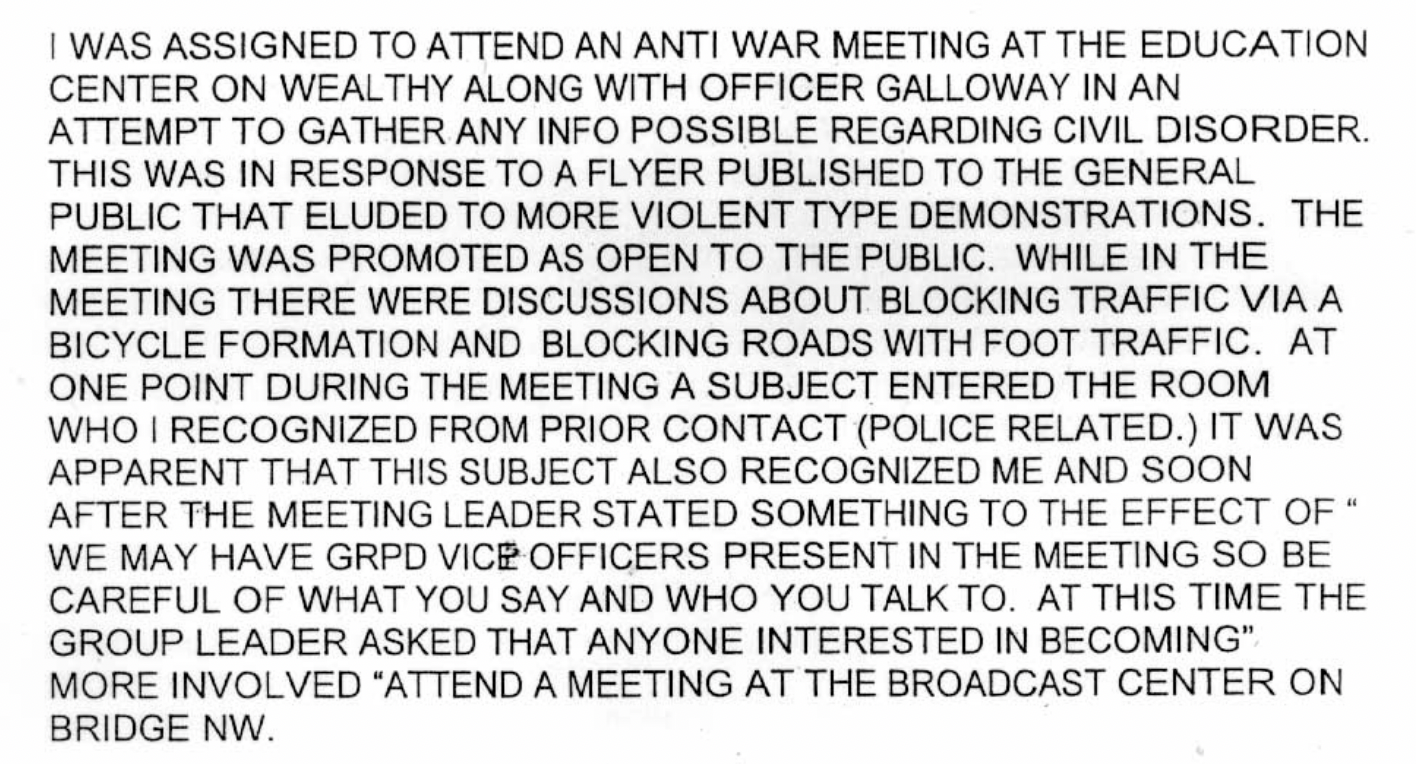
During the March 21st protest it became clear that the GRPD undercover cops were privy to what we had planned, which was to shut down traffic on Michigan Ave by the Federal Building using a slow-down cross-walk technique, where people would walk in pairs slowly and then turn right on the next cross walk, thus stopping traffic going two way initially, then 3 ways and then altogether. However, since the GRPD knew we were doing this, they made it difficult, by threats with arrest, for us to shut down more than one of the cross walks.
On that same day, there were other GRPD cops who were undercover and attempting to pass themselves off as anti-war protesters, even carrying signs. What they did not expect was that one of the anti-war protesters, who was also a translator in the District Court, recognized some of the undercover cops because they were with the vice squad. Here is a GRPD document dated March 26th, that was a result of what happened on March 21st, where the GRPD undercover cops were outed.
 What we didn’t know at the time is that after the undercover cops were pointed out to us, those same cops that were with the vice unit, stopped the person who at outed them and made threats against her for pointing them out to organizers, as was stated in the FOIA document. In fact, this issue was happening all across the country with cops infiltrating anti-war demonstrations, which was the subject of an article on salon.com in February of 2004, titled, A thousand J. Edgar Hoovers. Several people from Grand Rapids were interviewed for that story, which was later picked up by the GR Press making it known in West Michigan that the GRPD was engaged in COINTELPRO-like activities.
One thing became clear after the US Military War/Occupation of Iraq had begun, was that the numbers of those protesting had dwindled (unless a high ranking US official was in town). This was probably one of the results of the GRPD surveillance and repression of anti-war activists, but it also was a reflection of the bi-partisan support for the war and war funding, once the war had begun, which meant that many white liberals who identified as Democrats no longer were resisting the war since the Party’s leadership was behind it.
In our next post looking back at the 20th Anniversary of the US war in Iraq, we will look at how the Grand Rapids-based news media was reporting on the war, local war activity and even providing a platform for pro-war voices.
Last year during Black History month, I made three posts about books dealing with the Black Freedom Struggle that influenced how I saw the world. Now that we are in Women’s History Month, I want to do the same thing in regards to books by women, particularly feminists that influenced my understanding of the world.
I say feminist writers, as Women’s History month has evolved to the point where it is centered on identity politics, rather than the being rooted in the origins of International Women’s Day.
Last week, in Part I, I shared the titles of books that I read in the 80s and early 90s that challenged my understanding of myself and the world around me. In today’s post, most of these books are from the late 1990s and early 2000’s.

Feminist Freedom Warriors: Genealogies, Justice, Politics, and Hope, edited by Chandra Talpade Mohanty and Linda E. Carty
Global Obscenities: Patriarchy, Capitalism, and the Lure of Cyberfantasy, by Zillah Eisenstein
All Our Relations: Native Struggles for Land and Life, by Winona Laduke
Ecofeminism and the Sacred, edited by Carol Adams
Feminism is for Everybody: Passionate Politics, by bell hooks
The Checkbook and the Cruise Missile, Conversations with Arrundhati Roy, Interviews by David Barsamian
The Revolution Will Not be Funded: Beyond the Non-Profit Industrial Complex, Edited by INCITE! Women of Color Against Violence
Globalization & Militarism: Feminists Make the Link, by Cynthia Enloe
Talking Back: Thinking Feminist, Thinking Black, by bell hooks
Policing the National Body: Race, Gender, and Criminalization, Edited by Joel Sillman and Anannya Bhattacharjee
In Part I of our series looking back at the 20th anniversary of the public resistance to the US invasion/occupation of Iraq in 2003, we focused on early organizing efforts to build an anti-war movement before the US war on Iraq even began. In Part II, we looked at the protest when President’s Bush’s visited Grand Rapids the day after his State of the Union address and the GRPD’s response during that protest.
In Part III, we looked at the Women in Black actions, the global protest against the war march that took place in Lansing, along with the People’s Alliance for Justice & Change workshops on civil disobedience that were offered to a growing number of people who wanted to do more than just hold signs. Part IV focused on student organizing against the imminent US war against Iraq, along with civil disobedience that was done at Rep. Ehlers office before the war began.
In today’s post, we will look back on some of the plans that anti-war organizers had put in place once the US invasion/occupation of Iraq began. In addition, we will look at the increased surveillance of the GRPD on anti-war organizers and activities prior to the March 20th US bombing campaign against Iraq.
 For the week prior to the beginning of the US war/occupation of Iraq, the group People’s Alliance for Justice & Change had been circulating a flyer that announced plans for several different actions to take place the day of and a few days after the war began. You can see a copy of the flyer here on the right, which was also included in the Freedom of Information Act (FOIA) request regarding what the GRPD was doing to monitor, disrupt and target anti-war activities.
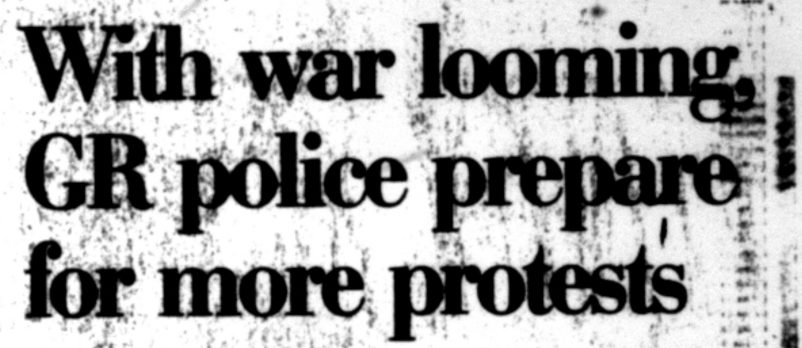
There was also an article in the Grand Rapids Press, entitled, With War looming, GR police prepare for more protests. (See page 16 of the hyperlinked document) Then police chief Harry Dolan made it clear in the Press article that they would be prepared to deal with protestors, including violent protests, which is always code for protests that don’t play by the rules – like civil disobedience, office occupations, blocking traffic, disrupting business as usual. The Press article also mentions that the GRPD was doing additional training and even listed the gear they would have, riot gear, pepper spray, and shield. Dolan also said they were prepared for “mass arrests.”
There was an ACLU lawyer, Pete Walsh who is cited in the article, but the rest of the sources cited were the City Manager, the Mayor and a City Commissioner, all of which were critical of anti-war protesters, some calling them violent for blockading traffic.
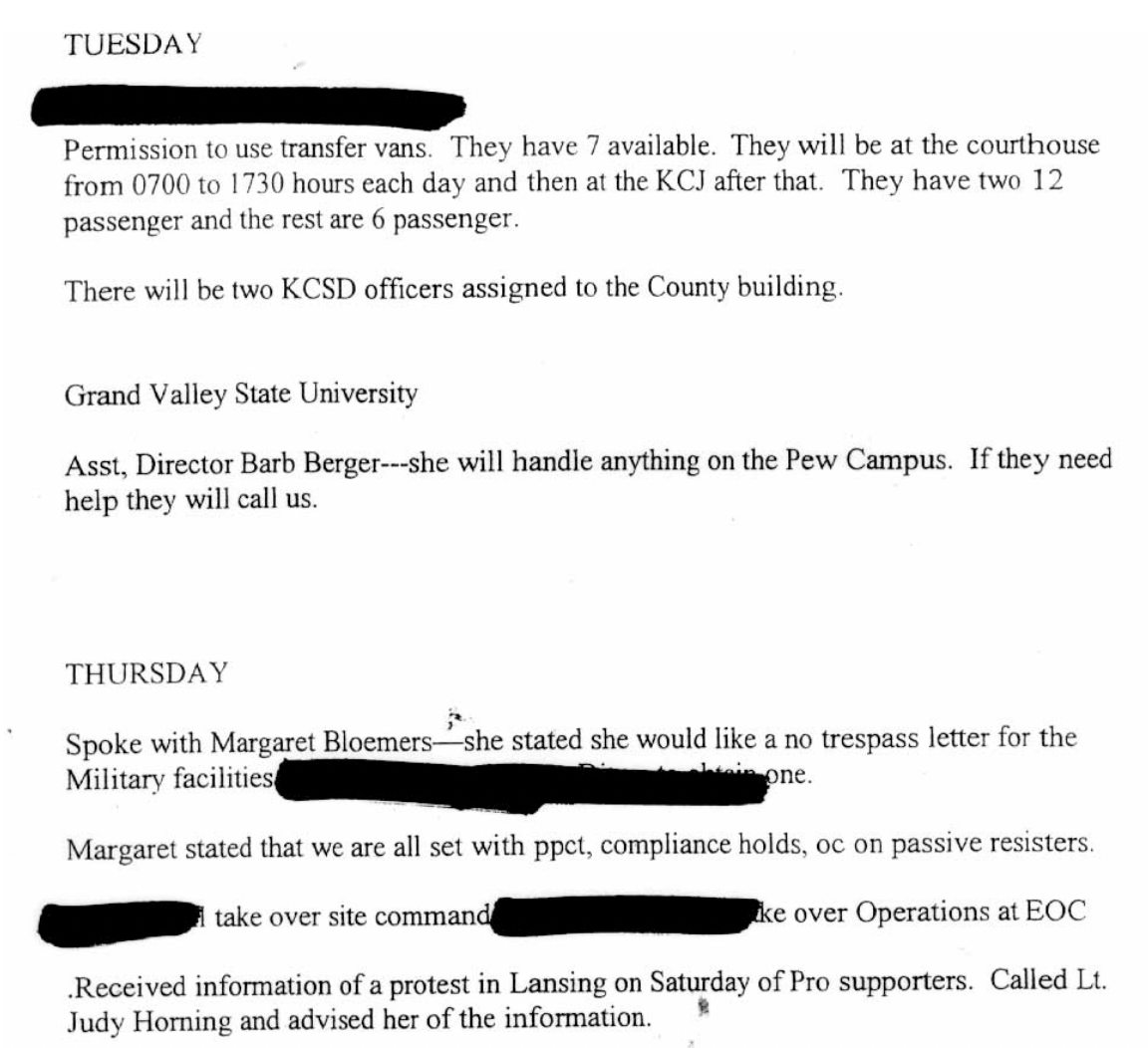
There was also an interesting FOIA document from the GRPD, which included plans to have police vans available, cops assigned to the County building, along with what GVSU security people were planning in case students protested, which you can see here below.
On Monday, we will post Part VI, since March 20th is the actual day that the US war against Iraq began, where we will talk about the anti-war actions on the first few days, plus the ongoing attempts by the GRPD to infiltrate and monitor anti-war organizers.
Yesterday, tenants living at Orchard Place Apartments, along with supporters and members of the Grand Rapids Area Tenant Union, held a protest outside of the office of the Property Manager.
The protest was based on the living conditions of the tenants at Orchard Place Apartments. In October, there was a fire in an adjoining apartment (which is still boarded up), which has caused significant health issues, because of the smoke ash from the fire, which was never cleaned up. Then in December, there was flooding in that same adjoining apartment, which affected their apartment and created black mold that has also not been dealt with by the property management company. In addition, there have been several needed repairs in their apartment, which were ignored for the past 6 months. These tenants had contacted the Grand Rapids Area Tenant Union for support, which provided some logistical support for the protest.

The tenants told us that earlier in the day they had received a call from the Property Manager telling them that if there was a protest that it would not be allowed, since Orchard Place Apartments was private property. Undeterred by the threats, people gather at 2pm, to protest outside of the Property Manager’s office, which is in the middle of the apartment complex.
As people made their way to the Property Manager’s office, they were stopped by someone who was working for a private security company, who again told the tenants that this was private property and that they would call the cops if people chose to protest there. We found out that Orchard Place Apartments had hired two private security guards, both of which had a car, to deal with protestors yesterday. It’s interesting that the company spent money to hire private security people, instead of investing in the repairs and meeting the demands of tenants who had brought numerous complaints to them.
Once people arrived in front of the Property Manager’s office, other tenants began to arrive, partly out of curiosity or because the tenants who organized the protest had dropped off flyers to other residents in the apartments complex. Someone from the Grand Rapids Area Tenant Union was live-streaming the protest (which you can watch at this link https://www.facebook.com/GRATU4Inquilinos/videos/224397420125351) Then tenants who organized the protest shared their story in the video, then as other tenants arrived, they also began to talk about their experience of living at Orchard Place Apartments. The stories were powerful and moving. What became clear to everyone, was that as other tenants arrived they too shared their stories and had very similar experiences with the company that took their money every month, but did little to make repairs or provide other basic resources that are necessary for living in a safe and healthy environment.

After about 30m minutes of protesting and sharing stories, two GRPD cruisers arrived. However, the GRPD officers kept their distance for at least 10 minutes before coming over the speak with the tenants that were protesting. Once the cops did approach people, the Property Manager came out of the office to tell people that they needed to leave, since it was private property. The Property Manager promptly went back into their office and refused to listen to tenant complaints and speak with them about the issues they were raising in the protest.
At one point that GRPD officers were saying that they thought it would be more advantageous for those protesting to go out to Fuller or Knapp and protest, since they would be more visible to the public. One of the members of the Grand Rapids Area Tenant Union responded by saying that, “it was actually more advantageous to protest in front of the office, since they wanted to be seen by other tenants and to make it easier for other tenants to participate.”
People eventually decided to move the protest to Fuller, since no one was prepared to get arrested that day. The protest ended 10m minutes later, since it had achieved what tenants had hoped for.
People began to disperse over the next 10 minutes and by the time that I got home, the tenants who had organized the protest sent a video message showing the Property Manager coming to their apartment to deliver a document. The document they delivered was a notice to quit to recover possession of their property, which is to say they were not going to renew the lease with the tenants who organized the protest. What is interesting is that just last week, the Property Manager said that they would not retaliate against the tenants, which of course was exactly what they did.

There has been a great deal of discussion in Grand Rapids about the housing crisis and the lack of affordable housing. However, what these tenants have been experiencing is the realty that thousands of tenants are facing in Grand Rapids on a daily basis. The real crisis is the ongoing harm that landlords and Property Management Companies are afflicting on tenants on a daily basis and anytime tenants speak up for themselves they are met with threats of eviction or termination of their lease. Until people who care about housing issues in Grand Rapids come to terms with the realities that tenants are facing, there will be no housing justice in this city.
To be part of the Grand Rapids Area Tenant Union, you can leave a message on their Facebook page https://www.facebook.com/GRATU4Inquilinos or send an Email to gratunion@gmail.com.
We’re not going to question you: WZZM 13 interviews GRPD Chief Winstrom and never challenges a single thing he says
It has been a year since Eric Winstrom was hired to be the new Chief of Police in Grand Rapids. On March 9th, WZZM 13 did a story that essentially allowed Winstrom to create his own narrative about what has happened over the past year and want he wants to see happen.

Let’s be clear about this kind of news story, a news story that is a form of stenography, where someone says something and the news media simply presents that narrative with question, without a challenge and without voices and perspectives to counter such a narrative.
The online headline for this story, a story which also aired on WZZM 13, reads: Shooting death of Patrick Lyoya, building trust | GRPD Chief Eric Winstrom reflects on one year in office. These kinds of headlines are important, because it creates a narrative and frames how news stories will often go. The headline is essentially a contradiction. How can you begin by saying, Shooting death of Patrick Lyoya, followed by building trust? This headline is also a play on words, since the headline did not say that the GRPD shot and killed Patrick Lyoya, which would have made it difficult to then say, building trust.
In the WZZM 13 broadcast version of the story, the news reader begins by saying that Police Chief Eric Winstrom is reflecting on his first year as Police Chief in Grand Rapids. The framing of the TV version sets viewers up by telling them that the Windstorm has been reflecting on his year as police chief, but does he actually do that? The news reader then says that a channel 13 reporter sat down with Winstrom to talk about 3 things; the lasting impact of the shooting of Patrick Lyoya, building trust, and what he hopes to accomplish this year.
Before viewers get to hear from Winstrom, the reporter frames the interview around the “controversial officer-involved shooting of Patrick Lyoya.” Again, the news uses the language that the cops use, officer-involved shooting, rather than say that Lyoya was shot in the back of the head by GRPD officer Christopher Schurr, while Schurr sat on Lyoya who was face down on the ground.
Instead of addressing the GRPD shooting of Patrick Lyoya, Winstrom, who has learned well from years of being coached by consultants, the GRPD Chief begins him response by talking about the 2020 riots that took place in Grand Rapids in response to the Minnesota police murder of George Floyd. Winstrom uses the riots to get viewers to sympathize with him on the conundrum he supposedly faced when releasing the video of the GRPD shooting of Patrick Lyoya. WZZM 13’s decision to show images of broken storefront windows from the 2020 uprising effectively gets viewers to think about property damage instead of the Patrick Lyoya being shot in the back of the head in the front yard of a house in the southeast part of Grand Rapids. For the majority white viewers in the West Michigan market, it makes a whole lot of sense to use riot images and damage to property, rather than to hear or see how the Congolese community and the Black community were traumatized by Lyoya’s death.
Winstrom then shits to talking about people “from outside of the city, people with bad intensions, who want to take advantage of an already awful situation.” Again, the well-coached cop makes the riots about individuals with bad intentions, instead of the thousands of people who protested in downtown Grand Rapids, who who were angry and enraged over the police murder of another Black person. Now stop for a moment, and ask yourself, if this was an honest interview, with a reporter that challenged people in power, what could they have done in this situation? A good reporter would questions these comments by Winstrom and provide facts, facts about the systematic murder of Black people by cops across the country or about the failures of performative politics that takes place every god damn time after another Black person is murdered by cops. However, we get none of that, and Winstrom gets to keep on saying that he wants to.
The news reporter than goes on to say that Chief Winstrom was proud that the GRPD was able to “keep the peace.” When people in positions of privilege say keep the peace, this is nothing more than code for maintaining the status quo, business as usual and allowing systems of power and oppression to continue operating without interruption.
We next hear from Winstrom who said, “We didn’t have one officer use force against a protester for these protests out there on Monroe Center. Not one. I’d say that was the biggest accomplishment of mine, but really it was a team effort of the department last year.” Again, the WZZM 13 reporter didn’t question or challenge this statement, despite the fact that there have been several incidents where cops used force on those protesting the GRPD murder of Patrick Lyoya, some of which were witnessed and recorded by other people protesting.
The reporter then continues to go along with the well-crafted narrative that Winstrom was creating by saying that the Police Chief wanted to build trust in the community. “It takes consistent, ethical behavior,” he said. “Showing integrity and showing the police department’s doing the right thing over time. It’s a journey, not a destination to build trust. We’re going to keep doing it for as long as I’m here.” Again, the news reported did not question or challenge Winstrom, nor did they ask for evidence or data around the department’s practice of accountability or transparency. It doesn’t matter what Winstrom says unless he can produce evidence that trust exists with the community, especially the Black community and other affected populations that are regularly targeted by the GRPD.
The news reporter then gets to the third thing that Winstrom wanted to talk about, which was the future of the GRPD and their desire to recruit, retain and diversify the department. Winstrom is then give even more airtime to talk about how the GRPD is recruiting and why he wants increase the number of cops in the department.
What the WZZM 13 reporter allowed Chief Winstrom to do was to essentially dictate the terms of the story, which came down to three over arching messages:
- The GRPD protects the community from bad people with bad intentions.
- The GRPD does not used force against people who are protesting, demonstrating they are accountable to the public.
- The GRPD wants and deserves to increase the number of cops in the City, which will lead to more safety and security.
My Grandma would call this list a load of horse shit. In some ways you have to admire the spin by Chief Winstrom, since he was able to craft whatever narrative he wanted to, a narrative which essentially made the GRPD out to be the saviors of Grand Rapids. But this is exactly what happens when you have reporters who do not question and do not challenge people like Chief Winstrom. What’s even worse, is that there were no other perspectives presented in this story, perspectives could have countered the narrative from Winstrom and challenged his spin of what the GRPD has been doing under his leadership over the past year.
Last Tuesday, the City of Grand Rapids posted an announcement about two upcoming forums that will focus on “public health and safety initiatives.” The two forums will be held on March 20th and 22nd, with details on time and location at this link.

The only local news that picked up this announcement, was MLive, which posted a story on March 9.
The MLive article included the headline, Grand Rapids holding community meetings around homelessness, nuisance behavior downtown. The headline reflects a certain bias or at least it frames the issue in a certain direction, making “homelessness” and “nuisance behavior” central to the forums.
In addition, there was no evidence from the City of Grand Rapids announcement that these forums were specific to downtown Grand Rapids, but the MLive article makes it clear that this is the case, since the article states:
City officials clarified to MLive/The Grand Rapids Press the concerns are related to ongoing discussions around homelessness and issues of aggressive panhandling, public defecation, harassment, people sleeping in doorways and more that downtown business leaders last December petitioned the Grand Rapids City Commission to resolve.
The MLive article goes on to discuss the Grand Rapids Chamber of Commerce role in proposing their own ordinance, which also received a letter of support signed by 130 people, many of whom make up the Grand Rapids Power Structure. The article also only cites City Manager Mark Washington, Deputy City Manager Kate Berens, and Police Chief Eric Winstrom, which completely ignores the fact that numerous people came to city Commission meetings to voice their opposition to the Chamber’s proposed ordinance, along with the fact that there was a protest at the GR Chamber of Commerce office in December and a call by groups to boycott downtown Grand Rapids.
The fact that MLive didn’t talk to community members, people who are impacted by the City policies or those who are organizing around these issues, should tell us something about how the local news crafts their own, often, pre-conceived narratives.
Other issues are also relevant on this matter. First, these forums are being facilitated by the “National Civic League, in collaboration with the City’s Public Safety Committee.” We were these organizations not cited in the MLive article? In addition, besides the City Commissioners that make up the Public Safety Committee, several of those who sit on the committee have a bias in support of the GRPD, like Ed Kettle.
Then there is the issue of why the National Civic League is being brought in to co-facilitate these two forums. Public tax money will no doubt be used to pay members of the National Civil League, money that could go to people who live in Grand Rapids and who actually know the community.
Then there is the issue of how managed these forums will be. Will people be split up in to smaller groups to discuss the issues, which always means that everyone else won’t be able to hear concerns, questions, observations and ideas about to address these issues. I have witnessed first hand how these meetings can often being highly managed, like the forum 2021 when the City was in the process of hiring a new Chief of Police, or the so-called “listening tour” that took place in 2017 around what was framed as “Community-Police relations.”
Even if these forums are not heavily managed, what will happen with the ideas and input from the public? There is no stated process or clear outcomes regarding these two forums, which certainly contributes to a very real level of frustration and refusal to even participate, since certain voices and certain ideas are ignored by those who get to make the decisions.
Last year during Black History month, I made three posts about books dealing with the Black Freedom Struggle that influenced how I saw the world. Now that we are in Women’s History Month, I want to do the same thing in regards to books by women, particularly feminists that influenced my understanding of the world.
I say feminist writers, as Women’s History month has evolved to the point where it is centered on identity politics, rather than the being rooted in the origins of International Women’s Day or the feminist values.
The books in Part I are books that I read in the 80s and early 90s that challenged my understanding of myself and the world around me.

Women, Race & Class, by Angela Davis
Gyn/Ecology: The Metaethics of Radical Feminism, by Mary Daly
Ain’t I a Woman: Black Women and Feminism, by bell hooks
Patriarchy: Notes of an Expert Witness, by Phyllis Chesler
Backlash: The Undeclared War Against American Women, by Susan Faludi
Feminist Theory: From Margin to Center, by bell hooks
Woman Hating, by Andrea Dworkin
The Chalice and the Blade: Our History, Our Future, by Riane Eisler
Women Respond to the Men’s Movement: A Feminist Collection, Edited by Kay Leigh Hagan
Bananas, Beaches and Bases: Making Feminist Sense of International Politics, by Cynthia Enloe
The Agribusiness model of the 2023 US Farm Bill as presented by MiBiz vs a Food Justice model
Our current food system is not inevitable. Decades of misguided farm policy designed by agribusiness and unchecked corporate consolidation have wreaked havoc on family farmers, food workers, rural communities, and public health. Today, one in seven households with children is food-insecure; median farm income is negative; slaughterhouse workers suffer double the rate of reported injuries and illnesses than workers in the manufacturing sector as a whole; and rural communities continue to decline as factory farms expand.
The above paragraph comes from the introduction of a report by Food & Water Watch entitled, A Fair Farm Bill For All.
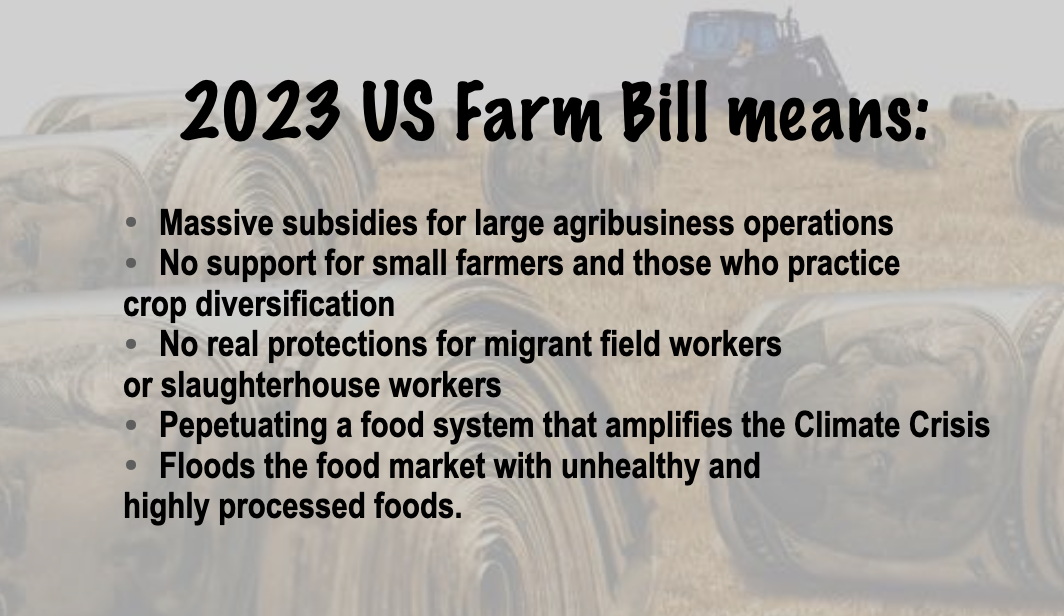
The US Farm Bill, which is the primary policy that determines how most of the food grown/raised in the US takes place.
Another excellent resource is the, “Farm Subsidy Database shows that federal farm subsidies between 1995 and 2021 totaled $478 billion. This huge amount of taxpayer money does almost nothing to help farmers reduce their greenhouse gas emissions or adapt to adverse weather conditions caused by the climate crisis,” from the Environmental Working Group. You can search to see which farms are being subsidized in you state and county. According to the Environmental Working Group, “most farm subsidies go to commodity crops, such as corn and soybeans, which are not grown to feed people, and to the largest and wealthiest farms.”
The last time the Farm Bill was decided upon was in 2018, where policy makers dictated how $428 Billion of taxpayer dollars were spent. Many of the same policy makers will determine once again how public money will be used.
This brings us to the question of what is happening in West Michigan around the US Farm Bill. A little over a week ago, MiBiz posted an article entitled, Michigan ag interests reach national stage in 2023 Farm Bill.
 In many ways, the headline conveys the overall sentiment, which is that it recognizes that Michigan is a major food commodity produce, plus Agribusiness interests will determine who benefits and who doesn’t.
The MiBiz article cites s few larger farm operations, someone from the MSU Food & Agricultural Policy department and a representative from the Michigan Farm Bureau. All of the sources cited have a vested interest in maintaining the same heavily subsidized food system that benefits the largest agribusinesses and perpetuates industrial food production that is detrimental to the top soil, contributes significantly to climate change, abuses migrant workers (in both the fields and slaughterhouses) and causes serious public health issues because of how food is processed/created in the commodity markets.
The MiBiz article also praises Senator Stabenow, who has been chair of the Senate Committee on Agriculture, Nutrition, and Forestry. However, the praise comes from those who benefit most from the farm subsidies in the Farm Bill, it doesn’t come from small farmers or community groups that are pushing for a food justice/food sovereignty model in the US. This praise of Stabenow was also misplaced in 2018, as we noted in a GRIID article 5 years ago.
The Food & Water Watch report mentioned earlier in this post, does have a section at the end that proposes some interesting policy changes around the Farm Bill. However, until the current Agribusiness system is radically transformed, the US Farm Bill will continue to prop up a food system that harms workers, destroys ecosystems and makes most of us unhealthy. We need to adopt policies and practices that are rooted in food justice and food sovereignty.
Check out the GRIID produced Food Justice Workshop slides, which we have presented on numerous occasions throughout West Michigan.

The uses and abuses of International Women’s Day in Grand Rapids: From Bread and Roses to Corporate sponsorships
 On Wednesday, March 8th, people around the world will celebrate International Women’s Day (IWD). However, there is a growing tendency to ignore the origins of IWD and merely use the day or Women’s History Month as a marketing opportunity or to acknowledge the accomplishments of women, even if they conflict with the spirit of International Women’s Day or simply promote a vague notion of identity politics.
International Women’s Day evolved out of a growing effort amongst women’s and working class groups to fight for more equality for women at the end of the 19th century and the beginning of the 20th century.
In 1908, 15,000 women marched in New York City demanding shorter work hours, better wages and the right to vote. In 1909, the Socialist Party of America designated February 28 as the first National Women’s Day, which was to be celebrated on the last Sunday of every February.
In 1910, at the Second International Conference for Working Women, there was a proposal to have an international women’s day, where women around the world would press for their demands on the same day. The proposal was not adopted until the following year and International Women’s Day (IWD) was celebrated in several countries around the world. However, something happened just one week later that would galvanize this new international movement.
On March 25, a fire began at the Triangle factory in New York City. It was common practice for factory owners to lock the workers inside until the work day ended and because of that practice 140 women, most Jewish and Italian immigrants, burned to death in that fire. The international women’s movement, labor and socialist movements mobilized around the world to mourn these women and to organize for worker and women’s rights.
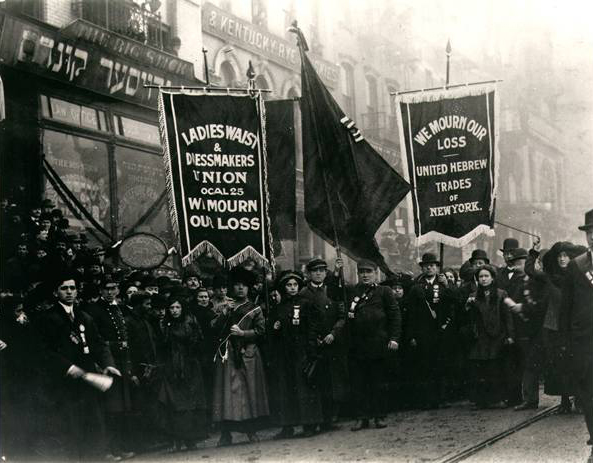 For years after the first, the Triangle factory fire became the focus of International Women’s Day and gave birth to the Bread and Roses Campaign. The Bread and Roses Campaign was begun by workers (mostly women) who went on strike at a textile factory in Lawrence, Massachusetts. This strike was organized by the Industrial Workers of the World (IWW) with the slogan, “We want Bread, but we want Roses too!” In other words, the history of International Women’s Day is rooted in the working class struggle, not in some nebulous notion of gender equality.
Unfortunately, International Women’s Day is often celebrated or acknowledged by organizations and entities that are NOT rooted in the same history and the same struggle that IWD was founded on. For instance, MLive posted an article on Tuesday about a Wednesday march and rally to commemorate International Women’s Day.
The MLive piece says that the nonprofit group SowHope is hosting the rally and march for International Women’s Day. SowHope’s approach to dealing with women’s issues, appears to be rooted in the usual non-profit world framework, which is to offer support without challenging systems of power and oppression, based on their history.
What is worse is that the only two speakers that have been identified for the rally are GVSU’s President Philomena Mantella and WGVU Public Radio personality Shelley Irwin. If SowHope was interested in honoring the history of International Women’s Day, they would be inviting women who are fighting economic, social and political justice, such as workers being exploited or women led movements, like Movimiento Cosecha GR or women who are part of labor unions fighting against exploitation.
Instead, we can see from the event, which has its own Facebook page, there are opportunities for corporate sponsorship. Corporate sponsorships are the exact opposite of what International Women’s Day has historically been all about. Then again, this is just another manifestation of West MI Nice!
As an alternative, there is an event at the corner of Fulton and Division for International Women’s Day, which is being hosted by the Freedom Road Socialist Organization, which also has their own Facebook event page.

