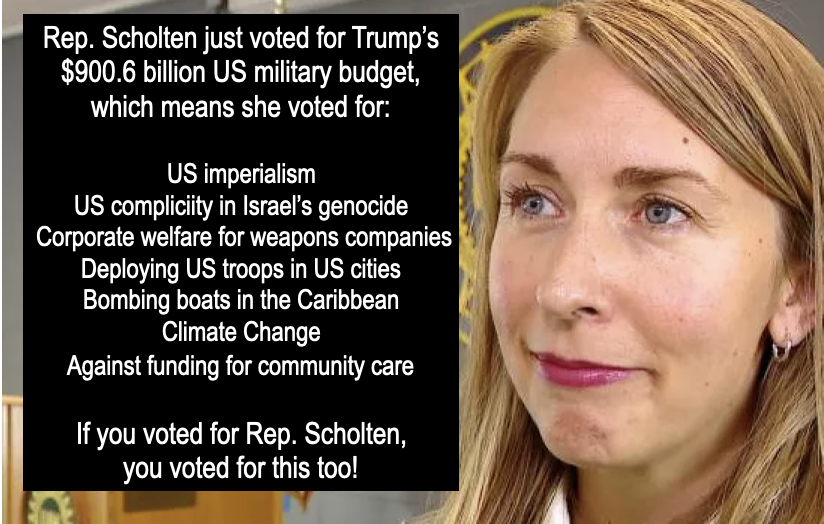
Rep. Scholten proudly voted for Trump’s $900.6 billion US military budget, demonstrating yet again that she is an imperialist
The US House of Representatives voted 312-112 in favor of the National Defense Authorization Act (NDAA) for fiscal year 2026. Rep. Hillary Scholten was one of the many Democrats to vote with the Republicans to support the nearly $1 trillion US military budget.
In a recent statement the National Priorities Project, which opposes US military spending wrote:
“The last thing Congress should do is deliver $1 trillion into the hands of Secretary Pete Hegseth. Under Secretary Hegseth’s leadership, the Pentagon has killed unidentified boaters in the Caribbean, sent the National Guard to occupy peaceful U.S. cities, and driven a destructive and divisive anti-diversity agenda in the miltiary,” said Lindsay Koshgarian, Program Director of the National Priorities Project at the Institute for Policy Studies.
National Priorities Project has previously shown what $1 trillion could do for the country: from ending the nursing shortage to insuring uninsured children, preventing evictions, and replacing lead pipes, every dollar the Pentagon wastes is a dollar that isn’t helping Americans get by.
Rep. Scholten has been blaming the Trump Administration for the increased cost of living, yet in standard hypocritical fashion she votes to approve $900.6 billion for militarism.
Guess how Rep. Scholten decided to communicate her vote for militarism on social media? On her Facebook page she wrote:
“The House just passed the NDAA, which included a full reauthorization of the United States Coast Guard, ensuring continued support for Great Lakes operations and the people who keep our waters safe. As a proud member of the Coast Guard and Maritime Transportation Subcommittee, I’m thrilled to see this bipartisan legislation clear the House floor to support our hardworking Coasties and keep our nation safe.”
Scholten doesn’t even have the courage to talk about the concrete consequences of her vote for the nearly $1 trillion US military budget. Scholten has the audacity to tell us that voting to fund US militarism and imperialism will keep us safe.
The facts are that voting for the $900.6 billion US military budget, Rep. Scholten is voting for the following:
- To maintain more than 700 US military bases around the world.
- To provided billions in corporate welfare to weapons manufacturers in the US.
- To perpetuate Climate Change, since the US military is one of the largest single consumers of fossil fuels on the planet, even larger than most countries.
- To support the ongoing funding of Israel with billions in weapons, while they continue their genocidal campaign against the Palestinians.
- To support the US National Guard’s deployment to US cities to terrorize people and to assist ICE in rounding up undocumented immigrants.
- To support the Trump Administration’s bombing of boats in the Caribbean and possible US military invasion of Venezuela.
- To support the manufacturing of nuclear weapons, weapons that would indiscriminately and instantly killed millions of people and all other life forms.
When people vote for Rep. Hillary Scholten, this is what they are voting for. Don’t give me that lesser evil shit, this is evil, brutal and oppressive.
If you want a more honest and critical assessment of US foreign policy, then I encourage you to sign up for an 8 week class that GRIID is offering and will begin on January 15th.

Some historical context on Kent County’s stance cooperating with ICE based on FOIA documents from the campaign to End the Contract
In November I reported on the actions that Movimiento Cosecha and GR Rapid Response to ICE engaged at the Kent County Sheriff’s Office.
The Kent County Jail has been putting holds on people who are in the jail, even after someone has posted bond, because ICE has requested that the Kent County Jail hold people until they decide to come and pick them up. The Kent County Jail is also doing this without obtaining a judicial warrant, which has been their policy since 2019.
When Cosecha and GR Rapid Response to ICE demanded answers as to why the Sheriff’s office is not requiring judicial warrants to hold immigrants for ICE their response was 1) submit a FOIA request if you want that information, followed by 2) Sheriff LaJoye-Young telling the groups they needed to set up a meeting with her, even though she could have given a yes or no answer to their demand.
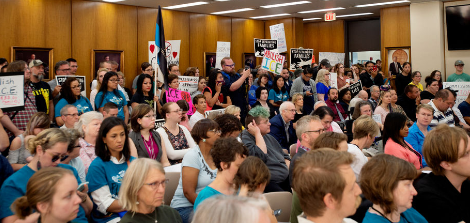
For those who have been reading GRIID for years of have been directly involved with Movimiento Cosecha or GR Rapid Response to ICE, the responses from the Sheriff’s office are consistent with how they dealt with the campaign to End the Contract with ICE that began in 2018.
Several months into the campaign a FOIA request was submitted. What follows is a summary of the 138 pages contained in the FOIA request. The documentation includes a great deal of repetitive content, since the e-mails include certain threads between county commissioners and county administration staff. However, there are several things that are instructive when reading the FOIA requested documents.
First, it is instructive that county officials (referring to staff, commissioners and Sheriff’s Dept.) began by stating that the ICE contract is a federal matter and that there is nothing they can do about it. From there, the language changed to “it is the Sheriff’s Department that has the contract,” and eventually the demand to end the ICE contract “will not achieve what your group wants to do.” There was clearly an evolution to how county officials responded to the demands to end the ICE contract.
Second, it was clear from numerous exchanges between county officials that they were clearly monitoring Movimiento Cosecha GR, GR Rapid Response to ICE and GRIID articles about the campaign to end the contract. On a June 14 communication between County Administrator Britt and Commissioner Saalfeld, Britt states, “It is strictly a Sheriff policy issue but it’s germane to the County Board because we are the funding unit that equips him with the jail. However, we can stop anyone from using public comment to politicize an issue.” Numerous commissioners have denied any relationship between the county budget and the ICE contract, even though it seems that Britt makes that point pretty clear. It’s also interesting how he is suggesting that they want to “stop anyone from using public comment to politicize an issue.” What else could public comment about the ICE contract be other than political?
County Administrator Britt does send out a message (June 29) just after the June 28 County Commission meeting, with a message that was vetted through corporate counsel, about what happened at the June 28 meeting. The meeting was ended “to ensure the safety of all individuals in the room.” This is ridiculous, since no one who came to that meeting was a threat to anyones safety. The only threat came from armed officers who threatened to remove people from the room. See my coverage of what happened that day.
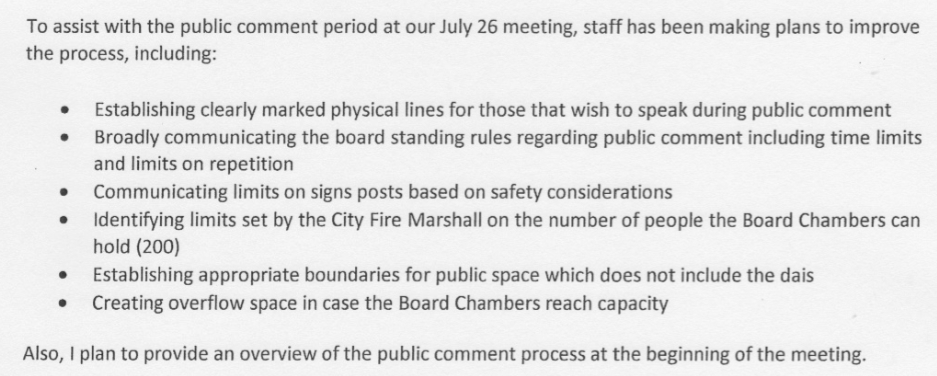
Third, in preparation for the July County Commission meeting, county officials wanted to make it clear that they were going to include some new protocols in response to the June 28 meeting, by dictating and controlling how public comment would go and how the physical space would be organized, as you can see from their comments here below.
Fourth, on pages 45 – 48 of the FOIA documents, regarding the August 23rd Commission meeting, county officials provide justification for their suspension of the meeting and moving it to another building.
Fifth, on page 55 of the FOIA documents, we see that a staff person with Michigan Senator Gary Peters was at the July Kent County Commission meeting. It was agreed that Chairperson Saalfeld would not introduce the staffer with Sen. Peters, rather he just wanted to listen and observe. There was no further information or correspondence with Sen. Peters’ office in the FOIA documents.
Sixth, on page 64, one County administrator states, “The County and its Commissioners remaining willing to discuss the issues and the limited ability of the County to influence the federal immigration law, but the recent vandalism and trespassing at the County Board Chair’s home and further disruption at the today’s meeting did not foster collaboration or cooperation.” There was no vandalism at Chairman Saalfeld’s home, just numerous signs left challenging him to end the contract with ICE. If there was vandalism or trespassing the police would have arrested people, but no one was arrested despite significant police presence. In regards to the disruption at the July County Board meeting, the groups that have organized these actions have made it very clear that until the county ends their complicity with ICE violence, there will be disruptions at the meetings, because the mild inconvenience of meetings being disrupted is nothing compared to how the lives of immigrants are being disrupted every day in this community.
This sentiment from county administrators is continued on page 65 when they state, “If they want to solely protest without listening and dialoguing it will be a disappointment.” Well, representatives from Movimiento Cosecha GR and GR Rapid Response to ICE did meet with County officials at a separate gathering in early August, but despite the information shared about the ongoing violence being done to the immigrant community, the County officials present refused to even discuss any possibility of ending the contract with ICE.
Seventh, on page 68, Commissioner Antor writes to County Administrators about his frustration with “protestors” and suggests that the county no longer allow signs in the commission meetings or bullhorns and any disruptive behavior. He also states that the county should put out a statement on the FACTS about the ICE contract to “dispel all the hyperbole and misinformation.” This same commissioner was recorded at a later meeting engaging in his own propaganda that was merely parroting the Trump administration positions on immigration.
Eighth, on page 70 we finally learn about the fact that some county officials were setting up a separate meeting that did not include those organizing the end the contract campaign, where the sheriff and undersheriff were present. Beginning on page 75, we see the first information about the decision of the County Board Chair to suspend the September 13th meeting because of the People’s Commission that was held in the commission chambers. On page 77, the FOIA documents show that the county once again was monitoring the campaign’s Facebook page and quoting it at length.
On page 81, Chairman Saalfeld makes his feelings known in a short rant about those involved with the End the Contract campaign:
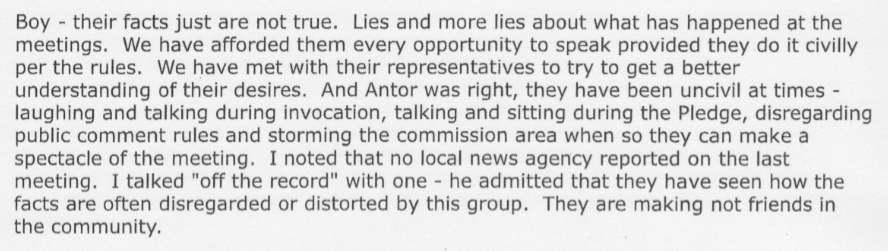
Interesting that he notes that he spoke with a news person off the record about how facts are distorted, which is interesting considering that the local news has continued to report on the campaign to end the ICE contract and has even provided information that challenges the County’s ongoing lack of taking people seriously.
Ninth, on page 97 there is an e-mail from Comm. Bulkowski asking if there has been any discussion about setting up a meeting between “the Sheriff and the Hispanic community.“ He then goes on to say, “I tam pretty confident that the few people who disrupt our meetings don’t represent the wider Hispanic community.” Then on page 104, Comm. Bulkowski goes on to say more about wanting to meet with the “Hispanic Community” and that groups like the Hispanic Chamber and the Hispanic Center should be invited to talk about these matters. This is further indication that the commissioners are dismissive of those involved with Movimiento Cosecha GR and the affected community that has continued to share their stories about the pain suffered by ICE violence.
Beginning with page 115 and continuing for several pages there is the county’s response/PR damage control in regards to their decision to not allow the public in the Commission chambers during the 2nd September meeting.
Tenth, on Page 121, Comm. Saalfeld commends County Administrator Britt for his interview on WKTV and then states that the others interviewed indicates both some inaccurate facts and some things that are not understood. We of course have a much different perspective on the interviews.
Eleventh, on page 128, Comm. Saalfeld sent another e-mail to County Administrator Britt, with a link to a GRIID article about the No Business With ICE Day action and the following comment.
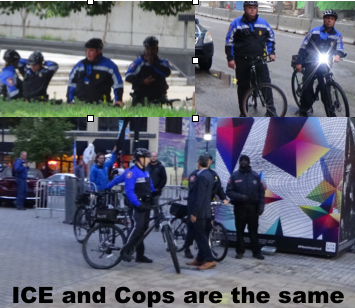 “Maybe time to engage the GRPD.”
Saalfeld no doubt makes this comment because in the GRIID article cited and many of others, there has been a huge GRPD presence at anti-ICE actions. Since the Kent County Sheriff has stated repeatedly that they will not arrest people during County Commission meetings that Saalfeld wants to enlist the GRPD to deal with those who disrupt the commission meetings.
While the documents based on the FOIA request don’t necessarily reveal anything significant, they are instructive as far as how the county views those involved with the end the contract campaign and how the disruptions have made some of them very uncomfortable moving forward. The same dynamic exists right up to the present.
In my most recent article I noted that during the Mayor’s Monday meeting that happened at the Lincoln Park Pavilion, Mayor LaGrand did make a verbal commitment to talking with City Commissioners about adopting a policy that would prohibit Grand Rapids from signing a 287g contract with ICE.
Another interesting thing that Mayor LaGrand said in response to some of the demands that Movimiento Cosecha and GR Rapid Response to ICE have been demanding had to do with not sharing Flock camera images on vehicle license plates with ICE. To this point Mayor LaGrand said that Chief Winstrom said there is a switch on the system, a switch that is currently off that will not allow ICE to access the Flock camera images of vehicles license plates.
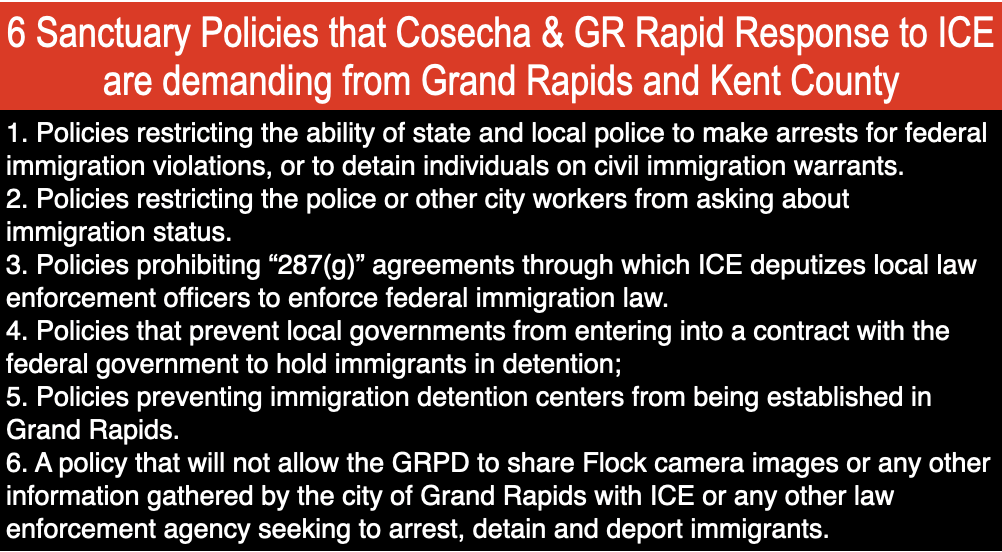
First, just because Chief Winstrom says so doesn’t mean it is true. Second, what Movimiento Cosecha and GR Rapid Response to ICE have been saying about the 6 sanctuary policy demands is for the city to adopt those 6 demands so that the demands will become policy, regardless of who is Mayor or is one of the 6 City Commissioners.
I have written several article about the Flock cameras that are being used in Grand Rapids, with the exact location of those cameras.
A local comrade shared with GRIID that in 2012, the GRPD went to the City Commission to request funding for 4 cruiser mounted ALPRs (ALPRs are similar to Flock cameras), which the commission approved.
In 2015, the City of Grand Rapids adopted their current surveillance policy, which you can find here. The PDF at the link clearly states that “Any City department intending to acquire, use, or deploy new surveillance equipment or surveillance services after March 14, 2015 shall obtain City Commission approval prior to the initial acquisition, use, or deployment of that equipment or service.”
However, there is an exemption in that policy which states:
“a. City Departments may acquire and use new surveillance equipment or surveillance services that are substantially similar to surveillance equipment or surveillance services that were previously approved in accordance with this policy in order to replace equipment due to failure without following the provisions of this policy prior to such acquisition or use. b. Equipment failure refers to any event in which any equipment cannot accomplish its intended purpose or task. It may also mean that the equipment stopped working, is not operating properly, or is scheduled for a contractual routine upgrade with substantially similar equipment. c. Should a department seek to acquire, use or deploy additional amounts of surveillance equipment or services that have previously been approved in compliance with this policy, the department need only provide notice to the Public Safety Committee and seek fiscal approval from the City Commission’s Fiscal Committee.”
The Flock cameras that are mounted at street corners and major intersections have only been in use since 2022. However, the GRPD did not obtain City approval for the Flock cameras that are located on streets throughout the city. The City claims, that the flock cameras meet the extremely narrow exemption from the surveillance policy above – “City Departments may acquire and use new surveillance equipment or surveillance services that are substantially similar to surveillance equipment or surveillance services that were previously approved in accordance with this policy“
The thing is that the 4 Flock cameras that were mounted on GRPD cruisers were used for checking plates against lists of stolen vehicles. With the three dozen Flock cameras that are located around Grand Rapids, they are subject to being used by ICE agents to track undocumented immigrants, especially if there is no formal policy in place to prohibit the City from sharing that information with federal agents.
With persistence Cosecha and GR Rapid Response to ICE got Mayor LaGrand to agree to work towards prohibiting a 287g policy
Last night Mayor LaGrand hosted one of his Mayor’s Monday conversation around the theme of justice and policing.
The community forum was held at the Lincoln Park pavilion, which is also the office space for the neighborhood association. I counted 28 people in attendance, which included the Mayor, City commissioner Belchak, County Commissioner Womack and a few neighborhood association staff members.
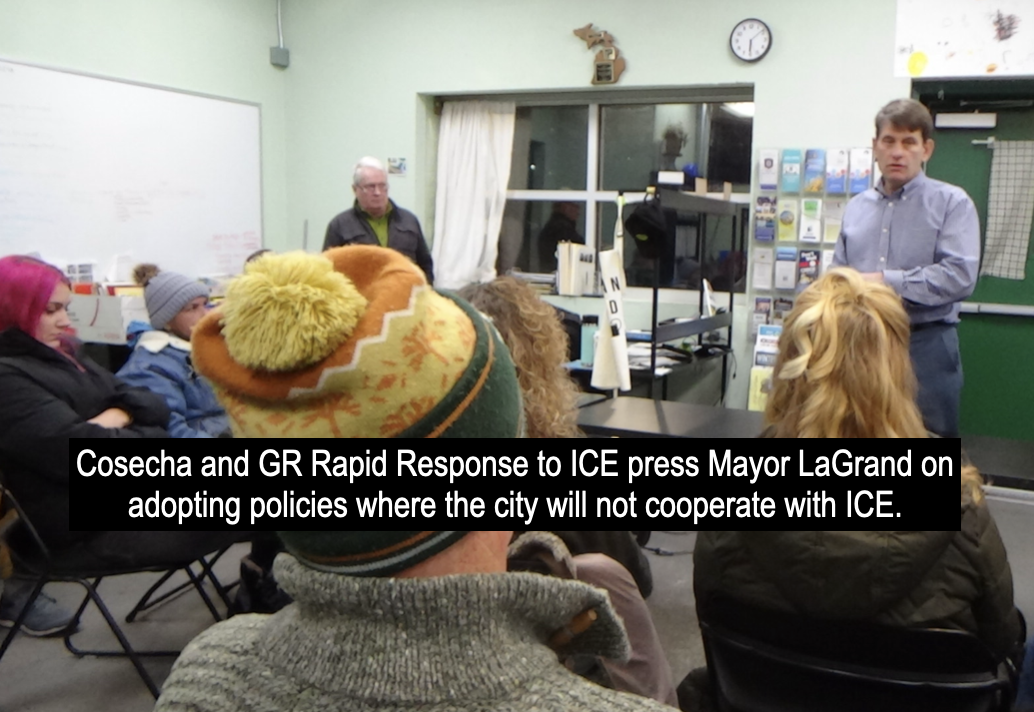
The major of the rest of the people in attendance were members of Movimiento Cosecha and GR Rapid Response to ICE. The Mayor spoke for the first 30 minutes, talking about related matters, but often in vague terms using made up scenarios and not really addressing the theme of justice and policing.
Mayor LaGrand did talk about moving from a punishment-based system to a system that embraces restorative justice, where victims of harm are centered. Gema Lowe with Cosecha said that she appreciated centering the idea of victims, which is exactly why she came to the meeting. The undocumented immigrant community is being terrorized by ICE right now and she asked the Mayor if he would make any sort of commitment to adopting the 6 sanctuary policies that Cosecha and GR Rapid Response the ICE have been demanding since January.
Other Cosecha and GR Rapid Response to ICE members also talked about how they have witnessed the GRPD cooperate with ICE when ICE is targeting undocumented immigrants. Mayor LaGrand said he believed that this was not happening, despite first hand accounts.
Several other people continued to press the Mayor on these issues, while others talked about why it is important for the Mayor to take a public position on this matters in support of immigrants who are being terrorized. Several people were clear about the fact that adopting the 6 sanctuary policies would not stop ICE from terrorizing immigrants, but it would send a powerful message to immigrants that the City of grand Rapids would not cooperate or assist ICE in arresting and detaining immigrants.
At one point someone began referring to ICE as the wolf that is terrorizing immigrants around the country and then Mayor LaGrand said that the wolf was not here in Grand Rapids. Immediately people pushed back on that comment stating that ICE is very active in the Grand Rapids area, arresting people, and separating families by sending the to the detention center in Baldwin, MI.
Another person then urged the Mayor to have the guts to take a stand on this, call a press conference at say that he and the City of Grand Rapids would not cooperate with ICE to terrorize undocumented immigrants.
Just before the meeting ended, Mayor LaGrand said he would be willing to talk more about these demands and specifically said he would be willing to talk with City Commissioners about adopting a policy that would prevent Grand Rapids from entering into a 287g agreement with ICE, which I have written about at length.
While many people were frustrated during the meeting, in the end it was the persistence of those who showed up that resulted in Mayor LaGrand making a verbal commitment to looking at the demands and a willingness to prohibit the GRPD from being deputized by ICE to enforce federal immigration laws, also known as a 287g policy.
I will certainly continue to write about this issue to see if Mayor LaGrand will follow up on his verbal commitments made during the meeting on Monday night.
I conducted an interview with 3 community organizers involved in the Residents United Lowell campaign, a campaign that is opposing the proposed data center in Lowell, Michigan.
These three amazing women responded to the following questions, in an interview that runs just over 27 minutes.

GRIID – What prompted you all to get involved and to get organized around the data center proposal?
GRIID – One news source said that the Lowell City Manager knew about the proposed data center 18 months ago. When did you all find out and what does this tell you about the lack of transparency and who has been making decisions up to this point?
GRIID – What all have you been able to find out about Franklin Partners LLC?
GRIID – Consumers Energy and The Right Place Inc. are also involved in this project. What does that tell you about this project, given what we know about both of these groups?
GRIID – The data center proposal might have the largest impact on Lowell and the surrounding communities in recent decades. How are you mobilizing people and that are your main talking points around why this project would be bad for residents of the area?
GRIID – How soon will there be a vote on the proposed data center project and what else do you think needs to happen to resist this project?
For those wanting to sign the petition against the proposed data center go here.
To access the ResidentsUnitedLowell information handout go here.
Follow ResidentsUnitedLowell on their Facebook page.
One of the 10 principles of journalism is that it must serve as an independent monitor of power.
Now, I don’t claim to be a journalist, more of a media watchdog, but I do engage in movement media. Movement media is reporting and documenting what social movements are doing, which is what I have been trying to do with GRIID since 2009.

However, since I have been monitoring what I call the Grand Rapids Power Structure for nearly two decades, it seems like a good idea to do a Monitoring the Rich and Powerful in Grand Rapids segment.
The Monitoring the Rich and Powerful in Grand Rapids segments will offer brief commentary on those who have power over others in this community. These segments will not replace my regular reporting on the Grand Rapids Power Structure, since those stories will offer more in depth writing.
As we navigate a second Trump Administration it seems like a perfect opportunity to shed some light on the rich and powerful of Grand Rapids, or to frame it the way that radical media from the 60s and 70s would do regarding the Capitalist Class, using the phrase, “up against the wall motherfucker!”
For Segment #8 I wanted to share 4 short examples of how the rich and powerful continue to wage class war against the rest of Grand Rapids.
In the first example Grand Rapids Power Structure member John Kennedy recently a piece for Crain’s Grand Rapids Business entitled, Rejecting corporate welfare makes Michigan better. Kennedy is critical of some corporate welfare and singles out the auto industry, but he and the West MI Policy Forum celebrate and rely on all the other forms of corporate welfare that the State of Michigan and municipal governments provide to developers, corporations that relocate to this community and in other so-called public private partnerships where the public pays while the private sectors profits.
My second example is from recent comments by the CEO of The Right Place Inc., Randy Thelen. The Right Place Inc., has been a member of the GR Power Structure for years, which I have written about. Thelen was quoted in MLive saying, “We need AI to be part of our portfolio here. So when we talk about data centers it’s not a solution or silver bullet in any way, but it’s another addition to the diversification of our economy.” This should not surprise us, as the Right Place Inc. not on recruits businesses to come to West Michigan, they have consistently supported corporate interests, like their involvement to get Amazon to establish a major distribution center in Grand Rapids years ago. Also, Thelen demonstrates his class allegiance, since the public is overwhelmingly opposed to data centers throughout the country and in Michigan.

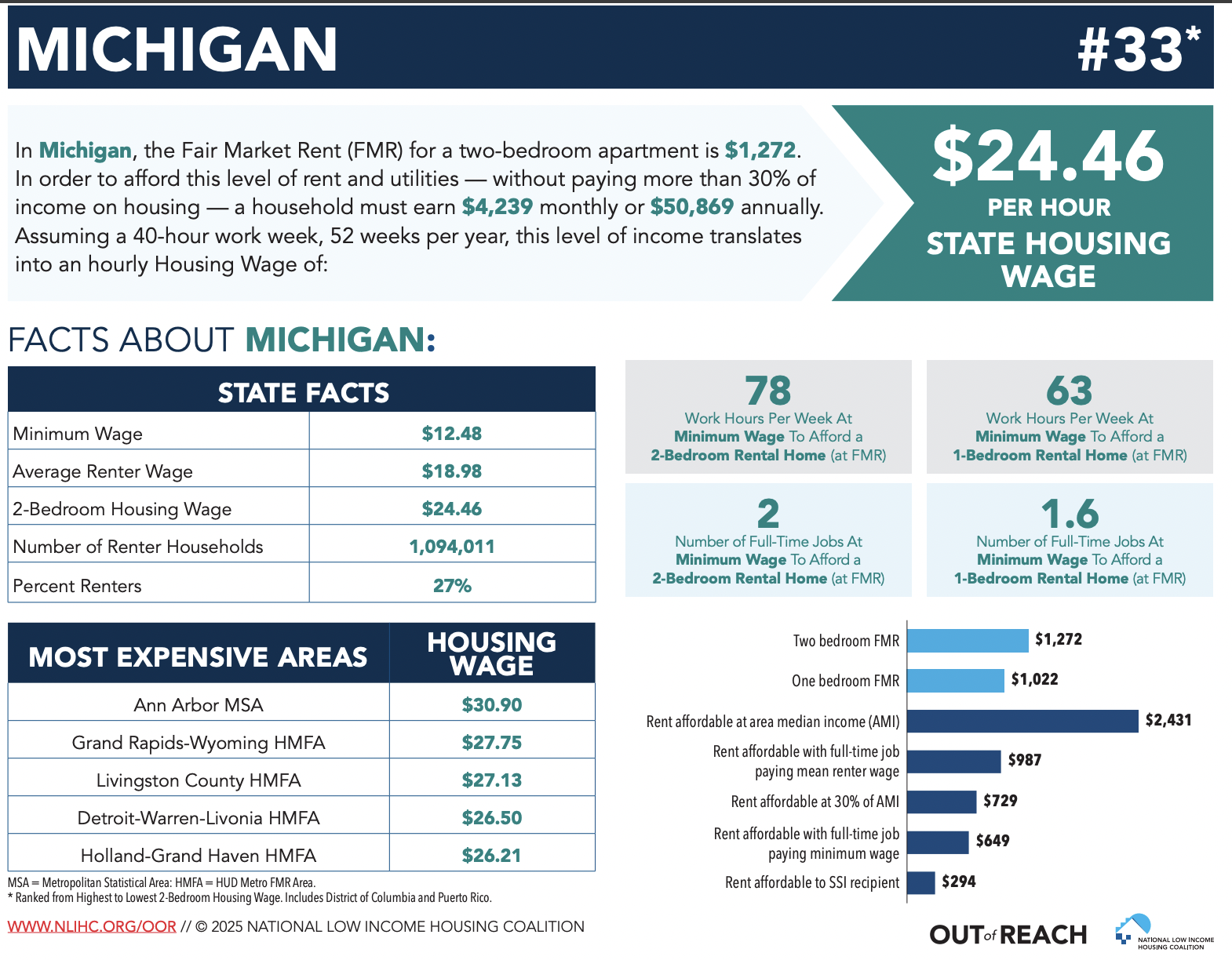
My third example is from Housing Next, which is a Grand Rapids Chamber of Commerce front group which has been pushing the expansion of housing for several years now. Housing Next even acknowledges the ridiculous rent costs in Grand Rapids, but their solution, which is a false solution, is “Zoning, financing, and public-private partnerships.” What Housing Next does not say and will not say is for people to be paid a living wage to everyone can afford the cost of housing in Grand Rapids. The National Low Income Housing Coalition says that in Grand Rapids, for a 2 bedroom apartment, people would have to make $27.75 an hour to afford the rent.
The last example is the latest really awful video that comes from GR& Riverfront, where they continue to celebrate all things development related in downtown GR, especially things that the public has disproportionately paid for, but the private sector profits from. The video celebrates Amway and uses lyrics like, “more green grass where crowds will cheer.” Sure there is some grass that will be part of the soon to be opened Amphitheater, but you will have to pay if you want to sit on that green grass. Arrogant pricks!!!
Minister, socialist and Presidential Candidate Norman Thomas gave a lecture at Fountain Street Church in 1965
Editor’s note: I have been working with Fountain Street Church and looking at a substantial amount of archival materials they have. Today’s post is only possible because Fountain Street Church has provided me access to their archives and they want this information to be public and available to the community. I will be hosting the archival material on the Grand Rapids People’s History Project site, but also posting here on GRIID. This is the second in a series of postings from the archival material at Fountain Street Church.
So far I have posted talks by Kwame Ture/Stokely Carmichael, James Meredith, Dick Gregory, Amy Goodman, bell hooks, Jane Fonda and Jonathan Kozol all of whom spoke at Fountain Street Church.
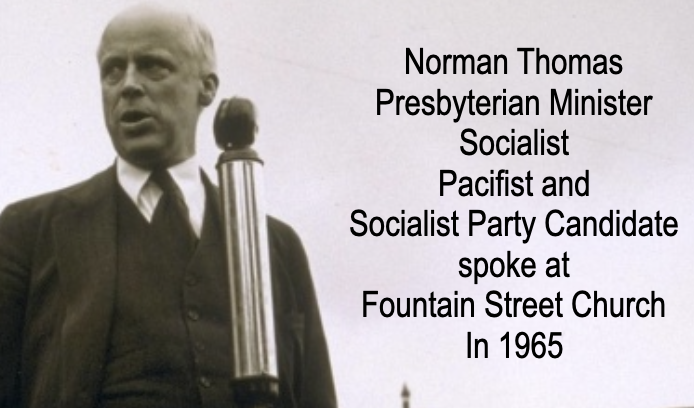
Today, I want to share a talk that was given at Fountain Street Church by Norman Thomas in 1965. For those of you who don’t know who Norman Thomas is, he was a Presbyterian minister, a socialist, an organizer, a pacifist and ran as a Presidential candidate during six consecutive elections between 1928 and 1948 as a member of the Socialist Party of America. Norman Thomas was involved in labor struggles, anti-war organizing and the Civil Rights Movement. In fact, Norman Thomas sat on a Commission of Inquiry that the Congress of Racial Equality (CORE) organized to address widespread police violence against the Black community. Thomas said at the end of his involvement in the committee, “Law enforcement attacks on the movement were nothing less than widespread police sadism.”
Here is the audio of talk that Norman Thomas gave at Fountain Street Church in 1965. The theme of his talk was on the importance of public dissent!
Accompanying an immigrant to court: Fear and loathing in West MI
Editor’s Note: I am a volunteer organizer with GR Rapid Response to ICE and have been doing accompaniment work for several decades.
Earlier this year I facilitated a class called Understanding the Prison Industrial Complex in Kent County.. We used as a primary resource the book, Beyond Courts, which was a project involving the Community Justice Exchange, Interrupting Criminalization and Critical Resistance.
Beyond Courts is an excellent resource, primarily we tend to focus most of our energy on cops and prisons, but not so much on the role of the courts. In chapter 5 of the book the authors write:
“For example, in 2022, there were almost 13 million misdemeanor charges that forced thousands of people into the criminal justice system each year. More than a quarter of all cases filed in criminal courts are motor vehicle, drug and broken windows offenses, so called “low-level” crimes that police and prosecutors pursued aggressively in cities particularly in the 1990s.”
The authors argue that these 13 million misdemeanor charges more often than not landed people in jail, primarily because they could not afford bail. These statistics expose the absurdity of the of the Prison Industrial Complex across the US, since for primarily non-violent offenses, people are separated from their families, lose their jobs and are subjected to a cruel form of punishment.
Accompanying an immigrant to court
On Wednesday morning I picked up a young man who had a court appointment in the Grand Rapids area. I drive, because undocumented immigrants are not allowed to have a drivers license in Michigan.
When I picked up the young man I could tell that he was nervous, then he told me that he did not sleep well, so he asked if we could get some coffee on the way.
The air was frigid this morning and when we got to the court house we stayed in the car to keep war, drink our coffee and reduce the amount of time he would be subjected to cops, lawyers and judges.
When we finally decided to go in the first thing you have to do is go through a metal detector and then possibly be subjected to cops searching your body, backpacks or other items that people carry in their person. Those doing the monitoring at the metal detector and searching through your property and body are cops, which always have side arms and other less deadly weapons that can do harm to you.
Once you get through the metal detector you generally need to wait. The court system tells people to show up at 8am in the morning, but that doesn’t mean you will be going before a judge at that time. Each judge has a docket, where they might hear several dozen cases in a day. This means that when people go to court they have to sit and wait. On Wednesday morning we sat and waited for about an hour.
Eventually the court clerk came out and told us to come in as the judge was getting ready to hear the case of the person I was accompanying. However, there was another delay, since the lawyer that the person I was accompanying was not present. Not only was the lawyer not present, they did not submit a request for translation, since the person I was accompanying had limited English skills.
I was doing my best to communicate what was going on without talking loudly as judges do not take kindly to any disruption in the courtroom. When the judge asked the person I was accompany regarding the whereabouts of his lawyer, he did not understand what was being said. I spoke up and said that he did speak much English and that I could translate for him if need be. The judge asked me if I was a state certified court translator and I said no. The judge then said they could not use me as a translator.
After the judge, the prosecutor and the court clerk spoke to each other, the judge decided to postpone the case until the lawyer showed up. We then went back out to the area just outside the courtroom so I could communicate with this young man what had just happened. Imagine people talking about your life and you are completely unaware of what they are saying.
We waited a few more minutes when the lawyer finally showed up, but instead of speak with the young man I was accompanying, they went directly to the courtroom. We were then called back into the courtroom, where the judge laid into the lawyer about being late and not submitting a request for a translator.
The judge then called an entity that provides translation services online. This means the person who was translating was listening and talking through microphones. Finally the young man I was accompanying knew what was going on.
However, the lawyer then told the judge that they no longer wanted to represent this young man, so the judge then said that the lawyer had to submit a request to withdraw from the case, which would then allow the young man the option of using a court appointed lawyer.
When we left the courtroom the young man said to me that he didn’t understand how lawyers can treat people like this, expect to be paid and then not do a damn thing. Unfortunately, while working with GR Rapid Response to ICE I have see repeated instances where lawyers demand several thousand dollars upfront in order to take cases, and many of them do the absolute minimum when it comes to representing undocumented immigrants who are facing potential detention and deportation.
After dropping the young man off, all I could think about on the way home is how demeaning and dehumanizing this was for him. Cops, lawyers and judges were determining his fate, and none of them seemed to show an ounce of compassion or care towards someone scared of them, plus the potential for ICE to apprehend him during the two and a half hours that we were in the court building.
We are told in school that the courts are part of our justice system. I did not witness any justice on this day.
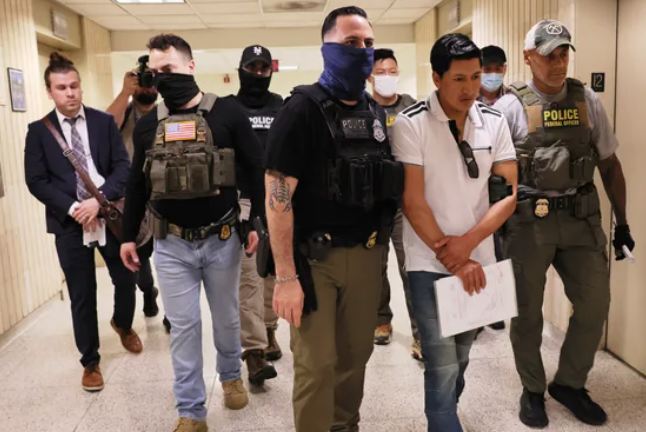
Note: the photo used in this article was used as a reflection of the possibility that ICE can apprehend immigrants when they go to court for case that are unrelated to their immigration status.
Crain’s Grand Rapids Business story on AmplifyGR omits critical information on the organization’s early years as a creation of the DeVos family
On Monday Crain’s Grand Rapids Business posted a story about a new development project in the Boston Square neighborhood that involves the DeVos-created and financed group known as AmplifyGR.
Early in the Crain’s article is states:
Amplify GR has tapped Habitat for Humanity of Kent County to build 22 affordable townhouses at its massive Boston Square Together project, the first homeownership component of the 9-acre redevelopment on Grand Rapids’ south side.

Later in the article it states what the townhouses will be sold at, stating:
The townhomes would be sold primarily to households earning up to 80% of area median income, which is about $85,120 for a family of four people in Kent County, per the latest U.S. Department of Housing and Urban Development guidelines. Some of the units may be sold to households earning up to 120% of AMI, or $127,680.
This means that families will pay between $85,120 and $127,680. To put into perspective, if you make $25 an hour in Grand Rapids you would make $52,000 a year. There are thousands of people in Grand Rapids who do not make anywhere near $25 an hour and that barely qualifies as affordable, especially for families. If there are two income families it would be more affordable, but again it depends on how much people are earning, which is not reflected in area medium income, which takes averages, thus ignoring the massive wealth gap in this city. African Americans are particularly impacted by this wealth gap. An article from MLive in February stated:
the five-county Grand Rapids-Wyoming metro area’s Black population had the worst homeownership, educational attainment and business ownership rates among the big metros.
The developer that is being tapped for this project is Pure Architects, which also developed the newer AmplifyGR space. It is also worth noting that the CEO of Pure Architects is Zachary Verhulst, who is the son of Michael B. Verhulst. Michael B. Verhulst runs V2 – Verhulst Ventures, is the CEO of Spesh Construction Company LLC, and a former VP of Rockford Construction, which worked with the DeVos family to purchase 37 different properties in the southeast part of Grand Rapids, which is the AmplifyGR target area.
The Crain’s article also states that AmplifyGR has already built a food incubator, which is a space for food entrepreneurs to start food businesses. I wrote a post in 2023 as a response to the food incubator project, primarily asking why they would not use it as a community kitchen space, since food insecurity is a significant issue in that part of the city.
There are only two sources cited in the story, someone with Habitat and someone with AmplifyGR, specifically Jon Ippel, Amplify’s executive director. Towards the end of the article Ippel says, “Amplify GR has engaged about 400 Boston Square neighbors and stakeholders since the nonprofit began planning the redevelopment in 2019.” This might be true in terms of numbers, but AmplifyGR actually began doing community engagement in 2017, which didn’t go so well.
I have been tracking the DeVos-created and funded AmplifyGR since 2017 when I first heard about them. In May of 2017, I wrote an article entitled, The DeVos Family now wants to remake part of a southeast Grand Rapids neighborhood. In late June of 2017, AmplifyGR hosted it’s first community forum, which was well attended, but there was also lots of push back from the community, as I noted in another post.
There was a second town hall style meeting in July, which I also attended and reported about. Here is an excerpt from that article:
Tempest Warfield, an afro-Latina, just made it plain when she given the chance to speak. She spoke passionately and called out who is running this process. She said that a lot of what this boils down to is race and class. “People want to just stay in their homes, but people are feeling bullied by the wealthiest family in the area. People want to keep their homes and leave a legacy for their kids. We do have purpose here, even if it doesn’t look like it to the DeVos family.” John Ippel, from AmplifyGR, responded by saying he gets it. Tempest came right back and said, “be careful about practicing white savior politics.”
Because there was significant pushback from the community at these town hall style meetings, AmplifyGR decided to shift tactics. In a 2019 article I wrote:
AmplifyGR has shifted their tactical approach to meeting with small groups of people and individuals in the southeast area, thus eliminating community accountability. When organizations like AmplifyGR, which has the backing of the wealthiest family in West Michigan, chose to operate with limited transparency, you can be sure that they still are committed to their original agenda, an agenda reflected in the graphic below.
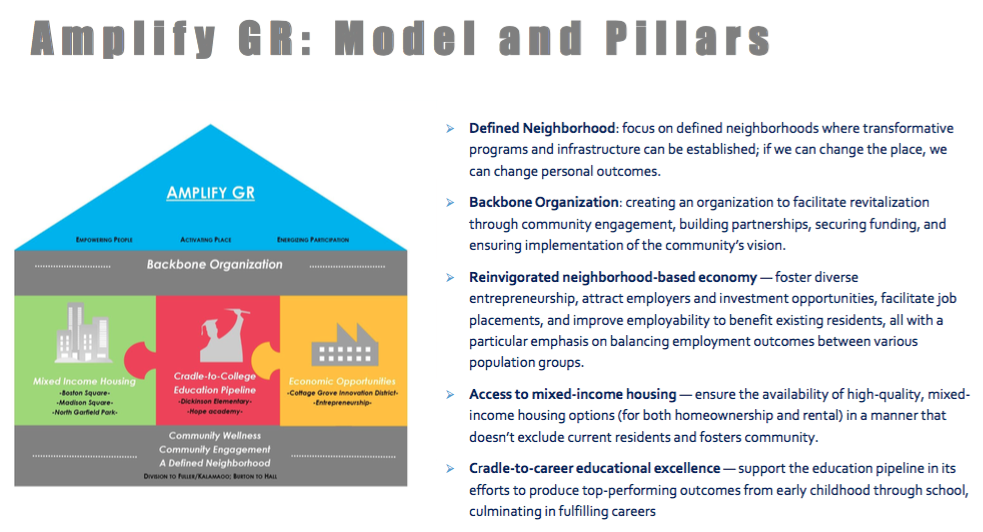
I included this information as a direct response to AmplifyGR’s executive director who made the claim that the DeVos-owned and financed organization had engaged the community since 2019. As I documented, AmplifyGR began engaging the community in 2017, but because of significant community resistance, they decided to approach community engagement in more isolated and behind closed doors fashion. None of the background information I provided here was part of the Crain’s Grand Rapids Business article.
Making sense of the idea to defend the Constitution and refusing orders through a historical lens
When Michigan Senator Elissa Slotkin and several other members of Congress went public with a video urging current US soldiers to refuse orders to be deployed in US cities, the Trump Administration pushed back and called them traitors.
Trump’s response was predictable, but what I want to examine is the message that Senator Slotkin and her colleagues made and how to make sense of it with the history of US military deployments both domestically and at the international level.
Yesterday I posted an article that deconstructed a meme claiming that the US Constitution was the handbook for anti-fascists. I stated that saying the US Constitution is the handbook for antifa is both insulting and absurd. In fact, I would argue that the US Constitution is antithetical to anti-fascism.
However, for the sake of argument, if we follow what Senator Slotkin and her colleagues were stating, that US soldiers have an obligation to disobey orders to deploy because it has nothing to do with defending the US Constitution, then let’s examine that claim.
First, it must be stated that US soldiers from the Revolutionary war and right up to the present have refused orders, primarily because they believed that what the US military was doing was unjust and had nothing to do with democracy.
In Robert Fantina’s book, Desertion and the American Soldier: 1776-2006, he documents that there have been thousands of US soldiers who have refused orders or deserted after a war had begun for a variety of reasons. Most people are familiar with the number of US citizens that refused the draft into Vietnam War, along with the large number of US soldiers that refused orders in the midst of that war. Some excellent resources for understanding draft resistance and Vietnam GIs who resisted being part of plans to murder Vietnamese communities can be found in David Cortright’s book, Soldiers in Revolt: GI Resistance During the Vietnam War, along with the powerful documentary Sir, No Sir.
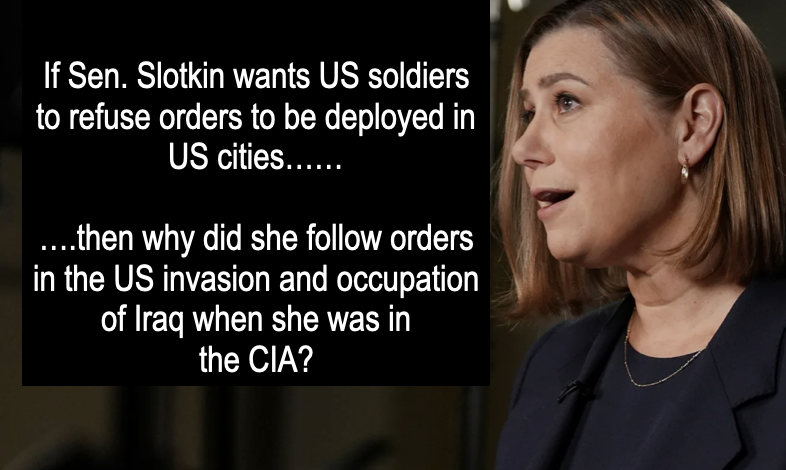
Second, we could start by looking at Senator Slotkin’s time in the CIA during the US invasion and occupation of Iraq. The US claimed that Iraq had Weapons of Mass Destruction (WMDs), specifically nuclear capability, as the pretext for the US invasion/occupation in 2003. Those claims were false, but even if they were true, did the US have the right to invade and occupy Iraq? The United Nations didn’t support the US invasion/occupation, so why didn’t Elissa Slotkin refuse orders to be part of that military operation? The US invasion/occupation of Iraq had nothing to do with defending the US Constitution or bringing democracy to that country.
Third, I would argue that most US military actions have had little or nothing to do with defending the US Constitution, let alone having a just and moral purpose. There is an excellent chronological online resource put together by Zoltan Grossman, which begins with the US Military massacre at Wounded Knee in 1890 and goes pretty much up to the present. Here are just a few examples:
- 1890 – US military kills 300 Native Americans at Wounded Knee, mostly shooting them in the back while they were attempting to run away from US soldiers.
- 1898 – US sent troops to Puerto Rico, kicked out the Spanish and have occupied that island ever since. Many Puerto Ricans consider their country to be a US colony.
- 1914 through 1918 – the US military engages in several different interventions in Mexico in opposition to Mexicans who were involved in a revolution, such as attacking Poncho Villa’s army in the northern part of Mexico.
- 1932 – US war ships were sent to El Salvador to suppress a labor and political revolt against the oligarchs.
- 1943 – US troops deployed to Detroit to put down a Black-led rebellion.
- 1953 – the CIA plotted and executed a coup in Iran because the Iranian government nationalized its oil.
- 1965 – the CIA assisted the Indonesian army in a military coup.
- 1973 – CIA coup in Chile to out the democratically elected Allende government.
- 1989 – US military bombs Panama to remove Manuel Noriega, a long-time CIA asset, killing some 2,000 civilians.
Again, these US military interventions has nothing to do with defending the US Constitution or promoting democracy.
Now, I agree with Senator Slotkin that US soldiers should refuse orders to be deployed to US cities. US soldiers have no business being involved in domestic affairs. However, I believe that there have been few examples of US soldiers being deployed anywhere in the world that was for just reasons or for the claim that they are defending the US Constitution.
Where was Senator Slotkin and her colleagues when it came time to denounce US complicity in Israel’s genocide of the Palestinians? Why did Senator Slotkin and her colleagues vote in favor of US military aid to Israel while they have been committing a genocide? I would argue that their call to US soldiers to disobey orders has more to do to with what the Trump Administration is doing and has little to do with the awful harm and carnage of US troops being deployed around the world.
If you want to explore this history of US interventions, I invite you to sign up for my class on the History of US Foreign Policy since WWII.
 Grand Rapids Institute for Information Democracy