While DeSantis gets headlines for whitewashing education curriculum, there are groups in West Michigan who are pushing the same anti-Black narrative
Over the past month, Florida Governor Ron DeSantis has been making headlines for numerous far right actions, including his push to undermine education curriculum that provides a more honest view of US history, particularly about the Black experience and the Black Freedom struggle.

There are numerous other high profile reactionaries who have been attacking any and all education-centered material that rightly names that the US was essentially founded on two major atrocities – the genocide of Indigenous people and the mass enslavement of Black people. These attacks have been going on ever since BIPOC communities have been demanding a more honest investigation of US history, particularly at the college level.
During the Trump administration, there was a renewed interest in undermining a more honest look at US history, such as the White House Conference on American History that was organized in September of 2020, which we wrote about. In fact, the Trump Administration endorsed the 1776 Project, which was crafted by educators with the far right Hillsdale College, in Hillsdale, Michigan.
The 1776 Project was a direct response to the work being done by Nikole Hannah-Jones and the work she was doing with the 1619 Project. The 1619 Project began in 2019, and has been the target of numerous high profile far right ideologues, like DeSantis, but also from numerous organizations that are committed to maintaining a white-centered narrative about US history.
Just last month, the 1619 Project had released a 6-part documentary series on the streaming services known as Hulu, which has once again prompted a great deal of criticism from the far right sectors of the country, along with groups right here in West Michigan.
One group that has been openly opposed to the 1619 Project, is the far right think tank, the Acton Institute. The Acton Institute had initially done a podcast in August of 2020, inviting Phillip W. Magness, with the American Institute for Economic Research, who wrote a book entitled, The1619 Project: A Critique. On February 1st, the Acton Institute re-played that interview with Magness, with an updated introduction to the podcast. In that Acton Institute interview, their quests makes the claim that people simply have a hard time “accepting the complicated totality of US history.”
A second example of someone in Grand Rapids that has openly attacked the 1619 Project, was a guest on the Doug DeVos podcast called Believe! DeVos invited Dr. Larry Arnn, the President of Hillsdale College to discuss the 1619 Project. The Hillsdale President does acknowledge slavery, but just in passing. Interestingly enough, Dr. Arnn then spends a great deal of time talking negatively about the 1619 Project, stating:
You know, the New York Times has done that frightful 1619 Project. And they claim that the movement of the founding of America from the colonies forward was in the direction of perpetuating slavery. The President of Hillsdale College then cites Gordon Wood as the leading US Historian, so as to contradict the claims made by the 1619 Project. This theme is not really explored by DeVos or his guest, since both are not interested in a serious exploration of the more honest history that the 1619 Project explores, particularly as it related to the centuries long practice of systemic racism in the US and how it has impacted the Black community in particular.
A third, and final example, comes from the pro-police Facebook group in Grand Rapids, Silent no More. Silent no More is a fairly recent creation, but appears to be some of the same people who host Stand With Schurr, the group that is defending the cop who murdered Patrick Lyoya last April. A few days ago, the group Silent no More posted a link on their FB page from the group legalinsurrection.com, with the headline, “Hulu series based on 1619 Project Pushes ‘False History.’ One of the main objectives of the group legalinserrection.com, is to discredit Critical Race Theory. The fact that the pro-police group Silent no More posted this information only demonstrates that besides defending cops, they defend white-centered history and deny that structural racism has been a fundamental component of the political experiment called the United States. Groups that a police apologists tend to justify policing targeted towards BIPOC people, along with denying structural racism.
While I am disgusted by the likes of Gov. DeSantis and his attacks on Critical Race Theory and the 1619 Project, I am more interested in groups in West Michigan that are doing the same thing. If I want to do more than be aware, then working to oppose these groups in West Michigan seems way more important than simply spouting off against the likes of Gov. DeSantis. We can actively work to expose and confront this kind of misinformation in Grand Rapids, misinformation that is well funded.
Blurring the lines between education and Neo-Liberal Capitalism: GVSU partners with local business to provide a talent pipeline
Last week both MLive and MiBiz reported that GVSU has begun a new program, where they are partnering with 5 Grand Rapids-based companies.
The program is being called the Laker Accelerated Talent Link. The name of the program is consistent with how the Capitalist Class sees educational institutions, where their main function is to create talent for businesses. In fact, the local group Talent First, said that the three main goals of their work, from a 2017 report, was to, 1) develop partnerships between businesses and educators, 2) Evaluate community investments to improve the opportunity ecosystem (make sure school funding was used for workforce development), and 3) Change public policy to create a new education system.
All of this think around talent creation and workforce development is consistent with Neo-Liberal Capitalism.
The President of GVSU, Philomena Mantella, confirmed this relationship between Neo-Liberal Capitalism and education, with the following comments from the MLive article:
We are grateful to these leading employers in the region for taking this initial step with us to equip dynamic and diverse professionals for the workforce.
We are addressing labor-shortage concerns and creating a positive impact on the business community. This program will highlight Grand Valley students’ human-centered skills and deep knowledge of their disciplines, and the companies will benefit from well-prepared employees
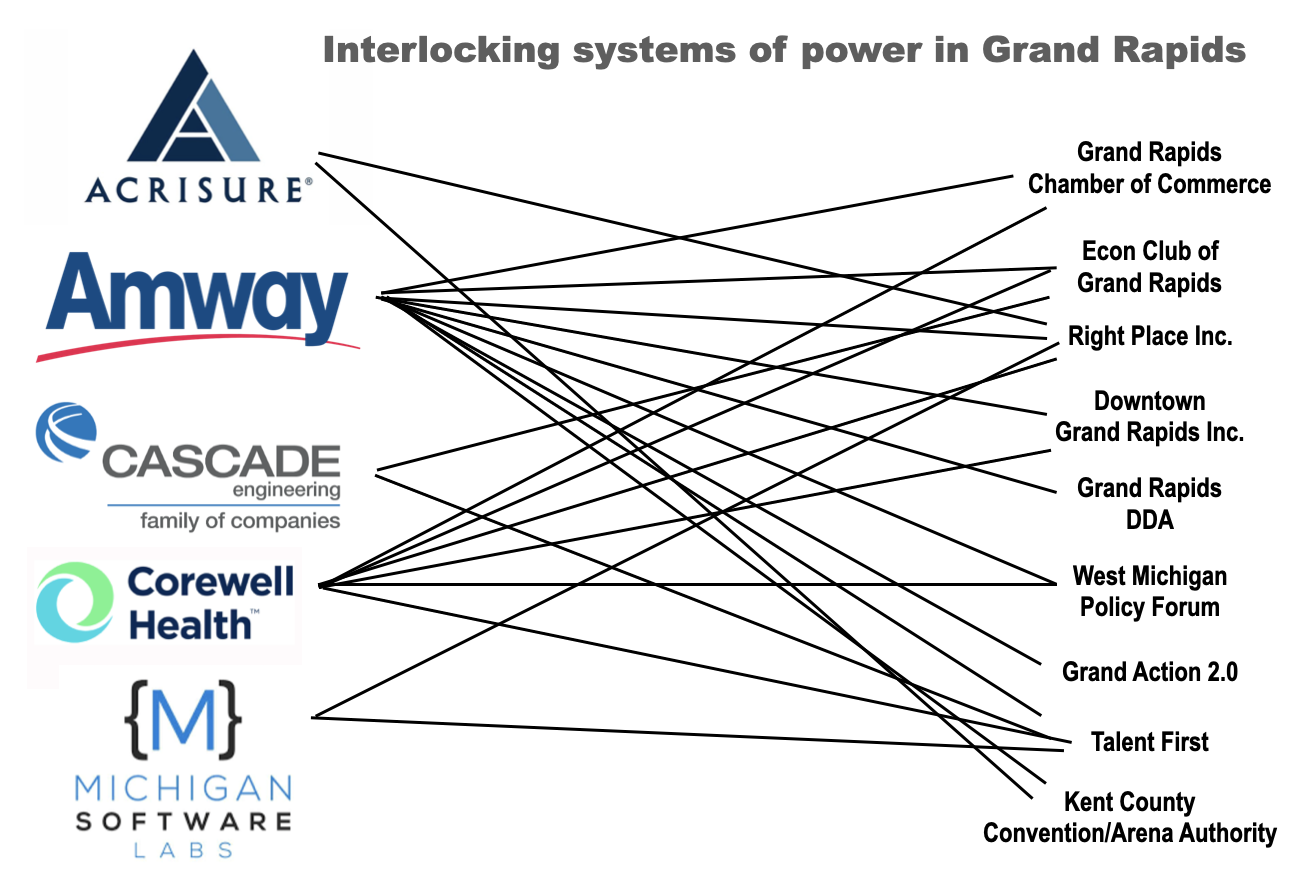
The five companies that are partnering with GVSU are, Acrisure, Amway, Cascade Engineering, Corewell Health and Michigan Software Labs. Now, these aren’t just random companies that will be partnering with GVSU, they are companies that are deeply tied to the Grand Rapids Power Structure, which is essentially an interlocking system of power, as is reflected in the graphic above. For the purposes of this post, we will attach the DeVos name to Amway, since the DeVos family is at the top of the Grand Rapids Power Structure and has dozens of subsidiaries that are represented in the groups that make up the local power structure.
It should also be noted that the President of GVSU, Philomena Mantella, also sits on the boards of Grand Action 2.0, Right Place Inc., Talent 2025, and the Econ Club of Grand Rapids.
Another connection to this project between GVSU and local companies, which is set to begin in August of 2023, is the fact that two of the companies involved, also sit on the GVSU Board of Trustees – Amway and Corewell Health. Lastly, GVSU President Philomena Mantella stated in the MIBiz article, “GVSU plans to scale the program and is actively seeking other corporate partners.”
The audacity of lawyers: Postponing the trial for the cop that murdered Patrick Lyoya
On Friday, it was reported by several local news agencies that the Judge Mark Trusock has granted a delay in the trial of Christopher Schurr. Schurr was the GRPD cop who shot and killed Patrick Lyoya last April.

The lawyers for Schurr asked the court to postpone the trial until October, meaning the trial would not begin until 18 months after Schurr shot Lyoya in the back of the head after a routine traffic stop. We’ll get to the reasons that Schurr’s lawyers used in order to get the trial delayed, but first I think it would be useful to provide a brief timeline from the murder of Patrick Lyoya to the present.
April 4th, 2022 – During a routine traffic stop, GRPD Officer Christopher Schurr shoots and kills Patrick Lyoya. GRPD and City officials hold Press Conference.
April 14, 2022 – GRPD and Grand Rapids City officials released video of the GRPD cop who shot and killed Patrick Lyoya.
April 26, 2022 – Pro-Police groups go on the offensive, support Christopher Schurr and argue that Patrick Lyoya died because he refused to obey a cop.
May 5, 2022 – Local news submits Freedom of Information Act (FOIA) request to get internal GRPD documents related to the Patrick Lyoya shooting.
May 12, 2022 – Mayor Bliss threatens to change City Commission meeting rules to prevent disruptions by the Justice4Patrick Movement.
May 23, 2022 – MLive article on Officer Christopher Schurr normalizes White Supremacy and White Saviorism.
June 10, 2022 – Cop who killed Patrick Lyoya is charged with second degree murder, plus responses from GR City officials.
June 12, 2022 – Lawyers now representing Schurr release a statement attempting to control the public narrative, which reads in part: “We were disappointed to learn that Officer Schurr has been charged with murder by the Kent County Prosecutor. Officer Schurr is a decorated member of law enforcement who has dedicated his career to helping others and protecting the citizens of Grand Rapids. The evidence in this case will show that the death of Patrick Lyoya was not murder but an unfortunate tragedy, resulting from a highly volatile situation. Mr. Lyoya continually refused to obey lawful commands and ultimately disarmed a police officer. Mr. Lyoya gained full control of a police officer’s weapon while resisting arrest, placing Officer Schurr in fear of great bodily harm or death. We are confident that after a jury hears all of the evidence, Officer Schurr will be exonerated.”
June 22, 2022 – Once again the Grand Rapids commercial news media presents a narrative that favors the ex-GRPD cop who killed Patrick Lyoya.
July 27, 2022 – New GRPD “Sanctity of Life” policy announced.
September 25, 2022 – Hearing on the Christopher Schurr case, where Schurr’s lawyers say they now have all of the documents needed for this case.
October 27, 2022 – Another hearing in the Schurr case to finalize the trial date.
October 28, 2022 – Witness testimony and character assassination: Local news coverage of the court hearing of Chris Schurr, the man who shot and killed Patrick Lyoya.
January 12, 2023 – Lawyers representing Schurr submit 45 page brief arguing the charges against Schurr should be dropped.
This brings us to last Friday, where the lawyers representing Christopher Schurr were granted a delay in the trial date, which will now take place in October. There were two reasons submitted by Schurr’s lawyers as to why the trial should be delayed:
- They needed more time to, “mull over more than 30,000 pages of files in the case.”
- Matthew Borgula, one of Schurr’s attorneys, explained to the judge that one of the members of their trial team recently died, and his co-counsel also recently lost an immediate family member.
To the first point, Schurr’s lawyers have had all the documentation they needed since September 25. In addition, as most law firms do, they often utilize or hire additional staff/clerks to sift through documents relevant to cases they are working on. Needing more time for the 30,000 pages seems like a weak argument and borders on petty.
On the second point, I am assuming that these family members weren’t murdered, rather they died under less horrific circumstances. Having the trial delayed by 7 months seems rather excessive. Most of us in this society rarely get much time off to grieve the loss of family members. More importantly, Patrick Lyoya’s family will now have to wait an additional 7 months to see if there will be any justice or possible closure. Is there no consideration for their grief, which is a direct result of the murder of their family member? Losing a family member to murder is a much more traumatic and horrendous death to deal with and will no doubt impact Patrick’s family for the rest of their lives. In using the loss of a family member, the lawyers representing Schurr not only insult the family of Patrick Lyoya, their request is a form of mockery, even taunting, as if to say, “we don’t give a damn about your loss and your grief.”
Some people might say, well it’s only another 7 months til the trial, so just be patient and wait. Such sentiment is a construct of white supremacy, not only because it is insensitive, but because it essentially erases the centuries of harm done to Black people by systems of power and privilege. You might recall what Dr. Martin Luther King Jr. had to say to white people, when they urged him to be patient, to wait for justice. Dr. King responded, while sitting in a jail cell in Birmingham, Alabama, and wrote these words:
We know through painful experience that freedom is never voluntarily given by the oppressor; it must be demanded by the oppressed. Frankly, I have yet to engage in a direct action campaign that was “well timed” in the view of those who have not suffered unduly from the disease of segregation. For years now I have heard the word “Wait!” It rings in the ear of every Negro with piercing familiarity. This “Wait” has almost always meant “Never.” We must come to see, with one of our distinguished jurists, that “justice too long delayed is justice denied.” We have waited for more than 340 years for our constitutional and God given rights. The nations of Asia and Africa are moving with jet like speed toward gaining political independence, but we still creep at horse and buggy pace toward gaining a cup of coffee at a lunch counter. Perhaps it is easy for those who have never felt the stinging darts of segregation to say, “Wait.” But when you have seen vicious mobs lynch your mothers and fathers at will and drown your sisters and brothers at whim; when you have seen hate filled policemen curse, kick and even kill your black brothers and sisters; when you see the vast majority of your twenty million Negro brothers smothering in an airtight cage of poverty in the midst of an affluent society; when you suddenly find your tongue twisted and your speech stammering as you seek to explain to your six year old daughter why she can’t go to the public amusement park that has just been advertised on television, and see tears welling up in her eyes when she is told that Funtown is closed to colored children, and see ominous clouds of inferiority beginning to form in her little mental sky, and see her beginning to distort her personality by developing an unconscious bitterness toward white people; when you have to concoct an answer for a five year old son who is asking: “Daddy, why do white people treat colored people so mean?”; when you take a cross county drive and find it necessary to sleep night after night in the uncomfortable corners of your automobile because no motel will accept you; when you are humiliated day in and day out by nagging signs reading “white” and “colored”; when your first name becomes “nigger,” your middle name becomes “boy” (however old you are) and your last name becomes “John,” and your wife and mother are never given the respected title “Mrs.”; when you are harried by day and haunted by night by the fact that you are a Negro, living constantly at tiptoe stance, never quite knowing what to expect next, and are plagued with inner fears and outer resentments; when you are forever fighting a degenerating sense of “nobodiness”–then you will understand why we find it difficult to wait. There comes a time when the cup of endurance runs over, and men are no longer willing to be plunged into the abyss of despair. I hope, sirs, you can understand our legitimate and unavoidable impatience.
In Part I of our series looking back at the 20th anniversary of the public resistance to the US invasion/occupation of Iraq in 2003, we focused on early organizing efforts to build an anti-war movement before the US war on Iraq even began. In Part II, we looked at the protest when President’s Bush’s visited Grand Rapids the day after his State of the Union address and the GRPD’s response during that protest.
Today, we will look at the Women in Black actions, the global protest against the war march that took place in Lansing, along with the People’s Alliance for Justice & Change workshops on civil disobedience that were offered to a growing number of people who wanted to do more than just hold signs. In addition, we will talk about how the local media responded to Colin Powell’s WMD presentation to the United Nations.

On February 4th, about 100 anti-war activists came to the Grand Rapids City Commission, demanding that the commission adopt a resolution against the US invasion/war against Iraq. Some people from the People’s Alliance for Justice and Change spoke and they were followed by Women in Black protesters. Women in Black was an international movement started by Israeli and Palestinian women who protester the Israeli occupation of Palestine. The movement then grew to oppose war and militarism in general. Only a few members of Women in Black spoke, while most of the members stood in silence wearing all black. It was a powerful image that generated a great deal of discussion and media coverage, like the Grand Rapids Press article above.
 The City of Grand Rapids eventually adopted a resolution against the US occupation of Iraq, but not until a year after the war had begun, plus the resolution was much weaker than the version that members of Women in Black and the People’s Alliance for Justice and Change had proposed.
Then on February 15th, the largest global anti-war protests in history took place. There were at least 60 different countries that participated in the anti-war protests, with 225 communities in the United States holding some sort of action. There was a big push for people in Michigan to attend a march Lansing, a march that began at MSU and ended up at the State Capitol. There was an estimated 10,000 people marching against the war, with at least 1,000 from Grand Rapids.
Despite the largest global anti-war protest in history, US President George W. Bush said that he wasn’t changing his mind about invading Iraq. Bush had actually referred to the millions of people in the streets on February 15/16 as a “focus group.” As a response to the Bush Administration’s dismissal of the massive global anti-war protests, the People’s Alliance for Justice and Change decided to escalate tactics and provide some training for people who were willing to participate in Civil Disobedience. In Part IV, we will talk about the acts of Civil Disobedience that took place just before the US invasion began.
 The last item we wanted to address in today’s post was US Secretary of State Colin Powell presentation the United Nations on his findings that “proved Iraq had Weapons of Mass Destruction (WMDs).” This was the so-called smoking gun that the US administration and the US media had been looking for, and while it was not cause enough to invade Iraq, the US government and the US media used it to win public support for the invasion.
What was interesting about this news was that several Grand Rapids-based news agencies had contacted the People’s Alliance for Justice and Change to get their response to the Powell report. However, the local news agencies didn’t just ask for a response, they took the position that local anti-war organizers were wrong and needed to acknowledge their mistake. Members of the People’s Alliance for Justice and Change never accepted the Powell report as fact, but more importantly, they argued that even if Iraq had WMDs, this was not a valid reason for the US to invade Iraq. The US was in possession of more WMDs than any other country in the world and had used them more times than any other country. The local news media wasn’t interested in facts, they only wanted to make local anti-war groups look bad.
Of course, we all know that years later it was proved that Iraq never had WMDs and that Colin Powell himself admitted that he lied during his February 2003 presentation to the United Nations. The local news media never apologized for their complicity in reporting Powell’s report as fact.
In Part IV of our exploration on the 20th anniversary of the US war against Iraq, we will talk about student organizing and Civil Disobedience that was done at the office of Congressman Vern Ehlers the week before the US invasion took place.
Why did Rep. Hillary Scholten vote for the Republican resolution that condemns Socialism?
In one of her first votes as a member of Congress, Rep. Hillary Scholten voted for a Republican resolution named, Denouncing the horrors of socialism.
In fact, Scholten was one of 109 Democrats who voted for the resolution, which means that more Democrats voted for the resolution to condemn socialism than those who voted against it.
Rep. Scholten doesn’t provide us with any reason(s) as to why she voted yes on this resolution, she only refers to it “a non-serious messaging bill from Republicans.”
Granted, the resolution is not a “deliverable”, as Rep. Scholten refers to it, but it is part of a larger ideological battle that should not be minimized.
The resolution is fairly brief and begins with these sentences:
Whereas socialist ideology necessitates a concentration of power that has time and time again collapsed into Communist regimes, totalitarian rule, and brutal dictatorships;
Whereas socialism has repeatedly led to famine and mass murders, and the killing of over 100,000,000 people worldwide;
Whereas many of the greatest crimes in history were committed by socialist ideologues, including Vladimir Lenin, Joseph Stalin, Mao Zedong, Fidel Castro, Pol Pot, Kim Jong Il, Kim Jong Un, Daniel Ortega, Hugo Chavez, and Nicolás Maduro;
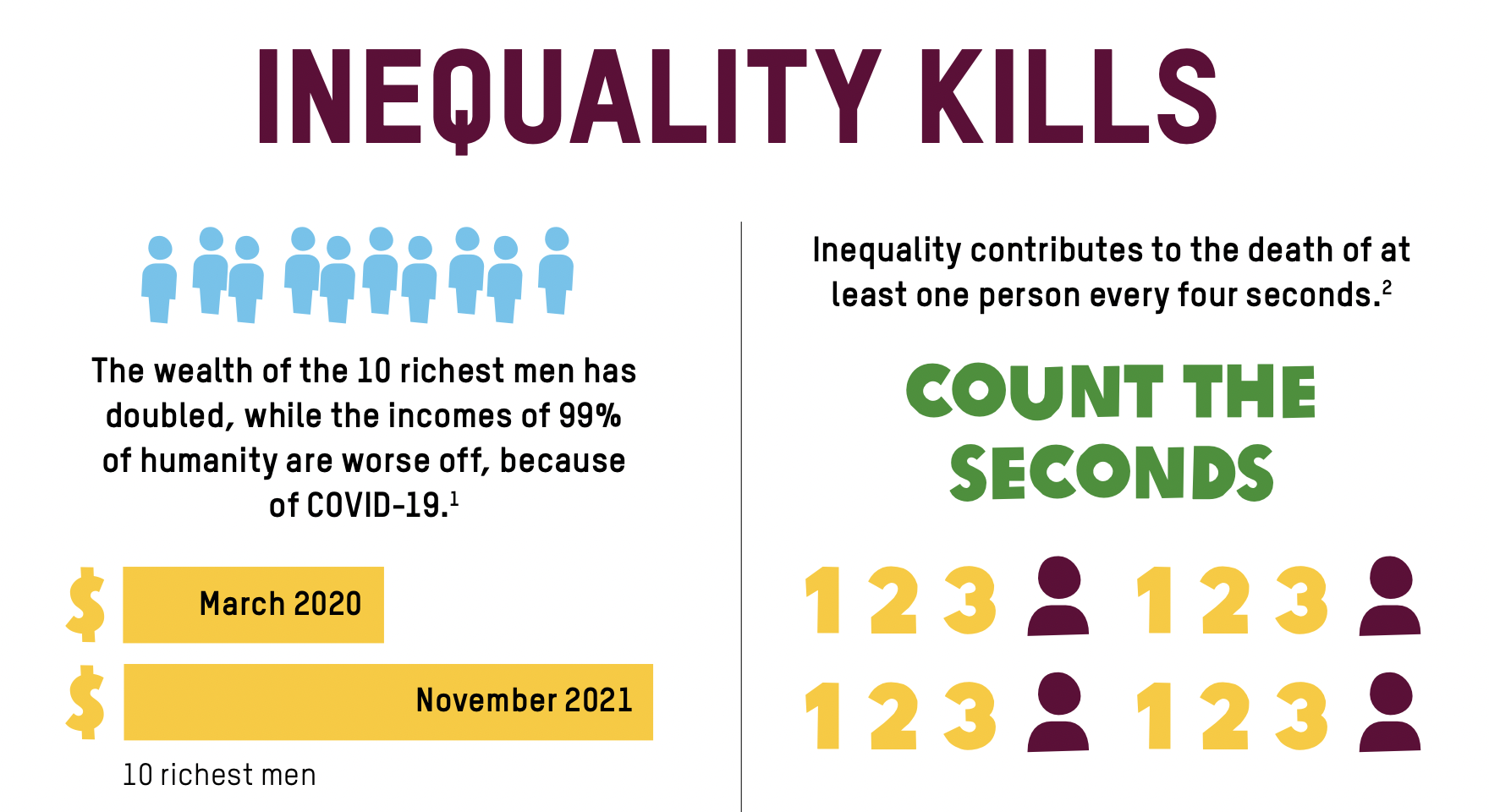
The first sentence makes the claim that socialism necessitates a concentration of wealth. I not really sure how they landed on this statement, but the economic system of Capitalism has clearly led to the concentration of wealth. Here is a brief part of the summary from a 2022 report by Oxfam entitled, Inequality Kills:
A new billionaire has been created every 26 hours since the pandemic began.6 The world’s 10 richest men have doubled their fortunes, while over 160 million people are projected to have been pushed into poverty.7 Meanwhile, an estimated 17 million people have died from COVID-19—a scale of loss not seen since the Second World War.8
These issues are all part of the same, deeper malaise. It is that inequality is tearing our societies apart. It is that violence is rigged into our economic systems. It is that inequality kills.
In the second sentence, which claims that 100 Million people have dies because of socialism. Like most of the Resolution, none of it is sourced to substantiate any of the claims made. Now, I am no apologist for socialism, and millions have suffered under the former Soviet regime, China, North Korea, etc, but we will do well to acknowledge how much suffering has occurred at the hands of Capitalism, particularly in the US.
The US was founded on genocide and slavery, meaning; 1) the killing of at least 1 million Indigenous people in the territory that is now the US, along with taking most of their land; 2) the enslavement of 12.5 million Africans who were sent to the Americas, according to the Trans-Atlantic Slave Trade Database. In terms of number of people who have been killed because of US foreign policy, it is hard to quantify, since it would include out right war the US has been engaged in, US military support for dictatorships and the use of proxy forces, along with sanctions and economic policies that have resulted in millions of deaths. See Ward Churchill’s book, On the Justice of Roosting Chickens: Reflections on the Consequences of U. S. Imperial Arrogance and Criminality.
Later in the text of the Resolution, it quotes Thomas Jefferson, “To take from one, because it is thought that his own industry and that of his fathers has acquired too much, in order to spare to others, who, or whose fathers have not exercised equal industry and skill, is to violate arbitrarily the first principle of association, the guarantee to every one of a free exercise of his industry, and the fruits acquired by it.” The irony here is that Jefferson, while President, owned 10,000 acres of land and at least 185 people he bought who were enslaved. In fact, Jefferson gave he daughter as a wedding present 25 of the people he had enslaved, like they were just another commodity.
Now, I know that this was just a resolution and maybe Rep. Scholten did not want to provide an opportunity for the GOP to attack her, but for me it sets a problematic tone for how she might vote in the future.
Lastly, it is worth quoting from an article by Liza Featherstone, who is a columnist for the Jacobin magazine, entitled, Democratic Leaders Join House Republican Attack on “Socialism”:
The resolution, which took the obligatory shots at Lenin, Castro and Maduro for taking money from rich people, asserts that the U.S. “was founded on the belief in the sanctity of the individual, to which the collectivistic system of socialism in all of its forms is fundamentally and necessarily opposed.” There was quite a lot of unpaid, collectivized forced labor supporting the “sanctity of the individual” founders, as I recall.
During the Grand Rapids Committee of the Whole meeting yesterday, there was a resolution to recognize the annual César E. Chávez Social Justice March as a City-Sponsored Event, beginning on page 2. Part of the Resolution reads:
The City of Grand Rapids has taken the necessary step of recognizing the César E. Chávez Social Justice March by way of a City Proclamation and now recommends endorsement of the César E. Chávez Social Justice March as a City-Sponsored Event to further unite Grand Rapids with a solid “Si Se Puede Spirit”!

For some, having the City of Grand Rapids sponsor the Cesar E. Chavez Social Justice March will be seen as good news. People might say that having local government support of an event that began in 2000, not only lends credibility to the event, it also means that the City of Grand Rapids will embrace and promote the legacy of Cesar E. Chavez and the United Farm Workers. However, having the City of Grand Rapids be a co-sponsor of this event is not only problematic, it will likely mean that the legacy of the farmworker struggle will become further co-opted.
I personally have attended the Cesar E. Chavez march for justice at least 8 – 10 times over the past 20 years. The City of Grand Rapids has always played a major role in the event, provide police escort and granting the event organizers a permit to march in the street.
As you can see in the photo above, which was included in the Committee of the Whole Agenda Packet, that the people holding the banner have had little or no involvement with migrant worker struggles. I particularly find it offensive to see the Grand Rapids Mayor, the City Manager and 1st Ward Commissioner Jon O’Connor holding banner with the image of a man that believed in direct action, which included disruptions of both commerce and government functions, and a movement that is rarely even represented during the annual march.
The march is usually led by an escort of GRPD vehicles, followed by roughly 25-30 JRROTC students marching in military formation. First, it seemed strange to have so much of a hyper-military presence with JrROTC students and GRPD officers on foot and in cars. Chavez was pretty militant about his commitment to non-violence, so their consistent presence seems rather contradictory and will only continue with the new City resolution.
 More importantly, having police presence sends a strong message to people who are undocumented and live in the Grandville Ave area. The ongoing deportations and raids conducted by ICE and other law enforcement officials is a reality that those who are undocumented must face on a daily basis. Having law enforcement officials present at such an event only discourages farmworkers and undocumented migrants from participating, even though they are the ones who have most in common with the legacy of Chavez and and current farmworker struggles.
The annual Cesar E. Chavez march is held during the week, usually late morning. This means that most farmworkers wouldn’t be able to attend, since they would be working. This begs the question about why the voices and lived experiences of migrant workers are not centered at such an event. One year several people from the group Foco Rojo handed out flyers about migrant worker conditions and information about the farmworker movement, in both English and Spanish, only to be told to stop handing out the information by the march organizers. The flyer read:
Migrant workers are some of the most exploited workers in our community. They work long hours, in difficult working conditions, and make very little money. In fact, migrant workers are one of the few jobs where minimum wage laws do not apply.
In 2010, the Michigan Civil Rights Commission published a report, based on testimony from farm workers, that concluded the living and working conditions for farm workers today is as bad, if not worse, than it was 50 years ago.
Migrant farm workers continue to live in poverty and many of them live in fear of harassment and deportation, since many of these workers are undocumented.
To honor the legacy of Cesar Chavez, which is to honor the lives of migrant farm workers, we ask, why are there no campaigns to organize migrant farm workers in West Michigan? We cannot truly honor the legacy of Cesar Chavez by holding symbolic marches while migrant farm workers and their families struggle to survive.
Migrant farm workers are organizing themselves all across the country through organizations such as the United Farm Workers, the Farm Labor Organizing Committee and the Coalition of Immokalee Workers. However, no such efforts to organize migrant farm workers is currently taking place in West Michigan, in spite of the fact that this area has one of the highest concentration of migrant farm workers in the country.
Honoring the legacy of Cesar Chavez should not be a day to make us feel good about ourselves, it should be a day where we commit ourselves to standing in solidarity with migrant farm workers. It should be a day where we hear the voices of migrant farm workers, not from politicians and other so-called leaders.
The United Farm Workers movement that Cesar Chavez was part of, was a movement that was committed to union solidarity, to the use of tactics like boycotts, strikes and other forms of direct action to force agribusiness to respect the dignity of migrant farm workers. This is the kind of movement we need today.
The issue of labor solidarity is an important one, especially since Mayor Bliss refused to support the bus driver’s union demands a few year back. In fact, there were GVSU students, who were part of the student movement known as Students Against Sweatshops, which was working with the bus driver’s union in Grand Rapids. Mayor Bliss approved sending GRPD cops to intimidate and threaten the GVSU students because of their support of the bus driver’s union. Because the Mayor was complicit in not supporting the union and approved the GRPD threats against students, the United Farm Workers sent Mayor Bliss a scathing letter, which read:
On behalf of the more than 10,000 members of the United Farm Workers, I am writing to express our deep disappointment in the breathtaking hypocrisy demonstrated by your administration this past week. On Thursday, March 17, you marched under our banner to commemorate the work of an American icon and our founder, Cesar Chavez. The very next day, on Friday, March 18, you dispatched Grand Rapids Police to the homes of student activists to intimidate them for organizing a January sit in to support transit workers represented by Amalgamated Transit Union (ATU) Local 836.
 You cannot march in the name of Cesar Chavez one day and use police officers to suppress all that he fought for the next. The United Farm Workers stands in solidarity with our ATU brothers and sisters struggling to preserve their retirement security and the United Students Against Sweatshops (USAS) who, in an inspiring acts of selflessness, have embraced their elders fight as their own.
I also write to call you to a higher purpose than implementing an austerity agenda that may win accolades from the comfortable, but will destroy the lives of the constituents who are counting on you the most. We ask that you adopt the spirit of our heroes – Cesar Chavez, Rosa Parks, Martin Luther King Jr. – whose names adorn your city streets and parks by rejecting the tactics who opposed and oppressed them in their lifetimes.
In the end, the Cesar E. Chavez March for Social Justice is primarily performative, since it doesn’t center the ongoing farmworker struggle. Having the City of Grand Rapids as a co-sponsor of the event further cheapens the message and legacy of Cesar Chavez and the ongoing farmworker movement. Chavez and the farmworker movement were all about engaging in tactics that disrupted business as usual, which the City of Grand Rapids clearly opposes. All you have to do is look at how city officials have responded to this demanding justice for Patrick Lyoya and the defunding of the GRPD to see how the city treats those who disrupt business as usual.
Agreement between Grand Action 2.0 and the Convention Arena Authority on the amphitheater is an agreement between those who run Grand Rapids
On Friday, it was reported by at least two local news sources that a formal agreement has been made between Grand Action 2.0 and the Grand Rapids-Kent County Convention/Arena Authority (CAA).

The agreement in question has to do with Grand Action 2.0’s push for an outdoor amphitheater in Grand Rapids, which the Convention/Arena Authority will operate once the amphitheater is operational in 2025, according to MLive.
In both the MLive article and a news story on WOODTV8, the primary source cited is Kara Wood, who is the executive director of Grand Action 2.0. However, both news sources failed to mention that Kara Wood used to be the Economic Development Director for the City of Grand Rapids. Woods was hired to be the ED of Grand Action 2.0 last year and has a history of supporting projects that involve the DeVos family, such as Start Garden being on the payroll of the City of Grand Rapids to promote more business development in Grand Rapids. GRIID received this information from Kara Wood when she was working for the City of Grand Rapids in 2016.
Both news stories mention that this is a public/private partnership, which means that lots of public money will be used in the process of developing the amphitheater, without public input, as we have reported on since 2020 in the article here:
How is it that we allow groups like Grand Action 2.0 to get away with the shit they do?
The coverage also mentions that there will be plans to further develop the Market Ave corridor where the amphitheater will be located, which also means that certain developers, businesses and members of the Grand Rapids Power Structure will be the primary beneficiaries. The DeVos family is the primary driver in this project, and they do engage in such projects by making sure that plenty of public dollars will be used for development and construction. After the Market Ave corridor is fully developed, the public will not share in the profits that the DeVos family and other members of the Grand Rapids Power Structure will pocket. This is how neoliberal capitalism works – get the public to pay up front, while the private sector reaps all the profits.
It has been almost a month since Tyre Nichols was brutally beaten by five Memphis cops. Over the past week and a half, since autopsy reports were released and the five cops were arrested (Jan.6), there have been a nationwide outcry against yet another Black person dying at the hands of police in the US.
Mapping Police Violence documented 1,192 civilian deaths at the hands of US police in 2022, which is the highest number since the project began documenting this type of death. The organization also has documented that Black people are 3 times more likely to die at the hands of the police than any other group of people, plus since 2013, in 98.1% of the police killing of civilians, there has been no accountability.
Protests have happened all over the US over the past week, but nothing like what happened after George Floyd was murdered by a Minneapolis cop. The police murder of Tyre Nichols has elicited more conversation around defunding and abolishing police departments, with the analysis that what happened to Tyre Nichols was not an aberration, but an expected outcome based on how policing is conducted in the US.
However, the more dominant news stories involve politicians who sometimes make noble speeches, which are generally filled with empty rhetoric. Take for example recent comments by members of the Michigan Black Caucus, as reported on MLive on February 1st, with the headline, Tyre Nichols’ death demands renewed scrutiny of policing in Michigan, Black lawmakers say.
The Michigan Black Caucus members that spoke at a press conference recently were Sen. Erika Geiss, House Speaker Joe Tate of Detroit, Sen. Sarah Anthony of Lansing, Rep. Donavan McKinney of Detroit, Rep. Stephanie Young of Detroit, and Rep. Amos O’Neal of Saginaw. Many of them used the kind of language we have become accustomed to when cops kill Black people, with words like accountability and training. More importantly, what we have seen time and time again is that politicians, even if they demonstrate righteous anger of the police murder of Black people, it doesn’t result in increased consequences for police departments. In fact, what often happens is an increase in funding for police departments, like what we have seen in Michigan, where under the leadership of Governor Gretchen Whitmer, there has been a $1 Billion investment in policing. Gov. Whitmer said in her 2023 State of the State speech:
Since I’ve been governor, we’ve invested $1 billion in public safety. Let’s continue funding law enforcement with better training, oversight, and access to mental health resources. Police officers, state troopers, and prosecutors have tough, dangerous jobs, and if we work together, we get them what they need to keep our communities safe.
The 2023 Michigan Budget includes the following for policing. After each funding allocation, GRIID provides some commentary to counter these policing funding justifications.
- $9.2 million to support a Trooper Recruit School (general fund) anticipated to graduate 50 new troopers in addition to the 120 troopers that are anticipated to be hired and trained using existing attrition savings. This investment allows the department to increase enlisted strength to nearly 2,200 while continuing to increase the diversity of uniformed personnel. GRIID Comments: More funding to recruit more cops does not translate into safer communities. Over and over again, the public is mislead into believing this major fallacy of more police, safer communities. See the report, Cops Don’t Stop Violence.
- $3.7 million to improve Data Collection during Traffic Stops (general fund) through the development of new tracking and documentation systems including a benchmarking dashboard and increasing data collected during traffic stops to allow for easier review and analysis of traffic stops made by the State Police. These improvements will build upon the recommendations of the recent Michigan State University Traffic Stop Study. GRIID Comments: Last year, the Michigan State Police had conducted a traffic stop study, which concluded there was racial disparity by their department. Despite this, the public will provide more money to tell us what we already know about policing, traffic stops and racial profiling.
- $3 million to expand Training and Professional Development (general fund) to provide training on cultural competency, implicit bias, and decision-making to expand positive interactions between department members, minority groups, and the diverse communities that the department serves. GRIID Comments: There are numerous studies demonstrating that racial sensitivity and cultural competency training for police departments are ineffective. As Alex Vitale, author of The End of Policing states, “Diversity and multicultural training is not a new idea, nor is it terribly effective. Most officers have already been through some form of diversity training and tend to describe it as politically motived, feel-good programming divorced from the realities of street policing. Researchers have found no impact on problems like racial disparities in traffic stops or marijuana arrests; both implicit and explicit bias remain, even after targeted and intensive training. This is not necessarily because officers remain committed to their racial biases, though this can be true, 19 but because institutional pressures remain intact.”
- $1.8 million to establish a Victim Services Program (general fund) that will support 14 full-time Victim Advocates across the state. These positions will serve to support victims’ needs early in their interactions with the criminal justice system while also building partnerships with community organizations in support of victim advocacy. GRIID Comments: There should be funding for victims of crime, but it should not go to the Michigan State Police. Funding for crime victims should go through the Department of Social Services.
- $1.1 million to increase the department’s capacity to Prevent, Detect, and Investigate Cybercrimes (general fund). This investment will support statewide investigatory assistance and digital forensic examinations to further the department’s position as a leader in areas of cyber security, computer crimes, and digital evidence. GRIID Comments: Cyber crimes prevention, detection and investigation should also not be done by the Michigan State Police. Such categories are nothing more than justifications for police departments to receive more funding.
- $1 million for Trooper Recruitment (general fund) to broaden the racial, ethnic, and gender makeup of the department to make it more representative of the communities it serves. This investment will support digital marketing campaigns, recruiting events, and improved public relations to assist the department in achieving its recruiting goals for enlisted positions. GRIID Comments: Recruiting and hiring more cops based on gender, race and ethnicity will NOT address the deep seated lack of trust between the police and the public. Do you think it matters that having a Black cop arrest you, beat you or shoot you is any better than a white cop doing the same?
The rhetoric from politicians like the Michigan Black Caucus also rings hollow since they have supported Gov. Whitmer’s $1 Billion in funding for policing. On top of that, at least three of the members of the Michigan Black Caucus have received campaign contributions from police unions, as has been documented by the group, No More Cop Money.
- House Speaker Joe Tate – $1500 from police unions
- Sen. Sarah Anthony – $1250 from police unions
- Sen. Erika Geiss – $1000 from police unions
- Gov. Whitmer & Attorney General Gilchrist – $3000 from police unions
All of the rhetoric in the world about police accountability means nothing if politicians continue to provide massive amounts of funding to police departments and continue to take money from cop unions. Not only is their rhetoric hollow, it is insulting to the public, and especially to the Black families that have had relatives murdered by cops. We need a massive movement and a mass uprising if policing in this country is going to be held accountable, defunded and eventually abolished.
If Michigan Democrats really want to help people, then they need to adopt policies that tax the Rich and Corporations
 Just days after the 2022 elections, Michigan Senate Democrats made the following statement, “Since 1984, Republicans have used their control of the Michigan Senate to block things Michigan families need. No more.”
For the first time since the early 1980s, Democrats control the Michigan legislature, with Whitmer as the Governor and a majority in both the House and the Senate. We wrote a three part series in November, asking the question, What kind of change do we really want to see in Michigan. Based on one of the first legislative proposals coming from the Democrats, the change were are likely to see will be marginal.
On Monday, MLive posted a story with the headline, House, Senate Democrats differ on when to give Michigan seniors pension tax relief. The article discusses the the different bills passed recently, by the Michigan House of Representatives and the Michigan Senate. The House Bill that was passed was HB 4001 and HB 4002. The Senate bill that was passed is SB 0001.
The differences that were discussed in the MLive article, have to do with when to repeal Michigan’s tax on retirement pensioners while boosting its Earned Income Tax Credit to 30%. The MLive article writes, “The EITC aids low- to moderate-income workers and families get a tax break according to the Internal Revenue Service, though the amount returned is relative to if the filer has children, dependents, is disabled or meets a slew of other criteria.”
Now, these bills are ultimately a good thing, in that they will mean that families and individuals who make moderate to low incomes, will have a little bit more money coming to them because of these tax changes in Michigan. According to a recent article in The Bridge, Whitmer’s tax cut plans would benefit more than 1.2 Michigan families. Some 700,000 households that would be in line to save more than $300 annually under an expanded Earned Income Tax Credit (EITC), while about 500,000 retirees would save about $1,000 per year in pension taxes. However, these bills do not address the larger tax policy discrepancies, which are how the state taxes corporations/businesses and members of the Capitalist Class. The Bridge article also provides some insight into why we will not likely see tax policies that will target the rich and corporations/businesses in Michigan.
Democratic lawmakers say more aggressive tax code changes — such as taxing the rich at higher rates or expanding corporate taxes — are unlikely given their slim, two-seat majorities in both the House and Senate.
“Because it’s been 40 years since Democrats have had control of Lansing, there are so many sensible and relatively easy and very important changes that we can make that will really help people in Michigan,” said Sen. Jeff Irwin, D-Ann Arbor.
“So some of those more difficult, more thorny, more complicated conversations around tax policy are going to be harder to get done because there’s just so much work to do.”
Apparently, Democratic Senator Jeff Irwin doesn’t think that taxing corporations and the rich will really help people in Michigan. Senator Irwin and the Michigan Democratic Party would do well to read a report from the Institute for Policy Studies (IPS) that was released in February of 2019.
The IPS piece notes that a majority of Americans support increased taxation on the rich, primarily because it would benefit everyone else. Here is a summary of the IPS talking points on What States Can Do to Reduce Poverty and Inequality Through Tax Policy.
STATE ESTATE TAXATION – The estate tax is a levy on large fortunes when they are transferred from one generation to the next, with exemption thresholds that shield middle and working-class families. Before the Bush tax cuts passed in 2001, every state in the nation collected revenue from the state estate tax credit, which sent the first 16 percent of federal estate tax revenue to the states. Congress phased out this tax credit gradually until fully repealing it in 2005. Re-instating a progressive state estate tax in states that lost their state estate tax could generate significant revenue while reducing the concentration of wealth in intergenerational wealth dynasties.
TAX ON CORPORATIONS WITH EXTREME GAPS BETWEEN CEO AND WORKER PAY – Such tax penalties are easy to administer because U.S. publicly held corporations began reporting the ratio between their CEO and median worker pay to the SEC in 2018. Lawmakers in seven U.S. states and in the U.S. Congress have introduced legislation similar to the Portland tax: California, Connecticut, Illinois, Massachusetts, Minnesota, Rhode Island, and Washington. These efforts build on the living wage movement by creating an incentive to pull down the top end of the pay scale while sending a message that everyone in a workplace contributes value (not just the CEO).
CARRIED INTEREST TAX – States with significant financial sectors can take action to make up for Washington’s failure to close the “carried interest” loophole, which allows private equity and hedge fund managers to reduce their tax bills by claiming a large share of their earnings as “capital gains” instead of ordinary income. This has allowed many of the wealthiest Americans to pay lower rates than firefighters and teachers. Legislation to close the carried interest loophole has been introduced in New York, New Jersey, Massachusetts, Connecticut, Rhode Island, Maryland, the District of Columbia, and Illinois. New York Governor Andrew Cuomo has included a state-level “carried interest fairness fee” in his budget proposal two years in a row.
FINANCIAL TRANSACTION TAX – The notion of instituting a Financial Transaction Tax has gained increased attention at the federal level in recent years, but Congress has failed to take action. This would not be relevant in states that do not have a large trading exchange. The Illinois state legislature is considering a bill that would place fees of $1-$2 per contract on Chicago’s commodities and financial exchanges, with revenue estimated at $10 billion to $12 billion per year.
STATE CAPITAL GAINS TAX – A capital gains tax is a levy on income from investments rather than wages. In the 42 states (including DC) that impose capital gains taxes, rates range from 3.1 percent in Pennsylvania to 13.3 percent in California. States without a capital gains tax should implement one and states that have one should increase the rate to at least 10 percent. Raising or introducing such taxes would mostly impact the wealthy, since the top 1 percent owns half of the nation’s financial wealth and the bottom 50 percent only own 0.5 percent of financial wealth. State capital gains taxes help ensure fairness between those who work paycheck to paycheck and those who pocket dividends.
HIGH-END REAL ESTATE TAXES TO FUND AFFORDABLE HOUSING AND OTHER PRIORITIES – Cities and States should consider taxes on luxury real estate investments, particularly unoccupied, vacant properties. A huge number of new luxury high-rise properties have been purchased, with many vacant and unoccupied, and many purchased by shell corporations, creating a method for the ultra-wealthy to hide their wealth. The impact has been to disrupt local real estate markets and push up existing housing prices for rent or sale higher and higher. States can pass enabling legislation to allow cities and localities to address this problem through taxes on vacant, unoccupied luxury units, and can consider transfer taxes, and laws to require beneficial ownership transparency in real estate transactions. States could also institute graduated real estate transfer taxes, taxing properties transferring over $1 million at progressively higher rates. Think of how much money could be generated for the construction of affordable housing for those who are currently priced out of the market.
LUXURY TAXES – A luxury tax is a duty levied on luxury goods, such as high-end automobiles and expensive yachts. In Connecticut, the sales tax rate jumps from 6.35 percent to 7.75 percent on vehicles costing more than $50,000; jewelry costing more than $5,000; and apparel and footwear costing more than $1,000. The clothing tax also applies to handbags, luggage, umbrellas, wallets, or watches costing more than $1,000. In New Jersey, a tax penalizes both luxury cars and gas guzzlers by imposing a 0.4 percent surcharge on vehicles that have price tags above $45,000 or get less than 19 miles per gallon.
STATE PAYROLL TAX ON HIGH INCOMES – Federal payroll taxes for Social Security have a huge loophole for the wealthy in the form of a cap on the amount of income subject to the tax. It’s currently $128,400 and is adjusted annually for inflation. This means a multi-millionaire and someone earning $128,400 per year pay the same amount in Social Security payroll taxes — not the same rate, the same amount. States can close this loophole by imposing a state level payroll tax on income above the federal cap.
STATE CORPORATE INCOME TAX – With the federal corporate tax rate dropping from 35% to 21%, this is an opportune moment for states to recoup some of these funds by raising or introducing corporate income taxes. Forty-four states levy a corporate income tax, with rates ranging from 3% to 12%. Nevada, Ohio, Texas, and Washington impose gross receipts taxes instead of corporate income taxes, while South Dakota and Wyoming have neither.
The bottom line is, if the Democrats want to put more money into the pockets of regular, everyday Michiganders, then these are the kinds of tax policies they need to adopt if they want to make real changes for Michigan residents and not be afraid to piss off corporations or members of the Capitalist Class.
Remember the message that the lawyers representing Christopher Schurr, the ex-cop who shot Patrick Lyoya in the back of the head, presented to the news media on January 11th? Schurr’s lawyers presented a 45 page brief laying out several arguments over why his case should be dismissed.
The local news media cited several of those same reasons why Schurr’s case should be dismissed, plus most of the local news outlets included a link to the 45 page brief, as we noted in a post from January 12.

The response from Kent County Prosecutor Chris Becker, who brought a second degree murder charge against Schurr, was not even picked up by all of the local news agencies. In fact, there is no evidence that Becker’s office even provided a Media Release, since we could not find any on the Kent County Prosecutor’s site, nor the Kent County Clerk or the County Administrators section of accesskent.com.
WOODTV8, WXMI17 and WWMT did not run a story on Becker’s announcement, just MLive, WZZM 13 and the Associated Press ran the story. As of January 31st, to access the MLive story you needed to be a subscriber.
The WZZM 13 story was short with channel 13 providing this narrative from the Prosecutor’s office:
Becker says in court documents that the district court did not abuse its discretion in finding probable cause to bind Schurr over on the second-degree murder charge.
Therefore, he argues, Schurr’s request to quash the bind over should be denied.
Becker believes there is enough evidence for the murder charge as opposed to the lesser count of manslaughter.
The channel 13 piece is so short, they decided to include information about the lawsuit that Patrick Lyoya’s family has filed against the City of grand Rapids.
The Associated Press (AP) story is also brief, with the following narrative based on what the Kent County Prosecutor’s office had shared:
Becker said in court documents filed Tuesday that the district court did not abuse its discretion in finding probable cause to bind Schurr over on the charge. Therefore, Schurr’s request to dismiss the charge should be denied, the prosecutor said.
The AP story did state that Kent County Circuit Judge Christina Elmore will hear both sides’ arguments during a motion hearing scheduled for 8:30 a.m. on February 3rd, plus they included the date that the trial will start, which is March 13. The WZZM 13 story did not mention the February 3rd motion hearing date, they only said there was “a hearing next week.”
The Kent County Prosecutor’s office missed a huge opportunity to create a counter narrative, which could have included clear reasons for why this case should go to trial. None of that happens in the local news coverage of Becker’s response to the lawyers representing the ex-cop who shot Patrick Lyoya in the back of the head.
The message coming from Kent County Prosecutor Chris Becker does not inspire and it does not create a counter narrative, which is crucial at this point, especially since the lawyers representing Schurr have hammered home their particular narrative. This battle is not just a legal one, it is about public perception, and right now the Kent County Prosecutor is losing the propaganda war.
 Grand Rapids Institute for Information Democracy