It all can seem overwhelming: Lessons from the 1980s Central American Solidarity movement in Grand Rapids
Right now there is a lot to be worried about, with some much oppression and corruption facing us. ICE continues to arrest, detain, deport and even murder people they are targeting.
The economy primarily works for the super rich, while the masses struggle to make ends meet, and about half of the population is living paycheck to paycheck. The government continues to spend large amounts on the US military and engage in imperialist actions in places like Iran, Cuba and Venezuela. Additionally, the US continues to be complicit in Israel’s genocidal campaign against the Palestinians.
There is so much pain and suffering going on, making it easy for us to give in to despair. What I learned from the popular movements in Central America and in Southern Mexico from 1980 through the early 2000’s was invaluable. First, movement organizers in Guatemala, El Salvador and Chiapas, Mexico taught me not only revolutionary patience, but how to focus our collective resistance against systems of power and oppression by developing strategies and implementing tactics that were necessary to create change.
We can’t merely engage in actions that make us feel good, instead we must engage in actions that resist and dismantle systems of power. This means we have to get out of our comfort zones and be willing to take risks. It also means we have to stop relying on electoral cycles that have rarely led to the kind of structural changes we need.
Therefore, I want to share a section from my book, A People’s History of Grand Rapids, from chapter seven, which focuses on the Central American Solidarity movement. This was during the Reagan era, where that administration was undoing some of the pervious gains made by civil rights and labor movements. Sometimes it is important to look back to what people have done collectively to make a difference.
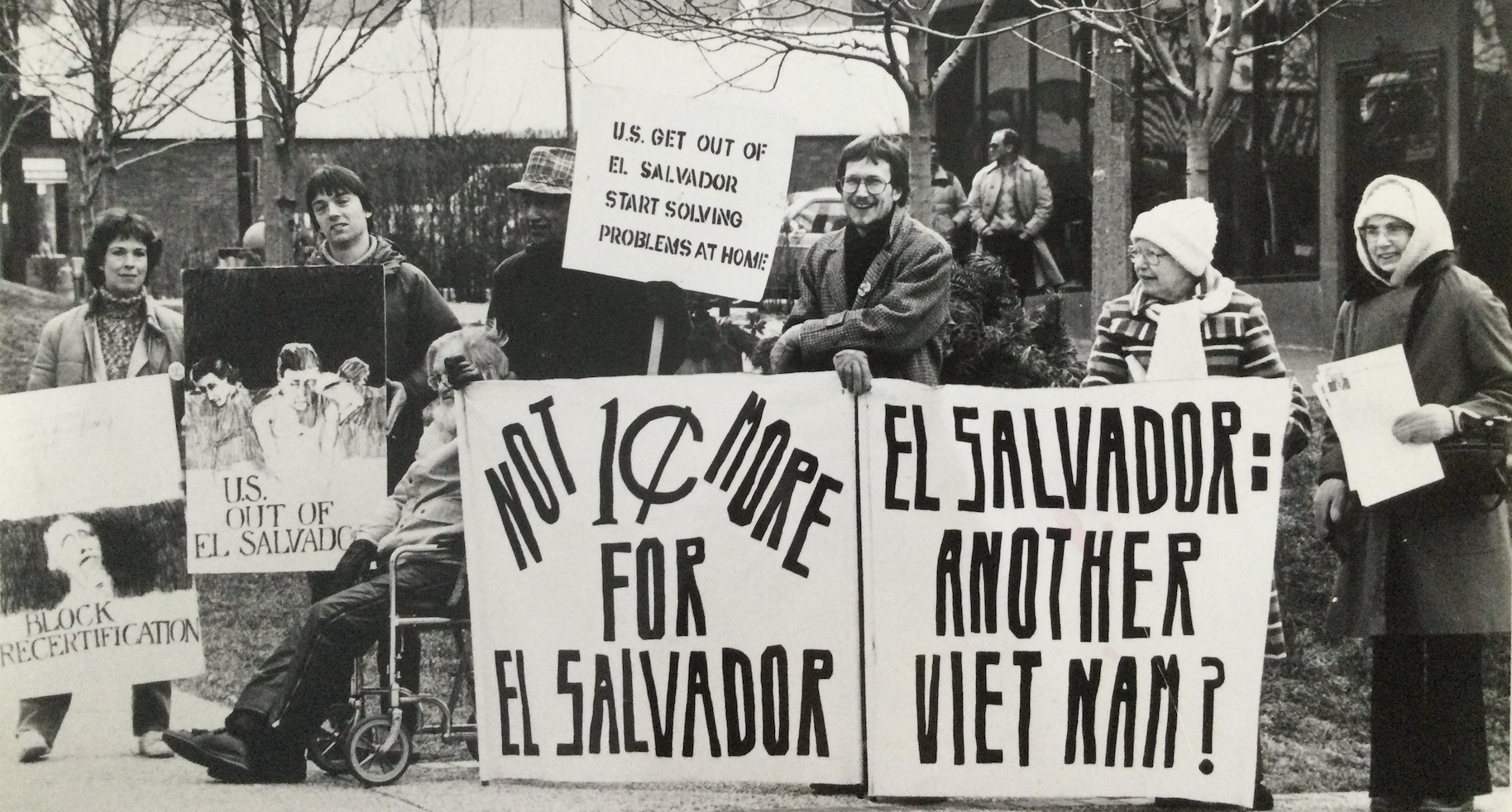
Central American Solidarity in Grand Rapids
The late 1970’s saw a great deal of revolutionary uprisings in the Global South, particularly in Central America. In Nicaragua, the FSLN, also known as the Sandinistas, were fighting against the decades long Somoza dictatorship. The Sandinistas overthrew the government in July of 1979, and almost immediately, the United States government began to demonize the new Nicaraguan government. In El Salvador and Guatemala, two armed insurgent movements, the FMLN in El Salvador and the URNG in Guatemala, were also fighting against long-standing dictatorships that were supported by the US government.
In the fall of 1980, when Ronald Reagan won the US Presidential election, few knew how much Central America would become his administration’s obsession. The Reagan administration increased military aid to El Salvador, Guatemala and Honduras beginning in 1981. In addition, the Reagan administration began to put significant pressure on the new Sandinista government in Nicaragua, first by imposing an international embargo and then by providing military training and funding to what became known as the Contra forces. Simultaneously, the US increased military funding to support the counter-insurgency wars in El Salvador and Guatemala. Honduras, which was geographically right in the middle of all of this, was trans- formed into a US military base, thus allowing the US to directly intervene whenever it needed.
The US war against the Sandinistas and the massive US support for the counter-insurgency wars in the rest of Central America, radicalized thousands of people in the US. In fact, the Central American solidarity movement had done things that previous movements confronting US foreign policy would never have imagined.
In Grand Rapids, a great deal of the Central American solidarity was coordinated by the Institute for Global Education (IGE). In the early 1980’s, IGE had created a Central America working group, which produced educational materials, hosted speakers, films and fact-finding trips to Central America.
Starting in 1983, there was a weekly vigil held on the old Monroe Mall in downtown Grand Rapids. The vigil began as a US Out of El Salvador demonstration, but by the time Reagan was re-elected in 1984, the vigil expanded to a larger US Out of Central America position. Besides holding signs, those attending the vigil would often pass out flyers to people walking by, flyers with information on US policy in Central America and how to get involved. Long-time civil rights activist Walter Bergman, sometimes joined those vigils. Bergman was a retire professor, who participated in the freedom rides in the 1960’s and was beaten so badly that he spent the rest of his life in a wheelchair.
Another group, known as the Stop the Invasion Campaign (STIC), began organizing in 1984. STIC was challenging the growing US support for the Contras that were terrorizing Nicaraguan civilians, as well as US military support to the Death Squad government in El Salvador.
One of the earliest actions that STIC organized was an elaborate form of street theater. The Stop the Invasion Campaign staged a series of mock kidnappings throughout Grand Rapids, where hooded men would drag off someone, throw them in a van and drive off. People who witnessed the mock kidnappings were not sure what was actually taking place, but moments later other STIC members handed out information sheets ex-plaining that what people just witnessed was a dramatization of what death-squads do in Guatemala and El Salvador every day.
The mock kidnapping began on Monroe Avenue, right in front of the Amway Grand Plaza Hotel cafe, where a van pulled up to a screeching halt and hooded men jumped out and grab a woman. The staged kidnappings then moved to the old Monroe Mall, where Father Paul Milanowski was taken. Milanowski was part of a regular Wednesday vigil that took place on the old Monroe Mall against US policies in Central America. After the priest was kidnapped, STIC members then went into the GRCC cafeteria and took a student, climbing over tables to grab her. The next stop was in front of a Meijer store on Kalamazoo & 28th street, where someone in a wheelchair was dragged into the van, with his wheelchair left behind and witnesses left in shock. The last mock kidnapping took place at the County building, where Kent County Commissioner Liz Oppewal was taken during a County Commission meeting. All of these actions began at noon and the STIC members and supporters ended up in front of the downtown Federal building for a protest that included about 40 people.
The street theater was an effective tool to get both the general public and other activists thinking about the daily violence in Central America that was being paid for by US tax dollars. However, after doing these mock kidnappings, STIC members found out that people were calling the local police, since they thought the kidnappings were real. More importantly, people did not completely think through the possibility that maybe someone who had witnessed these mock kidnappings could have been armed and tried to shoot one of the mock Death Squad members.
In 1984, Ronald Reagan was re-elected and that reality led to increased resistance on the part of those involved in the Central American Solidarity movement. The Stop the Invasion campaign began weekly protests in front of the federal building every Friday from 4:30-6pm, when commute traffic was at its peak. Congressman Paul Henry had an office in the federal building and he consistently voted for US aid to the Contras and to the Salvadoran military, which made him a clear target of actions.
In 1986, several people who had been involved with STIC made 100 wooden crosses with the names of Nicaraguan civilians that had been murdered by the Contras. Several activists hammered the crosses into the front lawn of the federal building, with a large sign that read: Murder Victims of US-backed Contras. The federal building security was not happy about this action, but instead of trying to stop the action, they turned the lawn sprinklers on us. The response from the federal building security was clearly passive aggressive, but the activists didn’t mind, since it was a hot summer day and the sprinklers didn’t have a negative impact on the wooden crosses.

At the same time that US intervention was escalating in Central America, there was a national call to action to resist US policy in the region. This national campaign was called The Pledge of Resistance, which was asking people to publicly commit to participating in civil disobedience until the US stopped the Contra war and the military support for the counterinsurgency wars in El Salvador and Guatemala. There were several dozen people in Grand Rapids who signed The Pledge of Resistance, most of which fulfilled that public commitment in the years to come.
A great example of people willing to do civil disobedience is based on a story that Barb Lester told about STIC in 1986.
“Another STIC action was a planned sit-in at the Gerald R. Ford Federal Building in the office of U.S. Representative Paul Henry. We had announced the plan the day before and the “Feds” were ready for us. There were fully armed U.S. marshals standing guard at all entrances to the building. Only staff was allowed inside. A group of about ten or twelve gathered at the Calder Plaza next door and milled around for a while with our picket signs and then left using the stairway down to the underground parking lot. One of our members had gone out on reconnaissance the night before to find a way inside the Federal building. She located an underground tunnel from the parking ramp to the building. The next day she led us down the steps, through the tunnel under the building and up a staircase to the office of the Representative Henry. You can imagine the reaction when our sleuth, Janet Mumaw, let the marshals know we had entered the office while they stood guard at the doors.
After an hour or two sitting-in at Rep. Henry’s office we were told to leave or we would be arrested. Some left but two of us stayed. Jeff Smith was one and I was the other. It was after 5:00 p.m. and the office staff and marshals wanted to go home. They called the Grand Rapids Police Department to come and pick us up and take us to the Kent County Jail. GRPD Lt. Victor Gillis told them he would not send out officers to do what the U.S. Marshall could do themselves. The marshals came back to the closet where they had stored Jeff and me and told us we could just leave. But we would not leave. They closed the door again and we could hear bits of conversation. After a short while conferring, the door opened again and we were grabbed by the arms. Both Jeff and I fell to the floor, limp as rag dolls. They were terribly irritated and used several methods to ‘encourage’ us to get up and walk but we deferred. They ended up dragging both of us out of the office, down the hall, into the elevator, through the lobby and out the doors of the building. One of the Marshals was kind enough to collect the lipstick and change that fell from my pocket and hand it to me before locking the doors. It was a rather ignominious end to the event but it got our message out to a few more Federal officials.”
Other actions were continuing to apply pressure to Congressman Henry. In the winter of 1986, after a major snowstorm, activists made very large snowmen and then squirted ketchup all over them, simulating blood. These bloody snowmen were placed in from the main entrance to the federal building, thus blocking people from going in or coming out. One of the snowmen had a large sign on it that read, “Hi, I’m Paul Henry and I fight God-less Communism in Central American by helping to torture poor people, rape children, burn babies and other fun & games.”
In the summer of 1987, Central American Solidarity activists began protesting in front of the LaGrave Avenue Christian Reformed Church, the same church that Congressman Henry attended. Later that year people created a Wanted poster of Congressman Paul Henry, posted it around town on bulletin boards and telephone poles. One activist even participated in a 30-day water only fast to protest US Aid to the Contras, which included writing a letter to Congressman Henry every day.
In November of 1989, we all learned that six Jesuit priests, their cook and her daughter, were murdered in El Salvador by government soldiers, some of which had been trained at the US Army School of the Americas in Georgia. Demonstrations took place all across the country and in Grand Rapids. Over 100 people showed up at the federal building, with signs and banners. Just minutes after the demonstration began, activists holding the banners began to walk out onto Michigan St. to block traffic. For nearly 30 minutes, the entire five lanes of Michigan St. were blocked, until the GRPD showed up and threatened to arrest people.
Undeterred, another six activists went into Congressman Henry’s office to make a citizen’s arrest. The staff person who greeted those coming into the office was not at their desk, so one activist picked up the phone on the staffer’s desk and called the GRPD to tell them that crimes were being committed in the federal building, specifically Crimes Against Humanity. The six activists then sat down in Congressman Henry’s office and began to read accounts of how the Jesuit priests, their cook and her daughter were murdered in El Salvador. Only a few minutes had passed by, when federal building security came in and told those protesting that they had to leave. People refused, so the security guards started carrying the protestors out, one by one, and dropping them on the ground outside. However, the protest did not end there.
There was a parking ramp used by the city, county and federal building employees, just to the south of the federal building, so those protesting the US-financed murders in El Salvador, blocked the exit from the parking ramp. Cars were backed up for about 20 minutes, until the police came and physically moved people blocking the ramp exit, thus allowing cars to leave. The police made no arrests that day, but ever major news agency reported on the demonstration.
In addition to all of the local organizing and actions that took place in solidarity with the people of Central America, something else happened that had not really happened on a large scale with previous instances of US foreign policy. There were thousands of people who went to Central America during the 1980’s, including several hundred from Grand Rapids. Some of those who went to Central American from Grand Rapids were those who were part of fact-finding trips or trips that were designed to meet with those most impacted by US sponsored militarism. This kind of solidarity had not happened in previous US wars and US supported wars. There were a few people, like Dan Berrigan and Howard Zinn, who traveled to Vietnam, but never on this scale and rarely to do direct solidarity or accompaniment work.
Some of those doing direct solidarity working with groups like Brigades de Paz in Guatemala, while others worked with Witness for Peace in Nicaragua. These kinds of solidarity work involved people from the US to act as non-violent bodyguards for Central American activist/organizers who were constantly receiving death threats from military or paramilitary groups. One example of a Grand Rapidian who did direct solidarity was Bill and Sue Van Lopik. I did an interview with Bill Van Lopik years later and this is what he had to say about doing accompaniment work in El Salvador:
“When we lived in El Salvador and even when we would make occasional visits back to the States during that time of 1986-1992, we were quite conscious about staying on the periphery of the CA Solidarity Movement. Our main focus at the time was not getting kicked out of El Salvador. We knew our phones were tapped, we saw helicopters circle low over our house on a weekly basis and we saw the leaflets that military planes dropped throughout the city that said ‘if you see foreigners engaged in any suspicious activities, please immediately inform the authorities.’ We did not want to be kicked out of the country and have all the programs that were directly benefitting many of the poor in El Salvador shut down because of political opinions. We were doing solidarity work behind the scenes and out of the media.”
Back in Grand Rapids, the Central American Solidarity Movement continued to evolve and engage in organizing beyond demonstrations and civil disobedience. The IGE Central American Solidarity group was working with the group Neighbor to Neighbor on a Folger’s Coffee Boycott campaign, since Folger’s relied heavily on coffee grown in El Salvador. Several activists got numerous stores in Grand Rapids to stop carrying Folger’s coffee, while others tried to get a video PSA aired on local TV stations, a PSA created by Neighbor to Neighbor about Salvadoran human rights abuses.
Another action taken on by a friend of mine, Richa, involved a media studies project, where we looked at how the only daily newspaper in the city, the Grand Rapids Press, reported on Central America. We actually did two studies, with the first one looking at the coverage for 1988, entitled, Aggravations: A Critical Look at How the Grand Rapids Press Reports on Central America.17 The very next year, we conducted a second study of the Grand Rapids Press, with a report entitled, Mis-Information: How the Grand Rapids Press Reports on Central America. This second report involved a more extensive re-search and content analysis methodology. We distributed 2,000 copies of the second re-port and even set up a meeting with then Press editor Mike Lloyd. When we got to the meeting at the GR Press building, we were invited into the office of the editor. The meeting lasted only 30 seconds, since just after arriving in his office, Mike Lloyd looked at us and said, “This is what I think of your report.” He then proceeded to throw it in the trash and told us to leave.
His reluctance to even discuss the findings of our report might have been clouded by the cover picture we used for the report, but we didn’t really expect any other response than the one he gave us. The cover of the report had a picture of Richa and myself standing in front of the GR Press building, with a banner we made that covered their sign, which said, “Grand Rapids Propaganda.” His response also prompted us to start our own newspaper, which was published from 1992-1998.


Comments are closed.