The DeVos narrative of US History vs a People’s History of the US and Grand Rapids
All of the hoopla over the 250th birthday of the US is now in our rearview mirror, but if you think that we can now movement on from that you are gravely mistaken.
Ever since the US was founded there has been a battle to control the narrative of how the country was founded and how it has evolved over the past two and a half centuries. On the one hand you have the narrative that the US was founded on freedom and liberty, yet at the same time there has been tremendous scholarly research and publications coming from historically marginalized communities and insurgent writers that tells a much different story about the what the US was founded on and what has happened over the past 250 years.
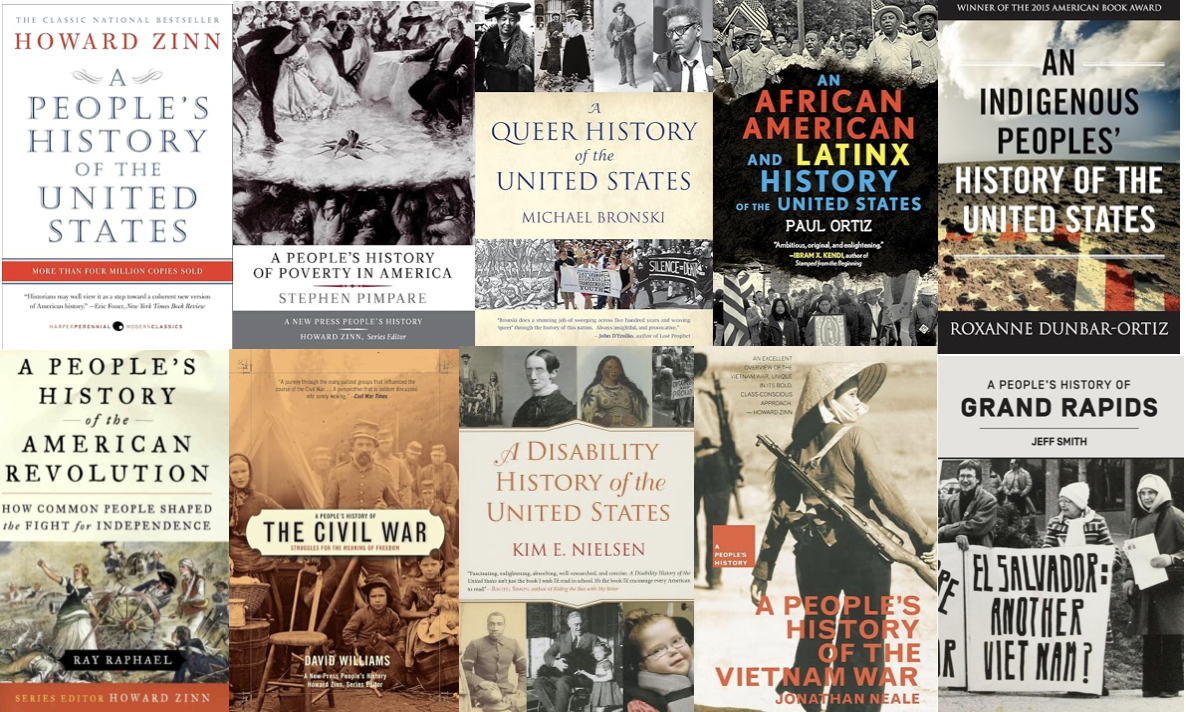
The 10 books listed above are an example of a people’s history of the US, which is in stark contrast to the narrative we all grew up with where some great white men won us our freedom. We are not told that the first Supreme Court Justice John Jay believed, “those who own the country ought to govern it.” Many of us have not been exposed to the well documented history of the US founding to demonstrate that is was based on genocidal policies of the US towards Indigenous people and the enslavement of African people.
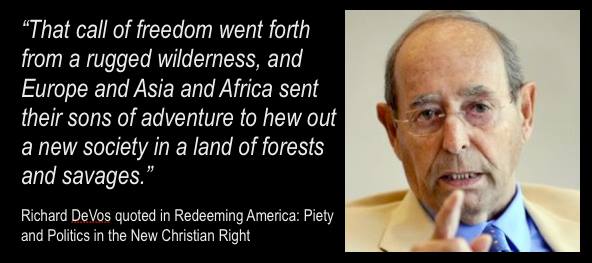
Most of us grew up with the vision of the founding of the US, one that Rich DeVos believed in, which says, “The call of freedom went forth from a rugged wilderness, and Europe and Asia and Africa sent their sons of adventure to hew out a new society in a land of forests and savages.”
Most of us were not exposed to the powerful speech that Frederick Douglass gave in 1952, What, To The Slave, Is The Fourth Of July? Douglass said in part:
What, to the American slave, is your Fourth of July? I answer: a day that reveals to him, more than all other days in the year, the gross injustice and cruelly to which he is the constant victim. To him, your celebration is a sham; your boasted liberty, an unholy license; your national greatness, swelling vanity; your sounds of rejoicing are empty and heartless; your denunciations of tyrants, brass fronted impudence; your shouts of liberty and equality, hollow mockery; your prayers and hymns, your sermons and thanksgivings, with all your religious parade, and solemnity, are, to him, mere bombast, fraud, deception, impiety, and hypocrisy—a thin veil to cover up crimes which would disgrace a nation of savages. There is not a nation on the earth guilty of practices, more shocking and bloody, than are the people of these United States, at this very hour.
For those of us in Grand Rapids we are influenced by the great white men here, like the DeVos family, with their names plastered on buildings across the city. In a recent issue of Doug DeVos’ online journal Believe!, he writes:
We make no apology for our patriotism. We believe this is the greatest country in human history, and that America’s example has uplifted the world. We also believe that every generation of Americans has done the hard work of better applying our national principles. Our people have continually forged a more perfect union, grounded in freedom, equality, and justice for all.
I ask you, how many people across the US or just in Grand Rapids have real freedom, equality or justice? Remember, the above statement is coming from a billionaire who has made his wealth off of the exploitation of others or by siphoning public funds.

Grand Rapidians are not generally taught about the about the 6,000 KKK members who who to town in 1925 for a parade on the 4th of July, where they had a GRPD escort and thousands of people lined the streets to cheer them on.
GRIID has been monitoring the DeVos-run GR A250 committee propaganda over the past year, where those with power in this city want to craft a very narrow narrative of this city’s history.

This is exactly why I wrote a People’s History of Grand Rapids in 2023, because I wanted to provide a counter-narrative. In the introduction of that book I write:
A People’s History of Grand Rapids is about what the Zapatistas, a revolutionary autonomous movement in Southern Mexico, refer to as: La Guerra en contra del Olvido, or in English, “The War Against Forgetting.”
The systems of power and oppression in Grand Rapids do not want us to know this history and will do whatever they can to suppress it or co-opt it. These same systems of power and oppression in Grand Rapids also want us to forget this history once we have learned it. They don’t want us to know that Grand Rapids was built on settler colonialism; they don’t want us to know that all the wealth in this city was created by laborers; they don’t want us to know that Grand Rapids practices a very sophisticated version of structural racism; and they certainly don’t want us to know that social movements and direct action – which disrupt their “business as usual” – have always been the most effective means of fighting oppression.
We cannot afford to forget this history and we need to continually create counter-narratives that celebrate the incredible work being done at the grassroots level. We need to celebrate the lived experiences of those on the ground and in the streets, and we need to center the voices of the most affected members of this community if we want to counter the narratives of the wealthiest and most privileged among us.


Comments are closed.