What a strange performative response from faith leaders and the Mayor of Grand Rapids: What solidarity really looks like
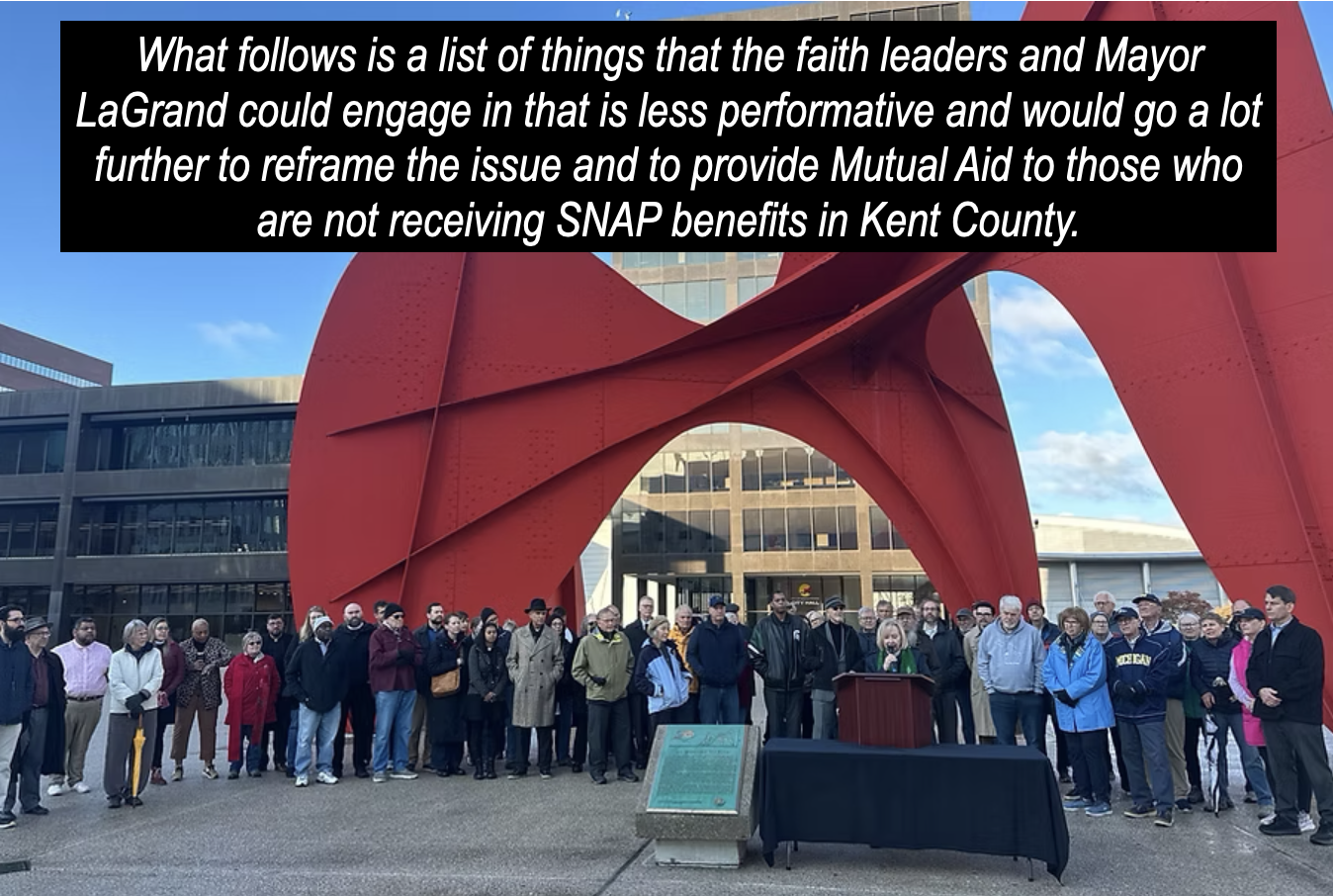
On Monday, several dozen “faith leaders” gathered at Calder Plaza to announce that they would begin a fast until SNAP benefits are restored to people around the country and the 70,000 residents in Kent County that rely on them.
An MLive article provided more details and quoted a few of the people who participated in the event at Calder Plaza, including Grand Rapids Mayor David LaGrand who was quoted as saying, “We cannot allow our neighbors to go hungry because of political gridlock.”
As a former Catholic I understand the role that fasting can play in building empathy and discipline for whatever issue or personal commitments you are seeking to strengthen. During the height of the Central American Solidarity Movement I went without food for 30 days to oppose US Military Aid to the Contras. The organized effort I was a part of in the 1980s engaged in regular actions against Congressman Paul Henry who consistently voted for US Military Aid to the Contras. However, my fast was only one tactic I used, but it did provide me focus to do the other work of direct action.
So, I don’t really think that faith leaders fasting until SNAP benefits are restored is a bad thing, but it is arguably the easiest thing to do and it is the least effective if your goal is to make sure that people who are food insecure don’t go hungry. What follows is a list of things that the faith leaders and Mayor LaGrand could engage in that is less performative and would go a lot further to reframe the issue and to provide Mutual Aid to those who are not receiving SNAP benefits in Kent County.
For faith leaders they should be using their position and their platform every Sunday to encourage people to not only donate food, but offer to transport food for people/families that rely on SNAP benefits.
Faith leaders could also turn the kitchens that more congregations have into a place where food in prepared and offered to people who are food insecure. Community Kitchen is something that congregations should be doing anyway, since it helps build community and connection with people who are being battered by Capitalism.
Faith leaders could also work with local food justice groups to turn much of the green space at GR places of worship that is primarily grass and use it for community gardens that would produce thousands of pounds of food. These same places of worship could offer their kitchen space for how to preserve items grown in these gardens, thus providing people with more skills that would be useful in working towards food justice and food sovereignty in Kent County.
Faith Leaders and Mayor LaGrand could be engaging in popular education and point out some crucial realities about what the government prioritizes over the well being of people who live in Kent County. First, they could put out a challenge to the two wealthiest families in Kent County, the Meijer Family (worth $16.5 billion) and the DeVos Family (worth $5.4 billion, according to Americans for Tax Fairness) and demand that each of these families give up $1 billion to fund not only robust food security programs, but assistance for skyrocketing rent and healthcare costs. This would leave both of these families with $15.5 and $4.4 billion left, which I assume they con continue to live off of.
Second, Mayor LaGrand and the faith leaders who stood on Calder Plaza on Monday could draw a direct link to how the federal government (and not just the Trump Administration) has always prioritized US military spending over the well being of those who live in this county. The US military budget is larger than the next 9 largest country military budgets combined. Having a vastly smaller US military budget would guarantee that there would be funds to make sure the millions of food insecure people living in the US would have enough food, health care, etc. From the 3rd Congressional District alone, taxpayers are paying $1.82 billion to the US military budget on an annual basis, according to the National Priorities Project. Imagine what kind of community care work could be done for people on an annual basis with $1.82 billion?
Third, faith leaders could pressure Grand Rapids City officials and Kent County officials around not providing massive tax breaks or subsidies to local developers for projects like the Amphitheater, the Soccer Stadium or the Three Towers Project (owned by DeVos and Van Andel) and prioritize public funds going to support families who are food insecure and housing insecure. The total amount of public funding that has been redirected by the Grand Rapids City Commission, the Kent County Commission and the State of Michigan is around $1 billion for the following projects: Amphitheater, Soccer Stadium, Three Towers Project and the Lyon Street upgrade project. Again, there it is not a question of funds being available for essential needs like food for families that rely on SNAP Benefits, rather it is a matter of priorities.
Fourth, local faith leaders could work on campaigns to get the City of Grand Rapids and Kent County to adopt Living Wage ordinances, which in this market would likely be about $40 an hour and allow individuals and families to have more economic independence and autonomy.
These are just a few ideas for how we can address short term and long term food insecurity issues, which are ultimately an economic issue where there is such a gap between the haves and have nots in this city and county.
 Grand Rapids Institute for Information Democracy
Comments are closed.