Where are we 5 years after the uprising in Grand Rapids in terms of defunding and abolishing the GRPD?
It has been five years since Grand Rapids had thousands of people in the streets as a response to the police murder of George Floyd, Breanna Taylor and other Black people over the past decade. All of that came to a head on late May of 2020, with some of the largest actions in US history that were demanding something beyond police reforms.
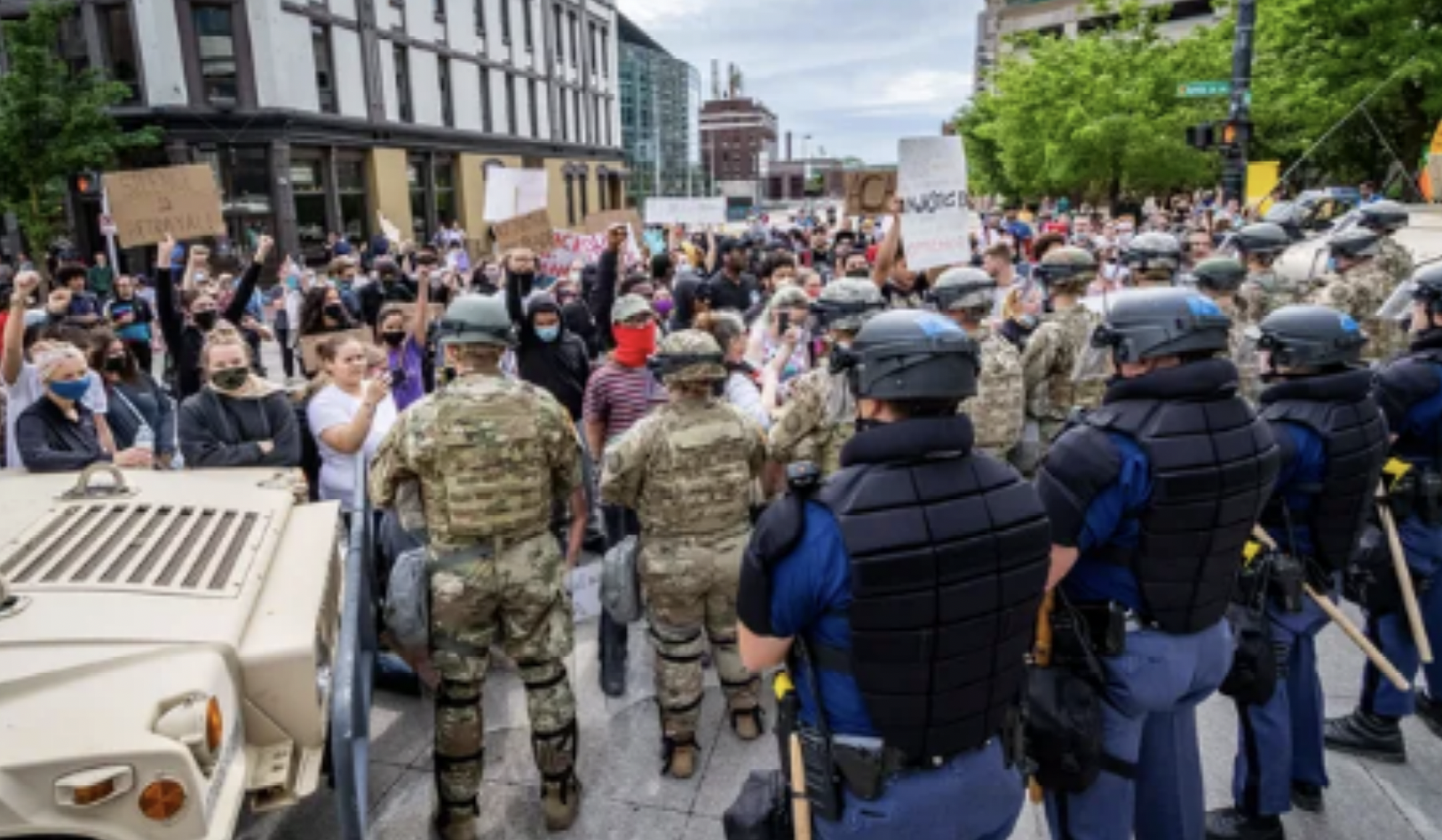
The uprising that took place on May 30th in 2020 was not planned, even though there were several marches planned that converged on Rosa Parks Circle that day. The convergence of people on that day resulted in a major confrontation between those in the streets and the GRPD and other local cops who came to their aid.

Most of the rage was directed at the cops, who sustained a great deal of damage, even the loss of a few cruisers. Unfortunately, most of the commercial news media focused on the smashing of windows and downtown and a small amount of looting, rather than give attention to how people took out their rage against the police that day.
From the very beginning, Grand Rapids City officials attempted to control the narrative about what happened on May 30th of 2020, but some of us have presented counter-narrative, like what I wrote.
The City of Grand Rapids responded with repressive actions, like a curfew for the downtown of Grand Rapids, plus they called in the Michigan National Guard, which turned downtown GR into an occupied military action. Plus, for the first week after the May 30th uprising, the local commercial news media also hijacked the narrative centered around cops killing Black people.
On the one year anniversary of the May 30th, 2020 uprising, I wrote that there were three main narratives that emerged in Grand Rapids, narratives that continue to be used. Those narratives are:
- Narrative #1 is the narrative of systems of power
- Narrative #2 is the narrative of liberalism and normalcy
- Narrative #3 is organized resistance and a call to Defund the GRPD
I also put together a visual depiction of how the GRPD has tried to control the narrative about public safety since the May 30th rebellion in Grand Rapids through November of 2020, which you can find here.
What else happened after the May 30th, 2020 uprising?
One of the frameworks of the national uprising after George Floyd was murdered by a cop came out of the Movement for Black Lives and Critical Resistance to call for the Defunding of the police and the eventual abolition of policing. These ideas had been around for decades, but after the uprisings of 2020, they became part of the national dialogue, as more and more people, were tired of the usual police reform promises that came from politicians and more mainstream civil rights groups.
The Movement for Black Lives created a Defund the Police Toolkit, which provided excellent resources for local communities to adopt this strategy. On June 26, 2020, Defund the GRPD held its first Press Conference, where they announced clear demands for defunding the Grand Rapids Police Department.

On July 8, 2020, after weeks of pressure from community groups to Defund the GRPD, 3 City Commissioners were set to propose defunding the GRPD to the 32% City Charter mandated minimum. However, the City Manager and the City Attorney stepped in and prevent such a vote, making the claim that the City Commission did not have the legal authority to do so. City Manager Mark Washington did say that they would revisit possible reduction in GRPD funding later that year.
July 29. 2020 – The City of Grand Rapids announced that there would be a new Strategic Plan for the GRPD in August, but the announcement made it clear that there is no way for the GRPD to reduce their funding, using recent gun violence as the main justification.
August 10, 2020 – New GRPD Strategic Plan placates those unaffected by police violence and ignores those calling for defunding.
September 24, 2020 – GRPD planned for another riot during a protest to honor Breonna Taylor in Grand Rapids.
November 17, 2020 – Defund the GRPD and other community groups stopped the efforts of the City of Grand Rapids to use Cares Act funding from Kent County to purchase ShotSpotter technology that the GRPD wanted.
December 2, 2020 – A member of the Grand Rapids Power Structure sends the City Commission a letter to oppose any defunding of the GRPD.
December 27 & 30, 2020 – The GRPD police union and supporters increased their efforts to oppose any sort of defunding of the GRPD, making it clear that the efforts of Defund the GRPD were a threat to their institutionalized power.

February 24, 2021 – GRPD Strategic Plan revisions claim that Grand Rapids, “will become the safest mid-sized city and most trusted police department in the United States.”
March 9, 2021 – Justice for Black Lives activists were targeted and arrested by the GRPD during a protest, showing how the GRPD engages in selective enforcement of local ordinances.
March 31, 2021 – GRPD rolls out their Operation Safe Neighborhood plan, which involved the use of helicopters terrorizing people in mostly Black and Brown neighborhoods. This so-called community policing approach, is nothing more than a re-packaging of what the GRPD has done for decades.
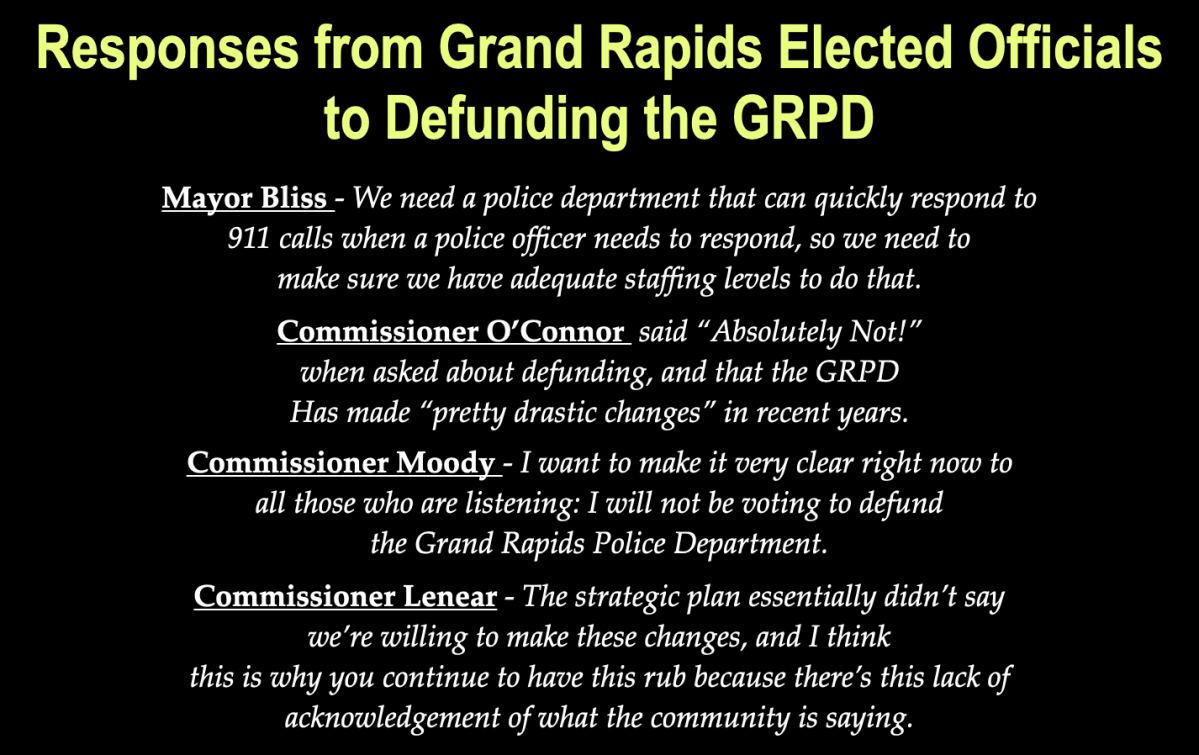
April 6, 2021 – Local news media talk to GR City Commissioners about the police budget, where they all pretty much oppose any defunding of the GRPD.
April 20, 2021 – Grand Rapids City Officials and the GRPD release a memo, which essentially threatens people who protest the upcoming Derrick Chauvin trial.
April 27, 2021 – Grand Rapids Police Officer’s Association says that the recent viral video of GRPD cops repeatedly punching a black motorists, is simply “fanning the flames of national outrage.
May 3, 2021 – Grand Rapids City Officials hold a 1 hour visual town hall to talk about the 2022 City Budget, which included the budget for the GRPD.
May 9, 2021 – GRPD arrests the wrong Black man who was on the way to a family funeral, but was charged with resisting arrest.
May 19, 2021 – City Commission hearing on 2022 Budget once again demonstrated how much contempt they have for public input, especially input that challenges their power.
Defund the GRPD did a lot of organizing around the 2022 City Budget proposal, which involved education on the budget, mobilizing people to come to the public hearing on the budget, sending electronic messages to Grand Rapids City Officials, organizing a demonstration with Justice for Black Lives to draw attention to continued police repression in Grand Rapids, and putting out their own list of demands for the 2022 Grand Rapids City Budget.
After Patrick Lyoya was murdered by the GRPD
Defund the GRPD and Justice for Blacks did the bulk of the organizing for 2 years around challenging the GRPD and building capacity for defunding the Grand Rapids Police Department.
Justice for Black Lives dissolved, but many people involved in that group created what became known as the Comrades Collective. DeFund the GRPD was still around, and engage in actions and other resistance work, but then Patrick Lyoya was murdered on April 4th of 2022, by a GRPD cop.
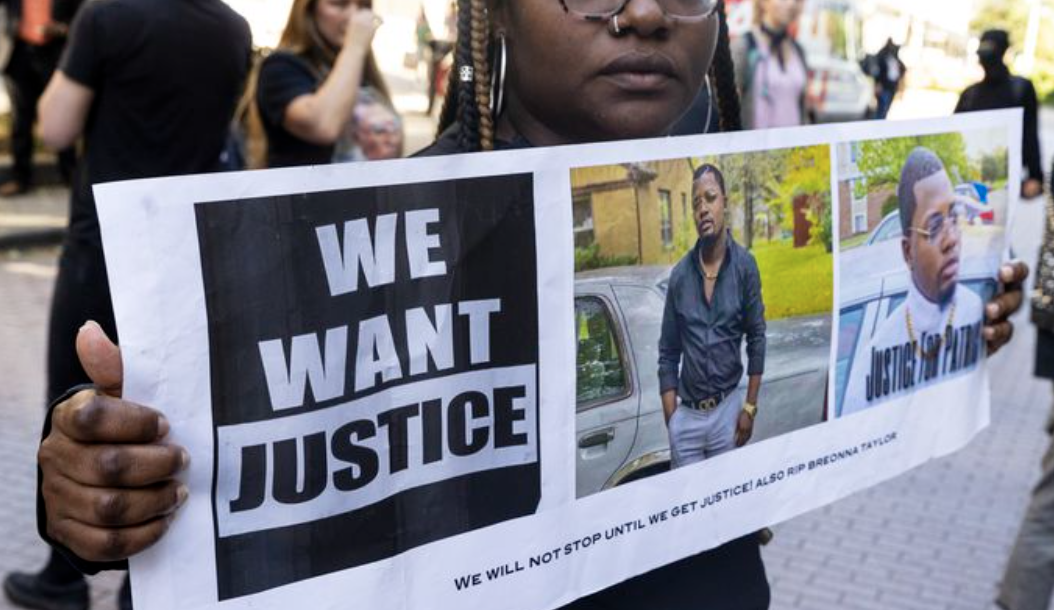
Within a couple of days after Patrick’s murder, the Grand Rapids Alliance Against Racist and Political Repression was formed. GRAARPR was formed out of the Freedom Road Socialist Organization, which is predominantly an ally group, which did not check in with the BIPOC-led groups Defund the GRPD and the Comrades Collective. This dynamic has created some tension and frustration within the organizing community and needs to be addressed.
People involved in Defund the GRPD, Justice for Black Lives and the Comrades Collective have faced significant repression at the hands of the GRPD over the past 5 years, and some of their members are still being targeted.
The number of people involved in working to defund and abolish policing in Grand Rapids has diminished for a variety of reasons, even after Patrick Lyoya was murdered by the GRPD. Some of those reasons are:
- BIPOC organizers that have been targeted have not be sufficiently supported, especially by those who identify as allies.
- There has been too much Respectability Politics injected into the larger movement, especially by politicians and mainstream civil rights groups that are more interested in police reforms and building so-called community trust with the GRPD than they are about defunding and abolishing the GRPD.
- When Chief Winstrom was hired in March of 2022, he made it a point to not only try to control the narrative about the GRPD, he adopted a no tolerance strategy that has seen the criminalization of dissent in Grand Rapids in the last three years.
- People put too much faith in the legal system, especially after Chris Schurr was charged with the killing Patrick Lyoya, Too many of us put hope in the outcome of the legal proceedings and the Schurr trial, when we should have at least been more suspicious of the outcome or never should have put any faith in a system that was never designed to actually bring about justice.

We have seen in recent months in Grand Rapids a clear pattern from the GRPD, with significant repression and no tolerance for any kind of protest. We need to move beyond simply protesting and start engaging in resistance work that doesn’t make it so easy for the GRPD to intimidate, harass, surveil and arrest people. We need to stop engaging in performative demonstrations that involve too many god damn speakers and no real revolutionary vision. If we want shit to change we are going to have to be strategic and willing to take risks.
 Grand Rapids Institute for Information Democracy
Trackbacks
Comments are closed.