Lessons on the history of US Immigration Policy #4: We will never solve immigration issues until we address root causes behind immigration
So far in this series on lessons on the history of US Immigration Policy, I have looked at the question – Is the US a Nation of Immigrants in Part I; how anti-immigration policies in the US are bipartisan in Part II; and the dominant narrative around how we talk about immigrants in Part III. Today, I want to look at the root causes of people migrating to the US, especially those coming from Latin America.
The bulk of undocumented immigrants that are crossing into the US every year are primarily Mexican, Central America and to a lesser degree, people from various Caribbean countries. Immigrants from the countries listed are coming to the US because of decades-long political violence, drug cartel and state violence, debilitating poverty that has been driven by de-valuing national currency, the displacement of people living off the land, and lastly, because of the growing ecological and social consequences of Climate Change.

Decades-long US sponsored counter-insurgency wars
In Aviva Chomsky’s book, Central America’s Forgotten History: Revolution, Violence, and the Roots of Migration, the author methodically documents how decades of US sponsored and funded counterinsurgency wars displaced millions of Central Americans beginning in the late 1970s. The consequences of these wars saw large a number of Central Americans fleeing to the US, which led to the US Sanctuary movement of the 1980s. During the peak of the US Central American Sanctuary Movement, there were 400 sanctuaries across the US, a movement that I was part of here in Grand Rapids.
The US government provided billions in military aid to Central America for more than a decade, along with military advisors and the training of soldiers from those countries at the infamous US Army School of the Americas at Fort Benning, Georgia. Rarely, is there an acknowledgement about how US military policies were a major reason for so many Central Americans leaving their country and ending up in the US seeking a better life.
By the mid-1990s, when the wars in Central America had ended, the US then began to impose Neoliberal economic policies on those countries. These Neoliberal economic policies further displaced people from the land, forced them to urban centers to work in so-called Free Trade Zones where they made low wages and often could not support their families.
This same dynamic was happening in countries like Haiti and Mexico, where Neoliberal economic policies imposed by the US radically altered the national economies and forced people into manufacturing jobs making products that were primarily for export.
With Mexico, this dynamic was further exasperated in 1994, when the US, Canada and Mexico signed the North American Free Trade Agreement (NAFTA). Mexican farmers were hot particularly hard because of NAFTA, which saw the US flood Mexico with cheap, subsidized corn, making it impossible for Mexican farmers to compete with US produced corn. See the report, Mexico’s Agriculture Crisis: How Free Trade, the United States and Transnational Corporations Made It Happen.
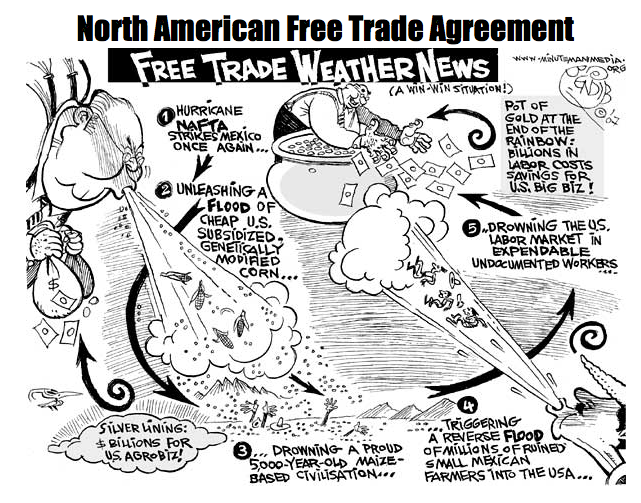
These trade policies and the imposition of Neoliberal economics on Mexico and Central America, forced millions over the past 25 years to flee debilitating poverty and find work in the US. Once in the US, immigrants continue to face economic exploitation, especially in the agricultural and food service sector. Still, the money that immigrants make in these sectors is enough to sustain them here in the US, plus it allows them to send money home to families still living in their countries of origin. The same kind of impact that NAFTA had on Mexicans, was repeated with the adoption of the Central American Free Trade Agreement (CAFTA). See the report, CAFTA’s Tragic Legacy in Central America: Failed Trade Policy That Drove Millions From Their Homes.
 Another consequence of decades of war and Neoliberal economic policies has been the rise of drug cartels in Latin America. Since the beginning of the 21st Century, the Mexican Drug Cartels have become even more violent and powerful, which has resulted in another kind of political violence in Mexico, plus the cartels have recruited thousands of Mexicans who have been impacted by NAFTA and Neoliberal economic policies to be part of the drug trade, often as mules. See Dawn Paley’s excellent book, Drug War Capitalism, on how these economic policies have impacted Mexico.
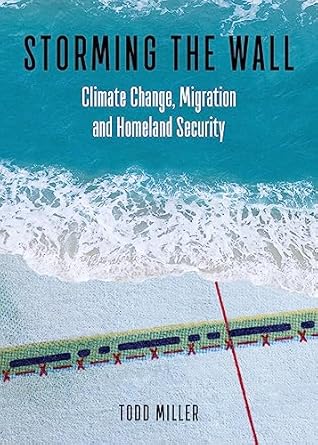
The last major contributor to displacement of people from Central American and Mexico, is the consequences of Climate Change. According to Todd Miller’s book, Storming the Wall: Climate Change, Migration, and Homeland Security, since 2008 there have been over 20 million people every year that have been displaced by Climate Change globally.
 We also know that the Global North, which includes the US, generates more carbon emissions and consumes more fossil fuels that those living in the Global South. However, Climate Change impacts those in the Global South, especially those who live closer to the equator, thus the US is also a major contributor to why so many people from Mexico and Central America are displaced from their country of origin.
The bottom line with all of this is, that until and unless we come to terms with the root causes of why people are coming into the US at the US/Mexican border, we will never had just immigration policies. The narrative that people should only come to the US through “proper channels” completely dismisses the root causes for people coming to the US, and it coldly denies the levels of desperation for people who are fleeing decades-long political violence, drug cartel and state violence, debilitating poverty that has been driven by de-valuing national currency, the displacement of people living off the land, and lastly, because of the growing ecological and social consequences of Climate Change.
For those who want to learn more about the history of US immigration policy, contact info@grrapiresponsetoice.org for information on workshops and presentations on this topic. Also, there is a scheduled presentation entitled, A People’s History of US Immigration Policy that will be held on Thursday, February 27, beginning at 6:30pm at Fountain Street Church. Details of that event can be found here.
 Grand Rapids Institute for Information Democracy
Trackbacks
Comments are closed.