Understanding the GR Power Structure – Part X: Why need need autonomous social movements if we want to challenge the local power structure
In Part I of this series I began an updated version of a Grand Rapids Power Analysis, which lays out the ground work for what the Grand Rapids Power Structure looks like and what it means for this community.
When I use the phrase, the Grand Rapids Power Structure and who has power, it is important to note that I mean power over. A local power analysis is designed to investigate who has power over – who oppresses, exploits and engages in policy that benefits them to the exclusion of everyone else – the majority of people living in Grand Rapids.
In Part II of this series on the Grand Rapids Power Structure, I looked at the DeVos family, which I argue is the most powerful family in this city, in terms of economics, politics, social and cultural dynamics. In Part III of this series I looked at some of the other families and individuals that also wield tremendous power in this city, economically, politically and socially. In today’s post I will focus on the private sector organizations that also have tremendous power and influence on daily life in Grand Rapids.
In Part IV, I focus on private sector organizations, many of which have individuals who are part of the Grand Rapids Power structure sitting on their boards. These private sector organizations serve a vital role in dictating local policy, which primarily benefits their own interests. Part V took a critical look at the role that the Grand Rapids City Commission and the Kent County Commission play in representing the interests of the private power sector, along with how they use fear and violence against residents who are actively challenging the local power structure.
In Part VI, I looked at how the major daily local news agencies normalize systems of oppression that protect and expand the Grand Rapids Power Structure. Then in Part VII, I discussed the role that local colleges and universities play when it comes to the Grand Rapids Power Structure. Part VIII focused on religious organizations in Grand Rapids and their relationship to the local power structure. In last week’s post, which was Part IX, I discussed the function of the Non-Profit Industrial Complex and how it primarily acts as a buffer in order to prevent people from organizing to challenge the Grand Rapids Power Structure and work towards collective liberation.
In today’s post, which will be the last in this series on the Grand Rapids Power Structure, I want to look at the existing grassroots and autonomous movements in this city over the past 5 years.
Reformism vs Systemic Change
There is a whole litany of groups working on issues from a reformist perspective in Grand Rapids. Many of these groups are advocating for electoral reform or supporting particular policies that could be adopted through the electoral process. While I think that voting can be a useful tactic in bringing about some form of social change, historically it has not created the kind of changes necessary for systemic and structural transformation.
Those who are part of autonomous movements and fighting for collective liberation are always confronted by those who think that electoral politics is where people need to put their energy. This happens during electoral cycles and it was in full effect during the 2020 election cycle and it is happening right now as we are less than 2 months before the November Election.
In addition to wanting autonomous movements to drop everything and get the “right” people elected, those who believe in electoral politics don’t want grassroots groups to criticize “their” candidates, and are often told to wait until after those candidates are in office. This is non-sensical logic, since the best time to pressure political candidates and political parties is before the elections. Once politicians are elected they are less interested in fighting for the issues that autonomous groups are organizing around.
Grand Rapids does have a rich history of people and movements being involved in direct action, the kind of action that challenges power. There are the examples of the 1911 Furniture Workers Strike, the Socialists who resisted during WWI in Grand Rapids, the Central American Solidarity Movement, the South African Anti-Apartheid Movement to the various forms of black resistance to White Supremacy over the years, as has been documented in Todd Robinson’s book, A City Within a City, and my book, A People’s History of Grand Rapids.
Since 2018, when I first wrote the ten-part series on the Grand Rapids Power Structure, I have annually been documenting social and autonomous movement work in Grand Rapids. From 2019 through 2023, I have provided an overview of the autonomous social movement work in Grand Rapids, which I will include here in chronological order.
2019 Social Movement work in Grand Rapids
2020 Social Movement work in Grand Rapids
2021 Social Movement work in Grand Rapids
2022 Social Movement work in Grand Rapids
2023 Social Movement work in Grand Rapids
I don’t want to rehash the work of all the autonomous groups in Grand Rapids during the past 4 years, which is why I have included these links. I highly encourage people to read all of the links, primarily because there has been a great deal of important work that has been done, along with the relationships that have been built and the collaborative dynamics that has happened.
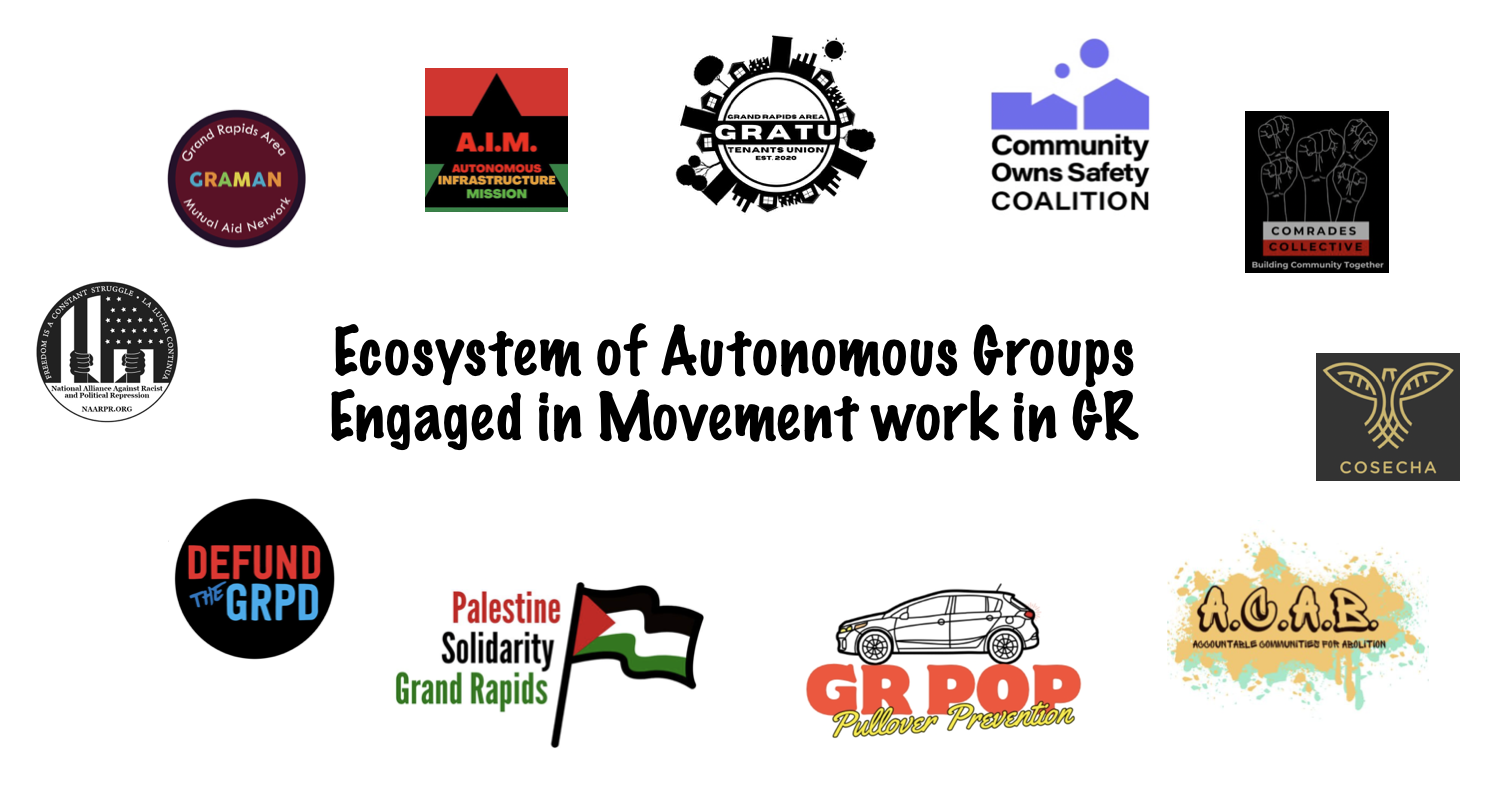
Right now, the groups included in the graphic above, are the primary autonomous groups doing movement-based organizing. It should be noted that there is also lots of less informal organizing that is taking place as well, even if there is no organization name attached to it. However, for the groups that are listed here, I would encourage people to get involved with them, as they are doing vitally important work, work that is not only issue based, but predicated on abolition, on building relationships, collaboration and working towards a world of collective liberation.
Lastly, I wanted to include some final thought about the power of social movements and what lessons I have learned about them over the years. The following comments are included in the epilogue of my book, A People’s History of Grand Rapids.
Lessons Learned from Social Movements
“Nobody in the world, nobody in history, has ever gotten their freedom by appealing to the moral sense of the people who were oppressing them.” Assata Shakur
Direct Action – taking collective action to change our circumstances, without handing our power to a middle person – elected officials, NGOs or political parties.
Horizontal organizing – organizing that is not hierarchical, that tries to build capacity for new “leadership” and believes that all roles in organizing should be shared.
Practices prefigurative politics – which means you want to practice the kinds of equity and relational organizing that doesn’t perpetuate racism, homophobia, ablism, etc., plus it means you want to practice what you preach. If you are organizing against homelessness, you need to practice radical hospitality and offer safe places for people to stay.
Mutual Aid – providing material, financial or emotional support to people who have a need, without perpetuating White Saviorism, policing of people or any other patronizing ways that non-profits often practice.
Abolitionist vision – to get to the root cause of systemic problems and abolish systems of power and oppression, as opposed to trying to “reform” them.
Radical Imagination – imagining that another world is possible, that we don’t have to settle for what systems of power and oppression give us. As the great Puerto Rican poet, Martin Espada once said, “No change for the good ever happens without it being imagined first, even if that change seems hopeless or impossible in the present.”
I wanted to end by saying that over the past four decades of being part of social movements and researching this two century history in Grand Rapids, that when injustice exists, there are always people who will rise up to fight it. I have also seen long lasting relationships blossom between people who have engaged in these struggles for liberation. While at times it may seem like we are not making the necessary changes to create more freedom and justice and equity, please know that you are part of a long standing tradition of fighting for collective liberation, even when we don’t see an immediate outcome.
People I have met in the struggle for justice want to win, but what I have witnessed is that when people engage in these struggles they are transformed because of the struggle. While I was in Chiapas, a young Mayan told me, “my people have not only endured 500 years of oppression, we have never lost sight of who we are as a people.” In the end, maybe that is enough.
“It is better to die on your feet fighting, than to live on your knees in submission.” Emiliano Zapata
 Grand Rapids Institute for Information Democracy
Trackbacks
Comments are closed.