Understanding the GR Power Structure – Part IX: The Non-Profit Industrial Complex in Grand Rapids
In Part I of this series I began an updated version of a Grand Rapids Power Analysis, which lays out the ground work for what the Grand Rapids Power Structure looks like and what it means for this community.
When I use the phrase, the Grand Rapids Power Structure and who has power, it is important to note that I mean power over. A local power analysis is designed to investigate who has power over – who oppresses, exploits and engages in policy that benefits them to the exclusion of everyone else – the majority of people living in Grand Rapids.
In Part II of this series on the Grand Rapids Power Structure, I looked at the DeVos family, which I argue is the most powerful family in this city, in terms of economics, politics, social and cultural dynamics. In Part III of this series I looked at some of the other families and individuals that also wield tremendous power in this city, economically, politically and socially. In today’s post I will focus on the private sector organizations that also have tremendous power and influence on daily life in Grand Rapids.
In Part IV, I focus on private sector organizations, many of which have individuals who are part of the Grand Rapids Power structure sitting on their boards. These private sector organizations serve a vital role in dictating local policy, which primarily benefits their own interests. Part V took a critical look at the role that the Grand Rapids City Commission and the Kent County Commission play in representing the interests of the private power sector, along with how they use fear and violence against residents who are actively challenging the local power structure.
In Part VI, I looked at how the major daily local news agencies normalize systems of oppression that protect and expand the Grand Rapids Power Structure. Then in Part VII, I discussed the role that local colleges and universities play when it comes to the Grand Rapids Power Structure. Part VIII focused on religious organizations in Grand Rapids and their relationship to the local power structure.
In today’s post I want to look at the function of the non-profit as it relates to the Grand Rapids Power Structure. First, I think it is important to state that not all non-profits are alike. Some non-profits genuinely make an effort to move beyond social services and education, even at times challenging systems of power. However, those non-profits are generally the exception and not the norm. Second, I understand that most non-profits do some form of “good”, which often translates into provided some support, relief or resources to those who are struggling.
However, regardless of the “good” that non-profits do or the support they provide to people, what they don’t do, or don’t do very often, is to challenge systems of power and oppression. In the chapter Social Service or Social Change, from the book, The Revolution will not be Funded: Beyond the Non-Profit Industrial Complex, Paul Kivel talks about the primary function of the non-profit, which is to act as a buffer for systems of power and oppression. Kivel identifies three ways in which the non-profits act as a buffer zone for the small percentage of people who control most of the wealth and political power.
- First, non-profits take care of those who are struggling economically. Take care of them primarily means offer services or resources.
- The second buffer zone function of non-profits is to keep hope alive, which translates into connecting individuals and families to opportunities in the community to improve their economic standing.
- The third function is to maintain a system of control. Non-profits do this consciously or unconsciously by discouraging people from getting organized and to make sure that they do not engage in socially disruptive acts.
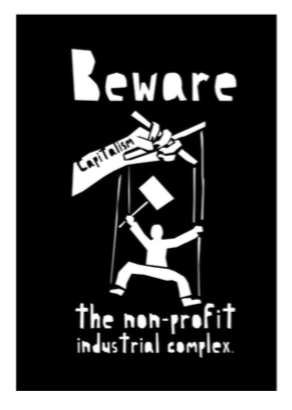 The Non-Profit Industrial Complex is a relationship between the Private Power, the State, foundations, the non-profit/NGO, social service agencies and sometimes social justice organizations. These relationships often result in the surveillance, control, derailment, and everyday management of political movements. The feminist group INCITE!, has identified the following ways in which non-profits function as it relates to private and state power.
- Monitor and control social justice movements;
- Divert public monies into private hands through foundations;
- Manage and control dissent in order to make the world safe for capitalism;
- Redirect activist energies into career-based modes of organizing instead of mass-based organizing capable of actually transforming society;
- Allow corporations to mask their exploitative and colonial work practices through “philanthropic” work;
- Encourage social movements to model themselves after capitalist structures rather than to challenge them.
In looking at non-profits in Grand Rapids and their relationship to private power, it is easy to see that these organizations rely heavily on the very foundations run by the wealthiest families who make up the Grand Rapids Power Structure, which we have been documenting here. These foundations channel millions of dollars to local non-profits, which results in; 1) the non-profits will not speak out about the power these families have in influencing public policy, and 2) the non-profits will not look at the root causes of the issues they are organized to respond to. In fact, the members of the Grand Rapids Power Structure, through their efforts to influence public policy, are part of the root cause of the issues that non-profits are responding to. The foundation money that goes to non-profits is what I call hush money.
Besides foundation funding to local non-profits, members of the Grand Rapids Power Structure, or their representatives, will often sit on the boards of directors of these non-profits. One example I reported on recently was the board of directors and the strategic partners that work with the non-profit Housing Kent.
I have spent lots of time writing about and engaging non-profits in a variety of ways, but let me give three examples of how non-profits have served those in power or remained silent about systems of power and oppression.
The first example has to do with silence. In 2017, it was reported that the non-profit group – Inner City Christian Federation (ICCF) – had received millions in funding from the DeVos family specifically to purchase dozens of properties in Grand Rapids. I asked three main questions of ICCF, questions I wrote about and questions I sent to them. I never got a response from ICCF to my questions.
A second example has to do with the group Kids Food Basket. I have written numerous article about this organization over the years, primarily about their failure to truly address food insecurity and hunger. Then in 2021, when a coalition of autonomous groups in Grand Rapids nominated them for being one of the worst non-profits in the area. In response, instead of choosing to do better or enter into a dialogue with these autonomous groups, Kids Food Basket had their lawyers send threatening letters to some of the BIPOC members of these autonomous groups. You can read about what happened in my article entitled, White Liberals, Kids Food Basket and the Non-Profit industrial Complex in Grand Rapids.
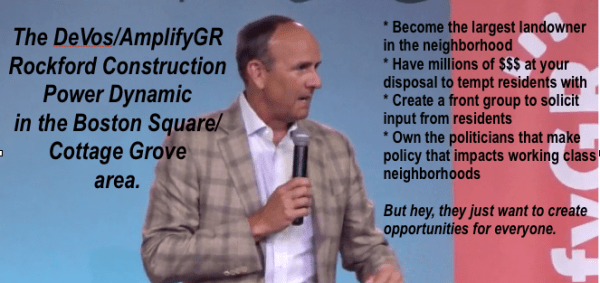
The final example I want to provide has to do with the non-profit group AmplifyGR. AmplifyGR is a non-profit that was created by the DeVos family, specifically with founding from the Doug and Marie DeVos Foundation in 2017. Many of the DeVos members also sit on the Board of Directors for AmplifyGR. In 2017, when there was an organized effort to question the role of AmplifyGR in the Southeast part of GR, specifically at several community forums in June and July of 2017, AmplifyGR decided to cancel any future community forums in order to prevent pushback from the community.
Non-profits do not have to act as buffers for systems of power and oppression, even if the way non-profits are structure limits their ability to work towards structural change. This is why I don’t have any expectations that non-profit work will lead to the dismantling of systems of power and oppression. We need local autonomous groups and movements, ones that don’t operate within the constraints of the non-profit industrial complex or within partisan politics. Autonomous groups and movements have the freedom to fight these systems and to create other possibilities, which can truly lead to collective liberation for those that the Grand Rapids Power Structure seeks to control.
In Part X, I will highlight some of these autonomous groups that exist in Grand Rapids and the work they have done that moves in the direction of collective liberation.


Trackbacks
Comments are closed.