Understanding the GR Power Structure – Part VIII: Religious Institutions as buffers against systemic change
 In Part I of this series I began an updated version of a Grand Rapids Power Analysis, which lays out the ground work for what the Grand Rapids Power Structure looks like and what it means for this community.
When I use the phrase, the Grand Rapids Power Structure and who has power, it is important to note that I mean power over. A local power analysis is designed to investigate who has power over – who oppresses, exploits and engages in policy that benefits them to the exclusion of everyone else – the majority of people living in Grand Rapids.
In Part II of this series on the Grand Rapids Power Structure, I looked at the DeVos family, which I argue is the most powerful family in this city, in terms of economics, politics, social and cultural dynamics. In Part III of this series I looked at some of the other families and individuals that also wield tremendous power in this city, economically, politically and socially. In today’s post I will focus on the private sector organizations that also have tremendous power and influence on daily life in Grand Rapids.
In Part IV, I focus on private sector organizations, many of which have individuals who are part of the Grand Rapids Power structure sitting on their boards. These private sector organizations serve a vital role in dictating local policy, which primarily benefits their own interests. Part V took a critical look at the role that the Grand Rapids City Commission and the Kent County Commission play in representing the interests of the private power sector, along with how they use fear and violence against residents who are actively challenging the local power structure.
In Part VI, I looked at how the major daily local news agencies normalize systems of oppression that protect and expand the Grand Rapids Power Structure. Then in Part VII, I discussed the role that local colleges and universities play when it comes to the Grand Rapids Power Structure. Today I want to talk about religious organizations in Grand Rapids and their relationship to the local power structure.
Historically, the three monotheistic religions of Christianity, Islam and Judaism have caused more harm than good. Christianity, especially since the Roman Empire adopted it in the 4th Century, has been the religion of empires, colonialism and settler colonialism. Sure there have been small enclaves of Christians that have adhered to a radical form of love, justice and mercy, but religious historians often refer to these groups as the faithful remnant. Since Christianity is the dominant religion in Grand Rapids, we will limit our analysis to that religion.
Grand Rapids is built on settler colonialism, with indigenous populations inhabiting this area for centuries, only to be forced or coerced into submission in the early part of the 19th Century. Various Protestant denominations and Catholicism have played a critical role in the formation of Grand Rapids, since those who have made up and continue to make up the local power structure identify as Christians. However, for the purpose of this article is to focus on how religious institutions, specifically Christianity, acts as a buffer against systemic change.
Grand Rapids is sometimes referred to as the City of Churches, with an estimated 800 churches. Hundreds of thousands of people in Grand Rapids belong to churches, yet very few of them take an active role in promoting systemic change. There are the ultra-conservative churches, which embraces and supports the concentrated wealth of a few over the many, but they are not the focus of this article. We want to look at the mainstream churches that ultimately acts as a buffer for the Grand Rapids Power Structure, rarely calling into question the systems of power and oppression that exist in this city.
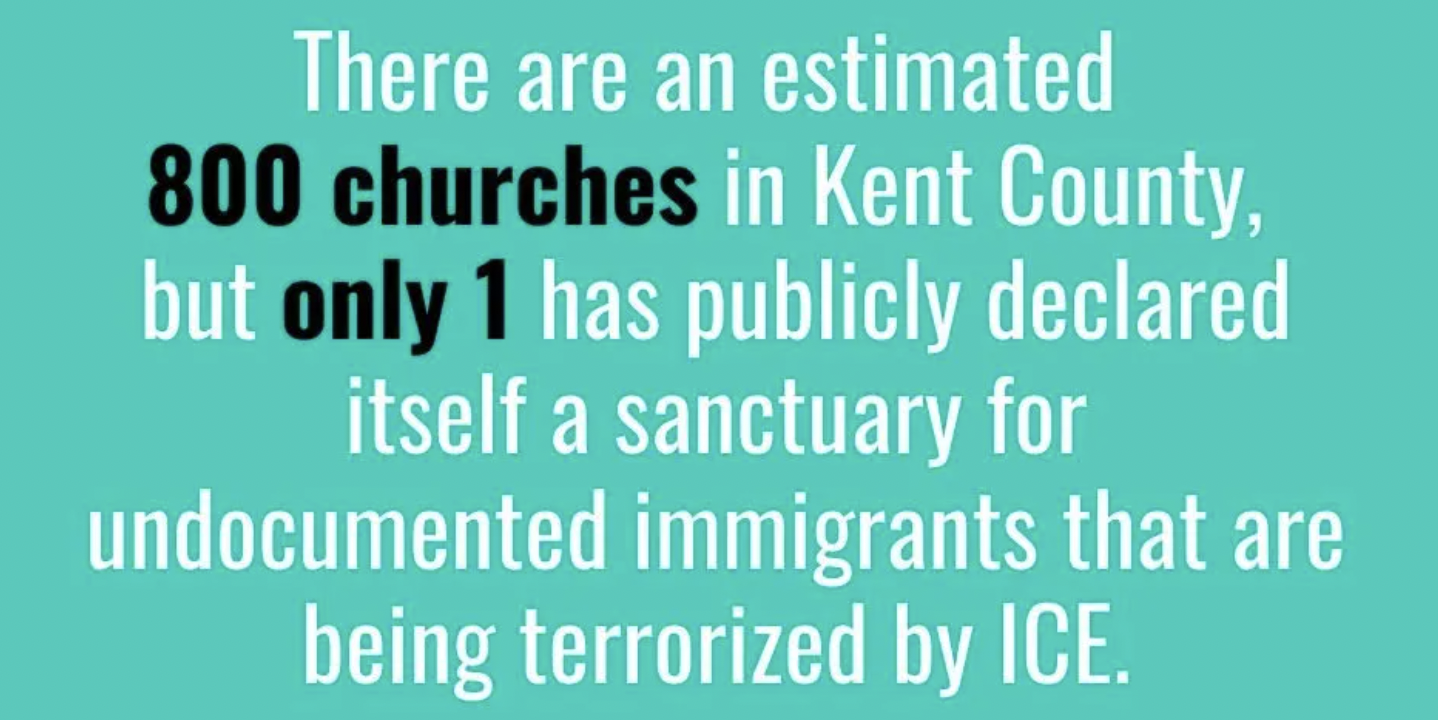
There are several ways that churches act as a buffer against systemic change in Grand Rapids. One of the most common ways, is to remain passive or distracted from the injustices that occur every day in this city. This is what Karl Marx meant by religion being the opiate of the people. In Grand Rapids, Christianity is certainly a distraction for thousands of Christians, so that they don’t have to even acknowledge the suffering, exploitation and oppression that exist in this community on a daily basis. For example, despite the tremendous anti-immigrant rhetoric in this city and the well-documented state violence against the undocumented community, there is only 1 church in this community that has publicly declared itself a sanctuary. Just one out of 800!
Other examples of the how churches are often complicit in systemic oppression and fail to speak out can be seen with the issue of policing and brutality against BIPOC people in this city. For years Black, Brown and Indigenous people have been trying to draw attention to the institutionalized policing of their communities, yet very few faith communities have gone public with condemning the GRPD. This silence was on full display with the GRPD murder of Patrick Lyoya in 2022, where the majority of the faith communities remained silent. There was a group of pastors that made a public statement and held a press conference some 2 months after Lyoya’s murder at the hands of the GRPD. Their statement is fairly strong, but there hasn’t been much activity or ongoing criticism of the GRPD in the past two years.
A Second way that churches act as a buffer against systemic change, are those churches that engage in various forums of charity. Now, I’m not saying that charity, in and of itself is a bad thing, but charity often doesn’t lead to people questioning the larger, systemic problems that lead to things like homelessness, hunger and poverty.  Charity is also an easy way to make yourself feel good without having to take any kind of risk that usually accompanies the dismantling of systems of oppression.
A Third way that churches act as a buffer against systemic change is to take on causes, without ever taking the necessary risks involved to challenge systems of oppression. Churches might be gay-friendly, but they do not challenge hetero-patriarchy that permeates the Grand Rapids Power Structure. Churches might try to practice being good stewards of the earth by recycling, but they rarely confront the fossil fuel industry or the economic system of capitalism, which is incompatible with environmental justice. Churches might promote some vague notion of peace, without ever taking the hard risks necessary to end war or white supremacy. Over the past year, how many churches have publicly condemned the Israeli genocide or taken an active role in resisting the unconditional US support of Israel, which includes providing weapons, some of which are manufactured here in West Michigan. Even Rep. Scholten, who goes out of her way to let us all know that her Christian faith is central to what she does, recently met with weapons contractors in West Michigan and said they promote peace.
A Fourth way that churches act as buffer against systemic change is to practice White Savior Politics. Churches often have good intentions in wanting to be good allies, but more often than not, they still think that they know what’s best for people experiencing poverty, those in the immigrant community or those in the black community. Good intentions are not only not enough, they often lead to “good people” doing real harm to those they seek to “help.” This is often the case with churches that focus on diversity, instead of racial justice. Diversity proponents rarely have a power analysis and believe that if we just treat each other with respect then we can all get along. Those who practice racial justice are those that recognize historical inequities, are willing to look closely at how they contribute to racial oppression and then develop relationships with communities of color to find out how they can best be in solidarity with them.
If churches in Grand Rapids were not acting as a buffer for the local power structure, what might that look like?
- Churches would demand the elimination of the wealth gap and practice economic justice, which cannot exist within capitalism.
- Churches would acknowledge that this community was founded on settler colonialism and ask the Native community what is required of them to undo settler colonialism.
- Churches would acknowledge that this city was built on and continues to practice White Supremacy. The churches would then ask communities of color what they need to do to not participate in White Supremacy, which is related to the wealth inequality and the need to pay reparations.
- Churches would stop practicing and condoning violence against women, violence against the LGBTQ community and practice inclusive and horizontal ways of sharing power.
- Churches would declare themselves a sanctuary and take in members of the immigrant community that are being targeted by ICE.
- Churches would not support the Prison Industrial Complex, would use their wealth to bail people out, would start seeing the police and the courts as instruments of oppression and work to end the criminalization of poverty and the war on drugs.
- Churches would stop defending US Imperialism and militarism, by demanding their members to not work for weapons manufacturers, to fight against the Military Industrial Complex, to not send their young members to war and to denounce nationalism.
These are just a few things that churches could do, which would surely scare the shit out of those who are part of the Grand Rapids Power Structure. Unfortunately, it is not likely that churches would even consider practicing justice to end systems of oppression. It is far easier for churches to act as a buffer in service of those who make up the Grand Rapids Power Structure. In Part IX, I will explore how non-profits organizations in this community also serve as a buffer for the Grand Rapids Power Structure.
 Grand Rapids Institute for Information Democracy
Trackbacks
Comments are closed.