Understanding the GR Power Structure – Part VI: The role of the local commercial news media
In Part I of this series I began an updated version of a Grand Rapids Power Analysis, which lays out the ground work for what the Grand Rapids Power Structure looks like and what it means for this community.
When I use the phrase, the Grand Rapids Power Structure and who has power, it is important to note that I mean power over. A local power analysis is designed to investigate who has power over – who oppresses, exploits and engages in policy that benefits them to the exclusion of everyone else – the majority of people living in Grand Rapids.
In Part II of this series on the Grand Rapids Power Structure, I looked at the DeVos family, which I argue is the most powerful family in this city, in terms of economics, politics, social and cultural dynamics.
In Part III of this series I looked at some of the other families and individuals that also wield tremendous power in this city, economically, politically and socially. In today’s post I will focus on the private sector organizations that also have tremendous power and influence on daily life in Grand Rapids.
In Part IV, I focus on private sector organizations, many of which have individuals who are part of the Grand Rapids Power structure sitting on their boards. These private sector organizations serve a vital role in dictating local policy, which primarily benefits their own interests.
Part V took a critical look at the role that the Grand Rapids City Commission and the Kent County Commission play in representing the interests of the private power sector, along with how they use fear and violence against residents who are actively challenging the local power structure.
Today, I want to talk about the role that the local commercial news media plays in normalizing systems of oppression that protect and expand the Grand Rapids Power Structure.
One significant misunderstanding about the media, specifically, the news media, is that it is often viewed through a liberal vs conservative lens. While there are nuances within various news media outlets, the main function of most news media is to serve and normalize power. The news media in the Greater Grand Rapids area also reflects this function.
In addition to serving and normalizing power, the local news media also serves the following functions:
- Consumerism
- Distraction
- Pacification
- Dumbing the public down
- Normalizing the values and perspectives of systems of power
Commercial news media functions within the framework of capitalism, which means that its primary objective is to make money. This is especially the case, since most local news media is owned by a much larger corporation. For example, WZZM 13 is owned by Gannett, MLive is owned by the Advanced Publications (Newhouse Brothers) and WXMI 17 is now owned by the Sinclair Broadcast Group. In fact, very little local news media is owned locally and none of the daily news entities parent companies are based in Grand Rapids. Since we last posted on the GR Power Structure in 2018, both MiBiz and the Grand Rapids Business Journal were bought up by the Detroit-based company Crain’s Communication, thus making the consolidation of local news media even more controlled.
Last month I posted an article about the methodical news media monitoring I have been doing since January 1st, particularly looking at critical issues such as policing, public education, climate justice and local democracy. The data is startling and is a reflection of the low quality of journalism that is being practiced in this community.
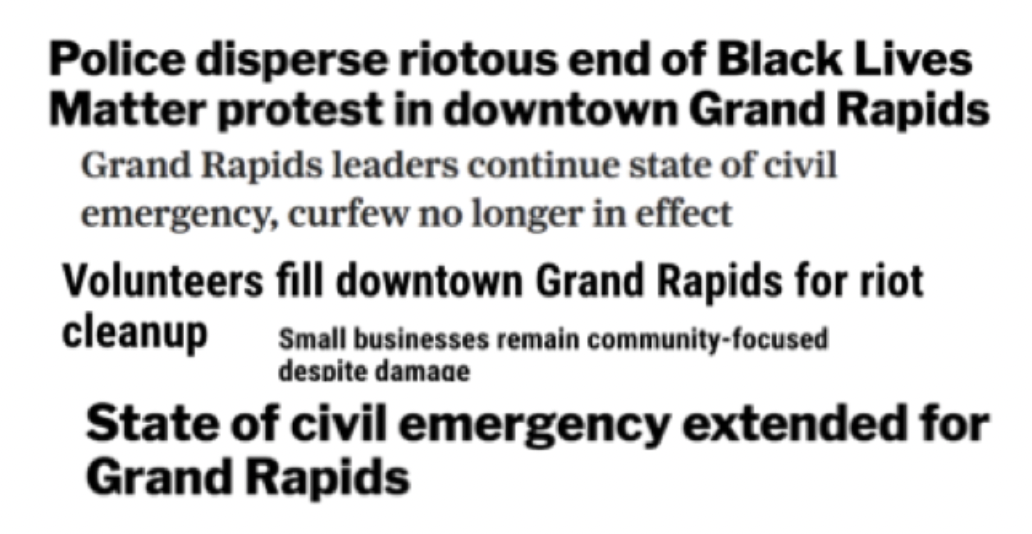
There are endless examples of how the local news media normalizes systems of oppression and defends the Grand Rapids Power Structure. One example is the local news coverage of the May 30th uprising that took place in Grand Rapids, including the 5 days after. Despite the fact that the the uprising included several thousand people in the streets, the local news media centered the perspectives of Grand Rapids City officials, the GRPD and downtown business owners.
A second example of how the local news media normalizes systems of oppression can be seen in the news coverage of the GRPD murder of Patrick Lyoya. GRIID has posted numerous stories that deconstruct how the local news has treated the GRPD murder of Patrick Lyoya, like a June 12th article about how the lawyers representing the killer cop want to control the narrative, how the local news coverage has been sympathetic towards the cop who killed Patrick Lyoya, clear examples of bias, and how the 2nd anniversary of Patrick Lyoya’s murder was reported.
A third example is how the local news reports on the current housing crisis, such as not adequately reporting on the un-affordability of housing in Grand Rapids, how the local news continues to present false solutions to the housing crisis and how the local news has made a GR Chamber of Commerce group the appointed experts on the housing crisis instead of talking to people who are actually most impacted by the housing crisis.
The last example(s) I want to share has to do with how the local news reports on development projects in downtown Grand Rapids and just how subservient the news is to those in the GR Power Structure. Here is a short list just in the past 6 months:
- Power Dynamics, community engagement and the Grand Action Soccer Stadium proposal
- MLive article doesn’t challenge the unelected, anti-democratic DDA Board, who also makes decisions on how millions in tax dollars are spent
- The end of the Richard & Helen DeVos Foundation – Part I: The news media’s subservience
- MLive’s Amphitheater coverage is a disgusting display of Neo-Liberal Journalism
- WZZM 13 provides a platform for the Destination Kent Committee to claim misinformation regarding August 6th Hotel Tax vote billboard
As long as the local news media choses to defend and protect the interests of the Grand Rapids Power Structure, it will mean that fewer people will be exposed to how this power structure functions and how much it controls. In Part VII, I’ll take a look at how local colleges and universities act as a buffer system for the Grand Rapids Power Structure.
 Grand Rapids Institute for Information Democracy
Trackbacks
Comments are closed.