News coverage of the proposed soccer stadium fails to ask the more important questions that will impact the public in Grand Rapids
On Friday, during the Grand Rapids-Kent County Convention/Arena Authority (CAA) meeting, the proposal to have a soccer stadium in downtown Grand Rapids became more formalized.
A Memorandum of Understanding (MOU) was agreed upon by the Grand Rapids-Kent County Convention/Arena Authority (CAA) and Grand Action 2.0. The MOU states in part:
That the CAA determines to enter a Third Memorandum of Understanding with GA2.0 for the purpose of reaching an agreement regarding the development, funding, construction, ownership, and operation of the Soccer Stadium, and the Chairperson of the Board is authorized and directed to execute said agreement, in a form approved as to substance by the Board Chair, and as to form by CAA legal counsel, contingent upon the CAA’s authority as set forth in the CAA’s Articles of Organization and Operating Agreement, as amended, and as may be amended.
To read the entire MOU between Grand Rapids-Kent County Convention/Arena Authority (CAA) and Grand Action 2.0, you can go here. (pages 33 – 38)
The major news entities that reported on the Friday Grand Rapids-Kent County Convention/Arena Authority were, MLive, WOODTV8 and Crain’s Grand Rapids.
The reporting is what we have come to expect from the local news media, especially when it has to do with major development projects like the outdoor amphitheater, and now the proposed soccer stadium, which is that local news agencies don’t even question what such a project means, who benefits and who will have to pay for it. Most of the local news coverage focuses on superficial details, like where the soccer stadium will be located. However, the Crain’s Grand Rapids article, there is a more honest comment from Doug Small, who is the president and CEO of Experience Grand Rapids. Small states:
“Any professional sport that we have here allows us to continue carrying on the Grand Rapids brand throughout the nation and the world, hopefully. It’s just another opportunity to get our name out there, so I’m excited for that. I think we’ve got a very robust soccer fan base here. It’s nice to see that the fanbase get rewarded with a team of the caliber they are looking to bring in here.”
However, the most important part of the Crain’s Grand Rapids article was this sentence, “Developing a soccer stadium has long been discussed by Grand Rapids officials as a way to drive economic development.” The question we need to be asking ourselves is, economic development for whom? In addition, we need to be asking questions like:
- How much public money will be used to support such a project and will the public have any say in the use of public money for a private project?
- Who will own the soccer stadium and the team, once all of this is in place?
- Why can’t the City of Grand Rapids adopt a model of community ownership, which would not only allow for potentially thousands of people to own shares in the stadium/team – which is a model that the Green Bay Packers use – or an ownership model where the City manages the soccer stadium/team, with an oversight board represented by people other than the usual suspects, and profits generated from the operation of the soccer stadium/team be used to support housing costs for families who are housing insecure.
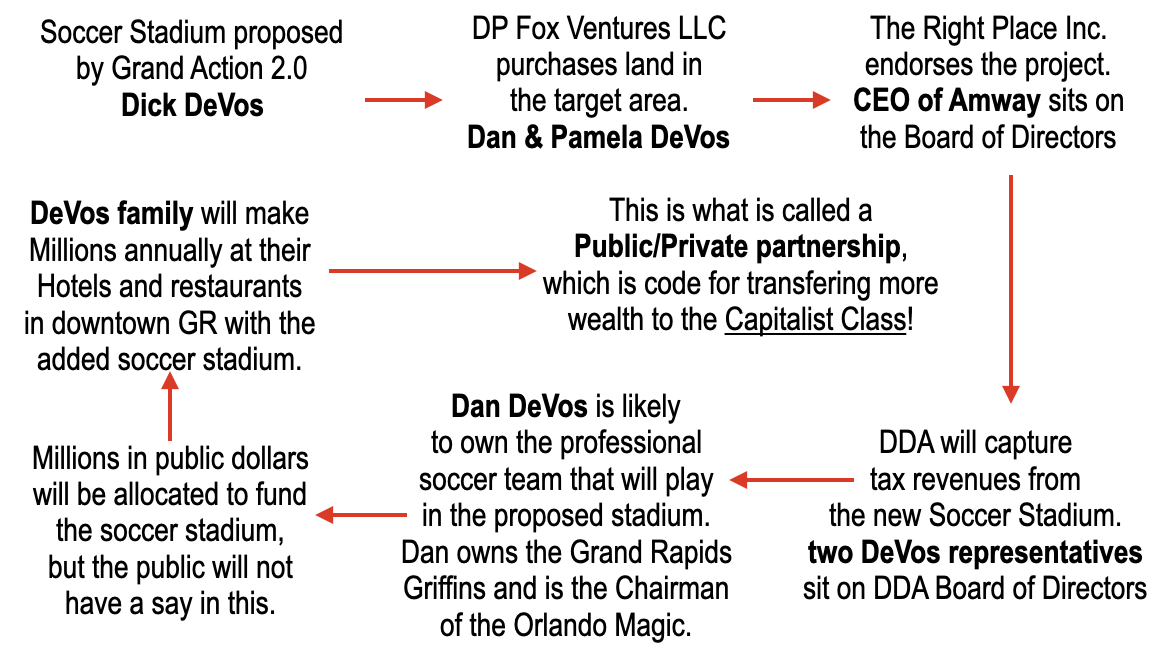
Unfortunately, we cannot rely on City or County officials to raise these kinds of questions or propose alternate models of ownership, or the idea that we don’t even need a soccer stadium and that truly affordable housing or other of the many pressing issues this city faces should be prioritized. Imagine what it would be like to live in a city where housing security, dismantling racism and promoting environmental just were prioritized over such things as the branding of Grand Rapids, promoting tourism and the transfer of public funds to members of the Grand Rapids Power Structure (reflected in the graphic above that GRIID created over a year ago.)
 Grand Rapids Institute for Information Democracy
Trackbacks
Comments are closed.