Indian Activist and AIM co-founder, Dennis Banks, Speaks to Overflow Crowd at GVSU
The six Native American drummers pounding out the traditional rhythm on one drum spanned several generations, one was a young girl, perhaps seven or eight years old. Part of President Obama’s speech commemorating National Native American Heritage Month was read aloud, “Native American voices have echoed through the mountains, valleys, and plains of our country for thousands of years, and it is now our time to listen.”

Like the message of the drums, the message Dennis Banks delivered will resound for generations to come. The Indian is strong—and that strength will continue the fight for justice in this land that was so unjustly taken from them.
Banks is one of the founders of the American Indian Movement, AIM. Grand Valley State University’s Loosemore auditorium was “standing room only” by the time the presentation began with a segment from the PBS television series, We Shall Remain. The segment revealed how, between 1878 and 1940, more than 100,000 Indian children were kidnapped from their families and forced to live at boarding schools. Dennis Banks, given name Nowa Comig, was forcibly torn from his mother and family at age five and taken to the Pipestone Boarding School.
“It was a social experiment to change the Indian child’s thinking, to destroy the Indian culture within the native child,” Banks said. “It was a bad experiment with a heavy toll. It failed, but we’re still here.”
Banks described the brutality that reigned within the schools. Upon arrival, children’s traditional braids were cut off; they were sprayed, naked, with DDT; then issued “white man’s” clothes and names. Beatings were common, especially for runaways, with other children enlisted to join in with sticks, clubs and brooms.
“There was deep pain when I witnessed the brutality,” Banks said. I screamed along with them,” Banks said.
The deeper pain was the disconnect Banks experienced with his mother and family—a disconnect which he was never able to overcome.
Much of the conversation Tuesday night told the rest of Banks’ life story: his successful stint in the Air Force; his many incarcerations; his times as a day laborer in the slums of Minneapolis, where Paddy wagons were sent to the bars on Friday nights and filled with Indians who would be forced, like slaves, to clean the streets and football stadium.

Wounded Knee 1973
Another segment of the PBS series was shown, this one documenting how in 1973 Dennis Banks and members of the American Indian Movement mounted an armed occupation of Wounded Knee, South Dakota, the site of the U.S. Calvary’s horrific massacre of 250 men, women and children in 1890. During AIM’s 1973 occupation, the Indians called for a review of treaties, restoration of the lands legally theirs and the removal of Dick Wilson, the corrupt tribal chairman of Pine Ridge reservation, known for violence and extortion. During Tuesday night’s event, not enough attention was spent on the US policy of Indian Removal or the specifics of the 1973 Occupation of Wounded Knee.
Event moderator, Levi Rickert, asked Banks if he thought AIM’s actions at Wounded Knee were too violent. Banks paused, took a breath and answered, “There comes a time when you’re up against a wall, taking beatings, and you’re just not going to take it any more.”
When an audience member asked what the Indian’s next fight would be, Banks answered “Water rights. We’re going to have to assert our water rights . . . in the west, Minnesota, the Midwest… we own a lot of water but states argue that the water belongs to them.”
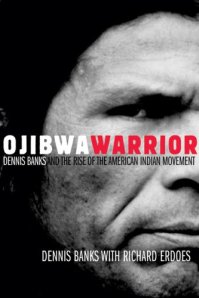
Banks went on to discuss how Indians’ fishing rights and control of oil on reservation lands has been likewise subverted by state and federal government. Banks concluded the evening by saying that, even though ignored by the doctrines of Manifest Destiny and Christianity, and subjected to U.S. brutality for the past 233 years, “Native people have had an impact on this continent for thousands of years.”
As the drummers came back on stage to close the event with ceremony, accompanied by Native singers, Banks joined the circle.
As Obama said, “ . . . it is now our time to listen.”
The question is, will we?
 Grand Rapids Institute for Information Democracy
It was an awesome conversation with Dennis Banks.
Of Indians still living and not locked up. Dennis Banks delivers the
best message. Lakota in Ohio