Labor organizing in Grand Rapids from after the 1911 furniture workers strike to the early 1950s
(This article is an excerpt from chapter 3 of my book, A People’s History of Grand Rapids)
Just one month after the 1911 furniture strike ended, Grand Rapids held its largest ever Labor Day parade, with some 10,000 people marching. The City of Grand Rapids had a population of 120,000 people in 1911, which meant that nearly 10% of the population participated. The strike raised an overarching support for workers and their grievances.
The 1911 furniture workers strike was perceived by the furniture barons and other members of the local power structure as a serious threat. Those with a great deal to lose at the hands of striking workers took other steps to protect their interests. And they did not forget that Mayor Ellis had denied them permits for a private army.
The City of Grand Rapids was made up of 12 political wards in 1911, with many of the wards dominated by certain ethnic groups – Polish, Dutch, German, Italian, etc. Most of the ethnic groups – and many of the wards – supported the furniture workers strike.
In order to hold power, in 1916 the furniture barons and their political cronies decided to change the Grand Rapids City Charter to do two things:
- Gerrymander and reduce the diversity of the political wards, down from a 12-ward system to a 3-ward system, with 2 representatives for each ward. This would give immigrant and ethnic groups, who were also predominantly working class, less say in local government.
- Eliminate a strong mayor and make future mayors into glorified city commissioners with only one vote. The balance of power shifted to the non-elected city manager position.
For a more detailed investigation of the 1911 furniture workers strike and the 1916 City Charter change, see Jeffrey Kleiman’s book, Strike! How the Furniture Workers Strike of 1911 Changed Grand Rapids.
Post-Depression Labor Organizing
When cops or other servants of the auto industry would attempt to enter the Flint GM factory, workers would throw auto parts at them from open windows above.
-Paraphrased from The Labor Wars, Sidney Lens
It is not said often enough: when people engage in direct action, it not only can get immediate results; it can inspire others to take similar action. When word spreads of the courageous acts of others, it creates cultural space for people to realize their own power to organize. This realization became more apparent to many working-class people after the Great Depression in the fallout of people questioning the flaws of the economic system of capitalism. Workers and their networks began to think about multiple ways to organize themselves using direct action as a major tactic.
One powerful example of direct action from the 20th century in Michigan was the 1936-37 Flint Wildcat Strike, just over 100 miles east of Grand Rapids. Several conditions laid the groundwork for an uprising in the Flint plant.
The auto industry was booming and pushing its workforce to crank out more and more vehicles in fewer hours. The pace of production at auto plants across the state in 1936 was taking its toll on workers, to the point that it caused the spouses of auto workers to speak up. One woman said, “They’re not men anymore if you know what I mean. They’re not men. My husband, he’s only thirty, but to look at him you’d think he was fifty and all played out.”
1936 saw a harsh summer heat wave: for a period in July temperatures were over 100 degrees for a week straight. The heat, combined with the work pace, resulted in hundreds of auto workers being hospitalized; several died from heat exhaustion. Yet wages in the auto industry declined from the late 1920’s through 1936. Finally, the Pinkerton Detectives, privately hired and notorious union-busting bullies, had infiltrated many of the traditional unions, especially the American Federation of Labor (AFL).
The United Auto Workers (UAW) was relatively young in 1936, so they hadn’t yet succumbed to bureaucratic dynamics. Responding to oppressive working conditions, low wages, and greedy industrial bosses, auto workers at a GM factory in Flint engaged in a wildcat strike, also known as a sit-down strike. Instead of leaving the plant and picketing outside, workers stopped working right in the middle of production, then occupied the factory and in effect took control of the building.
The wildcat strike lasted over a month, from December 30, 1936, through February 11, 1937. The owners of GM were not going to make it easy for the striking auto workers. Local cops, anti-union intimidators, and national guardsmen were all used to try to squelch the labor uprising. There are dozens of accounts of physical confrontation between striking workers and those acting on behalf of the capitalists. When cops or other servants of the auto industry would attempt to enter the factory, workers would throw auto parts at them from open windows above.
The sit-down strike had a mobilizing effect. The people of Flint rallied to support the auto workers and after 6 weeks they won numerous demands, including better wages, the right to organize, and improved working conditions. The workers also won the respect of people across the country. The UAW sit-down strike provided an opportunity for workers around the US to follow the example of Flint and demand their own rights, even in Grand Rapids.
Pushing Grand Rapids Left
Still reeling from their defeat during the 1911 furniture workers strike, Grand Rapids unions were not effectively mobilized to respond to the growing power of industrial capitalists. However, the insurgent labor organizing by the UAW and the CIO provided new inspiration and new opportunities for workers to challenge the business community in Grand Rapids.
In the Spring of 1937, the UAW called for strikes at the Robert Irwin Co., the Macey Co., and Irwin Seating, all based in Grand Rapids, which involved roughly 1,000 workers over a five-week period. In September of that same year, more strikes would break out at the Furniture Shops of America, John Widdicomb, Grand Rapids Chair, and other furniture factories in the area. In each of these instances the union won a closed shop contract guaranteeing to hire only union workers. The unions also won a check-off procedure, meaning union dues would be automatically deducted from the pay of authorizing employees, and, perhaps the cause of the most celebration to many of the workers, they won wage increases.
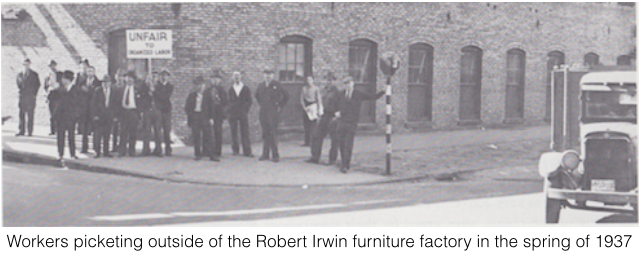
After a failed attempt to organize a union at the Kelvinator refrigerator and domestic appliances plant, the UAW tried again in 1937 and won their first contract, which included the recognition of the union and wage increases. Known as Local 206, this UAW organizing effort became a model for many of the other labor organizing efforts across the city of Grand Rapids. In some cases, workers defied local courts’ anti-picketing injunctions, and many workers went to jail for brief periods in order to win labor contracts and build worker power from the ground up.
While most of the labor organizing in Grand Rapids involved walk-out strikes and picketing that made significant gains, workers at the Atwood Brass Works held a wildcat strike and factory occupation that lasted for three days, following Flint’s example.
The radical direct-action efforts of the workers in Flint scared the business community enough to be willing to negotiate with angry workers in Grand Rapids out of fear that a wildcat strike might break out here. When people engage in radical direct action it pushes everything to the left. Workers in Grand Rapids were able to seize the moment created by the wildcat strike in Flint and mobilize workers (that had been labeled as “not radical enough” and “conservative”) to demand their rights and to unionize several thousand workers over the next several decades.
After the UAW and the CIO began organizing in Grand Rapids, union membership grew significantly. Yet union leadership at the national level made a deal with business leaders and the Roosevelt administration. The result was that the unions agreed to not strike while the US was involved in World War II.
Despite the no-strike pledge, union membership in the US grew from 7.2 million in 1940 to 14.5 million at the end of WWII. The strikes began almost the moment that the bombs stopped dropping on Japan. In September 1945, 43,000 petroleum workers and 200,000 coal workers went on strike. In October, 44,000 lumber workers, 70,000 teamsters, and 40,000 machinists joined them. Then in November 1945, the UAW called its first major strike against GM since the company was unionized in 1937. Nearly a quarter of a million men walked out. Grand Rapids saw the same dynamic: workers who experienced years of frustrations during the no-strike pledge of WWII began to challenge the capitalist class by engaging in walkouts and strikes. In 1946, workers at the UAW Local 730 at the GM plant in Wyoming, Michigan were part of the national UAW strike that lasted for 113 days. The UAW striking workers were fighting for better wages, pensions, and improved working conditions, all of which were denied them during the no-strike pledge of WWII.
With the growing labor unrest and increased militancy of workers in the US, the capitalist class decided to fight back. In 1947, in response to the growing influence of labor unions, Congress passed the Taft-Hartley Act. It prohibited jurisdictional strikes (strikes over work assignments and who has the right to assign them), secondary boycotts (boycotting businesses associated with the primary target), and “common sit-ins,” as well as picketing and closed shops (union-only workers). The law became known as the “slave-labor bill” in (mostly white) union circles.
The Taft-Hartley Act was not the only tool that business owners used to undermine unions after WWII. There was a growing interest to attack and expose those connected to the Communist Party, as well as anyone who embraced more radical ideals. This political tactic led to what became known as “red-baiting” and eventually McCarthyism.
Communism became the new boogeyman, an attitude ushered in by the Cold War with the Soviet Union. Many people know about the blacklisting that took place with actors, directors, and script writers in Hollywood, but less is known about the purges that took place in organized labor. According to Michael Johnston’s Non-Union Grand Rapids, Grand Rapids unions also participated in the “red scare.”
The earliest doctrinal battles of the Cold War years were fought out in Grand Rapids, beginning in late June of 1946. Fred Bonine, president of UFWA Local 415, joined with other locals from around the country in issuing a national resolution calling upon locals across the country to ‘divorce’ themselves from the “communist wing of their union.
Bonine led his local out of the CIO and into the Upholsters of the AFL. As one of the largest unions in the area, and one of the largest unions in the entire UFWA, this Cold War red baiting and raising took on national significance.
The Kent County CIO Industrial Union Council was caught in the middle. In spite of the reputation as a conservative city, the CIO Industrial Union Council urged the local to “remain in the CIO to fight the reds.
Johnston goes on to write:
The UAW used the red scare to raid the American Seating Company unit of UFWA Local 415. It began a protracted, bitter campaign to decertify the Communist influenced union. After two NLRB elections, the UAW finally ousted the furniture workers replacing it with UAW Local 135, chartered March 14, 1949. The UAW also raided the UE local at the York Band Instrument Company chartering a local there on January 19, 1950.”
It was clear that the business class would use any means necessary to undermine the militancy of organized workers, both through legislation and by questioning their loyalty to the nation. This post-war period of Grand Rapids and US history was the beginning of the decline of unions and organized labor, a decline that continues to this day.


Comments are closed.