Grand Rapids community members overwhelmingly support a ban on Flock cameras and support for the Cosecha six sanctuary policies
There were several communications listed in the agenda packet for the Grand Rapids City Commission meeting that were specific to the issue of the GRPD’s use of Flock cameras.
Some people attempted to speak to the issue of the GRPD’s use of Flock cameras in Grand Rapids during the first public comment period. However, Mayor LaGrand interrupted one of the people who was using this public comment period to speak about Flock, stating that it was not on the agenda.
The Mayor clarified that communications and petitions are NOT part of the agenda. Ok, so why did the Mayor then allow the preacher talk about abortion for most of his three minutes, just because he mentioned Cure Violence in his introductory comments? This was clearly a double standard, not just because it would be obvious to any reasonable person, but it was painfully clear to people in the room who bristled by the blatant double standard.
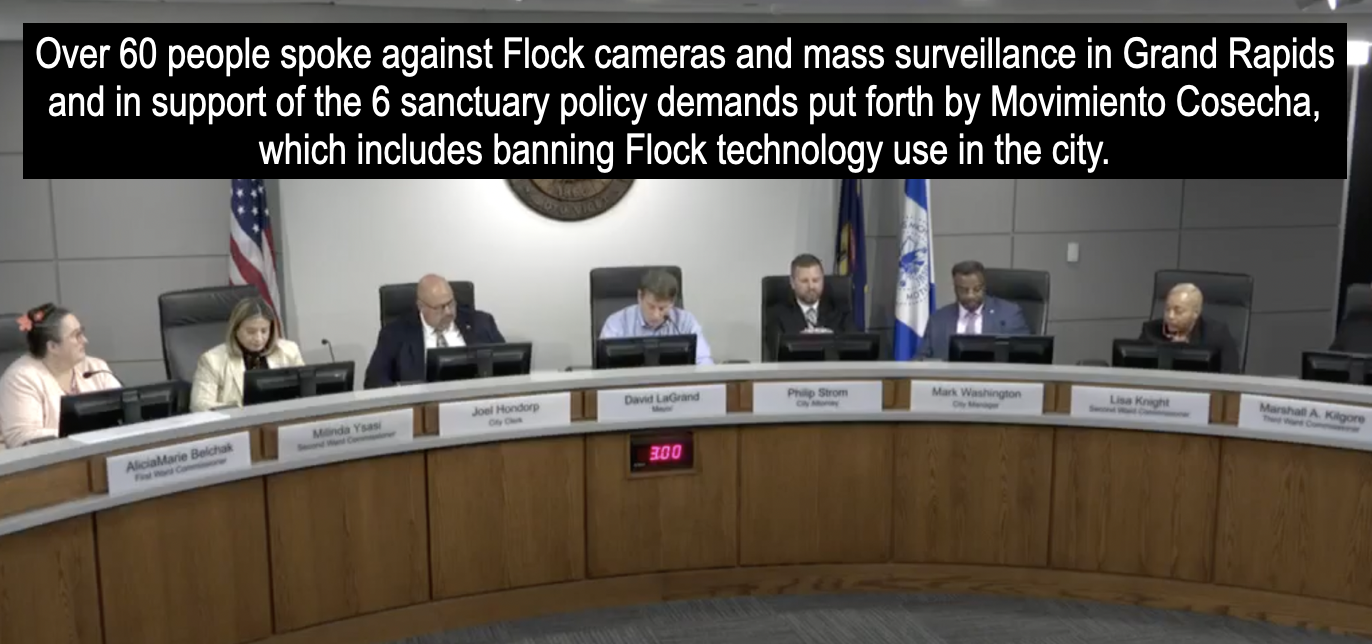
There were a number of people who spoke on banning Flock and/or Cosecha sanctuary policies throughout the night. Here are some of the themes that stood out:
- Flock cameras in MLK Park, in front of a food pantry, in the direction of apartment complexes, even near a domestic violence safe house.
- Flock camera outside a supermercado on West Leonard, while there are no Flock cameras in front of Aldi or Meijer at Knapps Corner, thus reflecting both a class and race bias.
- Flock says they have a contract with the City/GRPD and that they don’t own the information, yet Flock makes it clear in their contract and their narrative about their freedom to use the data that Flock cameras collect in whatever way they chose to.
- There were many more compelling arguments around Flock cameras being a 4th Amendment violation and other legal and Constitutional violations as well. People did their homework and provided a deep understanding of what Flock cameras are and why the city must end the contract with Flock and not use similar technology in the future.
A total of 61 people spoke against Flock cameras in Grand Rapids and most of them also voiced support for the six sanctuary policy demands put forth by Movimiento Cosecha and GR Rapid Response to ICE. No one spoke in support of Flock and no one spoke against the sanctuary policy demands if you watch the video from last night’s city commission meeting.
Afterwards several commissioners had brief comments, but once again Mayor LaGrand spoke the longest, nearly 10 minutes. The first thing that LaGrand said was against the Cosecha-led sanctuary policies, where he directed people to the OPA website, which has a list under the heading – Immigration Status and City Services. I will list them, with a response to some of them in bold.
The City does not operate a detention facility or jail. Kent County operates the county jail. The Trump Administration has been pushing detention centers in abandoned warehouses and GR has several of those. Cosecha is demanding that the City adopt a policy to never allow vacate buildings/warehouses to be used as detention centers.
The City does not have a 287(g) agreement with U.S. Immigration and Customs Enforcement (ICE). The City currently does not, but the Cosecha demand is to adopt a policy that says Grand Rapids will never sign a 287(g) agreement with ICE.
The City does not enforce immigration detainers. This is true, but Kent County does. When the GRPD arrests immigrants for non-violent offenses they end up in the county jail and then the Sheriff’s Office holds them for ICE.
GRPD is prohibited from conducting investigations or making arrests based solely on a person’s immigration status.
GRPD’s Foreign Nationals Policy prohibits collaboration with ICE on investigations. The GRPD’s Foreign Nationals Policy does provide language that says, “The policy allows officers to provide assistance to federal immigration authorities when there is an emergency that poses an immediate danger to public safety or federal agents.” In addition, Cosecha and GR Rapid Response to ICE have first hand accounts and photo evidence of GRPD assisting ICE during ICE arrests.
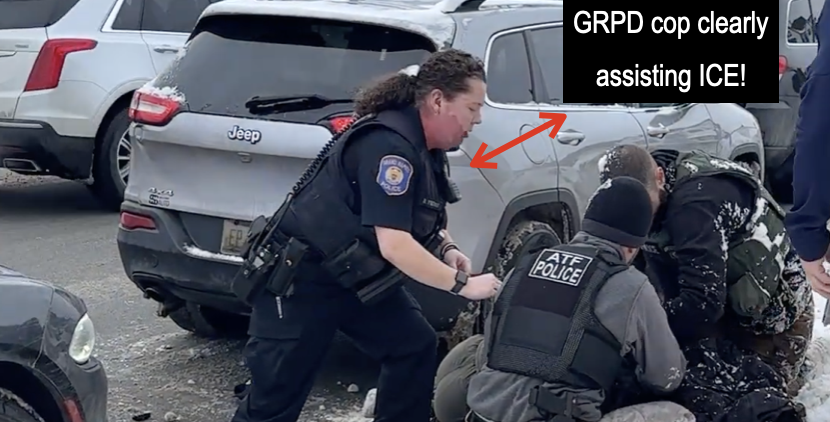
LaGrand then addressed the Flock surveillance issue and acknowledged that people had some thoughtful comments. He also named people who spoke, which I think is problematic. He also said a lot of other things, but made no real point(s), except that this issue will need more time and more conversation, which is a way of saying that city officials need to figure out ways to deal with public scrutiny over Flock and other forms of government surveillance technologies. This was evident during the Public Safety Committee meeting earlier on Tuesday, where elected officials didn’t seem to even know where the Flock cameras are in Grand Rapids, which GRIID posted over a year ago.
The city does not move quickly on anything when there is significant community pushback on critical issues, like mass surveillance. Everyone who spoke tonight should dig in for the long haul and think about campaign strategies and tactics to oppose Flock cameras in Grand Rapids and resisting the GRPD’s collaboration with ICE.


Trackbacks
Comments are closed.