A representative from Flock technology will speak at the Public Safety Committee meeting on Tuesday, but the ACLU was denied the same opportunity
Around the country, momentum is growing against Flock cameras. People are disabling these cameras in their communities—for example, someone sawed off and removed every Flock license plate reader operated by the Winona Police Department. This is laudable, civic-minded activity.
GRIID has been writing about the Flock cameras in Kent County and Grand Rapids since last year, primarily because it has been one of the demands of Cosecha and GR Rapid Response to the City and the County to not share Flock camera images with ICE.
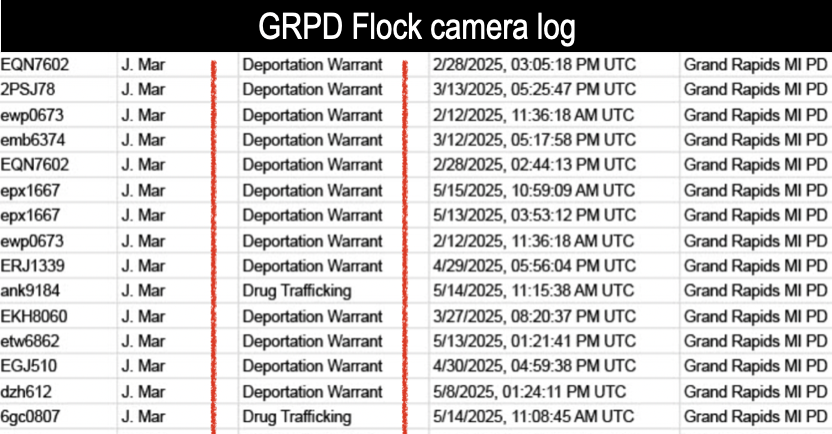
GRIID did an initial article in June of 2025, followed by a map of the then known Flock camera locations 10 days later.
In December of 2025 Mayor LaGrand said that Flock cameras being used in Grand Rapids have an off switch that doesn’t allow ICE agents to access the images from the cameras. Then in May of 2026, the Mayor made the claim that the GRPD does not share Flock camera images with ICE, even though there are GRPD logs showing immigration specific designations. (shown above)
Flock and the Grand Rapids City Commission
This Tuesday, Flock cameras are taking center stage as they will be discussed during the Public Safety Committee Meeting at 12:30 on the 9th floor at City Hall, then an anti-Flock camera rally at 5:30pm before the City Commission meeting on Calder Plaza.
There are several groups involved in promoting all of this, but there are also groups that are taking a more pro-police position, such as the Grand Rapids Chamber of Commerce. In a recent post the GR Chamber wrote:
“City Manager Mark Washington announced that during the next Public Safety Commission on August 25 city officials will present on their use of Flock license plate readers and they have invited Flock representatives to present on the technology as well. This has been a hot topic nationwide with some communities canceling service and reports of vandalized cameras. Local activist groups made comments on concerns regarding privacy and surveillance concerns, particularly around issues relate to immigration. Grand Rapids has strict policies related to surveillance technology. Chief Trigg stated that the readers are used to respond faster and investigate criminal activity. He cited an incident with someone wanted for attempted murder.”
So, a representative from Flock will provide their narrative about this technology to the Public Safety Committee, then be followed by GRPD Chief Trigg. The local chapter of the ACLU asked to be allowed to speak during the Public Safety Committee Meeting, specifically to address matters of state surveillance, but they were denied the opportunity.
The public can attend the Public Safety Committee meeting at 12:30pm on Tuesday, but there are no opportunities for public comment. During the 7pm City Commission meeting people will have a chance to address Flock cameras, the GRPD sharing of Flock camera data with ICE and mass surveillance.
I just want to end with an excerpt from a recent Crimethinc article that puts mass surveillance in proper context:
 Flock is not the only surveillance company, and cameras are not the only form of surveillance. There are many other corporations waiting to fill the role that Flock cameras are playing, and many other means by which those who aim to dominate us seek to monitor and control our activities. It is good to compel local governments to cancel Flock contracts or directly disable Flock cameras, but the movement against Flock must become a movement against all of the interlocking structures of domination or it will only function as a pressure valve as those structures tighten their grip on our lives.
Many people use a discourse about “privacy” to explain their opposition to surveillance cameras, as if the problem were simply that the cameras interrupt the isolation of the atomized individual—casting light on what would otherwise take place in obscurity. But anyone who reflects for a moment can see that the real problem is that the cameras enable the powers that be to impose an authoritarian order that benefits the wealthy at everyone else’s expense. Ubiquitous surveillance is only “necessary” in a social order that concentrates power in the hands of an elite class while impoverishing everyone else. A profoundly unequal society requires continuous policing and violence to maintain the gulf between the wealthy and the poor, and surveillance cameras are just one aspect of the control apparatus.
The danger is not only that rogue police officers will use Flock cameras to stalk their ex-partners, but that the state itself will be able to consolidate the abusive relationship that it imposes upon all of us.


Trackbacks
Comments are closed.