Money for community needs not for war: Why we need to resist the US obsession with military spending and militarism
In Norman Solomon’s book, War Made Invisible: How America Hides the Human Toll of Its Military Machine, the author exposes the human cost of US militarism abroad, stating:
From Iraq through Afghanistan and Syria and on to little-known deployments in a range of countries around the globe, the United States has been at perpetual war for at least the past two decades. Yet many of these forays remain off the radar of average Americans. Compliant journalists add to the smokescreen by providing narrow coverage of military engagements and by repeating the military’s talking points. Meanwhile, the increased use of high technology, air power, and remote drones has put distance between soldiers and the civilians who die. Back at home, Solomon argues, the cloak of invisibility masks massive Pentagon budgets that receive bipartisan approval even as policy makers struggle to fund the domestic agenda.
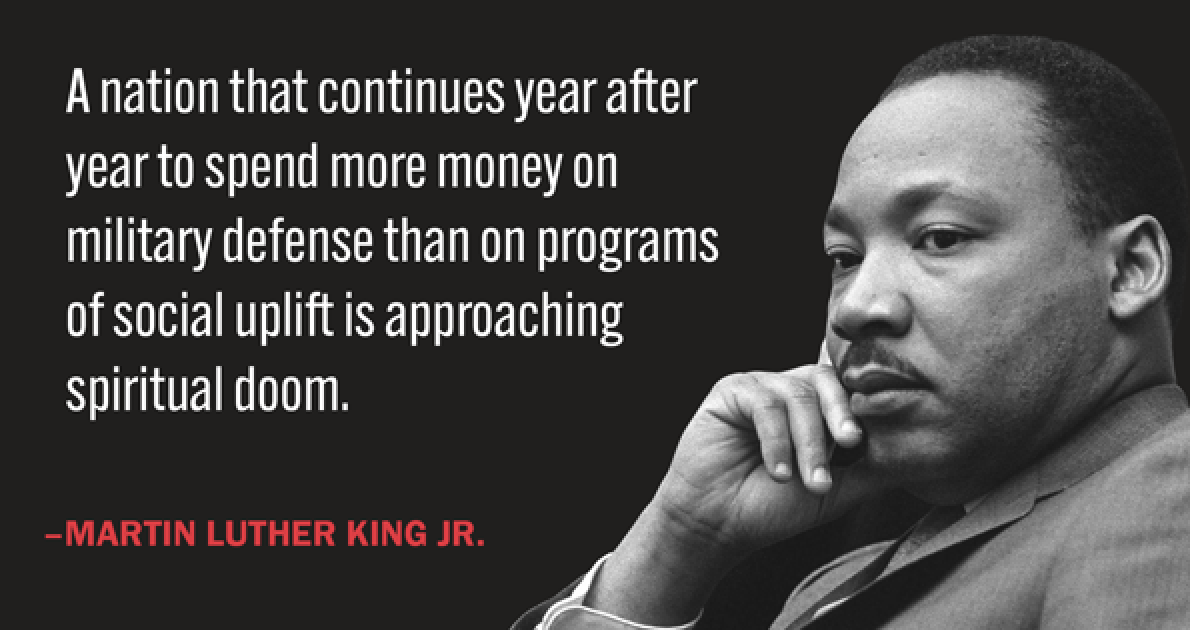
Every US Administration since WWII has made military spending a priority over meeting the basic needs of those who live in the US. A recent example of prioritizing military spending over human needs is the push to get approval for $200 billion of taxpayer funds to fuel the US war against Iran.
Fortunately there are groups like the National Priorities Project, which not only educates us on the ongoing costs of US militarism, but they also juxtapose that spending with how it could be used to meet the needs of people in the US. For instance, instead of spending $200 billion to continue the war on Iran, the United States could:
- Cover Medicaid for all 14 million people at risk of losing insurance,
- AND cover SNAP for all of the 4 million people at risk of losing food assistance, including 3.5 million due to new work requirements for older people and caregivers,
- AND expand Medicaid to an additional 10.3 million people.
If we wanted to break the $200 Billion for military spending in the US war against Iran at the state level, Michigan taxpayers would be paying out $4,794,000,000. Comparatively, that same amount of money – $4,794,000,000 – could be used to provide the following for people in Michigan:
- 813,000 Michigan residents could receive Medicaid
- 2,303,000 Michigan residents could receive SNAP benefits
If we look at the total US military budget for this year we can see that for every hour, taxpayers in the United States are paying $116.43 million for Pentagon & War. That is an incredible amount of public money going to militarism. If we look at the the state level of taxpayer money going to the US military budget, or the 3rd Congressional District or taxpayer funds from those living in Grand Rapids, it can help us understand the scope of how military spending is prioritized over all other community needs.
- Taxpayers in the state of Michigan are paying $26.66 billion towards military spending annually.
- Taxpayers in the 3rd Congressional District in Michigan are paying $2.01 billion towards military spending annually.
- Taxpayers in Grand Rapids, Michigan are paying $510.86 million towards military spending annually.
In an April 7 Democracy Now episode, a guest respond to the Trump Administration’s proposal to increase the US military budget from $1 trillion to $1.5 trillion. One of the guests on this episode said:
“But if you stop and think about what can we do with $500 billion, if we had the political will, which Trump says he has for war spending — if we had the political will for peace spending, what could we do? Well, we could restore all of the cuts to Medicaid and food assistance in Trump’s prior bill. We could expand Medicare to cover dental, health and vision. We could have universal care for children zero to four. We could double the budget for the EPA. We could invest in affordable housing and end homelessness in the United States. We could restore and expand all of the foreign assistance that’s been cut, which public health experts say will lead to the deaths of millions by 2030. We could invest all of that and more — not one of those things, all of those things and more — with this $500 billion.”
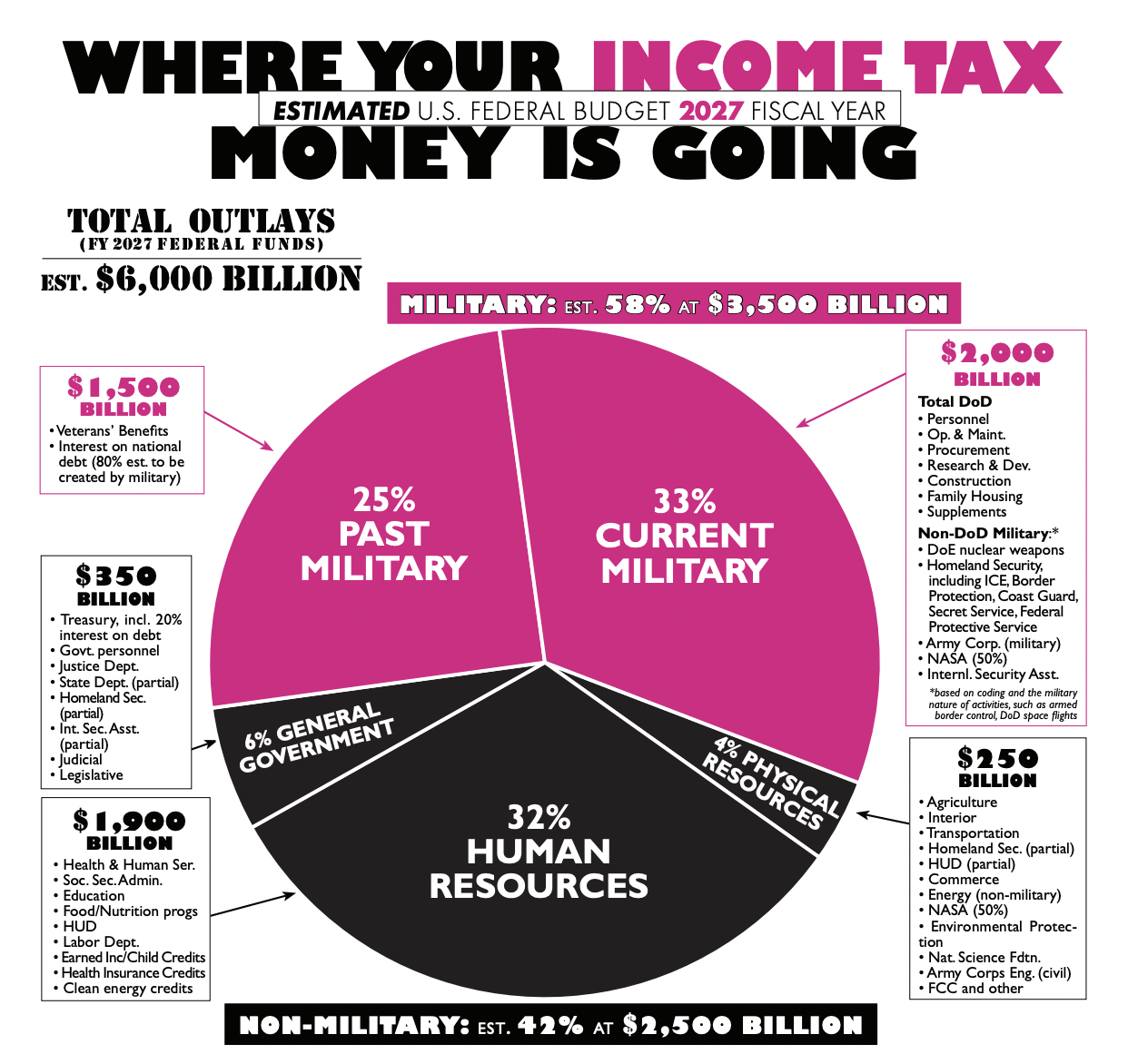
Since WWII roughly 50 cents of every tax dollar goes to pay for the US military, which also includes paying off the cost of previous wars. This obsession for military spending is so entrenched in the US that regardless of who sits in the White House or which party controls Congress the US military budget keeps increasing from year to year.
US Let’s be honest, US military spending has complete and total bi-partisan support. So what can we do to oppose this reality and resist US militarism around the world?
First, we need to education ourselves on the cost of war/militarism by checking out sites like the National Priorities Project, the Cost of War Project and the War Resisters League. A good documentary to watch is War Made Easy.
Second, we have to stop voting for politicians who vote annually for the massive US military budgets. We also need to engage in massive resistance to these same politicians by disrupting business as usual and occupy their offices.
Third, we can withhold our federal tax dollars. You can find out how to do tax resistance by going to this link.
Fourth, anti-war movements need to not operate in silos, but connect to BIPOC led social movements, environmental justice & climate justice movements, racial justice movements, feminist movements, queer and trans movements and labor movements to see how US militarism is connected to all of these movements.
Fifth, we need to identify private military contractors in our community and begin campaigns to shut them down.
Sixth, we not to resist military recruiters in our communities, especially those that are given access to our schools in order to prey on our children and get them to join the US military.
Seventh, we have to build anti-war movements that have the capacity to disrupt business as usual and shut down systems of power if we truly want to reduced the brutality that is being done on a daily basis around the world in our name.
 Grand Rapids Institute for Information Democracy
Comments are closed.